
Yesterday I blogged about the recent appearance of a mannequin (a sort of scarecrow) that had been placed on a grouse moor in the Yorkshire Dales National Park where a pair of hen harriers had been seen nest prospecting in April (see here).
Today, another blog reader has provided information about another eight mannequins (at least), and an active gas gun (a bird-scaring device designed to ‘boom’ intermittently), that have been placed out on another grouse moor in the Yorkshire Dales National Park.
These photographs of one of those prominently-placed mannequins and the gas gun were taken this morning:


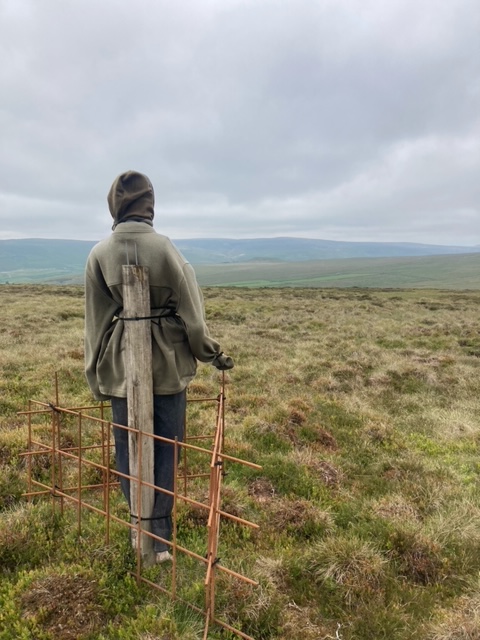
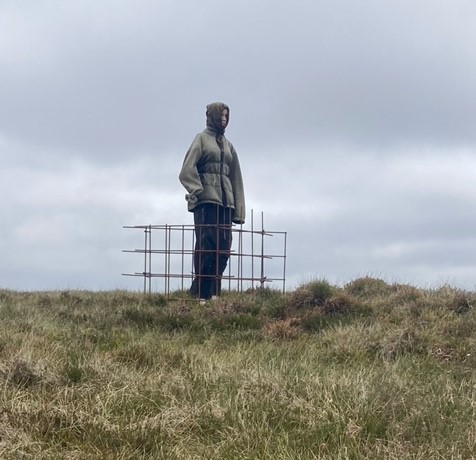
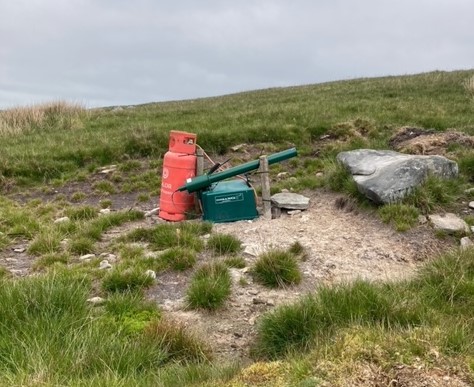
The blog reader will be reporting these to Natural England; it’s believed the same estate was reported for using a gas gun last year and was forced to remove it.
The presence of at least eight mannequins (the fieldworker believes there may be more over the hill) will, in my view, obviously deter hen harriers from settling to breed on this grouse moor, although it’d be difficult to prove the landowner/gamekeeper’s intent. There was another case of this happening at a peregrine nest site on a Northumberland grouse moor a few years ago (see here) but the gamekeeper in that case claimed he’d installed scarecrows to try to reduce predation of red grouse chicks by large gulls. His story wasn’t believed but the CPS decided there was insufficient evidence to secure a conviction so the landowner was just issued with a warning by Natural England and the scarecrows were removed.
If the use of these ‘scarecrows’ is as common as it seems, it’s no wonder that so few grouse-shooting estates have so far actively participated in the hen harrier brood meddling trial. Natural England hasn’t yet released the actual number of estates involved, they’ve just provided an overview of the number of brood meddled nests in each year of the trial. However, the most number of nests brood meddled in one year was four (in 2022), so assuming each brood was on a separate estate, that’s a grand total of four estates involved, out of a total of approximately 150 grouse moors in England. After five years, it’s hardly a resounding success, is it?

Potential criminality aside, the presence of these additional eight mannequins and the gas gun on another grouse moor in the Yorkshire Dales National Park is, in my view, a 16-fingered salute to Natural England’s ludicrous hen harrier brood meddling trial.
With these mannequins, in addition to the 94 hen harriers confirmed illegally killed or ‘missing’ on or close to grouse moors since the trial began, how on earth can Natural England still claim to have ‘insufficient evidence’ to ‘test attitudes’ towards hen harriers amongst members of the grouse shooting industry that aren’t yet participating in the trial (i.e. most of them)?
It’s blatantly obvious to everyone and Natural England just looks more ridiculous by the day.
UPDATE 19th June 2013: Another mannequin (hen harrier scarer), this time on a grouse moor in Peak District National Park (here)
UPDATE 19th June 2013: More gas guns positioned on another grouse moor in Yorkshire Dales National Park (here)
 Raptor Persecution UK
Can’t these scarecrows just be blown over by the wind and the gas gun immobilized? If these items have been placed illegally. Whose going to complain?
The mannequins are staked to the ground (and on this moor, surrounded by a wire cage) so being ‘blown over by the wind’ is an unlikely scenario.
Tampering with the mannequins, and the gas gun, would likely be a criminal offence.
Are they not lost property? Unless they are labled/signed, how would you expect joe public to believe these retail sales displays are in the right place?
Because almost all ‘lost property’ is found securely staked and fenced?
Set up a trail camera near the gas gun.(discretely obviously).
I
First, anyone doing this would be on private property. Second, how could anyone do this ‘discretely’ when they would be visible in every direction for miles? Third, for what purpose?
Probs go and read up on GL42.
It’s using the general license within the law (against corvids at a guess, with beneficial effects) to work around a problem.
Unfortunate that crows and other species overlap in there everyday lives.
A bit like birds that only exist on grouse moors, only dissappear on grouse moors.
Why would they dissappear in city centre’s?
Let’s look at the bigger picture, more than a minority of bird species, I would say 20-1 benefit from managed land.
Some of us are informed and educated.
If you are “informed and educated,” where did you get your information from about where harriers spend their time and where they go missing and what the research shows conclusively about this? Please direct me to your source material.
[Ed: I’m not going to publish that, Patrick, for what should be obvious reasons]
Is the law adequate for purpose to prevent the use of mannequins? To my knowledge, birds and their nests are protected. Is the wording tight enough to ensure that obvious attempts to frighten off birds from breeding attempts are also illegal?
Are these mannequins not litter and as such should be carted away in black bags? [Ed: tampering with the mannequins would likely be a criminal offence].
What’ll they think of next ?
Desperation ….
“Are these mannequins not litter…”
On private property?
I think there’s summat called The Tidy Land Act.
I found no such Act. Besides which, the mannequins, stakes and fences look very tidy to me.
Gas guns are commonplace on the moors near me on the north east border (Richmondshire area) of the YDNP. One of the local moors also had several scarecrows in place last year after a new shooting tenant and their keepers took over management of the moor. Certainly in the past the local wildlife officer has been well aware of the gas guns but no action has ever been taken so far as I am aware and it seems to be accepted as normal practice. Needless to say Hen Harriers are absent from the area.
Gas guns were last time I reported one on an SSSI moor in the Yorkshire Dales forbidden by NE unless a waiver has been obtained. These things MUST be reported to both NE and the police. The mannequins may constitute an offence if the purpose is to disturb or prevent pairs breeding. The desperation of the DGS lobby knows no bounds when it is the bird they are most afraid of ( unjustifiably of course) the Hen Harrier. I can recall a gas gun placed in defiance of NE and the law, in the terms used for a sat tag it suffered a catastrophic failure and its owner failed to locate its new position.
Well you did get gull protected so what do you expect all this is is more hate toward grouse shooting from a group of biased country sport haters
You mean those birds that are now both red and amber listed due to the drop in their populations?
I would rather hate the criminality involved in driven grouse shooting than be an apologist for criminals that do their best to exterminate our wildlife so a bunch of sick, rich individuals can sate their blood lust.
I suspect you have ingested too much lead shot over the years.
It’s all too evident that you have no idea how to construct a sentence, let alone an intelligent comment.
Once again, answer the question…
Who, exactly is the “you” that you continually refer to in your banal whingeing?
Woops! I’m getting my trolls mixed up now!
However, the question (minus the word “continually”) stands.
It’s not sport if there can only be one winner
What Country Sport ????? Hen Harriers are a Native species a species on the danger of extinction list think it is time that the Grouse was given the same listing as the Grey Squirrel
Hi Pete, I think you may be making an innocent mistake and confusing grouse with red-leg partridges. The former – the Red Grouse, is a native bird that has always existed in our uplands. It is where it should be. The conflict is about in what numbers, for what purpose and how (i.e. what methods are deployed by estates) those numbers are inflated for organised / commercial shooting. Red-Leg partridges on the other hand, have no natural place in our uplands and in my eyes at least should not be imported and released there at all, ever.
“think it is time that the Grouse was given the same listing as the Grey Squirrel”
So you want a native bird to be officially regarded as ‘introduced’. Is that your idea of integrity?
I’m not biased in my hate of country sports. I’d actually support small, well run shoots that would charge more for less and offer a better experience. DGS needs to die though. As does the mass release of pheasants into the environment. Its had its day and hasn’t kept its house in order. Mannequins on National Park moors. What kind of a country is this? Insanity. Desperation.
Shop mannequins, that’s new to me but no suprise. Gas guns, yes. Burning late in season as a means of deterrence, yes. Also I’ve heard of (and watched a YT video) about it crow traps with live decoy and stoat traps being sited close to Peregrine nesting sites – not to catch the Peregrine’s, but for the associated disturbance / regular checking to unsettle them and cause them to look elsewhere to nest. Also, would it be too far fetched to think that somewhere a couple of young wannabe keepers / helpers might even be given a few pound notes to just wander around vicinity of known raptor nesting territories – just often enough to make them go elsewhere too?
Most of which is and quite rightly illegal but difficult to prove, although apart from the dummies I’ve seen and herd of it all.
To be fair, the dummies arent pictured.
By law traps have to be checked twice a day, we have peregrines nesting in Lincoln Cathedral the hundreds if not thousands of tourist walking around their nest site does seem to disturb them in any way, in fact the male has returned to the cathedral for several years with his partner who died 2years back naturally not shot or poisoned. He has a new partner this year nesting successfully.
Hi Sean, the law is not twice a day for traps with a call bird. Guns on Pegs quotes this, “The General Licences impose a legal obligation to physically visit each call-bird at least once a day at intervals of not more than 24 hours to renew food and water.” But no matter, keepers tend to make up their own rules which may be more or less depending on how they prioritise their work.
But regardless of the checking, having a crow trap appear on a hillock close to the Peregrine’s nest site, with the live decoy call-bird vocally doing its nut, is enough to put off the nesting attempt.
And tolerance / intolerance to human activity (e.g. urban settings) is relative to what they are accustomed to over many months. Loads of literature & commentary is out there on that topic, by true raptor experts (not me), and also regards commercial quarry operations that re-start in mothballed areas of the quarry where Peregrine’s are nesting.
It’s just a miracle that Peregrine’s have adapted to some urban settings so well, or their population would be on the bones of its arse in the same way and for the same reasons that Harriers are.
“we have peregrines nesting in Lincoln Cathedral the hundreds if not thousands of tourist walking around their nest site does seem to disturb them in any way”
And you don’t think being permanently 80 metres above the heads of the tourists has any effect on the Peregrines’ sense of security for their nest site? They normally nest on cliffs.
Perhaps this may not be entirely a bad thing after all?
If this is a tactic to scare Hen Harriers away from an area where they are most likely to have their nests tampered with, and move to an alternative area where they are less likely to be persecuted then this may be to their benefit?
Granted it’s not ideal from the Hen Harrier’s perspective but if it results in less persecution and an increase in the population then this would be a positive outcome.
Given that very few cases of missing or dead Hen Harriers are ever solved and even fewer convictions, perhaps we should be thinking “outside the box” and take a different approach?
It must be worth considering by the experts?
It may even open up a new avenue with grouse moors in working in conjunction with them to the benefit of the Hen Harrier?
But it is persecution, Steve. Driving birds away from suitable breeding habitat, may well have the same effect on populations as illegal killing.
Hi Steve, the NE Brood Management (brood meddling) scheme was / is that very “outside the box” idea. It was the product of lots of research which said if you limit the predation of grouse chicks by harriers feeding young in the breeding season, the losses of a few adult birds at other times are sustainable in running a grouse shooting business. It sounds good and the studies of prey items brought to nests said it should work. But they didn’t factor in the capacity for entitlement of the Owners and Agents, who said “great, we will bank that one…but will still play the persecution card as well hahaha.”
I don’t think there should be any more “out of the box” stuff (although well intentioned by some), until the law is successfully enforced and everyone is playing 100% by the rules. Only then could there be a discussion opened to indulge owners ideas to mitigate predation at certain times of year.
This is persectution of a nesting species. No.
“If this is a tactic to scare Hen Harriers away from an area where they are most likely to have their nests tampered with, and move to an alternative area where they are less likely to be persecuted then this may be to their benefit?”
But you are ignoring the fact that when they fledge they will fly back to the grouse moors, where the ‘sportsmen’ will poison, trap and shoot them.
How does that lead to “an increase in the population”?
You’re not Tony Juniper in disguise, are you?
If the harriers have or are displaying/site selecting when the gas guns and mannequins arrive it is an offence under the WCA ( interfering with a nesting attempt). Although I can recall one GWCT employee 20 years ago supporting this idea even after he was told by NE staff it would be an offence. Whatever this use of gas guns and mannequins is certainly persecution and somebody in authority should get it stopped. Why are we not being told which moor it is?
As I mentioned in my comment to the previous mannequin appearance, does anybody know what jurisdiction the YDNP have over what goes on in the Park and especially on the moors? Very little it would seem!
Private land Mike there is little the YDNP can do if it is not an offence. Our NPs are not really NPs at all just a planning designation.
As there is no farm crop to protect here, the placement of scarecrows can only be intended to deter birds of any species from accessing existing or future nest sites – surely this is a criminal offence?
They can have no other purpose than to scare any birds – in the breeding season – this is a wider issue than just raptors.
Is it possible these are in fact scaregulls that prey on anything smaller than a half grown rabbit and plenty of ground nesting birds chicks?
Huge colony of gulls on these grouse moors nesting and no vegetation in the vicinity due to their excrement
See my comment above this would still constitute an offence. Gulls are part of the NATURAL ecology of our uplands and should be there.
I don’t think they are mannequins. I think it is more likely they are members of the Moorland Assoc on a day out.
Indeed, Mike.
Plastic through and through.
Just when you think you’ve seen it all from the grouse botherers……
A few years ago photographs were published of a blow up mannequin style dummie on a hillside in the Angus Glens. This was designed to deflate and to suddenly “stand up” when air was rapidly introduced by way of a valve. This was at the same times as strings of banger ropes were found in the same area. These are slow burning ropes with explosive cartridges placed an equal distance apart. The banger rope is designed to burn for a period of approximately 5 – 6 hours for day ropes or up to 12 hours for continuation ropes. Bangers are placed equal distances apart to explode at 15 – 30 minute intervals.
It would be interesting to see if the management regimes that are uysing these two types of devices are linked in any way.
They are taking the p*** and putting 2 fingers up to the law.
Couldn’t member of the public report a fly tipping incident to the relevant local authority. The LA would be oblige to report the incident to the landowner and ask them to remove it at their own expense. Should the landowner fail to do that then the LA or NP could remove it on their behalf and invoice them for the costs incurred.
I’m not sure you understand the situation. The mannequins have been put up on privately-owned land, presumably with the permission of the land owner. This isn’t fly tipping and nor is it anything to do with the local authority.
I wonder where the laws stands on the erection of these mannequins? I guess they could be deemed to be a temporary structure? In which case would there need planning consent or permission from the National parks Authority to erect them?
Whilst scarecrows are a recognised non lethal method of deterring crows and gulls, and something which NE promotes, the issue which perhaps needs further discussion is whether the use of such methods are suitable in a National Park, and if so what permission is required to place these structures on open moors, where their presence could detract from what should be the natural beauty of the landscape.
The presence of these mannequins also raises the question as to whether the intensive management of many grouse moors, especially within National Parks or in designated areas such as SSI’s AONB’s has become detrimental to the original citation which created that designation.
I am sure the grouse moor managers will claim they are carrying out conservation work- the question is whether that conservation work has swung far too heavily in favour of increasing game bird stocks, at the expense of everything else. (which most contributors to this blog believe it has.)
If so, then this needs addressing either by severely reducing the percentage of moorland which can be used for shooting purposes or by curtailing the land management practices which so heavily favour game birds over other species.
Certainly gulls and crows do need to be managed if other vulnerable bird species such as Curlew etc are to recover – if mannequins are part of that solution, then I would prefer that such means were carefully controlled and monitored by the authorities, with proper scientific studies carried out to show that such methods are effective and not interfering with the breeding success of other species such as Hen Harriers. I would also want reassurance that the mannequins were only sited in places agreed with field workers engaged in the Hen Harrier recovery program, to ensure Harriers were not negatively effected by their presence.
The problem for the shooting industry, a problem which has become the “elephant in the room” is that due to all the criminal and illegal activity which takes place, then it is very difficult for the public to believe that any action the industry undertakes isn’t done with a sinister motivation, and that gas guns and mannequins are just another manifestation of this.
John – I’d like to blow up the suggestion that grouse shooting estates are working their little socks off to conserve curlews.
All birds are protected from being injured, captured or killed with a few exceptions (like game birds in the shooting season or ‘pest’ birds).
There are however restrictions on the species of birds which are classed as ‘pests’ and this small number of birds can only be killed for a very limited range of purposes and they must be killed by methods set out in a particular licence and in accordance with conditions of use set out in specific licences.
The two licences most commonly used by shooting estates are:
(GL42) to prevent serious damage to livestock, crops or property. Grouse are not livestock so the killing of pest birds would not be permitted under GL42.
However, certain ‘pest’ birds (under GL40) can be killed for conservation purposes – hence the importance of Curlew ‘conservation’ to the grouse shooting industry! Oh how they loved that bird! They kill kill kill predators for those Curlews – not grouse!
In my opinion this conservation claim is a sham because (in my experience) these estates do next to nothing of the practices recommended by the RSPB to conserve Curlew.
According to the RSPB key conservation practices for curlew are:
* Retain and restore rough, damp pasture and traditional hay meadows.
* Extensively graze to provide taller vegetation through the breeding season.
* Timing of cutting is critical in meadows.
* Provide damp areas, wet flushes or small, shallow pools as feeding areas for chicks.
* Avoid planting trees in curlew nesting areas as these may provide habitat for predators; in some areas control of foxes and crows may be required.”
https://www.rspb.org.uk/our-work/conservation/conservation-and-sustainability/farming/advice/helping-species/curlew/
So – what additional things could all these grouse shooting estates do to ‘conserve’ curlew?
*They could be re-wetting the moors that they systematically drained over decades to create the moist but not wet soils preferred by heather (which support grouse with food and cover).
*They could be creating boggy areas and organic rich soils to provide the habitat preferred by the prey of Curlews (worms, beetle larvae, and leather-jackets (crane fly grubs).
https://community.rspb.org.uk/placestovisit/blacktoftsands/b/blacktoftsands-blog/posts/creating-good-feeding-for-curlew—is-it-all-about-organic-content
*They could ensure that local tenant farmers adopt the practice of cutting hay meadows in June, July or August to enable chicks to hatch and fledge. They could stop tenant farmers from cutting grass repeatedly from April to produce silage.
Click to access Cutting%20Article.pdf
https://www.cuttoclamp.com/step-1-cutting#:~:text=Typically%2C%20first%2Dcut%20silage%20may,in%20a%20few%20weeks'%20time.
*They could retain and restore rough, damp pasture and traditional hay meadows (as opposed to promoting heather moorland monocultures which are favourable to grouse for their food and cover.)
*They could stop burning heather – especially in the breeding season! Burning not only threatens the safety of nesting Curlew, their eggs and chicks but also damages or destroys the top soil inhabited by their prey.
Indeed, Lizzybusy. As I’ve asked on several previous comments here…
What if Curlews ate Red Grouse?
You may remember the film “The Dead Zone”. The final scene shows the villain (a populist, Trumpesque politician) shielding himself with a child when threatened by a righteous assassin. That sums up the tweed disease, and their fake concern for wader populations.
The way I’ve often thought of it, I never hear of a keeper being sacked for his failure to produce waders. Such as, “Well we hate to have to part with you, I mean yes – your grouse numbers are good, but you have really underperformed with the wader figures for five years running. Numbers are going down so badly this represents a loss to our capital outlay. We can’t have this – you will simply have to go…references provided of course.
Good luck and Goodbye.” etc, etc.
Maybe it is time the Grouse were removed that would then mean the game wardens ect can be removed and the Hen Harriers can live in peace
“Maybe it is time the Grouse were removed”
Really?
“that would then mean the game wardens ect can be removed”
‘game wardens’? In the UK?
“the Hen Harriers can live in peace”
But they feed Red Grouse chicks to their young.
Is there any good reason why these estates have not been identified?
Not sure if anyone else has asked this one, but is it actually permitted to put mannequins out like this in a national park? Or indeed SSSI?
Mannequin, what sounded like two gas guns and white pickup spotted on xxxxx xxxxx on 26 May. Do we really need this anti-social behaviour (without planning approval for erection of a structure) just so that a handful of people with money to burn can take pot shots at slow flying easy to kill targets? Not really a sport is it when only the totally incompetent would fail to hit the target?