REVIVE, the coalition for grouse moor reform in Scotland has produced a guide to help people respond to a request for views of the long-awaited grouse moor reform bill, formally known as the Wildlife Management and Muirburn (Scotland) Bill.
This is the Bill the Scottish Government introduced in March 2023, in response to the 2019 Werritty Review, which recommended a grouse moor licensing scheme in an attempt to address the ongoing illegal killing of birds of prey on grouse moors. The Bill is also designed to regulate grouse moor management ‘to ensure grouse moors are managed sustainably’.
Now the Bill has finally been introduced, this is how it will progress through Parliament over the coming months.
It is currently at Stage 1 in the process, which is where a cross-party Parliamentary Committee scrutinises the Bill. The committee (in this case, the Rural Affairs & Islands Committee) will hear from experts, organisations and members of the public, including an opportunity for some to present oral evidence, and then the Committee will write a report detailing its view of the Bill and there’ll be a subsequent Parliamentary debate before the Bill progresses to Stage 2.
Rather unhelpfully, some commentators from ‘our side’ are refusing to engage with the Bill because they take the view that a grouse moor licensing scheme is unacceptable, arguing that we should instead be pushing for a ban on grouse shooting. In my view, that’s counterproductive because a ban isn’t on the table, and won’t be until such time a licensing scheme proves to be ineffective. The licensing scheme is seen as an unavoidable, proportionate next step by the Scottish Government so for now, it’s either (a) get behind the licensing scheme and try and make it as robust as possible, or (b) refuse to engage, allow the game-shooting industry to water down the proposed regulation and put up with the status quo. I prefer option (a). If the licensing scheme proves to be ineffective, then will be the time to push for a ban, because the Scottish Government won’t have anywhere else to go, having exhausted all other routes.
Some of you may think you’ve already responded to a consultation on this Bill, and you’d be right. The Scottish Government held a public consultation last autumn (here) prior to drafting this new Bill, and that consultation elicited an impressive 4,863 responses.
The latest call for public views and evidence is different to that consultation. This time the request has come from the Rural Affairs and Islands Committee who are about to start scrutinising the Bill.
The Committee is calling for the public’s views on a number of specific issues to help inform its deliberation of the Bill. The closing date for submitting views is Friday 5th May 2023.
Having seen how some of the game-shooting organisations are encouraging their supporters to respond (e.g. BASC, whose guidance basically amounts to, ‘Say no to everything‘!), the REVIVE coalition has produced a handy guide to help its supporters engage more constructively. Click here for REVIVE’s guidance.
Please note, it’s only a guide. If you have different views, or personal experience, feel free to express those, in your own words.
Please also note, anybody can respond to the request to views. It’s not restricted to Scottish residents.
Here’s the link to REVIVE’s guidance again (here).
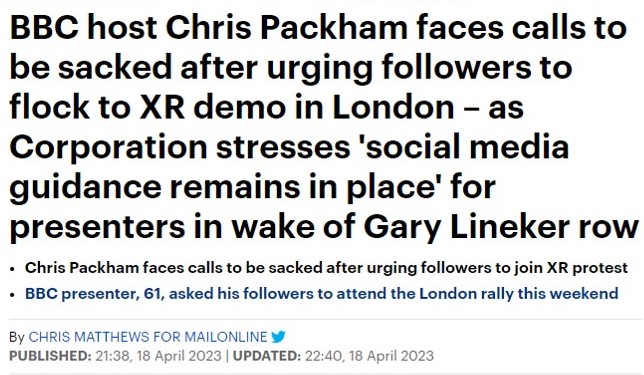
Earlier this week the seedy Daily Mail published a disparaging headline about Chris Packham, this time screaming that Chris ‘faces calls to be sacked‘.
It was published in response to a short video Chris had posted on Twitter about attending a Biodiversity Earth Day rally in London today, which Chris described as “a family-friendly affair” and which the organisers had described as ‘a procession for nature, a parade of reflection and celebration, with masks, costumes and nature based art to honour and respect our natural world and all endangered species‘.
I wondered who it was that was calling for him to be sacked this time – I imagined it would be the usual suspects at the Countryside Alliance or their pro-hunting/shooting associates, who rarely miss an opportunity to launch an attack on Chris and who repeatedly pile on the pressure to the BBC demanding that Chris lose his job (e.g. here, here, here).
But this time it wasn’t them.
Instead, it appears that the justification for this headline was solely based on five words written by an anonymous Twitter user who has just 50 followers:
Little wonder that this so-called ‘news’ paper has been banned as an ‘unreliable’ source by Wikipedia.
We, the signatories to this letter, support the Scottish Government proposal, as part of the Wildlife Management and Muirburn (Scotland) Bill, that all muirburn should require a licence, regardless of whether it takes place on a grouse moor or not.
We also support proposals to redefine deep peat depth. However, we recommend the Scottish Government redefines this as 30cm (as opposed to 40cm). This would take Scotland beyond the ambitions of the UK Government. In addition, we request you consider the purposes under which a licence to muirburn might be requested and accepted.
At least 163,000 hectares of Scotland’s landmass is regularly burned for grouse shooting, particularly concentrated in certain areas of the country. It is estimated that around 40% of the burned area has taken place over deep peat (as it is currently defined).
Even if the muirburn code becomes a mandatory legal requirement of land managers, the large areas in which muirburn takes place will be hard to police without significant resources and without continued significant risk to our vital peat reserves.
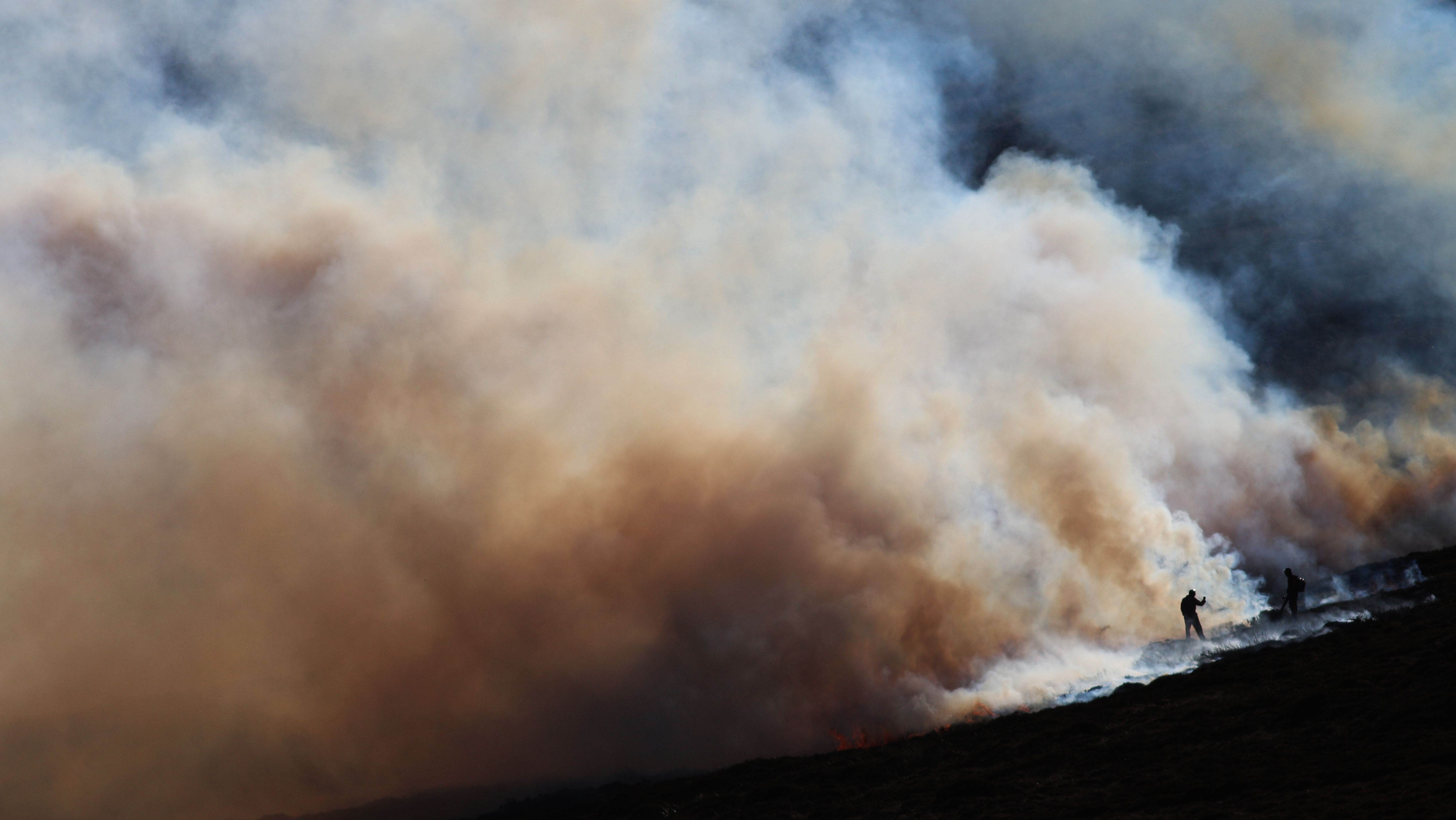
Gamekeepers setting fire to grouse moor in Aberdeenshire, Feb 2022
We note that BASC Scotland (in response to government plans on February 28th, 2023) said it would be ‘unfeasible, laborious, and impractical for land managers to be expected to measure peat depth across their land as part of a licensing regime’.
We believe this argument fails to account for the Government’s climate change efforts. As the grouse shooting industry has shown time and time again, particularly with regards to raptor persecution, voluntary restraint cannot always be relied upon. Moreover, against the recommendations of the UK Climate Change Committee they simultaneously argue, that best practice is widely followed while attempting to make the case that burning over peat is actually a good thing and should be allowed.
To draw a different conclusion on how muirburn should be handled, to make the regulation of muirburn manageable, in addition to our above points we propose that a licence should not be given for muirburn when the purpose is increasing grouse numbers for sport shooting.
In situations where there is evidence to support muirburn taking place, where alternatives like cutting are not available, we would not oppose this. These situations could include responsible research, creating strips for wildfire breakage points (as opposed to large less effective patches that are common on grouse moors) while peat should be avoided. We also support wider efforts from the Fire Service and the Scottish Government on public education initiatives and training land managers of all types to prevent wildfires where possible.
Large monocultures like heather moorland present their own challenges to fighting wildfires and that a more diverse mosaic of flora, fauna and trees can alter wildfire intensity and make them easier to tackle. Moving away from muirburn on our moors will unlock our land’s potential to provide far better resistance to wildfires over time, and also enable greater biodiversity and carbon sequestration potential.
The main point is that due to the risk of our vital peat reserves; our lack of faith in the grouse shooting industry to look after and prioritise peatland over grouse shooting; the difficulty and resources it would take to effectively enforce the licence; and because keeping so much of our land in state of monoculture stops the development of greater biodiversity: a licence should not be given for muirburn when the reason is as unnecessary as ensuring more grouse can be shot by a few people for sport.
We strongly urge you to consider and adopt the above position. To do so would be to aid the Government’s own stated goal to transition to more appropriate, economic and biodiverse land uses for our people, our wildlife and the environment.
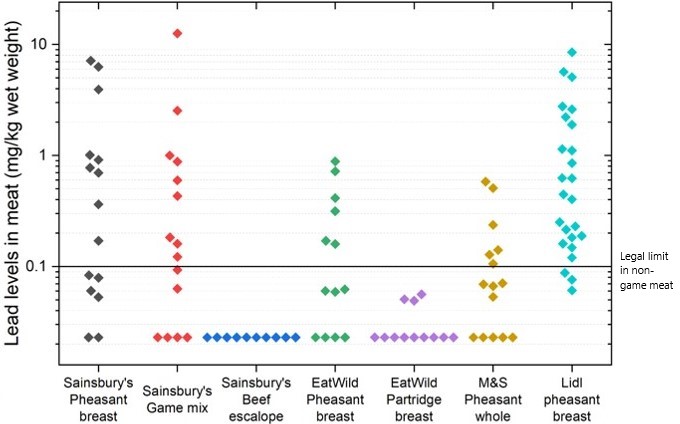
The conservation campaign group Wild Justice has just published the findings of its latest research into the level of toxic, poisonous lead shot found in gamebirds (pheasants and partridges) on sale in supermarkets and from some online traders during the 2022/23 shooting season (see here, here and here for their most recent blogs).
Summary graph showing results of lead contamination in gamebirds 2022/23 season. Copyright: Wild Justice
In 2020, nine UK game-shooting organisations made a massive U-turn after years and years and years of defending the use of toxic lead ammunition, and said they wanted to drag the industry into the 21st Century by making a five-year voluntary transition away from lead ammunition (see here).
A lot of us were sceptical because (a) we rarely trust anything the industry tells us; (b) previous ‘voluntary bans’ by the industry on a number of issues have been unsuccessful (e.g. see here, here and here); (c) the ongoing failure of the shooting industry to comply with current regulations on many issues, including the use of lead ammunition over wetlands (here), means there should be absolutely zero confidence in its ability and/or willingness to stick to any notional voluntary ban; (d) the Scottish Gamekeepers Association refused to sign up to the proposed five-year transition period because they believe there is insufficient evidence to support the claim that lead can have damaging impacts on humans, wildlife and the environment (here); and (e) in the very same year that nine shooting organisations committed to the five-year transition, BASC announced it was set to fight a proposed EU ban on the use of lead ammunition on wetlands (see here).
Wild Justice’s latest results demonstrate that, with the exception of the partridge breasts sold by ‘Eat Wild’, all of the gamebird meat tested contained high levels of poisonous lead, well above the legal limit set for non-gamebird meat such as pork, chicken, lamb and beef.
The gamebird shooting industry has just two years left, within its own proposed five-year voluntary transition period, to get its act together on this public health issue.
And it’s not just a public health issue. It’s also an issue of sustainability. We’re often told (by the industry) that gamebird shooting is sustainable. But have a look at the Wild Justice blog about the pheasant breasts it bought and tested from Lidl stores in Northern Ireland and the Irish Republic (here). According to the packaging, Lidl pheasant breasts were shot in the UK, then sent to Poland for processing, then shipped to Northern Ireland & the RoI to be put on the shelves in Lidl stores!
No matter how much the industry spins the narrative, this cannot possibly be described as sustainable in any way, shape or form!
There was an interesting case heard at Banff Sheriff Court yesterday where Scottish gamekeeper Terry Lindsay, 40, was facing a charge relating to the use of a trap that was alleged to have been illegally-set on Fyvie Estate in Aberdeenshire.
The trap at the centre of the trial was a clam trap (also known as a Larsen Mate trap) that had been baited with a pheasant carcass and placed next to a pheasant release pen on 26th August 2020. The use of these traps, baited with meat, is lawful (although highly contentious – see this blog from 10 years ago!) as long as certain General Licence conditions are met.
Here’s a photo of the trap. For readers unfamiliar with how they work, the spilt perch above the bait is designed to collapse when a bird lands on it, which causes the two metal sides of the trap to close (like a clam), capturing the bird inside the trap where it will remain until the trap operator comes along to either release the bird (if it’s a non-target species, such as a raptor) or club it to death if it’s a legitimate target species (e.g. crow).
Set trap on Fyvie Estate, 26th August 2020. Photo: RSPB
A write-up of the case was published yesterday in the Press & Journal (behind a paywall) but unfortunately the article includes a number of inaccuracies. For the purpose of clarification, I’ve reproduced the P&J article (below), followed by my understanding of the case.
Here’s the article published by the P&J yesterday:
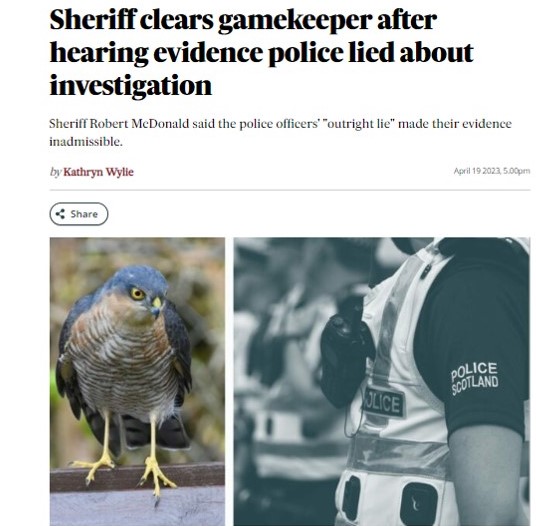
A gamekeeper has been cleared of illegally trapping a protected bird after it emerged police officers lied during the course of the investigation.
The case against Terry Lindsay collapsed when Sheriff Robert McDonald heard evidence that officers misled two people about why they were on the Fyvie Estate.
Police had received a tip-off that a sparrowhawk was “beside” a trap but lied to estate staff about why they were there – instead saying it was to look for a missing person.
Sheriff McDonald said that “outright lie” made the police officers’ evidence inadmissible and acquitted Mr Lindsay, 40, less than an hour after the trial started at Banff Sheriff Court.
“It seems to me that the critical point is the lying,” Sheriff McDonald said.
“I think the evidence of the search is inadmissible. It’s fatal that police have told an outright lie to two members of the public who, as I pointed out, had some authority as to who comes onto the land.
“That compounds it. I find the evidence inadmissible.”
A Police Scotland spokesman said: “We are aware of the outcome in court and the full circumstances leading to yesterday’s trial are being reviewed.”
The verdict was met with “disappointment” by the RSPB, the bird welfare charity which initially came across the trap and reported its whereabouts to police.
Pc Alison Davis told the trial she and her sergeant, Gary Johnston, spent about an hour scouring the estate on August 26 2020 after an RSPB informant made them aware there was a “trap with a bird beside it”.
She told procurator fiscal Gerard Droogan they were approached by a gamekeeper and the laird, Sir George Forbes-Leith, and told both that they were searching for a missing person.
“There was no truth in that as far as I am aware,” Pc Davis said, before adding: “He [Sgt Johnston] said to me afterwards that he was concerned that any evidence would be lost, or words to that effect.”
Mr Lindsay’s defence agent Paul Anderson asked Pc Davis why neither conversation was included in her statement.
She replied: “I didn’t consider them to be witnesses. I didn’t think of that as relevant to the inquiry. That’s why it’s not in my statement. It was certainly not intentionally left out.”
Mr Anderson asked: “Two lies were told in the space of one hour to two separate members of the public?”
“Yes,” replied the officer.
During her evidence, Pc Davis also explained how they eventually found the trap with a sparrowhawk inside around 20 metres from a pheasant breeding operation on the estate.
The bird was alive, she took photos of it and they released it, before placing the trap in the back of the van, she said.
Mr Anderson said this decision to lie, alongside a decision to search the land “without reasonable cause to suspect someone was committing an offence”, made any police evidence “unreliable and uncredible”.
“There were lies told to two members of the public within one hour about why police were on the land,” he told Sheriff McDonald.
“It’s inexcusable. The evidence is so tainted it cannot be considered by the court.”
He added the lies became “fatal to the search” and invited the sheriff to offer an acquittal.
Sheriff McDonald agreed and Mr Lindsay, of North Haddo, Fyvie, was acquitted of the charge under the Wildlife and Countryside Scotland Act 1981.
Speaking after the case, the RSPB said more needed to be done to regulate the use of traps.
Ian Thomson, RSPB Scotland’s head of investigations, told The Press and Journal: “While we are disappointed that this case was dismissed after the court considered witness evidence from the police, we remain concerned that traps authorised by the General Licences issued annually by NatureScot continue to be poorly regulated, with no compliance monitoring, and are widely misused and abused.
“We hope that provisions introduced by the Wildlife Management and Muirburn Bill, currently being considered by the Scottish Parliament, bring better training, accountability and tighter regulation of such devices that are in widespread use on gamebird shooting estates in particular.”
A Fyvie Estate spokesman said: “As per other legally set Larsen traps, a sparrowhawk was caught and upon Mr Lindsay checking the trap, he found the police in attendance. The sparrowhawk was released unharmed by police officers.
“All traps are licensed and tagged, and a meat bait return form is completed as per Nature Scot guidelines showing the release of non-target species caught. The beauty of this type of trap is that they are checked several times a day and birds can be released unharmed.”
ENDS
My understanding is that the main inaccuracy in this article is that the RSPB did not report a sparrowhawk being “beside” a trap to Police Scotland. Rather, the RSPB reported what appeared to be an illegally-set trap. It was suspected to be illegally-set because the trap didn’t appear to have a trap registration number attached to it (this is one of the conditions of the General Licence) so quite rightly, the RSPB reported it to Police Scotland for investigation.
By the time Police Scotland attended the scene, a raptor had been caught in the trap. It’s been reported that this was a sparrowhawk but the photographs suggest it was a goshawk. The species ID isn’t a significant issue though – it’s not unlawful to trap a raptor inside a clam trap, whatever species it is; it only becomes unlawful if the raptor isn’t released, unharmed, as soon as it’s discovered by the trap operator during the daily trap check. In this case, the police officers released the unharmed hawk, so no problem there.
Those are the two main inaccuracies in the article, as far as I’m aware.
What happened in court, according to the article, I’ll have to take at face value.
It seems the fact that the two Police Scotland officers lied to the estate owner and to the gamekeeper about their reason for being on the estate is not disputed. Unfortunately, the article doesn’t examine why the police officers lied about it. If they had reasonable suspicion that a crime may have been committed, they had full authority to enter the estate and conduct an initial land search, without a warrant. There was no reason for them to lie about the purpose of their visit – they had the authority to be there, under Section 19 of the Wildlife & Countryside Act 1981, which states:
‘If a constable suspects with reasonable cause that any person is committing, or has committed, an offence under this Part, he may, for the purpose of exercising the powers conferred by subsection (1), enter any land other than a dwelling or lockfast premises‘.
So why lie about their reason for visiting the estate? Why did they pretend they were looking for a missing person?
The only explanation I can think of (and this is pure speculation because I haven’t spoken to the two officers about it), is that they weren’t specialist Wildlife Crime Officers and so didn’t understand the extent of their powers to access the land and search for evidence.
If that is the case, it still doesn’t justify them lying to the landowner and the gamekeeper, but it perhaps provides an explanation of sorts.
Whatever their reasoning was, however, their actions are an embarrassment to Police Scotland and I hope that the ‘review of the full circumstances’, as stated in the P&J article, leads to lessons being learned.
For clarity, and for the benefit of anyone who might comment on this case, please note that gamekeeper Mr Lindsay was acquitted and any evidence about the alleged illegally-set trap was not put before the court because the Police Officers’ evidence was deemed inadmissible.
The Cairngorms National Park Authority (CNPA) is advertising a three-year, full time position for a Raptor Conservation Officer, to deliver the actions laid out in the National Park’s latest Partnership Plan (2022-2027) aimed at increasing the home range, occupation and breeding success of golden eagle, hen harrier, merlin and peregrine across the National Park.
This is a promising move by the CNPA, who have previously faced severe criticism for not dealing effectively with ongoing raptor persecution in some areas of the Park, notably on land that’s managed for intensive driven grouse shooting (e.g. see here & here).
Crimes against birds of prey, especially those that take place within the Cairngorms National Park, are often high profile, and quite rightly so. For example the recent poisoning of a golden eagle on a grouse moor within the Park (here) and the poisoning of a white-tailed eagle on another grouse moor within the Park (here) generated widespread outrage and media coverage, as did the sighting of a young golden eagle flying around a grouse moor in the Park with a spring trap clamped to its leg/foot (here).
Last year, the CNPA stated its intention to address intensive gamebird management within the Park as part of its Partnership Plan (here), which was seen as a good move by many of us who know that raptor persecution is disproportionately associated with land managed for gamebird shooting. That, combined with the creation of this new Raptor Conservation Officer post, is indicative of things moving in the right direction.
Make no mistake though, this new post will be a challenging one. There are some fantastic estates in the Cairngorms National Park who have been hosting and protecting breeding raptors (e.g. golden eagles, white-tailed eagles, hen harriers) for some time now, but there are also other estates that stubbornly refuse to tolerate these species and still behave as though it’s the 1890s.
The post is full time for three years, attracting a salary between £33,652 – £40,362. The closing date for applications is Sunday 30th April at 23.59hrs.
A detailed job description and list of essential attributes is provided here:
A poisoned red kite found in Lincolnshire in 2020 led to a multi-agency raid of two properties in March 2021 where suspected poisons were seized and sent for analysis (see here and here).
Last month, Lincolnshire Police issued the following statement in relation to this investigation:
‘A man has been charged with possession of an item for the purpose of killing a wild bird.
Jamie Harrison, aged 53, of Paulette Court, Spalding, has received a postal charge for possession of a poisonous substance for the purpose of killing a wild bird.
Harrison was interviewed after a warrant was executed in Spalding, in March 2021.
He is due to appear at Boston Magistrates’ Court, later this month.
Our Rural Crime Action Team was formed as part of Chief Constable Chris Haward’s pledge to provide a focus on targeting offences that affect our rural communities’.
No further details are available but I understand the next court hearing will be in June.
Well done to Lincolnshire Police’s Rural Crime Action Team and all the agencies involved in this investigation (NWCU, Natural England, RSPB).
As criminal proceedings are now underway, comments won’t be posted until the case concludes. Thanks for your understanding.
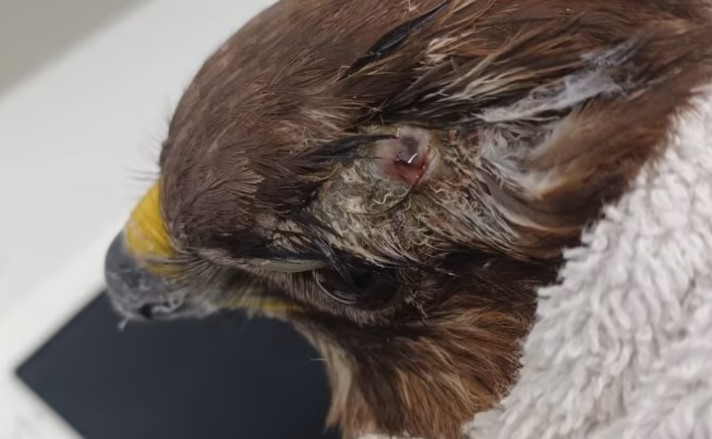
The RSPCA is investigating after a female buzzard was found having being shot in the head with an airgun pellet.
The buzzard was found in the front garden of a house in Walpole St Peter near Wisbech in Cambridgeshire. Unfortunately there are no details about when this discovery was made.
Buzzard with head wound. Photo: RSPCA
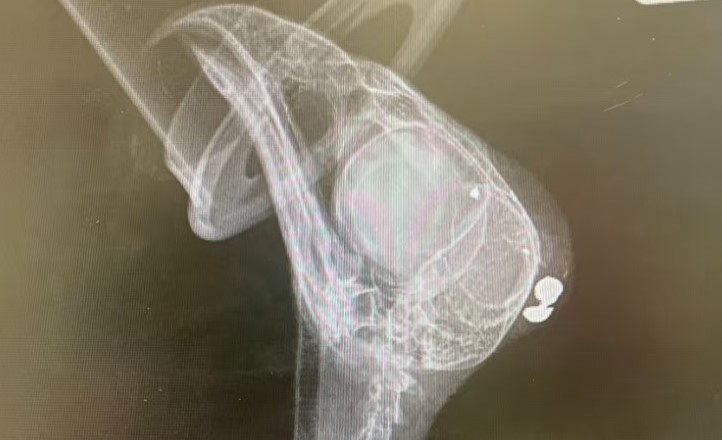
The RSPCA said the bird was thin and weak and was taken to a vet in Ely where an x-ray revealed the buzzard had an airgun pellet lodged in her head. It was considered ‘a miracle’ that it had missed both the skull and the eye.
The charity said the wound was infected and as the bird was emaciated it was likely she had been shot some time ago.
The buzzard has been put on antibiotics and pain relief and may need an operation to remove the pellet.
Vets think the pellet may be interfering with her eyesight, but hope she will be strong enough to be released into the wild eventually.
Buzzard x-ray showing the airgun pellet. Photo: RSPCA
RSPCA inspector David Podmore said: “It is upsetting to think that this beautiful bird was deliberately targeted and shot. While we do not know where the shooting would have happened, this is an offence under the Wildlife and Countryside Act 1981.
“We would urge anyone with any information about how this bird came to be harmed to call the RSPCA Inspector appeal line on 0300 123 8018 or the police.”
This news article was originally reported on the ITV website here.
The national enforcement campaign to protect our nesting wild birds is underway for 2023.
Egg thieves will go to any lengths to raid the nests of rare wild birds. Operation EASTER is determined to stop them in their tracks.
Operation Easter poster from Lincolnshire Police
The taking of wild bird eggs is a serious crime yet it remains an illicit hobby for some determined individuals. Whole clutches of eggs can be taken from some of the UK’s rarest birds with potentially devastating impacts. The eggs are stored in secret collections.
Detective Inspector Mark Harrison from the UK NWCU says:
“Operation Easter has stood for over a quarter century and this is a vital piece of police work that could easily go overlooked.
This year we are stepping up our attempts to protect the UK’s rarest birds of prey from would be thieves as we have seen the increase in wild taken chicks and eggs that have entered the legitimate falconry industry. This criminality causes us some concern for the ongoing nature status of some of the world’s most iconic birds of prey. The NWCU co-ordinate the policing response, ensuring dedicated Police Wildlife Crime Officers from the participating UK police forces receive an up to date intelligence briefing, problem solving plans and access to specialist investigators from the NWCU. As always, the success of this operation relies on the public who are our eyes and ears and our key partners who raise the profile of such crimes to keep them a priority for UK wildlife crime policing”.
Operation EASTER was developed in Scotland 26 years ago. The operation is now facilitated by the National Wildlife Crime Unit (NWCU) in conjunction with police forces and partner agencies across the UK. The operation targets egg thieves by sharing intelligence and supporting enforcement action.
In recent years the operation has also been expanded to cover some emerging trends of criminal behaviour such as the online trade in eggs and the disturbance of nests for photography.
If you have any information on egg thieves, or those who disturb rare nesting birds without a license, you should contact your local police by dialing 101 – ask to speak to a wildlife crime officer if possible. Nesting will be in full swing in April so please contact the police if you see anyone acting suspiciously around nesting birds.
Information can also be passed in confidence to Crimestoppers via 0800 555 111.
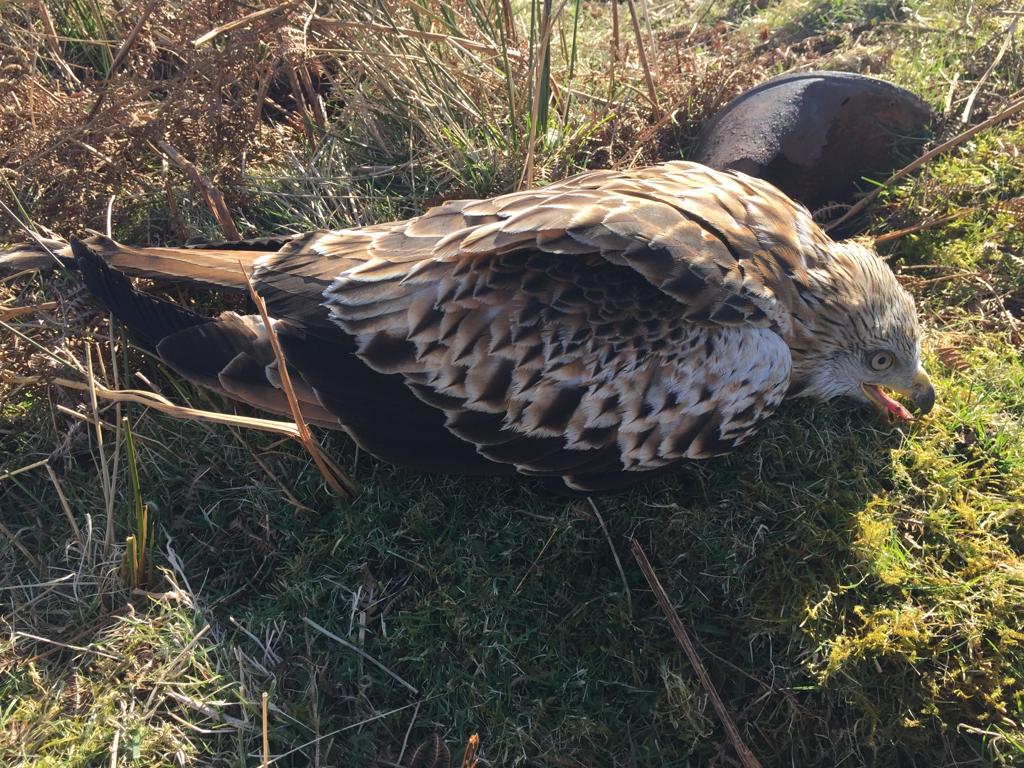
At the end of March the RSPB issued a press statement about a shot red kite that had been found on a Durham grouse moor (see here).
An x-ray revealed multiple shotgun pellets in the kite’s body, resulting in a fractured wing. The kite was described as ‘fighting for its life’.
After several weeks of expert care and attention by the brilliant Jean Thorpe (Ryedale Wildlife Rescue) and her equally as brilliant colleagues at Battle Flatts Veterinary Clinic, today the red kite was successfully released back to the wild.
The RSPB has released this short video on Twitter:
Fantastic news! As of today a Red Kite found shot on a grouse moor in County Durham is flying free once more. Thanks to the member of the public who found it, and @jeanthorpeRR for her expert care – without which this bird wouldn't have had a chance. One of the lucky ones. pic.twitter.com/ON2d5egocC
Durham Constabulary is still appealing for information about the shooting of this kite.
If you have any information, contact Durham Constabulary’s Wildlife Crime Officer, PC Dave Williamson, by emailing david.williamson@durham.police.uk or calling in to Barnard Castle Police Station.
Alternatively, to share sensitive information in confidence, call the RSPB’s Raptor Crime Hotline on 0300 999 0101.







 Raptor Persecution UK