The mystery of the disappearing hen harrier – guest blog by Peak District Raptor Monitoring Group

This is a guest blog written by the Peak District Raptor Monitoring Group.

The Mystery of the Disappearing Hen Harrier

On 27th February 2021, the Peak District Raptor Monitoring Group (PDRMG) received reports from a trusted source, of an adult male and female Hen Harrier on a grouse moor on the Wentworth Fitzwilliam Strines Estate, South Yorkshire.

The following day an area very close to where the birds had been seen was chosen for heather burning. Perhaps an unfortunate coincidence but it would not be the first time we have witnessed such tactics used to deter Hen Harriers from settling on grouse moors in the Dark Peak area of the Peak District National Park.

For example, on 11th April 2014, the group received reports from a reliable contact who had witnessed Hen Harriers performing a food pass and displaying on an area of grouse moor between the A53 and the A537 near Buxton. The following day raptor workers observed that moorland burning was underway in that very same area. A call to Natural England revealed that the estate had informed Natural England that burning had finished for the year earlier that same week.

Despite all the talk of welcoming Hen Harriers and other raptors on shooting estates in the Dark Peak, some estates would appear to be anything but welcoming to Hen Harriers and other larger raptors. There are within the Peak District National Park several estates who have a proven track record of year-on-year success with nesting raptors. With one or two exceptions these successful areas are largely associated with National Trust land holdings and the adjacent woodlands.

We are sure that the estates where raptors are fledging successfully must be wondering why some other estates do not appear to have any success and are dogged by strange disappearances and a history of birds being found shot or poisoned. We are certainly wondering, given the faith we have all invested in the Peak District Bird of Prey Initiative.

On several occasions at the end of March 2021 male and female Hen Harriers were observed on and around the Strines Estate, including a female with some heavy feather damage to one wing.

At the beginning of April, the female Hen Harrier with the damaged wing was observed ‘sky dancing’ around the Wentworth Fitzwilliam Estate’s western border along with a smaller (male) Hen Harrier observed from a distance interacting with this female.

Over the next two weeks there were multiple sightings of both adult and immature birds around the estate and surrounding areas. A summary of key sightings and dates is included below:

14th April 2021, adult female observed hunting on Brogging Moss in front of one of the occupied estate cottages.

15th April 2021, adult male and adult female Hen Harrier observed displaying and calling on  Foulstone Moor less than 800m from the above-mentioned building.

16th April 2021, 2 adult male Hen Harrier and 2 adult female Hen Harrier observed on Foulstone Moor and Brogging Moss. 1 pair exhibiting display and pair bonding behaviour as would be expected from a pair intent on breeding.

17th April 2021, several local bird watchers and raptor group members watched from multiple vantage points for most of the day. The ‘pair’ were now settled. Several copulation attempts were observed and both birds were seen to be visiting one spot in the heather on numerous occasions. Comparison of detailed notes collated on the day confirmed that there were 2 adult females and 1 adult male in attendance, interestingly neither of the adult females were the female with the damaged wing.

18th April 2021, adult male and adult female still present displaying, hunting and visiting the same area of heather as observed on 17th April.

18th April 2021, The Estate’s Sporting Agent and Head Keeper are informed of the imminent breeding attempt.

19th April 2021, adult pair displaying and interacting, hunting, and going into the heather as previously observed.

20th April 2021, no Hen Harriers observed despite several hours of observation.

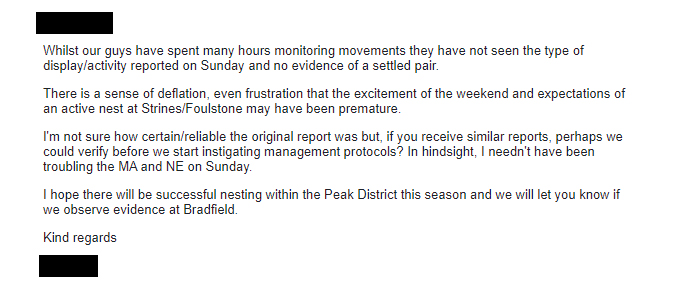
21st April 2021, the estate responds with a strange email, stating that despite their own staff spending hours monitoring the birds they have not seen the type of behaviour described and no evidence of a settled pair. They then go on to question the reliability of the observers involved:
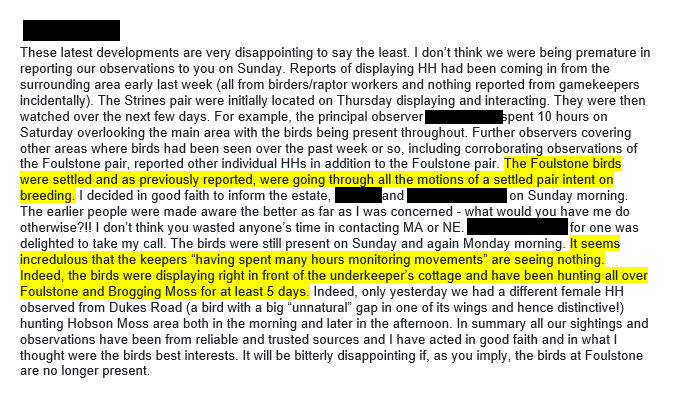
21st April 2021, follow up email from the raptor group explaining with some frustration, their position regarding the now absent Hen Harriers and their disappointment that the keepers had not reported any Hen Harrier sightings despite the birds being very active around one of the keeper-occupied estate cottages. This despite such glowing reports about improved cooperation between shooting estates and raptor workers in the 2020 Peak District Bird of Prey Initiative report:
Despite raptor workers and local bird watchers spending many hours over several weeks trying to relocate these birds it became apparent that the Hen Harriers previously observed, were no longer present and in particular no adult (grey) male Hen Harriers were subsequently located.

However, on a more positive note an immature pair of Hen Harriers bred successfully and fledged 4 young, once again on National Trust-owned land.

The questions that need to be answered are:

  1. Why didn’t the estate report the Hen Harrier activity on the estate to the Bird of Prey Initiative or the Raptor Group? It is inconceivable that they were not aware of the birds due to the proximity to one of the keepers’ residences; the birds were observed flying over his house and garden on many occasions.
  2. The more important question, which we know will never be answered is what happened to the adult male hen harrier that was so intent on breeding on Wentworth Fitzwilliam Strines Estate?

This incident was reported to South Yorkshire Police and the National Wildlife Crime Unit.

ENDS
Absurd & ineffective General Licence restrictions for wildlife crime are ‘fair & proportionate’, says Environment Minister

The ability to impose a General Licence restriction on an estate where there is ‘clear evidence’ of wildlife crime has been an option available to the Scottish Government’s statutory nature conservation advisor (NatureScot) since 1st January 2014.

This measure, based on a civil burden of proof, was introduced by then Environment Minister Paul Wheelhouse in response to the continuing difficulties of meeting a criminal burden of proof to facilitate a criminal prosecution in relation to raptor persecution crimes on game-shooting estates across Scotland (here). The measure has not yet been implemented in England, Wales or Northern Ireland.

General Licences represent a relatively ‘light-touch’ approach to regulation, allowing persons to carry out activities (typically the killing of so-called ‘pest’ bird species such as crows) without the need for those persons to apply for a specific licence or indeed without them having to submit any records whatsoever of how many birds, and of what species, they’ve killed in a given period at a given location. It’s actually a bit of a free-for-all, enabling the casual killing of birds with virtually no oversight and just a few rules to follow about the type and specification of various traps and a list of species that are allowed to be killed. Conservation campaign group Wild Justice has been challenging the lawfulness of these General Licences for the last three years (see here).

The rationale behind imposing a restriction on the use of General Licences is that light touch regulation should not apply in situations where the regulator has “lost trust or confidence“.

Since this new measure was introduced in 2014, NatureScot has imposed a General Licence restriction on only a handful of shooting estates (and one unnamed individual in 2017) – Raeshaw & Corsehope Estates (2015), Burnfoot & Wester Cringate Estates (2015), Edradynate Estate (2017), Leadhills Estate (2019), Leadhills Estate again (2021), Lochan Estate (2022) and Invercauld Estate (2022).

I have been highly critical of the supposed ‘sanction’ that a General Licence restriction is meant to secure because I believe it to be wholly ineffective, for a number of reasons, but not least because the supposedly ‘sanctioned’ estate can simply apply to NatureScot for an Individual licence which then allows the estate’s gamekeepers to continue the activities that were supposed to have been restricted by the General Licence restriction! It’s utterly bonkers and I’ve written about it many times before (e.g. see herehereherehere) and I even gave evidence to this effect alongside RSPB Scotland and others to a Scottish parliamentary committee in 2019 (here).

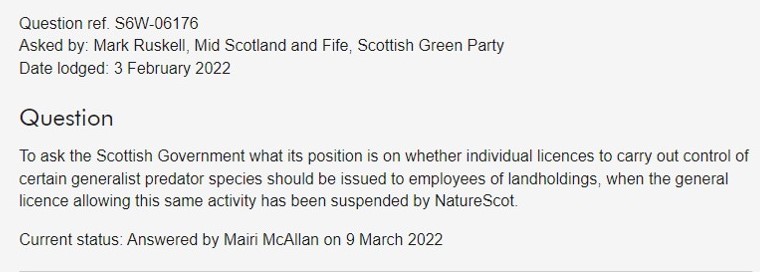
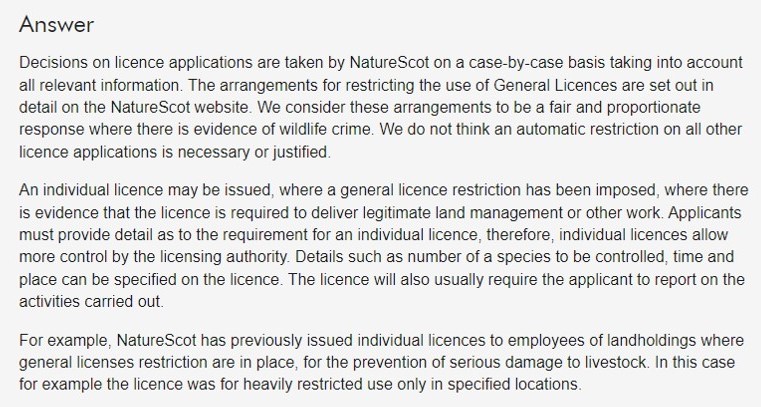
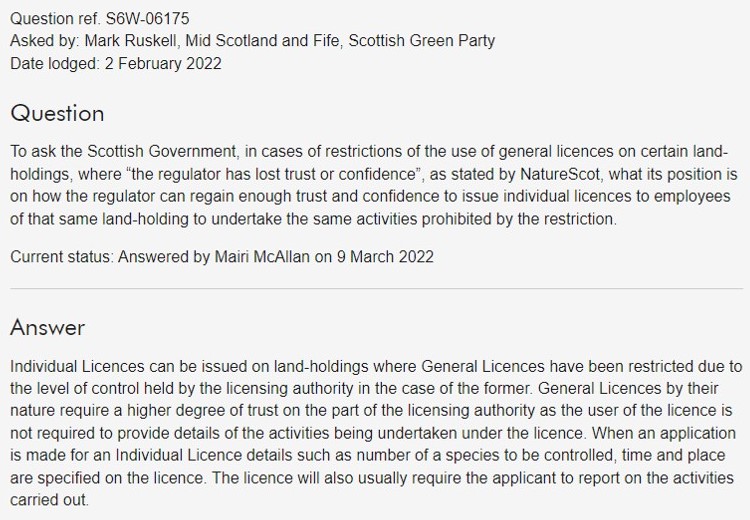
In February this year, Scottish Greens MSP Mark Ruskell took up the issue by submitting two written questions to the Scottish Parliament (see here). Scottish Environment Minister Mairi McAllan has now responded as follows:

I’m astounded that the Scottish Environment Minister thinks that this ineffective sanction is “a fair and proportionate response where there is evidence of wildlife crime“. Good grief. Really? She thinks this is a reasonable response to a deliberately poisoned golden eagle, found next to a poisoned bait, on a grouse moor inside the Cairngorms National Park?

Whatever happened to the Scottish Government’s 2019 commitment, made by former Environment Minister Mairi Gougeon, that the Scottish Government was ‘actively considering’ additional enforcement measures on wildlife crime, including whether General Licence restrictions are ‘as effective as they can be’ (see here)??

How about getting serious with estates where wildlife crime is discovered and imposing sanctions that actually are sanctions?

Otherwise, what’s the point?

Invercauld Estate in Cairngorms loses appeal against General Licence restriction imposed for wildlife crime

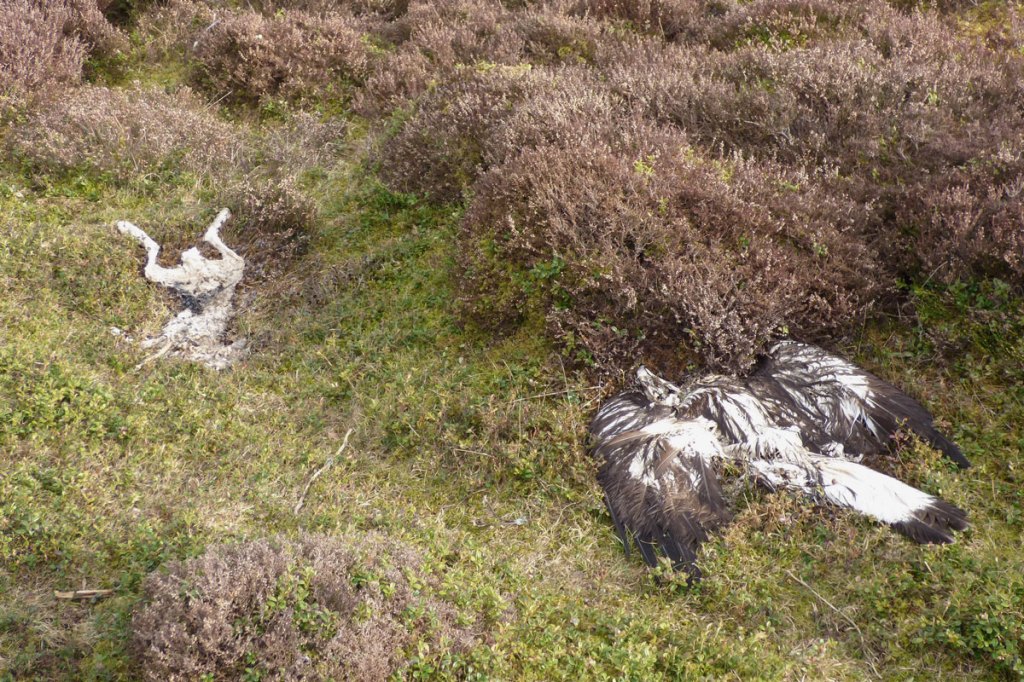
Invercauld Estate in the Cairngorms National Park has lost its appeal against a General Licence restriction that was imposed on the estate in February 2022 (see here) after Police Scotland provided the licensing authority (NatureScot) with evidence of wildlife crime against birds of prey on the estate, notably the discovery of a ‘deliberately poisoned’ golden eagle lying next to a poisoned hare bait in March 2021 (see here).

[Photo of the poisoned eagle & hare bait found on a grouse moor on Invercauld Estate in the Cairngorms National Park. Photo by RSPB Scotland]

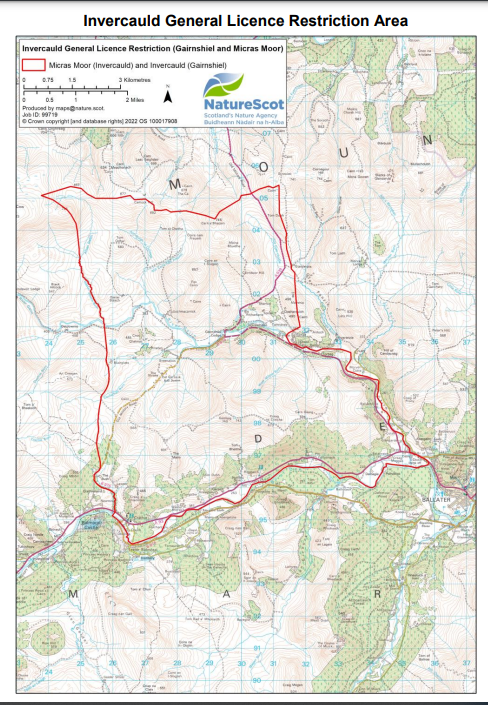
Regular blog readers will know that the three-year General Licence restriction on the Gairnshiel & Micras part of Invercauld Estate took effect on 9th February 2022, prohibiting the use of General Licences 01, 02 and 03 on the estate until 9th February 2025 (see here).

The estate submitted a formal appeal against NatureScot’s restriction decision on 25th February 2022 and the official ‘restriction notice’ was removed from NatureScot’s website. I looked today and the notice has been reinstated, which I take to mean that the estate’s appeal has failed, in the same way that Lochan Estate’s recent appeal against restriction also failed (see here).

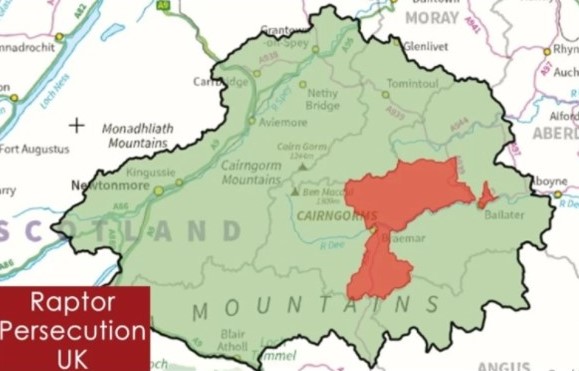
Here is the map from Naturescot showing the area of restriction on the Gairnshiel & Micras area of the estate:

If you’re at all familiar with Invercauld Estate you’ll recognise that this restriction area is only a small part of what is a massive grouse-shooting estate in the Cairngorms National Park (data from Andy Wightman’s excellent Who Owns Scotland website) rather than the restriction being applied across the entire estate, as seems to have been the case with other sanctioned estates:

I was curious about why the General Licence restriction was, well, restricted for want of a better term, to just the small area of Garnshiels and Micras, so I asked the licensing team at NatureScot about that decision.

The response from NatureScot was prompt (thank you!) and went like this:

‘…The decision was made on the basis that the evidence of crime provided [by Police Scotland] related to this one beat, rather than across the whole estate; and that the separate beats on this estate are managed independently of each other. Hence, the ultimate decision was to restrict to the beats where the evidence of crime occurred‘.

As many of you already know, the three-year General Licence restriction is barely worth the paper it’s written on because the estate can simply apply for ‘Individual licences’ (instead of relying on the General Licences) to continue its activities as before, albeit with the minor inconvenience of having to have a bit of a paper trail. This has been a major criticism of the General Licence restriction process ever since it began in 2014. This, combined with the shooting industry’s apparent reluctance to shun any estates where restrictions have been imposed for wildlife crime, means that the General Licence restriction is an utterly ineffective sanction (e.g. see here).

We were even provided with first-hand evidence of its ineffectiveness when further evidence of suspected wildlife crime was detected on two estates that were already serving a General Licence restriction for wildlife crime! Raeshaw Estate in the Scottish Borders had its Individual licences revoked (here) and Leadhills Estate was given a three-year extension to its original three-year General Licence restriction (here), a decision which it subsequently appealed and lost (here).

You may remember that in February, Scottish Greens MSP Mark Ruskell asked Parliamentary questions about this absurd so-called sanction (see here); more on that shortly.

Hen Harrier Fest, hosted by Wild Justice, 24th July 2022

Conservation campaign group Wild Justice is hosting a new event this year, Hen Harrier Fest, on Sunday 24th July 2022 at a very special venue in Cheshire.

Further details to follow so for now, please save the date!

Buzzard & red kite suspected poisoned on North Dorset estate

Well this saga gets more interesting by the day.

I’ve written about the poisoned white-tailed eagle found dead on an as-yet undisclosed shooting estate in North Dorset and Dorset Police’s decision to close the investigation prematurely (see here, here, here, here and here).

I’ve also written about the suspected poisoning of another white-tailed eagle on another as-yet undisclosed shooting estate in North Dorset and a subsequent multi-agency raid in which items of interest have been submitted for toxicology assessment (see here).

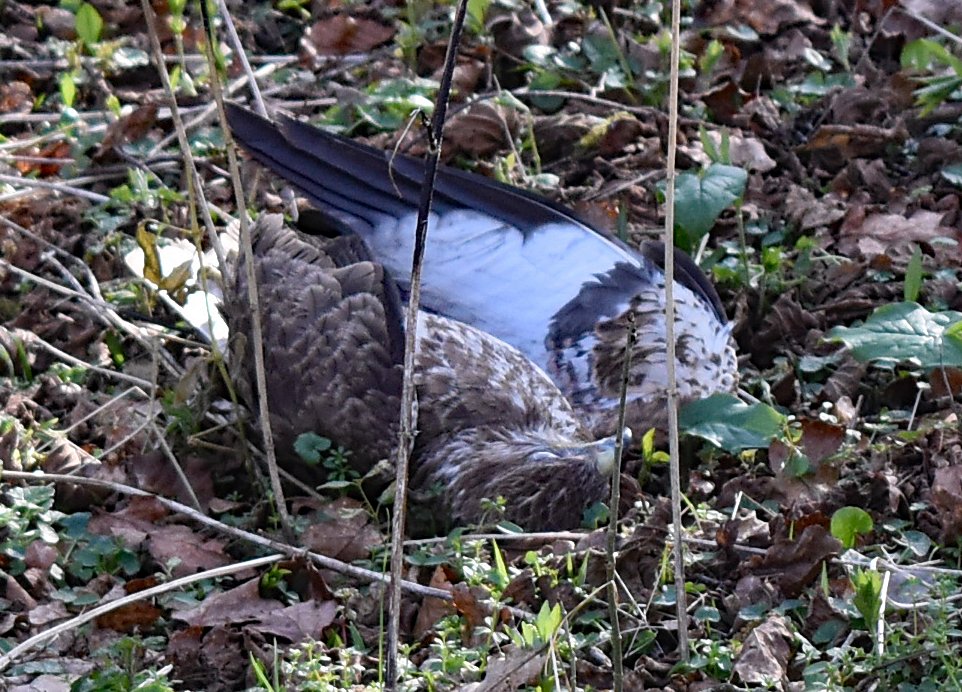
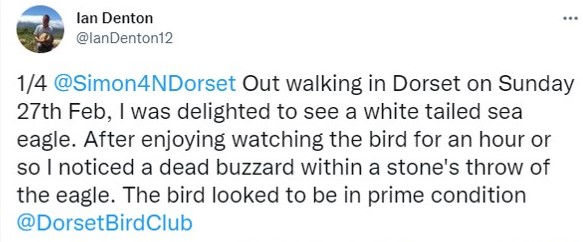
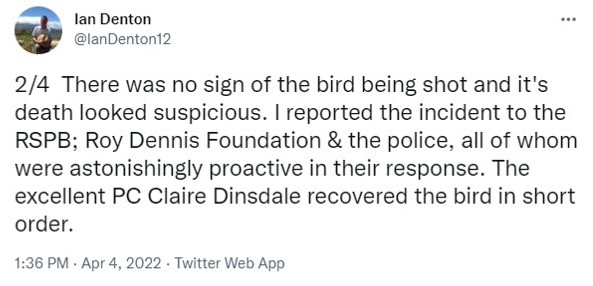
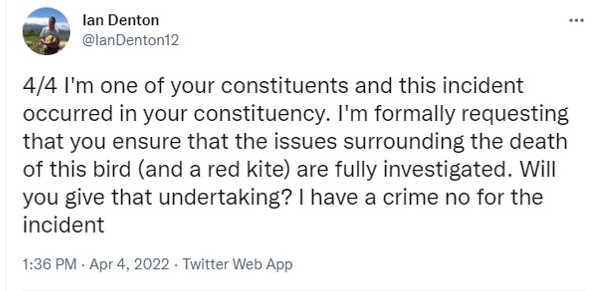
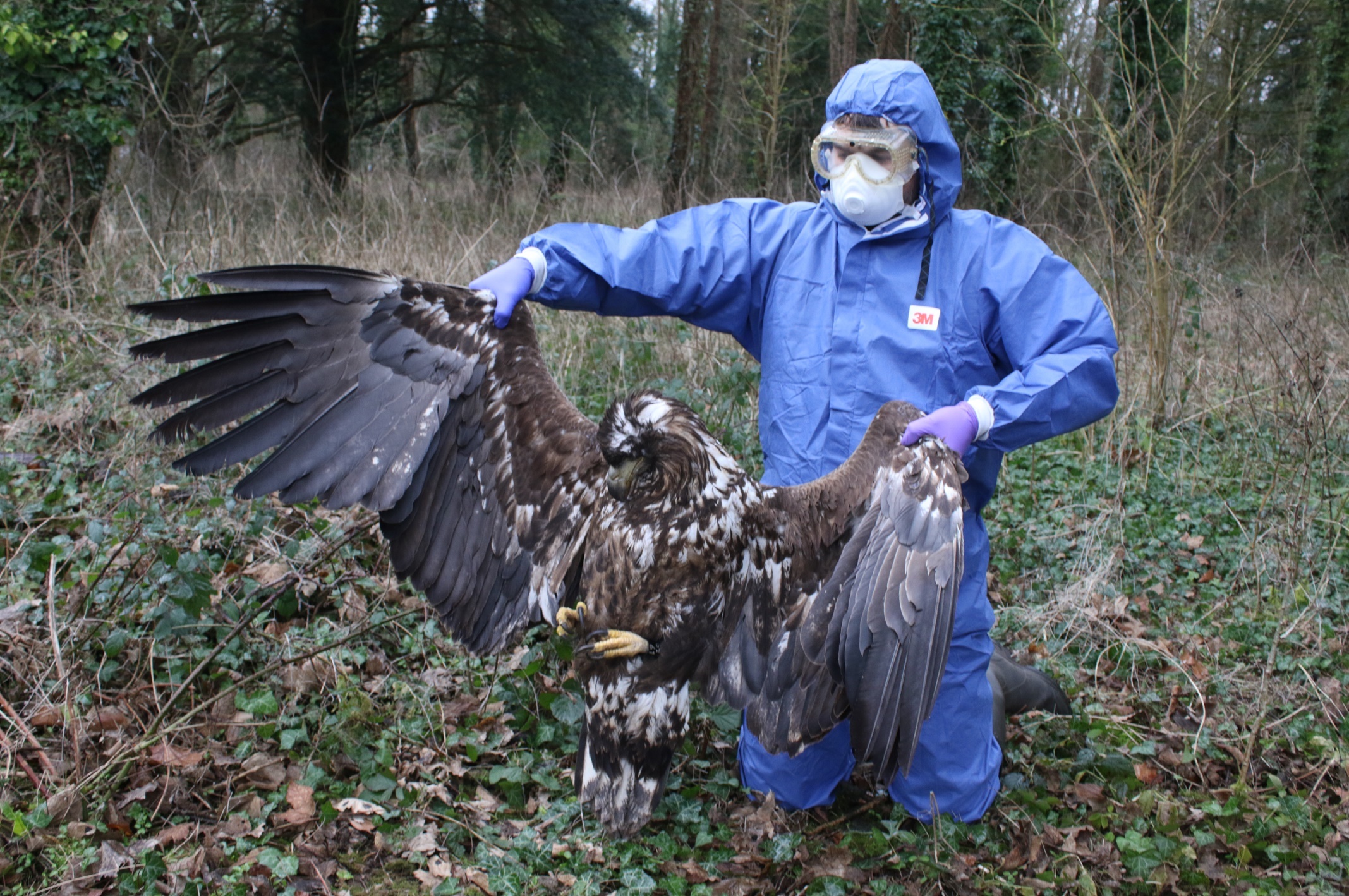
Now there’s this – the suspected poisoning of a buzzard and a red kite on an as-yet undisclosed shooting estate in North Dorset, as revealed on Twitter this afternoon by Ian Denton:

More to follow……

Another eagle suspected poisoned on a Dorset shooting estate

The story of the week has been the confirmed poisoning of a white-tailed eagle found dead on a shooting estate in Dorset in January, and Dorset Police’s astonishing decision to close the investigation even though toxicology results had proved that poisoning was the cause of death (see here,  herehere, here and here).

There’s still much more to come out about this story and I’ve spoken to a few journalists in the last few days who are making some headway. Let’s see what they produce in the coming days.

Meanwhile, in the course of these conversations I’ve learned that another white-tailed eagle is suspected to have been poisoned on a shooting estate in Dorset.

I’ve deliberately used the word ‘suspected’ in this case because unlike the first eagle, poisoning hasn’t been confirmed and the eagle hasn’t died.

This second case is not on the same shooting estate where the dead (confirmed poisoned) eagle was found, but it is on another game-shooting estate and it is nearby.

I understand that initially, this second eagle’s satellite tag data indicated that the eagle’s movements were unusual and this was a cause for concern given the eagle’s location and proximity to the area where the poisoned eagle had been found dead. A multi-agency team made a site visit to look for this second eagle and they found it, still alive but displaying some of the characteristic physical traits of a raptor that has ingested a large amount of an anticoagulant rodenticide (e.g. lethargic, head-drooping).

While on site searching for the sick eagle, a number of undisclosed items were apparently discovered which sparked a multi-agency raid on the estate a short while later and I understand that as a result of that search, multiple toxicology results are now pending from the lab.

The second eagle appears to have since made a recovery and has recently moved away from the estate, although long-term health issues may still be an issue. Time will tell.

It’s important to emphasise that at this stage poisoning (rodenticide or another substance) has not been confirmed but it is suspected.

What’s interesting about this second investigation is that the police considered there was sufficient evidence to conduct a multi-agency search, even though toxicology results were still pending. This is in direct contrast to the police’s response to the first case where toxicology results from the dead eagle had confirmed that poisoning was the cause of death and that the high concentration of rodenticide in the eagle’s liver (7 x the lethal dose) was clearly indicative of suspicious activity, and yet Dorset Police decided not to progress that investigation.

This is quite hard to fathom, although I suspect that this multi-agency search on the other estate took place in early March under the direction of the diligent and highly-competent wildlife crime officer, Claire Dinsdale. The ridiculous decision not to progress the first investigation (into the circumstances of the dead, confirmed-poisoned eagle) appears to have been made later in March after Claire Dinsdale had apparently been signed off on indefinite sick leave.

I look forward to the publication of the latest toxicology reports, which should be available by now, surely, and full disclosure from Dorset Police about the status of this second investigation, as well as an explanation about why the first investigation was closed prematurely, especially when Dorset Police would have known about this second case of suspected poisoning on an estate in close proximity to where the dead poisoned eagle had been found.