Mass poisoning of raptors in south Scotland – has there been a conviction?

From 2018 to 2020 there was a large, multi-agency investigation in south Scotland relating to the deaths of ‘upwards of 20 birds of prey’, including red kites and buzzards, around the Castle Douglas area – see here and here for previous blogs.

In April 2020 Police Scotland announced that a 64-year-old man had been charged in relation to the illegal poisoning of birds in the Stewartry area (which is close to Castle Douglas) and that a report had been submitted to the Procurator Fiscal (see here).

As far as I was aware, this case was ongoing, no pleas had been entered and the case was due back in court in March.

However, on Thursday the Daily Record ran a story about how some Police Scotland officers had been recognised for their efforts in ‘solving’ the poisoning crimes (see here).
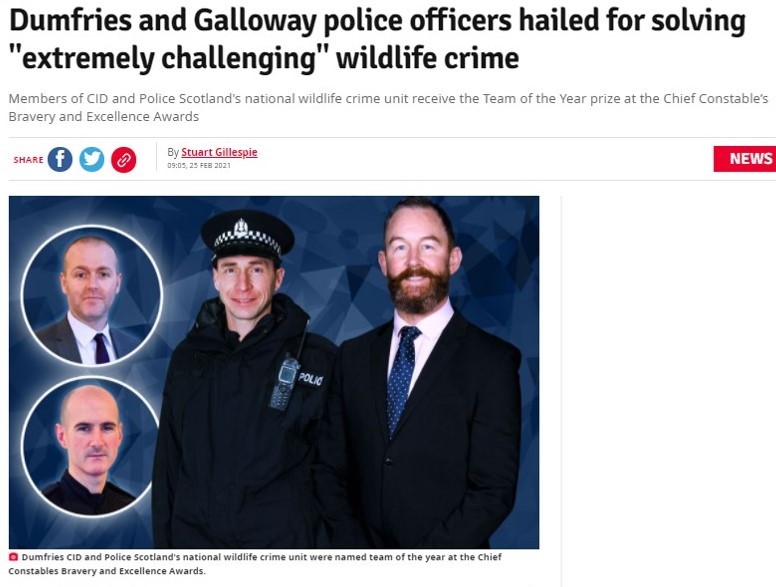
Prior to the Daily Record’s article, Police Scotland had issued a press release about the officers winning Team of the Year at the Chief Constable’s Bravery and Excellence Awards on 19th February 2021 and the statement said, ‘This investigation led to an individual being convicted of wildlife crime offences‘ (see here).

First of all, many congratulations to the award-winning officers – as regular blog readers will know, raptor persecution crimes are rarely easy to get to the prosecution stage, let alone secure a conviction. The police officers deserve recognition, as do all the partner agencies who worked on this investigation.

But what about the conviction? Where was the publicity about it? This was a high profile case where a large number of protected birds of prey had been poisoned with a banned substance over a number of years. NB: It was not thought to be linked to the game-shooting industry, for a change.

What, exactly, was he convicted of and what was the sentence?

It seems slightly bizarre that the apparent successful prosecution of a raptor poisoner has not made the headlines, doesn’t it? What’s going on?

Come on, Police Scotland, it’s rare to get a win, let’s hear about it when it happens!

I’ll be chasing this up with the police next week.

UPDATE 2nd March 2021: Mass poisoning of raptors in south Scotland: this case is still live (here)

Will the mass slaughter of mountain hares on grouse moors end on Monday?

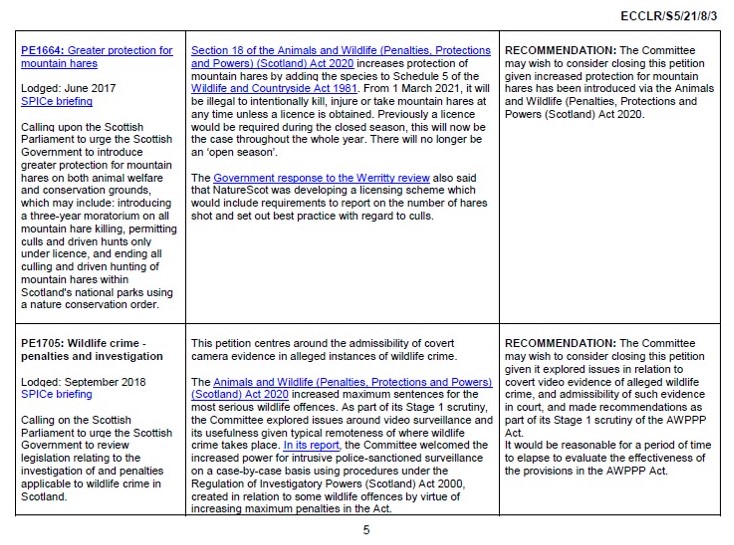
It has been legal to kill mountain hares in Scotland for decades, although in more recent years concerns about the species’ conservation status led to the introduction of a closed hunting season as part of the Wildlife and Natural Environment (Scotland) Act 2011, which became enacted on 1st March 2012 (see here).

Nine years later and after a long, hard-fought campaign by a number of organisations and individuals, backed by Scottish Greens MSP Alison Johnstone, as of this Monday (1st March 2021) mountain hares in Scotland will have increased protection, meaning it will be illegal to intentionally kill, injure or take mountain hares at any time unless a licence is obtained.

[Shot mountain hares strung up in a chilling larder, screen-grabbed from a controversial feature on Countryfile (2018) showing mountain hares being shot on a Scottish grouse moor]

Mountain hares have been killed for a variety of reasons, including to protect forestry interests and for recreational ‘sport shooting’, but overwhelmingly they’ve been killed on driven grouse moors in a vain attempt to control the viral disease ‘Louping-ill’ in red grouse – I say vain attempt because scientists have concluded ‘there is no compelling evidence base to suggest culling mountain hares might increase red grouse densities’ (see here).

The scale of the mass slaughter on some driven grouse moors in recent years has been eye-watering (nearly 38,000 killed in one season – see here) and this was despite widespread calls for voluntary restraint from within the shooting industry itself (e.g. see here). The killing is believed to have increased as part of the intensification of driven grouse moor management in some regions (see here).

Hopefully, from Monday, we won’t ever see a return to that level of obscenity but the new protection does not mean that mountain hares can’t still be killed – it means the hare killers will need to have a licence and thus presumably evidential support to justify the licence being issued, which should mean that slaughtering thousands of hares to protect grouse stocks will not be permissible.

We don’t yet know the terms of the new licensing scheme but NatureScot (the licensing authority) has begun to consult and there’ll be a lot of organisations watching with close interest to scrutinise the final details. NatureScot can also expect a series of FoIs to scrutinise licence applications vs licences issued.

RSPB Scotland’s Senior Species and Habitats Officer James Silvey has written an excellent blog laying out what the RSPB expects to see in the new licensing regime – see here.

Public perceptions of red kites using UK gardens – student’s survey needs your help

Georgia Locock, a final-year undergraduate at Hull University is investigating the public’s perceptions of red kites and is interested in finding out why and how people feed red kites in their gardens.

If you’re UK-based and lucky enough to live near a red kite population and you’re up for completing a short online survey to help Georgia’s research, please click here for the survey form.

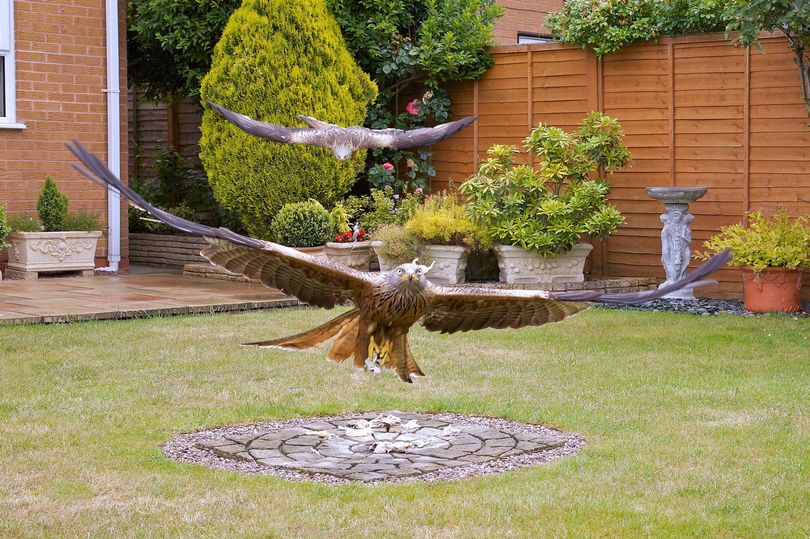
[Red kites picking up meat scraps in a Reading garden. Photo by Stuart Gay]

Convicted egg thief pleads guilty, again

According to the YorkshireLive website, a 63-year-old Huddersfield man has admitted stealing almost 200 wild bird eggs, including those belonging to endangered species (see here).

Terence Potter, from Huddersfield, appeared at Sheffield Magistrates’ Court on 17th February 2021 charged with two counts of possessing an article capable of being used to take birds eggs, three counts of possession of a wild bird’s eggs and three counts of taking wild bird eggs.

The charges brought against Mr Potter, of Cumberworth Lane, Upper Cumberworth, date back to April 2020 with allegations that he took 179 black headed gull eggs, four golden plover eggs and three curlew eggs.

In Holmfirth, in April 2020, Potter was found to be in possession of a number of items that helped in his removal of those eggs including syringes, binoculars, egg blowing equipment, thermal imaging binoculars and an incubator as well as handwritten data cards.

The curlew, the largest European wading bird, is listed as being under threat by the RSPB website stating its UK conservation status is red.

Potter will be sentenced at Sheffield Magistrates’ Court on April 23.

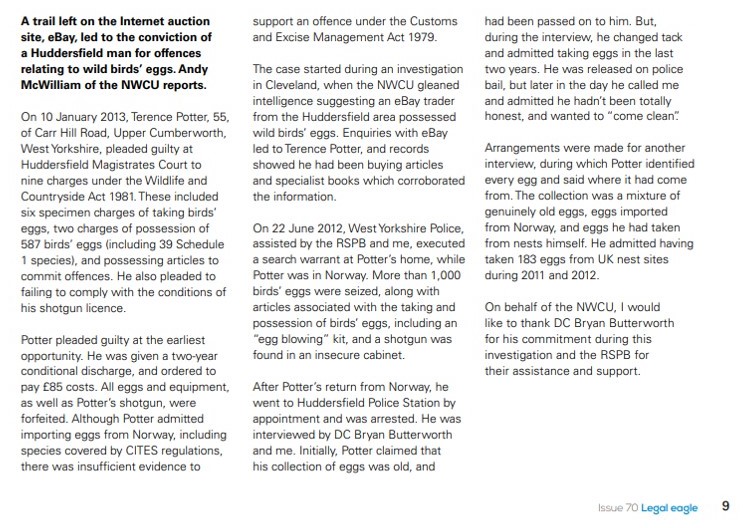
Potter is not new to this area of criminality. Eight years ago he pleaded guilty to nine related offences including six charges of taking birds’ eggs, two charges of possession of 587 eggs (including a number of Schedule 1 raptor eggs), and possessing articles to commit offences. He also had his shotgun removed for insecure storage. He was given a two-year conditional discharge and had to pay £85 costs.

Clearly an insufficient deterrent. It’ll be interesting to see what his sentence is this time.

[Potter’s illegal egg collection in 2012, photograph by Bob Elliot, from RSPB’s Legal Eagle Newsletter #70]

World Osprey Week 2021: 22nd – 26th March

Press release from charity Birds of Poole Harbour (23rd February 2021)

World Osprey Week celebrates Ospreys as they make their spring migrations to their nesting grounds.

Founded by the Leicestershire and Rutland Wildlife Trust, who are celebrating the 25th anniversary of their Osprey reintroduction project this year, the week-long event aims to enthuse and educate people, in particular children, about this brilliant bird of prey. From tracking treacherous migrations, to understanding their repopulation of Scotland, the week provides an opportunity to weave the excitement of Ospreys into learning about geography, history and science.

Each weekday, from the 22nd to the 26th March, we’ll be sharing a video and content pack about a different topic, featuring activities and competitions. For some extra fun, the competition winners will be announced by Chris Packham and Megan McCubbin in The Reintroduction and Rewilding Summit on Saturday 10th of April. More information on this topic will be announced soon…

Who’s involved?

We’ve connected with 5 other Osprey groups this year to form an Osprey Network – Leicestershire and Rutland Wildlife Trust, Cumbria Wildlife Trust, Glaslyn Wildlife, Osprey Leadership Foundation and Scottish Wildlife Trust… and hopefully some familiar Ospreys!

How can you participate?

All of the involved sites will be putting out WOW content through their websites and social media each day of the week from 22nd of March. All sites in the network will be putting out the same content, with a few personal touches, so we recommend keeping an eye on the page of the site closest to you!

Each group is also reaching out to local schools, who we hope will be able to use the content as part of their school day. If you know of a school that would be interested in participating in World Osprey Week, please get in touch with us at bophhq@birdsofpooleharbour and amustard@lrwt.org.uk Please note that most of the WOW content will be aimed at children of a primary school age, though anyone is welcome to get involved.

Don’t worry about missing out on the fun if a particular school isn’t participating – all the activities will be able to done from home. We hope you can get involved!

ENDS

New study shows pheasants still full of poisonous lead shot one year after start of ‘voluntary transition’ to non-toxic shot

A year ago, nine UK game-shooting organisations made a massive u-turn after years and years and years of defending the use of toxic lead ammunition, and said they wanted to drag the industry into the 21st Century by making a five-year voluntary transition away from lead ammunition (see here).

A lot of us were sceptical because (a) we rarely trust anything the industry tells us; (b) previous ‘voluntary bans’ by the industry on a number of issues have been unsuccessful (e.g. see herehere and here); (c) the ongoing failure of the shooting industry to comply with current regulations on many issues, including the use of lead ammunition over wetlands (here), means there should be absolutely zero confidence in its ability and/or willingness to stick to any notional voluntary ban; (d) the Scottish Gamekeepers Association refused to sign up to the proposed five-year transition period because they believe there is insufficient evidence to support the claim that lead can have damaging impacts on humans, wildlife and the environment (here); and (e) in the very same year that nine shooting organisations committed to the five-year transition, BASC announced it was set to fight a proposed EU ban on the use of lead ammunition on wetlands (see here).

Fortunately for us, a new project has been established to monitor the professed voluntary five-year transition from toxic lead to non-lead ammunition in the UK. Called SHOT-SWITCH, the project intends to test wild-shot pheasants offered for sale across Britain each year and determine if they have been killed using toxic lead or non-lead shotgun ammunition. Interestingly, the project is supported by funds from the RSPB, Waitrose (who you’ll recall are the only supermarket to be heading towards a ban on selling game meat shot with lead ammunition (see here) and Lincolnshire Game.

To find out more about the SHOT-SWITCH project please visit the webpage here

The project is being led by three prominent scientists who have been studying the effects of toxic lead ammunition for years – Professor Rhys Green, Professor Debbie Pain and Dr Mark Taggart – and today they have published the results of the first year’s study.

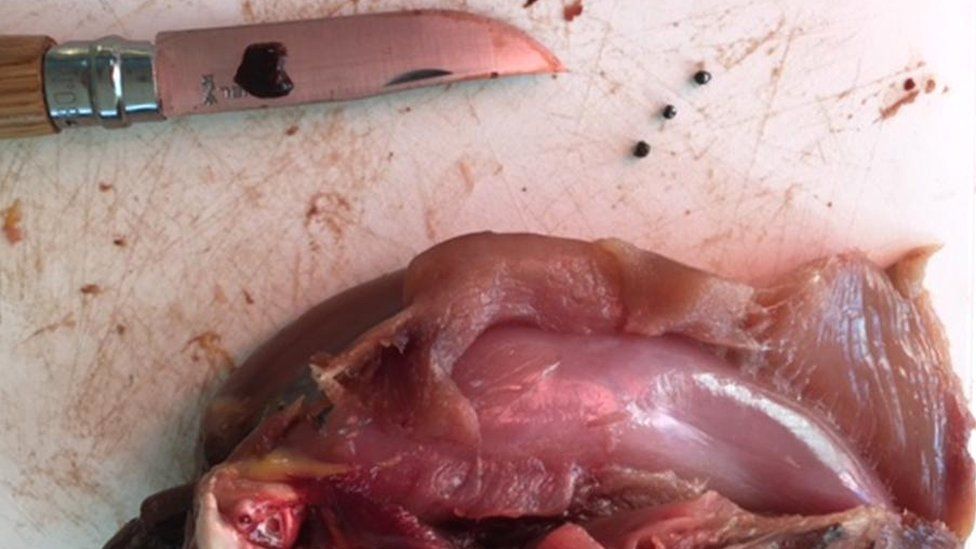
It doesn’t look good for the shooting industry. Of 180 pheasant carcasses examined, 179 were shot with lead ammunition.

These results have been reported in the press (BBC news here) and Mark Avery’s take is also well worth a read (here).

[Lead shot pellets removed from a pheasant carcass. Photo by Rhys Green]

The study results have been published by Conservation Evidence and the paper is open access, meaning nobody has to pay to read it.

I thoroughly recommend reading it – especially the introductory background section which provides a well-written overview of the recent science and politics associated with this issue. The paper can be downloaded here:

Project SHOT-SWITCH is completely separate to Wild Justice’s project examining Sainsbury’s gamebird meat for toxic lead ammunition (see here) although obviously there are many parallels.

Moffat to be celebrated as ‘Eagle Town’ during golden eagle festival

The UK’s first golden eagle festival will take place later this year, celebrating the town of Moffat being named as an ‘Eagle Town’ as part of a plan to boost eco-tourism to the area.

Moffat has been chosen as it’s close to the original release site for translocated golden eagles, brought down from the Highlands and released in South Scotland to boost the tiny, remnant population that had previously been ravaged by illegal persecution and of which there is still evidence to suggest an on-going intolerance of golden eagles in some areas (see here).

The five-year translocation project is being led by a coalition of groups under the banner of the South of Scotland Golden Eagle Project and this is also the group organising the golden eagle festival.

The event will take place between 19-26th September 2021 and wildlife cameraman Gordon Buchanan has been signed up to deliver the online keynote speech. He said:

I’m delighted to be part of the South of Scotland Golden Eagle Project’s first ever Golden Eagle Festival and to support their important conservation work to ensure golden eagles once again flourish in southern skies.

The thrill of seeing a golden eagle soaring over a Scottish hillside is an unbeatable experience.

Each glimpse of this magical bird is special, but they should and could be more common in the south of Scotland.”

More details about the festival will be publicised later in the year. It’s worth keeping an eye on the South of Scotland Golden Eagle Project website for info.

Scottish gamekeepers’ petition calling for independent monitoring of raptor satellite tags is ‘fact-free nonsense’

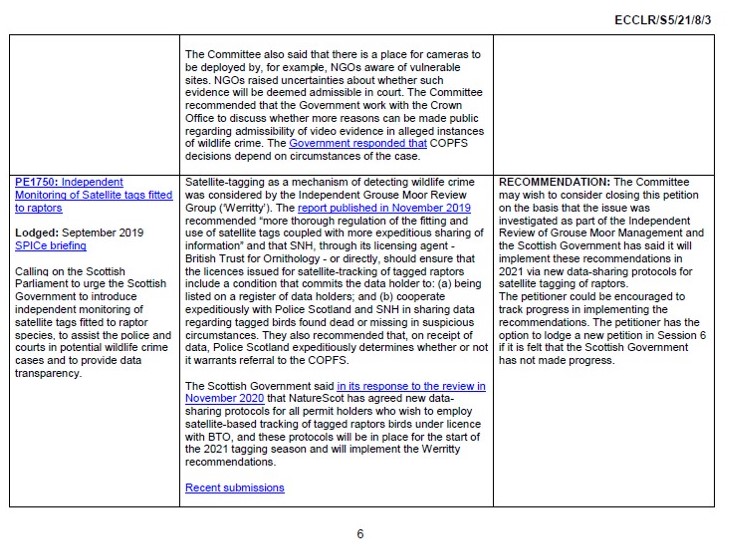
One of the petitions under consideration tomorrow by the Scottish Parliament’s Environment, Climate Change & Land Reform (ECCLR) Committee is PE01750 – Independent monitoring of satellite tags fitted to raptors – submitted by Alex Hogg on behalf of the Scottish Gamekeepers Association (SGA).

I’ve written about this petition before (here), back in late 2019 when it was first lodged, as did Ian Thomson, Head of Investigations at RSPB Scotland (here). It’s useful background reading for those with more than a passing interest.

As a brief summary, satellite-tagged raptors have caused the grouse-shooting industry all sorts of pain in recent years, because scientists have been able to use the analysis of extensive tag data to expose the scale of previously-hidden raptor persecution on or close to some driven grouse moors, even when the raptor-killing criminals thought they’d done a good clean-up job by destroying and removing the raptor corpse and the tag. Although sometimes the clean-up job wasn’t done so well, as evidenced last year by the discovery of a golden eagle’s satellite tag, its harness cut, wrapped in lead sheeting (to block the signal) and dumped in a river (see here and here).

Two significant scientific reviews based on tag analysis have identified illegal persecution hotspots for golden eagles (here) and hen harriers (here) in the UK. And indeed, the whole Werritty Review in to whether grouse moors should be licensed was triggered in 2017 by research that demonstrated almost one third of tagged golden eagles had ‘vanished’ in suspicious geographic clusters that were also areas being managed for driven grouse shooting and at a rate 25 times higher than anywhere else in the world.

Raptor persecution crimes in the UK continue to attract huge media attention because it’s hard to believe that people are still poisoning eagles in Scotland in the 21st century. As a result of this ongoing publicity, the game-shooting industry has spent considerable time and effort trying to undermine the satellite-tagging of raptors, either by launching disgusting personal & abusive attacks and by making outrageous defamatory claims targeted against named individuals involved in the projects, or by blaming disappearances on imaginary windfarms, faulty sat tags fitted to turtles in India & ‘bird activists‘ trying to smear gamekeepers, or by claiming that those involved have perverted the course of justice by fabricating evidence, or by claiming that raptor satellite-tagging should be banned because it’s ‘cruel’ and the tag data serve no purpose other than to try and entrap gamekeepers. There have also been two laughable attempts to discredit the authoritative golden eagle satellite tag review (here and here), thankfully dismissed by the Scottish Government. The grouse shooting industry knows how incriminating these sat tag data are and so is trying to do everything in its power to corrode public and political confidence in (a) the tag data and (b) the justification for fitting sat tags to raptors, hence this latest petition from the SGA.

What hasn’t previously been made public, but can be now as the papers have been published on the ECCLR Committee’s website, is a formal response to the SGA’s petition by the Golden Eagle Satellite Tag Group (GESTG), a research group established in Scotland by scientists as a forum for data exchange, tagging coordination and general cooperation.

The GESTG’s response takes apart the SGA’s petition pretty much line by line and eviscerates it. You almost feel sorry for the SGA, who up until last Thursday wouldn’t have known that this response even existed. It is a masterclass, and you have to admire the restraint behind the summary dismissal of the petition as ‘fact-free nonsense’.

There’s some other paperwork of interest, too. A letter to the ECCLR Committee from Ian Thomson (Feb 2020) and a letter from me (Feb 2021), pointing out to the Committee that despite the SGA’s misinformed rants and smears, raptor satellite-taggers in Scotland were told recently by NatureScot (formerly SNH) that neither NatureScot nor Police Scotland had any substantive concerns about the way we operate and communicate with the licensing and police authorities.

You can download the documents here:

The ECCLR Committee’s virtual meeting starts tomorrow at 9am. The meeting papers can be viewed here and the meeting can be watched live here.

Transcripts from the meeting will be posted here when available and I’ll be blogging about the Committee’s decision on this petition and a number of others of interest.

UPDATE 1st July 2022: Scottish Parliament sees sense and closes SGA’s petition seeking ‘Independent monitoring of satellite tags fitted to raptors’ (here).

Summary of petitions under consideration by Scottish Parliament’s Environment Committee on Tuesday

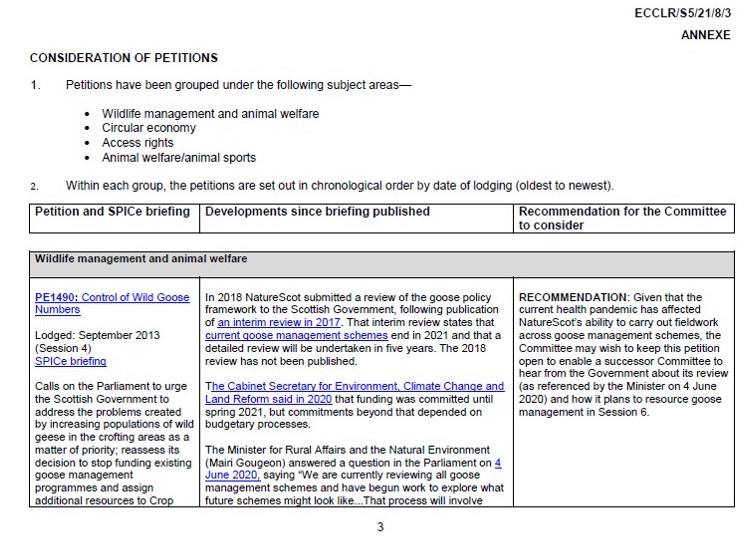
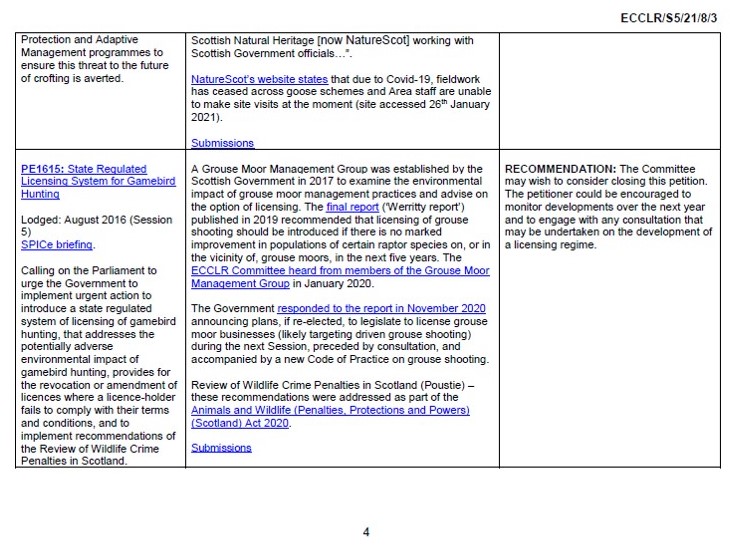
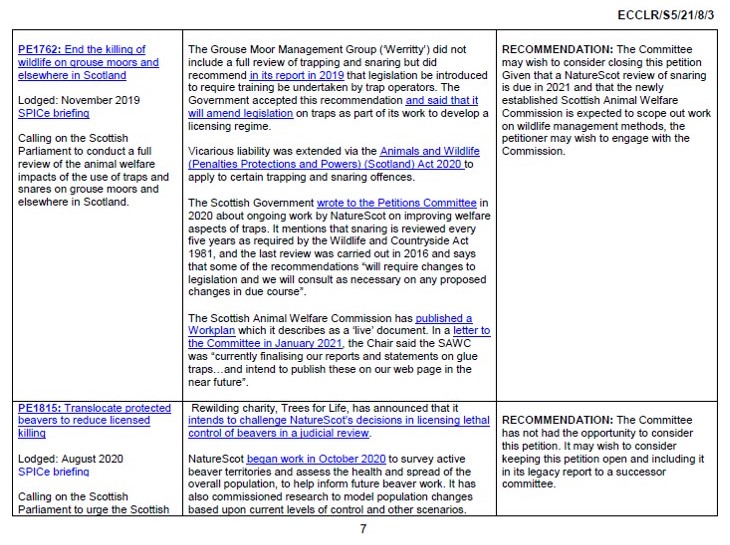
Last week I wrote about the Scottish Parliament’s forthcoming Environment, Climate Change & Land Reform (ECCLR) Committee meeting on Tuesday 23rd, when a selection of petitions will be considered including several of significant interest to this blog (see here), including gamebird licencing, mountain hares, wildlife crime penalties, raptor satellite tagging, and wildlife killing on grouse moors.

The official meeting papers have now been published on the ECCLR website and within those papers are recommendations for the Committee to consider for each of the petitions under consideration.

I’ll be discussing the petition from the Scottish Gamekeepers Association calling for ‘Independent monitoring of satellite tags fitted to raptors’ on this blog tomorrow and of course will be reporting on the ECCLR Committee’s decisions on the other relevant petitions after the meeting on Tuesday.

For now, here are the recommendations:

UPDATE 22nd February 2021: Scottish gamekeepers’ petition calling for independent monitoring of raptor satellite tags is ‘fact-free nonsense’ (here)

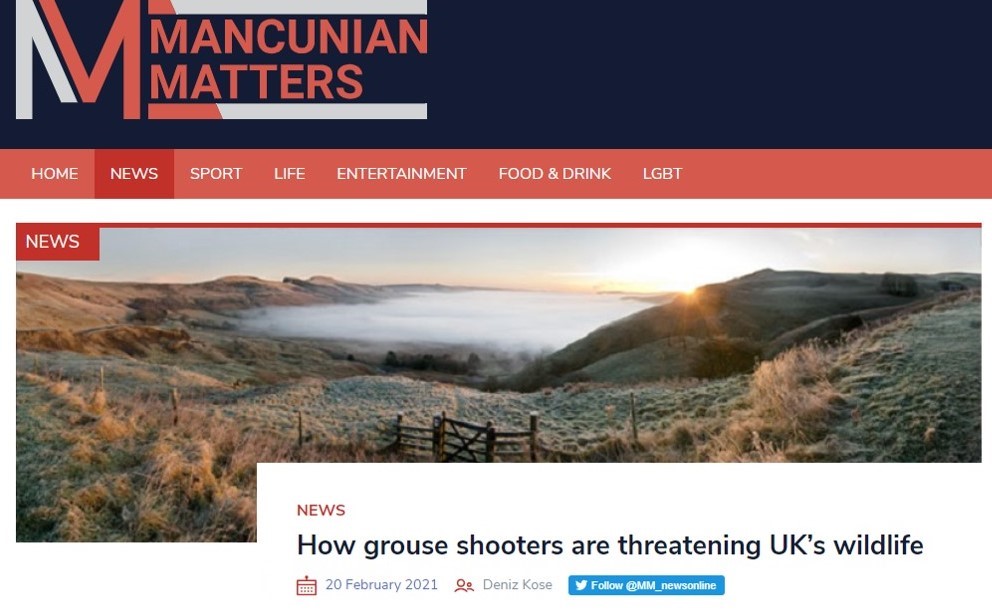
‘How grouse shooters are threatening UK’s wildlife’

Another new article, another new audience.

This time it’s an article published yesterday on Mancunian Matters, an online news website covering the Greater Manchester region.

Journalist Deniz Kose focuses attention on the work of local group Moorland Monitors, who describe themselves as a ‘grassroots community network working to protect persecuted wild species and wild spaces on driven grouse shooting estates’.

The article is worth a read (here) – it includes commentary from volunteer Bob Berzins about South Yorkshire Police’s ‘failure to act’ after the discovery of several illegally-set spring traps on a grouse moor in January 2019, which again serves to highlight the stark contrast between police forces – some are excellent and always right on top of their game, others, well, not so much, not all of the time.

It’s been that way for years, with enforcement in some forces seemingly based on an individual officer’s personality and/or links to the shooting industry rather than on upholding statutory regulation. It’s an issue that Chief Inspector Kevin Kelly, the new head of the National Wildlife Crime Unit, needs to get to grips with.

The Mancunian Matters article is likely to rile up the grouse shooting industry, not just because of its provocative headline but because it’s based on the testimony of the Moorland Monitors – a group that is utterly despised by the shooting industry. So much so that the Countryside Alliance, notorious for its unpleasantness, launched an e-lobby campaign in early February urging members to sign a petition asking Patagonia’s CEO to ‘immediately end both its promotion of, and working relationship with, Moorland Monitors’ after they found out that Patagonia had given a grant to the Moorland Monitors to help fund their work. Interestingly, the petition now seems to have vanished and Patagonia is still promoting the Moorland Monitors on the Patagonia website (here).

Still, I’ll bet that the hysteria generated by the Mancunian Matters article will be nothing in comparison to that generated yesterday by me posting the video of The Lounge Society, a teenage punk band from Yorkshire expressing their creative views on grouse shooting (see here).

In the video, the teenagers depict grouse shooters as rich, greedy, alcohol-swigging, blue-blooded, tweed-wearing toffs (that’s their interpretation, not mine) and the red grouse are symbolised by four lads (the band) wearing red/orange jumpsuits (the red grouse, geddit?). The grouse shooters use fake guns and pretend to chase, shoot and kill the lads in the red/orange jumpsuits (the grouse). But when the grouse shooters are sitting enjoying their lunch, the lads in red/orange jumpsuits (the grouse) come back to life and use fake guns to shoot the grouse shooters before walking off in to the sunset.

By sharing this video on this blog (and that’s all I did – share a video that’s been online for months – I didn’t produce or direct it!) according to some grouse shooting industry trolls it’s an indication that I’m ‘inciting violence against gamekeepers‘ and that I should be reported to the police, Government Ministers and probably MI5. Honestly, that is what has been written! These guys need to get a grip. It is interesting, though, to see them go in to meltdown over a music video showing some lads, representing zombie red grouse, using fake guns to pretend to shoot at some fake grouse shooters, but when real threats are made to real people, in real life, by people with access to real guns, (e.g. see here and here) not a word is spoken.

I think that puts the faux outrage in to perspective, don’t you? Especially when those real threats have come from some of the very same people now crying over a music video.

For those who missed it, here’s the video again. Take a look and make up your own mind: