Last week we learned that Police Scotland had conducted a raid, under warrant, of several properties on Invercauld Estate in the Cairngorms National Park following the discovery of a deliberately-poisoned golden eagle and a number of poisoned baits (see here).
This was headline news on social and mainstream media. For some, judging by the responses I read, the news was shocking. Some people were clearly previously unaware that deliberately laying out poisoned baits to kill birds of prey was even a thing in 21st Century Britain, and that a golden eagle had been killed this way, inside the Cairngorms National Park, the supposed jewel of the UK’s protected areas, was incomprehensible to many.
For those of us all-too familiar with the issue of ongoing illegal raptor persecution on driven grouse moors, the news wasn’t shocking at all. Not one tiny bit. Not even the brazen, blatant criminality involved in this case. We’ve seen it over and over and over again.
And the worst thing about that inevitability is the knowledge that the eagle killer will not be brought to justice. Despite the police’s ability to narrow down the likely perpetrator to one of just a handful of individuals, and despite a shiny new law ramping up the sentence for those convicted, the certainty that justice will not prevail is just about as depressing as knowing that yet another eagle was killed before it even reached its first birthday.
The victim this time was a young male golden eagle who hatched on a nearby estate in 2020. We know this because just prior to fledging last June, researchers at the Scottish Raptor Study Group had ringed him and his sister with a leg band each containing a unique identification code.
[The male golden eagle (on the right) with his sister after being ringed on the nest in June 2020. Photo by SRSG]
His poisoned corpse was found by a member of the public on Friday 19th March 2021. Ironically, this is the day that Scottish gamekeepers were holding an online protest about progress and modernisation (see here).
However, the discovery of this eagle’s corpse wasn’t the first indication of someone committing wildlife crime on Invercauld Estate during the third period of lockdown. A few days earlier a member of the public had stumbled across another poisoned bait nearby and, not knowing what it was, posted a photograph on social media asking if anyone knew what it might be. It was a classic image of a bait totally covered in dead insects – an indication of the toxicity of the poison used.
Fortunately the photo was immediately identified as being worthy of a report to the RSPB, who notified the police, and the bait was collected and sent for analysis. A search of the immediate area didn’t reveal any victims of the poisoned bait.
Several days later the eagle’s corpse was discovered, laying face down on the grouse moor close to an obvious poisoned bait (mountain hare).
[Poisoned golden eagle with poisoned mountain hare bait. Photo by RSPB Scotland]
Wildlife crime officers from Police Scotland responded immediately and the eagle’s corpse and the poisoned bait were sent for toxicology tests.
For some reason yet to be explained, Police Scotland did not immediately apply for a warrant to search properties at Invercauld Estate. Given the physical evidence from the scene, and the history of raptor persecution in this area, I would argue that the police had sufficient evidence to apply for a warrant without delay.
But they didn’t.
Instead, they waited for almost seven weeks before conducting a search under warrant, and they conducted this search when there was snow on the ground. It was an utterly pointless exercise because by then the news of this poisoned eagle was out, and had been out for weeks, certainly in game-keepering circles (as evidenced by posts on social media) and shooting industry circles (as evidenced by this post from Scottish Land & Estates, here). The perpetrator(s) had been given all the time in the world to ensure every scrap of evidence was removed before the search party arrived.
Now, it could be that Police Scotland was waiting for the toxicology results to be confirmed prior to applying for a warrant. A positive result would certainly increase the justification for a warrant to be issued, although looking at the crime scene photograph it should have been pretty bloody obvious what had happened and thus sufficiently evidenced to secure a warrant.
Whatever. Hopefully the police’s decision-making process in this case will be reviewed and lessons will be learned because a seven week delay is simply not good enough.
However, we shouldn’t fall in to the trap of believing that had a search been conducted immediately after the discovery of the poisoned eagle, that the perpetrator(s) would have been discovered, charged and prosecuted. It just doesn’t work like that.
Where these crimes are uncovered on massive, privately-owned estates where multiple people are employed, it is virtually impossible for the police to identify the perpetrator with sufficient evidence to charge them. In all the years that golden eagles have been illegally killed in Scotland, there has never once been a successful prosecution. Not one.
Even though large driven grouse shooting estates generally operate with a clear hierarchical structure, where a named person is hired as a ‘beatkeeper’ for a particular part of the estate, and he/she is answerable to the head keeper, when it comes to police interviews we know that ALL the keepers from across the whole estate will either (a) deny that one person has responsibility for a given area or (b) will give ‘no comment’ interviews. This leaves the police with nowhere to go with their investigation.
It’s not the police’s fault – although they suffer the brunt of the public’s frustration when these crimes go unpunished time and time again – it is the fault of ‘the system’, and that is the fault of the politicians for failing to effectively address it. And to some degree, it is our fault for not doing enough to pressurise the politicians to act.
Last November the Scottish Government took its biggest step yet and announced it was to introduce a licensing scheme for grouse shooting, partly to address ongoing environmental concerns about certain aspects of grouse moor management (particularly muirburn and the use of medicated grit) but also to address the issue of the ongoing killing of birds of prey. The discovery of this poisoned golden eagle goes some way to justify the Government’s decision to ignore Werritty’s recommendation to wait for yet another five years before doing anything.
The preparatory work for this licensing scheme should now begin in earnest as the SNP was re-elected last week. It remains to be seen exactly how a licensing scheme will be used to sanction estates where raptor persecution continues – if it’s anything like the Government’s previous attempts to address it (e.g. vicarious liability and General Licence restrictions) then we can expect more of the same atrocities and injustices which will lead campaigners to push for an outright ban on driven grouse shooting as the inevitable next step.
Many of us believe the time for a ban is now, particularly because enforcement of a licensing scheme will be so very difficult unless the Government introduces radical new measures such as unannounced spot checks with specialist detection dogs and the widespread use of covert surveillance equipment by an elite team of specialist investigators, paid for by hefty licence registration fees. It is up to us to push for stringent enforcement powers, increased investigatory powers for the SSPCA and a commitment from Government that if raptor persecution crimes are still evident under the new licensing regime that it will be scrapped and a ban on driven grouse shooting will be introduced with immediate effect. I look forward to seeing who is appointed as the new Environment Cabinet Secretary.
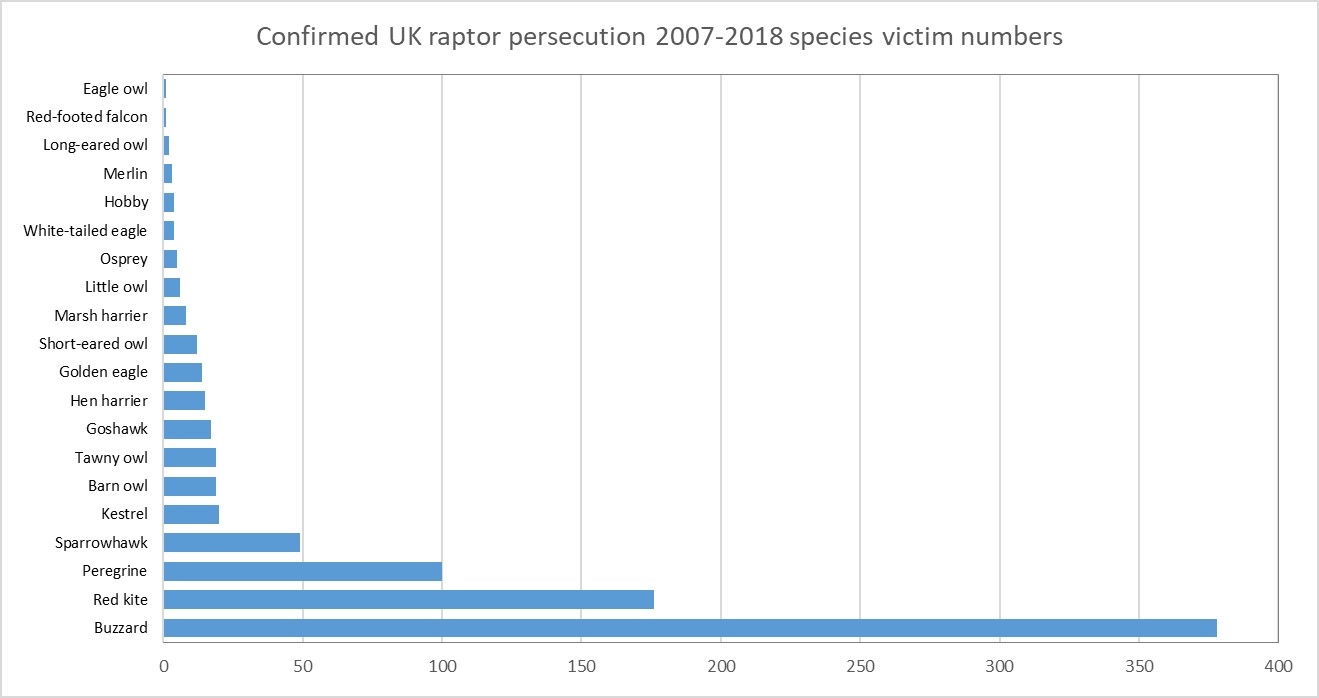
The question is, how any more golden eagles (or white-tailed eagles, buzzards, red kites, hen harriers, goshawks, peregrines, short-eared owls, tawny owls, kestrels, merlins, ospreys, marsh harriers, sparrowhawks etc) will suffer excruciating and savage deaths before the Government finally accepts that enough is enough?
For additional reading, I recommend this latest post from Nick Kempe on the ParkswatchScotland blog (Eagle persecution, land management and the Cairngorms National Park, here).





 Raptor Persecution UK