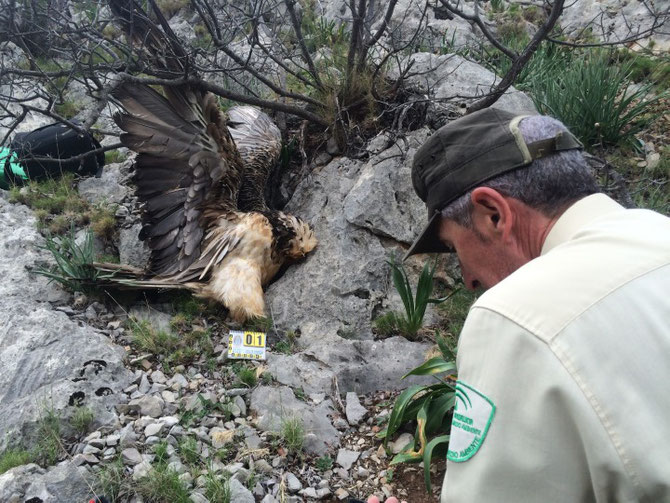
A farmer has been convicted of laying out poisoned baits in the Sierra Magina Natural Park in Andalucía in 2016 that killed two Bearded vultures from a reintroduction programme, as well as one Cinereous vulture, a golden eagle and numerous mammals.
He’s been fined 4,500 Euros and is banned from working as a cattle rancher for three years, although this sentence is apparently being appealed.
Further details about this case, including an extensive multi-agency investigation, can be read on the Vulture Conservation Foundation website here.
[One of the poisoned Bearded vultures, photo via Vulture Conservation Foundation]
Tackling the illegal poisoning of birds of prey is taken seriously in Spain with, for example, the deployment of specialist poison detection dogs and investigators given the authority to conduct unannounced spot checks in areas of suspicion. In recent years successful prosecutions have resulted in massive fines, custodial sentences and extended hunting disqualifications for those convicted of laying poisoned baits (e.g. see here, here, here, here and here).
Meanwhile, over here the illegal poisoning of birds of prey (and anything else unfortunate to consume the bait) continues without consequence. These are some of the cases reported this year alone, many during lockdown, and none of them are heading towards a prosecution:
The illegal killing of a white-tailed eagle found on a grouse moor inside the Cairngorms National Park in Scotland (here), the mass poisoning of 23 buzzards in a field in Co Cork, Ireland (here), the poisoning of four peregrines on Guernsey in the Channel Islands (here), the poisoning of a family’s pet dog, believed to have consumed a poisoned bait intended for birds of prey in Nidderdale, North Yorkshire (here), the poisoning of a buzzard found dead on a grouse moor in the North York Moors National Park (here), the poisoning of a buzzard in Nidderdale, North Yorkshire (here), the poisoning of a buzzard and a kestrel in Derbyshire (here), the poisoning of three peregrines and a buzzard in Staffordshire (here), the poisoning of a peregrine in South Yorkshire (here) and the poisoning of two peregrines in North Yorkshire (here).
There may well be further poisoning cases that haven’t yet been publicised.
There’s been a fair bit in the press in recent days on the alleged positive impact of grouse moor management on the Scottish rural economy, following the publication of a series of new reports.
Representatives and supporters of the grouse shooting industry will, of course, tend to focus on the assumed economic benefits and rarely, if ever, will they mention the economic costs of this damaging industry.
So this is a really important parliamentary question that’s been lodged by Scottish Green’s MSP Alison Johnson:
Question S50-04745. Alison Johnstone, Lothian, Scottish Green Party. Lodged 4/11/2020.
To ask the Scottish Government what assessment it has made of the impact on the rural economy of wildlife crime linked to grouse moor management.
Current status: Due in Chamber on 12/11/2020.
I’m not sure which Minister will be answering this question next Thursday but I look forward to the response.
Here’s a photo of a police officer examining the corpse of a white-tailed eagle, found illegally poisoned with a banned pesticide on a grouse moor inside the Cairngorms National Park earlier this year (see here). [Photo by Police Scotland]
He wasn’t the first victim and he certainly won’t be the last. Raptor persecution, whether that be poisoning, shooting or trapping, is still rampant on many Scottish (and English) grouse moors, despite it having been illegal since 1954.
It’ll be interesting to see how the Scottish Government intends to assess the economic cost of this ongoing criminality.
UPDATE 13 November 2020: Environment Minister acknowledges potential economic impact of wildlife crime linked to grouse shooting (here)
Wildlife cybercrime is in police’s sights, but wildlife crime underworld remains mostly beneath the radar
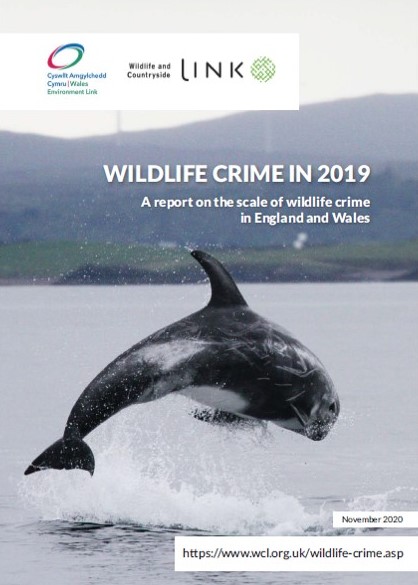
Our 2019 Annual Wildlife Crime Report gives a snapshot picture of the state of wildlife crimes across England and Wales
Wildlife and Countryside Link and Wales Environment Link’s latest report on wildlife crime across England and Wales reveals positive progress in identifying and tackling hi-tech online criminals who are harming our wildlife. Yet centuries old hunting, trapping, and poisoning practices, and smuggling of illegal wildlife goods, are still widespread, and exacting a heavy penalty for nature, warn conservation experts.
Activity on wildlife cybercrime (which can include illegal hunting and trapping coordination, gambling on live-stream cruelty such as badger and dog fights, and the online sale of rare protected species) has ramped up over the last year. Online initiatives from police and wildlife organisations have led to more tips from the public, arrests, and rescues of animals – such as dogs injured in badger-baiting. The creation of a new Cyber Enabled Wildlife Crime Priority Delivery Group, led by the police National Wildlife Crime Unit, has been hailed by conservationists as a major step forward in improving prevention, intelligence and enforcement.
Yet many wildlife crimes continue to be unwitnessed or unreported and go unpunished. A shocking array of wildlife including bats, birds, badgers, plants, hares, deer, fish, seals, dolphins, amphibians and reptiles, and more, are harmed at the hands of hunters, poachers, criminals, and even normally law-abiding members of the public every year. Overall levels of reported wildlife crimes have changed very little in the four years since our annual report was first published, with 3800 incidents reported in 2019 compared to 4288 in 2016.
Convictions remain shockingly low, with just 10 people convicted of wildlife crimes in 2019 (other than convictions relating to fisheries crimes).
Dr Richard Benwell CEO of Wildlife and Countryside Link said: “The wildlife crime underworld in Britain remains rampant. Our figures are just a snapshot of the number of animals being illegally hurt and killed every single day, sometimes for sport, sometimes for profit, sometimes in sheer callousness. Steps forward in tackling the growing online world of wildlife crime are very welcome. But overall a lack of adequate police recording and resourcing, low levels of prosecutions and inadequate sentencing are leaving our wildlife without the protection it needs“.
Martin Sims of the League Against Cruel Sports and Chair of Link’s Wildlife Crime Working Group, said: “It seems incredible in our digital age that our police forces can’t just call up the data they need to effectively tackle wildlife crime at the touch of a button. While the police are cracking down on wildlife cyber criminals more effectively now, their own electronic data on wildlife crimes is decades behind where it should be. We need to bring the fight against wildlife crime into the 21st century and ensure police have the resources they need to punish those who are harming our natural world“.
Paul De Ornellas, Chief Wildlife Adviser at WWF-UK said: “In recent years the UK has played a significant role in focusing global attention on the illegal wildlife trade. This report clearly shows that wildlife crime, including links to illicit wildlife trade internationally, is happening here at home, with a concerning increase in cybercrime and the use of major UK airports by traffickers. To continue to show global leadership, the government must do more to address IWT in its own backyard, as well as overseas”.
The biggest barrier to tackling wildlife crime remains the lack of recording, reporting, and resourcing allocated to these crimes by the police and Home Office. Wildlife cybercrime is believed to be extensive, but, as with many types of wildlife crime, it is not recorded in any meaningful way, due in large part to the absence of dedicated police wildlife crime reporting codes. So it is impossible to assess patterns and levels of wildlife crimes accurately and effectively target resources. There is a National Wildlife Crime Unit within the police, but this has been significantly underfunded for years and is currently going through an opaque restructuring process.
While fisheries crimes continue to receive low sentencing (and are a target for organised crime for this reason), the data, prosecution and conviction rates for fisheries crimes are notably better than for other types of wildlife crime. The main reason for this is that these crimes are tackled by a well-resourced section of the Environment Agency (in England) and Natural Resources Wales, funded by fishing licence fees. The fact that in 2019 2642 fisheries crimes were reported (more than double the number of all types of wildlife crime we report on combined) and 1992 people were convicted (compared to just 10 for other crimes) puts into stark relief the difference that adequate resourcing can make.
To help ensure that wildlife across England and Wales are adequately protected, conservation groups are calling on the Home Office and the Police to:
Ensure wildlife crimes are recorded and reported on effectively – with long-promised dedicated wildlife crime recording codes put into place urgently
Create a new Wildlife Crime Strategy with recording, reporting and resourcing at its heart, backed up by an action plan for the delivery of key targets
Provide transparency over changes to the police’s National Wildlife Crime Unit – including a consultation on funding, form and function to ensure this coordination body is better-resourced and fit for purpose
Keep up the momentum on wildlife cybercrime – by ensuring funding is in place to increase effectiveness through more dedicated officers to tackle the growth in online coordination and facilitation of wildlife crimes.
Deliver effective guidance and training on wildlife crimes for police officers through online knowledge and training hubs and tying local police in to regional wildlife enforcement hubs,
Strengthen the network of wildlife crime experts within the Crown Prosecution Service and ensure they are actively available to inform and support police officers
Wildlife and Countryside Link is the largest environment and wildlife coalition in England, bringing together 57 organisations to use their strong joint voice for the protection of nature. Wales Environment Link is a network of environmental, countryside and heritage non-governmental organisations with an all-Wales remit. Both operate as part of a UK-wide coalition – Environment Links UK. The calls in the Wildlife Crime Annual Report 2019 are supported by: Amphibian and Reptile Conservation, Badger Trust, Bat Conservation Trust, Born Free Foundation, Buglife, Humane Society International UK, Institute of Fisheries Management, League Against Cruel Sports, the National Trust, Naturewatch Foundation, Plantlife, RSPB, the RSPCA, Whale and Dolphin Conservation, Wild Justice, WWF-UK, Zoological Society of London (ZSL).
The Independent ran an exclusive on the report’s launch today – see here
A few days ago the League Against Cruel Sports published the results of a poll that indicated that almost three-quarters of Scots wanted an end to driven grouse shooting (see here).
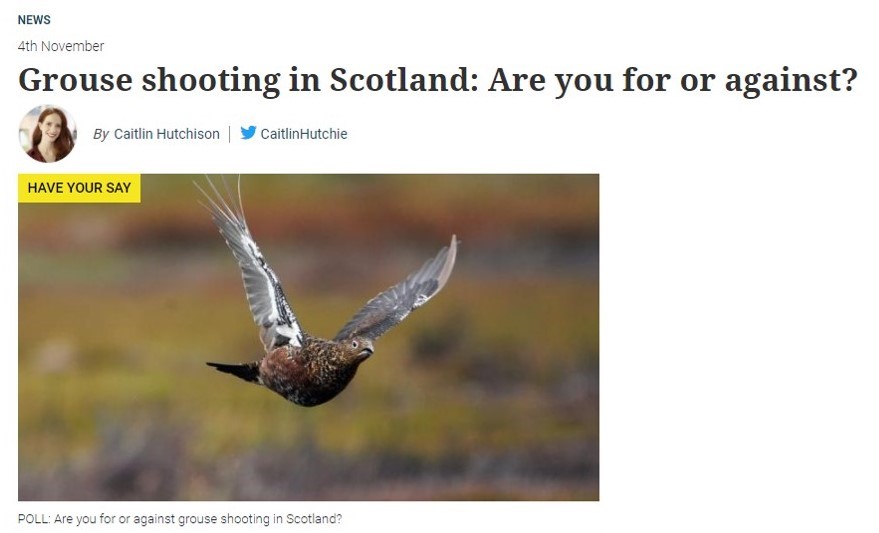
A second poll, this time being hosted by The Herald, was opened on 4th November after the publication of a series of new reports on the socioeconomic and biodiversity impacts of driven grouse shooting in Scotland.
The link to this poll is here. It ends today (not sure what time). Anybody can participate, and so far over 25,000 have taken part, so why not have your say?
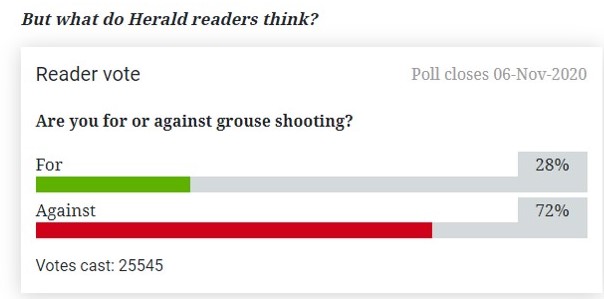
Earlier this morning, the poll results were looking like this:
Oh dear. It looks like the grouse shooting industry has quite a bit of work to do to convince an increasingly well-informed public that driven grouse shooting isn’t an environmental shitshow and shouldn’t be consigned to the history books without further delay.
The research group has written a short overview (here) explaining the background to the work and here’s what they say about each of the technical reports:
Part 1 – Socioeconomic impacts of moorland use
This research analysed 24 moorland use case studies. The case studies were selected systematically to include a range of different land uses, enterprise scales, management intensities and owner motivations. The results provide indicative estimates of the extent of socio-economic impacts arising from driven and walked up grouse shooting alongside those arising from alternative moorland uses – specifically: deer management, sheep grazing, afforestation and woodland creation, renewable energy and conservation management.
Part 2 – Employment Rights of Gamekeepers
This work helps deliver a Programme for Government commitment to undertake “work in relation to protecting gamekeepers’ employment and other rights”.
The results from our survey of gamekeepers provides unique insights into wage rates, tied housing and employment terms, as well as sentiments and experiences from being a gamekeeper in Scotland.
Part 3 – Mapping the areas and management intensity of moorland actively managed for grouse
This research built on work undertaken in Phase 1 and provides new insights into strip burning on moorland areas associated with grouse shooting.
Alongside updates of the extent of muirburn and its change over time, characterisation of grouse butt density (butts per km2) was also improved through more nuanced demarcation of the area of moorland associated with grouse shooting.
Part 4 – Biodiversity considerations on grouse moors
This work used the outputs from the mapping exercise (specifically strip burning intensity) and overlaid species data.
This allowed researchers to assess the effect of grouse moor management intensity on the distribution of selected upland species where the association between species distribution and grouse moor management is less well understood or unknown (Birch, Green hairstreak butterfly, Curlew, Merlin, Lesser redpoll, Bilberry / blaeberry, Adder, Golden plover, Kestrel, Whinchat).
Meanwhile, the RSPB issued a press release in response to the publication of these reports:
RSPB Scotland responds to socio-economic review of grouse shooting in Scotland
SRUC have today released a series of reports assessing socioeconomic and biodiversity impacts of driven grouse moors and the employment rights of gamekeepers.
Duncan Orr-Ewing, RSPB Scotland Head of Species and Land Management, said: “We welcome the production of these socio-economic reports. We do not take argument with the fact that grouse moor management may produce local economic benefits, however it is also equally important that these benefits are kept in proportion and not exaggerated. We do not think these economic benefits detract either from the need to take action over the increasing harms that intensive driven grouse shooting is causing to the environment and wider costs to society in the context of the climate and nature emergencies. The Werritty Review itself was primarily initiated to address the longstanding issue illegal killing of birds of prey, which is strongly linked to grouse shooting, and the need to address this issue has not gone away. We support the immediate introduction of licensing of driven grouse shooting to protect birds of prey alongside other public interests. Licensing would not result in a cessation of grouse shooting, and it can be delivered with minimum bureaucracy, therefore responsible land managers should have nothing to fear from his approach”.
ENDS
UPDATE 7th November 2020: Grouse moor report ‘ignores key issues’, say Scottish Greens (here)
UPDATE 12th November 2020: Government report shows driven grouse shooting is ‘economically unviable’ says Scottish think tank (here)
Alongside The National‘s exclusive a couple of days ago about how 25 SNP branches are putting forward a motion to conference calling for an end to driven grouse shooting (see here), the paper also published a comment piece from Max Wiszniewski, campaign manager at the Revive coalition for grouse moor reform.
It’s reproduced here:
IF grouse shooting had never existed, and the shooting industry wanted to start grouse moors in Scotland today, would the Government be in … or would it be out? Revive: the coalition for grouse moor reform has simulated this scenario in its new video Government’s Den in which two professional lobbyists ask Government ministers for 12-18% of Scotland’s land for the controversial bloodsport – Dragon’s Den style.
You can ask yourself the same question. If you were being asked to give over huge swathes of Scotland for grouse moor management, would you be in? Would you let hundreds of thousands of foxes, mountain hares, stoats, weasels, crows, and other animals be snared, trapped and killed every year so more grouse could be shot by a few people for sport? Would you let the land be scarred by unregulated bulldozed hill tracks to make life easier for shooters or burnt to make the environment more suitable for grouse – damaging our vital peatlands and biodiversity?
Would you say yes to mass outdoor medication of grouse so that their numbers become unnaturally high only to be shot by tons of poisonous lead ammunition which is spread across the countryside?
Twenty-five branches of the Scottish National Party and elected representatives have submitted a motion asking conference to say no to the circle of destruction that surrounds driven grouse moors and yes for a transition to better alternatives.
This motion shows the grassroots membership of the party leading the charge, to change the face of Scotland for the better. The enthusiasm for tackling Scotland’s grouse moors from within the party is immensely welcome but not such a huge surprise.
Revive meetings at previous conferences have been filled beyond capacity. Moreover, without the push by the SNP grassroots in 2015, working with the Our Land campaign, the 2016 Land Reform (Scotland) Act as it stands might never have happened.
The case for radically reforming grouse moors and land reform in Scotland is very interlinked. Grouse moors, it can be said, are a metaphor for land reform in Scotland – very few people using land very badly for very little benefit to society. In fact, for all the land grouse moors use up, they only contribute 0.02% to our overall economy.
To put this another way, if Scotland’s economy is the size of Ben Nevis, grouse shooting’s contribution would be the size of a bottle of Irn-Bru.
However, we also know that a few very powerful people with vested financial interests do not want things to change. These interests do not even think you should need a licence to manage a grouse moors, arguing against any kind of change or regulation that other industries would find reasonable.
Changes in the law may not alone be enough, however. Grouse moors are already commonly associated with the suspicious disappearances of countless birds of prey. These crimes are notoriously difficult to prosecute, so many believe a total ban on driven grouse shooting, or at least a transition to better land uses is the only way forward.
Wildlife tourism alone, a burgeoning sector, is already worth around five times the value of grouse shooting to the economy and forestry is about 30 times the economic value.
In order for Scotland to become “Green New Deal” compliant, which is the Scottish Government’s ambition, then it’s very clear driven grouse shooting and the circle of destruction and environmental damage that surrounds it is not sustainable going forward. If the Government is serious about fighting the climate crisis, it will do all it can to transform our moors despite the protestations of large, landed interests.
Revive fully supports the efforts of these branches and elected representatives to update their party policy on grouse moors which, if passed by the party’s conference, would put the SNP in line with the opinion of most Scots.
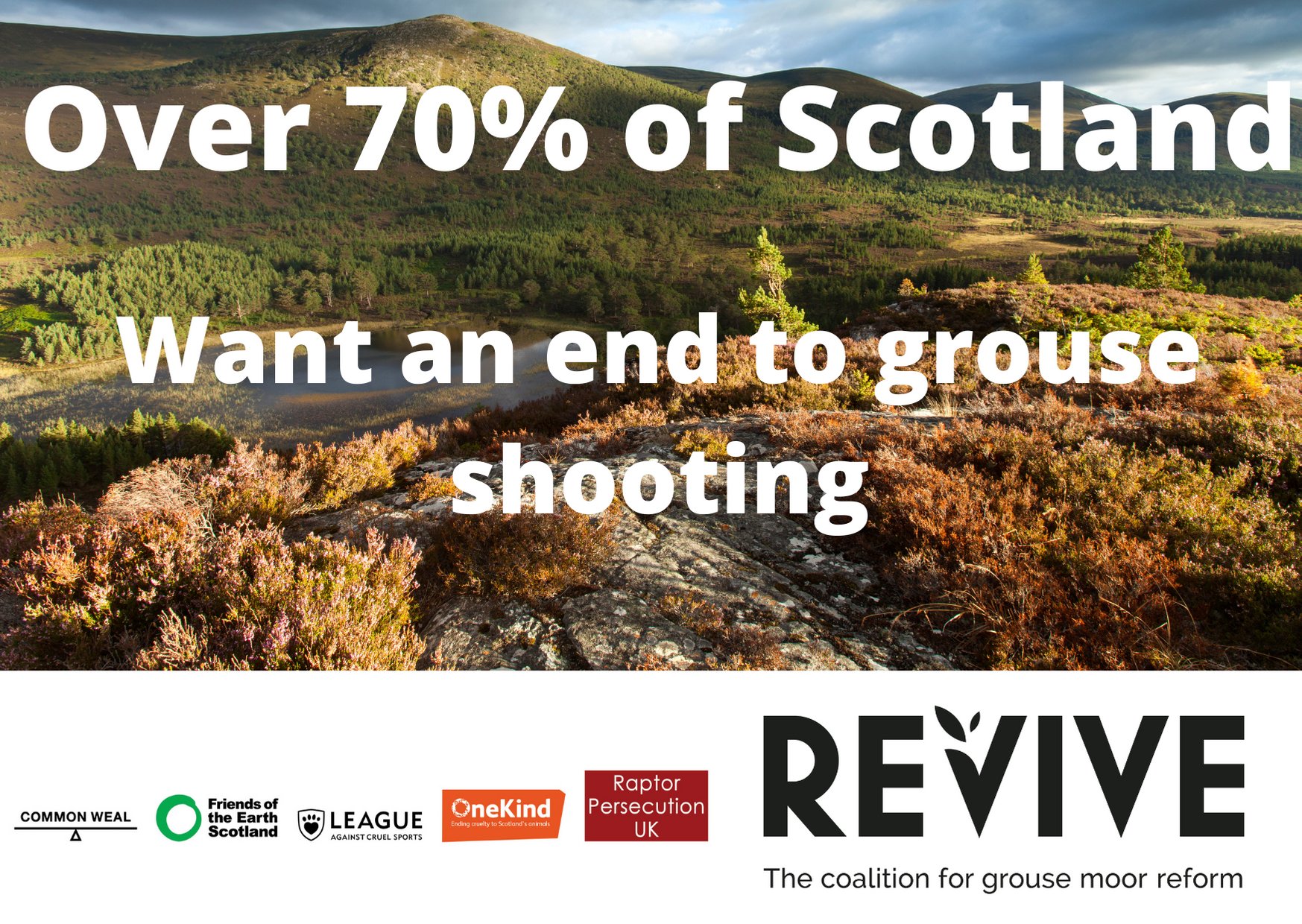
New polling shows more than 70% of Scottish people, rural and urban alike, are against grouse shooting for sport compared to just 12% who support it, so the SNP should certainly not be afraid to tackle it.
Driven grouse moors do exist in Scotland and they are one of the most destructive, cruel and least productive uses of our land. A modern progressive Scotland should declare itself out as soon as possible and along with land reform, make way for better land uses that benefit our people, our wildlife and the environment.
Max Wiszniewski is campaign manager for Revive, a coalition of like-minded organisations working for grouse moor reform in Scotland, made up of Common Weal, Friends of the Earth Scotland, the League Against Cruel Sports Scotland, OneKind and Raptor Persecution UK
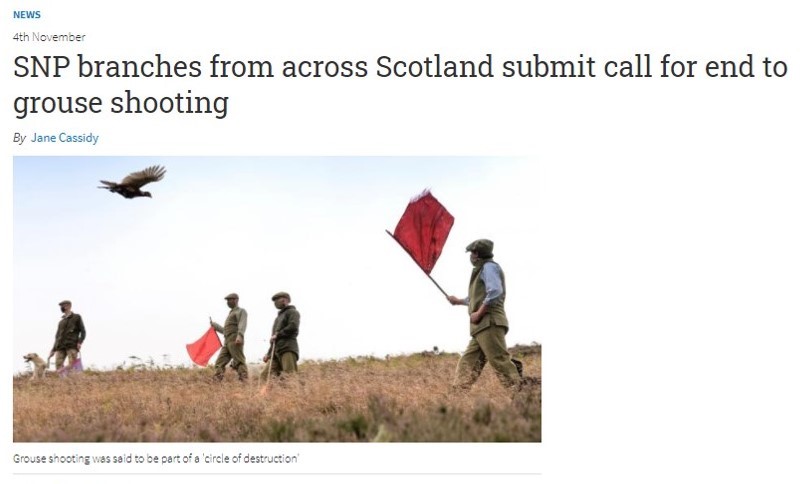
The National newspaper ran an exclusive yesterday (see here), written by Jane Cassidy, on a new motion calling for an end to driven grouse shooting in Scotland, submitted to the SNP conference for consideration by members and supported by 25 regional SNP branches. If successful it could be included in the SNP manifesto.
The article is reproduced here:
TWENTY-FIVE SNP branches from across Scotland have submitted a motion for national conference calling for an end to the circle of destruction of driven grouse shooting in Scotland.
The submitted motion calls for an end to all the unsustainable practices on grouse moors including the snaring, trapping and killing of hundreds of thousands of animals, muirburn and mass outdoor medication, all to increase grouse numbers for sport shooting.
The motion, proposed by councillor Julie Bell of Kirriemuir and Dean, an area dominated by grouse moor interests, also calls for an end to the “use of poisonous lead shot” and for all shooting estates to be “licensed as soon as possible”. In line with the Scottish Government’s ambitions for land reform and tackling the climate crisis, it calls for a transition away from driven grouse shooting and calls for these asks to be in the SNP manifesto next year.
The controversial sport has recently come under increasing pressure as polling of both rural and urban Scots this week revealed that 71% of Scots are opposed to it, compared to just 12% who support it.
Bell said: “There’s a real groundswell of concern, not only in my ward but across Angus and Scotland, about the impact this ‘sport’ has on our land. That’s reflected in my inbox and in local forums.
“I’m therefore urging our membership to support our motion as a step towards more ethical, sustainable land use.”
Ruth Maguire MSP, who is seconding the motion, said: “When it comes to grouse moors, the scale of land used for the benefit of so few and the accompanying damage done to the environment, wildlife and health is a matter of importance not just to the majority of rural Scots who support reform but to our whole nation. The SNP as the party of Scotland have the opportunity to be in the driving seat and take meaningful action to change the cycle of destruction.”
ENDS
UPDATE 6 November 2020: Why the SNP should back and end to grouse shooting on Scottish moors – comment piece from Revive’s campaign manager (here)
UPDATE 12 November 2020: SNP leadership faces grassroots rebellion at conference over watered down grouse shooting motion (here)
Last week we learned that Sainsbury’s was selling a new product – a mixed game casserole, made of 50% venison and 50% pheasant and red legged partridge.
It’s being produced by a company in North Yorkshire called Holme Farm Venison and acccording to the packaging, this product is ‘endorsed’ (ahem) by the British Game Alliance (BGA), whose ‘kitemark’ is stamped on the front (see here for earlier blog).
[Photo by Ruth Tingay]
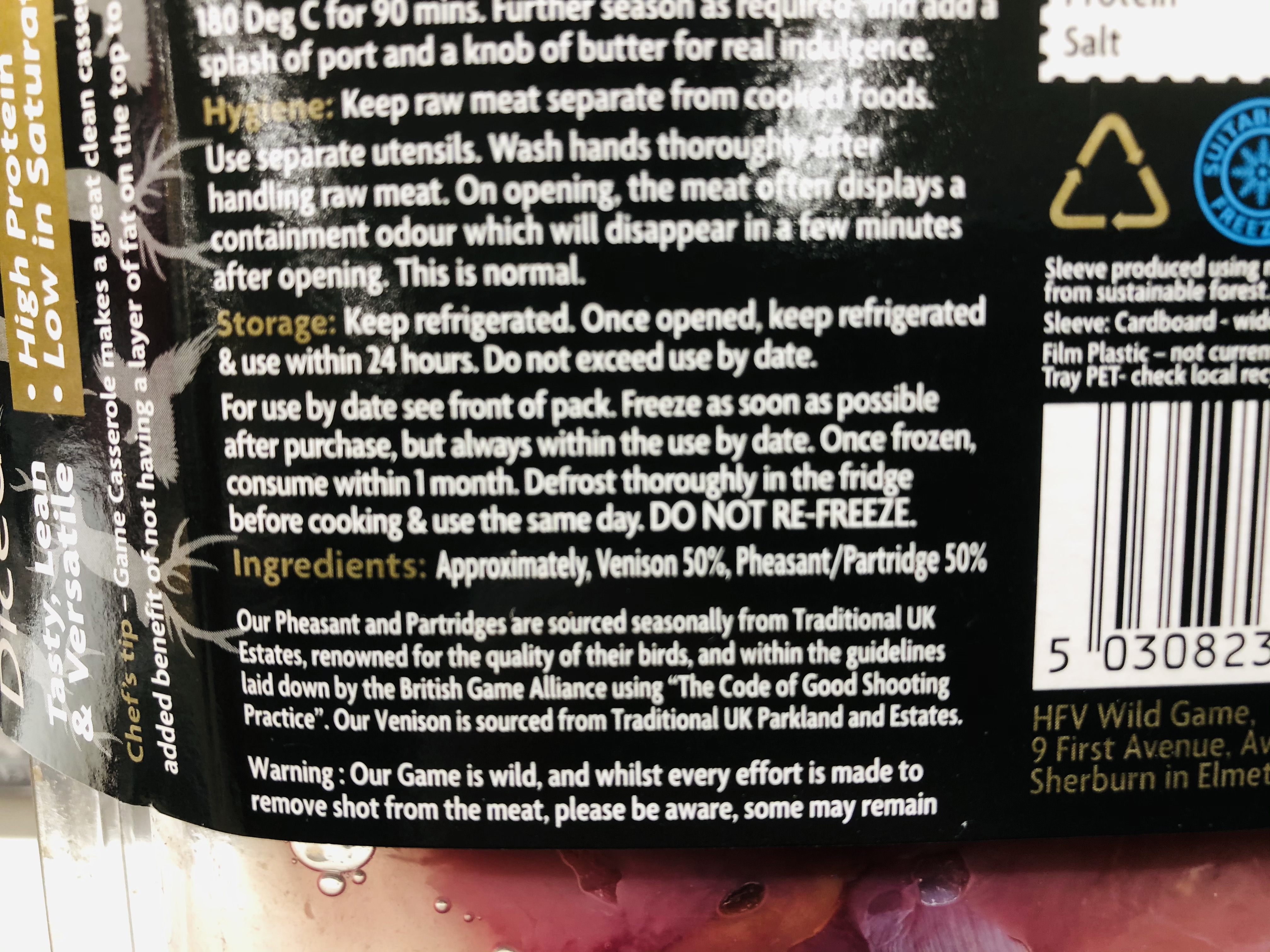
Amazingly, the packaging did not include any warning that the product may contain toxic lead ammunition and nor did any of the ‘on shelf’ information provided by Sainsbury’s.
Given the very serious public health risk of consuming any amount of toxic lead shot (the Food Standards Agency says there is no safe level and lead is a particular risk to children and pregnant women), this lack of information was of concern. Other supermarkets, such as Waitrose (here) have committed, by 2021, to not even be selling gamebirds that contain toxic lead shot, let alone not providing any health warnings (although see here), so Sainsbury’s seemed to be way behind the curve.
Blog readers were encouraged to contact Sainsbury’s, and the supplier, Holme Farm Venison, and ask for information about the toxic lead content of this product.
Many thanks to all of those who did. Sainsbury’s has now responded, and thanks to several blog readers who have sent us the standard reply, which goes like this:
Thank you for your recent e-mail received by Simon Roberts. He has has me to personally respond to you on his behalf.
The product you have enquired about is a branded product (not Sainsburys own brand) and we would encourage any further questions to be directed to Holme Farmed Venison, through their customer helpline.
The Branded Holme Farm Venison (HFV) game products are assured by the British Game Alliance (BGA). The British Game Alliance independently audits all shoots participating in the accreditation, ensuring that they are all compliant with the requirements.
Lead shot is being phased out, but is still in use, however HFV products only select from meat that has no shot in it. Initially, visually inspected and then metal detected at the game processor and again visually inspected in the final pack. There are additional warnings on pack that refers to shot to ensure customers are aware.
Kind Regards,
Wow. It’s hard to know where to start with that.
There seem to be two issues. First of all, Sainsbury’s is using the so-called ‘assurance’ of a British Game Alliance kitemark as an indication of the product being sourced from estates that ‘meet rigorous and ethical standards’. But as has been pointed out several times on this blog, the British Game Alliance (BGA) is secretive about its members, and some of those we do know about either have been, or still are, under active police investigation for alleged wildlife crime offences relating to the illegal persecution of birds of prey (e.g. see here, here and here). How is the Sainsbury’s customer supposed to know which BGA-assured members are supplying these half a million pheasants and red-legged partridge for the casseroles and whether those estates are indeed meeting ‘rigorous and ethical standards’ if the estates aren’t named?
The second issue is much more serious, and that is the lack of a public health warning on this product. Sainsbury’s must be the only supermarket in the world, ever, to be claiming that its supplier, Holme Farm Venison, ‘only select from meat that has no shot in it‘.
Really? Really, Sainsbury’s? Do you really believe that?
And if that is the case, then why is the supplier adding a warning on the package that says, ‘Whilst every effort is made to remove shot from the meat, please be aware, some may remain‘ ? It’s a clear warning, even though it fails to mention the toxicity of the shot:
If some shot may remain, as the supplier warns, then potentially this product may contain toxic lead shot (i.e. poison). In fact despite all the undoubtedly well-intentioned efforts the supplier may go to to remove lead shot pellets (poison), it’s well known that even when pellets are removed, high lead levels (poison) can remain from the tiny, tiny fragments that shear off when the ammunition tears through the flesh of the victim.
It’d be very embarrassing for Sainsbury’s if somebody decided to test a load of these game casseroles for lead ammunition (poison) and found them to contain, er, poison. This has been done before, a couple of years ago, when Mark Avery bought 40 frozen red grouse from Iceland supermarkets and had them tested for toxic lead ammunition (poison). Here’s what he found:
‘More than three quarters of the lead levels measured in Iceland Foods’ grouse meat would have been illegal if found in beef, pork, chicken etc where there is a level set (Maximum Reside Level) above which meat is illegal. Over a third of the grouse meat samples contained ten times the MRL for lead. Two samples contained very very high lead levels: one of 168 times the MRL and the other of 3699 times the MRL. Overall, the lead levels in these 40 samples of grouse meat were 100 times the MRL‘ (see here).
There may also be an issue here for Trading Standards and for the Food Standards Agency. Surely, surely Sainsbury’s has a duty of care to its customers and must warn them that they could be buying a product that could be a serious risk to their health (i.e. that contains poison)?
If there are any Trading Standards Officers reading this, or any experts from the FSA, please get in touch.
If you are a customer of Sainsbury’s and you’d like to know more about how this mixed game casserole meets the company’s responsible and sustainable sourcing codes for meat products, and ask why it has an apparently complacent attitude towards its customers’ health, please contact Sainsbury’s CEO Simon Roberts at simon.roberts@sainsburys.co.uk
Press release from the League Against Cruel Sports (Scotland), a member of the Revive Coalition for grouse moor reform (2 November 2020)
New figures show overwhelming support for an end to grouse shooting in Scotland
Seven in ten of those polled are opposed to grouse shooting for sport
New figures published by the League Against Cruel Sports Scotland show seven in ten people (71%) are opposed to grouse shooting in Scotland with only 12% in favour of the blood sport, views which are shared by those in both urban and rural locations. The figures are released as the Scottish Government prepares to publish its response to the Werritty Review, expected later this month.
A review of grouse moor management practices was ordered by the Scottish Government in 2017 with a view to introducing a licensing scheme for game-shooting estates. The Grouse Moor Management Group was tasked to look at the environmental impact of grouse moor management practices such as muirburn, the use of medicated grit and mountain hare culls, and advise on the option of licensing grouse shooting businesses. The Scottish Government-commissioned group published its report led by Professor Alan Werritty, in November 2019.
Robbie Marsland, Director of the League Against Cruel Sports Scotland said:
“Almost a year ago Professor Werritty said wider societal views needed to be taken into account and political decisions made, well here are those views. Seven in ten people do not support grouse shooting in Scotland with only a pitifully low number in favour.
“We are urging the Scottish Government to take these views into account when it responds to Werritty later this month. There is a circle of destruction that surrounds grouse moors. These moors account for enormous swathes of Scotland which deplete biodiversity, add to climate change pressures, employ rigorous predator control which causes untold suffering to tens of thousands of animals each year and make a woeful economic contribution.
“The time has come to move on from this archaic use of land and look at reviving grouse moors in a way which doesn’t revolve around a minority bloodsport opposed by the vast majority of Scottish people.”
The polling was commissioned by the League Against Cruel Sports Scotland as part of its work with Revive, the coalition for grouse moor reform.
ENDS
Notes
This survey was commissioned by the League Against Cruel Sports and was designed by Diffley Partnership,
Data were collected online among a sample of the ScotPulse online panel throughout Scotland, representative of the Scottish population,
Survey invitations were sent on 7th October, with results analysed on 12th October
A total of 1364 complete responses were received
Results are weighted to the Scottish population by gender and age.
In an uncertain world there’s one thing you can always rely on – Songbird Survival seeking licences to kill birds of prey.
Here’s the most recent call to arms, which looks virtually identical to every other call to arms going back to the Victorians, as published in last week’s Scottish Farmer:
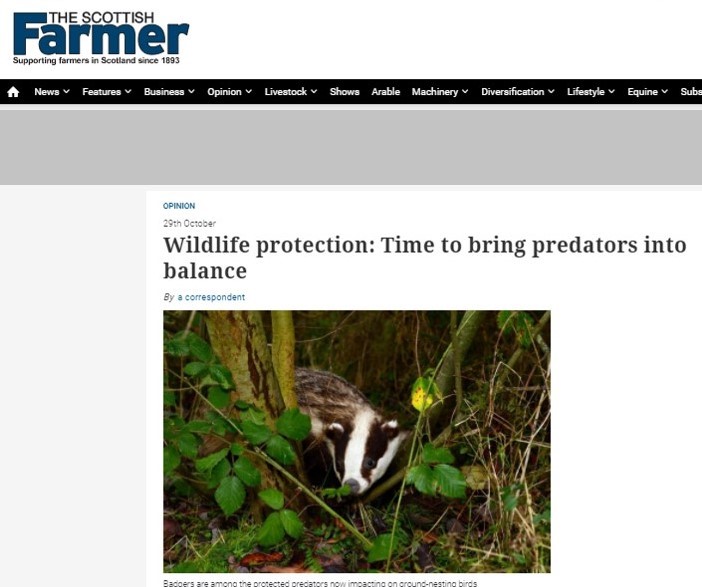
Sir, – Having pointed out an inaccuracy by the BBC Landward programme (are we surprised?) over pollination of cereal crops, Patrick Sleigh (The Scottish Farmer, October 24) once again painted a very realistic, albeit depressing, picture of the destruction of bumble bee and wasp nests by badgers, following another relevant letter (June 27 issue) about conservation.
He is absolutely right to highlight the unchecked predation by badgers, not just of bee and wasp nests but also and equally tragically of ground nesting birds and hedgehogs.
Despite enormous efforts by organisations like ‘Working for Waders’, ground nesting birds, like curlews, lapwings and oyster catchers, stand little if any chance of survival, let alone rearing any young when badgers are present.
To have seen badger numbers in the UK increase from 50,000 in 1980 to well over 500,000 now – and likely to increase even more due to their grossly overprotected status ( they are uniquely protected by two Acts of Parliament in 1973 and 1992) – is immensely disheartening and frustrating for all those who try to achieve a balanced wildlife situation.
It is not just badgers which can roam unchecked and wreak havoc on the country’s wildlife, but other species like sparrowhawks enjoying the same protected status continue to devastate fragile songbird populations, accounting for up to 30m songbirds per year, a figure which is totally unsustainable.
Our wildlife balance is now overly influenced by the visible attraction and drama of predators such as badgers, birds of prey and our pets (especially cats ). Meanwhile, political votes take priority over biodiversity loss which is all too easily blamed on farmers and global warming.
If we humans need to manage predator species, at least we can strive to be humane, unlike the grisly fate which so often awaits prey species.
So, if governments and conservation organisations are really serious about wildlife and want a varied and resilient population in this country, one way to make an immediate impact would be to lift the protected status on those over-protected mammals and birds of prey.
Nobody is advocating wholesale slaughter of these species, but if we are to have a healthy and balanced wildlife, then action needs to be taken before some of the more vulnerable species become extinct.
The pressure for action has been growing through the columns of The Scottish Farmer, with Patrick Sleigh, Malcolm Hay and Mark Tennant (chairman of Scottish Land and Estates), all expressing concern that governments need to adopt a more enlightened attitude to predation and actually do something rather than just talk about it.
Colin Strang Steel
Trustee SongBird Survival,
Threepwood,
Galashiels.
ENDS
Interestingly, it’s been brought to my attention that until very recently, another trustee of this ridiculous outfit was one Simon Lester. Would that be the same Simon Lester who was the former head gamekeeper at Langholm who has argued, without scientific evidence, for the need for legal raptor culling on driven grouse moors (here,here and here), and who is currently employed by Natural England on the proposed reintroduction of hen harriers to southern England?
How fascinating.
Perhaps Simon will be tempted by the recent recruitment drive to become Songbird Survival’s new CEO (see here).




 Raptor Persecution UK