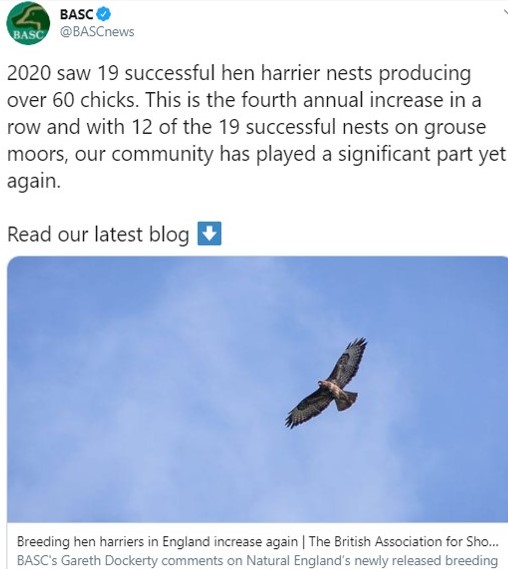
Natural England has announced that a total of 19 hen harrier nests were successful in England this year.
Strangely, Natural England didn’t mention the number of hen harriers that have disappeared in suspicious circumstances this year, or those that members of the public witnessed being shot (see here).
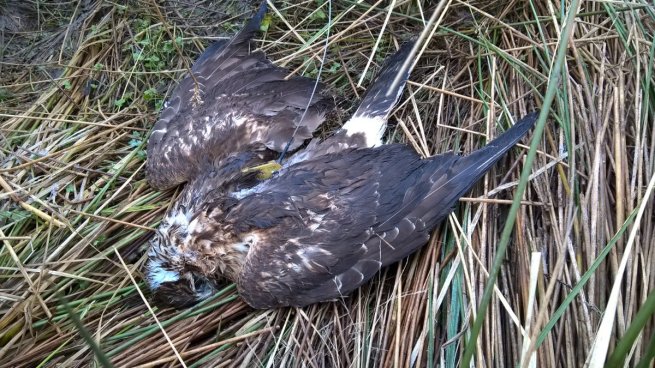
[A dead hen harrier that was caught in an illegally-set trap on a Scottish grouse moor – see here. Nobody was prosecuted for this barbaric crime. Photo by Ruth Tingay]

With a straight face, Natural England’s Chairman Tony Juniper has declared this year’s hen harrier breeding season a ‘wonderful result’ (since when has a 5% success rate been ‘wonderful’?) and, along with his good old pals from the grouse shooting industry (the very industry responsible for this species’ appalling conservation status), has issued a joint press release as follows:
A record-breaking year for hen harrier breeding
Natural England has recorded the best year for hen harrier breeding in England since Natural England’s Hen Harrier Recovery Project was established in 2002, with 60 chicks fledged from 19 nests across Northumberland, Yorkshire Dales, Cumbria and Lancashire in early summer 2020.
The success has been down to a number of factors including high numbers of voles which are a key food source, good weather, and strong partnership working between Natural England, RSPB, Forestry Commission, the Moorland Association, United Utilities, the National Trust, and others.
Hen harriers were once found across upland and lowland Britain including throughout many English counties, however after 1830 it became an exceptionally rare breeding bird in England due to raptor persecution, which was then made illegal in 1954. The hen harrier is now one of England’s rarest birds of prey.
Hen harriers are one of our most distinctive birds, with a characteristic owl-like face and stiff facial feathers that direct sound toward their ears to enable them to hunt more effectively.
Tony Juniper, Chairman of Natural England, said:
“2020 has seen the best breeding season for England’s hen harriers in years and I thank all those who’ve helped achieve this wonderful result, including landowners and managers, campaigners, conservation groups, police officers and our own Natural England staff and volunteers.
“Despite the great progress there is though no cause for complacency. Too many birds still go missing in unexplained circumstances and I urge anyone who is still engaged in the persecution of these magnificent creatures to cease at once.
“Hen harriers remain critically endangered in England and there is a long way to go before the population returns to what it should be.”
This year’s success means that 141 hen harrier chicks have fledged over the past three years alone. Natural England’s Hen Harrier Recovery Project was established in 2002 to monitor hen harriers and work towards improving their numbers in England.
Although persecution is thought to be the main factor limiting hen harrier numbers in England, other factors including the suitability of local habitats and food availability are also significant in some areas.
Natural England is involved in a number of initiatives to help ensure hen harriers recover including through Defra’s hen harrier joint action plan.
- satellite tracking to improve understanding of the bird’s movements and behaviour;
- supporting wildlife friendly habitat management in the uplands; and,
- working with a range of partners to protect the current population and extend its range across England.
Dr Adam Smith of the Game & Wildlife Conservation Trust (GWCT), said:
“This is a very promising result for a pragmatic conservation project. Management options for bird of prey conservation rather than just legal enforcement is very forward thinking approach. The GWCT has studied the very real tension between harrier conservation and grouse shooting for over 30 years. Until this managed approach was adopted – at no small risk to the reputations of all involved – there was a damaging deadlock.
“If this trend can be maintained and hen harrier conservation status further improved, whilst supporting the red grouse management that best delivers our unique heather uplands, it will be a real breakthrough for practical, working conservation.”
Amanda Anderson, Director of the Moorland Association, added:
“Yet again, it has been a fantastic year for hen harriers and we have now seen significant increases in successful nests and chick numbers for three years running as part of the hen harrier Recovery Plan which includes the innovative Brood Management Scheme trial.
“Twelve of the nests reported today are on land managed for grouse shooting and this reflects a genuine commitment from moor owners and managers to work with others and help rebuild the harrier population.”
Hen harriers lay 4-6 eggs during late April–May, with incubation lasting 30 days. Hen harrier chicks then fledge in 28-32 days. Both females and males attend the young, with the males providing food which is often passed mid-air to the female in a distinctive display of ‘throw and catch’.
A high proportion of this year’s chicks have been fitted with satellite tags, which will allow Natural England to monitor the progress of the birds as they move away from their nest areas.
ENDS
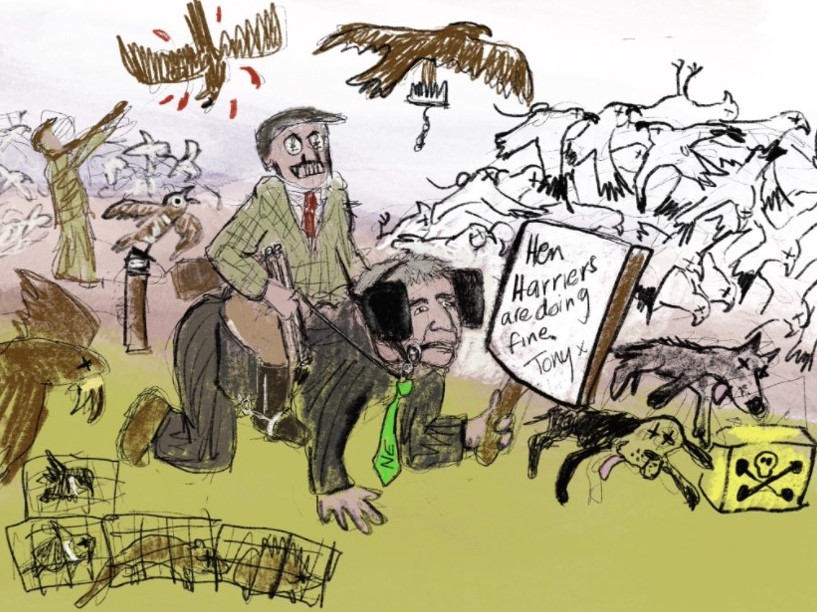
What this press statement amounts to is nothing more than a cynical ploy to disguise the tragic reality of this species’ downfall at the hands of the driven grouse shooting industry.
It’s hard to know where to start with this latest piece of deliberately crafted propaganda. Isn’t it interesting though, that the only other organisations quoted are the GWCT and the Moorland Association? Where’s the RSPB quote? The Police? Forestry Commission, United Utilities, National Trust, and the ‘others’ that were mentioned as ‘partners’ by Tony Juniper (presumably he means the Northern England Raptor Forum)? Weren’t they asked? Or were they invited to comment but refused to have any part in this conservation sham?
And then there’s the actual results – 19 successful nests in the whole of England is nothing like a ‘wonderful result’. It’s bloody pitiful – just 5% of the potential English breeding population estimate of 330 pairs. The fact it’s been the ‘best breeding season since 2002’ says an awful lot about how long and how severely this species has been a victim of illegal persecution, doesn’t it?
And then there’s Tony Juniper telling us, ‘Persecution is thought to be the main factor limiting hen harrier numbers in England…’ No, Tony, it’s not thought to be the main factor, it’s known to be the main factor and has been known for many, many years. Natural England’s own data have been used to evidence this time and time and time again! [see update 14 Sept below]
It’s hardly worth dissecting the quotes from GWCT and the Moorland Association. It could be argued that these organisations have about as much credibility on hen harrier conservation as the Kremlin has on the destruction of its stockpiles of Novichok.
It is worth noting though that back in 2002, the very same year that Natural England first implemented its so-called ‘Hen Harrier Recovery Project’, that the then Chairman of the GWCT’s Scottish Committee and later Vice Chair of the national GWCT was proposing an opt-out from the European Birds Directive to enable grouse moor owners to cull hen harriers that threatened red grouse stocks for shooting (see here). Perhaps today’s quote from the GWCT, talking about ‘management options’ for birds of prey, is a more carefully-worded version of the same principle?

It’s also worth noting that in this latest press statement, both the Moorland Association and GWCT appear to be keen that the grouse shooting industry deserves recognition for this ‘record-breaking season’. Yes, the industry does deserve recognition, but only for keeping the English hen harrier population at such a critically low level for so many years.
It’s funny, isn’t it, that the industry wants credit when hen harriers are allowed to breed on a grouse moor but it refuses to accept any responsibility for the hundreds of vacant breeding territories right across the English (and Scottish) uplands, nor responsibility for the suspicious disappearance of at least 72% of satellite-tagged hen harriers that are, according to Natural England’s own data, presumed to have been illegally killed on grouse moors.
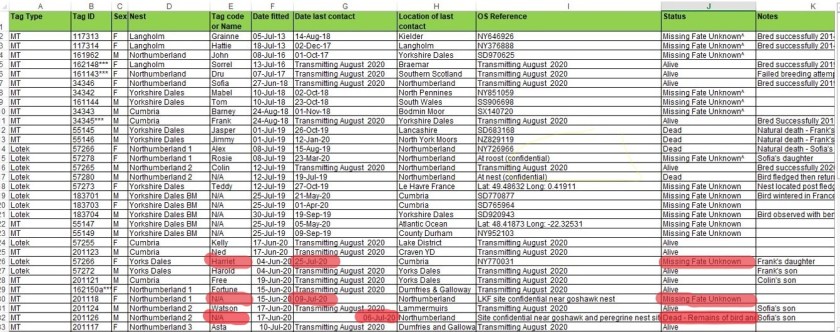
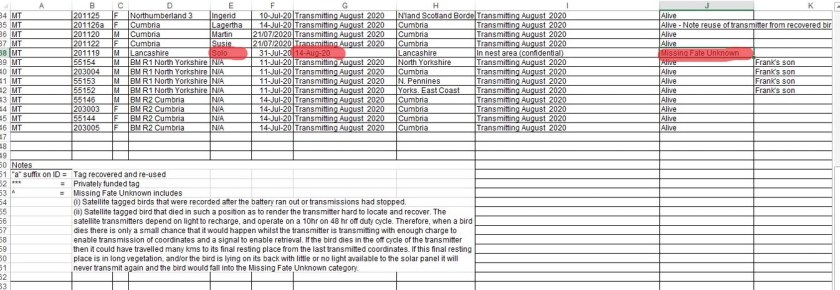
Talking about disappearing and illegally killed hen harriers is something the Natural England press statement doesn’t do. Why not? Well, because if it admitted that at least 43 hen harriers have disappeared in suspicious circumstances (or been found illegally killed) on or close to driven grouse moors in the last two years alone (see here), then it would be blindingly obvious to anyone with an ounce of common sense that the 19 successful hen harrier nests recorded in 2020 are totally irrelevant to the conservation recovery of this species if those recently-fledged young birds are subsequently shot, poisoned or trapped on grouse moors. Which, long experience has shown, is what will happen to many of them, probably before Xmas.
UPDATE 10.30hrs: ‘Illegal persecution remains most serious threat to hen harriers’ – RSPB statement on 2020 breeding season (here)
UPDATE 19.00hrs: Four of this year’s satellite-tagged hen harriers already dead or ‘missing’ (here)
UPDATE 12 September 2020: Northern England Raptor Forum statement on 2020 hen harrier breeding season (here)
UPDATE 14 September 2020: It’s been pointed out to us that we’ve wrongly attributed the quote, “Persecution is thought to be the main factor limiting hen harrier numbers in England…” to Tony Juniper. Our mistake. It is, though, still a quote attributable to Natural England, of which Tony Juniper is Chair.







 Raptor Persecution UK