Just before Christmas Scottish Environment Minister Mairi Gougeon told the Environment Committee that the Scottish Government was ‘actively considering’ additional enforcement measures on wildlife crime.
As part of this discussion, she told Committee member Mark Ruskell MSP (Scottish Greens) that the Government was considering whether current measures, such as General Licence restrictions which are imposed following evidence of wildlife crime, are ‘as effective as they can be’.
The issue of General Licence restrictions had been discussed at an earlier committee hearing where we and RSPB Scotland had argued the sanction was impotent because an estate could simply apply for an individual licence to continue killing the wildlife it would have killed under the General Licence, just with a bit more paperwork to do. However, BASC had disagreed with us and defended the General Licence restriction as an effective sanction as follows:
Ross Ewing (BASC): I disagree with Ruth Tingay and Ian Thomson on the effectiveness of the restriction of general licences. It is important not to underestimate the pivotal role that general licences play on shooting estates in Scotland, where they are an integral part of what the estates do. Restricting a general licence will make it very difficult for estates to carry out an integral function.
Ruth Tingay mentioned applications for individual licences—there is a litany of species for which individual licences would need to be applied for. Moreover, an estate’s having a restriction against it reflects very badly on it, and information about that is publicly available online. I know a number of people who would probably not visit an estate that had a restriction purely on the basis that they would know that wildlife crime was probably being committed there.
The other thing to note about the restriction of general licences is that it takes place under the civil burden of proof— there is no need to surpass the criminal burden of proof, as there would be otherwise. That is a really useful tool. Currently, the police and SNH meet every three months. Perhaps if they met more regularly to review the situation, that might result in a few more restrictions being put in place. As a result, restrictions might act as more of a deterrent.
ENDS
Let’s look at each of those claims in turn.
First, restricting a General Licence does NOT make it ‘very difficult for estates to carry out an integral function‘ (and that statement of ‘integral function’ deserves to be pulled apart, but this isn’t the time). As we’ve pointed out time and time again, when a General Licence restriction has been imposed based on ‘clear evidence’ of wildlife crime, the estate can simply apply to SNH for an individual licence to carry on as before but has to do a bit more paperwork by applying for the licence and then submitting a return at the end of the year, e.g. see here. That’s hardly ‘very difficult‘, is it?
BASC says, ‘There is a litany of species for which individual licences would need to be applied for‘ – this is misleading. As we’ve seen, when a General Licence restriction has been imposed an estate needn’t apply for an individual licence to continue killing each separate species – SNH will simply issue one individual licence (e.g. see here) that permits the gamekeeper and his/her named associates to kill multiple species. Again, this process is hardly ‘very difficult‘.
The BASC rep argued, ‘I know a number of people who would probably not visit an estate that had a restriction purely on the basis that they would know that wildlife crime was probably being committed there’. He may well know a number of people with principles but there is sufficient evidence to demonstrate that a General Licence restriction does not deter others from visiting.
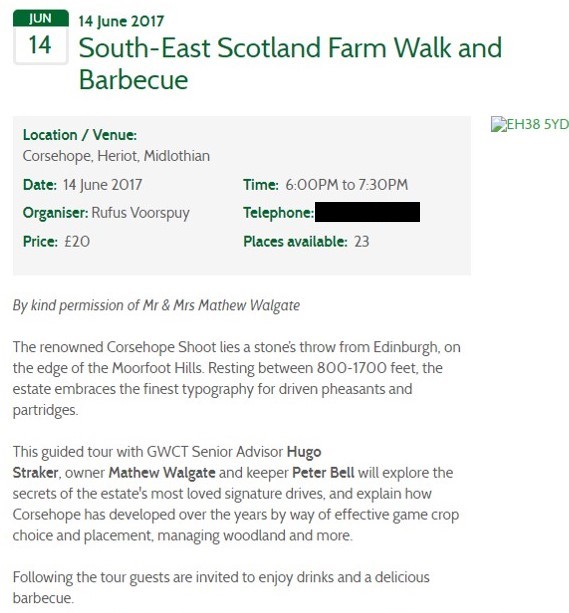
For example, here is evidence of GWCT hosting a guided tour and BBQ on ‘the renowned Corsehope Shoot‘ in June 2017, at the same time that this estate was serving a three year General Licence restriction, along with neighbouring Raeshaw Estate, following evidence of wildlife crime:
Here’s another example showing how a General Licence restriction is no deterrent to many visitors. This is a social media post on 30 January 2019 by the Edradynate Estate talking about “a belter season“, at the same time this estate was serving a three-year General Licence restriction following evidence of wildlife crime:

And it’s clear that a General Licence restriction is no deterrent for endorsement from the British Game Alliance, the game shooting industry’s own ‘assurance’ scheme, membership of which is supposed to indicate ‘rigorous and ethical standards’ although we’ve questioned this before (see here and here).

Yep, these General Licence restrictions are really hurting these estates.
BASC’s final argument about General Licence restrictions was a suggestion that if the Police and SNH met more frequently than every three months this ‘might result in a few more restrictions being put in place’. This is simply nonsense. It’s not the frequency of evidence-sharing meetings that has resulted in so few General Licence restrictions being imposed – quarterly meetings have been happening for the six years since the restriction sanction was made available to SNH.
However, the actual reasons behind decisions not to impose a General Licence restriction despite clear evidence of wildlife crime, including actual convictions, are still being kept secret by SNH because, they argue, it isn’t in the public interest to discuss them.
In these post-Werritty months we know the Scottish Government is going to have to make some big decisions about game bird management and its deep association with ongoing wildlife crime. The shooting industry will be doing its level best to maintain the status quo and limit any additional sanctions, which is what BASC is trying to do with this weak defence of General Licence restrictions.
We’ll continue to put evidence in front of Ministers and MSPs to ensure the status quo is not allowed to continue.








 Raptor Persecution UK