3rd brood meddled hen harrier ‘disappears’ in suspicious circumstances

Following the news that two of this year’s five brood meddled hen harriers had ‘vanished’ on grouse moors in the north of England in September 2019 (one in County Durham here and one in the Yorkshire Dales National Park here), we now learn that a third harrier has disappeared, also in the Yorkshire Dales National Park.

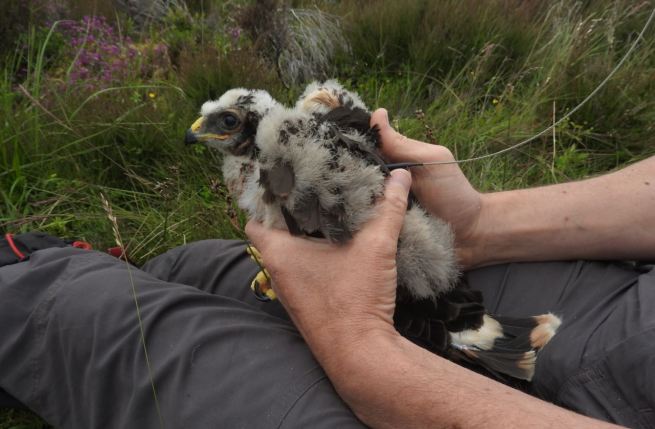
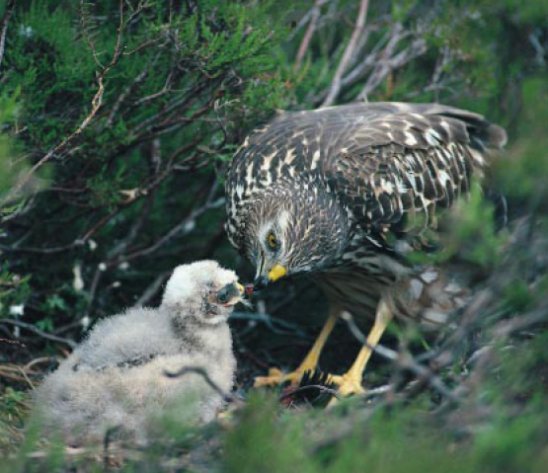
[Hen harrier photo by Laurie Campbell]
Here’s the press release from North Yorkshire Police, published today:

Second satellite-tagged hen harrier goes missing in North Yorkshire

Police appealing for information about whereabouts of hen harrier

North Yorkshire Police is appealing for information after another satellite-tagged hen harrier has gone missing in the region just weeks after another one also stopped transmitting a signal.

The hen harrier is a young female bird tagged at the release site in the Yorkshire Dales on 30 July 2019 as part of the hen harrier brood management scheme. The bird has not been named and is known to the Natural England monitoring team as 183703.

It is known from satellite tag data that the bird had the bird stayed in the Hawes area since her release, with one excursion to the Sedbergh area on 16 September, then south to the West Pennine Moors near Horwich 17-19 September before returning to land near Semerwater where she had remained for at least a fortnight.

The last transmission from the bird’s satellite tag was received on the 29 September on Thornton Rust moor, 3.37km east of Semerwater, but the bird could have flown on for some distance since the last transmission.

Since then no further transmissions have been received from the tag. Natural England field staff have carried out checks with a hand-held scanner and monitored the area with no findings and North Yorkshire Police have also searched the area with colleagues from the Yorkshire Dales National Park Ranger team, as well as making extensive local enquiries.

The bird is a juvenile female, brown in colour and ringed with the BTO ring number FJ48404.

This appeal for information sadly follows the disappearance of another satellite-tagged hen harrier in the area, this one a juvenile male known as 183704 who was last known to be in the area of Askrigg Common on 19 September.

At this time North Yorkshire Police are keen to locate both birds safe and well, but if found deceased the birds can be subject to post mortem to establish if the cause of death was from natural causes or if criminal activity was involved.

If you find the bird or have any information please contact North Yorkshire Police on 101 and quote reference number 12190186540.

ENDS

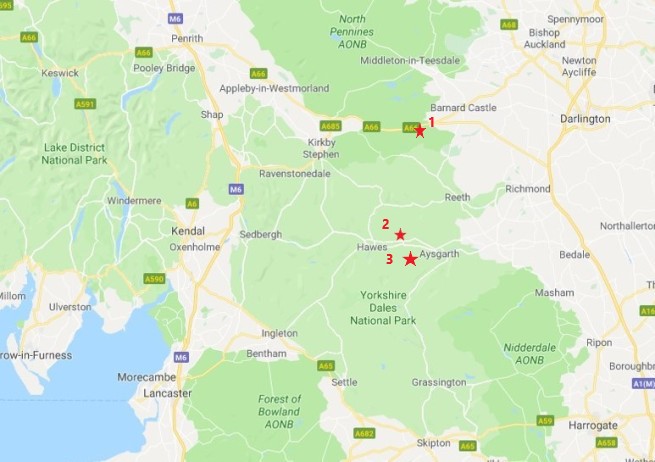
Here is an RPUK map showing the approximate last known locations of the three brood meddled satellite-tagged hen harriers that have ‘disappeared’ this year: 1 = the HH that vanished on 9th September; 2 = the HH that vanished on 19th September; 3 = the HH that vanished on 29th September:
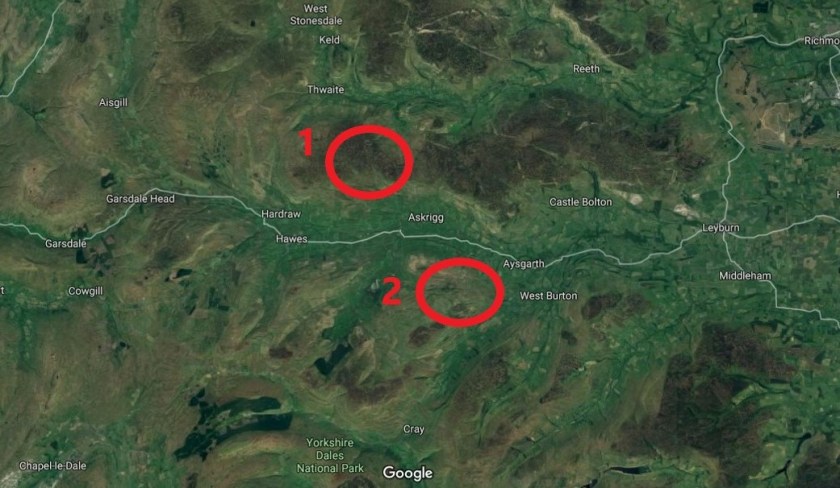
Here is an RPUK map showing the approximate last known locations of the two brood meddled hen harriers that have disappeared on moors in the Yorkshire Dales National Park:
So within weeks of those five brood meddled hen harriers being released back in to the uplands of northern England, three of them (60%) have disappeared without a trace.

This isn’t unusual nor is it unexpected – we know from authoritative research published earlier this year that 72% of young satellite-tagged hen harriers will disappear in suspicious circumstances on grouse moors in northern England, probably having been killed illegally.

What this is, though, is a bloody joke. This brood meddling ‘trial’, sanctioned by DEFRA and carried out by Natural England, in cahoots with the very industry responsible for the species’ catastrophic decline in England, is supposed to test whether those people responsible for killing hen harriers illegally would stop if the chicks were brood meddled (removed from the grouse moor in June at the critical grouse-rearing stage and then returned to the wild in August). We all knew this wouldn’t work because we know that young hen harriers are killed routinely during the grouse shooting season, and especially in September and October and yet still DEFRA, Natural England and their grouse shooting mates pressed ahead.

No doubt we’ll now have to endure more bollocks from Natural England, DEFRA, the Moorland Association and all the rest of the persecution deniers, pretending that nothing’s going on, everything’s fine and isn’t the grouse shooting industry doing great things for conservation.

What we will be doing is asking Natural England, again, what its exit strategy is for the hen harrier brood meddling trial and when will it implement it? We’ve asked several times, including at direct face to face meetings with senior staff, most recently last week. We were promised an answer – we haven’t had it yet.

Well done and thank you, North Yorkshire Police, for publishing a relatively swift appeal for information and for including enough detail to make it useful. And also for not including any grouse shooting propaganda in the appeal this time, in contrast to a previous appeal for info.
Scottish SPCA & Police raid suspected animal fighters in Angus

Press release from Scottish SPCA and Police Scotland, 14th October 2019
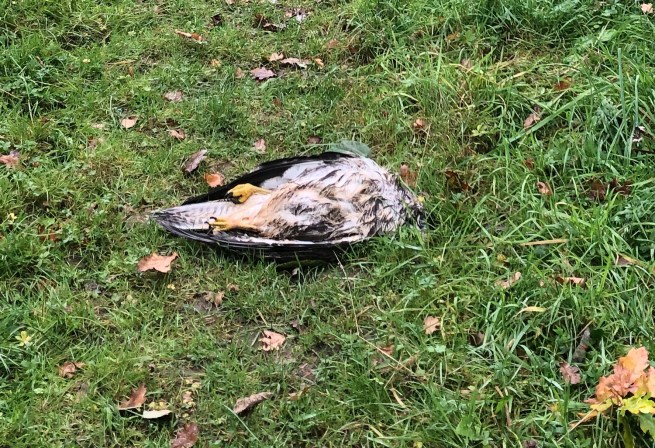
Double swoop on suspected animal fighters

Numerous dogs have been seized by the Scottish SPCA following two simultaneous raids at different addresses in Scotland

Working in partnership with Police Scotland, the Scottish SPCA led raids at an address in Angus and an address in Aberdeenshire last week. Scotland’s animal welfare charity acted on intel gathered on animal fighting activities in both areas.

An undercover officer in the Scottish SPCA’s special investigations unit (SIU) said: “We uncovered intelligence to suggest illegal animal fighting was taking place at these locations. With serious concerns about the welfare of both the dogs and wild animals being subjected to this, we worked with the police and external partners to raid both addresses. We’ve seized several animals and will be checking on their condition.”

Offences such as this are incredibly difficult to investigate as they are very well-guarded by those involved. Our expertise, in conjunction with the police, has proven to be invaluable to tackling these underground crimes.”

This is the latest in a string of animal fighting cases the Scottish SPCA has taken on recently. The Society is taking the fight to anyone engaging in this barbaric practice and sending out a clear message that it is not acceptable.”

As it is an ongoing investigation, we are unable to give any more specific information at this time.”

A Police Scotland spokesperson said: “Officers supported the Scottish SPCA in relation to search warrants at an address in Angus and an address in Aberdeenshire. Officers from Police Scotland will continue to work with the Scottish SPCA and partner agencies.”

So far this year, the Scottish SPCA has taken an average of a call on animal fighting every other day. Approximately 50% of the jobs the charity’s SIU take on relate to it.

The investigation continues.

ENDS

You may be wondering why we’ve posted a press statement about suspected animal fighters on this blog. Unfortunately we’re not able to comment further at this stage but it will become apparent in due course if this case progresses.

As this is a live investigation and a potential case of huge significance, we won’t be accepting any comments.

We’ll be blogging updates when they become available.

UPDATE 17 October 2019: Millden Estate named in joint SSPCA/Police Scotland raid as part of investigation in to suspected animal cruelty (here)

UPDATE 21 October 2019: More detail emerges about SSPCA/Police raid at Millden Estate (here)

UPDATE 3 December 2020: Animal cruelty charges follow SSPCA/Police raid at property on Millden Estate (here)

UPDATE 2 November 2021: New trial date for Millden Estate gamekeeper accused of animal fighting offences (here)

UPDATE 3 December 2021: Angus Glens gamekeeper in court today on animal fighting charges (here)


Buzzard shot dead in North Yorkshire

Appeal for information from North Yorkshire Police (11 October 2019):

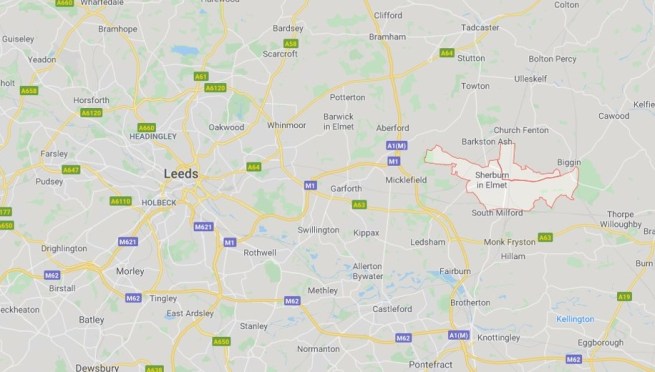
APPEAL FOR INFORMATION AFTER BUZZARD FOUND SHOT NEAR SHERBURN IN ELMET

North Yorkshire Police is appealing for information after a dead buzzard was found by a member of the public at 11.45am on 3 October on a footpath close to Hagg lane near Sherburn in Elmet.

The bird was recovered and taken to a local vets to be x-rayed which revealed it contained what appeared to be eight pieces of shot.

A spokesperson for North Yorkshire Police said: “This is sadly yet another example of the unacceptable bird of prey persecution which blights our region. Killing wild birds is an offence under the Wildlife and Countryside Act and we are committed to putting a stop to this deplorable crime.”

North Yorkshire Police have carried out extensive enquiries in the local area. Officers are appealing for anyone with any information, or who may have witnessed anything taking place in relation to this bird to call 101 quoting ref: 12190183166

ENDS


RSPB challenges misinformation about satellite tags

This is an excellent blog written by Ian Thomson, Head of Investigations at RSPB Scotland, countering the misinformation (that’s being kind) about satellite tags that is being touted by some in the game shooting industry.

We’ll be writing more on this shortly.

We’ve reproduced Ian’s blog here:

Challenging misinformation about satellite tags

RSPB Scotland’s Head of Investigations Ian Thomson outlines our thoughts on claims made accompanying the launch of a petition regarding satellite tags fitted to raptor species.

One of the greatest conservation tools to emerge in recent years has been satellite-tagging technology. Whether following the journeys of migrating cuckoos or shedding light on the dangers facing UK birds of prey, these tiny pieces of technology are becoming increasingly valuable in the conservationist’s mission to save nature.

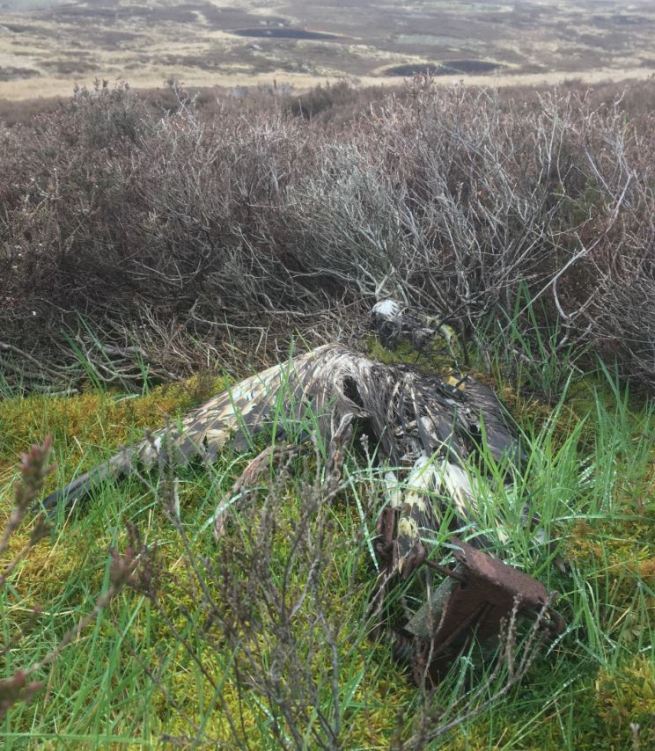
As you read this, satellite tags are helping scientists monitor a handful of recently released captive-reared white-rumped vultures in Nepal after the species almost went extinct. It allowed the finding of a turtle dove nest in Suffolk this August, crucial for a species which has declined in the UK by 97% since 1970. Another tag’s data led us to the body of a hen harrier, Rannoch, lying in the heather, her leg caught in an illegal spring trap on a Perthshire grouse moor.

[Hen harrier Rannoch was fitted with a satellite tag at a nest in Perthshire in summer 2017]

A couple of weeks ago the Scottish Gamekeepers Association (SGA), lodged a petition “calling on the Scottish Parliament to urge the Scottish Government to introduce independent monitoring of satellite tags fitted to raptor species, to assist the police and courts in potential wildlife crime cases and to provide data transparency.”

The Scottish Parliament Information Centre (SPICe) briefing about the petition gives a rounded picture of the context.

However, the supporting information provided by the SGA to support their petition contains misleading information which appears to be part of an ongoing and concerted attempt to undermine the credibility of these scientifically-approved tags and the integrity of those monitoring them.

In recent years, various statements the SGA have made in the media (eg. as discussed here) are symptomatic of an organisation in complete denial about the extent of raptor persecution and it’s association with grouse moor management. Indeed, every story about a dead or disappeared satellite-tagged bird of prey on a grouse moor is met with denials, obfuscation or conspiracy theories.

[Rannoch was killed by an illegal trap on a grouse moor in November 2018. Had she not been tagged, this crime would have remained undiscovered]

The RSPB has been involved in the fitting of satellite transmitters, using experienced, trained and licenced taggers, to a wide variety of birds of prey and other species, both in the UK and abroad, for the last 15 years. As a key adviser and contributor to a number of high-profile conservation research projects involving the tagging of bird species across the world, we thought it important to share our experience to put the SGA’s claims into context.

In the UK, all tagging projects require approval from the independent British Trust for Ornithology (BTO)’s Special Methods Panel, who rigorously scrutinise all such proposals on behalf of the UK statutory conservation agencies, including SNH in Scotland, to check their scientific validity and that the welfare of the birds tagged is ensured. The BTO’s process also ensures all projects meet Home Office requirements.

All practitioners must demonstrate experience and capability to undertake this work and this is heavily scrutinised by the Special Methods Panel. Most of those involved with this technique are experienced bird ringers and handlers. An annual licence return is supplied to the BTO by all satellite practitioners for their records, and this is a condition of receiving further licences in the future.

The RSPB also has considerable experience in monitoring the data coming from our own transmitters and in working closely with other individuals and organisations involved in similar projects, notably with regard to development of tag technology, sharing good practice and the analysis of satellite tag data.

We lead on police training on the interpretation of tag data, recently attending key events in Perthshire and Yorkshire in 2019 to ensure that the police and officers from the National Wildlife Crime Unit are equipped to carry out independent scrutiny of tag data. We have also helped ensure that, where satellite-tagged birds of prey are suspected of being illegally killed, relevant tag data is provided to investigating officers as required.

We have assisted the police in numerous follow-up investigations where tagged birds have been illegally killed or have been suspected to have been victims of criminality – as with Rannoch, mentioned above.

In 2017, the government-commissioned review of the fates of satellite-tagged golden eagles concluded that almost a third of young tagged eagles “disappeared (presumably died) under suspicious circumstances” and that “areas managed as grouse moors were strongly associated with the disappearance of many of the tagged eagles”. This independently peer-reviewed study was underpinned by data from tags that researchers from RSPB and several other organisations and agencies had fitted to Scottish golden eagles, and is key evidence that scientifically highlights the ongoing problem of raptor persecution on Scotland’s grouse moors.

Satellite transmitters, all fitted as part of projects licensed by the BTO, have revolutionised the study of bird ecology. They have proved invaluable research tools in understanding the movements of birds, from Asian vultures to English turtle doves, Welsh hen harriers and Scottish golden eagles. They have allowed us to identify important migration staging areas, key nest and roost site locations, allowing us to further protect these birds. They have also allowed recovery of dead birds, enabling post-mortem examinations to take place and identify causes of death which would otherwise remain a mystery. Indeed, they are shining a very bright light on those areas of upland Scotland where raptor persecution continues unabated.

It is unfortunate that the SGA, which has consistently attempted to undermine the veracity of tag data, has also refused to take part in meetings of the partnership for action against wildlife crime (PAW Scotland) since the government’s satellite-tag review was published. Had it done so, perhaps many of the inaccurate statements contained in the briefing document, or in their recent members’ magazine, prepared to accompany the petition would not have appeared.  One can only question their motives.

ENDS

UPDATE 1st July 2022: Scottish Parliament sees sense and closes SGA’s petition seeking ‘Independent monitoring of satellite tags fitted to raptors’ (here).

North Yorkshire Police appeal for info after Marsh Harrier found shot nr Scarborough

North Yorkshire Police have issued the following appeal for information:

Police appeal after an injured marsh harrier was found near Scarborough

8 October 2019

Police are appealing for information after an injured marsh harrier was found near Scarborough.

The bird was found at 4pm on Sunday 18 August 2019 by a member of the public in a stubble field close to the village of Hutton Buscel near Scarborough.

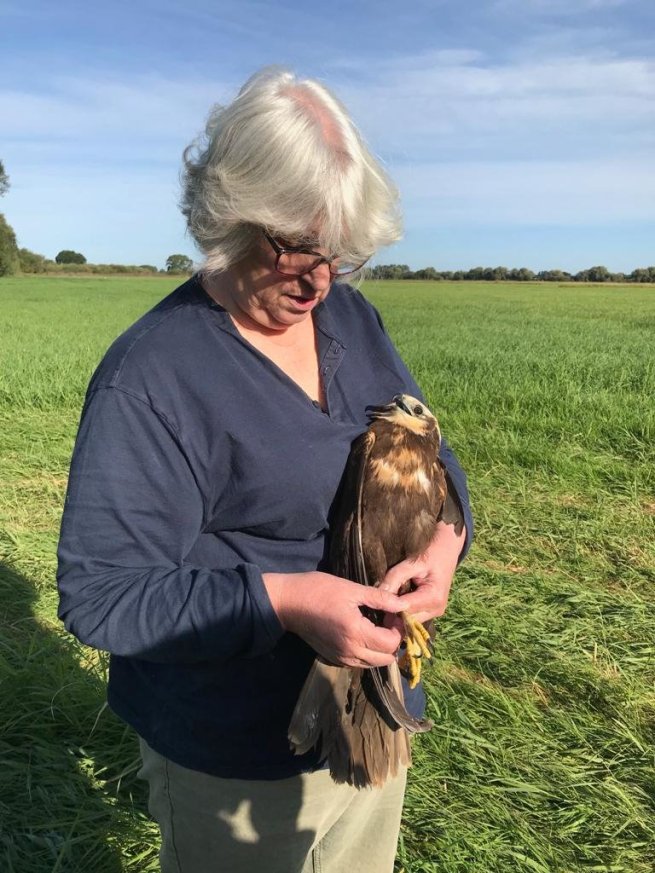
It was taken to local wildlife rehabilitator Jean Thorpe for care, and was subsequently taken to a veterinary practice for examination. The marsh harrier was found to have a broken left wing with a shotgun pellet lodged next to the fracture, which shows the bird had been subjected to persecution.

[Photo from Lower Derwent Valley National Nature Reserve, where it was subsequently released after being helped by Jean Thorpe and veterinary specialists at Battle Flatts Veterinary Clinic]

A spokesperson for North Yorkshire Police said: “Sadly, North Yorkshire is the UK’s worst hotspot for confirmed cases of bird of prey persecution. This magnificent bird has been very fortunate to survive, largely thanks to the dedication and care given by Jean Thorpe, but is yet another example of a wildlife crime having taken place against our birds of prey.”

North Yorkshire Police have carried out extensive enquiries in the Hutton Buscel area. Officers are appealing for anyone with any information, or who may have witnessed anything taking place in relation to this bird, to contact PC Mark Atkinson at Malton Police Station by dialling 101, quoting reference number 12190155625.

ENDS

We believe this Marsh harrier is the one we blogged about on 18 September 2019 (here), having been found injured on a game-shooting estate near Scarborough in August, rescued, rehabbed and then released.

It’s not the first time a Marsh harrier has been found targeted on a game-shooting estate in Yorkshire. This one was found with shotgun injuries next to a partridge release pen on an East Yorkshire sporting estate in 2016 and this breeding pair was shot at and had their eggs removed by men dressed as gamekeepers on a grouse moor in North Yorkshire in 2017.

In 2017/2018 Amanda Anderson (Moorland Association) denied that her members were interested in obtaining licences permitting them to kill Marsh harriers but several witnesses said otherwise.

Legal challenge against hen harrier brood meddling goes back to court

Fantastic news!

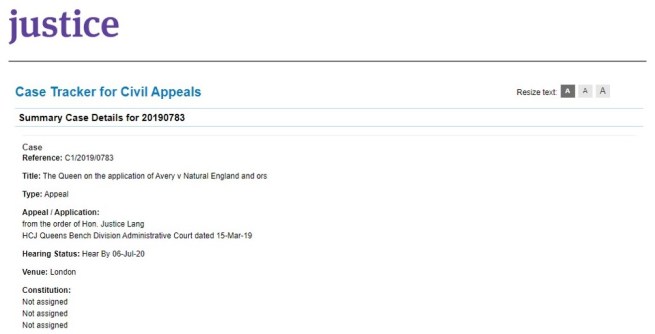
Mark Avery is going back to the Royal Courts of Justice in London after being given permission by the Appeal Court to challenge an earlier court decision that hen harrier brood meddling is legal.

[Back to the High Court for Mark and his brilliant legal team. Photo by Ruth Tingay]

The RSPB has also been given permission to appeal.

As Mark explains on his blog today (here), details of the exact grounds for an appeal have not yet been given, nor has a court date, although according to this public notice record it should be before 6th July 2020!

I wonder how many more brood meddled hen harrier chicks will have vanished in suspicious circumstances by then? Two of them disappeared within weeks of being released from captivity back in to the uplands this year: one on a grouse moor in County Durham on 9th Sept (here) and one ten days later on a grouse moor in the Yorkshire Dales National Park on 19 Sept (here).

We don’t know what’s happened to either of them, although an informed and educated guess would suggest they’ve both been illegally killed, exposing the sheer stupidity and futility of the brood meddling scheme.

Well done Mark and the RSPB for continuing the fight.

Angus Glens landowner ordered to remove unauthorised vehicle track

Press release from Scottish Ramblers, working on behalf of Scottish Environment LINK Hilltracks Group

7 October 2019

Landowner told to remove track scarring Cairngorms hill

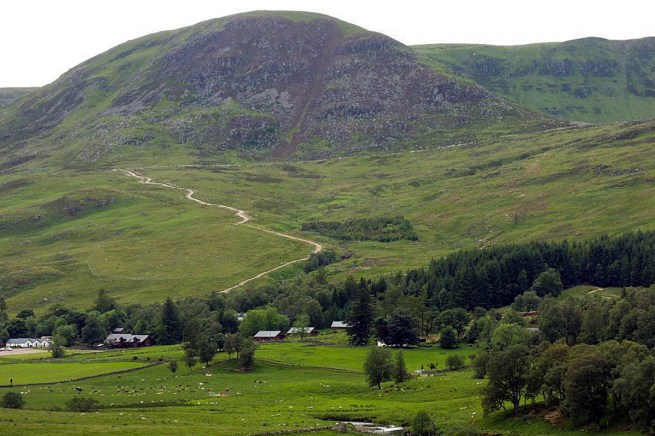
A landowner in the Cairngorms National Park has been ordered to remove a controversial vehicle track that is visible from miles around in scenic Glen Clova, Angus.

Campaigners have welcomed Cairngorms National Park Authority’s enforcement notice against the ugly vehicle track, which appears to be used to support field sports.

The landowner – registered to Pitlivie Farm in Carnoustie – has been given until October 2020 to restore the upper part of the track, which is 1.5km long and has created spoil mounds up to 10 metres wide. They have also been told to seek retrospective permission by 23 December 2019 for changes to a separate section of track lower down the hillside.

[The unauthorised track in Glen Clova. Photo from Ramblers Scotland]

Such tracks made national headlines this year when the Scottish Parliament voted against Planning Bill amendments from Scottish Green Party MSP Andy Wightman which would have closed loopholes and introduced stricter controls over their construction.
Helen Todd is Ramblers Scotland’s policy manager and co-convener of the LINK Hilltracks group, which continues to campaign for stronger public oversight of upland vehicle tracks.

Ms Todd: “We commend the Cairngorms National Park Authority for taking decisive action against this ugly and unauthorised track, which is a scar upon the landscape in this historic, protected glen.

It is one of very few examples of an authority being able to spend the time and money required to retrospectively tackle inappropriate tracks, which for too long have been creeping further and further into wild landscapes.

I hope that other landowners across Scotland will take notice of the Glen Clova order, which will force the person who built this track to pay for an expensive restoration job.”

Beryl Leatherland, of Scottish Wild Land Group and co-convener of the LINK Hilltracks group said: “The case highlights the urgent need for the Scottish Government to introduce stronger controls over vehicle tracks in our hills – to boost local democracy, improve construction standards and protect precious environments from further damage.”

The Scottish Government last week announced that hill tracks will be one of the top priorities in its forthcoming review of ‘Permitted Development Rights’, which governs which types of developments can bypass the full planning permission process.

Currently, landowners simply need to tell authorities before building tracks which are said to support ‘agriculture or forestry’ – and full planning permission is generally not required. Campaigners believe these tracks are often created to support shooting activities.

Research published last year by the Scottish Environment LINK Hilltracks group found that vehicle tracks continue to expand further into Scotland’s mountain landscapes, and that weak planning processes can lead to them being badly-sited and designed.

Some tracks have even been built over the top of narrow, low-impact trails and historical routes, with little chance for the public to comment in advance.

ENDS

How refreshing to see a landowner held to account for causing environmental damage apparently in pursuit of fieldsports. Well done to Scottish Environment Link’s Hilltracks Group for its campaigning work and well done to the Cairngorms National Park Authority for issuing an enforcement notice. More of this, please!

Helen Todd and Beryl Leatherland gave a compelling presentation at the Revive conference in Perth in August (see video below). Unauthorised hilltracks are part of Revive’s campaign for grouse moor reform and you can read more about this in Revive’s report here.

2nd brood meddled hen harrier chick vanished from grouse moor in Yorkshire Dales National Park

Following earlier blogs about the two ‘missing’ brood meddled hen harriers (here), one of which vanished on a grouse moor in County Durham on 9th September 2019 (here), further detail has now emerged about the loss of the second harrier.

Here’s a press statement published this afternoon by North Yorkshire Police:

Appeal for information about a missing satellite-tagged hen harrier

Police are appealing for information about a missing satellite-tagged hen harrier.

The young male bird was tagged at its release site in the Yorkshire Dales on 30 July 2019, as part of the hen harrier brood management scheme. The bird had not been named, but is known to the Natural England monitoring team as 183704.

It is known from satellite tag data that the bird had recently spent a few days in the Forest of Bowland in Lancashire. On the morning of 19 September it had spent time near Thirlmere in the Lake District, before passing through the Mallerstang Common area in the afternoon. At 6.03pm that same evening the last transmission from the tag was received in the Seavy Gutter area of Askrigg Common, but the bird could have flown on for some distance since the last transmission.

Since then no further transmissions have been received from the tag. Natural England field staff have carried out checks with a hand-held scanner and monitored known roost sites, but the bird has not been found.

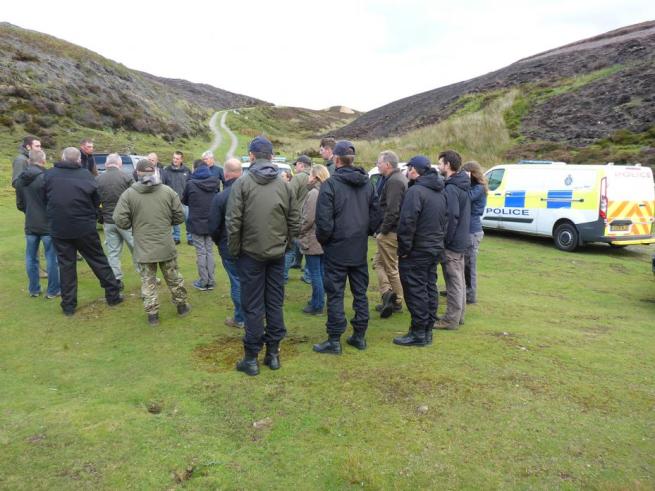
North Yorkshire Police have carried out two searches, the first being an initial search in the area of the last known transmission, and the second being a more extensive search covering several square kilometres, along with local enquiries. There have been no further sightings of the harrier or transmissions from the tag. Farmers, land owners and gamekeepers in the area have given both Natural England and North Yorkshire Police full cooperation with the search.

The bird is a juvenile male and will still be brown in colour. The bird was ringed and will bear the BTO ring number EA54306.

At this time North Yorkshire Police are keen to locate the bird safe and well, but if found deceased the bird can be subject to post mortem to establish if the cause of death was from natural causes or predation, or if criminal activity was involved.

If you find the bird or have any information please contact North Yorkshire Police on 101 and quote reference number 12190177425.

ENDS

At least this police press release doesn’t include a ridiculously glowing estate testimonial (unlike this one) but what’s all this about ‘Farmers, land owners and gamekeepers in the area have given both Natural England and North Yorkshire Police full cooperation with the search‘? So what? Why is that information included? When do you ever see this type of information in any other police appeal for information?

‘Police are investigating a burglary at 123 Letsbe Avenue and the homeowner has given full cooperation with the investigation’.

‘Police are investigating an assault on a dog walker in Dodge Country Park and the park rangers have given full cooperation with the investigation’.

The police (and Natural England and DEFRA for that matter) need to stop pandering to the game shooting industry, which is well known to harbour a criminal element, and just report on the facts of the case.

That gripe aside, this is a decent press statement from North Yorkshire Police and provides useful detail about the date of the tag’s last known transmission and the location. That another satellite-tagged hen harrier has vanished in suspicious circumstances on a grouse moor in the Yorkshire Dales National Park will come as no surprise to anybody. This National Park is a dark pit of persecution for most birds of prey that dare to fly there.

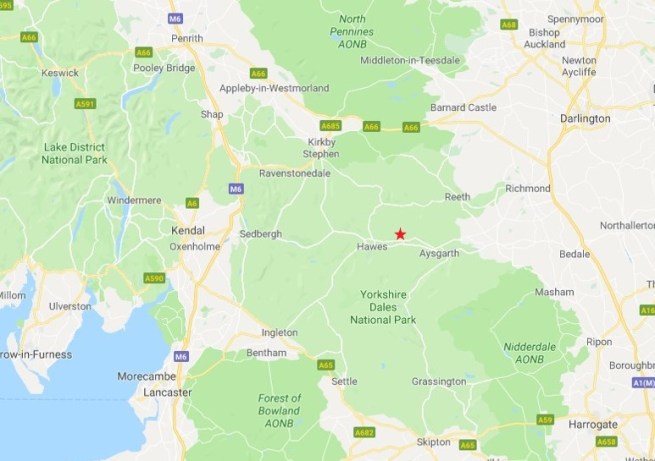
Askrigg Common is marked with a red star on this map:

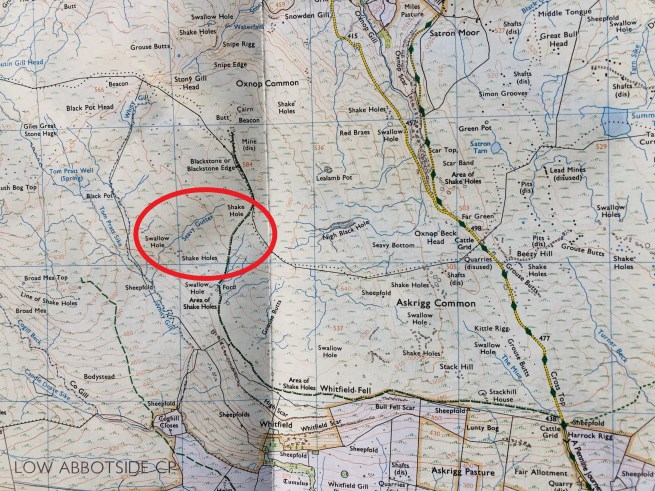
The Seavy Gutter area of Askrigg Common is circled:

At least part of Askrigg Common is used for driven grouse shooting and the shooting rights appear to be owned by the neighbouring Gunnerside Estate, who in 2015 applied for planning permission for a beaters lunch hut, claiming amongst other things that this building would be in the ‘public interest through the economic and social benefits associated with the shooting activities run by the Estate‘! See: Planning consent Gunnerside lunch hut 2016

As ever, with no hen harrier corpse and no tag, it is impossible for this bird’s disappearance to even be recorded formally as a crime, even though the Government’s very own commissioned research has shown that the 72% of young satellite tagged hen harriers that have vanished in suspicious circumstances are most likely to have been illegally killed on grouse moors.

This is the pitiful state of hen harrier conservation in the UK in 2019.

Another police training event for tackling illegal raptor persecution

This seems timely given the news that one of the brood meddled hen harriers vanished in suspicious circumstances on a grouse moor in County Durham earlier in September.

From the Teesdale Mercury, 7 Oct 2019:

Fighting raptor crime soars to new heights

A CONSERVATION organisation and the police have joined forces to protect birds of prey.

The North Pennines Area of Outstanding Natural Beauty (AONB) Partnership worked with Durham Constabulary to co-host a training event aimed at raising awareness of crimes against the birds.

More than 20 officers from Durham, Northumbria, Cumbria and North Yorkshire forces attended the event.

They heard presentations from the AONB Partnership, the Northern England Raptor Forum, the RSPB investigations team and North Yorkshire Police’s Rural Task Force.

Officers learned how to recognise raptor crime, including illegal trapping, nest disturbance, poisoning or shooting wild birds.

Chris Woodley-Stewart, director of the North Pennines AONB Partnership, said: “It is important to give police officers the knowledge and confidence to deal with raptor crimes.

Some parts of the North Pennines AONB have become something of a hotspot for this type of crime in the last ten years.

Raising awareness among police officers and the public is an important step in stamping this out.”

Insp Ed Turner, from Teesdale Police, said: “This was a great opportunity to share experiences and knowledge across the policing teams and partners that cover the northern Pennines.”

The event was supported by staff from Raby Estate who led a field visit to train officers on recognising illegal and legal traps.

John Wallis, Durham estates manager for Raby Estates, said: “We were only too pleased to support this initiative. Partnership working and closer collaboration will be vital if we are to overcome wildlife crime and other challenges in the northern uplands.

This training was part of Operation Owl, the national police operation against raptor crime.

Supt Nick Lyall, the chairwoman [?!] of the England and Wales Raptor Persecution Priority Delivery Group, a body set up by Defra to tackle the illegal persecution of birds of prey, said: “The ongoing persecution of our birds of prey is an issue that I am delighted partners are supporting me to address it.”

ENDS

OneKind launches new petition: End the killing of wildlife on grouse moors & elsewhere in Scotland

A new petition has been lodged at the Scottish Parliament calling for ‘an end to the killing of wildlife on grouse moors and elsewhere in Scotland’.

Petition # PE01762 is the work of animal welfare charity OneKind and runs from now until 13 November 2019. Petitions to the Scottish Parliament are different to those lodged at Westminster because (a) there is no requirement to reach a signature threshold (e.g. 10,000 or 100,000) before the Petitions Committee will consider the petition, and (b) anybody anywhere in the world can sign this petition.

Here is some background information from OneKind on why they’re calling for the Scottish Parliament to conduct a full review of the animal welfare impacts of the use of traps and snares on grouse moors and elsewhere in Scotland:

The focus of the review called for in this petition should be:

• The ethics and sustainability of the routine and repeated killing of the same species in the same location;
• The case for banning snares, Larsen traps and certain other types of live traps outright, on animal welfare grounds;
• The animal welfare issues surrounding lethal traps such as spring traps, both approved and non-approved categories;
• Mechanisms to ensure proper scrutiny of all practices undertaken by hunters, shooters and trappers and only to permit the use of traps under exceptional circumstances; and
• Whether activities closely associated with causing unnecessary suffering by means of trapping and snaring, such as driven grouse shooting, should be banned.

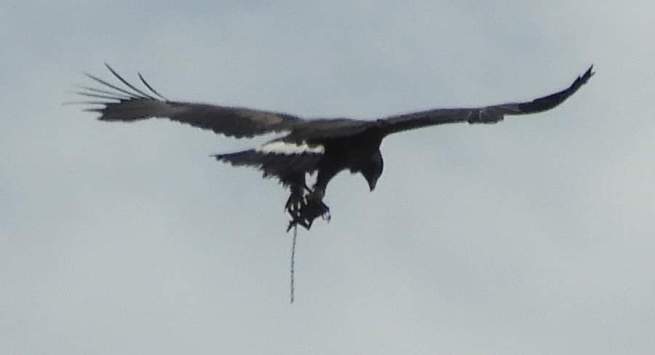
OneKind has created this public petition to the Scottish Parliament following the publication on 13 August 2019 of a photograph of a golden eagle – Scotland’s national bird – flying near Crathie in the Cairngorms National Park, with its leg apparently caught in a spring trap.  At the time of writing the fate of the eagle is unknown, but it is thought likely to have suffered considerably and probably to have died.

OneKind is a member of the Revive coalition, along with Common Weal, Friends of the Earth Scotland, the League Against Cruel Sports Scotland and Raptor Persecution UK.  Revive campaigns for significant reform of Scotland’s grouse moors and is working to propose an alternative vision for the estimated 12 – 18% of Scotland’s land currently used for grouse shooting. Such reform will not be achieved overnight and in view of the widespread public outrage provoked by this incident the petitioners see it as urgent to institute a Scottish Parliament review of wildlife persecution with the aim of eradicating inhumane practices associated with driven grouse shooting as soon as possible.

The petitioners are aware that the Grouse Moor Management Group (the Werritty Review), is likely to report shortly.  The terms of reference for the Werritty review group are to: “look at the environmental impact of grouse moor management practices such as muirburn, the use of medicated grit and mountain hare culls and advise on the option of licensing grouse shooting businesses.”  These do not allow for full consideration of the severe animal welfare consequences of continued trapping and snaring practices on grouse moors.

The Crathie incident has caused a public outcry and a petition by Wild Justice to the UK Parliament calling for an outright ban on driven grouse shooting attracted tens of thousands of signatures within a few days of its launch.  OneKind supports that petition, as driven grouse shooting is intimately connected both with so many wildlife offences across the UK, as well as the legal infliction of suffering on animals, including by trapping and snaring.

Given that animal welfare and wildlife protection are devolved issues, the scale of wildlife killing in Scotland and the suffering caused, we believe that action is urgently required in the Scottish Parliament.

ENDS

PLEASE SIGN THIS PETITION HERE

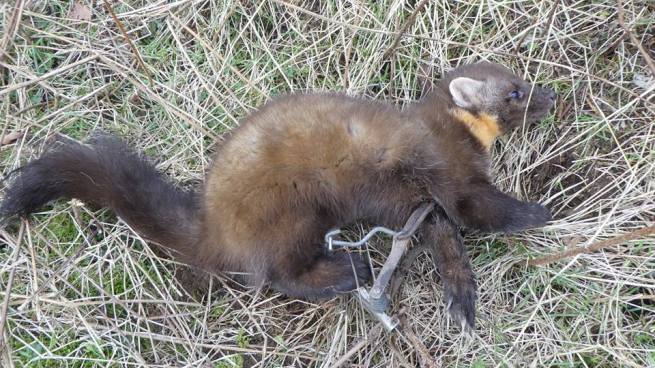
This pine marten (a so-called protected species) was caught in a spring trap on a Highland shooting estate in 2017. It didn’t survive these injuries.