
The Scottish Government has recently launched a short public consultation, seeking views on a substantial increase of penalties for wildlife crime.
This has been a long time coming. Six years, in fact.
In 2013, the then Environment Minister Paul Wheelhouse commissioned a review on whether penalties for wildlife crime should be increased, as a direct response to ongoing illegal raptor persecution. Professor Mark Poustie submitted his report and a series of recommendations, including a penalty increase, in 2015. The then Environment Minister Dr Aileen McLeod broadly accepted those recommendations in 2016 and the Scottish Government committed to progressing them in its 2017/2018 Programme for Government.
Now it’s 2019 and we have yet another consultation, although to be fair this consultation is short (opened 19th July, closes 16th August) and judging by this illustration doing the rounds via Scot Gov social media accounts, this consultation appears to be a formality:
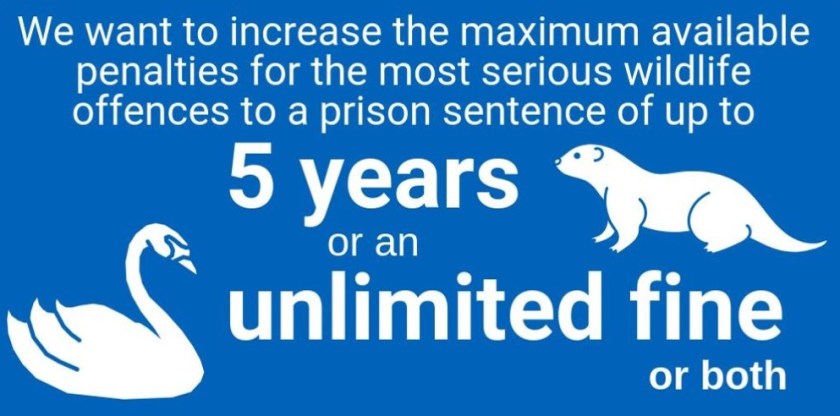
Wildlife crime can include barbaric acts of cruelty and can have significant consequences for the
conservation status of protected species. Penalties need to be dissuasive and of personal significance to act
as a deterrent. Time and time again we’ve seen pathetically lenient sentences for raptor persecution that have offered zero deterrent effect and have been of no personal significance to the criminal (e.g. when a shooting estate pays their guilty employee’s fine or when the offender’s employment isn’t terminated) so as far as we’re concerned, a substantial increase in the available penalties is long overdue and would be very welcome. It would also bring Scotland more up to date with countries like Spain, whose Government is not only saying it has zero tolerance for raptor persecution, it’s backing up that claim with massive penalties for those convicted (e.g. see here, here and here).
However, the most significant aspect of these current proposals, as far as we’re concerned, is the five-year custodial penalty. This is big, big news because effectively it would mean that Police Scotland would now have the authority to apply for permission, under the Regulation of Investigatory Powers (Scotland) Act 2000 (RIPSA), to install covert cameras on private sporting estates for the purpose of detecting wildlife crime.
Currently, Police Scotland do not have the authority to seek permission to install covert cameras as part of an investigation simply because raptor persecution crimes do not merit a custodial sentence of three years or more. Authority will only be given if the activity is considered ‘proportionate’ and when the crime being detected is considered ‘serious’ (i.e. where the penalty would constitute a term of imprisonment for three years or more).
As we’ve seen in recent years, the RSPB has installed covert cameras at the remote nest sites of specially protected birds of prey and have recorded what is obviously a wildlife crime, but because the RSPB is a charity and not a statutory agency it is ineligible for RIPA/RIPSA authorisation so clever defence lawyers have been able to get cases thrown out of court on technicalities, and more recently some of these cases haven’t even reached court because the Crown prosecutors have decided the footage is inadmissible (e.g. see here and here).
As the legislation stands at the moment, it is not fit for purpose when it comes to detecting raptor persecution crimes in remote landscapes where the landowner may have a vested interest in the commission of that crime. If the Scottish Government amends the legislation to increase the maximum penalty to five years in prison, we would be very, very happy.
We’d encourage as many of you as possible to fill in the short consultation form and encourage the Scottish Government to press ahead with its proposals. Background info and the consultation itself can be found here. Don’t forget it closes on 16th August.
Just a word of warning to the Scottish Government, though. Even if stiffer penalties are applied to those who commit serious wildlife crime, and even if those penalties would be of personal significance to the criminal, their deterrent effect would still be minimal if the offenders still know that the chance of being caught in the act is so slim that this outweighs the risk of committing the offence in the first place. Hopefully the chances of being caught will be significantly increased if the police are able to use covert cameras, but those cameras will only capture certain crimes. There will be plenty of other crimes committed, away from nest sites and other fixed positions such as crow cage traps, and those offenders need to believe that police response times and follow ups will be timely and thorough.







 Raptor Persecution UK