
Some more excellent news!
Press release (22 August 2019)
The first white-tailed eagles to be reintroduced to England have been released on the Isle of Wight. The six young birds, the first to be returned to southern England for 240 years, are part of a five-year programme to restore this lost species led by Forestry England and the Roy Dennis Wildlife Foundation.
The young birds were collected under a Scottish Natural Heritage licence from the wild in Scotland and brought to the Isle of Wight. Here they have been fed and monitored by a team of experts and dedicated volunteers whilst becoming familiar with their new surroundings. All six birds have made good progress and have now been successfully released. The team will initially continue to provide feeding sites for the birds to encourage them to settle along the south coast.
[WTE Reintroduction Project team Steve Egerton-Read, Dr Tim Mackrill, Ian Perks, Roy Dennis. Photo by Robin Crossley]

Before being released the birds were fitted with small satellite trackers so their progress can be closely monitored. Data on their movements will be available on the Roy Dennis Wildlife Foundation website and once the birds are well established it is hoped that they will become a familiar site over the skies of the Island and nearby mainland coast.
Roy Dennis, Founder of the Roy Dennis Wildlife Foundation said:
“I have spent much of my life working on the reintroduction of these amazing birds and so watching them take to the skies of the Isle of Wight has been a truly special moment. Establishing a population of white-tailed eagles in the south of England will link and support emerging populations of these birds in the Netherlands, France and Ireland, with the aim of restoring the species to the southern half of Europe. The team is pleased that the project fulfils one of the specific aims of the Government’s 25 year Environment Plan.
“We have seen from other reintroduction programmes that returning lost species offers real benefits for nature and the health of our environment, and to people and local economies. I would like to thank everyone from the local community who is working with us to support and manage this project including our volunteers and project officer who are all Isle of Wight residents. We are also very grateful to the private donors who are supporting the project.”
Bruce Rothnie, Forestry England’s South District Forest Management Director, said: “The diversity of our wildlife is under real pressure with many species now in long-term decline. The nation’s forests provide an important habitat for wildlife and are playing a critical role in supporting the successful re-establishment of many lost or threatened species. We are immensely proud that the woodlands we manage on the Isle of Wight and surrounding South Coast are now home to these incredibly rare birds as they return to England’s coastline.”
[One of the first White-tailed eagles to leave the release aviary. Photo by Forestry England]
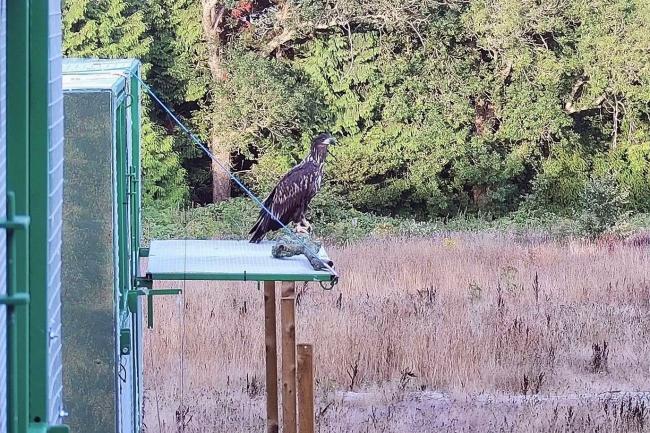
The Isle of Wight was chosen as the location to reintroduce the white-tailed eagles, also known as sea eagles, as it offers an ideal habitat for these coastal loving birds. Areas where the cliff edges have slipped will provide quiet areas for the young eagles, and its network of cliffs and woodlands provide many potential nesting sites. The Solent and surrounding estuaries will provide a rich food supply for the eagles, with fish such as grey mullet and water birds forming a key part of their diet.
The Isle of Wight was also chosen for the project given its central position on the south coast allowing the birds to disperse east and west along this coastline.
A comprehensive feasibility study and public surveys were conducted prior to reintroduction and a steering group made up of local organisations and members of the community has met and is helping to guide the project.
The project is also expected to make a significant contribution to the local economy. A similar scheme on The Isle of Mull was found to have boosted its local economy by up to £5 million a year, demonstrating the interest in this iconic bird.
The reintroduction of Britain’s largest bird of prey is being conducted under licence from Natural England, the Government’s wildlife licensing authority. Further releases of the birds will take place annually as part of the five year programme, with at least six birds released each year. It will take several years for the young birds to become established and breeding is not expected to start until at least 2024.
Chairman of Natural England, Tony Juniper, said: “The return of these spectacular birds to England is a real landmark for conservation. I very much hope that it will also provide a practical demonstration of the fact that we can actually reverse the historic decline of our depleted natural environment.
“It will also show how helping the recovery of our wildlife can be done at the same time as bringing benefits for people, in this case by offering a boost to the local economy through wildlife tourism, as has happened in Scotland after these birds were reintroduced there back in the 1970s.
“As with all applications to restore lost native species, Natural England carefully considered the short and long term impact of reintroducing the eagles on the environment, including implications for local communities as well as the impacts on the animals themselves.
“Everyone at Natural England is delighted to see this project reach this stage and I know just how excited Roy Dennis and the Forestry England team are about this reintroduction. I’m sure the local community will share their passion and excitement and look forward to seeing these magnificent creatures return to our skies.”
ENDS
Not everyone’s thrilled, predictably:

According to this article in The Times, the National Sheep Association (presumably a club for sheep farmers) opposed the reintroduction licence and claimed that farmers in Wales(!) hadn’t been properly consulted.
Stand by for hysteria in the press about sea eagles attacking the Isle of Wight ferry and dodgy photographs of them flying off with yachts they’ve ‘grabbed’ in the Solent.
For the rest of us, bring on the boat trips where we can pay our money to go and see these spectacular eagles.
Well done and thanks, Roy Dennis, Tim Mackrill and team.
 Raptor Persecution UK
Ah, another sound reintroduction .
Hopefully they’ll be spread along the south coast within 20 years.
Well done all involved.
Keep up the pressure !
What a ridiculous contribution from the Raptor Persecution moderator at the end of the main content.
Firstly, the NSA represent sheep farmers from right across the board – from pure pedigree flocks, rare breed flocks, large commercial flocks to small tenant sheep farmers and ‘hobby’ sheep farmers.
Rightly, IMO, all sheep farmers other than that of commercial flocks are entitled to be concerned about the reintroduction of the WT Sea Eagle.
Compensation does not replace or easy the loss of breeding bloodlines or rare breed stock.
I’m not comparing it to the loss felt with the BSE or foot and mouth outbreak, but it can be very upsetting for those involved and have a long term financial impact.
To dismiss it is somewhat ‘off’.
Also, you mentioned ‘Wales(!)’ had not been properly consulted, as if Wales had nothing to do with it.
Have you any idea the distances the eagles will spread to, either to settle or just on their travels?
Look at the RSPB’s tagged sea eagles movements.
No difference from an eagle from Mull visiting the Angus glens. The same as an Isle of Wight eagle visiting South Wales.
Why have a swipe at the NSA?
SNH recently acknowledge that the eagles are predating on lambs and vulnerable ewes and is a problem for some farmers.
Having said all that, I am for the reintroduction but the location on this instance is wrong IMO.
Ghlaney. Won’t the sheep farmers from where they are being taken be happy?
Surely a sheep farmer somewhere must be? farmers in Norfolk?
If farmers in Wales are going to be effected by this please tell us where they should be introduced, since you say you are for the introduction. Where would make you and the Welsh farmers happy or are you just concerned trolling?
Do eagles really take breeding stock?
Yes, they do take breeding stock, albeit mostly young lambs.
I’m not against the reintroduction and appreciate they have got to be released somewhere and inevitably, lambs will form the main diet down south IMO.
My issue was with the way/tone the moderator just dismissed and ridiculed the NSA which represents their members.
But on the subject of the release site, I do think this is the wrong area for sea eagles..
I would’ve thought West/North West Wales would’ve been more appropriate.
Ghlaney, thanks for the reply.
Can’t you see that your reply is just making my point clearer. You are recommending White-tailed Eagle re-introductions in Wales. Do you think the farmers there will be happy when they are complaining about the IOW
My basic theme is that sheep farmers exaggerate and never welcome sea eagles no matter where.
I am sure the Norfolk farmers who stopped the re-introduction there are not happy about the IOW introduction because yes eventually they will be everywhere. That is the whole point of re-introductions.
Everyone knows sea eagles take some live lambs. That was understood very early on in an survey on Mull. It is the numbers which are vastly exaggerated and now you are talking about breeding stock as if every lamb is going to bankrupt a farmer. Of course the loss of every healthy lamb is hard for farmers but most people on this forum would argue that this is a natural process if we want to have the biodiversity which is our heritage. A farmer’s wife on Mull told me that there was a reason they got rid of the sea eagle. We are just claiming back what was lost by that belief.
The whole argument for and against sheep is a whole other topic but here is an opener
https://www.theguardian.com/commentisfree/2019/aug/08/ipcc-land-climate-report-carbon-cost-meat-dairy
The NSA should be ridiculed at every opportunity, because they are ecologically illiterate and have a deep resentment for anything resembling wild nature. They made complete fools of themselves regarding the lynx reintroduction and deliberately perpetuated false information, purely to exert lobbying pressure. Your tales about depredation of breeding stock are utterly laughable. Show us the scientific data to back up your ridiculous hyperbole, otherwise keep quiet.
The NSA is a joke. They threw their dummy out of the pram and decided they would not even discuss a trial lynx reintroduction so not surprised at all at this ludicrous stance from them. Welsh sheep farmers have also complained about pine marten reintroduction and also are very negative re the return of the beaver. Welsh sheep farmers seem to be particularly bad pains in the arse. They’ve been prominent in calling for the cancellation of the rather modest Summit to Sea rewilding project in spite of the fact its promoters have bent over backwards trying to inform and consult with people. My old home town of Gloucester suffered some very severe flooding a few years back that almost certainly had a lot to do with much of the river Severn’s watershed being in treeless sheep grazed wastes. But of course it’s always the poor sheep farmers who are the victims eh? It was noticeable at the Birdfair dfebate with Charlie Jacoby that Chris mentioned Welsh sheep farming, the current situation is bloody awful and personally at a time when we have an obesity crisis and we chuck a third of our food in the bin I’d prefer money to go to education and healthcare than to subsidizing marginal agriculture that’s only good for killing off wildlife and increasing flooding of businesses, homes and genuinely useful farmland downstream. And lest we forget all these claims about sheep and lambs being snatched by evil wildlife need to be treated with a very big pinch of salt – https://www.google.com/search?q=gairloch+sea+eagles+not+eating+lambs&rlz=1C1CHNY_enGB816GB817&oq=gairloch&aqs=chrome.1.69i57j35i39j0l4.4296j0j7&sourceid=chrome&ie=UTF-8
What a ridiculous post.
Completely littered with inaccuracies. Not even worthy of a response as you clearly have an entrenched view, with posts spewing more shit than a 1m gallon slurry tower!!!
I suppose the flooding of the Somerset levels was down to livestock too in the same year that Gloucester was badly flooded. And before you answer that, I farmer down there at the time and know exactly why the Levels flooded and the Severn, which had ‘f’ all to do with sheep.
One thing I do agree with you though which is a miracle considering the amount of guff in your post, is that the government shouldn’t be subsiding and propping up a failing industry.
Les, set you browser to go past 2009 for your sea eagle info!!!!
May 2019 – SNH documents supporting the fact that sea eagles are taking live healthy lambs.
SNH are also trialing ways to prevent this. Covered on mainstream Scottish news at the time and Landward.
Another Les inaccuracy!!
Ghlaney
You’re welcome to comment here but if you’re here to be rude or troll, you’ll be banned.
Fair warning.
‘Methinks the lady doth protest too much!’ – I know perfectly well about the supposedly up to date data about lambs taking healthy lambs, but is the sample that big and how about the interpretation – certain people rushed to make that claim and that seems to have set how the study was reported? Personally I think radio collaring live lambs and seeing what happens is a brilliant way of determining whether or not sea eagles have a taste for them. The crofters were a bit pissed off when the Gairloch study didn’t give the conclusions they wanted – hoping to expand from a subsidy into a compensation economy as well it would seem (‘Darn! And we would have got away with it too if it hadn’t been fur those pesky researchers!’). And as far as flooding from tree denuded hills goes who has provided some of the best information about this as a direct result from tree planting? Well it’s actually a bunch of sheep farmers in Pontbren, Wales! The exception that proves the rule – Welsh sheep farmers are in the main a backward, whiney lot which is why the Pontbren folk are especial heroes of mine. Want to explain how with much of its watershed in overgrazed, relatively treeless Welsh hills that made no contribution to Gloucester getting soaked? Please read this – I try to make my research as deep and broad on any subject that I’m interested in which is why I even watch the execrable Fieldsports Channel, so ‘do what Les does’. BTW for someone who said I wasn’t even worthy of a response you seem to have had a lot to say, in quantity if not quality….somewhat flattered rather than insulted, thank you. https://theecologist.org/2014/mar/06/woods-and-trees-are-functioning-parts-living-landscape
Given SNH stance on licensed killing of ravens at Amulree last year and their ridiculous ” we dont see persecution as a problem in South Scotland” re the Golden Eagle reintroduction – I wouldnt be using them as a fair and scientifically unbiassed authority.
The worst affected farm in Scotland lost 6 lambs out of 600 over one year – hardly justifies yours or the NSA’s hysteria on the subject
Great news! Fingers and toes crossed for all of them!
First, this is brilliant. I’m all for getting these magnificent birds re-established in their former range, where we can, and with huge debt to Richard Evans (and Lorcan O’Toole and Phil Whitfield) for going so far in identifying what that range was.
In the scheme of things I’m not sure if my concern is trivial, but I’m always a little uneasy when I see smiling raptor workers posing with a wild bird like it was some sort of pet. I know the meeja love this sort of thing but to me it is out of place. I know that birds are very rarely handled in the course of the release and that the feeding etc is all done remotely so as to minimise the risk of imprinting, so why when keeping the birds and people apart is so important, show the bird actually being displayed like a prized pet? The second picture of the bird actually taking flight sums the work up so much better.
The dark side want to portray raptor workers as ‘raptor botherers’ and I don’t think pictures like this help us.
https://www.scotsman.com/news-2-15012/sea-eagles-not-taking-lambs-to-slaughter-1-781555?fbclid=IwAR06_q_7a4mLxOp4qkK5F9mZQSJf-uTnptTtoqZSdIqvXv8OJ9ioZhHgKmc
You are referencing an article from 2009!!! Lol
Get with the programme!!!
https://www.google.co.uk/amp/s/www.telegraph.co.uk/news/2019/05/31/farmers-welcome-documents-showing-sea-eagles-do-kill-healthy/amp/
‘Post-mortem examination of a small sample of lambs killed by the sea eagles found most were fit and healthy when attacked’ is that it? Desperately little after the Gairloch study showed far more comprehensively that live/healthy lambs are not a mainstay of the sea eagle diet. I read this as capitulation to a farming community that has for far too long played the victim card and as it’s not very PC to contradict that has got away with it especially crofters. I’ve personally witnessed how people in genuine need are being largely ignored yet affluent ‘crofters’ on Lewis wanted more and usually get it. If your sheep flock is heavily subsidized so most of your money doesn’t come from actual sales, not much of an incentive to look after it is there? Blame mortality and thereby financial loss on a wild animal that others have helped bring back then you can try and tap into compensation too. Way past time we had a look at subsidy ranching and poor sheep husbandry on the likes of Countryfile, but suspect there’s more chance they’d do a feature on flying pigs. https://www.ncbi.nlm.nih.gov/pubmed/7361390 oh yes and not forgetting this – and he claimed he got the idea from other farmers https://www.bbc.co.uk/news/uk-wales-46593004
Afraid I take everything published in the right wing anti environment press with a very big pinch of salt! The Gairloch study is the best data set on Sea Eagle lamb predation, although there are areas where they do take lambs there is no evidence it is the main part of their diet.
Sorry you need to give a link to the original paper.
Not saying there isn’t one, thery can’t be making it up entirely but i can’t find anything on SNH that remotely fits that description in the Telegraph.
A month after that article SNH releases its White-tailed Eagle Action Plan
Click to access Guidance%20-%20White-tailed%20Eagle%20Action%20Plan%202017-2020.pdf
in it is this quote
‘Scottish Natural Heritage and Scottish Government have funded two studies into lamb predation, one on the island of Mull, where white-tailed eagles first bred, and one at Gairloch in Wester Ross. These studies have identified that the eagles can and do take a small number of live lambs, however, the majority of lambs taken were scavenged as carrion.’
Wouldn’t you know it Charlie Jacoby did a feature on the Fieldsports Channel about the release a few months ago. A sheep farmer claimed that they had not been properly consulted, which I somehow doubt very much, but it’s the standard approach when playing the hard done by local against outsider conservationists card (see the execrable ‘Isles of the West’ by Ian Mitchell it’s a supreme example). Foxes, badgers, ravens and crows – his sheep were apparently being attacked from all sides and now sea eagles were being brought in! I really wish that we had a media that didn’t treat farmers as sacred cows, but as human beings like everyone else and wouldn’t it be great to get objective programming on subsidies and sheep husbandry standards instead of rather sycophantic treatment by the likes of Countryfile. Strangely poor husbandry never seems to kill sheep it’s always wildlife. https://www.youtube.com/watch?v=EaMa1WHZOUs
Last year at Easter stayed on Loch Tay (had some great full on winter walking around Ben Lawyers). On the path from the Hotel up to the fells there were initially two dead sheep (not lambs) over the course of the week this expanded to 7 . Sheep die when left out in the fields for numerous reasons, the the main one exposure. If the farmers are so concerned about stock loss why don’t they look after them better.
remember a traditional method, that was used for hundreds of years, was that the shepherd would live in the fields with their sheep, protecting them from predators and nursing the weak and sick.
It funny how this type of countryside tradition has been left to die whilst other more destructive traditions are help up as worthy of celebration.
Just a reminder while this argument rages [or sputters?]…that a comparison with Norway’s sea eagle diet is in order..over there the percentage of fish taken compared to mammals is massively in favour of fish. In Scotland where the fishing industry has wrecked our fish stocks with trawling the seabed fish nurseries and got caught making millions out of illegal “black fish” – we get sea eagles turning to lambs. Our whole environment both on land and sea is an over-exploited mess, not yet fit for top predators…..sometimes it seems like vultures fighting over a carcase….
Yeah we have a rural mafia that wants to keep Scotland as a place of subsidy ranching and putting metal into salmon, grouse and red deer. This is the case of large scale fraud I know of in the fishing industry – the sort of thing that never gets covered on Countryfile or Landward – https://www.bbc.co.uk/news/uk-scotland-north-east-orkney-shetland-17153085
That is a fascinating theory. Has there been any research on the subject?
Talk to any one elderly on the west coast and they will tell you how the shoals would fill the visible surface of the sea. The stories are legendary. Even 30 years ago hobby fisherman could cast a line and fish would bite within seconds one after another (even taking into account exaggeration it paints a picture) mostly Cod as i recall. Now where i live it takes hours to get one Pollock and that is about all that is caught.
But still there are enough fish to feed all the seals, Otters, Gannets, auks, Shags, Kittiwakes etc.
So if the theory is correct it is about the amount of energy that the eagles have to go to get a fish and how that compares to raiding seabird nests and lambs.
The theory would also probably depend on there being similar densities of lambs in those eagle areas of Norway as in Scotland.
I suspect that it is the size of the fish that are relevant. Eagles may not try to fish when the fish are too small and that could be most of the time.
The recent British Wildlife (v30/6, p 426) has an article about devastation of seabed by trawling for scallops.