
At the weekend, the Revive coalition for grouse moor reform issued the following press release:
CAMPAIGN GROUP CALLS FOR URGENT ACTION TO END MUIRBURN ON GROUSE MOORS
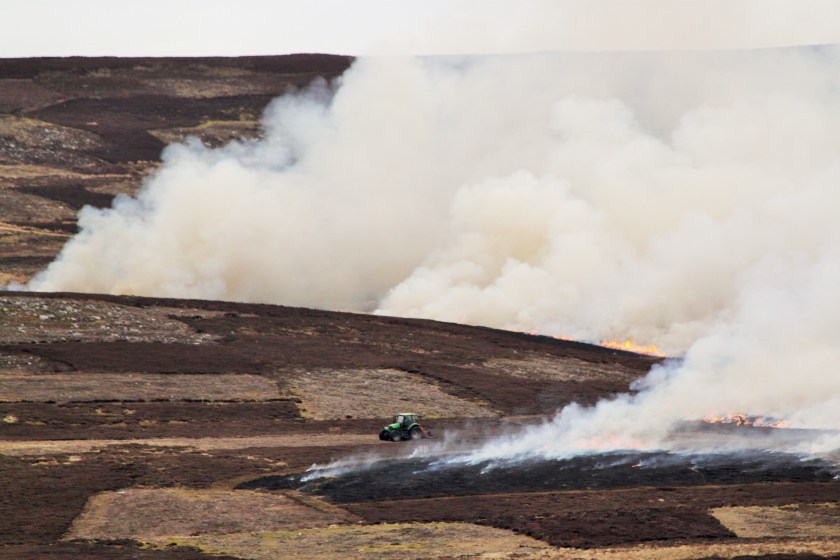
A campaign group has released new footage showing parts of the Cairngorms, an area which has a high density of peat, quite literally on fire, as gamekeepers burn heather moorland as part of intensive management of grouse moors.
The footage obtained by Revive, the coalition for grouse moor reform, shows the extent land managers will go to in their quest to create a habitat suitable for just one species – the red grouse. These grouse will subsequently be shot for entertainment.
Revive campaigner Max Wiszniewski said: “The footage that we captured is extremely disturbing showing vast swathes of heather upland on fire with flames and smoke billowing for miles, all for the single purpose of protecting grouse which will subsequently be shot for entertainment.
“I’m sure the public will be shocked to see the damage which is deliberately inflicted on our uplands to create a habitat suitable for one species to the detriment of our environment and wildlife.”
Grouse moor managers routinely burn patches of heather to create a structurally diverse patchwork habitat to favour red grouse. Tall heather provides concealment from predators while younger heather provides adult grouse with more nutritious shoots for food, and short heather provides greater insect availability for chicks.
The practice known as muirburn is hugely detrimental to the environment. Moorlands are of high conservation value for their vegetation, invertebrate and bird communities with large areas given legal protection under the European Habitats Directive. Muirburn is in direct conflict with concerns about meeting global carbon emissions.
[Gamekeepers setting fire to a grouse moor, photo by Ruth Tingay]
Dr. Richard Dixon, Director of Friends of the Earth Scotland added: “We’re growing increasingly concerned about the extent and intensity of burning on grouse moors, and particularly the effects of burning over deep peat. Where blanket bog is damaged by burning, impacts include a lowered water table and breakdown of the active peat-forming structure, resulting in the carbon store in the peat being released as climate change emissions.
“There is more carbon locked up in Scotland’s peaty soils than in all the trees and vegetation in the whole of the UK. Urgent action is needed to reduce Scottish climate emissions and lock stored carbon into our environment. The Scottish Government must put in place plans to reverse the damaging environmental effects of moorland burning and protect our peatlands as the huge natural treasure they are.”
The footage also shows mountain hares fleeing for their lives as their habitat burns, illustrating the devastating impact this practice has on other wildlife.
Robbie Marsland, Director of the League Against Cruel Sports Scotland said: “To witness wild animals running for their lives to escape such willful and deliberate environmental vandalism is extremely upsetting, made worse by the complete lack of justification for this action.
“As well as the iconic mountain hares, seen on the footage, there’s also the extensive risk to many other species including ground nesting birds and all for nothing more than to line the pockets of land owners looking to enrich their stocks of game birds for paying guns.”
The Revive coalition which includes Common Weal, OneKind, Friends of the Earth Scotland, League Against Cruel Sports and Raptor Persecution UK, will set the agenda for a multi-year strategy aimed at encouraging a national dialogue about how Scotland’s moors should be utilised. It believes that a fresh look at how this land is used could lead to a better Scotland, better for its economy, its people, its environment and its fauna.
ENDS
This article, and the very angry responses from the grouse shooting industry, received extensive coverage in the news, e.g. The Ferret (here), The National (here), The Scotsman (here), The Telegraph (here) and The Times (here).

The Scottish Gamekeepers Association (SGA) also posted a statement on its website:
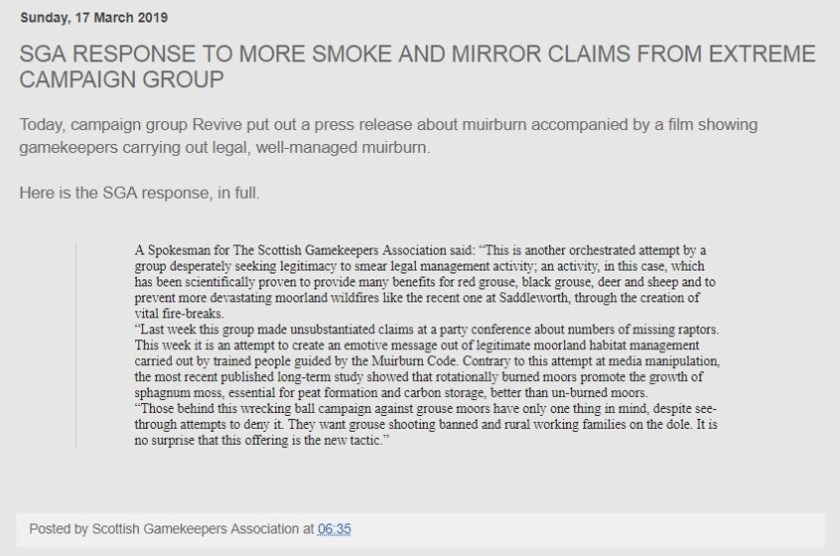
The SGA makes some interesting claims but the one we’re most interested in because it’s used repeatedly by those within the grouse shooting industry, is that muirburn ‘prevents’ wildfires. The Gift of Grouse (a propaganda campaign funded by Scottish Land & Estates) made a similar claim last year: they claimed that the continued burning of peatland moors is ‘one of the most effective means of reducing the risk of damage from wildfires by providing breaks in continuous moorland cover and reducing the fuel load’ (see here).
It’s a fascinating claim, because it contradicts the Muirburn Code (often cited by the industry as evidence of good practice, even though the Code is rarely, if ever, enforced) which states that:
“Fires escaping from muirburn are a major cause of wildfire in Scotland“.
Let’s just repeat that, in case anyone missed it:
“Fires escaping from muirburn are a major cause of wildfire in Scotland“.
It’s not just the Muirburn Code that states this fact. The SNH-commissioned review of sustainable moorland management (published in 2015) states:
“Whilst large, intense wildfires can be destructive, many may have no greater impact than prescribed burns (Clay et al. 2010) and evidence suggests that over 50% of wildfires with known causes may themselves be caused by loss of control of prescribed burns“.
And who authored that report? None other than Professor Werritty, the Chair of the current Government-commissioned review of grouse moor management!
For anyone interested in more detail or for the full citations, have a look at the Revive report that was published at the launch in November 2018 – it’s all in there.
 Raptor Persecution UK
Excellent post. However, should SNH, whom you have quoted, not have a statutory duty to ensure that the muirburn does not harm deep peat or areas of blanket bog. The Scottish Government has made pledges and allocated money to protect and maintain a high water table at such places. Are SNH doing their job?
I noted that in response one of the gamekeepers local groups posted a counter video to show the honest guardians of the countryside working away to the highest standards.
Nice extensive drone footage of a fire up the side of a watercourse…… Great demonstration of environmentally damaging bad practice for all to see.
It’s not just blanket bog that should not be burnt.
Having reduced the landscape to a fire prone, near heather monoculture in the first place they’ve got a bit of a cheek (not for the first time) in claiming what they do reduces fire risk. The argument that regular burning prevents the build up of flammable material makes you wonder (again) how our uplands and wildlife survived for thousands of years without muir burn. I’ve read material from the John Muir Trust that charcoal in peat cores indicates that fire has only occurred at any significant level every 150 or 200 years naturally. Of course now we have carelessly tossed fags, neglected barbecues and idiot arsonists, but still healthy upland ecosystems should not be as fire prone as the contrived ‘habitat’ that is the grouse moor. The answer to our fire service bothering vast moor fires must be kick starting the process of getting back to a more varied and ecologically healthy uplands trying to leap frog any tricky transitional phase where might be (stress might be) a temporary issue of large fuel load – a situation created by the grouse moors. I’m sure it’s not difficult, but good if heads were put together to come up with a plan of how to do it to counter the crap we must keep grouse shooting to keep muirburn to stop our hills from becoming one raging conflagration!
For my part I think targeted riparian tree planting to reduce flood risk and which would also improve water quality and biodiversity would be a good first step. The excellent Treesponsibility in Yorkshire does exactly this. In Scotland in particular we can take this further faster by planning to translocate beavers into some of these upland areas. Obviously their dam building won’t just reduce flooding downstream, it’ll create pretty bloody good fire breaks in the uplands too. Derek Gow posted a fantastic photo from the USA of a dry area burnt out by fire, but right in the centre was a bright green, untouched oasis of water and vivid tree trees and vegetation – a beaver created waterway. At present the beaver is getting it in the neck technically and politically from the same lot that don’t like raptors – the scale of still legal killing has certainly meant ‘disappearing’ populations – sounds familiar? Between reducing millions of pounds worth of flood damage and stopping our uplands from being a human created tinder box the call for change is building and very hard to deny. The last submission made to this petition on 03/12/2017 happened to raise the issue of reducing the fire risk caused by grouse moors, before we were hit by the disastrous moor fires like Saddlecloth in summer 2018. http://www.parliament.scot/GettingInvolved/Petitions/PE01663
Obviously Saddlecloth should read Saddleworth. That’s mucking predictive text for you.
I’m just trying to get a handle on the logic here.
So half the wild fires on the moors are caused by the un-wild fires becoming wild?
You don’t say how many wild fires there are, so let’s call it “WF” and the muirburn “MF”:
So WF = MF/2
Let’s say WF=MF? If that were so, then three quarters of ALL fires are caused by Keepers. That doesn’t sound very good.
If MF>WF then more than three quarters of all fires are caused by Keepers. That sounds worse.
But if MF<WF then more than half of the Keepers’ fires get out of control. That sounds just as bad.
Actually, I got that wrong. It’s WF/2 = MF gone wild. My orriginal was an assumption. Can you delete that please?
Brilliant post!
This takes me back over a decade and more to the burning of stubble and the various issues it raised in terms of desease control, straw does not breakdown, more cost effect land management, which many considered weak at the time. But the killer blow was the harm done in terms of carbon release coupled with the other toxic chemicals that are also released. It was banned, though many stopped before the banned. All the arguments then disappeared. I think the time has come for the grouse moors. It would be interesting to know the carbon release from burning heather, I can image without difficultly; that one acre of heather equates to several and if not more acres of stubble. Grouse are a wild birds that sits in a ecosystem that is strictly managed to the detriment of all other species without exception. It is about time the Scottish Government took the bull by the horns and banned the burning. As the idea that the concerned landowners would do anything is a pipe dream.
Is there any suggestion that the fires in the footage caused damage to deep peat? Were any follow up inspections carried out by Revive?
I was surprised not to see any comment on here regarding the GWCT all party event that discussed muirburn last month, or the comments made by Prof Rob Marrs and Clifton Bain.
The reality is, the fires over the past 12 months in the north west of England serve to demonstrate what, in the relatively short term (and I’m prepared to suggest decades here) will happen in areas where no traditional muirburn is carried out. Against that background, I do not believe there will be any political appetite for curbing or certainly banning, muirburn as it is currently practiced.
Alauda – if we want truly resilient uplands (and not just high numbers of red grouse to shoot) it is about breaking the cycle of burning as Les suggests above. The more that blanket bog is burnt, the drier it gets, the more heather dominates, and the larger the amount of material there is that could burn.
No one else burns upland habitat to “reduce the fire risk”. It is simply being done to increase numbers of red grouse for shooting.
And that’s setting aside, for a moment, the fact that most “wild fires” are caused by people who have lost control of a deliberate fire.
And as for political will, at the moment there doesn’t seem much political will to stop illegal raptor persecution on driven grouse moors, but we’ll get there too.
It is not up to Revive to monitor the damage caused by the muirburn. For one thing, the landowners are hardly likely to allow them on their land to check. The landowners and their serfs have shown that they cannot be trusted to self-regulate. Therefore it should be the duty of the statutory agencies (SNH or the National Parks Authorities) to do so – but they have shown that they cannot be trusted to do the right thing either. It needs legislation (or, better still, banning).
National Parks, much as we might wish otherwise, have no power in this, the land is all open access of course people can inspect. Yes it should be banned but to get politicians on board you need evidence gathering!
You fundamentally misunderstand why muirburn should not continue; it creates the vicious cycle of increasing heather dominance, and therefore fuel load, whilst also drying out peat areas. These areas are then burned again, which can’t possibly allow sphagnum species to regenerate to their natural states and form large parts of those moors. As for Rob Marrs; he sits on the board for the heather trust, who are yet another Astro turf group for DGS.
No factory or industrial process would be allowed to cause such deliberate pollution – arguments about accidental or malicious fires are not relevant here. The why’s and wherefores of “muirburn” are incidental to the gross atmospheric pollution. Speaking as a pipesmoker I find it somewhat curious that I am vilified by the nanny state and then have to watch (as I shortly will) the whole northern horizon blanketed in acrid smoke. Perhaps one of the anti-smoking pressure groups should make a stand here on secondary smoking!
Pip
Brilliant! The heat is on the bastards. Damn right we want driven grouse shooting banned. Licensing won’t work and they know it.
They won’t accept the science and the law is failing our uplands and our wildlife – public opinion will turn the tide. Keep shining the light on them.
So is that what we want, grouse shooting banned and innocent people on the dole, I don’t see it like that, what I want is criminal gamekeepers in jail and there are many of those associated with grouse moors. If grouse shooting gets banned along the way they only have themselves to blame. The problem with landowners and people that shoot grouse is they can’t see beyond themselves and have been brought up to be selfish. Come to think about it a ban can’t come quick enough
Barney, I don’t have a lot of sympathy for Gamekeepers and owners of shooting estates, and them losing their jobs and ending up unemployed. I did not see them jumping to the aid of other “honest” professions and workers, who lost their jobs over many, many, years due to government action’s in closing down factories and businesses all over Britain. Shooting estates have had many years to change their way’s, they have ignored, denied, told lies, poisoned, trapped their way to where they are now. So if they get banned or closed down due to illegal activities then “tough” They will just have to sign on the dole. Same as millions of other workers have done. At least when they are gone the burnt moors will regrow into a more natural habitat. Or then again just maybe they can mend their ways and start to work their land in a more natural way without destroying it. OOOOPS. Just forget that last paragraph, it’s Gamekeepers we are talking about. So sorry dreaming again, my mistake, no more wee drams tonight. hic.
I assume they have other skills to offer. Like fencing, tree work, track maintenace, and general outdoorsy stuff. There working lives can’t be absolutely filled with killing and destruction, can they?
What intrigues me is how on earth red grouse managed to survive before grouse-botherers arrived on the scene to burn the heather, kill their natural predators and ply them with noxious substances. Seems to me that Nature must have made a pretty job of it for them to have still been here. Maybe their numbers were lower, but they were probably much healthier, the weaker birds being weeded out by their natural predators.Then along comes man, interfering and commandeering as with everything else, and buggers up the whole show!
Out of interest, what percentage of the world’s blanket bogs does the UK hold as opposed to it’s percentage of the world’s heather habitat?
My understanding is that globally, and within the UK, heather habitat has declined significantly. Has this decline been more severe than the decline of blanket bog habitat?
Maintaining existing heather habitat through burning, and increasing the heather habitat acreage through reseeding etc is clearly a cornerstone of grouse management. If grouse shooting was to cease, what do people anticipate will happen to the UK’s heather habitat, and also the blanket bog habitat? Will the viable alternative land uses, which despite some views, appear to be sheep farming or commercial forestry, be better or worse for these habitats?
Emotions run high on many issues relating to grouse, including heather burning, but I think it’s a case of being careful what you wish for.
Again, you really need to do some research before asking bad faith questions like the above. A healthy upland bog ecosystem will consist of heather, grass and sphagnum species. The idea that, without burning, heather will somehow disappear is just a complete nonsense. The limiting factor of heather dominance will be hydrology, so you have a wetter, more fire resilient, as well as more biodiverse environment, instead of dryer, heather dominated areas that suit grouse and very little else.