
Yesterday the RSPB posted a blog about the death of an osprey chick that died when two staff members were visiting the nest to ring the chick. It’s an exceptionally rare incident and the blog is well worth a read for a bit of perspective, here.
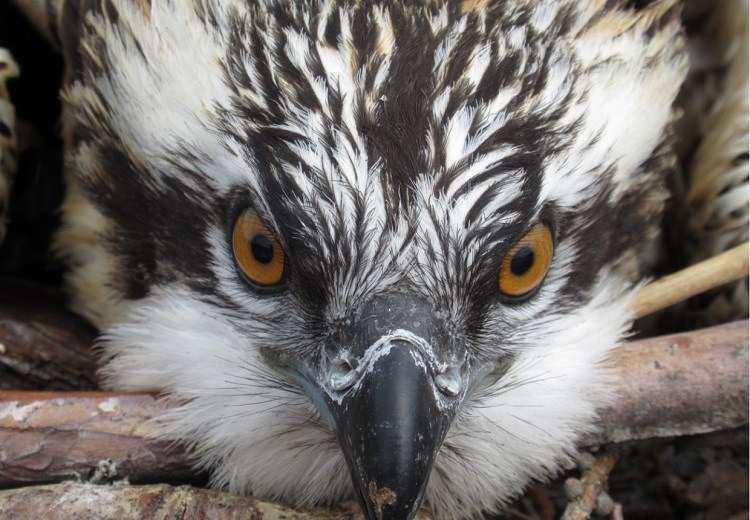
[Photo of an osprey chick by Lewis Pate]
This unfortunate accident has been picked up by the usual game-shooting trolls on social media who are, unsurprisingly, using this story to incite the usual anti-RSPB rhetoric and cast doubt on the professionalism of the ringers, including calls for them to be prosecuted! One of the main instigators is Bert Burnett of the Scottish Gamekeepers Association, who crassly headlined with this sensationalist nonsense:
“OSPREY DIES, RSPB INVOLVED”
and went on to say:
“Careless behaviour by ordinary members of the public connected to wild birds can and does result in prosecutions, will those responsible for this birds tragic death feel the weight of the law?“.
By ‘careless behaviour’ he’s presumably referring to the deliberate and pre-meditated actions of gamekeepers who have been caught illegally poisoning, shooting and trapping protected raptor species year after year after year, crimes which of course should lead to a prosecution. That’s clearly quite different from the circumstances of this osprey chick’s death.
Inevitably, the trolls’ faux outrage has quickly moved on to the malicious abuse of anyone involved in raptor tagging projects and includes calls for the satellite tagging of raptors to be halted on ‘welfare grounds’, despite an extensive review published last year that showed there are currently zero grounds for concern.
What happened to this osprey chick was an accident. A tragic, horrible accident. Mistakes can happen, and, as the RSPB blog states, there will be a review of the circumstances and all recommendations taken on board to ensure the chance of this happening again is minimised.
The ringing team will be devastated. These are qualified, highly skilled and experienced bird ringers, operating under a hard won licence, motivated by the opportunity to contribute towards osprey research and conservation. That an osprey chick died whilst in their care will probably haunt them for a considerable number of years.
The vitriolic response from the game shooting trolls is entirely predictable. They don’t like the idea of raptors being fitted with any sort of marker, and especially not satellite tags, because they know that the data being generated by those tags are all pointing, overwhelmingly, towards the illegal killing of raptors on grouse moors, despite the shooting industry’s best efforts to hide these crimes. Any opportunity they get to try and discredit the RSPB and raptor workers, they’ll take it, as we’ve seen today.
Oh, and let’s not forget, some of these trolls were actually begging to be allowed to ring raptors in the Cairngorms National Park not so long ago, presumably with the idea of taking control of the data and hiding it from public view (hiding stuff seems to be one of their special skills – we’re still waiting to hear what happened to the dead red kite found on an Angus Glens grouse moor back in February). Their hypocrisy is staggering.
Before the trolls hyperventilate from their latest bout of frothing hysteria, they might want to take a breath and read about another incident where a species of high conservation concern died as a result of an unfortunate miscalculation by an expert ringing team, this time employed by the trolls’ comrades at the Game and Wildlife Conservation Trust (GWCT).
We weren’t going to blog about this because, having read the associated reports and documents, it’s quite clear that, like the osprey incident, the outcome was unintentional, but given the abuse currently being thrown at the RSPB ringers and anyone else associated with tagging raptors, this other incident demonstrates that, sometimes, things can go wrong, mistakes can be made, and lessons will be learned.
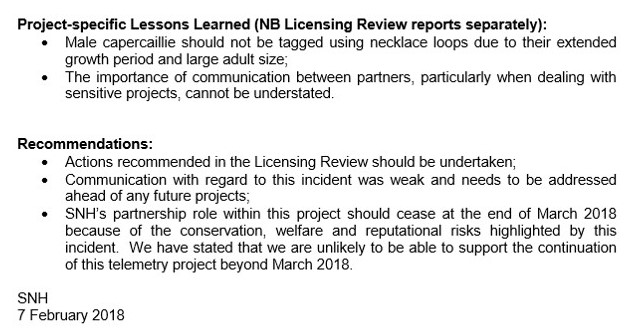
The case in point relates to a study of Capercaillie in the Scottish Highlands. Last year, staff from the GWCT fitted necklace radio tags to a number of Capercaillie, which resulted in the deaths of at least two male birds (a third bird has not been found). The necklace loops were the wrong size (way too large) and one bird got its leg caught in the neck loop and the other bird got its mandible caught.
Should we be calling for the prosecution of the GWCT ringing team? Should their licences be revoked? No, absolutely not. According to the reports we’ve read, the GWCT team quickly recognised their error and caught up the remaining tagged males and removed their neck tags. The incident was reported to the licensing authorities (SNH and BTO) who both conducted a thorough review and found that the ringing team had operated within the terms of the licences. The GWCT ringers didn’t deliberately set out to kill these birds, just as the RSPB ringers didn’t deliberately set out to kill the osprey chick. The Capercaillie died as a result of a miscalculation, nothing more, nothing less. Lessons have been learned, and as a result permission for anyone to fit tags to the necks of male Capercaillie has now been withdrawn (no such issues have been identified for female Capercaillie and special licences are still available for experts wishing to tag the females).
What was interesting about the Capercaillie incident wasn’t the actions of the ringing team, but the actions of the GWCT’s project management team. SNH raised serious concerns about this and as a result has now pulled out of this particular partnership. This news is of particular interest to those of us currently challenging SNH’s raven cull licence, as GWCT is heavily involved with the planning, data analysis and reporting of that ‘study’.
For those who will undoubtedly accuse us of peddling fake news, here are some excerpts from the SNH report:

What interests us about the Capercaillie tagging incident is the complete lack of publicity about these deaths, which occurred almost a year ago. This is a red listed species of high conservation concern, and yet we’ve only been able to find out about these deaths after several months of submitting FoI requests to various authorities.
Contrast the GWCT’s public silence with the RSPB’s response to the osprey death – a blog was published within a week of it happening.
But that particular point wasn’t our intended focus of this particular blog. Our point is that mistakes can be made, those fieldworkers involved will be inconsolable (whether they work for the RSPB, GWCT or anyone else), and none of them deserve to be on the receiving end of such caustic and malicious abuse, especially from those who work in an industry that doesn’t think twice about routinely and deliberately causing pain and suffering to wildlife, legally and illegally, in the name of a so-called ‘sport’.
 Raptor Persecution UK
Thanks for expanding what I knew. The osprey issue was highlighted by the RSPB in an open way and it is possible improvements may result. The small number of incidents in what is an enterprise which probably feels as hazardous to the ringers as it does to the ospreys, and produces excellent science from a group of people of whom many of us are in awe an grateful for their contribution to science.
Please explain the ‘excellent science’ produced. I’m unsure what this is.
You don’t think studying species migration and breeding patterns are worthwhile science? I suspect you are just spoiling for a fight and are arguing in bad faith here.
All ringers understand that their activities introduce extra risk to the birds they catch and handle, over and above the everyday risks that all wild animals face during their lives. Compared to the risks posed to birds by cars on the school run, say, or by holiday trips by air to exotic locations to watch birds, the ringer’s activities can then be put into perspective. The gains outweigh the losses.
There’s not much you can do to prevent road kill, unfortunately, but you have a choice about whether you ring birds or not. Please explain the gains.
Totally agree with all you have said and thank you . My heart goes out to the ringers they do an amazing job and take every care I know . This Berk sorry Bert has said the dead chick was put back in the nest can you please confirm for me and for the many people that has read his awful comments that this is not true (I don’t believe it but a few have :( ) .
I do put all your blogs on a osprey FB group I run and thank you for all you do
While I’m sure these deaths were accidental, there must surely be some level of incompetence involved in both the Osprey and Capercaillie incidents. I have witnessed myself a case of incompetent bird ringing activity involving a Blackbird trapped in a mist net for over half an hour. I know it was over half an hour because I photographed the bird struggling to escape and there was over 30 mins between my first and last image and the bird was already trapped in the net when I came across it. After 10 mins of watching this bird become more and more distressed, feathers becoming more and more dishevelled, it’s tongue snared in the netting to the point of bleeding, I decided to wait and see just how long it would be before some ”qualified, highly skilled and experienced bird ringer” would take to show up and relieve this bird from it’s plight. By the time he arrived the bird was hanging limply in the net, and had given up struggling. I thought at one point that it had actually died. By now I had become quite angry at what I had witnessed and challenged the ”expert” saying, ”About time, that bird has been there for over half an hour, your a bloody disgrace !”. His response was, ”No it hasn’t, and anyway, it doesn’t do them any harm”.
When done properly, maybe the effect might be minimal, but this bird was close to death and who knows whether it survived or not.
This incident prompted me to research bird ringing more deeply and I came to the conclusion that because the recovery rate is so miniscule and the amount of ‘new’ information gained these days isn’t great, the thousands and thousands of birds ringed each year can not be justified. Particularly when you consider the prime ring period is during the Spring migration. When birds have flown thousands of miles to get here and are probably at their most vulnerable and should be refuelling and conserving energy, the last thing they need is to be fighting to free themselves from a mist net, whether it be for 1min or over 30mins.
Ospreys are one of the few success stories in recent times, having gone from one breeding pair 50 odd years ago, to around 225, ( 2017 BTO ). I know of 6 sights within 1hrs drive of my home now. 5 of the 6 are subjected to disturbance by bird ringers each year. I can’t see how this benefits the birds. Surely now they have re-established themselves they are best left alone.
For starters, they haven’t re-established themselves across most of the UK (the entire Welsh population is four breeding pairs, there are no nesting birds in England south of Rutland and none in Northern Ireland).
Ringing and GSM tagging allow us to understand where these birds migrate to, what their return rates are (crucial in a species with a return rate of only 30%), where they return to and which birds are nesting on which nests with whom.
Understanding these things is crucial to a European-wide re-population plan which involves a series of trans-locations which aim to be far enough apart to establish breeding populations in each location while being close enough that some birds will settle in the next population, thus maintaining genetic diversity. These programmes are proving successful, but there is still a lot of work to do (for example there are only four breeding nests in Italy and the first nests from the Spanish trans-locations have only started breeding recently) . In the UK we are only in year two of a five year translocation at Poole which is designed to bridge the gap between Rutland and the Ille-de-France population.
Finally, Ospreys are also generally a safe species to ring since the chicks generally practice thanatos once the parents make the alarm call, leaving the main issue being one of accessing the nest itself. So there is a considerable upside vs what historically has been very little risk.
Many of your assertions about ringing are also incorrect in relation to Ospreys. Ospreys are ringed at their nest before they fledge so migration, refuelling and conserving energy are not a factor. Because they have not fledged I’ve never heard of them being netted (I believe a tiny number of birds who are GSM tagged may have been netted since I think some juvis have fitted with tags). Normally they are ringed in the nest, or lowered to ground in holdalls and ringed at the base of the nest. I don’t have a national recovery rate to hand, but for nests in the public domain probably 20-30% are identified returning to the UK and I know of individual breeding pairs where its 50%.
I know how Ospreys are ringed. Obviously they are not trapped in mist nets. I was referring to the birds that ARE trapped in mist nets, like the unfortunate Blackbird. Sorry if that wasn’t clear. Yes we have gained some knowledge from ringing, but it seems to me that a lot of birds are being ringed for no justifiable reason. For example, according to the BTO, up to and including 2016, the total number of Blue Tit ringed was 4,287,203, 43,363 of which were subsequently re-trapped, (1.01%), and only 529 recovered, only 0.01%. What more is there to know about Blue Tits that we don’t already know, that can justify ring any more Blue Tits ?
Duncan, I’m working on the basis that you figures for blue tit ringing are accurate. The value of such work showing small returns and recovery are twofold. First, it gives an indication of how big the population is. A larger return proportion would suggest a smaller population. Therefore, the second point, long term and continuous ringing allows us to monitor trends, so that any rapid change is quickly picked up, allowing the possibility of prompt action to be taken.
In reference to your anecdotes about the blackbird caught in the mist net, your course of action astounds me. You talk about welfare, and yet you stood by and observed this suffering. I suggest you could have taken your photo, presumably with time record, release the bird (without damaging the net), then waited for the ringer to arrive, explain what you had done, and reported this to the BTO. Your failure to do so makes you equally culpable in that suffering.
Rather than standing around waiting and doing nothing, why did you not approach the ringers if you knew where their base was? Most ringers would listen to the concerns of a passer by and take action, even if there was no actual welfare risk to the bird.
Chris, Duncan has asked, in a very reasonable manner, for answers to his queries.
As you are probably aware, mist nets are a devil to untangle especially when a bird is already tangled in them. Trying to untangle a trapped, struggling bird can be difficult and obviously cause the bird distress. I applaud Duncan for caring for the welfare of that blackbird. Clearly Duncan cares deeply for that poor blackbird, just as much, I am sure, the RSPB ringer cared about the Osprey that died.
I myself once tried to release a bird from a mist net in a public park where dogs were running around and children playing nearby. It was upside down and completely wrapped in the net. I tried without success to release that poor bird. I must have been in the park for at least 30 minutes. Without scissors or damaging that net, it was impossible to release that bird. In fact there were loads of birds trapped in a huge line of nets easily hundreds of yards long. No one was around to ask for help, release or ring the birds. I left the area, depressed and angry at the negligent and cruel way those birds were treated. Just because something is done for scientific purposes doesn’t make the method ethical.
Duncan took the appropriate action to record an offence – record but don’t interfere. Report the incident to the appropriate person to deal with.
Lessons need to be learnt from these terrible incidents. It simply should not be possible for netting to take place without sufficient people to immediately deal with the trapped birds and, if that’s not possible, well perhaps Duncan’s ethical position should be considered.
You suggest I should have released the bird myself, ‘without damaging the net’. Well according to the BTO, ”Birds can only be removed safely from mist nets by experienced ringers who have received special training”. So that was out of the question. And what do you suppose would have happened if the ringer had arrived as I was in the process of trying to extricate this bird ? You can be pretty sure he wouldn’t have been best pleased, and it would have been ME being accused of committing an offence.
Just for the record, it was reported to the BTO, who said there was nothing they could do because the ringer would just deny it ever happened, ( despite my photographic evidence ). They also asked that I remove the photograph I posted from public view as ”some people may find it upsetting”. Hopefully something was said to this ringer to warn him of his future conduct, or indeed that my verbal altercation with him was enough to make him more vigilant in future.
If my actions make me ”equally culpable” in the Blackbirds suffering then I truly sorry, but I can assure, it will not happen again.
The figures quoted are the BTO’s own figures and can be viewed here; https://app.bto.org/ring/countyrec/results2016/ringBI2016.htm
You admit to standing there, watching a bird suffer(allegedly), without lifting a finger to help or to alert somebody, just to make a point?
What a sickko.
I bet Duncan didn’t expect to be waiting for long for the ringer to release the bird! When the ringer arrived, he did alert the ringer! Surely the ringer was the person responsible for the suffering of this poor bird, not Duncan.
What do you think of ringers. Suffering of netted birds is inevitable.
Quite simply, satellite tagging has told us where a wide range of birds migrate and winter. Losses of feeding points – and obviously wintering areas – are critical to their future survival, whilst events in wintering areas can inform us of causes for fluctuation in population which may not be related to events on the breeding grounds – for example, drought in the Sahel.
And, as any experienced ringer knows, most birds are quite calm in the net until the ringer approaches to extract them – or someone hangs around photographing them.
If you are implying that my presence was in any way affecting the birds behaviour I can assure you that was not the case. My photos were taken from some distance away using a telephoto lens. In any case, the Ringers should not have left their nets unchecked for over half an hour when they were only yards away in their hut.
Duncan, why did you just sit and watch the bird ‘suffering’ and not try to find someone to sort it out?
In my opinion, all birds that are caught in mist nets suffer and are potentially injured – whether it happens in the UK or Cypress, whether it is set up legally or illegally, whether the bird is still or struggling, whether the bird is trapped for seconds or minutes or worse still. I think they’re terrible things. However, in certain circumstances, they are legal in the UK.
These situations can be tough calls. Duncan was a considerable distance away and I assume he didn’t want to distress the bird further by approaching it. I think it is fair to expect the ringers to check the nets at short intervals. I assume Duncan shared that view. Perhaps he could have tried to find the ringers earlier but these are one off situations where you try your best to make the right decision. Duncan took what he felt was the best action – photograph the incident and report it both to the ringer and BTO.
The ringers are to blame for the suffering not Duncan!
In addition, the BTO’s response was terrible. That lack of action and feedback deserves criticism.
Every time a tree or crag is climbed there is risk to both the birds and the climber.
And because every tree and crag is different accidents can happen.
Of course those that seek to persecute wildlife will attempt to capitalise on this incident for their own benefit.
Well done to all those involved in conservation and science particularly if that involves personal risk to their own safety.
Keepers forcing meds down a grouse in the middle of the night never kills birds.
Keepers footering with waders eggs never causes disturbance .
Keepers never disturb protected nests.
Keepers never loose poults in transport,
Keepers never have a by catch in traps.
Aye right…. They are professional killers that dont give toss for anything but their tips. Carnage is their stock in trade.
Then there are the doo men that kill thousands of pigeons as part of their game…but cry foul if they think they loose one to nature.
Countryman:- they kill and maim everything they claim to have an interest in -but they do it intentionally.
Was the Capercallie incident referred to the Police or Procurator Fiscal? Not saying it should be, but wondering if it was.
Did the GWCT make a mistake or were they incompetent ?
I think it would be interesting to find out if the collar size was specified in the licence? Did they know it was the wrong size in advance? Did they actually check against the methodology?
Did the supplier send the wrong size? Or did they simply have some old collars lying around an decided “these will probably do, what harm will come of it?” “(We are only a wee charity and have to cut corners here and there).”
What it does do, is highlight a possible lack of competence.
So when considering a later licence application… say for culling ravens… SNH would have grounds to question the rigour of GWCT of an organisation capable of following a strict methodology for collecting data.
Imagine the scandal if GWCT said they had coordinated the collection of a full years base line data….only to be challenged and been forced to reveal they had only a fraction of the data they claimed!!!
Where does this leave SNH and their licence application system? A tad exposed?
I’m a Raptor keeper and I know beyond doubt if something can go wrong it will you can only learn from mistake’s and some cost more than others.Placing poison on carcasses traps on post that break the legs leaving it to die is no mistake, can’t understand how anyone can do this for profit you need help.I’m sure the lessons that can be learned Will be by tag team,something I’m sure will not happen and that’s the unlawful killing off birds prey, after all you can’t put a brain in a coconut.
Not only can mistakes happen, but with any human based system; they inevitably happen. Procedure and procedure review tries to minimise the number and put the maximum time possible between mistakes, but they will happen eventually. It is just how the world works. As long as the mistakes are outlier numbers then it is well within bounds of acceptable levels. The idea that the only acceptable number of mistakes, in any field whatsoever, is zero is pure fiction. We shouldn’t ever have to explain that to people, it is the sort of thing that people ought to know as a baseline for human interaction.
In fact even fiction is more realistic than those people who insist the only acceptable level of mistakes is zero.
“It is possible to commit no mistakes and still lose. That is not a weakness; that is life”
— Star Trek: TNG “Peak Performance”.
I do not agree. The only figure for acceptable mistakes is zero. This should always be the target. Realistically, we all know that mistakes will occur – but this does not make them acceptable.
Then you are setting people up to fail, and encouraging a “can’t win, don’t try” mindset among the workforce.
Not at all. What is wrong in aiming for 100% perfection? We won’t always achieve it, but we should try. I simply do not understand your argument.
So what do you do when the inevitable happens then? I’ve seen where that leads, it leads to good people being fired for not succeeding the unachievable. Everything has an error rate above zero, unless you accept that then your initiative has failed right out the gate. Surgeons have acceptable loss rates, Nasa has acceptable loss rates, barristers have an acceptable loss rate, engineers have acceptable loss rates, Dumbledore had an acceptable loss rate (although his was disturbingly high). You benchmark the acceptable loss rate, work to improve it sure, but don’t try and deny that it won’t exist. You can still pursue that impossible perfection and also acknowledge that there is an expected failure rate.
What a fantastic opportunity to educate the wider public who have no understanding of raptor ecology !
Always regrettable when these very rare accidents occur but any rational person understands the benefits that ringing has provided in raptor conservation, through unravelling the complex lives of these birds & contributing to the massive resurgence in their populations in the UK for most species.
Despite the attentions of some game keepers and pigeon fanciers of course !
At least 50 % of raptor chicks die in their first winter, so very few ever make it into the breeding population !
Lets get the facts out there and educate people.
Keep up the pressure !
Has anyone collated any figures? An accident rate per 1000 ringings might be revealing. I’m talking raptors here, not netting. I hope & trust such accidents will turn out to be pretty rare.
This will be bloody awful for the tagging team, as I am terrified of heights I wouldn’t be capable of going up the tree at all, having to do the work they do at that height must be very demanding and I’m amazed incidents like this don’t happen more often, but of course if they did ringing wouldn’t happen. So good of you RPUK to only mention the GWCT tagging story in relation to this one to put things in perspective – and to express sympathy for their ringing team. The other side wouldn’t have done this and they never seem to recall that the GWCT is involved in sat tagging woodcock, selective amnesia and goal post moving are their forte.
https://ww2.rspb.org.uk/community/ourwork/b/scotland/default.aspx “In more than 50 years of ringing osprey chicks in Scotland, this is only the second incident we are aware of where an osprey chick has died as part of the ringing procedure.”
It is so sad that this has happened – the ringers will NEVER be able to forget irrespective of any recommendations that may or may not be made as a result.
So why are the RSPB staff not facing criminal prosecution? The Nobile Officium of the Court of Session and the High Court of Justiciary ruling HCA/2017/000009/XM stated animals have rights at common law in Scotland!!