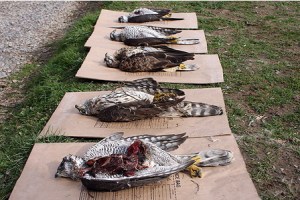
Four goshawks and a buzzard found poisoned

The RSPB has put up a reward of £1,000 for information about the deaths of four goshawks and one buzzard which have been found poisoned in Devon. They were discovered in Forestry Commission woods near to Exeter and had been poisoned with the bannned pesticide Carbofuran.

A recent survey suggests that there are no more than 20 breeding pairs of goshawk in Devon.

Ian Parsons, a Forestry Commision ranger, said: “The people that do this to our wildlife not only deprive people of the chance to see these rare birds but they also put the public at risk. The poison involved is lethal to dogs and humans and the land where this happened is open to the public. These people obviously don’t care about the dangers of doing this“.

Anyone with information about these crimes is urged to call Crimestoppers, in confidence, on: 0800-555-111, or email Devon & Cornwall Police Wildlife Crime Officer P.C. Josh Marshall directly: Joshua.MARSHALL2@devonandcornwall.pnn.police.uk

PC Marshall said: “We rely on the public to be our eyes and ears in wildlife crimes such as this. If anyone knows anything about this, please get in touch“.

BBC News story here

Western Morning News article here

Poisoned raptors ‘flung from vehicle’

Police are investigating after four birds of prey were poisoned and dumped in a lay-by in Midlothian, according to a report in today’s Scotsman.

Two buzzards and two sparrowhawks were found by a dog walker next to the A68, south of Pathhead, a few miles from Edinburgh, on Monday 5th September. They are believed to have been killed by ‘industrial grade chemicals’ and thrown from a passing vehicle. The bodies are currently undergoing toxicology tests to determine which poison was used. The police are asking anyone with information to contact them.

Well done to Lothian & Borders police for publicising this incident in a timely manner.

Scotsman article published here and reproduced here:

Scottish Police are investigating after four birds of prey were poisoned and dumped in a remote lay-by in Midlothian. Two buzzards and two sparrow hawks were found by a dog walker next to the A68, south of Pathhead, after being killed with what is thought to have been industrial grade chemicals.

Police believe the birds may have been thrown from a moving vehicle as it drove past the stop point and appealed for any witnesses to help.

The incident comes just weeks after the Evening News told how officers were still hunting criminals who killed two peregrine falcons and took the head of one as a trophy.

Pc Hannah Medley, Midlothian wildlife and environmental crime officer, said the birds in the latest incident were discovered on Monday, September 5.

“It appears to be two sparrowhawks and two buzzards which have been dumped, possibly thrown from a car, in a lay-by on the A68. We’re appealing for any witnesses who may have seen anything in the area on that day. We’re still waiting to find out what the poison is, but these poisoned baits are often fairly strong and would be well capable of killing a family pet.”

She added: “It’s very unusual for this to happen in Midlothian, and we haven’t really had anything like this recently. I’d say to anyone who knows what has happened to contact police. It could possibly be a car speeding off or anything suspicious in the area that didn’t look quite right.”

The incident also came as the Royal Society for the Protection of Birds Scotland prepares to publish its annual report into illegal killings of birds in Scotland last year.

The report includes details of golden eagles and red kites, and a raid on an estate in Sutherland in which 10 kilos of lethal poison were found.

Ian Thomson, investigating officer at RSPB Scotland, said: “This is an absolutely heartless crime and the fact that people are still committing this kind of acts in 2011 is disheartening. This case is very unusual, why someone would want to dump these in a lay-by isn’t clear. One of the key things coming from our annual 2010 report into illegal killings of birds is the amount of illegal poisoning that is going on. We’ve seen four golden eagles, seven red kites and these are just the ones found”.

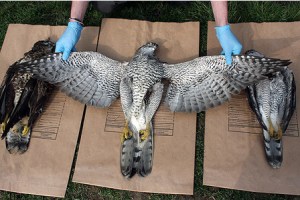
UPDATE June 2012: SASA toxicology results have confirmed all four birds were poisoned with Carbofuran.

 

Here come the soundbites…

They’ve started already. Landowner and game-shooting representatives are responding to yesterday’s publication of the RSPB’s 2010 persecution report. We’ll add to this page throughout the day as the predictable denials and counter claims emerge…
Here is the reported response from Douglas McAdam, chief executive of Scottish Land and Estates (formerly known as SRPBA), which represents about 2,500 landowners in Scotland:

Landowners are working hard in partnership with police and other organisations to help eradicate this. This requires a sustained approach over time and there is evidence these joint efforts are beginning to pay off. There has been a significant decrease in illegal poisoning incidents in the first half of this year at a time when some species are increasing rapidly and now number tens of thousands, the highest overall for nearly a hundred years. It is regrettable that RSPB, who are part of that collaborative effort, continue to point fingers at a time when real progress is being made. Many more birds were killed accidentally by agricultural rodenticides than by deliberate poisoning“. (See BBC News for quote here).

Some readers might get a sense of deja vu when reading that. If the words sound vaguely familiar its because you’ve heard them before, almost verbatim, last month from Luke Borwick, Chairman of Scottish Land and Estates, who was responding to the SASA 2010 poisoning report:

Landowners are working hard in partnership with police and other organisations to help eradicate poisoning. This requires a sustained approach over time and there is evidence these joint efforts are beginning to pay off. Early indications for the first half of 2011 show there has been a significant decrease in illegal poisoning incidents at a time when some species are increasing rapidly and now number tens of thousands, the highest overall for nearly a hundred years. This decrease is welcome, reflects serious partnership working in this area and needs to be sustained“. (See quote on Scottish Government website here, and this is what we had to say about his quote here).

Come on Scottish Land and Estates – less of the soundbites and a bit more spontaneous sincerity wouldn’t go amiss.

RSPB publishes 2010 raptor persecution report

The RSPB has just published its annual report on raptor persecution in Scotland. The report, ‘The Illegal Killing of Birds of Prey in Scotland 2010‘ is the only known published record of all known persecution incidents including poisoning, shooting and trapping, in contrast to the PAW Scotland annual report which only details poisoning incidents. As well as the confirmed incidents of persecution, the report also provides information about ‘probable’ incidents (those where the available evidence points to illegality as by far the most likely explanation but where the proof of an offence is not categorical) and ‘possible’ incidents (where an illegal act is a possible explanation but where another explanation would also fit the known facts).
The report provides details of several confirmed and probable persecution incidents that didn’t make it into the public domain at the time they occurred, including two shot sparrowhawks (Dingwall, Inverness-shire & nr Dolphinton, South Lanarkshire), a goshawk killed in a pole trap (nr Dalwhinnie, Inverness-shire), a shot short-eared owl (Leadhills, South Lanarkshire), 5 separate incidents involving peregrines (Stirlingshire, South Lanarkshire and Dumfries-shire), ‘disappearing’ hen harrier chicks (nr Knockando, Moray), a member of the public witnessing the shooting of a buzzard (nr Leadhills, South Lanarkshire), the discovery of a heavily decomposed buzzard carcass found in a stink pit (nr Dornie, Inverness-shire) and the discovery of a suspected pole-trapping site (nr Dornie, Inverness-shire).

Interestingly, although the report doesn’t go as far as naming estates in most incidents (apart from the reports of successful prosecutions), it does go further than the vague information provided in the annual PAW statistics. For example, in the PAW Scotland ‘Bird of Prey Poisoning Incidents 2006-2010 – Incident Details’ report (that we discussed here in March 2011), there are several cases of buzzard poisoning that were just listed as ‘Tayside’. The RSPB report clarifies this a little bit, and lists the locations as ‘Glenogil’ and ‘nr Kinross’.

This annual report makes for grisly reading, but as the report says, these incidents no longer shock or surprise us. The evidence yet again points to the involvement of people within the game-shooting industry; the latest statistics show that of all those convicted for illegal raptor persecution in Scotland between 2003-2010, 88% were involved with gamekeeping (the rest involved pest controllers, farmers and pigeon racers at 4% each).

The RSPB makes several recommendations in the report that would considerably reduce the difficulty of bringing these criminals to justice. They include recommended action for the police, the crown office & procurator fiscal service, the Scottish government, and representatives from the game-shooting industry. Some of these recommendations have been made before but have apparently remained unheeded.

Well done to the RSPB for publishing this report and for keeping the issue high on the political and public agenda.

The report can be downloaded here

Poisoning whodunnit? Police forensic scientist has no-eyed deer

Pioneering research in Scotland may lead to a new approach in detecting the perpetrators of wildlife crime. A new study has shown that low levels of human DNA can sometimes be retrieved from the carcasses of dead animals – in this case dead deer.

The original idea to look for human DNA on dead animals came from James Govan, a forensic scientist with the Scottish Police Services Authority, who was looking at ways of addressing the problem of bird of prey poisoning. He is reported to have said the following:

It’s a horrendous problem, and nobody quite knows who’s doing it or why. Sometimes farmers are blamed, sometimes gamekeepers are blamed – but I associate with quite a few gamekeepers and most of them detest it, so it’s a mystery.”

Oh dear. Let’s hope his forensic skills are more impressive than his comprehension skills.

The researchers behind the new study (‘Recovery of human DNA profiles from poached deer remains: a feasibility study’) claim that this technique may be useful to identify deer poachers in the UK, as well as endangered species poachers in other parts of the world. They also suggest it has the potential to be used on other evidence collected in wildlife crime investigations such as feathers, eggs, snares or traps. This is encouraging news, although others have cautioned that the technique has yet to be tested on samples that have been exposed to the elements for any length of time, which may or may not degrade the quality and quantity of available DNA.

The study abstract can be viewed here

BBC news story here

Science Daily article here

SGA extends pointless rant about sea eagles

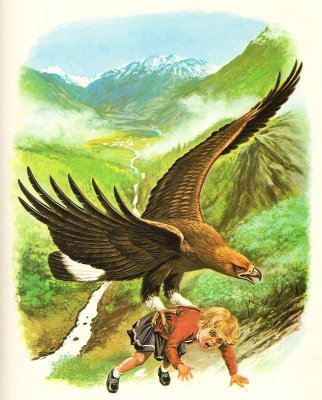
Last week the SGA wrote to the Scottish Government about the threat of sea eagles eating children. The Scottish Government effectively told them to sod off, although not using those exact words, of course. The letter (or at least the snippets that we were privy to) caused astonishment around the world – a common response was, “What’s wrong with these people?” 
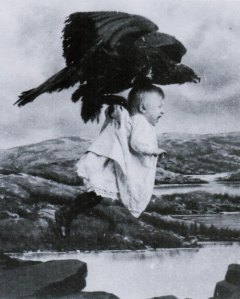
However, not to be deterred, the SGA is still pursuing answers to its earlier questions. In an ill-disguised attack on the RSPB, Bert Burnett switches from the ‘eagle might eat child’ approach (although he doesn’t discount it entirely), and instead focuses on what he calls the “considerable direct damage being done to farmed stock by these eagles“. What considerable direct damage?, you may ask. It’d be a good question. Claims of this nature have been made before, notably by sheep farmers on the west coast (see here). However, several scientific studies later, the evidence demonstrated that sea eagles have a ‘minimal impact’ on lamb survival (see here), although when the results didn’t go their way then the crofters claimed the study was rigged (see here and here). Has Bert Burnett got new evidence to back up his claim of ‘considerable direct damage’? If he has, he needs to share it. Put up or shut up, Bert.

Bert’s latest rant is accompanied by two emails from some random individuals. I’m not sure why they were included. I wish he’d shared the following message, which was posted on the SGA Facebook page in response to their ‘eagle could eat baby’ story:

If a sea eagle introduced by the RSPB carried off and ate a human baby, would the RSPB be guilty of murder? I think so.” Priceless.

To read the SGA’s latest rant about sea eagles, click here.

Remony Estate provides safe haven for golden eagles

Remony Estate in Perthshire has joined a very small group of Scottish sporting estates known to actively support breeding populations of raptors on their grounds. Following in the footsteps of estates such as Coignafearn and Glen Tanar, Remony, near Aberfeldy, has provided a safe haven for a species not often tolerated on a working grouse moor – the golden eagle.

This year a pair of golden eagles was allowed to breed successfully and without disturbance at Remony, resulting in the production of two healthy offspring. One of the youngsters has been collected under licence to join the on-going effort to re-introduce the golden eagle to Ireland.

For the full story, click here.

Congratulations to Remony Estate owner, James Duncan Miller, and his team of gamekeepers, for showing the rest of their industry that raptor conservation and grouse moor management need not be mutually exclusive activities. They deserve to be recognised and acknowledged for their efforts.

Remony Estate website here

“Alarmist nonsense from the SGA”, says RSPB

Just in case there was any doubt, the RSPB says that the SGA’s concern over whether a sea eagle could differentiate between a child and its natural prey, is “alarmist nonsense”.

Bert Burnett of the SGA is reported by the BBC to have said: “Some might think this is gamekeepers making a fuss for some obscure reason. That’s not the case. It is a genuine concern felt by other people out there other than gamekeepers“. He didn’t elaborate about who these ‘other people’ are and whether or not they have game-shooting interests.

Don’t worry about being misunderstood Bert, I’m sure everyone can work out what the agenda is.

BBC news story here, including the response from the Scottish Government.

sea eagle snatches vicar from RSPB reserve

In a shock news release, Songbird Survival is reporting that a rare white-tailed eagle has snatched a vicar from the RSPB reserve at Abernethy Forest and taken it to feed its young.

Go here to read the full story.

Brilliant writing by John Hague, aka the drunkbirder.

SGA turns up the hysteria on sea eagles

A couple of weeks ago a clergyman in Perthshire reported being ‘attacked’ by one of the recently reintroduced sea eagles – his story received widespread coverage in the national press (eg see here, here, and perhaps the best one here, where the clergyman hints that sea eagles could attack and kill a baby in a pram!).

Today, the Scottish Gamekeeper’s Association has joined in with the hysteria and says it has called for a public enquiry into the impact of reintroduced species (see here). The SGA has apparently written to the Scottish Environment Minister, and asked: “Will these very large creatures differentiate between a small child and more natural quarry?” – see BBC news article here.

Wow. This sort of propaganda was common about 100 years ago when people didn’t know any better. Is it any wonder that raptors continue to be illegally poisoned and shot in this country when the industry figureheads are still spouting this nonsense?

What next? A call for licences to ‘manage’ [kill] sea eagles?