Further to yesterday’s news that criminal gamekeeper Paul Allen had escaped a custodial sentence despite committing multiple wildlife, poisons and firearms offences whilst employed on the Shaftesbury Estate in Dorset (here), the RSPB has issued the following press release:
Gamekeeper fined as dead birds of prey and poisons found on Dorset estate
Gamekeeper Paul Allen (54, of Baileys Hill, Wimborne St Giles) appeared at Weymouth Magistrates’ Court today (16 February 2023) following a guilty plea last month relating to multiple raptor persecution offences.
He was sentenced to 15 weeks in prison, suspended for 12 months for the possession of the buzzards, a £674 fine for failing to comply with firearm regulations, £1,348 for the chemical storage and usage offences, and told to pay £884 compensation [Ed: to Wild Justice’s Raptor Forensics Fund] to cover the cost of the x-rays and post-mortems for the bird carcasses.
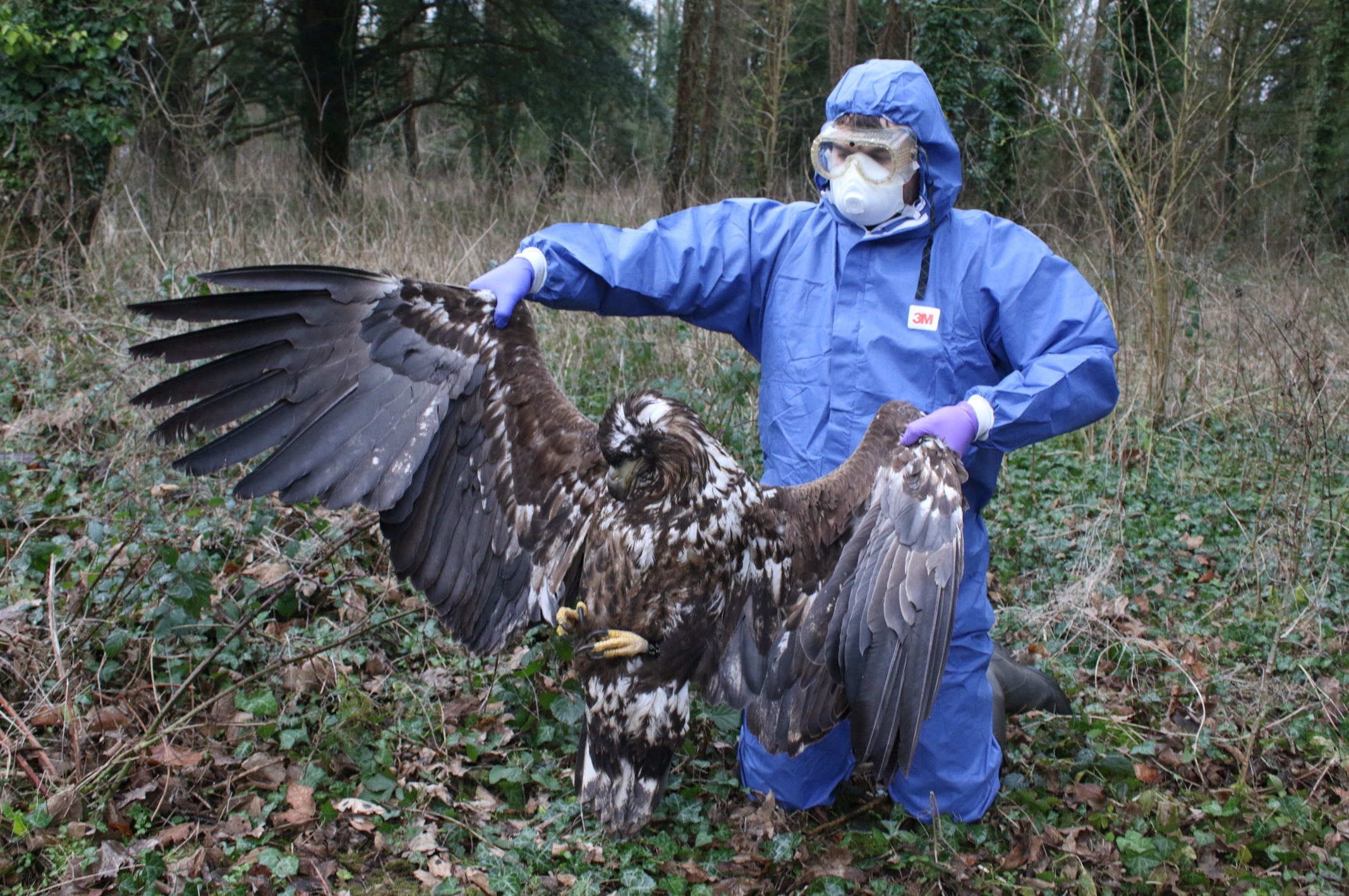
The bodies of six shot Buzzards and the remains of three more were discovered in Allen’s yard on the estate in 2021, after a poisoned Red Kite was reported to Dorset Police by a member of the public. The kite contained high levels of brodifacoum, the deadliest rat poison on the market, which also shockingly killed a White-tailed Eagle in the vicinity 10 months later.
The poisoned red kite that triggered a multi-agency search on the Shaftesbury Estate in March 2021, which uncovered gamekeeper Paul Allen’s widespread criminal activities. Photo: RSPB
The search of Allen’s land also uncovered stashes of deadly poisons, including the pesticide bendiocarb – which has been abused for deliberately killing of birds of prey for years – two bottles of the banned substance strychnine, two tins of the banned poison Cymag and the toxic rodenticide brodifacoum. There was also a loaded gun left propped behind a door in Allen’s home.
Allen pleaded guilty to the possession of the dead Buzzards and the poisons.
All birds of prey are protected under the Wildlife and Countryside Act 1981 and killing them is against the law, punishable by an unlimited fine and/or jail. In November, the RSPB published the Birdcrime report 2021, which revealed 108 confirmed incidents of raptor persecution in the UK. 71% of these occurred in relation to land managed for gamebird shooting.
A satelite-tagged White-tailed Eagle, poisoned with seven times the lethal dose of brodifacoum, was found dead 10 months later on the same estate, although it is unknown exactly where it picked up the poison. However, in a disappointing turn of events, the investigation was unexpectedly and prematurely shut down by Dorset Police before a full follow-up search could take place, despite police knowledge that the same substance had been found on the same estate during the investigation at court today.
Mark Thomas, UK Head of Investigations at the RSPB, said: “It is clear that the use of the lethal rat poison brodifacoum needs much tighter regulation and controls over use, as it is clearly being both misused and abused to kill birds of prey. At the very least this product should be restricted to indoor use only, as it was before the Government relaxed its use in 2016. We also suggest that only accredited pest controllers should be able to use it in specific circumstances. If not, then the unnecessary increase in bird of prey deaths, including White-tailed Eagles and Red Kites, will continue.”
ENDS
In addition to this press release, RSPB investigations officer Tom Grose has written an excellent blog about the investigation on Shaftesbury Estate into Allen’s criminal activities, and has also provided some information about the poisoned white-tailed eagle that was found on the same estate 10 months later, the investigation that was prematurely cancelled by Dorset Police, despite them knowing all about Allen’s crimes on the same estate. To read Tom’s blog click here.
The RSPB’s investigation team has also produced a short video about both cases, which can be watched via their Twitter account here:
BREAKING – Dorset gamekeeper Paul Allen sentenced to 15 weeks imprisonment (suspended for 12 months) and fined £2022, after pleading guilty to possession of shot Buzzards and banned poisons, found by police on the Shaftsbury Estate, Dorset in 2021. pic.twitter.com/mFSqwMdXax
In March last year a young, satellite-tagged white-tailed eagle was found dead on the Isle of Wight in what were considered to be suspicious circumstances and a police investigation was launched (see here).
This was the third white-tailed eagle death since October 2021 and all three birds were from the Isle of Wight Reintroduction Project, a Government-backed five-year project bringing young sea eagles from Scotland and releasing them on the Isle of Wight to re-establish this species in part of its former range.
The two other dead eagles found during that period included the one found on the Shaftesbury Estate in Dorset in January 2022, which was confirmed to have been illegally killed by ingesting an extraordinary high quantity of the rat poison Brodifacoum but the subsequent police investigation was botched by Dorset Police (see here); and the eagle found dead on a game shoot in West Sussex in October 2021, confirmed to have been illegally killed by ingesting the poison Bendiocarb and whose death is currently the subject of an on-going police investigation (see here).
A preliminary post-mortem on the eagle found dead on the Isle of Wight revealed it was carrying avian flu, but at that time it was unknown whether avian flu had been the cause of death. Later tests revealed it had not.
The presence of avian flu has important consequences for how the corpse is handled and stored under strict government rules, and unfortunately this impacts on the ability to conduct standard toxicology analyses for other potential causes of death, notably the detection of certain poisons.
Last week Hampshire & Isle of Wight Constabulary issued the following statement about the death of this eagle:
Death of White-tailed Eagle remains uncertain after conclusion of police investigation.
A police investigation into the death of a satellite-tracked White-tailed Eagle on the Isle of Wight has found no evidence of unlawful killing.
It comes after Hampshire Constabulary were called shortly after 5pm on Thursday 24 February 2022 to a report of a dead sea eagle on Bowcombe Road on the Isle of Wight.
The circumstances surrounding the death were investigated by local Country Watch officers, along with the support of various partners including the Animal and Plant Health Agency, DEFRA, Forestry England and the Roy Dennis Wildlife Foundation.
Officers explored all possible lines of enquiry into the death, including; analysis of satellite tracking data, evidential land searches in and around the site where the bird was found deceased, obtaining accounts from witnesses in the local area at the time, comprehensive veterinary x-rays as well as conducting specialist post mortem examinations.
The bird initially tested positive for Avian Influenza (AI), but subsequent post-mortem examination carried out under strict AI protocols concluded that this was not the cause of death.
Standard toxicology testing was not possible due to the AI positive test, but the limited analysis that was undertaken did reveal elevated background levels of two rodenticides, brodifacoum and difenacoum, though not at sufficiently high levels to have caused the death of the bird. As such the post-mortem concluded that the actual cause of death of the White-tailed Eagle remains uncertain.
During the post mortem, there was no evidence of any lesions on the sea eagle to explain the cause of death.
Police Sergeant Stuart Ross of Hampshire Constabulary’s Country Watch team, said: “Hampshire Constabulary has carried out a thorough criminal investigation into the death of the White-tailed Eagle and have found no evidence of unlawful killing from the lines of enquires carried out and evidence gathered by officers.
“As such, we are satisfied that there is no evidence of criminal offences having taken place and that the death of the White-tailed Eagle is being treated as uncertain at this time”.
“The criminal aspect of this investigation has now concluded, but we urge all users of rodenticides, particularly brodifacoum, which is known to be highly toxic to wildlife, to follow all guidelines regarding use. Brodifacoum should only be used in and around buildings.”
The reintroduction of White-tailed Eagles on the Isle of Wight is part of a dedicated scheme run, under a Natural England licence, by Forestry England and the Roy Dennis Wildlife Foundation.
ENDS
There are no complaints about Hampshire & Isle of Wight Police’s handling of this investigation. They were responsive, thorough and transparent.
The police statement, above, is fairly detailed and informative. However, caution should be applied when interpreting the statement about the presence of ‘elevated background levels of of two rodenticides, brodifacoum and difenacoum, though not at sufficiently high levels to have caused the death of the bird. As such the post-mortem concluded that the actual cause of death of the White-tailed Eagle remains uncertain‘.
Whilst this is factually accurate, and I’m sure not intended to mislead in any way, readers should be aware that the storage of the eagle’s tissues in formalin (as required for AI positive birds) reduces the laboratory’s ability to determine the significance of these rodenticides.
Here is an excerpt from the final lab report:
‘It was suspected that this white-tailed sea eagle had been poisoned, or possibly exposed to anticoagulant rodenticides. Laboratory analysis for some likely pesticides has been undertaken on samples of fixed tissue only, although it is possible that typical abuse pesticides (such as bendiocarb) would not be detected within this sample type. These tests have detected and confirmed a residue of the anticoagulant rodenticides brodifacoum and difenacoum in the fixed liver from this eagle, but the significance of these residues is uncertain given the prior treatment of the sample with formalin. Therefore, the actual cause of death of this white-tailed sea eagle remains uncertain, but this result confirms that it had been exposed prior to death to brodifacoum and difenacoum’.
Unfortunately we won’t ever now know whether this eagle had ingested high quantities of rodenticides, or whether it had been poisoned with a banned substance such as Bendiocarb, because of the rules on the handling and storing of tissues containing Avian Influenza. And this may prove to be an issue that hampers other investigations if avian flu is detected in a raptor that has died in what are perceived to be suspicious circumstances.
But at least in this case, the police did conduct searches of the land where the eagle was found dead, and have also included a warning in their press statement about the proper use of rodenticides.
To follow news about the reintroduced white-tailed eagles please visit the Roy Dennis Wildlife Foundation website here.
A young white-tailed eagle, released into the wild as part of a conservation reintroduction project, has been found poisoned with the banned pesticide Carbofuran.
The National Parks & Wildlife Service in Ireland is appealing for information after the discovery of the dead eagle in November 2022 on land between counties Cavan and Westmeath.
The juvenile male white-tailed eagle who was just over a year old had been brought in as a chick in 2021 from Norway under phase two of a national re-introduction programme (e.g. see here and here).
It had been fitted with a satellite tag prior to its release on Lough Derg in 2021 and subsequent monitoring showed the eagle had been spending time around Lough Sheelin in Co Westmeath with two other white-tailed eagles, but tag data indicated the eagle had become stationary in November.
The corpse was retrieved and toxicology tests undertaken at the State Laboratory confirmed the eagle had been poisoned with Carbofuran, a deadly pesticide so dangerous it was withdrawn for use in Ireland over a decade ago.
NPWS regional manager, Maurice Eakin, said white-tailed eagles were a protected species under the Wildlife Acts. The death of the bird last November highlighted “once again” the extent of the illegal practice of using poisonous material as pest control.
“In this instance, it is particularly disturbing that the reckless laying of poison has resulted in the death of a white-tailed eagle, one of our largest and most majestic bird species, which had been persecuted to extinction by the early 1900s,” he said.
The NPWS is seeking any information from the public in the Westmeath/Cavan region, particularly anyone who may have seen anyone or any vehicles acting suspiciously in recent weeks in the area between Lough Sheelin and Lough Ramor.
Over 100 white-tailed eagles, donated by Norway, have been reintroduced to the Irish Republic since 2007, with the first successful breeding taking place in 2012 and there have been many successes over the last decade, bringing biodiversity and ecosystem benefits as well as a boost to local economies via ecotourism.
However, a scientific review of the reintroduction project in 2019 indicated that the small population was still vulnerable to illegal poisoning events so additional eagles have been reintroduced as part of phase two of the reintroduction to help bolster the population. It’s sadly ironic that one of those eagles has become the latest poisoning victim.
After today’s court case, where gamekeeper Paul Allen was found guilty of seven wildlife, poisons and firearms offences, including the possession of six shot buzzards and banned poisons in March 2021 (here), it can now be revealed that the poisoned white-tailed eagle that was found dead on a Dorset estate in January 2022 was on the very same estate – the very same estate (the Shaftesbury Estate) that Dorset Police u-turned on their decision to search during their botched investigation into the poisoning of that eagle (see here).
Now, before I go any further, there are a few things that need to be clarified before anyone jumps to conclusions and makes libellous comments. Firstly, and importantly, there is NO EVIDENCE to indicate that the eagle was poisoned on the Shaftesbury Estate. The eagle was found dead there, yes, that is a statement of fact. However, we know from the eagle’s satellite tag data that in the days preceding its death it visited two or three other estates in the area. We also know that the poison that killed the eagle (Brodifacoum) is not a fast-acting poison and that this eagle’s health deteriorated over a number of days before it died. It is quite feasible that it picked up the bait elsewhere but succumbed to internal haemorrhaging once it had reached the Shaftesbury Estate.
On the same lines, it is also important to clarify that there is NO EVIDENCE that gamekeeper Paul Allen had any involvement in the poisoning of the white-tailed eagle. He just happened to work on the estate where the eagle was found dead. My understanding is that the shoot that Paul Allen worked on, although located on Shaftesbury Estate, was not directly associated with the estate; it was a privately-run shoot (perhaps tenanted) that was not under the management of Shaftesbury Estate.
What is up for discussion though, is Dorset Police’s decision NOT to search the Shaftesbury Estate as part of their investigation into the poisoning of that eagle in March 2022, when they were already acutely aware of the offences that gamekeeper Paul Allen had committed on the very same estate, a year earlier.
Dorset Police’s (now former) wildlife crime officer, Claire Dinsdale, had organised a search of the Shaftesbury Estate after the toxicology results came back on that eagle. She was absolutely right to do so, whether earlier offences had been committed there or not. It’s a no-brainer. This is policing for beginners. You find a poisoned eagle, you go and search the location where it was found to see if there’s any evidence to identify a potential perpetrator. That these other raptor persecution offences were already under investigation on the same estate just ramps up the justification for another search, surely?
Why Claire’s decision to undertake a search was overruled by senior officers, who then repeatedly said, for months afterwards, that their decision not to conduct a search was ‘proportionate’ and that ‘there weren’t any new leads’ to justify a search, just beggars belief. Their decision to u-turn on the search was made despite representations from the National Wildlife Crime Unit (NWCU) and the RSPB, based on the eagle’s satellite tag data and decades of experience investigating raptor persecution crimes. Something happened to cause the police u-turn. But what?
There is a strong stench of something sinister going on at Dorset Police HQ.
I’m certain that this latest revelation will lead to more questions being asked of Dorset Police, and from a much higher authority than this little blog.
Dorset Police were never far from the headlines last spring and summer, thanks to their appalling, botched investigation into the poisoning of a white-tailed eagle, found dead on a game-shooting estate and containing seven times the lethal dose of the rodenticide Brodifacoum.
As a recap for new blog readers, the corpse of the young satellite-tagged eagle, which was one of the birds from the high profile reintroduction project on the Isle of Wight, was found on the unnamed shooting estate in January 2022. Dorset Police’s wildlife crime team, led at the time by the exemplary Claire Dinsdale (one of few officers awarded the Queen’s Police Medal for her work), undertook a multi-agency operation to retrieve the corpse, sent it off for toxicology analysis, and when the results came back in early February 2022, she set about organising a warrant for a multi-agency team to search the estate to look for evidence that might identify who was responsible for this serious wildlife crime. She also issued a public appeal for information (here).
The news of this eagle’s death made national news and led to some disturbing criticism of Dorset Police by local Conservative MP Chris Loder, who publicly declared that Dorset ‘wasn’t the place for eagles’ and argued that the police should be focusing their resources on other types of criminality and not on suspected wildlife crime (see here). It also emerged that Chris Loder had some interesting connections with at least one prominent Dorset estate from whom his local party had received considerable donations, although it wasn’t known whether funding had been received from the [unnamed] shooting estate where the eagle had been found poisoned (see here).
By the end of March 2022, Dorset Police issued an astonishing statement, claiming that the toxicology results were “inconclusive” (actually they were anything but!) “and it has therefore not been possible to confirm that any criminal offence has been committed…..As a result, no further police action will be taken in relation to this report“.
This decision to prematurely pull the planned search and close the investigation made no sense whatsoever, including to the RSPB (here) and it even led to questions being tabled in the House of Lords (here). It was a ludicrous situation. For this dead eagle’s liver to contain seven times the lethal dose of Brodifacoum (i.e. seven times the amount needed to kill a bird the size of an eagle), it could only be the result of either (a) mis-use of the rodenticide or (b) deliberate abuse of the rodenticide. Either way, these are both offences and deserved a full investigation, especially given Dorset’s reputation as a bird of prey persecution hotspot (see here). For Dorset Police to effectively pull down the shutters and shout ‘Nothing to see here’, without conducting a search, looked very dodgy indeed.
Around the same time news also emerged that Claire Dinsdale QPM had gone on ‘long-term sick leave’ with stress and, strangely, Dorset Police’s Rural Wildlife & Heritage Crime Team had a name change, which happened just after MP Chris Loder’s Twitter outbursts about Dorset Police spending time investigating wildlife crime. The words ‘wildlife’ and ‘heritage’ were completely and mysteriously removed from the name, which had now become ‘Dorset Police Rural Crime Team’ (see here).
There followed months of protracted aggro, as FoIs were submitted to Dorset Police who first ignored them (e.g. see here) and then subsequently refused to provide the requested information (e.g. see here), even after appeal. Many people were asking whether there was evidence of political interference by Chris Loder MP and the Dorset Police & Crime Commissioner David Sidwick, influencing Dorset Police’s decision to drop the investigation. All parties denied this, of course, and no hard evidence has emerged to answer the questions, but Dorset Police’s refusal to answer FoI questions simply left these concerns hanging in the air like a bad smell.
Dorset Police then attempted a futile damage limitation exercise where they claimed their decision to prematurely close the investigation before conducting a search was ‘proportionate’ (see here) and then they claimed to have undertaken a review (effectively marking their own homework) which concluded that there was ‘insufficient evidence’ and ‘no outstanding lines of enquiry’ to progress the case. Well of course, if you fail to conduct a search you’re not going to find any evidence, are you?!
In August news emerged that Wildlife Crime Officer Claire Dinsdale QPM had left Dorset Police and was now working at the National Wildlife Crime Unit.
On 7th October 2022, Dorset Police published another statement about this botched case, probably in response to the ongoing criticism that simply refused to go away. The new statement, issued by Dorset Police Assistant Chief Constable Rachel Farrell (here), just reinforced the earlier denials of dodgy policing and repeated the line that, “…there was insufficient evidence to prove an offence of wilful poisoning by an individual – so no one person can be proven to have been criminally responsible for the bird’s death“.
On 16th November 2022, coinciding with the publication of the RSPB’s latest annual Birdcrime report, Claire Dinsdale posted a remarkable comment thread on Twitter as follows:
Tweet 1:2020 – a series of concerning incidents in Dorset stood out to me & colleagues from various agencies. Progress was being made with multi agency searches & raising nationally at our Bird Of Prey PDG (Priority Delivery Group) meetings. It is clear to anyone with a basic understanding of wildlife crime that Dorset had a problem.
Tweet 2:Up until early 2022, there was thankfully no-one interfering with these specialised cases. Policing must be objective & not influenced by threats or pressure from other parties or their own officers. Without fear or favour. So no surprise to see Dorset is 2nd worst county in UK Bird Of Prey Crime 2021 data, with only 1 less than the No 1 slot.
Tweet 3:I hope lessons will be learned by those who made serious errors of judgement. Policing needs to respect & listen to those experienced & specialist officers on the ground.
Tweet 4:It needs to have the strength & courage to do what is right without personal regard for ambition or self importance. The public are not fools & will rightly hold us to account for the decisions made. When policing or other public servants get it wrong, they should say so.
Tweet 5:If I can correct the statement for the record here by the Dorset Echo and Natures Voice. The eagle case was shut down prematurely in my view & the planned multi agency search I had arranged was cancelled by a new boss with no understanding of wildlife crime and a very senior officer within days of an MPs rebuke & threats on police funding, got the word wildlife removed from our twitter bio. [Ed: I believe the Dorset Echo article to which Claire was referring was this one]
Tweet 6:The previous Chief Constable (who’d retired before these events) advised me should anyone interfere with one of my cases to come straight to him.
Tweet 7:There has been some great work done by WCOs colleagues in other forces. My last Dorset wildlife crime case myself & other agencies worked so hard on, will hopefully show how you can investigate bird of prey crime with searching being a key part of it.
Claire’s tweets earned her considerable support on Twitter – it takes an incredibly courageous officer to speak out on police failings – but by the end of November all but Tweet #7 had been deleted. We can only imagine what hell some senior officers in Dorset Police are now bringing to her door. Nevertheless, her revelations will lead to even more scrutiny of Dorset Police’s obvious mishandling of this case…more on that soon.
Meanwhile, and also in November 2022, MP Chris Loder’s apparently cosy relationship with Dorset Police was once again in the spotlight. Two Dorset residents and long term anti-sewage campaigners, Beverley Glock and Fran Swan, both received police visits to their homes after they’d registered to attend a public meeting to raise concerns with Chris Loder about sewage pollution in the area (see their press release here). [EDITORUPDATE 4th Jan 2023: the original press release now appears to be unavailable. There is an archived copy (here) and if that also disappears I’ve provided a copy and paste version in the comments section of this blog].
What the actual?!
According to a subsequent article published on the DorsetLive website on 3rd December 2022 (here), Dorset Police & Crime Commissioner David Sidwick (whose astonishing correspondence with Chris Loder (“You and I need to get our ducks in the row on this one“) on the poisoned eagle fiasco was revealed by FoI, here) is now conducting a review about why a uniformed officer visited these two ladies, at night, apparently after police had received an email from Chris Loder’s office about their planned (registered!) attendance at the public meeting.
A spokesperson from Dorset Police is quoted:
“Officers from the neighbourhood policing team wished to understand the intentions of those people to ensure that public safety was preserved and any lawful protest could be facilitated. This approach was well-intentioned without any direction from the local MP“.
And David Sidwick is quoted saying he was given a “satisfactory explanation” (from Dorset Police) about why the two women were visited by police. He noted that it is “routine” that the police are notified of attendances to MP events following the murder of Sir David Amess MP, but has promised a review into the incident.
Public confidence in Dorset Police continues to plummet, and I guarantee there’ll be an even bigger shit storm after revelations emerge about Wednesday’s court case concerning a Dorset gamekeeper facing multiple charges of alleged raptor persecution, poisons and firearms offences dating back to March 2021.
Interesting times.
UPDATE 4th January 2023: The estate that Dorset Police refused to search after discovery of poisoned eagle is the same location where gamekeeper was today convicted of multiple raptor persecution crimes (here)
The BBC News website published an article a few days ago about the proposed reintroduction of white-tailed eagles to Cumbria. The article was based on a recent BBC radio interview with Dr Alex Dittrich from the University of Cumbria who is reportedly involved with the project.
This project is in its infancy, with an initial feasibility study completed in April this year and now the group, led by The Lifescape Project, is seeking an eye-watering £120-150k to undertake 12 month’s worth of further ‘sensitivity testing’ in addition to consultation with stakeholders and the public. This funding request does not cover the cost of an actual reintroduction, only the preliminary stages up to submitting a licence application to Natural England.
I’m not sure why the results of a previous, extensive stakeholder consultation from 2013, undertaken by the University of Cumbria to establish the views of the farming, fieldsports and conservation sectors to the proposed reintroduction of white-tailed eagles to Cumbria, isn’t being utilised here?
The most recent reintroduction project report (see below) was published in April 2022 and lists the members of a newly-formed group called ‘White-tailed Eagles Cumbria Working Group’. Those listed include the Lifescape Project, Cumbria Wildlife Trust, RSPB, the Solway Coast AONB, University of Cumbria, University of Leeds and Natural England. The report states that this group will ‘oversee the development of the proposed feasibility study and any subsequent post-release activities’. If things go to plan, the report suggests that the first release of white-tailed eagles could take place in ‘summer 2024’.
The report, which can be read below, isn’t off to a convincing start. The eagle photograph on the front cover looks like a Bald eagle from North America, not a White-tailed eagle from Eurasia.
The good news is that a local Conservative MP, Mark Jenkinson (Workington) is fully supportive of the proposal to undertake further feasibility studies and consultations. This attitude is very welcome and in marked contrast to the well-publicised anti-eagle hysteria of another Conservative MP, Chris Loder (Dorset).
The Federation of Cumbria Commoners (representing hill sheep farmers) on the other hand is already questioning the justification for restoring the sea eagle to its former range (see here) but, to me at least, the Federation’s response does seem to reveal an air of inevitability about the potential release and reintroduction of eagles to this part of the country.
UPDATE 7th October 2024: Translocation of white-tailed eagles to Cumbria – public consultation opens & ill-informed hysteria begins (here)
UPDATE 23 October 2025: Should White-tailed Eagles be reintroduced to Cumbria? Another questionnaire seeks your views (here)
Claire Dinsdale QPM, the wildlife crime officer who was leading on the Dorset eagle poisoning case until senior officers decided to close the investigation prematurely after what looked suspiciously like political interference (here), has left Dorset Police and has taken up a new role with the National Wildlife Crime Unit (NWCU).
This is really good news! Claire was held in very high regard by those involved in tackling wildlife crime and her dedication to the role saw her contributing thousands of hours of her own time, on top of her normal police duties, to gather evidence to identify suspects and increase the chances of them being charged. She was awarded the Queen’s Police Medal in 2020 for her efforts.
A twitter spat with local Conservative MP Chris Loder, followed by senior officers’ inexplicable decision to block the investigation into the poisoned eagle, led to Claire going on long-term sick leave in March this year.
I’m delighted to see her move to the NWCU where hopefully her contributions will be valued and supported.
Ian Blackford MP (Scottish National Party) is the latest politician with a vested interest to whip up some anti-raptor rhetoric by accusing white-tailed eagles of “slaughtering” his lambs, emboldening those who have been calling for an eagle cull.
It follows recent outbursts from Conservative MP Chris Loder (here and here) and the SNP’s Angus MacNeil (here).
Blackford’s hysteria was published in the Sunday Times at the weekend, as follows:
With a wingspan of up to 2.5m, the majestic white-tailed eagle reintroduced to Britain from Norway is the country’s largest bird of prey.
But calls for a cull of the giant bird have grown after it was blamed for the deaths of lambs raised by Ian Blackford, the SNP Westminster leader.
Three of nearly 200 breeding pairs of the bird, also known as sea eagles, live near to the politician’s croft on the Isle of Skye, and are said to have killed up to ten of his 60 lambs in the past month.
It comes less than three years after a non-native mink killed his three-year-old ducks — named Mrs McGregor, Mrs Campbell, Mrs Morrison and Mrs McFarlane.
Last year conservationists failed in a bid to introduce 60 white-tailed eagles, likened to “flying barn doors”, to Norfolk after objections from landowners.
Blackford, who runs the smallholding with his wife, Anne, in the northwest of the island, watched from a distance recently during one of the attacks.
“Coming across a dead lamb slaughtered by an eagle it’s not a sight that you want to see. It’s an upsetting one,” he said.
“When all your efforts have gone into the lambing season, you take a pride in looking after your flock. To lose even a small number of lambs is soul destroying.”
Angus MacNeil, his neighbouring SNP MP in the Western Isles, favours a targeted cull of the eagles first reintroduced to Britain in the 1970s and again in the 1990s and early 2000s, with most in the Highlands.
Condemning “monoculture conservationists who cannot see beyond one species”, MacNeil said: “Sea eagles eat puffins and other small birds like Mars bars yet they’re heavily protected.
“A livestock law introduced last November says the owners of dogs that attack livestock can be fined £40,000 or sent to prison, but if you’re a conservationist protecting sea eagles who do the same, you’ll get a big desk in Edinburgh and a promotion.”
David Colthart, an Argyll hill farmer who represents National Farmers Union Scotland (NFUS) on a sea eagle stakeholder panel, suffered 135 unaccounted-for losses out of several hundred lambs last year.
There are four breeding pairs of sea eagles in his area and he says that lambs are an easy target for birds feeding their chicks.
“Many farmers and crofters have found the sea eagle reintroduction very challenging,” he said.
NatureScot, the public body responsible for Scotland’s natural heritage, has no plans to allow the killing of the magnificent birds, which emit a yelping cry which is made up of 15-30 short “yaps”.
It said: “We understand the concerns of farmers and crofters, and continue to work closely with them, and a range of stakeholders at the local and national level, to offer management support . . . and to trial management techniques which can help reduce these negative impacts.”
Ross Greer, the Scottish Greens MSP, said the return of sea eagles had been “a great success story”, with efforts by the government and conservation charities to help farmers mitigate their impact.
“If we’re to combat the nature and climate emergencies, then sustainable agriculture and nature restoration must learn to work together,” he said.
Meanwhile, Benedict Macdonald, the conservationist and television wildlife director, has made more calls for lynxes to return to Scotland. In a new book, Macdonald argues that the species, last seen about 1,300 years ago, would bring ecological and financial benefits by controlling deer and foxes. He also defends wild boar as critical to woodland wildlife as nature’s oldest rotational farmers, churning soil and encouraging plant growth.
NFUS is opposed to the reintroduction of lynxes, which has been previously proposed unsuccessfully for Kielder, an English village three miles from the Scottish border. It says they have been responsible for thousands of sheep deaths in Norway. “The Norwegians told us that to reintroduce predators into our country would be an absolute catastrophe,” Colthart said.
ENDS
I find it interesting that Blackford claimed ‘up to ten’ of his lambs had been ‘slaughtered’ by eagles – how many is ‘up to ten‘? Surely he can count? Or is it a case of him seeing a sea eagle consuming an already dead lamb and he’s assuming the eagle has killed it, rather than acknowledging that eagles will readily eat carrion?
If he’s quick, he can apply to join NatureScot’s Sea Eagle Management Scheme which offers support for adapting livestock management and for trialling prevention measures (see here). The closing date for support in 2023 is 31st July 2022.
Dorset Police is still desperately undertaking a damage limitation exercise in relation to its botched investigation into the poisoning of a white-tailed eagle found dead on an unnamed shooting estate in January.
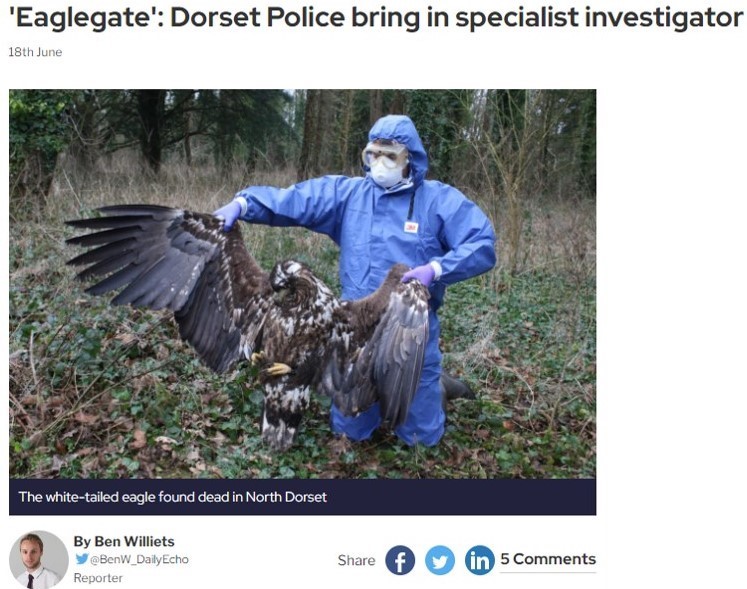
The following article appeared in the Dorset Echo yesterday, reproduced here:
DORSET Police said it has “never been in any doubt” the poisoning of an “extremely rare” white tailed eagle is a “serious offence”.
An investigation was launched in February after the bird had been found dead in North Dorset.
Despite finding high levels of rat poison brodifacoum in the eagle, named G461, Dorset Police dropped the investigation, a decision which “baffled” the RSPB.
Dorset Police said tests were “inconclusive” and it was not possible to confirm if a criminal offence had been committed.
Now, after large criticism and a Freedom of Information request revealed correspondence between West Dorset MP Chris Loder, who reportedly said the investigation should not be a priority, and Police and Crime Commissioner David Sidwick, a specialist investigator has been brought in by police.
A spokesperson for Dorset Police said: “We understand that concern has been expressed as to whether more could have been done in respect of the investigation into the death of the white-tailed sea eagle.
“Therefore, in the interests of transparency, it was important for a senior detective to review the investigation, seeking expertise from the Wildlife Incident Investigation Scheme and liaising with a specialist prosecutor from the CPS to ascertain if the evidential threshold for prosecution is met. We hope this will give confidence in decisions made.
“It has never been in any doubt for Dorset Police that if poisoned deliberately, this is a serious offence as the sea eagle is protected by the law.
“We have always been keen to secure a prosecution if at all possible and have been working with a range of partners to try and achieve this.
“We have increased the number of officers with knowledge of wildlife crime offences and are working with our partners to ensure we are able to utilise our different powers, expertise and resources to their best effect.
“We will of course reflect on any learning in respect of the initial or future investigations.”
The spokesperson added the force was always open to new information and hoped it could give “further transparency” to future decisions.
Correspondence between Mr Loder and Mr Sidwick showed the latter saying the pair needed to get their “ducks in the row on this one”.
In a statement on the PCC’s website, he said suggestions the investigation was politically impeded were “bizarre and entirely without merit”.
He added: “It is a plain and simple fact that the team continues to do what they have always done, which is to tackle all aspects of rural, wildlife and heritage-related crime in Dorset.”
Answering what was meant by getting “ducks in a row”, Mr Sidwick said: “All this meant was that was there was a need a for a mutual understanding about the independence of Dorset Police to carry out investigations as they see fit.”
The eagle was released as part of a reintroduction project by Forestry England in a bid to bring the breed back to the country after an absence of over 240 years, by releasing up to 60 birds over five years.
ENDS
It’s a nice try by Dorset Police, but, as I’ve said previously, asking a senior officer from the same police force to review the investigation is effectively just Dorset Police marking its own homework. Had it been a review undertaken by a senior officer from another force it might have been more credible, although of course that would depend on the integrity of that force/officer. As regular blog readers will be only too aware, there is huge disparity between how different police forces and different officers tackle wildlife crime investigations. Some are fantastic, some are not.
But anyway, the ‘review’ undertaken by the senior officer from Dorset Police has already been done according to comments made by Dorset Police Chief Scott Chilton in a Facebook live chat almost three weeks ago, and that officer had determined that there was ‘insufficient evidence’ and ‘no outstanding lines of enquiry’ to progress the case. Well of course, if you fail to conduct a search you’re not going to find any evidence, are you? It’s simply bonkers.
And increasing the size of the force’s rural crime team is utterly pointless if investigations are going to be closed down prematurely. Dorset Police could employ 3,000 wildlife crime officers but if they’re not allowed to undertake a search to look for evidence when an eagle has been found poisoned with 7 x the lethal dose, then what’s the point?
Besides, they don’t need 3,000 wildlife crime officers – they had one (Claire Dinsdale) who was brilliantly committed and effective and who was leading on the poisoned eagle investigation until senior officers pulled the plug and Claire left on long-term sick leave. They only need to employ a few like Claire (and Dorset Police does have some good officers in its rural crime team), and then support them in their investigations, and they’d get results.
And as for claiming ‘transparency’, good grief. Dorset Police continues to refuse to respond to Freedom of Information requests and has now been reported to the Information Commissioner for multiple breaches of the Freedom of Information Act.
If it wants to regain public trust and confidence, Dorset Police can start by explaining the real reason the poisoned eagle investigation was dropped (because this fundamental question still hasn’t been answered). And then it could highlight the ongoing investigation (running since 2021) into alleged raptor poisoning, on the very same estate where the poisoned white-tailed eagle was found(!!) and tell us whether anyone is being charged.
It can also provide an update on the toxicology results of the dead buzzard and red kite, picked up on another shooting estate in early March (see here), and the dead buzzard found on another estate in late April (here).
There is clearly a raptor persecution problem in Dorset, and Dorset Police needs the public onside to help detect these incidents, and we need Dorset Police to do its job properly and try and bring these criminals to the courts. Nobody is suggesting this is easy – we’re all well aware of the difficulties involved, but the least we should expect is that the police will take every opportunity to undertake a robust and thorough investigation, and not to drop it when a local MP kicks off on social media with ridiculous and outdated anti-eagle hysteria.
Well done to local Dorset Echo reporter Ben Williets for tracking this case and keeping it in the news.
Well done to the BBC’s Countryfile programme last Sunday for doing a 12-minute feature about the poisoning of the white-tailed eagle on an unnamed shooting estate in Dorset in January, and Dorset Police’s fiasco of an investigation which was brought to an abrupt halt when the police decided, astonishingly, that they ‘didn’t have sufficient evidence’ to execute a search warrant on the estate. This decision was made shortly after local MP Chris Loder argued on Twitter that the Police shouldn’t be investigating it and that eagles weren’t welcome in Dorset anyway.
Countryfile isn’t generally renowned for its hard-hitting investigations but I’ve got to say I was pleased with what they produced. Sure, a lot of material was left on the cutting room floor and they studiously removed all the discussion about the scale of illegal raptor persecution in the UK and the ingrained raptor-killing culture amongst some of the game-shooting industry, who still refer to these protected species as ‘vermin’, but I think for millions of viewers, who generally aren’t a specialised audience, this piece would still have been an eye-opener.
I’ve spoken to a few people since it aired who didn’t even know that eagles could now be found in southern England, let alone that they were being poisoned. They do now.
I was also impressed that they managed to get Chris Loder MP in front of a camera and the Assistant Chief Constable of Dorset Police, Rachel Farrell. Remember this is the police force that has repeatedly refused to respond to Freedom of Information requests on this matter. Personally, I don’t think either of them gave convincing explanations that there wasn’t any undue political pressure placed on the police to close down the investigation (asking a senior officer from the same force to effectively ‘mark the Police’s own homework’ doesn’t cut much ice with me), but you can draw your own conclusions.
I think a lot of credit needs to go to Countryfile’s researcher James Agyepong-Parsons, a former journalist from the ENDS Report and the instigator for Countryfile running this piece. He was meticulous in ensuring that the facts of this case were accurately presented, and Charlotte Smith did a brilliant job in pressing for answers.
It’s now available to watch on BBC iPlayer for the next 11 months (here – starts at 09.50 min).
There’s still much more to come out about this case, including the name of the estate where the eagle was found poisoned. It hasn’t yet been made public because there is another, separate, ongoing investigation into alleged raptor persecution that I understand is nearing a charging decision. Nobody wants to name the estate for fear of giving Dorset Police any excuse to drop this other case. We shouldn’t have to be concerned about that but such is the loss of confidence in Dorset Police that nobody is taking any chances.




 Raptor Persecution UK