First Irish-bred sea eagle shot & killed

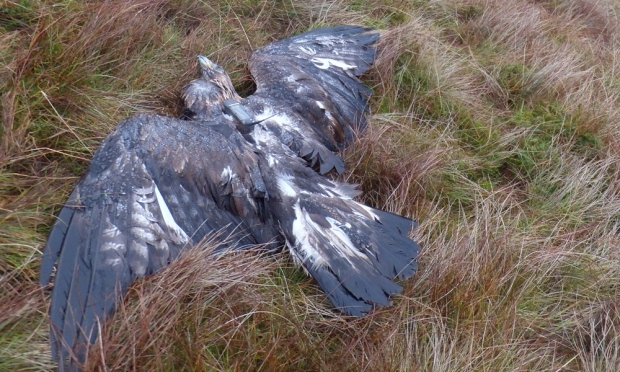
One of two Irish-bred white-tailed sea eagles, hatched last year for the first time in over 100 years, has been shot and killed.

The nine-month old bird was found in a remote part of Tipperary with 40-50 shot gun pellets in its body.

A post mortem revealed that the pellets had broken one of the bird’s legs and wing but the bird had survived for several weeks before succumbing to its injuries.

What an absolutely tragic and shocking outcome, highlighting once again that the disgraceful illegal persecution of raptors continues unabated in these isles.

See here for the report in the Irish Times to read the response of the Minister and the Irish White-tailed Eagle Reintroduction team.

We’re absolutely gutted for them.

The photograph shows Project Manager Allan Mee with one of the first sea eagle chicks donated to the project by Norway in 2007.

Further coverage

Golden Eagle Trust press release here

Independent Ireland article here

BBC news article here

RTE News & audio here

Senior SGA man calling for complete eradication of sea eagles?

Remember last week when we blogged about the calls from a former Crofting Commissioner, Donnie Ross, for the ‘complete eradication’ of sea eagles (see here)?

Well have a look at the response of George Macdonald, the Scottish Gamekeepers’ Association’s Development, Education & Training Officer – this is what he posted on his Facebook page (and we got a screen shot before he deleted it):

George MacDonald SGA sea eagles Feb 10 2014

To us, and to others, it seems, this looks like the senior SGA man is endorsing the former Crofting Commissioner’s view that sea eagles (and pine martens) should be ‘absolutely destroyed’.

Mr Macdonald has denied the claims – see here. He says he ‘was meaning that people need to look at the issue’. If that’s what he meant, why not say, “People need to look at the issue” rather than say, “Mr Ross of Leault is absolutely correct with his observations”?

The SGA is a member of the Partnership for Action against Wildlife Crime, and they are also represented on the PAW Scotland Raptor Group – a consortium of organisations supposedly working towards the eradication of raptor persecution in Scotland (see here).

Is it any wonder that this group has been so utterly ineffective?

Isn’t it time that the SGA was booted off this group?

Sea eagles should be “absolutely destroyed”, says Crofting Commission rep

Here’s yet another example, as if we need it, of persistent, ignorant Victorian attitudes towards raptors in 21st Century Scotland.

Check out this letter, published this week in the Scottish Farmer:

Vacate your perch!

 SIR, – Listening to and reading about the Winter Watch tv programme regarding sea eagles, I found most of it incredible and so ‘too bad’ as far as the loss of lambs was concerned – they didn’t even mention hoggs or ewes.

Then, for Mr Warnock of NFUS to say: “Sea eagles are here to stay”. Surely it’s time for him to vacate his perch – and if that is the view of the NFUS, what a precarious position hill sheep farmers and crofters are in.

Nothing short of complete eradication will do, and it is the same for the pine martin – both should be absolutely destroyed. The National Sheep Association, the Crofting Commission and Crofting Federation should be backing this to the hilt.

Will Mr Lochhead or Mr Wheelhouse do anything about the sea eagle? No, they didn’t even prick their ears until a danger to our native eagle was mentioned and, for Mr Lochhead to say they are a tremendous tourist attraction is rubbish. If, like me, he had spoken to tourists from all over the world over the last 20 years at ‘Working Sheepdogs’ here, he would know they don’t come for one attraction but to see as much as they possibly can. The oblivion of the sea eagle wouldn’t matter and, indeed, would be an absolute blessing for the countryside and its animals.

DW Ross,

Leault, Kincraig

We believe the author is Mr Donnie Ross, a now retired shepherd who was elected in 2012 to represent the East Highlands constituency of the Crofting Commission (see here). It’s quite incredible that someone in this position of influence is so utterly mis-informed and able to incite the illegal killing of two protected species.

UPDATE 14.30: Looks like Mr Ross resigned from the Crofting Commission in Sept for reasons that are now not altogether surprising (see here).

On a related note, Environment Minister Paul Wheelhouse has just answered a Parliamentary Question on the subject of crofters, farmers and sea eagles:

Angus MacDonald (Falkirk East) (Scottish National Party): To ask the Scottish Government how many (a) farmers and (b) crofters applied for compensation under the Sea Eagle Management Scheme, broken down by parliamentary constituency.

(S4W-19252). Paul Wheelhouse: “The Sea Eagle Management Scheme pays for positive management of sheep flocks, in order to reduce conflict with sea eagles. It does not pay compensation for lamb losses. The scheme ran for three years from 2011-13, and closed in summer 2013, but Scottish Natural Heritage (SNH) will honour all agreements entered into under the scheme. Through the scheme, SNH offered three-year management agreements (MAs) to land managers.

SNH received 70 applications, all of which resulted in management agreements being offered to the applicants. Of those 70 management agreement offers, 62 have been accepted or concluded by the land manager and 7 agreements were rejected by the applicants. The final management agreement was only offered recently, so it is not known whether the land manager will accept the offer.

Of the 62 concluded agreements:

1 contains ‘special measures to reduce impacts from sea eagles’;

2 contain ‘promotional measures’;

4 contain ‘special measures to benefit sea eagles’;

58 contain ‘sheep management measures’ (The numbers add up to more than 62 because some MAs contain more than 1 element).

Of the 62 concluded agreements:

17 are with crofters/common grazings;

9 are in Skye, Lochaber and Badenoch;

1 in Argyll and Bute;

5 in Caithness Sutherland and Ross (Wester Ross);

2 in Na h-Eileanan an Iar;

2 are with constituted community groups (these are the two ‘promotional measures’ agreements);

1 in Argyll and Bute (Mull);

1 in Na h-Eileanan an Iar;

43 are with farms/ estates (i.e. not registered croftland);

31 in Argyll and Bute;

9 in Skye, Lochaber and Badenoch;

3 in Caithness, Sutherland and Ross (Wester Ross).

SNH has commissioned a review and evaluation of the scheme, on behalf of the assessment panel, and this will be completed by the end of March 2014. It will help inform the design of a new scheme, along with advice/input from the Sea Eagle Stakeholder Group, which advised on the design of the current management scheme.

The expectation is that a new scheme will be launched in late spring 2014. The budget for this has not yet been agreed, nor has its scope and geographical extent. SNH look forward to working with key interested bodies including the National Farmers Union Scotland and the Scottish Crofting Federation over the coming months to design a scheme that best meets the needs of land managers and others with an interest in sea eagle management.

In the meantime, SNH will continue to provide advice and assistance to land managers concerned by sea eagle impacts on their livestock”.

Let’s hope the new ‘scheme’ includes compulsory attendance on a ‘Basics of Sea Eagle Natural History & Ecology’ course before any more tax-payers’ money is handed out.

For other recent examples of blind prejudice against Scottish sea eagles see here, here and here.

White-tailed eagle photo by Mike Watson.

SNH says no to sea eagle control

A spokesman for SNH has told the BBC that the growing population of Scottish white-tailed eagles should not be a concern, in response to the recent call for sea eagle ‘control measures’ from the National Farmers Union Scotland.

The BBC article (here) reports that the NFUS, in return, appears to be wanting to distance itself from any calls for a cull, (perhaps in response to strong public opinion,  see here) but does still think that relocating individual ‘problem’ birds might be an option.

Quite what they think that would achieve is anyone’s guess – if you create a vacancy in a viable territory then another pair will simply move in; it’s basic ecology.

There’s also an interesting quote from a Skye farmer, who says that scientists [who disagree with the purported number of lamb losses to eagles] “would say anything to support the continuing rise of the sea eagle“.

Hmm, not sure scientists are renowned for ‘saying anything’, are they? Now who was it that claimed that sea eagles might eat small children….?

There was similar anti-sea eagle hysteria whipped up in Perthshire in 2012, when the Courier headlined with: “Farmers distressed by savage sea eagle attack on newborn lamb” (see here). A later post mortem revealed it was more likely the lamb had died from hypothermia rather than a ‘savage sea eagle attack’ (see here).

Expect to see much more of this nonsense until the new compensation scheme has been agreed. Let’s just hope this ignorant intolerance isn’t used as justification to poison, shoot or trap any more of these eagles, nor fell their nesting trees….

Sea Eagle poll results: 92% against ‘control measures’

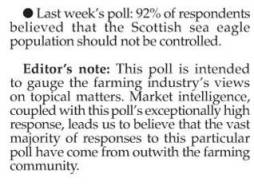
SF WTE pollThe results of the Scottish Farmer’s sea eagle poll have been published.

For anyone who missed it, last week the Scottish Farmer conducted a poll on the following question:

“Should the Scottish sea eagle population be controlled?” 

The result? 92% of respondents believed that the Scottish sea eagle population should not be controlled.

What’s amusing about this, apart from the obvious overwhelming support for sea eagles, is the Editor’s note published directly underneath the poll result. It seems that the editor is prepared to dismiss the poll result because he doesn’t think it’s representative of the farming industry’s views.

Now, had the poll result been different, i.e. ‘92% of respondents did believe that the Scottish sea eagle population should be controlled’, do you think the editor would still be dismissive of the result?

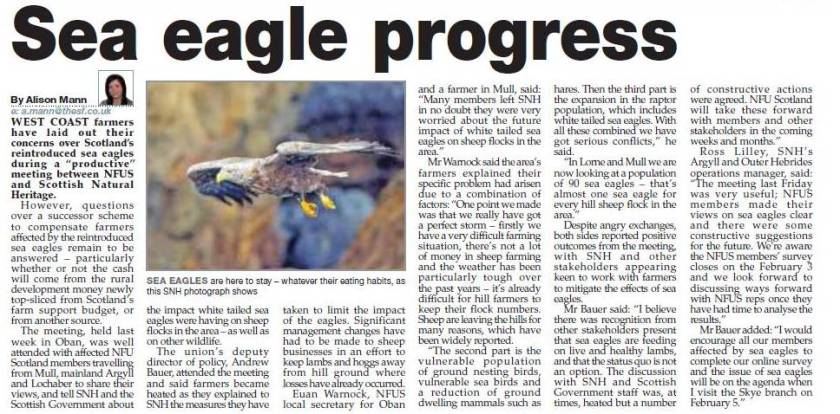
Elsewhere in the latest edition is an article on the NFUS meeting with SNH in Oban last week. It’s not that informative in terms of telling us the outcome other than “there were some constructive suggestions for the future” but it did include some information about the farmers’ specific concerns. These were divided into three parts:

1. “There’s not a lot of money in sheep farming and the weather has been particularly tough over the past years“.

2. “The vulnerable population of ground nesting birds, vulnerable sea birds and ground-dwelling mammals such as hares“.

3. “The expansion in the raptor population, which includes white-tailed sea eagles. With all these combined we have got serious conflicts“.

They also claim that, “In Lorne and Mull we are now looking at a population of 90 sea eagles“. Really? There aren’t even 90 breeding pairs in the whole of Scotland! There are, at a stretch, probably no more than 25 breeding pairs in the whole of Argyll, and being highly territorial they will be foraging on their ‘own patch’, vigorously defending their resource from neighbouring pairs and opportunistic transient juveniles. To imply that 90 sea eagles are descending on sheep farms in this area is just absurd.

As we pointed out in our previous blog on this subject (here), it is well recognised, through peer-reviewed science, that some eagles do eat some live lambs (although with minimal impact) but where this does occur then it is fair that the farmer receives compensation. What isn’t acceptable is grossly exaggerated claims of marauding eagles wiping out sheep flocks, ground-nesting birds, sea birds, hares and small children.

It seems that no matter how much evidence is put to them, it’s simply not enough to suppress an inherent prejudice against anything with talons and a hooked beak.

ScotFarmerWTE

Farmers taking aim at sea eagles, again

Scottish Farmer eagle eaction call front pageRepresentatives of NFU Scotland are meeting with SNH today in a ‘call for action’ against white-tailed eagles.

They haven’t exactly specified what ‘action’ they want from the government although the words ‘control measures’ are mentioned. These words are the more palatable version of  ‘kill/cull’.

Why do they want sea eagles to be ‘controlled’? Ah, the usual arguments – the sea eagle population is out of control, sea eagles are out-competing golden eagles, sea eagles are eating all the lambs, sea eagles are eating everything else as well as all the lambs, sea eagles might eat a child, sea eagles are ‘impacting’ on the wider biodiversity, sea eagles are eating all the hares, sea eagles are eating all the goats, sea eagles are causing emotional damage…. Oh, and the government’s ‘eagle-damage’ compensation scheme for farmers/crofters just happens to have ended.

The NFU Scotland ‘call for action’ features on the front page of the Scottish Farmer today (see here).

Unfortunately, the article doesn’t include any information about the findings of previous studies looking at the so-called impact of reintroduced sea eagles on lambs (answer = negligible, see here and here).

Nor does it include any reference to two recent scientific studies looking at the presumed competitive effect of white-tailed eagles on neighbouring golden eagles. Both concluded no evidence of effect:

Evans et al. (2010). Comparative nest habitat characteristics of sympatric White-tailed and Golden Eagles in western Scotland. Bird Study 57 (4): 473-482 (read it here).

Whitfield et al. (2013). Breeding season diets of sympatric white-tailed eagles and golden eagles in Scotland: no evidence for competitive effects. Bird Study 60 (1): 67-76 (read it here).

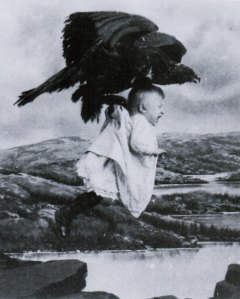
baby-and-eagleOf course, this is just the latest in a long line of alarmist nonsense from both farmers and gamekeepers (who can forget the SGA’s recent claim that sea eagles might eat children – see here!) and then there was this, and perhaps best of all, this.

Not to be deterred by scientific evidence, or even just plain common sense, the editor of the Scottish Farmer, Mr Alasdair Fletcher, has set up a survey to ask whether the sea eagle population should be ‘controlled’ (in his opinion the answer should be ‘yes’). You, too, can take the carefully considered, unbiased survey here!

UPDATE 26th JANUARY 2014 – POLL RESULTS HERE!

31 eagles, 7 years, 0 prosecutions

In April 2012, we wrote an article called ’21 eagles, 6 years, 0 prosecutions’ (see here).

In September 2012, we updated it and called it ’26 eagles, 6 years, 0 prosecutions’ (see here).

In July 2013 we updated it again. This time, ’27 eagles, 7 years, 0 prosecutions’ (see here).

Here’s the latest version: 31 eagles, 7 years, 0 prosecutions.

This article should provide some context the next time you hear someone (usually from the game-shooting industry or from the government) say that “we’re making real progress in the fight against raptor persecution”. So much ‘progress’ in fact that 13 of these eagles have been lost in the last 3 years; 4 of them this year, the so-called Year of Natural Scotland.

As before, a number of eagles included in this list (7 of them, to be precise) may not be dead. However, they are included here because their satellite tags unexpectedly stopped functioning (i.e. they’d been transmitting perfectly well up until the eagles’ last known location, often a known persecution hotspot). Two further satellite-tagged eagles (‘Angus’ and ‘Tom’) are not included in this list as although their transmitters stopped functioning, there had been recognisable problems with their tags prior to the final transmissions and so the benefit of the doubt has been applied.

A couple of eagles have been added that should have featured in the previous version but we’ve only just received details about them.

Many of these listed eagles from recent years have only been discovered because the eagles were being satellite-tracked. Much kudos to the dedicated teams of fieldworkers who have put in hours and hours of skilled hard work to allow this to happen. Obviously there are many other eagles out there that have not been sat-tagged and on the balance of probability will have been killed at the hands of the game-shooting industry. 31 eagles in the last 7 years is the bare minimum. The number of prosecutions (zero) is undeniable.

Dinnet & Kinord May 2006MAY 2006: A dead adult golden eagle was found on the Dinnet & Kinord Estate, near Ballater, Aberdeenshire. Tests revealed it had been poisoned by the illegal pesticide Carbofuran. Grampian Police launched an investigation. Seven years and 7 months later, nobody has been prosecuted.

~
Glen Feshie June 2006JUNE 2006: A dead golden eagle was found on Glen Feshie Estate in the Cairngorms. Tests revealed it had been poisoned by the illegal pesticide Carbofuran. Northern Constabulary launched an investigation. Seven years and 6 months later, nobody has been prosecuted.

~

Peebles August 2007AUGUST 2007: A dead adult female golden eagle was found on an estate near Peebles in the Borders. She was half of the last known breeding pair of golden eagles in the region. Tests revealed she had been poisoned by the illegal pesticide Carbofuran. Lothian & Borders Police launched an investigation. Six years and 4 months later, nobody has been prosecuted.

~

bird-nNOVEMBER 2007: Tayside Police received a detailed tip-off that a young male white-tailed eagle (known as ‘Bird N’) had allegedly been shot on a grouse moor estate in the Angus Glens. The timing and location included in the tip-off coincided with the timing and location of the last-known radio signal of this bird. Six years and 1 month later, the bird has not been seen again. With no body, an investigation isn’t possible.

~
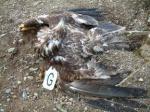
White G Glenquioch May 2008MAY 2008: A one year old male white-tailed eagle hatched on Mull in 2007 and known as ‘White G’ was found dead on the Glenquoich Estate in the Angus Glens. Tests revealed he had been poisoned by an unusual concoction of pesticides that included Carbofuran, Bendiocarb and Isofenphos. A police search in the area also revealed a poisoned buzzard, a baited mountain hare and 32 pieces of poisoned venison baits placed on top of fenceposts on the neighbouring Glenogil Estate. Laboratory tests revealed the baited mountain hare and the 32 poisoned venison baits contained the same unusual concoction of highly toxic chemicals that had killed the white-tailed eagle, ‘White G’. Five years and 7 months later, nobody has been prosecuted.

~
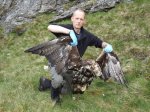
Glen Orchy 2009JUNE 2009: An adult golden eagle was found dead at Glen Orchy, Argyll, close to the West Highland Way. Tests revealed it had been poisoned by the illegal pesticide Carbofuran. Strathclyde Police launched a multi-agency investigation. Three years and 3 months later, estate employee Tom McKellar pled guilty to possession of Carbofuran stored in premises at Auch Estate, Bridge of Orchy and he was fined £1,200. Four years and 6 months on, nobody has been prosecuted for poisoning the golden eagle.

~

Alma Millden 2009JULY 2009: A two year old female golden eagle known as ‘Alma’ was found dead on the Millden Estate in the Angus Glens. Tests revealed she had been poisoned by the illegal pesticide Carbofuran. Alma was a well-known eagle  – born on the Glen Feshie Estate in 2007, she was being satellite-tracked and her movements followed by the general public on the internet. Tayside Police launched an investigation. Four years and 5 months later, nobody has been prosecuted.

~

August 2009 Glenogil WTEAUGUST 2009: A young white-tailed eagle was found dead on Glenogil Estate in the Angus Glens. Tests revealed it had been poisoned by the illegal pesticide Carbofuran. Tayside Police was criticized in the national press for not releasing a press statement about this incident until January 2010. Four years and 4 months later, nobody has been prosecuted.

~

Skibo GE May 2010MAY 2010: #1 of three dead golden eagles found on or close to Skibo Estate, Sutherland. Tests revealed they had been poisoned; two with Carbofuran and one with Aldicarb. Northern Constabulary launched a multi-agency investigation. One year later (May 2011), Sporting Manager Dean Barr pled guilty to possession of 10.5 kg of Carbofuran stored in premises at Skibo Estate. Three years and 7 months later, nobody has been prosecuted for poisoning this eagle.

~

Skibo GE2 May 2010MAY 2010: #2 of three dead golden eagles found on or close to Skibo Estate, Sutherland. Tests revealed they had been poisoned; two with Carbofuran and one with Aldicarb. Northern Constabulary launched a multi-agency investigation. One year later (May 2011), Sporting Manager Dean Barr pled guilty to possession of 10.5 kg of Carbofuran stored in premises at Skibo Estate. Three years and 7 months later, nobody has been prosecuted for poisoning this eagle.

~

ge headMAY 2010: #3 of three dead golden eagles found on or close to Skibo Estate, Sutherland. Tests revealed they had been poisoned; two with Carbofuran and one with Aldicarb. Northern Constabulary launched a multi-agency investigation. One year later (May 2011), Sporting Manager Dean Barr pled guilty to possession of 10.5 kg of Carbofuran stored in premises at Skibo Estate. Three years and 7 months later, nobody has been prosecuted for poisoning this eagle.

~

ge headJUNE 2010: #1: Leg rings with unique identification numbers that had previously been fitted to the legs of four young golden eagles in nests across Scotland were found in the possession of gamekeeper James Rolfe, during a multi-agency investigation into alleged raptor persecution at Moy Estate, near Inverness. It is not clear how he came to be in possession of the rings. The bodies of the eagles from which the rings had been removed were not found. No further action was taken in relation to the discovery.

~

ge headJUNE 2010: #2: Leg rings with unique identification numbers that had previously been fitted to the legs of four young golden eagles in nests across Scotland were found in the possession of gamekeeper James Rolfe, during a multi-agency investigation into alleged raptor persecution at Moy Estate, near Inverness. It is not clear how he came to be in possession of the rings. The bodies of the eagles from which the rings had been removed were not found. No further action was taken in relation to the discovery.

~

ge headJUNE 2010: #3: Leg rings with unique identification numbers that had previously been fitted to the legs of four young golden eagles in nests across Scotland were found in the possession of gamekeeper James Rolfe, during a multi-agency investigation into alleged raptor persecution at Moy Estate, near Inverness. It is not clear how he came to be in possession of the rings. The bodies of the eagles from which the rings had been removed were not found. No further action was taken in relation to the discovery.

~

ge headJUNE 2010: #4: Leg rings with unique identification numbers that had previously been fitted to the legs of four young golden eagles in nests across Scotland were found in the possession of gamekeeper James Rolfe, during a multi-agency investigation into alleged raptor persecution at Moy Estate, near Inverness. It is not clear how he came to be in possession of the rings. The bodies of the eagles from which the rings had been removed were not found. No further action was taken in relation to the discovery.

~

ge headJUNE 2010: A golden eagle was found dead on Farr & Kyllachy Estate, Inverness-shire. Tests revealed it had been poisoned by the illegal pesticide Carbofuran. Northern Constabulary apparently did not search the property until July 2011. Three years and 6 months later, nobody has been prosecuted.

~

WTE Farr & Kyllachy June 2010JUNE 2010: A white-tailed eagle was found dead on Farr & Kyllachy Estate, Inverness-shire. Tests revealed it had been poisoned by the illegal pesticide Carbofuran. Northern Constabulary apparently did not search the property until July 2011. Three years and 6 months later, nobody has been prosecuted.

~

Lochindorb WTE Dec 2010DECEMBER 2010: A decomposing carcass of a white-tailed eagle was found and photographed on Logie (Lochindorb) Estate, Morayshire. It was reported to Northern Constabulary. By the time the police arrived to collect it, the carcass had disappeared. The police said they couldn’t investigate further without the body.

~

ge headFEBRUARY 2011: The signal from a young satellite-tracked golden eagle ( ‘Lee’, hatched in 2010) unexpectedly stopped transmitting after a final signal from the North Angus Glens. A technical malfunction or another mysterious ‘disappearance’?

~

Glenbuchat GE March 2011MARCH 2011: The body of a young golden eagle was discovered on North Glenbuchat Estate, Aberdeenshire. Tests revealed it had been poisoned by the illegal pesticide Carbofuran. Grampian Police launched an investigation and raided the property in May 2011. Two years and 7 months later, nobody has been prosecuted.

~
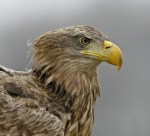
wtseAPRIL 2011: The body of a white-tailed eagle was found at the base of cliffs on Skye. The person who discovered it (a professional medic) considered it to have been freshly shot with a rifle, decapitated with a sharp implement and thrown from the cliff top. He took photographs and alerted Northern Constabulary and RSPB. There was a delay of two weeks before the now probably decomposed carcass was collected. A post-mortem was inconclusive. This incident was not made public until one year later after a tip off to this blog. Two years and 8 months later, nobody has been prosecuted.

~

ge headSEPTEMBER 2011: The signal from a satellite-tracked young golden eagle (‘Strathy’, hatched in 2010) unexpectedly stopped transmitting after a final signal from an Aberdeenshire grouse moor. A technical malfunction or another mysterious ‘disappearance’?

~

Lochaber poisoned ge March 2012MARCH 2012: The body of a young golden eagle being tracked by satellite was discovered in Lochaber. Tests revealed it had been poisoned with the banned pesticides Aldicarb and Bendiocarb. Information about this incident was not made public until three months later. One year and 9 months later,  nobody has been prosecuted.

~

ge headMARCH 2012: The signal from a satellite-tracked young golden eagle (‘Angus 26’, hatched in 2011) unexpectedly stopped transmitting after a final signal from a grouse moor in the Angus Glens. This bird’s suspiciously damaged sat tag was found in the area.

~

ge headMAY 2012: The signal from a young satellite-tracked golden eagle (#32857) unexpectedly stopped transmitting when the bird was north-east of the Cairngorms National Park. A technical malfunction or another mysterious ‘disappearance’?

~

Deeside GE May 2012MAY 2012: The dead body of a young satellite-tracked golden eagle (hatched in 2011) was discovered near a lay-by in Aboyne, Aberdeenshire. The data from its satellite tag & the injuries the bird had when found (2 broken legs) suggested it had been caught in an illegal trap on a grouse moor in the Angus Glens and then removed, under cover of darkness, to be dumped in another area where it was left to die, probably a slow and agonising death. Information on this incident was not released until almost five months later, by the RSPB. It appears the police failed to properly investigate this incident as we understand that no search warrants were issued and no vehicles were searched. One year and 7 months later, nobody has been prosecuted.

~

Wanlock Head GE Oct 2012OCTOBER 2012: An adult golden eagle was found shot and critically injured on grouse moor at Buccleuch Estate, near Wanlockhead, South Lanarkshire. The bird was rescued by the SSPCA and underwent surgery but it eventually succumbed to its injuries in April 2013. One year and 2 months later, nobody has been prosecuted.

~

ge headMAY 2013: The signal from a two-year-old satellite tracked golden eagle (‘Angus 33’, hatched in 2011) unexpectedly stopped transmitting after it’s last signal from North Glenbuchat Estate in Aberdeenshire. A technical malfunction or another mysterious ‘disappearance’?

~

ge headJUNE 2013: A dead golden eagle was found on an RSPB reserve on Oronsay. This bird had been shot although it is not known whether this was the cause of death or an historical injury.

~

ge headJULY 2013: The signal from a young satellite tracked golden eagle (‘Cullen’, hatched 2010) unexpectedly stopped transmitting after its last signal in Aberdeenshire. A technical malfunction or another mysterious ‘disappearance’?

~

Fearnan Angus Glens Dec 2013DECEMBER 2013: A two year old satellite tracked golden eagle (‘Fearnan’) was found dead on a grouse moor in the Angus Glens. Tests revealed he had been poisoned with the banned pesticide Carbofuran.

Golden eagle found poisoned on Angus grouse moor

A two-year old golden eagle named ‘Fearnan’ has been found dead on a Scottish grouse moor. He had been poisoned with a banned pesticide. The poison hasn’t been named but we’ll take an educated guess at Carbofuran, the gamekeepers’ poison of choice.

Interestingly, there are three separate press releases about this latest disgraceful crime:

One from the government via PAW (here)

One from the police (here)

One from RSPB Scotland (here)

Usually, we’re lucky to see anything for at least 4-5 months after the crime so it’s somewhat surprising to see the scuffle for media attention on this one. Could this be a sign that Environment Minister Wheelhouse has put his foot down and demanded that timely press statements are released? We can’t think of any other reason why the police should suddenly change their tactics from seemingly apathetic to seemingly responsive.

Of course, regular blog readers will already know that Fearnan is not the only poisoned eagle to have been found dead in the Angus Glens. In fact, there’s been a fair bit of raptor persecution over the last nine years. Here’s a list of incidents we’ve compiled from various published reports:

2004 May, near Edzell: long-eared owl and two short-eared owls starved to death in crow cage trap.  No prosecution.

2004 May, Invermark Estate: peregrine nest destroyed. No prosecution.

2006 March, Glenogil Estate: poisoned rabbit bait (Carbofuran). No prosecution.

2006 April, Easter Ogil: poisoned buzzard (Alphachloralose). No prosecution.

2006 April, Easter Ogil: poisoned tawny owl (Alphachloralose). No prosecution.

2006 May, Glenogil Estate: poisoned rabbit bait (Carbofuran). No prosecution.

2006 June, Glenogil Estate: poisoned woodpigeon bait (Carbofuran). No prosecution.

2006 June, Glenogil Estate: Traces of Carbofuran found in estate vehicles & on equipment during police search. No prosecution. Estate owner had £107k withdrawn from his farm subsidy payments. This was being appealed, but it is not known how this was resolved.

2006 July, Millden Estate; poisoned sheepdog (Lindane). No prosecution.

2007 November, Glenogil Estate: Disappearance of radio-tagged white-tailed eagle ‘Bird N’ coincides with tip off to police that bird been shot. No further transmissions or sightings of the bird.

2008 May, ‘Nr Noranside’: poisoned white-tailed eagle ‘White G’ (Carbofuran, Isophenfos, Bendiocarb). No prosecution.

2008 May, ‘Nr Noranside’: poisoned buzzard (Bendiocarb). No prosecution.

2008 May, ‘Nr Noranside’: poisoned mountain hare bait (Carbofuran, Isophenfos, Bendiocarb). No prosecution.

2008 May, Glenogil Estate: 32 x poisoned meat baits on fenceposts (Carbofuran, Isophenfos, Bendiocarb). No prosecution.

2008 October, ‘Glenogil Estate: poisoned meat bait on fencepost (Carbofuran). No prosecution.

2009 March, Glenogil Estate: poisoned buzzard (Carbofuran). No prosecution.

2009 March, Glenogil Estate: poisoned buzzard (Carbofuran). No prosecution.

2009 April, Millden Estate: poisoned buzzard (Alphachloralose). No prosecution.

2009 July, Millden Estate: poisoned golden eagle ‘Alma’ (Carbofuran). No prosecution.

2009 August, Glenogil Estate: poisoned white-tailed eagle “89” (Carbofuran). No prosecution.

2010 May, ‘Nr Noranside’: poisoned red kite (Carbofuran). No prosecution.

2010 September, Glenogil Estate: poisoned buzzard (Chloralose). No prosecution.

2010 October, Glenogil Estate: poisoned buzzard (Carbofuran). No prosecution.

2010 October, Glenogil Estate: poisoned pigeon bait (Carbofuran). No prosecution.

2010 October, Glenogil Estate: poisoned pigeon bait (Carbofuran). No prosecution.

2011 February, Airlie Estate: buzzard caught in illegal crow trap. (see below)

2011 March, Airlie Estate: 3 x buzzard caught in illegal crow trap. Prosecution (!) but dropped after statement from suspect given to SSPCA deemed inadmissible.

2011 April, Millden Estate: shot buzzard. No prosecution.

2012 April, ‘Nr Noranside’: Remains of buzzard found beside pheasant pen. Suspicious death.

2011 June, Rottal & Tarabuckle Estate: dead kestrel inside crow cage trap. No prosecution.

2012 February, ‘Nr Edzell’: spring-trapped buzzard. No prosecution.

2012 February, ‘Nr Bridgend’: remains of buzzard found under a rock. Suspicious death.

2012 May, Millden Estate: satellite-tagged golden eagle caught in spring trap, then apparently uplifted overnight and dumped on Deeside. No prosecution.

2012 May, Glen Esk: disappearance of sat-tagged red kite. No further transmissions or sightings of bird.

2013 January, Invermark Estate: white-tailed eagle nest tree felled. No prosecution.

2013 November, Glen Lethnot: poisoned golden eagle. Prosecution? Highly unlikely!

We think you’ll agree, this is overwhelming evidence that some people in the Angus Glens are systematically persecuting birds of prey, they have been for many years, and those same people are avoiding criminal justice for their disgusting and illegal activities. We call them The Untouchables.

Why have they been able to avoid prosecution for so long?

Now would be a good time to ask the Environment Minister for an explanation. While you’re at it, please also mention your revulsion about the continued practice of illegal raptor persecution on driven grouse moors. The time for estate licensing is here; the game-shooting industry, quite clearly, cannot or will not self-regulate.  Emails to: ministerforenvironment@scotland.gsi.gov.uk

RIP Fearnan.

posioned GE Lethnot 2013

Gamekeeping orgs’ half-witted attempts to blur the truth

Birdcrime 2012Earlier this month the RSPB published two reports: one detailing raptor persecution crimes in Scotland during 2012 (see here) and one detailing raptor persecution crimes throughout the UK in 2012 (see here).

You’d think that the RSPB’s so-called ‘partners’ in the Partnership for Action Against Wildlife Crime (PAW) would welcome the reports, highlighting as they do the continued criminal persecution of birds of prey. That’s what PAW partners are all about, right? Raising public awareness and finding ways of cracking down on wildlife crime?

Apparently not.

Here is the response of the National Gamekeepers’ Organisation to the RSPB’s UK-wide report. In case they decide to remove it from their website, we’ve reproduced it here:

NGO Comments on the RSPB 2013 Birdcrime Report

Saturday 14th Dec 2013

The National Gamekeepers’ Organisation has issued the following comment on publication of the latest edition of the RSPB Birdcrime Report.

A spokesman for the National Gamekeepers’ Organisation said: “The NGO stands for keepering within the law and automatically condemns illegal activity. That is why the NGO is proud to be a member of PAW – the Partnership for Action Against Wildlife Crime. Furthermore, science has proven gamekeepers to be some of the most effective conservationists working in the British countryside today.

Intriguingly the RSPB’s shrill comments on persecution appear to lack the context that is essential for the public to form its own considered opinion. What the RSPB fails to mention in its news release is that the UK’s bird of prey population, taken as a whole, is thriving, with almost all species at record high levels. 

This seems a curious oversight for a charity required by law to educate the public in a balanced manner. This very important omission is intriguing, given the RSPB’s usually conscientious approach to its work. I believe it is fair to ask whether it’s perhaps to encourage charitable donations to the RSPB in the run-up to Christmas, a time of year when people are quick to put their hands in their wallets?

To view the RSPB 2013 Birdcrime Report News Release visit http://www.rspb.org.uk/media/releases/359085-sixty-years-of-protection-but-the-killing-continues

Good god, where do we start? With the bit about gamekeepers being ‘some of the most effective conservationists working in the British countryside today’?!! Or the bit about how we, the general public, are unable to form our own ‘considered opinion’ because the report apparently ‘lacks context’?!!

How about the statement: “What the RSPB fails to mention in its news release is that the UK’s bird of prey population, taken as a whole, is thriving, with almost all species at record high levels“.

The reason the RSPB ‘failed to mention’ this is probably because it’s a big fat massive distortion of the truth! ‘Almost all species at record high levels‘? That would be ‘almost all species’ apart from golden eagle, white-tailed eagle, hen harrier, red kite, goshawk, peregrine; all of which are being held at unnaturally low population levels thanks to illegal persecution, according to countless scientific studies.

And what on earth does ‘taking the UK’s bird of prey population as a whole‘ mean? Where’s the scientific validity of that? It’s absolutely meaningless pseudo-scientific rubbish! It’s like saying there’s no need to be concerned about the near-extinction of rhinos or elephants in Africa because big mammals ‘as a whole’ are doing ok.

sam4Not to be outdone in the idiot stakes, the NGO’s Scottish colleagues at the Scottish Gamekeepers’ Association have published their own statement in response to the RSPB’s Scotland Persecution report.  We’ve reproduced it here:

SGA STATEMENT: RSPB BIRD OF PREY REPORT

Following the release of an unofficial report by the RSPB today on the Illegal Killing of Birds of Prey in 2012, the SGA issued the following response. An SGA Spokesman said: “The RSPB has clearly spent a lot of money in writing this report, which entitles them to put forward their own viewpoint. “With this agenda in mind, it is important, that the public refer to the actual crimes, as published annually by the Scottish Government with information provided officially by the Police and SASA, rather than speculative possible or suspected cases, which are clearly going to confuse the public. “All PAW partners, including ourselves, are fully behind the printing of the official statistics annually, based on actual legal cases, and see no reason why this should change. “While we have been encouraged by the progress made, with the official statistics stating a record of only 3 confirmed cases of illegal poisoning of birds of prey in 2012, reports such as this do little other than damage to on-going partnership efforts designed to reduce crimes against birds of prey. “As stated consistently, the SGA continues to advocate legal means to solving countryside conflicts. Because of this, the clarity and impartiality provided by law is important to us.”

Again, not what you might expect from a PAW ‘partner’. According to the SGA, the public are ‘clearly going to be confused’ by the report’s contents. Really? Is anybody ‘confused’? We’re not – the report presents the facts in the most clear way possible – the illegal persecution of raptors continues to take place on game-shooting estates up and down the country. Our raptors are still being poisoned, trapped, shot, and bludgeoned to death on sporting estates and the majority of the criminals are still avoiding prosecution: we call them The Untouchables.

It’s also interesting to see the SGA continue to peddle the myth that poisoning is in decline. According to our 2013 figures, poisoning in Scotland has actually increased by 66% in this, the Year of Natural Scotland, and that’s not including the discovery of poisoned baits…if we included every single poisoned bait found this year (as each one had the potential to kill at least one raptor had the baits not been discovered and removed), then the figure would jump to a phenomenal 1,333% increase in poisoning!!!

The SGA claims that the RSPB’s report does ‘little other than damage the on-going partnership efforts designed to reduce crimes against birds of prey’. We would argue that the SGA’s continued involvement in the PAW Scotland raptor group, and the NGO’s continued involvement in the English PAW group, does little other than taint the credibility of the PAW concept. In fact it doesn’t just taint it – it soaks it in implausibility. The sooner the other PAW partners realise this and vote these gamekeeping organisations off the panel, the better. PAW is not going to achieve anything as long as some of the ‘partners’ continue to deny and distort the facts. Oh, and harbour convicted wildlife criminals.

RSPB Scotland publishes 2012 persecution report

sam4RSPB Scotland has today published its annual persecution report which documents the known and suspected incidents of  illegal raptor killing throughout Scotland in 2012.

It’s a shame it’s taken so long to get it published, but that minor criticism aside, massive kudos and appreciation to them for their continued meticulous collection of these data and especially their willingness to publish them. Without these reports the general public, and probably the government, would be unaware of exactly what’s going on in our countryside. If we relied upon the ‘official’ figures (i.e. those ‘approved’ by the likes of Scottish Land & Estates, the Scottish Gamekeepers’ Association, Police Scotland etc) we wouldn’t know the half of it.

The 2012 report, just like all the previous 18 reports, makes for grim reading. Sure, it documents a reduction in the number of birds known to have been illegally poisoned last year; some people (guess who?) have spent much of 2013 shouting about this as being evidence of the game-shooting industry cleaning up its act – we know better – the 2013 figures (to date) show no such reduction and in fact show an increase in known poisoning incidents…but more of that next year. Let’s focus on the 2012 report for now.

Three things caught our attention in this report. The first thing was the Foreword by Stuart Housden, RSPB Scotland Director. This is the hardest-hitting Foreword of his that we’ve read. In the past it’s been a bit wishy-washy, with too many platitudes aimed at the landowning and gamekeeping communities and suggestions that the raptor killers are just an unrepresentative minority. This time it’s quite different:

It is evident that a significant number of individuals or estates illegally persecute birds of prey“.

Is this subtle change of language an indication that RSPB Scotland is tiring of the whole ‘partnership-working’ pretensions? Let’s hope so.

The second thing to catch our attention was an entry in Table 3 (page 24): Confirmed incidents of illegal killing or attempted killing (excluding poisoning) of birds of prey in Scotland, 2012

The entry of interest is this:

‘February. Buzzard caught in illegal spring trap. Nr Edzell, Angus’.

There isn’t any further detail about this incident, and it certainly hasn’t been publicised by the Police (no surprise there). However, for reasons that we can’t go in to right now, we are particularly interested in the details of this incident and would ask any blog reader with specific information to contact us, in confidence: raptor.persecution.scotland@hotmail.co.uk

The third thing that caught our attention was the Case Study: Poisoning in Progress (pages 19-20). This case relates to the discovery of poisoned corvids and poisoned bait found in the Borders in May 2012.

We’d blogged about this case in Sept 2012, criticising the Police for not publicising the discovery of poisoned birds and poisoned bait (see here). We also blogged about it in October this year, after the incident was excluded from the ‘raptor persecution’ section in the  Government’s ‘official’ 2012 Wildlife Crime Report (see here). We asked blog readers to contact the Environment Minister and ask why this incident had been excluded. Here is part of the reply received by one of our readers:

You ask why a bird poisoning incident was omitted from the Scottish Government’s first annual report into wildlife crime. I can advise you that the incident in question was not listed in the section on raptor crime because no raptors were involved“.

Now, have a read of the Case Study in the RSPB’s report. Guess what was found at the scene? “The feathers and bones of two dead buzzards, lying beside the old, dried-out carcases of two rabbits, in a wood beside a partridge rearing pen. A dead crow was also found a short distance away“.

That’s a pretty clear indication that raptors were indeed involved.

According to the Case Study report, the rabbits were covered in dead insects (a sure indication of the presence of poison) and they were submitted for toxicology analysis, along with the crow. The buzzards were not submitted as they were considered too decomposed.

The results – all contained the pesticide Bendiocarb.

There was no police follow-up, no search, no nothing. Why not, when there was clear evidence of long-term poisoning at the site? And even better, the site is a very well-known raptor persecution blackspot in the Borders, where many other poisoned raptors have previously been discovered.

It’s just the same old familiar pattern, same shit, same locations, different year. The sooner the Government launches its public consultation on increasing the powers of the SSPCA to allow them to investigate raptor persecution, the better. (Where is that consultation anyway? We heard it would be launched in mid-Oct. No sign yet…)

Anyway, well done and thanks again to RSPB Scotland – funny, lots of poisoning, trapping and shooting incidents but not a single ‘death by tree’ report!!

Download the report: The Illegal Killing of Birds of Prey in Scotland 2012