Just asking

Last week we blogged about an Aberdeenshire gamekeeper’s failed appeal against his sentence for the possession and control of a live wild bird on Aswanley Estate. Craig Barrie’s appeal was rejected by two appeal judges (see here).

What wasn’t reported was whether Barrie was a member of the Scottish Gamekeepers’ Association, and if he was, whether he had now been ejected from the group.

In recent months, the SGA has been admirably quick to make a public statement on its website about the membership status of several gamekeepers who have found themselves in court. However, the SGA has been unusually coy about Craig Barrie, but perhaps he’s just been forgotten in the recent flurry of gamekeeper convictions – it would be an easy oversight to make.

So, after our readers’ success in getting the National Gamekeepers’ Organisation to finally admit that convicted gamekeeper Glenn Brown was an NGO member, perhaps some would like to ask whether Craig Barrie is/was a member of the Scottish Gamekeepers’ Association?

info@scottishgamekeepers.co.uk

Gamekeeper on Aswanley Estate, Aberdeenshire, loses appeal [UPDATED]

An article on the STV website reports that a gamekeeper on the Aswanley Estate has lost his court appeal against his sentence for illegal possession and control of a wild bird.

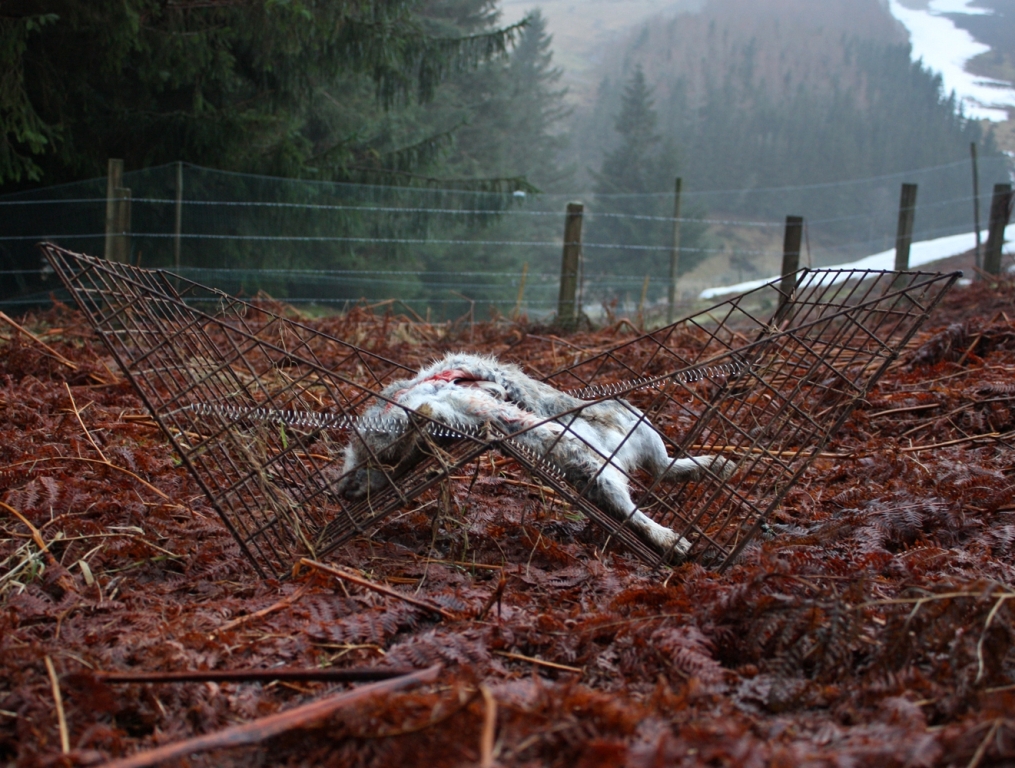
30 year old gamekeeper Craig Barrie of Glass, Huntly, Aberdeenshire, had previously been convicted for having a live pigeon inside a cage trap. On 28 October 2011 at Aberdeen Sheriff Court he had been fined £520 for the possession and control of a live wild bird contrary to the Wildlife & Countryside Act 1981. Barrie is reported to have appealed his sentence, arguing that unless he received an admonishment or an absolute discharge, he would lose his job. Two appeal court judges rejected his argument yesterday, meaning that Barrie has now lost his job. The article reports that Barrie had previously resigned from his job following his earlier conviction, “but the post had been kept open for him in case the appeal was successful“!!!!! (The point being that Barrie wasn’t appealing against his conviction – just against his sentence. Why would Aswanley Estate want to ‘keep his job open’ when he’d been convicted of a wildlife crime, no matter what his sentence?!)

There’s some shoddy journalism in the article, referring to Barrie’s “gamekeeper licence” and saying that the offence took place in “2019” (it actually took place in 2010). It is presumed that the “gamekeeper licence” refers to the general licence. Unfortunately we have not yet reached the stage where gamekeepers are regulated by a ‘gamekeeper licence’ but who knows, the way things are going this might just be the next step after estate licencing!

It is not known whether Barrie was a member of the Scottish Gamekeepers’ Association. More on this shortly…

Well done to the two appeal judges – a refreshing change is in the air.

STV article here

Aswanley Estate website here

Thank you to the contributor who alerted us to this story.

UPDATE: We have received the following email from Aswanley Estate: “We notice that you have used a photograph of Aswanley Estate on your blog entry. You are infringing copyright laws and would ask that you please take this of [sic] within 48 hours or we will take further action”. Thanks for keeping us on the right side of the law, Aswanley Estate – it’s a shame this level of vigilance didn’t extend to the criminal activity of the Estate’s gamekeeper. Keep ’em peeled!

Poisoning by numbers

Last week the RSPB published its annual UK-wide report on raptor persecution (Birdcrime 2010, see here). We said we’d comment on the report once we’d had a chance to read it. Others chose to comment on the day of its release, or to be more accurate, their commentary was probably written prior to the release and was probably based on the content of the RSPB’s press release, rather than on the actual report’s content (see here).

Birdcrime 2010 held few surprises for many of us. The report carried details of raptor persecution incidents (confirmed, probable and possible) that had been reported throughout 2010, so by not publishing the report until November 2011, many of the items could be considered ‘old news’ (or at least those incidents that had been previously reported in the media – as usual, there were several incidents recorded in this report that were not made public at the time they occurred). That’s not to say the report has no value – it is an immensely important document because it is still the only publication to collate these national statistics in one place. It would just be more useful if it could be published at the beginning of the following year to which the report relates, rather than at the end of the following year, but limited RSPB staff resources may prevent this.

One advantage of publishing the report so late is that information can be provided on the outcome of criminal proceedings for those persecution incidents that actually made it to court. For example, the report provides some previously unpublished information about the trial of gamekeeper Glenn Brown, who was found guilty in June 2011 of operating an illegal trap to take birds of prey (amongst other crimes) on Howden Moor in the Peak District in April and May 2010 (see here, here and here). According to Birdcrime 2010, Judge Caroline Goulbourn “ruled that she viewed the attack on the integrity of the RSPB investigations staff by Bertie Woodcock QC on behalf of Knights Solicitors as an aggravating factor in the case. In addition, she criticised Brown’s employer, Geoff Eyre, who leases Howden Moor from the National Trust, for being evasive and reluctant to answer questions” [Birdcrime 2010, p.17].

Incidentally, there is further detail about this case that has been written in the RSPB’s newsletter, Legal Eagle 65. On page 2 the following has been written: “During the ten day trial, the prosecution relied on expert evidence including Prof Ian Newton, Dr Mick Marquiss, Stewart Scull, Dr Alisdair Wood and Guda van der Burght. The defence case, led by Bertie Woodcock QC, centred on the fact that Brown was not using the trap and the entire investigation was a set up with RSPB officers acting in bad faith throughout”. It’s good to see that Judge Goulbourn ruled against this, although what will happen at Brown’s impending appeal remains to be seen. Legal Eagle 65 reports that this appeal “is expected to take place in 2012”.

In addition to the case studies of earlier persecution incidents, Birdcrime 2010 reports that annual poisoning figures were down from 2009 (128 reported poisoning incidents in 2010, compared to 153 in 2009). It also reports that the 2010 figure is below the average for the last five years (2005-2009 average of 150 incidents). Unsurprisingly, it is this aspect that has been picked up on by the game-shooting lobby (e.g. see here). There has also been much made in the media this year about the ‘low’ poisoning figures for 2011 (e.g. see here) – although the published figures only relate to the first half of 2011; figures from June 2011 onwards are not yet available. So is this a sign of progress, as many of the game-shooting lobby would have us believe, or is it indicative of something else? For example, the lower figures could well be an indication that the gamekeepers have finally seen the light and have decreased their poisoning efforts. On the other hand, it could be an indication that gamekeepers are either (a) getting better at hiding their crimes, (b) switching to other persecution methods such as shooting, which is less likely to be detected, or (c) reporting efforts by the authorities have fallen. At this point I don’t think that either ‘side’ can claim a ‘victory’ in the on-going war of words. It is far too early to tell. For example, if you look at the graph that was published in the RSPB’s earlier report, The Illegal Killing of Birds of Prey in Scotland in 2010 (see here), then this reported decline in poisoning incidents can be seen in much clearer context. The graph I’m referring to appears on page 11 of that report and shows the number of confirmed poisoning incidents in Scotland from 1989-2010. The graph has been recreated for this post – see below (thanks to the contributor who sent it!).

If you look closely at the graph, you will see a great deal of variation between years in the number of confirmed poisoning incidents. Of particular interest are the years 1994 and 1995 – in these two years, confirmed poisoning incidents dropped to a low of 15 from a previous high of 35+. However, if you then look at the following three years, the number of confirmed incidents steadily rose until they reached 35+ again. In 1999, the figure dropped again to 15, and from then until 2010, that figure has steadily risen and fallen, although never reaching the low of 15 again. So what does that tell us? I’m fairly sure that in the years 1994 and 1995, the game shooting lobby would have declared a ‘victory’ as the figures had dropped so much, and would have shouted from the hilltops that they’d changed their ways.  I’m also fairly sure that in the following three years when the figures rose again, the conservationists would have declared a ‘victory’ and pronounced that their claims of widespread persecution had been vindicated. Either way, it is clear that neither ‘side’ can draw conclusions just based on an annual figure; for a trend to be detected, we need to see long-term figures.

But do these figures actually provide the full picture? If you read the recent paper on historical persecution at Atholl Estate (see here), then it’s pretty obvious that the ‘official’ persecution figures are meaningless, in the sense that they don’t tell the whole story. And from a conservation perspective, the figures, whether accurate or not, are not really that important. To steal a line from the recent paper on peregrine persecution on grouse moors (see here), “….it is the population level impact that is important, rather than the number of confirmed persecution cases”. We now have peer-reviewed scientific studies that have shown how persecution on grouse moors is having a population level impact on several vulnerable species (golden eagle, hen harrier, red kite and now peregrine). We have yet to see any peer-reviewed scientific studies that can counter these findings and show that these species are NOT impacted by persecution on grouse moors at a population scale. Why do you think that is, and more to the point, what are our politicians going to do about the published findings, apart from telling us that the Scottish government’s support for grouse shooting “goes beyond words“? (see here). Let’s hope that support doesn’t go beyond action as well.

New study shows extent of peregrine persecution on grouse moors

A new study has just been published in the international scientific journal Biological Conservation. Following hot on the heels of earlier studies that have demonstrated how illegal persecution on UK upland grouse moors is affecting the conservation status of golden eagles, hen harriers, red kites and goshawks, the latest study shows the damage that this disgusting practice is having on a population of peregrines in northern England.

You need to be a subscriber to the journal Biological Conservation to access the full paper (or alternatively you can buy it [see link at foot of this post] or you can google the paper’s lead author, Dr Arjun Amar, to see if he’ll send you a free PDF for your own private use), but here is the published abstract:

Wildlife crime can be difficult to quantify, and its true impact on populations can be underestimated if rates are under-recorded. The illegal killing of birds of prey is an important form of wildlife crime, which in the UK, is often associated with land managed for the recreational shooting of red grouse Lagopus lagopus scoticus. In the UK, increases in peregrine falcons Falco peregrinus following recovery from organo-chlorine pesticides have not been uniform, with slow growth and localised declines in some areas, including those managed for red grouse shooting. In this study, we combined 1081 peregrine nest histories across northern England between 1980 and 2006 with a remotely sensed map of grouse moor management, to test whether breeding performance was lower in areas with active management for grouse shooting. Productivity of pairs on grouse moors was 50% lower than pairs breeding on non-grouse moor habitat. However, clutch size and brood size of successful nests did not differ between habitat types, suggesting that food constraints were unlikely to explain this difference. Population models suggested source-sink dynamics, with populations on grouse moors unable to sustain themselves without immigration. Population data confirmed that growth rates were indeed lower on grouse moors than on non-grouse moor sites. Analysis of wildlife crime data confirmed that persecution of the species was more frequent on grouse moors than in other habitat types. This population will be more secure, and better able to function as a barometer of environmental health and climate change, if illegal persecution of the species ceases on areas of land managed for grouse shooting.

Even more evidence then, yet again, that illegal persecution in the UK is so serious that it is having population-level impacts on several raptor species. I think we can be fairly sure that the game-shooting lobby will try to dismiss these latest findings, especially as the lead author was an RSPB scientist and his co-authors were members of the Northern England Raptor Forum. We await their response(s) with interest.

Full citation:

Amar et al. (2011). Linking nest histories, remotely sensed land use data and wildlife crime records to explore the impact of grouse moor management on peregrine falcon populations. Biological Conservation.

Link to on-line abstract here

RSPB press release on British Birds website here

Tip of the iceberg

Anyone who has been reading the ‘official’ annual raptor persecution reports over the last few decades will be familiar with the phrase, “These figures represent the tip of the iceberg”. Conservationists have long held the view that many illegal raptor persecution incidents go unreported, given the remote locations involved and the cultural and social pressures that inhibit certain sectors of the rural community from speaking up about these crimes. Most reports of poisoned, shot, or trapped raptors come from people who have found them by chance, for example hill walkers and dog walkers. The game shooting lobby, in response to the ‘tip of the iceberg’ statement, usually asks, “Where’s the evidence?” The numerous (and ever-increasing) glut of peer-reviewed scientific publications, that show a clear correlation between persecution and upland grouse moors, are usually dismissed as ‘pseudo-science’ by the landowners and gamekeepers, and the conservationists are often accused of conducting some sort of smear campaign against the game shooting industry.

No doubt we will hear all of this, and more, in the coming few days once the RSPB Birdcrime 2010 report has been published later this week. For certain, the report will contain the statement, “These figures represent the tip of the iceberg”, or words to that effect.

So, if the gamekeepers want evidence, here’s some that was unwittingly provided by….er, gamekeepers. It comes in the form of a recently (Sept 2011) published paper in the journal Scottish Birds, which is published by the Scottish Ornithologists’ Club. The paper was written by R.L. McMillan and is entitled, ‘Raptor persecution on a large Perthshire estate: a historical study’. Unfortunately we’re not allowed to publish the whole paper here (you have to be a member of the SOC to get access, or google the author and ask him for a PDF for your personal use) but here is the abstract:

The Atholl Game and Vermin Lists provide an almost continuous record from 1867 until 1988 and in many respects are unique for a large estate in Scotland. Large numbers of raptors and owls were destroyed by gamekeepers during the latter part of the 19th century and into the late 20th century. The implementation of legislation to protect predatory birds appears to have made little difference to persecution levels. Gamekeepers on individual beats seemed able to decide whether they killed predators or not. A few gamekeepers chose not to kill any birds of prey. Some persecution continued well into the late 20th century and a comparison between estate records and incidents recorded by the authorities strongly suggests that a substantial amount of illegal persecution was not recorded.

The paper provides a detailed insight into the extent of raptor persecution on Atholl Estate,  covering the historical period when it was legal to kill raptors (pre-1954), and the current period when it is illegal to kill raptors (1954 onwards). Gamekeepers on the nine beats at Atholl Estate were required to submit annual report cards that recorded the number of game and ‘vermin’ [including raptors!] that was killed on each beat. According to the paper, McMillan writes of Atholl Estate:

To maintain the estate record of game and vermin killed, the individual shooting beats were required to complete a card by the end of February each year and this contained details from the preceding year. The same printed card had been in use for many years and this included hawks, owls and ravens. Although the estate factor regularly checked the returns on these cards, it was only when a member of staff expressed concern that protected birds were included in the returns, that a new form was introduced for the 1988/89 season which excluded protected species”.

The historical records covering part of the period (1867-1911) when it was legal to kill raptors don’t provide any surprises, showing that 11,428 ‘hawks’ were killed on Atholl Estate, in addition to 3,731 owls. Sadly the records do not distinguish between different species of ‘hawks’ or owls and McMillan has interpreted the term to include every raptor and owl species that would typically occur in the area.

The more recent records, however, are of far more interest. They show the period covering the introduction of the 1954 Protection of Birds Act (making it illegal to kill all raptors except sparrowhawks, which weren’t protected until 1961) and McMillan’s graphs of persecution incidents show that the legislation was ignored on the two beats whose records he analysed. In fact on one beat, McMillan shows that persecution actually increased at the time the Act was implemented.

But the most interesting part of this paper comes in Table 3. It is a comparison of gamekeeper records from just one Atholl Estate beat, with the ‘official’ RSPB data for the whole of Scotland, from the period 1980 – 1988. The RSPB data only include details of raptors that have been killed (so not details of ‘suspected’ incidents). Here’s an overview of McMillan’s findings:

1980/81: Atholl Estate beat = 19 raptors killed; RSPB official data for all of Scotland= 9 raptors killed.

1981/82: AE beat = 21; RSPB all Scotland= 23.

1982/83: AE beat = 36; RSPB all Scotland= 16.

1983/84: AE beat = 36; RSPB all Scotland  = 13.

1984/85: AE beat = 25; RSPB all Scotland= 12.

1985/86: AE beat = 22; RSPB all Scotland= 8.

1986/87: AE beat = 14; RSPB all Scotland= 13.

1987/88: AE beat = 30; RSPB all Scotland  = 15.

So, in each of the years listed, with the exception of 1981/82, the ‘official’ RSPB figures for the WHOLE of Scotland were lower than the number of illegally persecuted raptors on just one shooting beat. Does anyone need any clearer evidence that the ‘official’ statistics of illegal raptor persecution are just the tip of the iceberg?!! Of course, there are plenty of arguments that could be made about the reliability of the gamekeepers’ records – i.e. keepers could have inflated the number to earn a bonus, or alternatively keepers could have reduced the number for fear of providing potentially incriminating evidence. McMillan deals with these and other issues in the paper. And for those who think the persecution stopped when Atholl Estate stopped recording it in the 1988/89 season, McMillan reports that “between 1989 and 1999, a number of incidents were logged by the RSPB on several shooting beats on the Atholl Estates, not all of which were confirmed, but which included shootings of raptors, trapping of birds including golden eagle and the deliberate destruction of broods of hen harrier and peregrines“.

It’s worth bearing in mind that these figures in Table 3 are from just ONE beat on just ONE sporting estate. You don’t need much imagination to guess what these figures would look like if records from every sporting estate in Scotland were included in the analysis. This should provide some perspective when we read the ‘official’ figures in the RSPB Birdcrime 2010 report later this week.

It should be noted that under the current management, Atholl Estate regularly provides a home for breeding golden eagles, peregrines, hen harriers and other raptors.

Full paper citation: McMillan, R.L. (2011). Raptor persecution on a large Perthshire estate: a historical study. Scottish Birds 31(3): 195-205.

Atholl Estate website here

Thank you to the contributor who alerted us to this publication.

Inverinate Estate gamekeeper’s trial – more delay

The case against gamekeeper Andrew Malcolm Slaughter, which opened at Inverness Sheriff Court in March 2011, has been delayed once again.

The case opened in mid-March (see here for details) and was continued until 7th April.

On 7th April, it was adjourned until 28th April (see here).

On 28th April the case continued without plea until 19th May (see here).

On 19th May the case was put back until 12th October (see here).

The case has now been postponed until 17th November, eight months after the trial first started.

Silence over hen harrier carnage – now updated

One week on from the publication of the Hen Harrier Conservation Framework, leaked by investigative journalist Rob Edwards on 16 January 2011, here are the published responses from the shooting lobby and from those with a statutory duty to protect this species of high conservation concern:

Scottish Gamekeeper’s Association – silence

Scottish Rural Properties & Business Association (SRPBA) – silence

Scottish Estates Business Group (SEBG) – silence

Scotland’s Moorland Forum – silence

Game and Wildlife Conservation Trust (GWCT) – silence

Scottish Natural Heritage (SNH) – silence

Partnership Against Wildlife Crime Scotland (PAWS) – silence

National Wildlife Crime Unit (NWCU) – silence

Interesting. Perhaps they’re all hoping that if they keep quiet, everyone will forget about the damning evidence presented in the report? It is, after all, only the 5th scientific study published since 1997 to demonstrate the indisputable link between hen harrier persecution and heather moorland that’s managed for red grouse shooting. Here’s a quick summary for anyone who missed the latest scientific facts:

  • The potential national Hen Harrier population for Scotland is estimated to be within the range 1505 – 1790 pairs.
  • The most recent national survey of Hen Harriers in Scotland (2004) was estimated to include 633 pairs.
  • This means that 872 – 1,157 harrier pairs (1,744 – 2,314 individuals) are missing.
  • The areas from where these birds are missing are areas managed as grouse moors.
  • Illegal persecution of hen harriers is particularly prevalent in five areas, where the majority of breeding attempts fail. These five areas are: Central Highlands, Cairngorm Massif, Northeast Glens, Western Southern Uplands and Inner Solway, and Border Hills.
  • At a national scale, the hen harrier in Scotland is not in favourable conservation status, largely due to illegal persecution. Ditto the English hen harrier population.

So, up to 2,314 hen harriers are missing in Scotland, and no-one has anything to say about it? Think about that number. It’s not 23, it’s not even 213 – it is two thousand, three hundred and fourteen birds. This is wholesale destruction on a massive scale! Are we to believe that “just a few rogues” are responsible?

How much more scientific evidence is required before we see the effective enforcement of our wildlife legislation? How can those people who own and manage the sporting estates still be getting away with this level of illegal activity? Why is the Environment Minister still set against the licensing of sporting estates, when it is blindingly obvious that they are unable to self-regulate?

In light of the contents of the leaked report, it is to be hoped that the Scottish Government’s Rural Affairs & Environment Committee will once again push for an amendment to the WANE Bill for estate licensing. Stage 2 of the Bill was completed on Wednesday 19 January and there was no mention of the Hen Harrier Framework during that meeting, probably because the RAE Committee hadn’t had time to read the report in full. Stage 3 begins in several weeks and by that time the Committee and the Environment Minister should be fully conversant with the extent of illegal raptor persecution on Scottish grouse moors.

UPDATE: 28 January 2011. SRPBA denies extent of persecution (yawn)

The SRPBA has written a letter of response to The Sunday Herald, dated 16 January 2011. I’m not sure if it was actually published by The Herald, but here it is as a PDF – SRPBA response to killing fields article 16 Jan 2011

UPDATE: 19 February 2011. See our blog entry on 19 Feb 2011 for an update on this story.

The Mark Osborne Coincidences Continue…

Even casual readers of this blog will be aware of the frequency with which the name “Mark Osborne” occurs. His connection to locations with both actual and alleged raptor persecution incidents, which must of course be coincidental, is not confined to Scotland.

February 2008. Three gamekeepers working on the Snilesworth Estate, near Northallerton in North Yorkshire, have pleaded guilty to a range of charges relating to the use of cage traps containing live pigeons to take birds of prey.

In May 2007, following allegations of traps being set to catch birds of prey, the North Yorkshire Police, supported by the RSPB and RSPCA, visited the Snilesworth Estate. The estate is reportedly part of a network of shooting estates managed by Mr (John) Mark Osborne (56) of Banbury, Oxford, according to the RSPB link, below, and this link here.

James Benjamin Shuttlewood, the headkeeper of the Snilesworth Estate with 20 years experience, pleaded guilty to five offences, relating to the setting of illegal traps by his subordinates. He was fined £250 for each offence.

Charles Lambert Woof pleaded guilty to one offence of mis-using a cage trap. He was fined £100.

Eighteen-year old David George Cook pleaded guilty to two offences of setting cage traps. Cook, who was 17 at the time the offences were commited, was given a conditional discharge for 12 months.
Additionally, the three convicted keepers have each been asked to pay £43 costs.

Full story here: http://www.thenorthernecho.co.uk/news/2032154.0/?act=complaint&cid=1114142

RSPB story here: http://www.rspb.org.uk/news/details.aspx?id=tcm:9-183005

RSPB Investigator’s blog about this case here

2006 article in the New York Times about Snilesworth Estate, with James Chapel listed as ‘manager of a Snilesworth Moor estate’ (here). James Chapel is Director of William Powell Sporting (see here), a company owned by Mr Osborne.

Ian West, Head of RSPB Investigations added: ‘As a major manager of shooting estates Mr Osborne has a real opportunity to show leadership and signal an end to the Victorian tradition of intolerance towards birds of prey.’
The illegal killing of birds of prey is a major factor limiting the range and populations of many species across the UK.