‘No evidence’ of gamekeepers persecuting hen harriers, says Moorland Association

As a prelude to this evening’s programme about the illegal persecution of hen harriers, there was a short piece on BBC Radio Newcastle this morning.

In an astonishing interview, the secretary of the Moorland Association (the representative body of grouse moor owners) suggests that there is ‘no evidence’ of gamekeepers being involved with the illegal persecution of hen harriers.

Fortunately, Guy Shorrock of the RSPB’s Investigations Team was on-hand to provide an eloquent and well-informed rebuttal.

It’s remarkable that the Moorland Association are still in denial, even though we’re all well aware that this species is on the very brink of becoming extinct as a breeding species in England. It’s especially remarkable given that the Moorland Association have been party to the Hen Harrier Dialogue – the discussion process set up specifically to find ways of addressing the conflict between grouse moor management and hen harriers (now in its 7th year). We’ll be blogging about the latest news from the Hen Harrier Dialogue shortly – and given the Moorland Association’s flat denial that hen harrier persecution exists, you won’t be surprised to find out the latest development…

Meanwhile, listen to this morning’s radio interview (here, starts at 1.25.30 and ends at 1.31.06) and be sure to watch the tv programme this evening (here).

Photograph below shows a hen harrier being removed from an illegally-set trap on a Scottish grouse moor in 2010. This bird was lucky – he survived. Nobody was prosecuted for setting the illegal trap.

Hen harrier being removed from illegal trap on Moy Estate

Clam traps: SNH in the last chance saloon

snh_logoOn Tuesday we blogged about SNH’s response to our concerns over the on-going clam trap fiasco (see here). We said we would outline what we thought the next step should be. Here are our thoughts:
There are two main issues. The first one is that the consultation process was flawed. It did not meet the standard required by the Scottish Government’s ‘Consultation Good Practice Guide’, which is applicable to an agency like SNH (see here).

For example, consultations should allow “at least 12 weeks to respond”. This particular consultation opened on October 1st 2012 and closed on November 9th 2012, thus only allowing 5.5 weeks in which to respond. In addition, in order to be transparent, SNH should have provided feedback on how each and every point raised during the consultation was treated. As far as we can tell, this has not taken place. Instead, it appears that the majority of points raised have been ignored (in terms of the final outcome of the consultation). In which case it could be argued that the whole consultation was pointless; SNH had already decided what they were going to do, regardless of the majority view of respondents, and they were just going through the motions of holding a public consultation to appease those of us who might object to their proposals.

The second main issue is the basis of evidence that SNH used to approve the use of clam-type traps. According to SNH, the consultation did not provide any evidence that clam-type traps were unsafe for target and/or non-target species, or a threat to protected species. Instead, they argued that as clam-type traps had previously been in use (albeit probably illegally!) it would be “disproportionate to ban their use outright”. There are several problems with this argument.

First of all, it is clear that no independent testing has taken place to provide evidence that these traps are safe. If SNH are using the ‘lack of available evidence’ to show that the traps are unsafe, then surely that mandate should also apply to demonstrate that the traps are safe before they are authorised for use? Is there any evidence to show that the traps have no welfare or lethal impacts to either target or non target species, which may include protected species, to justify their use? If there is evidence, it has not been made available to the public, in which case, SNH should have applied the precautionary principle and not authorised these traps until such time as independent testing shows they pose no threat to animal welfare as well as no impact on non-target species, some of which may be protected species.

Secondly, SNH have argued that by restricting the type of bait for these traps (bread and eggs only), they have “minimised the risk to non-target species”. Whilst this may be applicable to raptors, it certainly does not minimise the risk to other protected, non-target species, including the pine marten, a species that loves to eat eggs! According to SNH’s own website, it is an offence to intentionally or recklessly capture a pine marten unless you have a special licence to do so (see here). So why authorise a trap that, depending on its location, is highly likely to capture a pine marten?!

Thirdly, SNH said that it would be “disproportionate to ban their [the traps] use outright”. But, if you read the responses to the consultation, the majority of respondents were not asking for an ‘outright ban’ – they were asking for independent testing prior to the traps being authorised. Furthermore, there are alternative traps (Larsen trap) that could be used if clam-type traps were not approved this year or until such time as a trial showed that they are safe. So for SNH to say that not approving their use is ‘disproportionate’ is overstating the reason for approving the use of these traps.

So, where to go from here? In the first instance, we propose that people contact SNH and ask them to provide evidence to show that clam-type traps have no welfare or lethal impacts on either target or non-target species, and if they can’t provide such evidence then they should pull the clam-type trap from the General Licences until such time as that evidence is available.

This is SNH’s last chance to act. If the evidence is not forthcoming and SNH still refuse to withdraw the clam-type trap from the General Licences, then the next step would be to go to the Ombudsman and ask whether SNH has carried out this consultation appropriately.

If that fails, then we think there is a very strong case for making a formal complaint against SNH to the EU, for failing to protect the very species that they have a statutory duty to protect. This complaint wouldn’t just be limited to the clam-type trap issue – it would cover other traps that SNH have authorised, including crow-cage traps, without addressing the legitimate concerns about their use. These concerns have been raised over and over again during the last few years (see the current and previous consultation responses of groups such as RSPB, SRSGs and OneKind for examples) and SNH has consistently ignored them. They may argue that they’re going to address these concerns in their proposed ‘Code of Practice’ that they say they will develop ‘early this year’. The problem with that is it has not been made clear whether they will actually address all the concerns, and even if they do, whether this ‘Code of Practice’ will be a voluntary code (in which case it’ll be worthless) or whether breaking this code will be considered a formal breach of the conditions of the General Licence (and therefore should result in a prosecution).

It’s time to get serious. Please consider emailing SNH. It only takes a minute. The complaint should go right to the top again: Ian Jardine, (Chief Executive SNH) – ian.jardine@snh.gov.uk

If you’re not sure what to write, either copy the blog URL into the body an email, or you could use the following text as a guide – simply cut and paste or adapt it to your own words:

Dear Dr Jardine,

Re: the recent SNH consultation which led to the authorisation of clam-type traps in the 2013 Open General Licences.

Please can you provide the evidence you have used to demonstrate that clam-type traps have no welfare or lethal impacts to target or non-target species. If the evidence is unavailable, please consider withdrawing the use of clam-type traps from the Open General Licences until such time as independent and rigorously tested evidence is available.

Thanks.

Gamekeeper charged with six offences

North Yorkshire police logoaA gamekeeper from Pickering, North Yorkshire, has been charged with six offences for the illegal use of cage traps to capture a buzzard.

This is the gamekeeper whose arrest was reported last October (see here). He has still not been named, and nor has the estate/shoot where the alleged offences took place. It is not yet known whether he is a member of the National Gamekeepers’ Organisation.

He has been charged with six offences under the Wildlife & Countryside Act and the Animal Welfare Act. He has been bailed to attend Scarborough Magistrates court next month. Article in the Ryedale Gazette & Herald here.

In other court news, the long-awaited verdict in the Lochindorb Estate hare snare trial is due tomorrow…..

Eagle persecution featured on the One Show

One-Show-smallYesterday evening, the BBC’s One Show ran a feature on golden eagle satellite-tracking in Scotland, featuring two legendary raptor fieldworkers from the RSPB, Stuart Benn and Brian Etheridge.

Thanks to these two, the message about illegal raptor persecution was heard by a mainstream tv audience (an estimated 5 million viewers) both during the film (when they were sat-tagging an eaglet) and then again when Stuart was interviewed in the studio.

Two top blokes doing a top, top job. Well done!

For anyone who missed it, catch it on BBC iPlayer here (20.37 min – 28.41 min) for a limited period.

Here is a link to Stuart’s blog about the filming day last summer.

Another poisoned buzzard in Scotland

SASA (the Government’s Science & Advice for Scottish Agriculture) have just published their latest ‘Summary of Incidents’ where they report on the number of animals that have been submitted for poisoning analysis, dating from January – September 2012 (see here).

It’s an interesting read. The results from the first three-quarters of 2012 suggest a decline in the number of reported raptor poisoning incidents. Does this reflect an actual decline in poisonings, or does it mask something more cynical, such as a change of tactics in the method of persecution used? Nobody can tell for sure at this stage, although you’d have to be pretty naive to believe the first explanation, especially after the recent shocking non-poisoning incidents such as the dead golden eagle found in a lay-by with two broken legs, believed to have been illegally trapped on an Angus grouse moor and then moved by vehicle in the dead of night and dumped by the side of the road, barely alive and left to suffer an horrific death. Then there was the golden eagle that was found shot and critically injured on a grouse moor in Dumfrieshire, now making a slow recovery. And then the shot hen harrier found dead on another grouse moor in Grampian. And these are just the ones we know about.

The latest SASA results show that a buzzard was found dead in Grampian in September 2012, confirmed to have been poisoned by the illegal pesticide Carbofuran. We don’t remember seeing any police reports about this incident. Perhaps they kept it quiet so as not to hinder their investigation? Fair enough, but it’s now four months later…Perhaps Grampian Police will report where was it found, and whether anyone is being charged. They probably won’t though; yet another incident being quietly swept under the carpet? We blogged about these poisoning incidents going unreported the last time SASA published their stats (see here).

There were a number of dead buzzards that were submitted to SASA for testing between Jan-Sept 2012, including the satellite-tagged ‘Buzz’, believed to be the first sat-tracked buzzard in Scotland (see here). His last signal came from near Brechin, Angus in late September. His corpse was picked up by the side of the road. Given the location and the on-going history of raptor persecution in the nearby area, his body was submitted for a post-mortem. He hadn’t been poisoned though – SASA concluded that his probable cause of death was starvation. It would have been nice if Tayside Police had provided information about this result, given so many were following his movements on Roy Dennis’ website…

Buzz wasn’t the only buzzard to starve to death. There are four other buzzards listed in the report with the same probable cause of death; strange really, when there are some people who maintain that buzzards are gorging themselves silly on gamebirds.

Interestingly, the dead golden eagle found in suspicious circumstances on Harris in June did not not appear in the SASA results, even though the press reported at the time that poisoning was suspected (see here). Perhaps Northern Constabulary will provide an update on the outcome of this one? Yeah, you’re right, of course they won’t.

Misleading guff from Scottish Land and Estates

scotsman_logo_200The following letter has appeared in The Scotsman in the continuing ‘debate’ on grouse moor management (see here to read the earlier articles).
“Logan Steele’s letter (14 Jan) which alleges that driven grouse shooting is only viable with the persecution of birds of prey, particularly the hen harrier, is misleading.

First, official statistics demonstrate a clear decline in the number of incidents of raptor persecution.

Second land management for driven grouse shooting delivers a huge benefit for other protected wildlife, especially waders, and sustains employment and communities in remote rural areas. This is something the suggested alternative of walked-up grouse-shooting would not do.

Of particular significance is clear evidence that where grouse and hen habitat and vermin management have declined in some hen harrier “special protection areas”, this has actually resulted in lower harrier populations, as well as declines in other species such as waders.

This is a more complex situation than some make out.

The Langholm Moor Demonstration Project, set up in partnership with the government to bring back driven grouse shooting in the presence of sustainable numbers of hen harriers, is where the best hopes of progress on this issue lie.

Results at Langholm so far are that neither harriers nor grouse have recovered – not what anyone expected, but each year scientific understanding improves and practical solution gets closer.

Making progress will involve compromise on all sides.

Organisations representing grouse moor managers such as SLE are fully behind this process and it is unfortunate that RSPB has pulled out of the mediation process in England. Perhaps Scotland provides the best opportunity to make progress now.  Douglas McAdam, Scottish Land & Estates, Musselburgh”

[Link to the letter here].

And he accuses Logan Steele’s letter as being misleading!

First, which “official statistics demonstrate a clear decline in the number of incidents of raptor persecution” is Doug McAdam referring to? The ones we know of only relate to known poisoning incidents, although they are limited to poisoned birds; they do not include the discovery of poisoned baits and nor do they include suspected poisoning incidents or unreported poisoning incidents. More to the point, they do not relate to other types of raptor persecution, such as shooting, trapping, nest destruction, ‘disappearing’ birds etc. The only statistics that account for all types of raptor persecution incidents are those compiled annually by the RSPB; statistics that have never been accepted by SLE or any other game-shooting organisation.

Second, McAdam says “land management for driven grouse shooting delivers a huge benefit for other protected wildlife, especially waders, and sustains employment and communities in remote rural areas“. Another misleading statement. Land managed for driven grouse shooting is not only bad for protected wildlife (golden eagles, white-tailed eagles, hen harriers, goshawks, red kites, buzzards, peregrines, ravens, pine martens, mountain hares etc etc) but it is catastrophic for other species too (foxes, weasels, stoats, crows etc etc). And that’s without even touching on the landscape-level environmental damage.

McAdam goes on to suggest that “making progress will involve compromise on all sides“. No it won’t. Making progress will depend entirely on whether the grouse-shooting industry will accept that they have to work within the law and put an end to illegal persecution. If they do, all well and good. If they won’t, then they face a direct action campaign to ban driven grouse shooting by those of us who are sick of waiting for the government to act on our behalf. Hollow promises just don’t wash anymore. Time’s up.

McAdam’s penultimate sentence is laughable. He’s trying to suggest that the RSPB are the unreasonable ones in this 20+ year saga, for walking away from the six-year long Hen Harrier Dialogue process (see here). They are definitely not the unreasonable ones – they recognised a sham process and got out. Until SLE start to publicly expel their member estates where raptor persecution is rife (and we all know who they are, and so should McAdam – if he doesn’t, he’s in the wrong job), then the credibility of SLE’s involvement in ‘making progress’ will be viewed with as much contempt as it deserves.

Here comes 2013….the year of natural scotland

imagesHappy Hogmanay!

Tomorrow marks the start of another Scottish government themed year: The Year of Natural Scotland, in which we’re encouraged to celebrate Scotland’s stunning natural beauty and biodiversity. Good job it wasn’t this year’s theme as there might have been some red faces in the government:

  • SGA gamekeeper Whitefield sentenced for poisoning four buzzards (he already had an earlier wildlife crime conviction). His sentence this time? 100 hours community service.
  • Scottish gamekeeper McLachlan, convicted for possession of the banned poison Carbofuran. Fined £635.
  • Scottish gamekeeper Barrie lost an appeal for his sentence of £520 for illegal possession and control of a wild bird.
  • COPFS choosing not to prosecute a Scottish gamekeeper who had been filmed beating birds to death with a stick inside a crow cage trap.
  • Scottish gamekeeper Christie convicted for wildlife crimes relating to the illegal use of a crow cage trap. His sentence? An admonishment (a telling off).
  • Scottish gamekeeper Graham convicted for allowing a buzzard to starve to death inside a crow cage trap. Fined £450.
  • Scottish gamekeeper McKellar convicted for possession of banned poison. Fined £1,200.
  • Scottish gamekeeper Scobie convicted for using banned poison. Fined £270.
  • A satellite-tagged golden eagle mysteriously ‘disappeared’ in the Angus glens.
  • A satellite-tagged golden eagle mysteriously ‘disappeared’ to the North East of the Cairngorms National Park.
  • Peregrine chicks mysteriously ‘disappeared’ from a nest site in Dumfries & Galloway.
  • A golden eagle was found dead, poisoned in Lochaber.
  • A golden eagle was found dead in suspicious circumstances on the Isle of Harris. Still awaiting results.
  • A satellite-tagged golden eagle mysteriously ‘disappeared’ in the Monadhliaths.
  • A poisoned raven, crow, and three poisoned baits were found in the Borders.
  • A satellite-tagged golden eagle was found dead near a lay-by in Aberdeenshire. Its injuries and its sat tag data suggested it had been illegally trapped on an Angus grouse moor and then dumped during the night and left to die.
  • A golden eagle was found shot and critically injured on a grouse moor in Dumfries & Galloway.
  • Barry, the sat-tagged hen harrier from Langholm mysteriously ‘disappeared’.
  • Buzz, the sat-tagged buzzard mysteriously ‘disappeared’ in the Angus glens. (More on this case in the New Year).
  • Willow, a sat-tagged marsh harrier mysteriously ‘disappeared’ in Galloway.
  • A hen harrier was found shot dead on an Aberdeenshire grouse moor.

These are just a few of the ‘highlights’ from Scotland this year – there are a few more that we can’t yet report but we will in the New Year. And of course this list doesn’t include other confirmed incidents from other parts of these fair isles such as England, Wales, Northern Ireland and the Irish Republic; a list that includes shot and poisoned sea eagles, buzzards, kites, harriers, peregrines and sparrowhawks. Nor does it include the incidents that went undiscovered.

We’ll be blogging quite a lot about the Year of Natural Scotland, which hopefully won’t be just a banner-waving exercise by the government but an opportunity for them to put their money where their mouths are. You don’t think so? No, neither do we. Why should 2013 be any different from the previous three decades of ineffective action?

A hint of what’s to come is the revelation that the theme will be highlighted during several events throughout the year. Two particular locations caught our attention: the Scone Game Fair and the Moy Game Fair.

The Scone Game Fair is of course organised by the GWCT. That’s the same GWCT that has recently asked for the addition of buzzards and sparrowhawks to the General Licences (that means they want permission to kill them…we’ll be blogging about that shortly). It’s also the same Game Fair that has previously attracted sponsorship from some very, how shall we put it, ‘surprising’ sources.

The Moy Game Fair is held on the Moy Estate near Inverness. If you’re unaware of this place, try googling it.

Thanks for all your interest and support in 2012…we’ll see you soon. Sláinte!

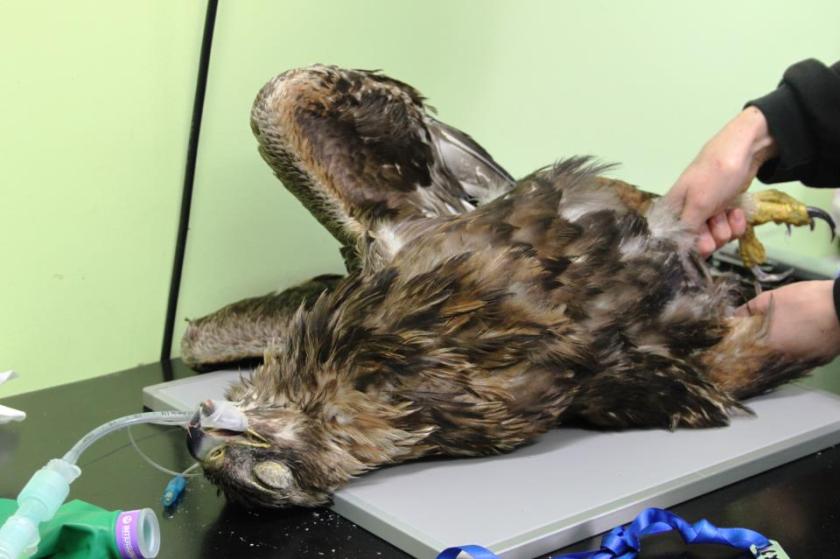
This golden eagle was found shot, critically injured &left to die on a Scottish grouse moor. Photo SSPCA
This golden eagle was found shot, critically injured and left to die on a Scottish grouse moor. Photo SSPCA

Row escalates over SNH’s decision to authorise clam traps

The controversial clam trapEarlier in December we blogged about SNH’s decision to authorise the use of clam-type traps under the 2013 General Licences, despite the concerns of a number of organisations that these traps are likely to cause injury to non-target species, especially raptors (see here).

This story has now been picked up by the BBC (see here). According to this article, at least two organisations (SSPCA and RSPB) have called on SNH to reconsider its decision on clam traps. Judging by the comment attributed to SNH’s Licensing Manager, Ben Ross, a U-turn looks unlikely:

We will commission objective research on these traps; if the research shows they pose unacceptable risks, we will then prohibit them“.

Surely this is the wrong way around? You do the research to assess their suitability BEFORE you decide to approve their use, not afterwards!

But that’s not the end of the story. When we first blogged about SNH’s decision to approve these traps, we also raised concerns that SNH had appeared to ignore the recommendations made to them by all groups except those with an interest in game-shooting (blog article here). We asked blog readers to contact SNH and ask to see ALL the consultation responses they’d received, so that we could assess which groups’ recommendations had been accepted and which had been ignored. This was a successful tactic – in a letter to consultees yesterday, SNH wrote this:

Following our response letter to the consultation we received a number of information requests for us to publish all responses that we received to the consultation. This email is to let you know that we are legally obliged to provide this information and as such will be publishing it on our website either later today or tomorrow……..As we have received a number of requests for the information, we will make the responses available on our website“.

So well done and thank you to those of you who made the effort to send an email request to SNH. We look forward to seeing the consultation responses published on the SNH website later today.

Let’s also not forget that the written answers are due tomorrow in response to MSP Claire Baker’s parliamentary questions about the use of these clam-type traps (see here).

RSPB walks out of hen harrier ‘dialogue’

tec_logo_16271This isn’t especially new news, as it happened in the summer, but we were reminded of it today after reading something on Mark Avery’s blog – more on that later – and it does seem pertinent to blog about it now.

So, most readers will be aware of the Environment Council’s ‘Hen Harrier Dialogue’ – a process that started in 2006 that aimed to bring ‘stakeholders’ together to try and work out a way of resolving the hen harrier / grouse moor conflict in England (see here for website). Those stakeholders involved in these dialogue meetings included the usual suspects such as BASC, Countryside Alliance, Country Land and Business Association, GWCT, Moorland Association, National Gamekeepers’ Organisation, RSPB, Hawk & Owl Trust, Northern England Raptor Groups etc.

The ‘dialogue’ process has produced an awful lot of documents (and a lot of awful documents, see here) and meeting reports (see here), and a strong interest in pursuing a trial on a ‘quota system’ for hen harriers – a controversial idea spawned by Steve Redpath several years ago. In simplistic terms, this quota system would mean that grouse moor owners would ‘allow’ a certain number of breeding pairs (number yet to be established) and once a ‘ceiling’ had been reached, then they would be ‘allowed’ to remove harrier broods (non-lethally) to other parts of the UK away from grouse moors. This idea is still being discussed, although it brings with it obvious ethical and legal debates.

Hen harrier being removed from illegal trap on Moy EstateSome argue that conservation groups shouldn’t be sitting at the table with representatives from an industry that has been responsible for killing off England’s breeding hen harrier population. Others argue that the quota scheme may be the best way forward because at least there’d be some harriers, which is a better proposition than having none. Others have suggested that the quota system would never get off the ground anyway because the grouse moor owners would have to ‘allow’ a certain number of breeding hen harriers on their estates and they’ve shown themselves incapable of tolerating any.

Whatever your point of view, the bottom line is that six years on from the start of the dialogue process, and after all that talking over egg sandwiches and coffee, the English hen harrier breeding population has been reduced to one known pair. That’s it. Just the one pair. In a country that has suitable habitat to support over 300 breeding pairs.

This summer, the RSPB made a bold move and decided to walk away from the dialogue process. They said that as hen harriers have been systematically eradicated from English grouse moors then there was no longer any conflict and therefore no point in spending any more time talking about it. Instead, they intended to get on with their own plans for hen harrier recovery.

It’s not yet known what will happen to the Environment Council dialogue process now a major player has walked away. As far as we’re aware, there are still many questions about the lawfulness of the proposed trial quota scheme so it’s unclear whether attempts will still be made to push that through.

So what next for English hen harriers? After the recent sad story of the illegal shooting of Bowland Betty (see here), in addition to all the other horror stories we keep reading about from English and Scottish grouse moors (e.g. see here, here, here, herehere), is it time for a different approach? It’s obvious that the authorities can’t, or won’t deal with illegal persecution, and the grouse-shooting industry can’t, or won’t put a stop to it either. An alternative suggestion has been put forward by Mark Avery – unless things miraculously improve for breeding hen harriers in Northern England in 2013 then it will be time to start the campaign, on 12 August 2013, to end grouse shooting (see here for Mark’s blog).

Up until now we’d been supporters of the idea of estate-licensing schemes rather than an outright ban. Licensing seemed a fair and reasonable approach to regulate an industry so clearly incapable of expelling its criminal elements. But now?  The time for being reasonable has long since passed. Count us in, Mark.

For our anagram fans: Grouse moor – morgue or so

Parliamentary questions asked about SNH’s decision on clam traps

Claire Baker MSPFollowing on from earlier blog posts about SNH’s latest baffling decision to authorise the use of clam-type traps in the 2013 General Licences (see here), a well-informed MSP has now asked the following excellent parliamentary questions:

Claire Baker (Scottish Labour, Mid-Scotland and Fife), Date lodged 7/12/2012

Question S4W-11729 To ask the Scottish Government what independent testing has been carried out to evaluate the risk of injury to birds and other animals from (a) Larsen Mate and (b) Elgeeco cage traps.
 
Question S4W-11730 To ask the Scottish Government what independent testing has been carried out to evaluate the impact of (a) Larsen Mate and (b) Elgeeco cage traps on (i) protected species and (ii) species not targeted by the devices.
 
Question S4W-11731 To ask the Scottish Government what provision must be made for (a) food, (b) water and (c) shelter for (i) birds and (ii) other animals caught by a (A) Larsen Mate and (B) Elgeeco cage trap before a general licence for its use can be granted.
 
Question S4W-11732 To ask the Scottish Government what its position is on issuing general licences for untested cage traps.
 
Question S4W-11733 To ask the Scottish Government whether independent evidence establishing a need to supplement a trap with a (a) Larsen Mate and (b) Elgeeco cage trap is required before a general licence for its use can be granted.

Expected answer date: 21/12/2012

Those answers should make for interesting reading. Well done Claire Baker MSP.

Meanwhile, we’re still waiting for SNH to publish ALL the responses they received on their 2013 General Licence consultation. They told us last Thursday that they were “currently preparing the information for publication” (see here).