Statement from Invercauld Estate re: illegal traps

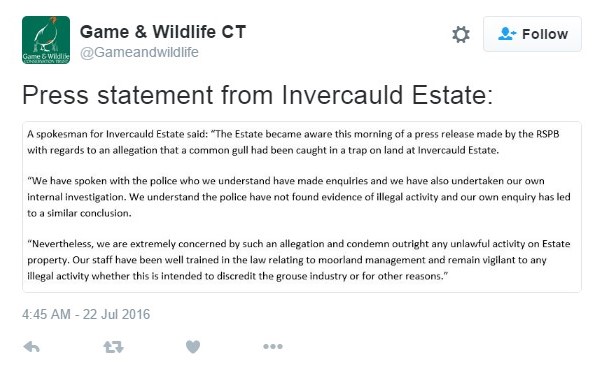
In relation to this morning’s news (here) that illegally-set traps have been discovered on a grouse moor on Invercauld Estate in the Cairngorms National Park, the following statement from Invercauld Estate has just appeared on GWCT’s twitter feed:

Invercauld statement

This is staggering! In one paragraph the estate is denying that this crime ever happened, but then in the next paragraph suggests that if it did happen the evidence was probably planted by someone trying to discredit the grouse shooting industry. Really? Really? Seven hours to think about it and that’s the response? Really?

The RSPB, the SSPCA, and two witnesses (the hill walkers) say it happened (full statement here).

Cabinet Secretary for the Environment Roseanna Cunningham believes it happened and has said, “It is difficult to see their use [the illegally-set spring traps] as anything other than a blatant and criminal attempt to target protected birds of prey” (full statement here).

Grant Moir, CEO of the Cairngorms National Park Authority also believes it happened and has asked for a meeting with the Head Trustee of Invercauld Estate, the Sporting Partner on Invercauld Estate, and Police Scotland to improve enforcement measures (full statement here).

So, Police Scotland, over to you. Was evidence of illegal activity found on Invercauld Estate? Emails please to Assistant Chief Constable Malcolm Graham who leads on wildlife crime for Police Scotland: ACC.CrimeMCPP@scotland.pnn.police.uk

When you’ve sent your email, please consider signing THIS PETITION calling for the licensing of all gamebird hunting in Scotland.

When you’ve done that, please consider signing THIS PETITION calling for a ban on driven grouse shooting.

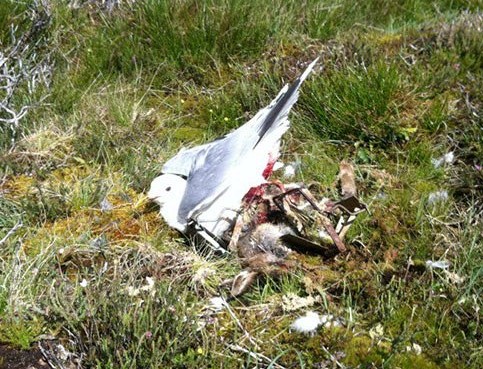
Invercauld gull

Illegal traps on Invercauld Estate: part 2

Further to today’s news that illegally-set traps have been found on a grouse moor on Invercauld Estate in the Cairngorms National Park (see here), we are interested in the SSPCA’s role in this investigation.

As you’ll recall, RSPB Scotland notified the SSPCA about the severely injured gull caught by both legs in two spring traps. An SSPCA Inspector attended the scene (utilising powers under the Animal Health & Welfare (Scotland) Act) and was able to put the poor suffering bird out of its misery. However, the SSPCA Inspector did not conduct a wider search of the area for evidence because their current powers do not permit that.

Invercauld gull

Instead, the wider search was delayed until Police Scotland could attend (Police Scotland does have the authority to undertake searches of land to look for evidence of offences committed contrary to the Wildlife & Countryside Act). Now, this delay is NOT a criticism of Police Scotland’s actions in this case (they were on site relatively swiftly and invited both the SSPCA and RSPB Scotland Investigations to assist with the search. That’s a big improvement on some previous cases).

But, the problem of the SSPCA’s limited powers are clear in this case.

When the multi-agency search did take place ‘a few days later’, ‘clear evidence was found that eight similar traps had been deployed, attached to stakes and baited with dead rabbits, in a line stretching two hundred metres across the moor. It was also evident that these traps had been removed very recently’.

Whichever criminal had set these two traps that caught the gull was given the time to remove those further eight traps before the Police turned up.

How ridiculous is it that the SSPCA Inspector wasn’t allowed to walk two hundred metres across the grouse moor to retrieve those eight additional traps (and any other evidence that the criminal may have left lying around)? It’s plainly bonkers! Instead, there was an inevitable delay while the Police sorted themselves out (again, not a criticism in this case), allowing the criminal to distance him/herself from the crimes.

As many of you will know, on 1 Sept 2016 it will be two years since the closure of the Scottish Government’s public consultation on increased investigatory powers for the SSPCA. Three Environment Ministers later and we’re still waiting for a decision (see here). It’s pathetic.

More on this Invercauld case shortly…..

Illegally-set traps found on Invercauld Estate grouse moor, Cairngorms National Park

RSPB Scotland has today issued a press statement about the discovery of illegally-set traps found on a Royal Deeside grouse moor in the Cairngorms National Park (see here).

On 27 June 2016, two members of the public found a Common Gull that had been caught by the legs in two spring traps that had been positioned next to a dead rabbit that had been used as bait. The gull was distressed and bleeding profusely. The hill walkers called RSPB Scotland, who immediately alerted Police Scotland and the SSPCA. An SSPCA Inspector quickly attended the scene and the gull was found to have two broken legs. The bird’s injuries were so extensive it had to be euthanised.

Several days later, a multi-agency (Police Scotland, SSPCA, RSPB Scotland) search was undertaken on the grouse moor, ‘where clear evidence was found that eight similar traps had been deployed, attached to stakes and baited with dead rabbits, in a line stretching two hundred metres across the moor. It was also evident that these traps had been removed very recently’.

The press statement continues, ‘Police Scotland officers later spoke to a number of people involved with the management of the land on which the traps were found, but the identity of who had set the traps could not be established‘.

According to the press statement, the two hill walkers had found the distressed gull on “the northern slopes of Geallaig Hill, a few miles north west of Ballater“.

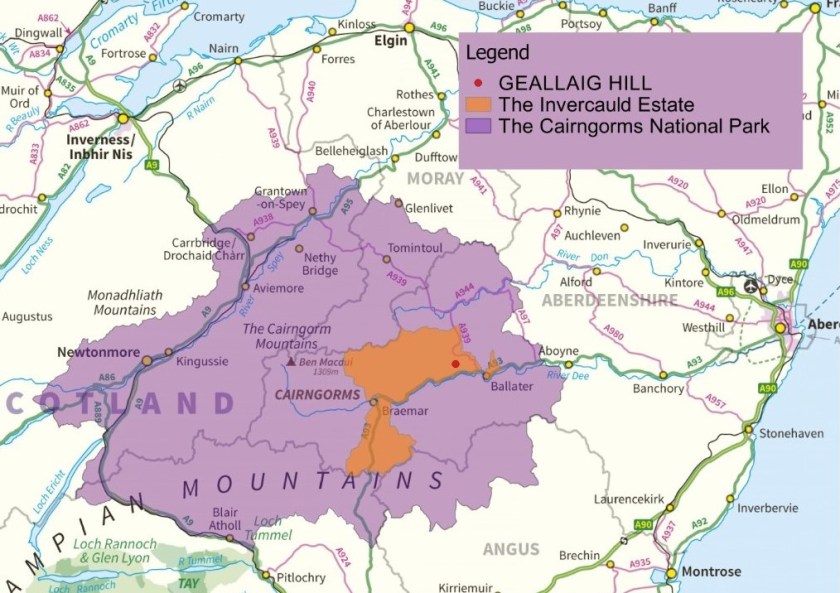
According to Andy Wightman’s fantastic website Who Owns Scotland, Geallaig Hill lies within the boundary of the Invercauld Estate. Using Andy’s data, we’ve created this map to show the position of Invercauld Estate within the Cairngorms National Park and the location of Geallaig Hill within the boundary of Invercauld Estate.

Cairngorms Invercauld - Copy

This is not the first time illegally-set spring traps have been found on Invercauld Estate. In 1997, a gamekeeper was fined £120 after admitting to illegally setting a spring trap to catch a rook (see here).

Spring traps can (currently) be used legally to catch stoats, weasels, rats etc BUT ONLY if they are placed inside a natural or artificial tunnel with a restricted entrance to minimise the risk of catching a non-target species. There are frequent reports of their illegal use on some shooting estates to trap birds of prey (e.g. set in the open next to a bait, or attached to the top of a post to turn them in to pole traps) – some recent examples can be found here, here, here, here, here, here, here, and of course the recent and now infamous Mossdale Estate traps here.

There’s a lot to discuss about this latest crime, and we’ll be doing just that in a series of blogs later this afternoon.

In the meantime, well done to the two hill walkers who reported this crime, well done to the SSPCA Inspector for a quick response, well done to the Police Scotland wildlife crime officers for a quick, multi-agency follow up and search, and well done to RSPB Scotland for a timely press release.

More shortly…..

UPDATE 2.30pm: Illegal traps on Invercauld Estate part 2 here

UPDATE 4.45pm: An astonishing statement from Invercauld Estate here

UPDATE 23 July 2016: SGA statement re: illegal traps found on Invercauld Estate here

General Licence restriction not worth paper it’s written on

SNH logo 2Further to yesterday’s blog about the status of the General Licence restriction on Raeshaw Estate (see here), SNH has now provided an explanation.

You’d better make sure you’re sitting down:

Thank you for your email to Andrew Bachell. I am writing to give you an update.

SNH issued a restriction on the use of General Licences in two separate locations in November 2015. Following this, Raeshaw Farms Limited petitioned the Courts to seek a Judicial Review (JR) of our decision. The Court has yet to make a decision as to whether or not a JR will proceed but we expect a decision shortly.

As an interim measure during the petitions process the Judge suspended the restriction up until 10th June 2016. This date has now passed and the use of General Licences on this land is once more prohibited. Our website has been updated accordingly.

In response to an application from Raeshaw Farms Limited, we have granted them an individual licence to carry out some activities otherwise permitted under General Licence. This licence is subject to specific conditions and controls. This will allow the business to continue to operate but under tighter scrutiny rather than the relatively ‘light touch’ approach to Regulation that General Licences afford.

We will issue a press statement once the legal proceedings have concluded.

Yours sincerely,

Nick Halfhide, SNH Director of Operations

END

This is unbelievable, even by SNH standards.

SNH issued a General Licence restriction order on Raeshaw Estate as a sanction for recent alleged raptor persecution crimes, on the basis of evidence provided to SNH by Police Scotland (see here and here). Even though that evidence wasn’t enough for a criminal prosecution, SNH must have been satisfied that it was sufficient to warrant this penalty, otherwise they wouldn’t have issued the GL restriction order.

Raeshaw Estate has been the subject of several police raids in connection with alleged wildlife crime since 2004, although none have resulted in a prosecution (see here).

SNH’s procedures for issuing a GL restriction are now subject to a potential judicial review but the GL restriction is now back in place on Raeshaw Estate after a temporary suspension by the court.

So why the hell has SNH now issued an individual licence to permit the very activities their GL restriction is supposed to prevent?!

What is the point of having a GL restriction in place if SNH is then going to totally undermine it by issuing an individual licence?

SNH says the individual licence is “subject to specific conditions and controls”. And what might they be? Unless you’ve got an enforcement officer shadowing the individual licence holder (wholly impractical and unrealistic), SNH is placing a huge amount of trust in the individual licence user to comply with these ‘specific conditions and controls’. That’ll be the trust that SNH deemed absent from the estate when it issued the GL restriction order.

UNBELIEVABLE. Remember this the next time the Scottish Government says it’s getting tough on wildlife crime.

Police investigate suspicious death of tenth red kite in North Yorkshire

RKHarrogateNorth Yorkshire Police are investigating the suspicious death of yet another red kite – the tenth red kite to have been either shot or found dead in suspicious circumstances in North Yorkshire in the last few months.

The latest victim was found at Timble Ings near Harrogate, just a short distance from Blubberhouse Moor where another red kite was found shot and critically injured a few weeks ago (see here).

Although the cause of death of this latest red kite has not yet been established, it’s not difficult to see why North Yorkshire Police are treating it as suspicious at this stage. The eastern side of the Yorkshire Dales National Park and the adjoining Nidderdale AONB are notorious black spots for illegal raptor persecution, particularly for hen harriers (see here) and red kites (see here). The area is dominated by driven grouse moors.

Article on the latest dead red kite can be read in the Harrogate Advertiser here

UPDATE 5.30pm: North Yorkshire Police have now confirmed this red kite had been shot. Well done to them for putting out a quick statement and appeal for information (here).

E-petition to ban driven grouse shooting can be signed here

More raptor persecution at Moy

Moy chicksPolice Scotland has issued an appeal for information following the discovery of disturbed and abandoned buzzard and goshawk nests in the Moy Forest near Tomatin in the Scottish Highlands.

During May this year, one goshawk and four buzzard nests have been abandoned in suspicious circumstances, with some evidence of illegal disturbance. These nests were being monitored by staff from Forestry Enterprise Scotland.

Further details and an appeal for information here

This area is no stranger to illegal raptor persecution. In 2010, a 20-year old gamekeeper employed by Moy Estate was convicted for possession of a dead red kite that was found in the back of his vehicle. It had two broken legs and it’s head had been smashed in.

During the police raid on the grouse moors of Moy Estate, the following was also found:

  • The remains of a further two dead red kites.
  • A red kite’s severed leg, along with wing tags that had been fitted to a sateliite-tracked red kite, hidden in holes covered with moss.
  • Six baited spring traps illegally set in the open.
  • A trapped hen harrier (still alive) caught in an illegally set spring trap.
  • A poisoned bait.
  • Four leg rings previously fitted to golden eagle chicks found in the possession of a gamekeeper.

No charges were brought against anybody for these additional crimes.

Our previous blogs on Moy can be read here.

Moy is also home of the annual Highland Game Fair, regularly attended by certain MSPs, Scottish Land & Estates and the Scottish Gamekeepers’ Association to ‘celebrate’ the activities of the game-shooting industry.

The petition to ban driven grouse shooting can be found here

General Licence Restriction suspended on Raeshaw Estate while judicial review underway

Regular blog readers will recall that in November 2015, SNH served two General Licence Restriction Orders on the Raeshaw Estate and Burnfoot Estate in response to alleged raptor persecution crimes (see here). This was the first time these GL restriction orders had been used since they became available on 1st January 2014.

The alleged offences on Raeshaw Estate, a grouse moor near Heriot, Scottish Borders, related to ‘the illegal placement of traps’. The alleged offences on Burnfoot Estate, a grouse moor in Stirlingshire, related to ‘the poisoning of birds of prey and illegal use of traps’. No criminal prosecutions were brought for any of these offences.

The GL restriction orders were due to run for three years, from 13th November 2015 to 12th November 2018, and would restrict the killing of certain ‘pest’ species (e.g. crows) that are usually permitted under the General Licence.

However, the restriction orders initially only lasted for six days because the estates appealed the decision (see here).

On 3rd February 2016, SNH reinstated the restriction orders after dismissing the estates’ appeals (see here).

On 7th February 2016, both estates denied any wrongdoing and indicated that they would try for a Judicial Review of SNH’s decision (see here).

It now appears that one of these estates (Raeshaw) has successfully applied for a Judicial Review, which is set to be heard on 20th May 2016. A Judicial Review is not about whether the principle of applying a General Licence restriction order is fair or unfair per se, but is more about the process underlying SNH’s decision. Did SNH act lawfully and follow the right procedures when it made the decision to apply GL restriction orders to these two estates? That’s what the court will have to decide. Obviously, the result of the Judicial Review, whichever way it goes, will have implications for the future use of the GL restriction order.

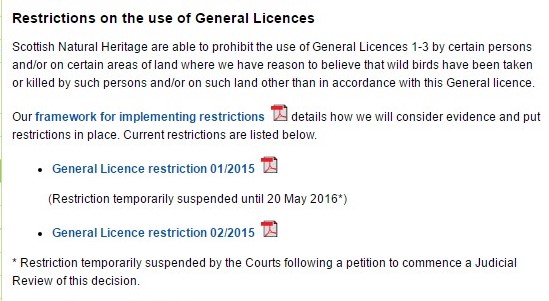
Meanwhile, in another twist, the GL restriction order on Raeshaw Estate has once again been suspended while the Judicial Review is underway. It’s not clear to us who instigated this suspension. The Estate may have applied for a temporary suspension to enable the killing of ‘pest’ species at this crucial time of year. Or, SNH may have decided to temporarily suspend the restriction order for fear that, if the Judicial Review goes against them, they may be subject to a lawsuit by the Estate for loss of earnings.

SNH temp suspension of GL - Copy

The Burnfoot Estate does not appear to be directly involved in the Judicial Review, which makes sense because the decision from the Raeshaw judgement will be equally applicable to Burnfoot so two Judicial Reviews on the same subject would be a waste of money. So consequently, the General Licence restriction order on the Burnfoot Estate is still in place – they are not permitted to kill ‘pest’ species as they would have done under the General Licence. We know from a recent FoI that SNH has not received any applications for an individual licence that would permit individual gamekeepers to carry out ‘pest’ control on this estate.

Let’s hope the Judicial Review for Raeshaw on 20th May results in a timely decision and that we don’t have to wait for months on end for a pronouncement. We’re pretty sure that there are other potential General Licence restriction orders for other estates sitting in SNH’s ‘pending folder’ (at least there should be) but, understandably, SNH may be reluctant to begin proceedings while this Judicial Review is still underway.

Increase in raptor persecution crimes in 2015

The Partnership for Action against Wildlife Crime (PAW Scotland) has just published the ‘official’ 2015 raptor persecution data, including their annual persecution hotspot maps.

The PAW Scotland press release can be read here and the hotspot maps can be accessed here.

20 crimes against birds of prey were recorded in 2015, which is an increase on the 18 recorded in 2014. The 2015 crimes included six poisoning incidents, five shootings, five disturbance incidents, three trapping or attempted trapping offences and one case of chick theft. The victims included red kite, peregrine, buzzard, goshawk, osprey and hen harrier. Surprisingly, golden eagle isn’t included in the list. We’ll discuss that below.

Having read the press release and looked at the hotspot maps, four things jumped out at us.

First is the increase in recorded raptor persecution incidents in 2015. It’s only a slight increase, from 18 to 20 recorded crimes, but nevertheless it is still an increase. This is important to note, especially in light of a recent statement made by Tim (Kim) Baynes of the Scottish Moorland Group (funded by the landowners’ lobby group Scottish Land & Estates). In December 2015, in response to the publication of the RSPB’s 20-year raptor persecution review, Kim said this:

“Bird of prey deaths……have fallen dramatically over the last five years in particular“.

At the time, Kim didn’t back up this claim with any evidence and as the 2015 data have now been published, it’s clear why he didn’t. Basically, the evidence wasn’t there. As Head of RSPB Scotland’s Investigation team Ian Thomson says in the latest PAW Scotland press release:

These latest figures make it readily apparent that claims of a decline in the illegal killing of raptors are wholly without foundation“.

This time, Kim isn’t claiming that there has been a decline but he still tries to diminish the problem by saying “annual variations [in the number of reported persecution crimes] are now very small“. Another way of putting it, Kim, would be to say that no progress has been made!

The second thing to jump out at us is perhaps the most concerning of all, and that’s the withholding of data relating to a quarter of the recorded 2015 crimes. If you read the PAW Scotland press release, you’ll notice the following caveat written in the ‘Notes to Editors’ section:

Further details of 5 of the 20 bird of prey crimes recorded in 2015 are currently withheld for police operational reasons. It has therefore not been possible to include the locations of these incidents on the hotspot maps‘.

So here’s one of the maps purporting to show all types of raptor persecution crimes recorded over a three-year period in Scotland (2013-2015). Only it doesn’t show them all, as 25% are missing. Not only are 25% missing, but also missing are details of poisoned baits (no victims present) that were recorded during this period – for some reason they’ve been placed on a separate map. So when you look at this map, ignore the misleading title. It isn’t a map of ‘All Recorded Bird of Prey Crimes Scotland – 2013-2015’, it’s a map of SOME Recorded Bird of Prey Crimes 2013-2015, just the ones we’re allowed to know about.

ALL Raptor crimes 2013 to 2015

The purpose of publishing these annual hotspot maps and their associated data is, according to the PAW Scotland website, ‘to allow all the partner organisations to enter into meaningful discussions and work together to eradicate bad or illegal practices in Scotland‘. Presumably, because the maps and data are also placed in the public domain, the purpose is also to increase transparency and thus public confidence. What is the point of publishing a proportion of the data and withholding the rest? It just makes a mockery of the whole process. Why bother publishing at all?

The caveat in the ‘Notes to Editors’ section goes on to say:

The [withheld] incidents are, however, included in the figures provided in the summary tables accompanying the maps. The maps and background data will be updated, where possible, in future publications‘.

Sounds promising, but when you actually look at the summary tables you find large sections still marked as ‘withheld’:

Confirmed poisonings 2015

ALL raptor crimes 2015

These ‘withheld’ incidents, shrouded in secrecy, make it virtually impossible to cross reference known reported persecution crimes with those being touted as the ‘officially recorded’ crimes, which closes off any opportunity to scrutinise these ‘official’ data to ensure that incidents have not been ‘missed’ or ‘forgotten’ (we’re being kind). In other words, we are expected to accept and trust the ‘official’ data from Police Scotland as being accurate. Sorry, but having seen Police Scotland’s shambolic handling of some wildlife crime incidents we have limited confidence in their ability, either intentionally or unintentionally, to get this right.

This leads us nicely on to the third thing to jump out at us. As mentioned above, we were surprised not to see golden eagle listed as one of the 2015 victims. According to our sources, a traditional golden eagle eyrie was burnt out in 2015 – we blogged about it here. Why wasn’t this incident included in the 2015 PAW data? Or was it included and it was categorised in the ‘withheld’ category? Who knows. Do you see what we mean about the difficulty of cross-referencing known incidents?

The fourth thing to jump out was an entry in Table 5c (see above). The second line down tells us that a red kite was poisoned in Tayside in January 2015. That’s news to us. Does anybody remember seeing anything in the media about this crime? Any appeal for information? Any warning to the public that deadly poison was being used in the area? No, thought not.

The reticence of the police to publicise some of these crimes is deeply concerning, and especially when that suppression extends to details of crimes in ‘official’ reports that are supposed to demonstrate openness and transparency. Ask yourselves, in whose interest is it to keep these crimes under wraps?

New report reveals hundreds of raptors illegally killed on game-shooting estates in Scotland

RSPB persecution review 1994 2014Yesterday the RSPB published its latest figures on illegal raptor persecution in Scotland.

Rather than their usual annual review, this time they’ve produced a 20-year review covering the period 1994-2014. This is a really useful exercise as it puts the scale of (known) persecution in to perspective. It’s a sobering read.

A total of 779 birds of prey were confirmed to have been illegally killed during this period, either by poisoning, shooting or trapping. The known victims included 104 red kites, 37 golden eagles, 30 hen harriers, 16 goshawks, 10 white-tailed eagles and 458 buzzards.

In addition to these confirmed victims, a further 171 incidents are documented where poisoned baits and/or non-birds of prey victims were found, including 14 pet cats and 14 pet dogs, and then a further 134 incidents where no victim had been found but clear attempts to target raptors had been uncovered (e.g. illegally-set traps).

The report includes a map showing the landholdings of all known persecution incidents during this period. As ever, it’s pretty revealing, with a handful on the west coast but the vast majority in the uplands of central, eastern and southern Scotland – areas dominated by driven grouse shooting.

RSPB persecution review 1994 2014 map

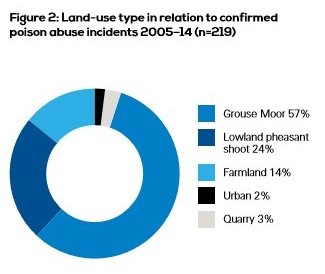
Drilling down in to the detail, there’s a useful analysis of land-use type of confirmed poisoning incidents between 2005-2014 (219 incidents). A shocking (or not) 81% of confirmed poisoning incidents during this nine-year period were on land used for game-shooting: 57% on grouse moors and 24% on land managed for lowland pheasant shoots. This tells us a great deal about who is responsible for the vast majority of illegal raptor poisoning. Despite their continued denials and protestations, and their increasingly-desperate attempts to minimise the scale of these crimes (“it’s just a few rogues”, “it’s just a small minority”), this graphic exposes the criminality at the heart of the game-shooting industry:
RSPB persecution review 1994 2014 land use

Further damning evidence, which isn’t needed by most of us but for the benefit of those who are still in denial of the bleedin’ obvious, is this graph showing the occupations of those convicted of raptor persecution between 1994-2014. Surprise, surprise, 86% of them were gamekeepers:

RSPB persecution review 1994 2014 occupation

RSPB Scotland is to be commended for publishing this exceptionally detailed and meticulously-researched report. There are a number of things in it that are of particular interest to us and we’ll come back to those in due course. For now though, particular recognition should go to the Investigations team – they may be small in number but their contribution to exposing the disgraceful continuation of illegal raptor persecution in Scotland is enormous. They, and their colleagues south of the border, are worthy of high acclaim. If anybody reading this is in a position to recognise excellence in the field of raptor conservation, e.g. a nomination for an award, this team should be at the top of your list.

So, how has the Environment Minister, Dr Aileen McLeod, responded to such an embarrassing report? She said: “There is no doubt that the figures in this report make for uncomfortable reading, but we have made progress in recent years with the new vicarious liability provisions, the publication of the report from the Wildlife Crime Penalties Review Group, new measures implementing restrictions on the use of General Licences and earlier this year the Scottish Government funded pesticide disposal scheme that removed over 700kg of illegally held poisons in Scotland“.

We have made progress…” Hmm. Let’s have a look:

Vicarious liability – introduced almost 4 years ago and only two successful convictions to date. A slow (but good) start, but we need to see many more convictions.

Wildlife Crime Penalties Review – Commissioned over two years ago, published last month. An excellent report calling for tougher sanctions but we’re waiting to hear whether the Environment Minister will act on the recommendations. Can only be defined as ‘progress’ if she agrees to act.

General Licence restrictions – available to be used against landholdings where raptor crimes committed/suspected from 1st January 2014. So far, only two restrictions have been implemented and those only lasted for six days each before they were suspended as legal arguments continue. A slow start, and the legal challenges were to be expected, but can’t be defined as ‘progress’ unless the restrictions are fully implemented. There should also be a lot more of them.

Pesticide disposal scheme –  implemented this year and resulted in the removal of some illegally-held poisons. That is progress, although it is tinged with frustration that the game-shooting industry was given yet another chance to avoid justice as this scheme (the second of its kind) comes 14 years after the pesticides were originally banned. It’s also interesting to note in the RSPB’s report (page 18) that evidence suggests a number of individuals have retained their illegal stocks. This is supported by more poisoning incidents that have taken place this year, after the disposal scheme ended.

So some progress has been made (and almost entirely due to the efforts of Dr McLeod’s predecessor, Paul Wheelhouse) but it is glacially slow and, so far, has not stemmed the occurrence of illegal persecution, as the damning figures in this report show all too clearly. Much, much more can and needs to be done before we’ll be convinced that Dr McLeod is having any sort of impact. She has, though, announced that tenders have just been invited for a review of game licensing practices in other countries (to inform a possible decision of introducing licensing to game-shooting estates in Scotland), and that’s a good thing, but again, the research needs to be done and then a decision made, which probably won’t happen for a number of years if past performance is anything to go by. She’d find herself with a lot more support if she got on with announcing increased investigatory powers for the SSPCA – the public consultation closed 1 year and 3 months ago – and still we await her decision as the criminals continue their rampage. It’s not impressive at all.

And what of the response of the game-shooting industry itself? Some didn’t bother to publish a statement (Scottish Gamekeepers’ Association), which ironically tells us quite a lot, although they are quoted in an article by STV (see media coverage below) where they revert to type and simply deny the evidence and slag off the RSPB instead. And remember, the SGA is a fully-paid up member of the Partnership for Action Against Wildlife Crime (cough).

Scottish Land and Estates (SLE), another PAW partner, did manage to issue a statement, via their Scottish Moorland Group (see media coverage below). Again, it’s the usual lamentable denial, characterised beautifully by this statement from Director Tim (Kim) Baynes:

Bird of prey deaths……have fallen dramatically over the last five years in particular“.

Er, here are some persecution figures that Kim might want to re-punch in to his calculator:

2012 – 18 confirmed deaths

2013 – 28 confirmed deaths

2014 – 37 confirmed deaths

There’s also this statement:

Our condemnation of wildlife crime is unquivocal...” All very touching but how is that “condemnation” manifested in the real world? It’s been brought to our attention that the current head gamekeeper on a Scottish grouse shooting estate has a (spent) conviction for shooting dead a raptor when he worked on another Scottish grouse moor. How does a criminal with a conviction like that (spent or not) remain employed in the game-shooting industry, let alone get a senior position on another Scottish grouse moor? Was he one of the posse of moorland gamekeepers recently invited to Holyrood to mingle with, and be applauded by, a number of MSPs, as part of the Gift of Grouse propaganda campaign? Surely not…

Download the RSPB report here

Media coverage

RSPB press release here

Statement from Environment Minister Dr Aileen McLeod here

Scottish Moorland Group statement here

BBC news here

STV article here

BBC Radio Scotland (Newsdrive) interview with Ian Thomson, Head of Investigations RSPB Scotland here (starts at 21.50, available for 29 days)

Guardian article here (a mis-leading headline but nevertheless good to see coverage in this paper)

General Licence restrictions on Raeshaw & Burnfoot Estates last only six days

On 4th November, we blogged about SNH’s intention to restrict the use of General Licences in two areas, in response to alleged raptor persecution incidents. The two areas included parts of the Raeshaw and Corsehope Estates in the Borders (Restriction #1), and parts of the Burnfoot and Wester Cringate Estates in Stirlingshire (Restriction #2) (see here for our earlier blog about these restrictions, and see here for SNH’s explanation for the restrictions).

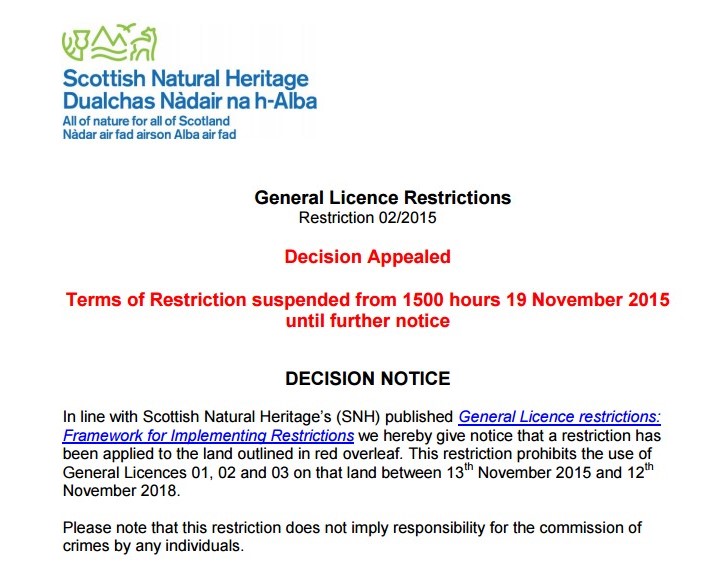
The General Licence restrictions were due to begin on 13th November 2015 and run for three years. They actually only ran for six days.

SNH GL restriction 1 SUSPENSION - Copy

SNH GL restriction 2 SUSPENSION - Copy

On 19th November 2015, the General Licence restrictions were suspended in both areas until further notice, because the Estates have lodged legal appeals, as they said they would last week (see here). While the appeals are underway, the Estates can continue to use the General Licences (i.e. continue to set crow traps and Larsen traps to catch and kill corvids, continue to shoot corvids, and continue to kill lots of other stuff that falls under the remit of activities permitted under the General Licences – see here for a list).

We don’t know what the basis of the appeals are, and nor do we know the procedural process of the appeals system, but presumably SNH now has a fixed period of time to respond. If SNH decides to uphold the appeals then the General Licence restrictions will be removed. If SNH decides to stick to its original decision and impose the three-year restrictions, then the restrictions would be re-instated. However, then these Estates would be entitled to apply for a judicial review to test whether SNH has acted fairly.

Settle yourselves in for a long legal battle.