Illegal pole trap set next to pheasant pen on Lanarkshire shooting estate

An article was published yesterday on The Ferret website about an illegal pole trap found next to a pheasant pen on an unnamed shooting estate in Lanarkshire.

Unfortunately the article now sits behind a paywall because we’ve viewed our allotted three free articles in one month, so we can’t add the actual link here. Some of you will be able to access the specific article by visiting The Ferret website and searching for it, or you can subscribe and get access to everything they publish.

Here’s an overview of the pole trap incident:

On 7 September 2015 at around 10.30am an investigator from the League Against Cruel Sports (Scotland) found an illegal pole trap that had been positioned next to a pheasant-rearing pen. The trap was set (i.e. the safety catch was off) and had been placed on top of a freshly-dead pheasant.

The investigator phoned the SSPCA who attended the scene at around 1.30pm and said the police should be called.

At 3.09pm, a man arrived at the pen carrying a bag of pheasant feed and was informed an illegal pole trap had been found next to the pen’s entrance door. Despite being warned not to tamper with potential police evidence, the man removed the trap from the pheasant bait and left it dangling from the post. He then entered the pen, fed the pheasants and then left the scene.

Two police officers turned up at 4pm and took the trap away in an evidence bag.

The police subsequently dropped the case.

The League Against Cruel Sports have published a video from the scene – watch it here.

The point being made in The Ferret article is that had the SSPCA been given increased investigatory powers, the SSPCA officer attending the scene would have been permitted to remove the illegal trap and collect it as evidence before the man came along and dismantled it, and the outcome of this case could have been very different.

As regular blog readers will know, we are still waiting for a long-overdue decision from the Scottish Government about whether the SSPCA will be given increased investigatory powers. Environment Cabinet Secretary Roseanna Cunningham said in January 2017 that a decision would be announced in the first half of 2017.

1,000 birds killed despite General Licence Restriction at Raeshaw Estate / Corsehope Farm

Regular blog readers will know that in November 2015, SNH issued two General Licence restriction orders on the Raeshaw Estate and neighbouring Corsehope Farm in the Scottish Borders (see here). This was in response to alleged raptor persecution crimes (see here), although there was insufficient evidence to proceed with a prosecution and the estates have denied any responsibility.

The General Licence restriction orders were supposed to last for three years, starting 13 November 2015 and ending 12 November 2018. However, since being implemented, these restriction orders have been on and off as Raeshaw Estate mounted a legal challenge against their use. This legal challenge resulted in a judicial review, which was heard in January 2017, and we await the court’s findings.

Meanwhile, unbelievably, SNH issued two so-called ‘individual licences’ (see here) – one to Raeshaw Estate and one to Corsehope Farm, allowing the gamekeepers to continue the activities they would have undertaken had the General Licence restriction orders not been imposed (i.e. killing so-called ‘pest’ bird species). In our view (here) this was a ludicrous move because it totally undermined the supposed ‘sanction’ of the General Licence restriction. RSPB Scotland shared our view (see here).

SNH responded by saying the individual licences represented “robust regulation” (see here) and argued that the use of the individual licences would be “closely monitored” and that the gamekeepers would be “under tighter supervision” than they would have been if using a General Licence (see here).

As a reminder, here are copies of the two individual licences:

Raeshaw Estate individual licence here (valid 10 June 2016 – 31 December 2016)

Corsehope Farm individual licence here (valid 1 July 2016 – 31 December 2016)

As a condition of each individual licence, the estates had to submit to SNH, within one month of the licence expiry date, a log of all activities undertaken under each licence.

Last month we submitted an FoI to SNH asking for copies of these logs, as well as asking for details of the number of visits SNH staff  had made to the two estates to check for licence compliance (you know, that ‘close monitoring’ and ‘tight supervision’ SNH had been promising). What we discovered validates all our earlier concerns about this so-called ‘sanction’.

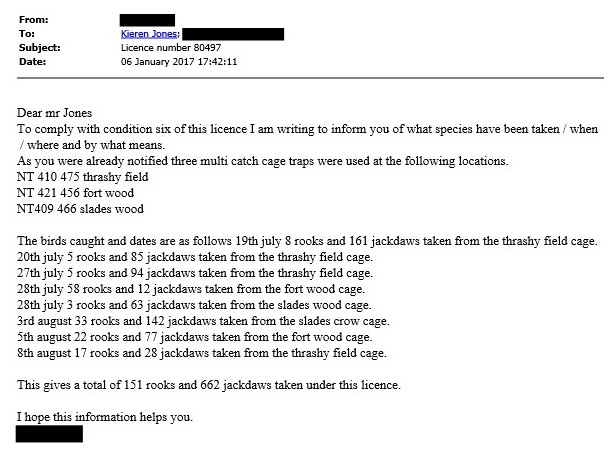
Here are the two logs submitted to SNH by the gamekeepers, detailing what species they’d killed, where, and when. The first log is for three crow cage traps placed on Raeshaw Estate and the second log relates to a single crow cage trap situated on Corsehope Farm (believed to be operated by Raeshaw Estate gamekeepers):

In total 294 rooks and 706 jackdaws were killed between 19 July and 25 August 2016. This amounts to 1,000 birds.

SNH staff undertook one compliance check visit for each estate. Both visits took place on 25 August 2016. The visit to Raeshaw Estate took 2.5 hours and the visit to Corsehope Farm lasted for one hour.

We’ve mapped the position of the four crow cage traps (note that the grouse moor at Raeshaw Estate lies directly to the west of these traps (the dark brown area).

These findings raise a number of questions and further concerns:

  1. The licence returns only refer to two species of birds that were caught and killed using four crow cage traps. Are we to believe that no other form of avian ‘pest control’ took place on either land holding between 10 June and 31 December 2016 (the duration of the individual licences)?
  2. For what ‘purpose’ were 294 rooks and 706 jackdaws killed? According to the individual licences (see above), the purpose was to “Prevent serious damage to livestock, foodstuff for livestock, crops, vegetables, fruit, growing timber, fisheries or inland water” and in the case of the Corsehope Farm individual licence, also to “prevent the spread of disease“. Can SNH explain the specific purpose of allowing these birds to be lawfully killed (i.e. if it was to protect livestock, what was the livestock and what threats do rooks and jackdaws pose? If it was to protect crops, what sort of crop and what threats do rooks and jackdaws pose? etc etc).
  3. What steps did SNH take to ensure that these 1,000 birds were not killed in order for the estates to produce artificially high densities of gamebirds for shooting? (This would be illegal).
  4. Why were 294 rooks allowed to be killed when this species has suffered a 37% decline in Scotland between 1995-2014, which would trigger a formal Amber listing if the listing criteria were applied at a Scottish level instead of a UK level (as pointed out to SNH by RSPB Scotland here)?
  5. Does SNH believe that one visit (per estate) for the duration of these six-month long individual licences equates to “close monitoring“, “tighter supervision” and “robust regulation“. If so, how?
  6. What did SNH staff do on their 2.5 hour visit to Raeshaw Estate? Did they just visit the three known crow cage traps or did they search the rest of this 9,000 acre estate to search for unlicensed (and thus illegal) traps?
  7. What did SNH staff do on their one hour visit to Corsehope Farm? Did they just visit the one known crow cage trap or did they search the rest of this farm for unlicensed (and thus illegal) traps?
  8. Are we still expected to believe that a General Licence restriction order is an effective sanction for alleged raptor persecution crimes, and if so, how?

We’ll be asking these questions to the SNH licensing team. If you want to join in, here’s their email address: licensing@snh.gov.uk

Convicted shooting agent no longer listed on tourism website

Some of you may remember back in December 2016 and January 2017 we were blogging about an organisation called the Scottish Country Sports Tourism Group (SCSTG).

The SCSTG had been awarded funding from Scotland’s national tourism agency, VisitScotland, to help develop an initiative called ‘Game for Growth’, aimed at boosting the value of shooting, stalking and fishing to the Scottish rural economy.

This raised eyebrows, and even a parliamentary question, when we pointed out that a convicted wildlife criminal’s business (Dunmhor Sporting) was being promoted on the SCSTG website and yet this Game for Growth initiative had been launched at a parliamentary reception at Holyrood (see here, here, here).

We also noted that two sporting estates (Invercauld Estate & Glendye grouse moor) were being promoted on this website (here), despite the recent discovery of illegally-set traps on both landholdings, although nobody has been charged in relation to the Invercauld incident (here) and we understand the Glen Dye incident is still under police investigation. (Well done to the local police wildlife crime officer, by the way, who reacted quickly when he was alerted to the traps at Glen Dye and has been fast to respond to subsequent correspondence on this matter).

Some of our readers, and us, contacted Fiona Hyslop, Cabinet Secretary for Culture, Tourism & External Affairs, and Malcolm Roughead, Chief Exec of VisitScotland, to ask whether they were aware that tax payers’ money (via VisitScotland) was being used to promote the business of a convicted wildlife criminal and whether they thought this was an appropriate use of public funds.

So far, the responses from both have been unsatisfactory (e.g. see here) and further correspondence via a number of local MSPs is currently being undertaken.

However, after a quick look at the SCSTG website this morning, it would appear that Dunmhor Sporting is no longer listed. Whether the Minister and/or VisitScotland has had this listing removed, or whether Dunmhor Sporting has removed itself, remains to be seen.

However, Invercauld Estate and Glen Dye are both still listed.

We’ll be returning to this when we find out whether SNH intends to invoke General Licence restrictions on either of these two estates, assuming GL restrictions are still possible after the findings of the recent judicial review are made public – any day now.

Driven grouse shooting auctioned at Tory fundraising ball

Every year the Tory party hosts a lavish Black & White fundraising ball for wealthy donors, with a range of opulent prizes on offer in an auction.

We’ve blogged about this event before (see here) when in 2015 one of those auction prizes – an opportunity to shoot 500 pheasants and partridge at the Maristow and Bickleigh Estate in Devon – reportedly sold for £110,000.

This year’s ball took place on Monday evening and one of the auction lots was ‘a fantastic grouse shoot for 8’ at the Westerdale and Rosedale Estate in the North York Moors National Park.

Would this be the same grouse moor where an horrifically injured buzzard with a severed leg and gunshot wounds was found last summer?

westerdale-bz2

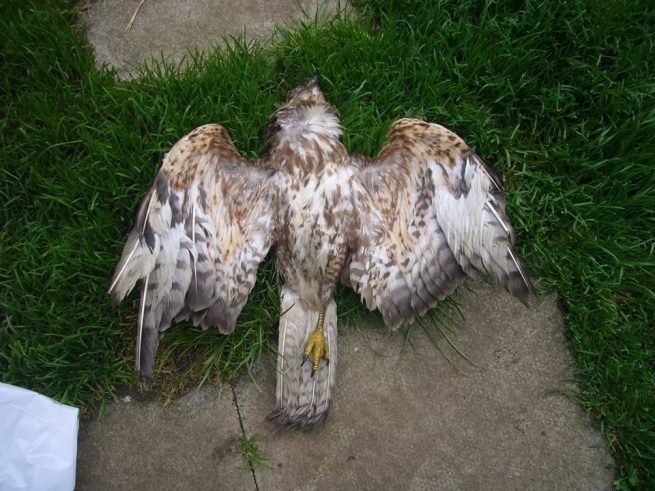
It’s not known on whose land this buzzard was shot and trapped, nor the identity of the perpetrator(s), just that the critically injured bird was picked up on a Westerdale grouse moor within the North York Moors National Park. It didn’t survive.

RSPB publishes 2015 UK Birdcrime report

On Friday (3 Feb 2017) the RSPB published its latest UK Birdcrime report (2015).

The format for the 2015 report has changed. Instead of publishing a downloadable PDF, the report has been published ‘online’ – see here.

This isn’t to everyone’s liking, including ours; we prefer to have a report that can be filed and read offline. Nevertheless, the new online version includes all the usual information that we’ve come to expect from the RSPB’s Investigations Team, including a downloadable PDF of the data appendices (very useful), and for the first time it includes a new ‘interactive’ map of persecution incidents. This is a fantastic development, and although at the moment it only includes data from 2015, it is hoped that data from previous and future years will be added in due course, which will make this a very valuable tool when looking at persecution hotspot areas.

Overall, the RSPB received 196 reports of shooting, trapping and destruction of birds of prey in 2015. 64 of these were confirmed crimes, including the shooting or attempted shooting of 46 raptors and 16 trapping crimes.

There were also 50 reports of poisoning and pesticide-related incidents. Of these, 32 were confirmed and included the illegal poisoning of 15 buzzards, four red kites and three peregrines.

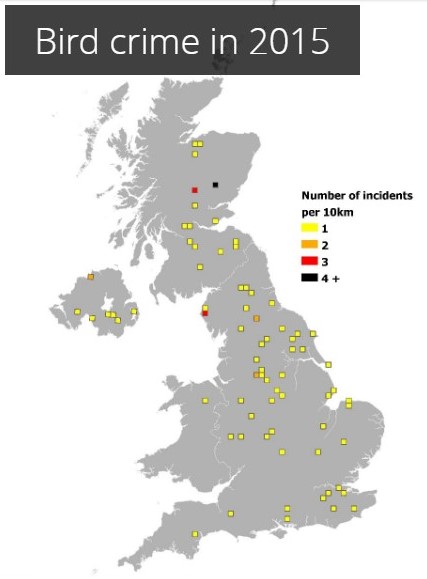
A map documents some of the 2015 reported incidents, although some are not mapped because there wasn’t an associated grid reference and others were not mapped “as requested by Police Scotland“.

birdcrime-2015-map

This map illustrates the geographical extent of raptor persecution in the UK (even with some of the Scottish incidents being withheld) and according to the report the UK breakdown for 2015 was 61% of all confirmed persecution reports were in England, 29% in Scotland, 9% in Northern Ireland and 1% in Wales.

The regional breakdown is very familiar to those who take an interest in regional trends. It’s no surprise to see that the worst area for reported raptor persecution continues to be North Yorkshire (40 reports), closely followed by Highland (39 reports) and then Aberdeenshire (23 reports). All three areas are dominated by land managed for driven grouse shooting, including three National Parks (Yorkshire Dales NP, North York Moors NP and Cairngorms NP).

The report includes a pie chart to illustrate the occupation / interests of 176 individuals convicted of bird of prey persecution related offences between 1990-2016. Again, no surprises here:

occupations-convicted-1990-2015_from-rspb-birdcrime-2015

Given that 68% of all those convicted of raptor persecution offences over the last 26 years were gamekeepers, the response to the 2015 Birdcrime report by the National Gamekeepers’ Organisation is predictable in its denial and insincerity. We might have more trust in them if they didn’t harbour convicted criminals.

ngo-reponse

Many congratulations and thanks to the RSPB Investigations Team for continuing to compile these data and for making them available to the public.

We’ll be writing another, related blog, later today about Police Scotland’s continued withholding of data.

Public funds being used to promote Glendye grouse moor

Yesterday we blogged about the illegally-set traps that had been photographed on a grouse moor at Glendye Estate in Aberdeenshire (here). We await the result of a police investigation to determine who was responsible for setting those traps (but we’re not holding our breath).

Meanwhile, as taxpayers, you’ll all be thrilled to learn that your money is being used to promote grouse shooting on Glendye Estate. This estate is listed on the Scottish Country Sports Tourism Group’s website, which is part-funded with a grant from VisitScotland.

We already knew that the Scottish Country Sports Tourism Group is promoting a sporting agent with a criminal conviction for raptor persecution (see here), so it shouldn’t really come as a surprise to find them also promoting a grouse moor where illegally-set traps have been discovered. In fact the SCSTG was already doing this because Invercauld Estate is also being promoted as a ‘sporting provider’ on the SCSTG website – you’ll recall that illegally-set traps were discovered on an Invercauld Estate grouse moor last summer and this resulted in what we believe to be a ‘cover-up’ by the authorities (see here).

Why is public funding being used to promote a ‘sport’ that is mired in illegal activity? It’s bad enough that public funds are being used to promote such an environmentally damaging ‘sport’ but to promote estates where criminal activities have been uncovered is scandalous. Why is the Scottish Government still turning a blind eye to what’s going on on some of these estates, despite incident after incident after incident after incident after incident after incident being uncovered? Scottish Ministers are being made to look like fools.

Illegally set traps on Glendye Estate grouse moor, Aberdeenshire

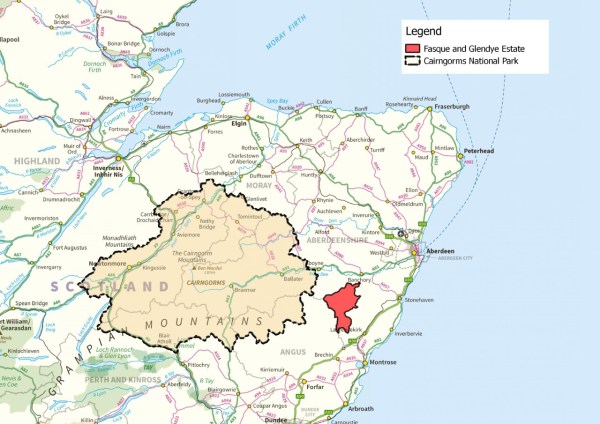
Have a look at this blog. You’ll see a series of photographs, taken yesterday (17 January 2017) on a grouse moor at Glendye, just beyond the famous Clachnaben hill, which is part of the Fasque & Glendye Estate according to Andy Wightman’s always useful website Who Owns Scotland. This area looks like it’s the area covered by the Glendye Grouse Syndicate who apparently took on a 20-year lease of this moor in 1997.

We’re not allowed to reproduce the photographs here so you’ll have to click the link if you want to see them. And you really should see them.

Three of these photographs depict illegally-set traps. They are all ‘bridge traps’ – comprising a Fenn spring trap fixed to a log across a burn or gully and designed to catch so-called ‘vermin’ such as stoats or weasels. This type of trap is legal if the trap is covered either in a natural or artificial tunnel, but the three traps photographed yesterday are definitely illegal.

One is covered with wire mesh but the entry and exit holes are wide open. This is illegal. These entry/exit holes are supposed to be partially closed to minimise the risk of catching non-target species. This trap in the photograph could easily catch a non-target species, including protected Scottish wildcats, otters and pine martens.

The other two spring traps are totally uncovered except for a single wire loop above each trap. A wire loop is not going to protect any species from standing on these traps and thus both traps are illegal. These two traps are effectively pole traps – if a bird or mammal stands on the trap, the trap will fall from the log, with the animal attached (probably by the leg), and the animal will dangle, suspended below the log, until it dies a slow, miserable death.

We don’t know whether the photographer has reported these crimes to the local police. We would hope he has – he understands that the traps are illegally-set (the safety catch is not on – we’ve looked) so we’d expect him to have provided grid references and photographs to the local Police Wildlife Crime Officer. In case he hasn’t reported them, we’ll do it for him, although by now the individual who set these traps has probably been alerted and is probably out on the moor removing all the evidence as we speak.

The local Police Wildlife Crime Officer is Doug Darling. Here’s his email address: douglas.darling@scotland.pnn.police.uk

Ask him for a crime reference number so we can follow up what action he has taken to identify the individual(s) responsible. This is important because after his investigation, we expect him to alert SNH to these illegal traps. Why? Well, because these illegal traps should result in the withdrawal of the General Licence on this grouse moor. According to SNH guidelines, evidence which may be considered by SNH in any decision to impose a General Licence restriction includes:

Illegal placement, design or use of traps or methods that are not in compliance with the requirements of the General Licence‘.

However, the evidence must be provided by the Police. So, just in case the Police ‘forget’ to tell SNH, we’ll notify SNH as well so they can’t then argue they haven’t been informed. Emails should be sent to Nick Halfhide, Director of Operations: nick.halfhide@snh.gov.uk 

To be fair to SNH, they are probably awaiting the findings of the Raeshaw Estate judicial review before they impose any more General Licence restrictions. That’s fine, they can just add this case to the others they’re currently sitting on and hopefully they’ll be in a position to take action in due course.

And, if you’re in the mood for writing emails, you might also want to alert the Environment Cabinet Secretary, Roseanna Cunningham, to these illegally-set traps. The information will be very helpful as she ponders the issue of introducing state-regulated licensing. These photographs confirm that law-breaking continues, despite the grouse shooting industry’s fervent claims to the contrary. Emails to: scottish.ministers@gov.scot and mark it FAO Roseanna Cunningham.

We wonder what the grouse shooting industry’s Gift of Grouse project has to say about these illegal traps? We wonder if Glendye is part of the Grampian Moorland Group, which in turn is part of the Gift of Grouse propaganda campaign? That’d be interesting…..

UPDATE 17 March 2017: Update on illegally-set traps on Glendye grouse moor (here)

Withheld raptor crime data: some info for DCS Scott of Police Scotland

This morning the Scottish Parliament’s Environment, Climate Change & Land Reform (ECCLR) Committee heard evidence on the Scottish Government’s 2015 annual wildlife crime report.

The archived video can be viewed here.

The official transcript can be read here: ecclr-transcript-wildlife-crime-10-jan-2017

The session was dynamite and there are many things to discuss – we’ll be blogging a lot more about this in the coming days but we wanted to start with the issue of withheld raptor crime data.

As some of you may remember, we criticised the Government’s annual wildlife crime report when it was published in November, precisely because we knew that several confirmed raptor crimes had not been included in the data presented to the Government by Police Scotland (see here). At the time, we didn’t elaborate on which specific crimes had been withheld from the report but we argued that the withholding of data completely undermined the public’s confidence in the report’s findings.

We were delighted to see this issue raised at this morning’s evidence session by Mark Ruskell MSP (Scottish Greens), and with devastating aplomb.

In the video link above, the discussion starts at 1:06:31.

Mark asked the Police Scotland representatives (ACC Steve Johnson and DCS Sean Scott) why some raptor crimes that had been recorded by RSPB Scotland had been excluded from the Government’s report. DCS Scott looked blank, and then mumbled something about perhaps the crimes weren’t actually crimes at all so they wouldn’t have been recorded. Mark pressed on and gave DCS Scott specific details about the crimes in question and even showed him a photograph of one of the illegally set traps involved, to check that it was indeed an illegally-set trap and thus a confirmed crime. DCS Scott maintained he didn’t know about these specific crimes, even when Mark gave him more detailed information about the location. This went on for some time and it was excellent to see Mark’s persistence and his unwillingness to be fobbed off. Eventually, DCS Scott committed to finding out about these specific crimes and gave assurance that he would later write to the ECCLR Committee to explain why these data had been withheld from the Government’s report.

To help DCS Scott, here’s some background about these specific crimes:

If you look at Table 19 in the Scottish Government’s 2015 annual wildlife crime report, there is a list of raptor persecution crimes and the data are attributed to Police Scotland. Listed under Lothian & Borders, Police Scotland recorded the following incidents between April 2014-March 2015:

Peregrine shooting (Sept 2014)

Attempted trapping (species not identified) (Sept 2014)

Buzzard shooting (October 2014)

Tawny owl shooting (Dec 2014)

Now, compare the Police Scotland data with the data published in Table 4 in the RSPB’s annual report – ‘The Illegal Killing of Birds of Prey in Scotland, 1994-2014, A Review‘. In that report, listed under Scottish Borders, the RSPB has recorded the following additional confirmed crimes for the same time period, that were excluded from the Police Scotland data in the Government’s annual report:

Crow trap baited with 2 live pigeons, surrounded by 4 set spring traps, nr Heriot (May 2014) – there is even a photograph of this illegally-set trap on page 16)

and

4 x shot buzzards, nr Heriot (May 2014).

pigeon-in-trap-heriot-2014

rspb-table-4

It was later revealed during the second part of the ECCLR Committee evidence session this morning, in evidence given by Ian Thomson (Head of Investigations, RSPB Scotland) that the above offences were uncovered during a Police Scotland-led multi-agency raid on this estate ‘nr Heriot’, so it is somewhat surprising that DCS Scott claimed to have no knowledge about them.

In due course we look forward to reading DCS Scott’s written explanation about why these data were withheld from the Government’s 2015 annual wildlife crime report.

In the meantime, kudos and thanks to Mark Ruskell MSP, who was one of several MSPs who performed exceptionally well at this morning’s evidence session. More on that in later blogs…..

RSPB Scotland slams General Licence system as ‘cover for criminal destruction of raptors’

Earlier this year, SNH opened a consultation on the use of General Licences (GLs), in anticipation of updating the terms of use for their suite of 2017 GLs.

This wasn’t anything new. SNH regularly reviews the GLs, but, as has happened so many times before, this year SNH has yet again ignored the on-going conservation concerns about the use of these GLs.

We’ve blogged about the terms of the GLs many times, particularly in relation to the mis-use of traps that are authorised under the terms of the GLs (e.g. see here, here, here, here, here, here, here, here) and RSPB Scotland has been questioning the terms of GLs for over ten years (e.g. see here [pages 6-13] and here).

RSPB Scotland responded to this year’s GL consultation, repeating the same concerns as they had ten years ago. You can read their consultation response here: rspb_scotland_response_to-snh_2016_gl_consultation

(As an aside, SNH has now published all the responses to this year’s GL consultation but we’ll be blogging about that in another post).

A couple of weeks ago, SNH announced the changes it was making to the 2017 GLs and, surprise surprise, many of the concerns raised by RSPB Scotland and other conservation organisations have been totally ignored, again. You can read SNH’s announcement here: snh-ogl-consultation-response-letter-annexes-a-b-and-c

baited-clam1Amongst other things, SNH has decided to reinstate the use of meat bait inside clam traps (thus increasing the likelihood of catching birds of prey), and there is also a commitment to ‘explore new and responsive licensing solutions to prevent agricultural damage by ravens’. On-going concerns that have not been addressed include (but are not limited to) compliance (or not) with European environmental legislation; welfare concerns; poor trap design that allows indiscriminate species trapping; year-round use (as opposed to seasonal use); ineffective regulation of trap users; ineffective monitoring of trap use (i.e. number and species caught/killed); inability to identify an individual trap user; and the lovely get-out clause for any General Licence user with an unspent criminal conviction.

Justifiably, RSPB Scotland are pretty unimpressed, as well they should be, and they have issued a scathing press release about SNH’s failure to address long-term concerns, particularly in relation to the use of GLs as a cover for the illegal persecution of raptors. RSPB Scotland’s press release can be read here.

RSPB Scotland has also produced a video to highlight some of their concerns. Watch it here.

If you share RSPB Scotland’s concerns, and you agree that the current GL system is not fit for purpose, you can make your views known to SNH by emailing them at: licensing@snh.gov.uk

Further delay in case against Angus Glens gamekeeper accused of pole trapping offences

Criminal proceedings continued on Monday (5 December 2016) against Scottish gamekeeper Craig Graham.

Mr Graham, 51, is accused of setting and re-setting a pole trap, baited with a pheasant carcass, on the Brewlands Estate between 9-17 July 2015. He has denied the charges.

This case was first called on 31 March 2016. A provisional trial date was set for 9th September 2016. This date was later dumped and another provisional trial date was set for 5th December 2016.

On Monday, the case was adjourned, again. An intermediate diet is scheduled for 28 March 2017 and another provisional trial date has been scheduled for 15 May 2017. This is the third time a provisional trial date has been set for this case.

Previous blogs on this case here and here