Case against Inverinate Estate gamekeeper to continue in October

The case against Andrew Malcom Slaughter, gamekeeper on the Inverinate Estate, Lochalsh, will continue at Inverness Sheriff Court on 12 October 2011 for a debate. This is an intermediate step in procedure when legal points are considered.

Slaughter is charged with offences under the Wildlife & Countryside Act 1981 and the Agriculture (Scotland) Act 1948. Background info on this case can be found in blog posts on 23 March 2011, 8 April 2011 and 28 April 2011.

Inverinate Estate gamekeeper trial continues without plea

Further to blog posts 23 March and 8 April 2011…

The trial of Andrew Malcom Slaughter, gamekeeper on the Inverinate Estate, was continued without plea at Inverness Sheriff Court today. It is now due to continue on 19 May 2011.

Press & Journal article here

Latest on Inverinate Estate case

Another case adjournment….

Gamekeeper Andrew Malcom Slaughter from Inverinate Estate, Lochalsh, is facing charges under the Wildlife & Countryside Act 1981 and the Agriculture (Scotland) Act 1948. He did not attend his court hearing yesterday at Inverness Sheriff Court and he did not enter a plea. His case has been adjourned until 28 April 2011, back at Inverness Sheriff Court.

See blog entry 23 March 2011 for background to this case.

Gamekeeper charged with wildlife crime offences on Inverinate Estate

The case against a gamekeeper accused of wildlife crime offences began at Inverness Sheriff Court last week. Andrew Slaughter, 34, of Faddock, Killialan, Kyle, faces two charges under the Wildlife & Countryside Act 1981 in connection with setting a spring trap at Glen Elchaig on Inverinate Estate on 22 September 2010.

He also faces a charge under the Animal Health & Welfare (Scotland) Act 2006 that he failed to ensure that a crow which was caught in a trap was “provided with adequate shelter and protection from adverse weather”. A fourth charge states that he “set a spring trap which was capable of catching birds, pine martins, badgers and otters”, contrary to the Agriculture (Scotland) Act 1948.

Slaughter, who did not appear in court, had his case continued without plea until 7 April 2011.

Thank you to the contributor who sent us a copy of the newspaper report about this article (published in Press & Journal, 18 March 2011). We could not find an on-line link to this article.

Inverinate Estate, close to the Isle of Skye, is believed to be owned by Sheikh Mohammed Bin Rashid al-Maktoum, crown prince and ruler of Dubai. He is thought to have bought the 63,000 acre estate for £2 million 25 years ago. The Sheikh, worth an estimated £12 billion, is believed to visit the estate with his family for a few weeks every year in the summer.

gamekeeper claims poisoned red kite was “planted”

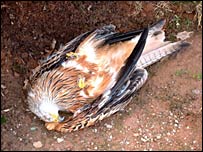
poisoned red kite

An un-named gamekeeper from the estate in Tayside where a poisoned red kite was found in July 2010 has denied all involvement and claims the dead bird was “planted“.

The self-proclaimed SGA member said: “There is something funny about this and I think someone else has killed this bird and planted it on my estate. Why they have done that, I don’t know“.  This view will come as no surprise to the regular readers of this blog – it is the standard line that is heard so often from the SGA.

He went on: “Anybody who does this should be jailed because it’s not on and I have never done anything like this in my life“.

Interesting that over the last 15 years, the following have all been found dead, confirmed poisoned, on this estate: 9 buzzards, 2 sparrowhawks, 2 crows, 1 gull, 1 tawny owl, 1 pole cat, 1 domestic cat, and now 1 red kite. In addition, 12 poisoned baits have been discovered there (see blog post Aug 27 2010). Whoever is doing the “planting” is managing to maintain a long-term campaign of illegal killing.

Full article about the un-named gamekeeper in The Courier here: http://www.thecourier.co.uk/Living/Outdoors/article/4416/gamekeeper-claims-poisoned-red-kite-was-planted.html

Is Edradynate Estate the place where the red kite was found poisoned?

The location where the dead red kite was found in July (now confirmed to have been poisoned – see earlier blog below) was given by Tayside Police as “Strathtay, near Aberfeldy”, Perthshire. I mentioned a number of sporting estates in my earlier post that have their addresses in this area. I’ve since investigated further and look what I’ve found –

According to Tayside Police’s press release about the latest dead red kite, over the last 15 years the following have been found poisoned in the same area where the recent red kite was found dead – 9 buzzards, 2 sparrowhawks, 2 crows, 1 common gull, 1 tawny owl, 1 pole cat and 1 domestic cat. In addition, they say 12 poisoned baits have also been found.

Compare the above list of dead animals & poisoned baits with the following list of dead animals & poisoned baits, which was reported in the RSPB’s Legal Eagle newsletter (January 2005, #43, page 3) – “In 14 separate incidents since 1998, 16 poisoned victims (9 buzzards, a cat, a tawny owl, 2 sparrowhawks, a common gull, a pole cat and a crow and 12 poisoned baits [rabbits, woodpigeons and a pheasant]) have been found, with traces of the pesticides mevinphos, carbofuran and alphachloralose“.

The 2005 RSPB report relates to the Edradynate Estate, which is situated in Strathtay, near Aberfeldy. Coincidence? You decide.

Nobody was convicted for the earlier alleged offences at Edradynate Estate  thanks to the apparent chronic mishandling of the prosecution case. The Edradynate Estate head gamekeeper (aged 55) and underkeeper (22), both of Aberfeldy, were arrested in 2002 and charged with nine offences relating to the use of poisoned baits and also bird cruelty, including the use of spring traps. On 22 July 2004, two years after the original arrests and 13 court hearings later, the Fiscal dropped the case against them at Perth Sheriff Court. A spokeswoman for the Crown Office admitted the time taken to prepare the case for a trial had been a major factor in the decision to scrap it.

Link to RSPB Legal Eagle #43 here: legal_eagle_43_Jan2005

News report about the failed 2004 court case here: http://www.thefreelibrary.com/Fury+after+’bird+killers’+walk+free.-a0119726014

and here: http://scotlandonsunday.scotsman.com/nature/RSPB-Fury-as-gamekeepers-escape.2548762.jp

Record Year for Raptor Poisoning

Published on Friday an annual RSPB Scotland report confirmed that 2009 marked the highest number of raptor poisoning incidents for 2 decades. “The Illegal Killing of Birds of Prey in Scotland in 2009”  indicates that human persecution continues to have a serious impact on the populations of some of the country’s most vulnerable species.

Last year, 21 buzzards, 4 red kites, 2 golden eagles and 1 white-tailed eagle, the latter gifted to Scotland from Norway as part of a reintroduction programme, were among the victims in 46 poisoning cases confirmed by Scottish Government testing.

Illegal killing, through shooting, nest destruction or the use of spring traps, were also confirmed in nine incidents. As many raptors are long-lived and have slow reproduction rates the killing of these species, particularly adult breeding birds, has dire consequences for their populations as a whole. This illegal persecution is affecting the conservation status of raptors such as hen harriers, golden eagles and red kites.

The vast majority of poisoning incidents were associated with shooting estates and in particular grouse moors. Predictably, various pro-shooting bodies have attempted to discredit the RSPB Scotland figures and  fudge the issue.  Notably, the landowners’ organisation, the Scottish Rural Property and Business Association (SRPBA) said the figures were misleading.

A spokesman said: “The official government report on the illegal poisoning of birds of prey for 2009, published in March 2010, shows the level has stayed the same for the last three years with the exception of 2008 when there were 16 incidents. There is ample legislation in existence to deal with this problem and we support the full weight of the law being brought to bear on those using illegal poisons.”

As these crimes are mainly committed in extremely remote areas and discovered by hill walkers and similar outdoor enthusiasts stumbling upon dead birds, it must be remembered that these “confirmed” cases must represent only a fraction of the true number of raptors illegally killed each year.

The increase in these incidents proves beyond reasonable doubt that the perpetrators of these crimes have little  fear of the Scottish judiciary system. Perhaps if the penalties for killing our birds of prey were more of a deterrent we would see this disgraceful trend reverse.

Press and Journal report. http://www.pressandjournal.co.uk/Article.aspx/1838869

BBC News Report. http://www.bbc.co.uk/news/uk-scotland-10730222

RSPB Report. http://www.rspb.org.uk/Images/illegalkillingscotland_tcm9-256571.pdf

Duncan Orr-Ewing, RSPB Scotland discusses the report on Radio 4’s Today http://news.bbc.co.uk/today/hi/today/newsid_8847000/8847745.stm

landowners’ condemnation of raptor persecution exposed as a sham?

On 21 May 2010, this blog reported on the news that over 200 landowners (members of the Scottish Rural Property & Business Association – SRPBA)  had written a letter to Environment Minister Roseanna Cunningham MSP, condemning the continued practice of illegal raptor persecution on Scottish sporting estates.

This letter has now become available for public viewing: SRPBA LETTER MAY 2010

On close scrutiny of the signatories to this letter, it is now apparent that on 23 of the estates listed, wildlife crime incidents have been recorded, and on seven of them, estate employees have criminal convictions. Here they all are in their full glory:

Careston Estate, Brechin: Buzzard found poisoned by Chloralose 1992.

Dochfour Estate, Inverness: Buzzard found poisoned by Chloralose 1992.

Invercauld Estates, Braemar: Buzzard found poisoned by Chloralose 1992; Three Buzzards and a raven found poisoned by Carbofuran 2005; Gamekeeper convicted for illegal use of spring trap 1997.

Balmanno Estate, Bridge of Earn: Buzzard found poisoned by Carbofuran, illegal gin traps and egg collection – Gamekeeper convicted 2003.

Haystoun Estate, Peebles: Gamekeeper filmed allegedly removing Peregrine chick from nest – evidence ruled inadmissable in court (a legal technicality) – but keeper convicted of firearms offences 2003.

Haddo Estate, Aberdeenshire: Gamekeeper convicted for  laying poisoned baits and illegal traps and fined £2,600 in 1989.

Dunachton Estate, Kincraig: Buzzard found shot 1990; Buzzard found shot 1992.

Dougarie Estate, Isle of Arran: Eagle found poisoned by Chloralose 1991.

Rosehaugh Estate, Black Isle: Buzzards found poisoned by Mevinphos 1991.

Dinnet & Kinord Estates, Aboyne: Gamekeeper convicted for firearms offences and trespassing on neighbouring estate while carrying a firearm 2006; Golden eagle found poisoned 2006.

Straloch Farm, Blairgowrie: Buzzard found poisoned by Chloralose 1992.

Lothian Estates, Jedburgh: Osprey found shot 1993.

Glenfeshie Estate, Kincraig: Golden eagle found poisoned by Carbofuran 2006.

Islay Estates, Islay: Raven found poisoned by Mevinphos 1989; Buzzard found poisoned by Mevinphos 1989.

Dunecht Estates, Aberdeenshire: Buzzard found shot 2007.

Coignafearn Estate, Tomatin: Poisoned bait found 1983; Golden eagle found poisoned 1988.

Roxburghe Estate, Kelso: Buzzard found poisoned by Mevinphos 1989.

Seafield Estate, Strathsprey: Buzzard found poisoned by Chloralose 1991.

Innes Estate, Elgin: Dead Buzzards and crows found dying after poisoned by Carbofuran – Michael Royan (head gamekeeper) convicted of firearms offences and possession of illegal poisons 2007.

Carbeth Estate, Stirlingshire: Buzzard found poisoned by Chloralose 1989.

Wemyss & March Estates, Longniddry: Managers of the Barns Estate in Peebleshire, where gamekeeper was convicted of poisoning 20 raptors, described at the time as “Britain’s worst wildlife crime” 2004.

Alvie Estate, Kincraig: Golden eagle found poisoned 1980.

Aberarder Estate, Strathnairn: Eagle found poisoned 1993.

One has to ask, why are these estates still allowed a membership of SRPBA? Doesn’t their continued membership ruin any credibility of the SRPBA’s public pronouncements against illegal raptor persecution? Indeed, it seems to go against the SRPBA’s very own Code of Practice: http://srpba.com/view_item.aspx?item_id=136&open2=false

Although of course, we should point out that some of these Estates may have changed ownership/staff since some of these incidents occured – we should probably give them all the benefit of the doubt because after all, the SRPBA has ‘repeatedly condemned the illegal poisoning of wildlife’ and of course we should all accept that their members are all above board and not engaged in criminal activities.

The SRPBA is also a fully-fledged partner in the Partnership Against Wildlife Crime (PAW Scotland) – as a commited partner, I’m sure that the SRPBA has expelled any members that are associated with wildlife crime. Otherwise, what is the point of SRPBA being a partner in PAW Scotland? No point, other than paying lip-service to raptor conservation in a feeble attempt to protect their public image. But we are giving them the benefit of the doubt, aren’t we.

At the latest PAW Scotland meeting  that was held on 25 May 2010, Environment Minister Roseanna Cunningham MSP apparently congratulated the SRPBA on their letter. Let’s give her the benefit of the doubt too and assume she hadn’t read it yet.

8 buzzards & 1 red kite dead on Corrybrough Estate, Tomatin

8 buzzards and 1 red kite were found dead on the Corrybrough Estate, Tomatin, near Inverness in March 1998. One buzzard was found in a spring trap with its legs chewed up. Many of the dead birds were found on a rubbish dump and later tests showed they had been poisoned with Carbofuran.

http://findarticles.com/p/articles/mi_qn4156/is_19990919/ai_n13941450/

At the time of the discovery, Corrybrough Estate was owned by former English magistrate, John Tinsley. It’s not the first time Tinsley has been in trouble with the police: http://www.heraldscotland.com/sport/spl/aberdeen/english-landowner-cleared-over-struggle-with-police-officers-at-his-highland-estate-laird-feared-kidnap-bid-1.349215

The Corrybrough Estate was sold in 2009. Let’s hope the new owner is a law-abiding one.

Dumfriesshire gamekeeper fined for setting illegal trap

On 12th January 2009 at Dumfries Sheriff Court, part time gamekeeper Jonathon Charles Galbraith of Hightae, Lockerbie, pleaded guilty to two charges under the Wildlife and Countryside Act. These related to the illegal use of a spring trap against wild birds and animals listed under section 6 of the Act.

He was fined £1,400

Example of a Fenn spring trap as used by Galbraith.

On the 21st August 2008 the Scottish SPCA received an anonymous complaint that there was an injured bird in a trap at Kirkhill Farm near Dalton where Galbraith had sole responsibility for the management of a pheasant shoot.

The following day SSPCA officers visited Kirkhill Farm to look for the injured bird and subsequently discovered an un-set spring trap beside a dead pheasant poult next to an active pheasant release pen.

 As officers widened their search of the area they were alerted to an approaching motor vehicle. They then observed Mr Galbraith set the spring trap and place it on top of the dead pheasant poult.

The officers approached Galbraith and interviewed him about the trap. He admitted setting the trap and claimed that “something” was killing his pheasants. Presumably he was referring to a raptor.

Spring traps are often illegally set in this manner or on top of posts to catch raptors and corvids by the legs.