
 Way back in June, we blogged about a golden eagle that had been found dead in suspicious circumstances in Grampian in May (see here). Four and a half months after the dead bird was found, a press release has now been issued by the RSPB which provides the sickening details of how this eagle is believed to have been destroyed (read it here, if you’ve got a strong stomach). It is reproduced below:
CONSERVATIONISTS APPALLED BY EAGLE DEATH
RSPB Scotland has today issued an appeal and a reward for information, following the discovery of the body of a golden eagle on Deeside.
The bird, fitted with a satellite transmitter, was found on 5 May 2012, after signals sent by the transmitter indicated that the bird had not moved for several days.
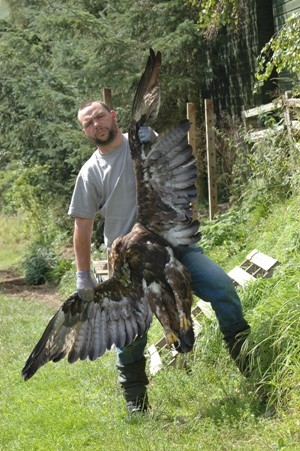
The body was found, lying face down, with its wings folded, under a tree branch, close to a lay-by on a quiet country road near Aboyne, and was seized as evidence by officers from Grampian police.
The carcass was then taken for a post mortem at the Scottish Agricultural College laboratory in Aberdeen. This concluded that the bird had suffered two broken legs due to trauma ‘that could be consistent with an injury caused by a spring type trap’ and that the severity of these injuries ‘would prevent the bird from being able to take off.’
The bird had been fitted with a transmitter by RSPB Scotland staff, in full partnership with a local landowner, a few days before it had fledged from a nest in the Monadhliath Mountains, south-east of Inverness, in July 2011.
By re-examining the satellite data, staff discovered the young bird spent its first few months in its natal area before venturing further afield. By April 2012 it was frequenting an area of upper Deeside, before moving south-west into Glenshee.
On 28 April, the bird moved eastwards into Angus. The following day, at 6am, the bird was located on a hillside overlooking Glen Esk. Over the next 15 hours, a succession of satellite tag readings, accurate to within less than 20 metres, showed that the bird did not move from this precise spot until at least 9pm that evening, after nightfall.
However, by 4am the next morning, 30 April, according to transmission data, it appeared to have travelled during the hours of darkness, some 15km north, to the location where its body was subsequently discovered some five days later. Satellite readings revealed that whilst the bird did not move from this position, it was probably alive until 4 May.
Follow-up enquires by both Tayside and Grampian Police found no further evidence as to how the eagle came to suffer its injuries, nor could it be established how the eagle came to move from Glen Esk to a position under a tree branch on Deeside overnight. However, a number of eagle down-feathers were found between the lay-by and the bird’s final resting place.
Ian Thomson, RSPB Scotland’s Head of Investigations, commented: ‘It is disgraceful that this magnificent bird was subjected to such suffering. The post mortem evidence suggests that this bird was caught in an illegally set-trap, smashing both legs. The data obtained from the satellite transmitter indicated that the eagle did not move from one spot on a hill high above Glen Esk, for over 15 hours. Then, during the night, when eagles do not readily fly, it has inexplicably moved to a new position, hidden under a tree and close to a road. Here, over the next four days, this eagle suffered a lingering death.’
Stuart Housden, RSPB Scotland Director, added: ‘Anyone who cares about our wildlife will be disgusted by what appears to be an appalling crime and the lengths taken to hide the facts from discovery. Whilst efforts to stamp out the illegal poisoning of birds of prey are perhaps beginning to yield results, this dreadful case shows that the persecution of our raptors continues through the use of traps and other means.
‘We call upon anyone who can provide further information about this case to contact the wildlife crime officer at either Tayside or Grampian Police without delay. Cases like this really do have a negative impact on Scotland’s reputation as a country that respects and values all its wildlife heritage. I am today offering a £1,000 reward for information that will assist a successful prosecution.’
ENDS
Yet again, as in so many other alleged persecution cases, there has been an unexplained and lengthy delay in releasing this information to the public. It should not take this long, especially for such a high-profile incident of such an appalling nature. Isn’t investigating wildlife crime a supposed ‘priority’ amongst Scottish police forces? That’s what we’re told! The reality still seems somewhat removed from that ideal, even after all this time and all these other cases with which to fine tune a response. Note that it’s the RSPB that has released this information today; not Tayside Police and not Grampian Police.
We’ve been given some interesting information about this incident. The press release states that this eagle’s satellite tag sent signals from “a hillside overlooking Glen Esk” and those data apparently suggested the eagle didn’t move from that precise spot over a 15-hour period, until it inexplicably moved, under cover of darkness, close to a layby 15 km north over the border into Grampian. Well, according to the grid reference provided by the sat tag, which may or may not be accurate because accuracy can be affected by a number of variables, this location is on Millden Estate. Millden Estate may be a familiar name to some as it was where a young sat-tagged golden eagle named ‘Alma’ was found poisoned in 2009 (see here). Nobody has ever been charged in connection with her death.
It appears the police trusted the accuracy of the sat tag data enough to pinpoint a location for an informal ‘search’ on Millden although the extent of this ‘search’ was apparently limited to the precise grid reference from the sat tag. We understand that a search warrant was not requested to examine vehicles or the wider estate for potential evidence. Why not? It’s also worth noting that there are two other sporting estates in Glen Esk – were either of these also searched as part of this inquiry? If this eagle had been caught in an illegal spring trap in Glen Esk, as is being alluded to in the media, who’s to say on which estate the trap was located? (although that assumes the trap was un-anchored, which would be highly unusual). That’s where a wider search, especially of vehicles, might have come in useful.
So here we are again. YET ANOTHER eagle persecuted in Scotland and YET ANOTHER profoundly unsatisfactory response from those with a statutory duty to investigate. How many more of these (e.g. see here for a long list of others) do we have to endure before we see a fundamental change in the way these offences are investigated and prosecuted?
UPDATE 25th September: If you would like to use your anger about this case in a positive way, please send an email to the new Scottish Environment Minister, Paul Wheelhouse MSP, to tell him how you feel about this disgraceful crime: ministerforenvironment@scotland.gsi.gov.uk He already knows about the incident – he tweeted about it last night: @PaulWheelhouse “Absolutely appalling – disgusted with whoever did this“. What he might not know is the strength of feeling of the rest of us.
UPDATE 26 February 2013: Deeside golden eagle fiasco rumbles on as SGA release their ‘report’ (here)
 Last month we blogged about the ‘disappearance’ of a satellite-tagged golden eagle (see
  In February we blogged about the forthcoming UK parliamentary audit on wildlife crime (see
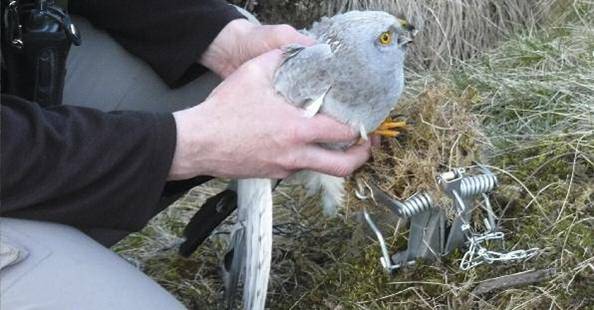
 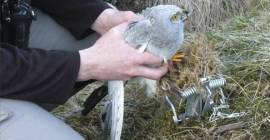 There was a lot of discussion during the oral evidence about how difficult it is to detect the perpetrators of certain wildlife crimes, which is why it’s so bloody frustrating that when investigators do find evidence of hen harrier persecution (e.g. the harrier that was found caught in an illegally-set spring trap on Moy Estate in 2010), no charges were forthcoming.
 In the November 2011 edition of Birdwatch magazine, Mark Avery calls for our views about hen harriers and grouse moors. He says that if we send our views to the Birdwatch editor, they’ll be summarised and sent to a range of organisations including the Moorland Association, the Game and Wildlife Conservation Trust, the RSPB and the Scottish Raptor Study Groups.
 A recent study that revealed how illegal persecution is affecting the growth of a red kite population in Scotland has won a scientific research award.
 Today is the inglorious 12th, the start of the four-month grouse shooting season in the uplands of northern England and Scotland. Today, and for many days to come, ridiculously rich people will dress up in clownish outfits and head for the moors in the hope of shooting dead some birds. Many will pay an estimated average of £15,000 for the experience. I wonder how many of them will enjoy the sight of a hunting hen harrier or a golden eagle quartering across the moor? Very few, infact probably none of them because scientific evidence shows that hen harriers and golden eagles have been exterminated on most grouse moors in the UK, with just a few notable exceptions. Has anyone been convicted? One person was once convicted for killing a hen harrier, and that’s it. Nobody has ever been convicted for killing a golden eagle (someone was once taken to court a few years back but the case was dropped). Even though several dead eagles and the UK’s biggest stash of the poison they died from were all found on a sporting estate last year, still nobody has ever been convicted.
 According to an article published in The Scotsman (
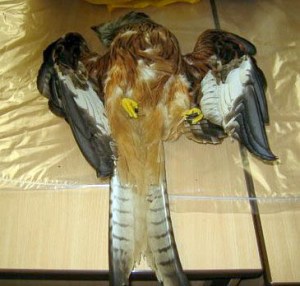
 The images here show the dead kite in the back of his vehicle. No explanation has been given to account for the obvious injury this bird suffered to its head area. According to the Inverness Courier, Rolfe claimed the bird was already dead when he found it.
 Raptor Persecution UK