New gamekeepers just as bad as the old ones

No changeThere’s a comical news item on BBC News today about the new generation of gamekeepers.

The Borders College and Scotland’s Rural University College in Fife said ‘the skills obtained by their students [on gamekeeping courses] were proving valuable to landowners’. Yes, aren’t they just.

According to Angus McNicol of Cawdor Estates, “It’s a highly-trained profession these days. It’s very different to how things were in the past“. Really?

What short memories they all have. Here are a couple of recent examples of newly-trained students, fresh out of gamekeeping college, who now have wildlife crime convictions:

1. Lewis Whitham, who was 19 when he was caught placing a Carbofuran-laced rabbit bait out on the hill on Leadhills Estate (see here).

2. James Rolfe, who was 19 when he was caught with a severely-injured dead red kite in the back of his landrover on Moy Estate (see here).

How very inconvenient when we’re supposed to believe that the criminal gamekeeper is of the old school, now dying out and being replaced by a new generation of ‘highly-trained professionals’. Nice try.

BBC News article here.

Here comes 2013….the year of natural scotland

imagesHappy Hogmanay!

Tomorrow marks the start of another Scottish government themed year: The Year of Natural Scotland, in which we’re encouraged to celebrate Scotland’s stunning natural beauty and biodiversity. Good job it wasn’t this year’s theme as there might have been some red faces in the government:

  • SGA gamekeeper Whitefield sentenced for poisoning four buzzards (he already had an earlier wildlife crime conviction). His sentence this time? 100 hours community service.
  • Scottish gamekeeper McLachlan, convicted for possession of the banned poison Carbofuran. Fined £635.
  • Scottish gamekeeper Barrie lost an appeal for his sentence of £520 for illegal possession and control of a wild bird.
  • COPFS choosing not to prosecute a Scottish gamekeeper who had been filmed beating birds to death with a stick inside a crow cage trap.
  • Scottish gamekeeper Christie convicted for wildlife crimes relating to the illegal use of a crow cage trap. His sentence? An admonishment (a telling off).
  • Scottish gamekeeper Graham convicted for allowing a buzzard to starve to death inside a crow cage trap. Fined £450.
  • Scottish gamekeeper McKellar convicted for possession of banned poison. Fined £1,200.
  • Scottish gamekeeper Scobie convicted for using banned poison. Fined £270.
  • A satellite-tagged golden eagle mysteriously ‘disappeared’ in the Angus glens.
  • A satellite-tagged golden eagle mysteriously ‘disappeared’ to the North East of the Cairngorms National Park.
  • Peregrine chicks mysteriously ‘disappeared’ from a nest site in Dumfries & Galloway.
  • A golden eagle was found dead, poisoned in Lochaber.
  • A golden eagle was found dead in suspicious circumstances on the Isle of Harris. Still awaiting results.
  • A satellite-tagged golden eagle mysteriously ‘disappeared’ in the Monadhliaths.
  • A poisoned raven, crow, and three poisoned baits were found in the Borders.
  • A satellite-tagged golden eagle was found dead near a lay-by in Aberdeenshire. Its injuries and its sat tag data suggested it had been illegally trapped on an Angus grouse moor and then dumped during the night and left to die.
  • A golden eagle was found shot and critically injured on a grouse moor in Dumfries & Galloway.
  • Barry, the sat-tagged hen harrier from Langholm mysteriously ‘disappeared’.
  • Buzz, the sat-tagged buzzard mysteriously ‘disappeared’ in the Angus glens. (More on this case in the New Year).
  • Willow, a sat-tagged marsh harrier mysteriously ‘disappeared’ in Galloway.
  • A hen harrier was found shot dead on an Aberdeenshire grouse moor.

These are just a few of the ‘highlights’ from Scotland this year – there are a few more that we can’t yet report but we will in the New Year. And of course this list doesn’t include other confirmed incidents from other parts of these fair isles such as England, Wales, Northern Ireland and the Irish Republic; a list that includes shot and poisoned sea eagles, buzzards, kites, harriers, peregrines and sparrowhawks. Nor does it include the incidents that went undiscovered.

We’ll be blogging quite a lot about the Year of Natural Scotland, which hopefully won’t be just a banner-waving exercise by the government but an opportunity for them to put their money where their mouths are. You don’t think so? No, neither do we. Why should 2013 be any different from the previous three decades of ineffective action?

A hint of what’s to come is the revelation that the theme will be highlighted during several events throughout the year. Two particular locations caught our attention: the Scone Game Fair and the Moy Game Fair.

The Scone Game Fair is of course organised by the GWCT. That’s the same GWCT that has recently asked for the addition of buzzards and sparrowhawks to the General Licences (that means they want permission to kill them…we’ll be blogging about that shortly). It’s also the same Game Fair that has previously attracted sponsorship from some very, how shall we put it, ‘surprising’ sources.

The Moy Game Fair is held on the Moy Estate near Inverness. If you’re unaware of this place, try googling it.

Thanks for all your interest and support in 2012…we’ll see you soon. Sláinte!

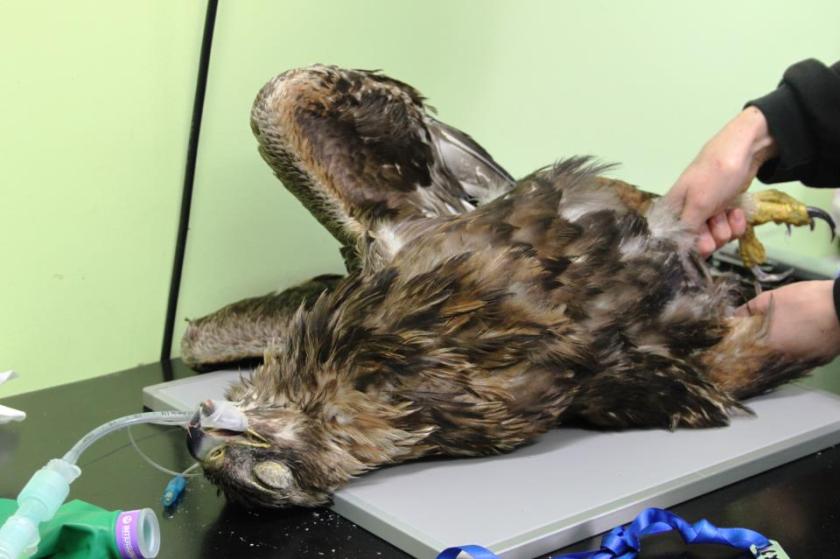
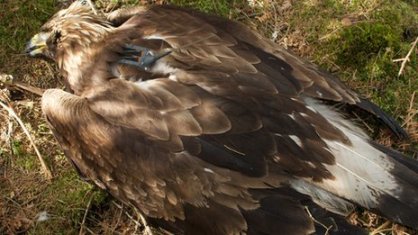
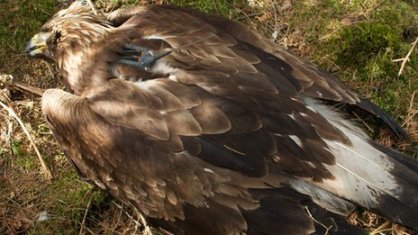
This golden eagle was found shot, critically injured &left to die on a Scottish grouse moor. Photo SSPCA
This golden eagle was found shot, critically injured and left to die on a Scottish grouse moor. Photo SSPCA

SNH to publish consultation responses

snh_logoFollowing yesterday’s blog and the request to SNH to publish all the consultation responses relating to the 2013 General Licences (see here), SNH have just sent us the following tweet:

We’re currently preparing the information for publication“.

Even if SNH redacts names in the documents, it should be obvious which response belongs to which group.

Credit where it’s due – thank you, SNH, we look forward to seeing this published.

Thank you and well done to all of you who publicised this request on Twitter and Facebook, and especially to those of you who made the effort and emailed SNH. We’ll blog again about the consultation responses once they’ve been published.

SNH announce changes to 2013 general licences

snh_logoIn October we blogged about how SNH was preparing to make changes to the 2013 General Licences via a public consultation process (see here).

They’ve now just published their proposed changes and by the looks of things, they’ve ignored almost every single recommendation except those made by the game-shooting lobby.

Their letter to consultees, in which they outline their proposed changes, can be read here.

Many concerns remain unaddressed, and particularly about the use of crow cage traps under the General Licence, including trap design (welfare issues), year-round use (as opposed to seasonal use), uncontrolled positioning of these traps, ineffective regulation of crow trap users and ineffective monitoring of crow cage trap use.

There’s one particularly strange ammendment:

Requirement for persons to have read and understood conditions: We will remove the requirement for people to have read the licences before using them. New licenses will require users to ensure that they have understood the conditions“.

What’s the significance of removing the requirement for people to have read the licences before using them? This sounds like the introduction of a very dodgy legal loophole…we wonder who made this recommendation to SNH?

The controversial clam trapHowever, the biggest concern is that SNH has officially authorised the use of ‘clam’-type traps (see above), even though they are fully aware of concerns that these traps are likely to cause injury to non-target species (e.g. see here and here). SNH acknowledges these concerns and proposes to “commission research in 2013 that will examine how these traps are currently being used“. Why authorise a trap before you’ve carried out research to assess the potential damage that trap could cause? By authorising its use without being able to define the trap, SNH has just opened up the floodgates for gamekeepers and other users to put out any trap, call it a clam-type trap, hang an ID tag on it and it’ll be legal. How will SNH control trap size, height, spring tension? It’s nothing short of disgraceful that these traps have been authorised without a proper, independent assessment of their use. SNH say they will work with the representative bodies of the trap users as part of their research. Brilliant – do they really think those users are going to tell them when they’ve caught a non-target species? Or when they’ve ‘accidentally’ injured or killed a non-target species? You only have to read the evidence given in the current hare-snare trial to know the answer to that.

What a total shambles. What we’d like to see now is a complete list of ALL the consultation responses that SNH received for the 2013 general licences. Why? So we can assess whose recommendations SNH has listened to, and whose have been ignored. SNH has not made these consultation responses available in the public domain, but it’s common practice for any public authority conducting a consultation to do so (just look at the Environmental Audit Committee consultation on wildlife crime – every single consultation response was made publicly available).

We urge our blog readers to write to Robbie Kernahan, SNH Head of Wildlife Operations, and ask for ALL of the 2013 general licence consultation responses to be put on the SNH website. Here’s his email address: licensing@snh.gov.uk

Tayside Police respond to questions about dead eagle investigation

The dead golden eagleLast month we encouraged blog readers to contact Tayside Police Chief Constable Justine Curran to ask for further clarification about the way Tayside Police had handled the investigation into the death of a golden eagle. This young eagle was believed to have been illegally trapped on an Angus grouse moor and then moved, in the dead of the night, to a lay-by in Aberdeenshire where it was left, with horrific injuries, to die a slow and undoubtedly agonising death. See here and here for earlier blog posts about this case.

Once again our blog readers stepped up and contacted Tayside Police and once again this has paid off; Tayside Police have responded. We’ll come to that in a minute, but first of all a big thank you to everyone who tweeted, facebooked and shared the story on their own blogs and websites – people power in action. We’re convinced that it was the sheer volume of emails that prompted the response from Tayside Police, so well done to all involved.

Tayside Police also deserve credit for responding. This is the second time they’ve posted a comment on this blog and to be honest, we didn’t expect them to do it twice. However, although they deserve credit for responding, the content of their response still leaves a lot to be desired.

As a quick re-cap, here is a summary of the questions that were asked of Tayside Police:

  • Is the death of this golden eagle being treated as a CRIME?
  • Were attempts made to recover evidence from a wide search area?
  • Were attempts made to recover evidence from vehicles and buildings?
  • Why hasn’t Tayside Police publicised the death of this eagle?
  • Did Tayside Police provide details of the post-mortem to any defence agent?
  • Did Tayside Police advise the Minister’s office that the eagle’s injuries could have been caused by anything other than a spring-type trap? If so, what did they say could have been the cause of the injuries?

We’ll come back to each question once you’ve read the full police response. As before, their response was made via the comments section of the blog and we’re reproducing it here in case anyobody missed it:

TaysidePolice-logoComment from Wildlife and Environmental Crime Officer Tayside Police

Thank you for bringing these matters to my attention and by way of assurance, on behalf of Tayside Police, I am now in a position to provide an update in regard to many questions asked through the Blog. In order to deal with this effectively in the future, I would ask that any further correspondence be directed to this email address in order that they can be dealt with appropriately – mail@tayside.pnn.police.uk

You will appreciate that it has taken some time to consider the issues raised. The following comments take into account the on-going investigation into the death of the Golden Eagle in May 2012, as we continue to attempt to establish the exact cause of the eagle’s death.

This reported incident was recorded as a crime in Tayside area and has been investigated as such. Along with our partners in Grampian Police and the RSPB Investigations Unit, I have carried out a full and comprehensive enquiry into this incident. The enquiry remains ongoing and we have unfortunately yet to identify those responsible.

In every investigation, Police and other partner agencies consider the use of the media. In this case utilising the media was indeed considered by the enquiry team and after discussion with partners, it was decided not to publish the incident. Be assured that the media are considered in every investigation by Police and other agencies but I am content that the correct decision was made in this case.

As per Karen Hunter’s (Scottish Government) letter of the 24th October 2012 “It is extremely frustrating (for all involved in the investigation of wildlife crime) that it is so difficult to detect, and in some cases to prosecute and convict those responsible for wildlife crimes. However while it easy to make suppositions about circumstances of an apparent offence as reported in the media, wildlife crime must be subject to the same standard of proof as any other crime. Police and prosecutors also apply the same stringent procedure for dealing with wildlife crime as for any other sort of crime.”

In Scotland, in all cases, sufficient and admissible evidence is required to report a case to the Procurator Fiscal.

A charge may be proved by purely circumstantial evidence, by accounts from two or more credible witnesses or a combination of the two types of evidence but, in order to be sufficient, the material facts and circumstances must point only to one conclusion, and that is, the guilt of the accused. It is not necessary to have corroboration of every fact and circumstance in a chain of circumstantial evidence but the more important circumstances should be corroborated.

Evidence must also be legally admissible which means it has to have been obtained by legal means. Only competent evidence will be admitted by the courts. The court alone decides what evidence in a particular set of circumstances is admissible.

To clarify Police procedures, there can often be sufficient evidence to suggest a crime has been committed to allow for further investigation, but this does not automatically infer there is enough evidence to report the matter to the Procurator Fiscal or indeed secure a conviction. This is the current situation.

Please be advised that in relation to some of the more specific questions, asked regarding the on-going investigation, we can not disclose information due to the risk of compromising the investigation. However we can confirm that Tayside Police did not allow any access to the Golden Eagle carcass to any defence agent.

Be assured that Tayside Police are eager to bring the perpetrators to justice and in conjunction with the other agencies referred, Tayside Police will continue to investigate all circumstances surrounding this incident with a view to identifying those responsible. Police and other agencies will apply appropriate and proportionate resources to this type of crime on every occasion and diligent enquiry will be carried out.

Tayside Police will also continue to support and develop all preventative measures available to us and our partners to minimise the threat of any further such incidents occurring in the future.

I trust my comments will be of use to all those who have contacted Tayside Police regarding this incident.

In regard to other general questions, I can advise that this information can be accessed via your own website, the SASA website and RSPB website.

For any further comments or information that can assist us in this investigation please contact: mail@ tayside.pnn.police.uk , call 0300 111 2222 or speak to any Police Officer.

So, let’s go back to each question in turn.

Q1. Is the death of this golden eagle being treated as a crime? A. Yes.

Q2. Were attempts made to recover evidence from a wide search area? A. We can not disclose information due to the risk of compromising the investigation.

Q3. Were attempts made to recover evidence from vehicles and buildings? A. We can not disclose information due to the risk of compromising the investigation.

Q4. Why hasn’t Tayside Police publicised the death of this eagle? A. In every investigation, Police and other partner agencies consider the use of the media. In this case utilising the media was indeed considered by the enquiry team and after discussion with partners, it was decided not to publish the incident. Be assured that the media are considered in every investigation by Police and other agencies but I am content that the correct decision was made in this case.

Q5. Did Tayside Police provide details of the post-mortem to any defence agent? A. We can confirm that Tayside Police did not allow any access to the golden eagle carcass to any defence agent.

Q6. Did Tayside Police advise the Minister’s office that the eagle’s injuries could have been caused by anything other than a spring-type trap? If so, what did they say could have been the cause of the injuries? A. No response.

So what have we learned?

That Tayside Police won’t provide detailed information about the nature of their search. We didn’t really expect them to and in any case we already know (from other sources) that a search warrant was not requested for this investigation. It’s hard to understand why not but we’re unlikely to get an explanation.

We’ve learned that Tayside Police considered using the media to publicise this case but chose not too. Actually we didn’t just learn that, we already knew they hadn’t publicised it – what we asked was why they hadn’t publicised it. No satisfactory answer was received.

We’ve learned that Tayside Police didn’t allow any defence agent access to the eagle carcass. What we specifically asked though was whether they allowed a defence agent access to the post-mortem results. No satisfactory answer was received. Our sources suggest that a defence agent did have access to the post-mortem results, although who gave him that access remains a ‘mystery’.
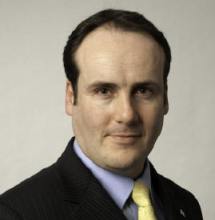
Environment Minister Paul WheelhouseThe most important thing we learned was that this incident IS being treated as a crime by Tayside Police. That is reassuring, but begs the question then, who advised the Minister’s office to put out this statement:

The reports may suggest that the circumstances of this incident were suggestive of an offence however there is no hard evidence and it remains possible that there is an alternative explanation“.

Tayside Police didn’t answer this question directly but we can infer that, as they were treating the incident as a crime, the advice to the Minister probably didn’t come from them. It’s also fair to assume that the advice didn’t come from the Police’s partner agency in this investigation, the RSPB, as they were the ones to put out a press release stating that they believed the eagle had been caught in an illegally-set trap. So who did advise the Minister? This is an important question; we need to be reassured that the Minister is not taking advice from anybody who has a vested interest in covering up this crime. Let’s ask him: “From whom did the Environment Minister’s office take advice that suggested this eagle’s death was anything other than a crime?” Email to: ministerforenvironment@scotland.gsi.gov.uk


RSPB Scotland: 2011 persecution report published

RSPB Scotland has just published its latest report, The Illegal Killing of Birds of Prey in Scotland in 2011. You probably won’t be surprised or shocked by the content, especially if you’ve read the previous 17 annual reviews. In fact, when you read this 18th review, you might get a strong sense of déjà vu.

It opens with a Foreword by Stuart Housden, Director of RSPB Scotland. Apart from the new photo, this foreword looks like a cut and paste job from the 2010 report, with a few words or sentences added or adjusted. To be fair, not much has changed since the 2010 report was published so perhaps he felt justified in repeating what he’d written the previous year.

Then there are RSPB Scotland’s strategic recommendations for addressing raptor persecution. Again, these show a remarkable similarity to the recommendations made in the 2010 report, and also in the 2009 report. The recommendations were / are still good and to see them repeated again is a useful indicator of how little progress has been made by those with the power to push them forward.

Next come the tables showing the confirmed and probable persecution incidents recorded by the RSPB during 2011. It’s these tables that the game-shooting lobby usually object too – they’re especially reluctant to accept the ‘probable’ incidents although to date, they’ve failed to provide a convincing argument to account for any of them.

The data in the 2011 tables demonstrate once again that illegal raptor persecution is widespread, with incidents reported in Perthshire, Angus, South Lanarkshire, Aberdeenshire, Dumfries-shire, East Ayrshire, Borders and Inverness-shire. We counted 15 very familiar-sounding locations within these regions, although there are a few notable absentees this time. Have they stopped their criminal activities or have they just got better at covering up? Time will tell.

Just focusing on the confirmed incidents, in total 17 incidents of deliberate poison abuse were confirmed during 2011, involving 20 victims: 7 buzzards, 4 red kites, 1 golden eagle, 2 peregrines, 2 ravens and 4 other bird species. Sixteen other illegal incidents relating to shooting, nest destruction, and the use of uncovered spring traps or cage traps were confirmed. The victims included 8 buzzards, 2 peregrines, 1 goshawk, 1 sparrowhawk, 2 kestrels and 1 short-eared owl. As in previous years, not all of these incidents were publicised at the time they occurred. It’s a continual disappointment that several years have to pass before the public learns of these appalling crimes.

Once again the occupations and interests of those convicted for illegal raptor persecution crime have been analysed (data from 2003-2011 inclusive). 87% of them were gamekeepers (7% pigeon racers, 3% pest controllers, 3% farmers).

The report includes an interesting case study of poisoned raptors that have been found in recent years on the Glen Kyllachy and Farr Estate near Inverness. Very little of this information has been previously published and certainly this is the first time these photographs have been published. It’s a shame it’s taken several years for the info and images to reach the public domain but nevertheless it’s very encouraging to see RSPB Scotland highlight these cases, especially as Northern Constabulary hasn’t bothered.

All in all the report makes for grim reading, but nobody should be surprised by that. We all owe a large debt of gratitude to the RSPB’s Investigations Team for meticulously collecting these data and especially for making them publically available.

TO DOWNLOAD A COPY OF THE REPORT CLICK HERE

Here’s some media coverage:

RSPB Scotland press release here

BBC news article here

STV news article here

Herald Scotland article here

Scottish Gamekeepers Association: statement here

Scottish Land and Estates: nothing yet

@SNHMedia: “SNH report finds vast majority of gamekeepers highly qualified”. Link to this.

PAW Scotland: nothing yet

Trout farmer convicted for illegal use of spring traps

A topical story given today’s discussions…
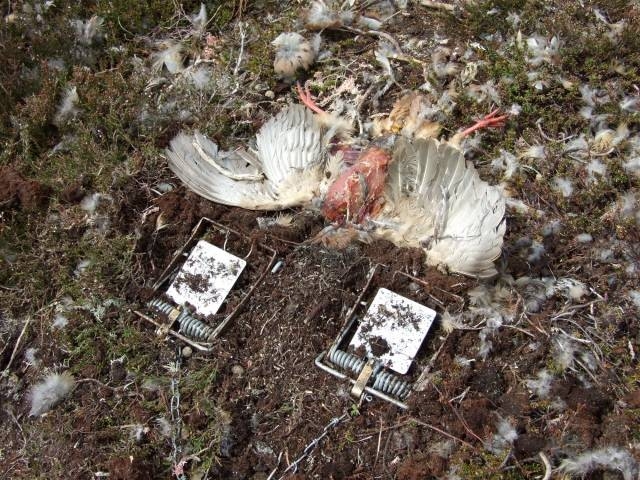
A Scottish trout farmer has been convicted of illegally trapping a heron by using spring traps. Simon Duffin, 61, of Morrinton, was convicted at Dumfries Sheriff Court yesterday and was fined £1,500. He admitted recklessly injuring the bird in a trap likely to cause injury to a wild bird, and setting in position a trap likely to cause bodily injury to any animal at Cargenglen Trout Farm in Dumfries. (Surely not the same Simon Duffin mentioned here offering worldwide advice on all aspects of trout farming?).

A member of the public found the injured heron in the water with a Fenn spring trap around its leg. The bird’s injuries were so severe that it had to be euthanised.

Well done to the SSPCA (again) for a successful prosecution and special mention should go to the Procurator Fiscal Pamela Rhodes. Now if only Pamela had been given that third wildlife crime specialist spot that she apparently applied for at COPFS last year….

SSPCA press release here

Is this what happened to the Langholm harriers?

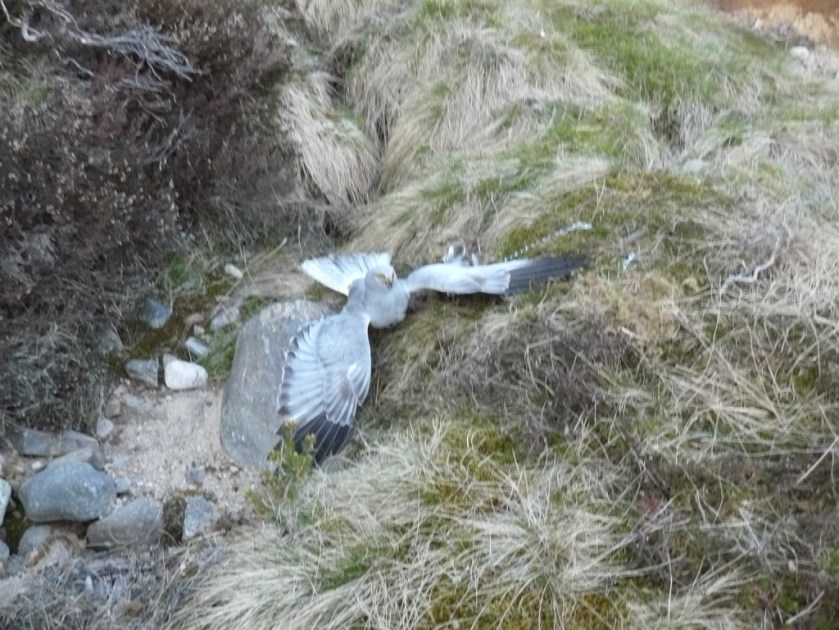
Is this what happened to this year’s Langholm harrier chicks, Barry and Blae? (Blae confirmed dead, Barry now ‘missing’ – see this morning’s blog entry below).

These photos were taken on Moy Estate in 2010. Naturally, nobody was charged with these offences. Probably not enough “hard evidence”, eh? One gamekeeper (James Rolfe) was charged with possession of a dead red kite that was found in the back of his vehicle. The kite had two broken legs and its head had been caved in with a blunt instrument (see here and here for background info).

This first photograph shows a skinned rabbit that had been placed out on the moor. Can you see the hidden spring traps on either side of this bait? No? Any passing raptor would probably struggle to see them, too:

This next photo shows another bait found set on Moy with two spring traps. This time the moss has been removed so the traps could be photographed. These traps are illegal when used in this way:

This next photo shows a hen harrier caught in one of the illegal traps that had been laid out on Moy Estate. The picture is slightly blurred but we can forgive the photographer, given the circumstances:

Here’s the same harrier being carefully removed from the trap. This one was lucky – he survived:

Environment Minister’s response to dead eagle found in Grampian

Un-fucking-believable. Yes, it’s a swear word but that’s the least of our concerns. Read what follows and you’ll be swearing in anger too…
The Environment Minister has responded to a letter sent to him by one of our readers (Dave Adam) concerning the appalling death of that golden eagle back in May (see here for details of that bird’s demise). This is the eagle whose satellite transmitter showed the bird went down on a grouse moor in Glen Esk, Angus for 15 hours (an area where another golden eagle had previously been found poisoned in 2009, oh, and a buzzard was also found poisoned there in 2008 although that wasn’t publicised at the time) and then this eagle miraculously moved to a layby in Aberdeen, in the middle of the night, where it was found dead several days later with two broken legs – injuries consistent with being caught in a leg-hold trap. Yes, THAT eagle. According to the Minister, this scenario may not have been the result of criminal activity.

Dave Adam has posted the Minister’s response letter in the comments section of the original post (thank you) but it’s far too important for it to remain there, hence the decision to publish it here.

Here it is in full:

Thank you for your letter of the 25 September 2012 to the Minister for Environment and Climate Change, Mr Paul Wheelhouse. I have been asked to respond.

I agree that the media reports were a terrible story of the suffering of a young golden eagle. The reports may suggest that the circumstances of this incident were suggestive of an offence however there is no hard evidence and it remains possible that there is an alternative explanation. It is therefore inappropriate for me to comment.

The unlawful killing of any raptors has no place in today’s Scotland and we will continue to work hard to eradicate this criminal activity. We believe that the partnership approach with the Partnership for Action Against Wildlife Crime (PAW) Scotland, is bringing the reduction in bird of prey poisoning that can be seen in the statistics in recent years. However we are not complacent and if there is evidence of a switch to other methods of persecution we will take action to bear down on those methods.

The Scottish Government recognises that game shooting generates significant income and employment in our rural economy, often in areas where there are few alternative opportunities. However it is important that these businesses operate within the law, and the Scottish Government recognises that most such businesses do so. However where there appear to be conflicts for example between raptors and highly-intensive grouse moor management, we believe that an approach of seeking to improve the effectiveness of law enforcement while working with partner organisations to isolate those persisting with illegal practices is the best way forward.

Scottish police have a clear focus on tackling wildlife crime cases. Law enforcement’s role in tackling wildlife crime was reviewed by Her Majesty’s Inspectorate of Constabulary Scotland in 2008, and there was a follow-up review in 2009. As a result there are officers with wildlife crime duties in every police force area and a consistent and professional approach from senior officers.

It is frustrating that it is difficult to detect, prosecute and convict those responsible for wildlife crimes. However while it easy to make suppositions about circumstances of an apparent offence as reported in the media, wildlife crime must be subject to the same standard of proof as any other crime. Police and prosecutors also apply the same stringent procedure for dealing with wildlife crime as for any other sort of crime.

You say that the golden eagle population is threatened by illegal persecution. The Golden Eagle Conservation Framework published by SNH in 2008 did identify persecution in eastern Scotland and food shortages in the west as threats to the birds’ conservation status. It is difficult to estimate the amount of illegal persecution, but we recognise that in the longer term the best measure of success in dealing with raptor persecution will be when vacant golden eagle territories, as identified in the Framework document, are re-occupied.

K. Hunter, Policy Officer, Scottish Government.

Like we said at the top, un-fucking-believable. Especially coming a day after we learn that another golden eagle was the target of criminal activity on a grouse moor, this time being found shot and critically injured and left to die.

What did we say yesterday about needing a strong response from government, and not the usual platitudes about ‘partnership working’?

The question is, what are we going to do about it? And by ‘we’, that means all of us. Angry? You’d better believe it.

If you want to tell him how angry you are, and why (because it obviously needs spelling out) here’s his email address again: ministerforenvironment@scotland.gsi.gov.uk

When you’ve done that, send a copy to Alex Salmond: FirstMinister@scotland.gsi.gov.uk

These politicians HAVE to understand that we’re not tolerating this any longer.

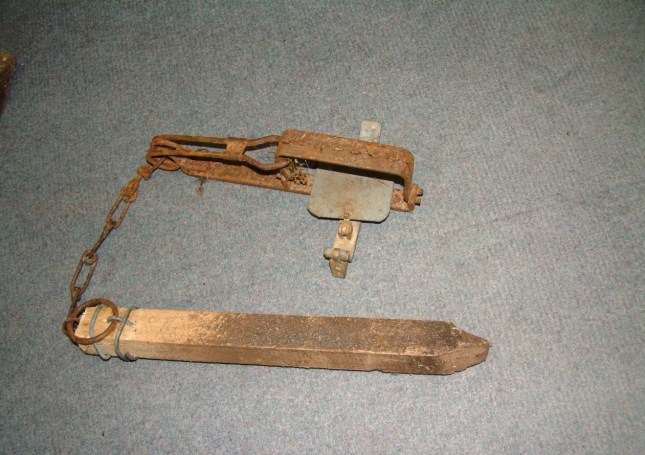
Photo: a Scottish gamekeeper’s illegal gin trap

Thanks to the contributor who sent in this photo and the following information:

Given the appalling news story about a golden eagle found with injuries from a leg-hold trap…here’s my photo of a freshly used gin trap and stake seized by the police and RSPB from a keeper in 2003. One of a bagful.

To my certain knowledge these traps, outlawed finally in Scotland in 1974 (20 years after England…seems it was ok to torture foxes legally up to that point), have been used (and are probably still being used) under a bait to trap golden eagles, wild cats and foxes..

The most likely trap to have been involved in the recent golden eagle case. Eagles are strong enough to rip one of these up and fly or hobble away…if stake isn’t well tied down. They can snap bailer twine (the usual attachment for Fenn/Springer pole traps) like it was thread”.