Landowners & gamekeepers claim ‘misrepresentation’ on BBC’s The One Show

One-Show-smallScottish Land and Estates and the Scottish Gamekeepers’ Association have written a letter of complaint to the BBC, claiming ‘misrepresentation’ on The One Show programme.

The programme (see here and here) included a feature on golden eagle persecution and during a studio interview, the RSPB’s Stuart Benn laid the blame firmly at the door of gamekeepers on Scottish grouse moors.

Doug McAdam, Chief Exec of Scottish Land & Estates, took great exception to that statement and wrote a hilarious letter of complaint, on behalf of SLE and SGA, to The One Show’s executive editor, Sandy Smith.

Here is his letter: SLE SGA complaint about BBC One Show

According to dear old Doug, there have only been four dead golden eagles found since 2010 and no charges [for these deaths] have been brought against anyone involved in grouse moor management. Conveniently, he failed to include the other known incidents of dead raptors turning up on grouse moors since 2010 (including white-tailed eagles, red kites, hen harriers, buzzards, short-eared owls, sparrowhawks, peregrines, kestrels), or the critically-injured golden eagle found shot and left to die on a grouse moor, or indeed the satellite-tagged raptors (particularly golden eagles and hen harriers) who have all gone ‘missing’ after their last known signal was received from, er, a grouse moor. There may well be more of these ‘missing’ birds but of course we’re no longer allowed to hear about them after the introduction of the new PAW Scotland ‘protocol’ that aims to keep these incidents away from the public’s gaze (see here).

Apart from trying to play down the extent of persecution incidents on grouse moors, and inferring that a lack of criminal convictions is a good indicator that gamekeepers are not involved with the illegal killing of golden eagles on grouse moors, Doug goes on to emphasise the SLE’s involvement with PAW Scotland, as though membership of that ‘partnership’ should be a measure of good behaviour. We’ve all seen how effective these ‘partnerships’ can be, following the near-extinction of breeding hen harriers on English grouse moors during the six-year Hen Harrier Dialogue ‘partnership’ designed to resolve the conflict. Indeed, three raptor conservation organisations have now resigned from that particular ‘partnership’ because they recognised it could be used as a convenient political cover by certain organisations with grouse-shooting interests.

Doug makes an astonishing claim about the PAW Scotland partnership: “Our combined efforts with the police, rural communities, the RSPB and over 120 other relevant stakeholders have been universally acknowledged as a key factor in reducing the number of raptor persecution incidents“.

Talk about misleading! For a start, there are not 120 ‘relevant stakeholders’ in relation to addressing raptor persecution. Many of the stakeholders have absolutely no involvement in directly addressing raptor persecution – they are there to specifically address other types of wildlife crime such as poaching, theft of freshwater pearl mussels, bat persecution and badger persecution.

Secondly, where does this notion come from that work by PAW Scotland has been ‘universally acknowledged as a key factor in reducing the number of raptor persecution incidents’? Has it been ‘universally acknowledged’? We don’t think PAW Scotland has had any demonstrable impact whatsoever on the number of raptor persecution incidents – where’s the evidence? Perhaps by ‘universal’ he means those with a vested interest in having people think that illegal raptor persecution is being dealt with effectively (e.g. the police, SNH, Scottish Government, SLE, SGA etc etc).

Doug finishes by saying, “Owners of moorland estates all over Scotland look after golden eagles” (ahem) and he invites Sandy Smith to visit a grouse moor “to find out for yourself the valuable conservation measures being implemented“. Let’s hope Sandy takes him up on his offer. Ooh, which grouse moor to choose? We could give Sandy quite a few suggestions….

Sandy Smith responded with a letter of his own: One Show’s reply to SLE

He says he’s sent an email to all One Show staff and suppliers “asking them to ensure they don’t make assumptions about gamekeepers based on out of date or inaccurate assumptions“.

Interestingly, Sandy Smith was the former executive editor of Panorama – a programme recognised for its investigative journalism and an ability to differentiate between fact and PR. Let’s hope he’s taken those qualities with him to The One Show.

We’ve sent a letter to Sandy, giving him the URL of this blog, to ensure his staff are kept up to date and are not basing their work on inaccurate assumptions (spin). You may wish to do the same – send your email, marked for the attention of Sandy Smith, to: TheOneShowEmails@bbc.co.uk

If you think grouse moor owners and their gamekeepers need to be held to account for their activities, please sign this e-petition and share it with your friends and colleagues: SIGN HERE.

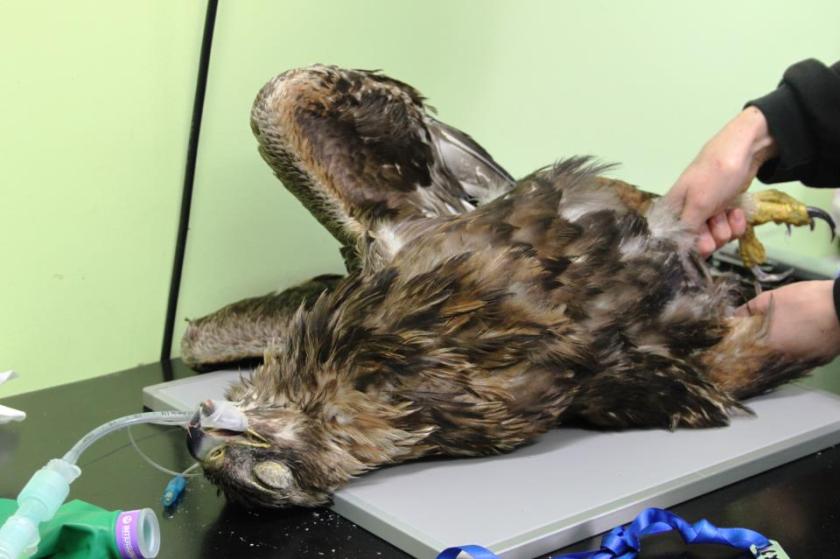
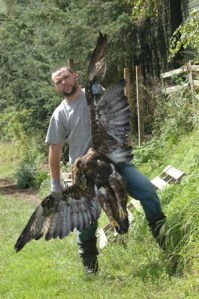
Here’s a photo showing how well golden eagles are looked after on some Scottish grouse moors. This one was found critically injured on Buccleuch Estate last aututmn – he had been shot and left to die, although it is not known on whose land he was shot. He is currently recuperating with the SSPCA after undergoing life-saving surgery. Needless to say, nobody has been charged for this crime.

The shot golden eagle undergoing emergency surgery

Here comes 2013….the year of natural scotland

imagesHappy Hogmanay!

Tomorrow marks the start of another Scottish government themed year: The Year of Natural Scotland, in which we’re encouraged to celebrate Scotland’s stunning natural beauty and biodiversity. Good job it wasn’t this year’s theme as there might have been some red faces in the government:

  • SGA gamekeeper Whitefield sentenced for poisoning four buzzards (he already had an earlier wildlife crime conviction). His sentence this time? 100 hours community service.
  • Scottish gamekeeper McLachlan, convicted for possession of the banned poison Carbofuran. Fined £635.
  • Scottish gamekeeper Barrie lost an appeal for his sentence of £520 for illegal possession and control of a wild bird.
  • COPFS choosing not to prosecute a Scottish gamekeeper who had been filmed beating birds to death with a stick inside a crow cage trap.
  • Scottish gamekeeper Christie convicted for wildlife crimes relating to the illegal use of a crow cage trap. His sentence? An admonishment (a telling off).
  • Scottish gamekeeper Graham convicted for allowing a buzzard to starve to death inside a crow cage trap. Fined £450.
  • Scottish gamekeeper McKellar convicted for possession of banned poison. Fined £1,200.
  • Scottish gamekeeper Scobie convicted for using banned poison. Fined £270.
  • A satellite-tagged golden eagle mysteriously ‘disappeared’ in the Angus glens.
  • A satellite-tagged golden eagle mysteriously ‘disappeared’ to the North East of the Cairngorms National Park.
  • Peregrine chicks mysteriously ‘disappeared’ from a nest site in Dumfries & Galloway.
  • A golden eagle was found dead, poisoned in Lochaber.
  • A golden eagle was found dead in suspicious circumstances on the Isle of Harris. Still awaiting results.
  • A satellite-tagged golden eagle mysteriously ‘disappeared’ in the Monadhliaths.
  • A poisoned raven, crow, and three poisoned baits were found in the Borders.
  • A satellite-tagged golden eagle was found dead near a lay-by in Aberdeenshire. Its injuries and its sat tag data suggested it had been illegally trapped on an Angus grouse moor and then dumped during the night and left to die.
  • A golden eagle was found shot and critically injured on a grouse moor in Dumfries & Galloway.
  • Barry, the sat-tagged hen harrier from Langholm mysteriously ‘disappeared’.
  • Buzz, the sat-tagged buzzard mysteriously ‘disappeared’ in the Angus glens. (More on this case in the New Year).
  • Willow, a sat-tagged marsh harrier mysteriously ‘disappeared’ in Galloway.
  • A hen harrier was found shot dead on an Aberdeenshire grouse moor.

These are just a few of the ‘highlights’ from Scotland this year – there are a few more that we can’t yet report but we will in the New Year. And of course this list doesn’t include other confirmed incidents from other parts of these fair isles such as England, Wales, Northern Ireland and the Irish Republic; a list that includes shot and poisoned sea eagles, buzzards, kites, harriers, peregrines and sparrowhawks. Nor does it include the incidents that went undiscovered.

We’ll be blogging quite a lot about the Year of Natural Scotland, which hopefully won’t be just a banner-waving exercise by the government but an opportunity for them to put their money where their mouths are. You don’t think so? No, neither do we. Why should 2013 be any different from the previous three decades of ineffective action?

A hint of what’s to come is the revelation that the theme will be highlighted during several events throughout the year. Two particular locations caught our attention: the Scone Game Fair and the Moy Game Fair.

The Scone Game Fair is of course organised by the GWCT. That’s the same GWCT that has recently asked for the addition of buzzards and sparrowhawks to the General Licences (that means they want permission to kill them…we’ll be blogging about that shortly). It’s also the same Game Fair that has previously attracted sponsorship from some very, how shall we put it, ‘surprising’ sources.

The Moy Game Fair is held on the Moy Estate near Inverness. If you’re unaware of this place, try googling it.

Thanks for all your interest and support in 2012…we’ll see you soon. Sláinte!

This golden eagle was found shot, critically injured &left to die on a Scottish grouse moor. Photo SSPCA
This golden eagle was found shot, critically injured and left to die on a Scottish grouse moor. Photo SSPCA

RSPB Scotland: 2011 persecution report published

RSPB Scotland has just published its latest report, The Illegal Killing of Birds of Prey in Scotland in 2011. You probably won’t be surprised or shocked by the content, especially if you’ve read the previous 17 annual reviews. In fact, when you read this 18th review, you might get a strong sense of déjà vu.

It opens with a Foreword by Stuart Housden, Director of RSPB Scotland. Apart from the new photo, this foreword looks like a cut and paste job from the 2010 report, with a few words or sentences added or adjusted. To be fair, not much has changed since the 2010 report was published so perhaps he felt justified in repeating what he’d written the previous year.

Then there are RSPB Scotland’s strategic recommendations for addressing raptor persecution. Again, these show a remarkable similarity to the recommendations made in the 2010 report, and also in the 2009 report. The recommendations were / are still good and to see them repeated again is a useful indicator of how little progress has been made by those with the power to push them forward.

Next come the tables showing the confirmed and probable persecution incidents recorded by the RSPB during 2011. It’s these tables that the game-shooting lobby usually object too – they’re especially reluctant to accept the ‘probable’ incidents although to date, they’ve failed to provide a convincing argument to account for any of them.

The data in the 2011 tables demonstrate once again that illegal raptor persecution is widespread, with incidents reported in Perthshire, Angus, South Lanarkshire, Aberdeenshire, Dumfries-shire, East Ayrshire, Borders and Inverness-shire. We counted 15 very familiar-sounding locations within these regions, although there are a few notable absentees this time. Have they stopped their criminal activities or have they just got better at covering up? Time will tell.

Just focusing on the confirmed incidents, in total 17 incidents of deliberate poison abuse were confirmed during 2011, involving 20 victims: 7 buzzards, 4 red kites, 1 golden eagle, 2 peregrines, 2 ravens and 4 other bird species. Sixteen other illegal incidents relating to shooting, nest destruction, and the use of uncovered spring traps or cage traps were confirmed. The victims included 8 buzzards, 2 peregrines, 1 goshawk, 1 sparrowhawk, 2 kestrels and 1 short-eared owl. As in previous years, not all of these incidents were publicised at the time they occurred. It’s a continual disappointment that several years have to pass before the public learns of these appalling crimes.

Once again the occupations and interests of those convicted for illegal raptor persecution crime have been analysed (data from 2003-2011 inclusive). 87% of them were gamekeepers (7% pigeon racers, 3% pest controllers, 3% farmers).

The report includes an interesting case study of poisoned raptors that have been found in recent years on the Glen Kyllachy and Farr Estate near Inverness. Very little of this information has been previously published and certainly this is the first time these photographs have been published. It’s a shame it’s taken several years for the info and images to reach the public domain but nevertheless it’s very encouraging to see RSPB Scotland highlight these cases, especially as Northern Constabulary hasn’t bothered.

All in all the report makes for grim reading, but nobody should be surprised by that. We all owe a large debt of gratitude to the RSPB’s Investigations Team for meticulously collecting these data and especially for making them publically available.

TO DOWNLOAD A COPY OF THE REPORT CLICK HERE

Here’s some media coverage:

RSPB Scotland press release here

BBC news article here

STV news article here

Herald Scotland article here

Scottish Gamekeepers Association: statement here

Scottish Land and Estates: nothing yet

@SNHMedia: “SNH report finds vast majority of gamekeepers highly qualified”. Link to this.

PAW Scotland: nothing yet

Raptor Persecution: still a national disgrace

The following article has been published in the autumn edition of Wild Land News, the magazine of the Scottish Wild Lands Group (visit their website here). The magazine should be posted online in the near future and we’ll provide a link when it’s available. Congratulations to the SWLG’s magazine editor, Calum Brown, for providing a platform for this subject. UPDATE: Magazine now published online. Link here.

Raptor Persecution: Still A National Disgrace. By Bob McMillan.

Bob McMillan has had a lifelong interest in birds of prey. He retired as Assistant Chief Constable in Tayside Police in 1998 at which time he was the ‘lead officer’ on wildlife crime in Scotland on behalf of ACPOS. He represented Scottish Raptor Study Groups on PAW Scotland and the Raptor Priority Persecution Group until 2011. He now lives on Skye and runs the website www.skye-birds.com

My childhood in the 1950s had been spent in a rural village near Dunblane in south Perthshire surrounded by sporting estates. To see a Buzzard or a Kestrel was a rarity, let alone a Hen Harrier. An early interest in birds was cultivated by older friends, one of whom had found breeding Harriers on a moor on the nearby Cromlix estate. He subsequently studied and photographed the birds, much to the consternation of the local estate which eventually took out a civil action and interdicted him from the ground. Twice prosecuted for breach of interdict, the case remains unique amongst individuals who have put themselves on the line to protect birds of prey from the illegal actions of gamekeepers and sporting estates.

Eddie Blake from Dunblane died recently. Somewhat eccentric, he received little support for his actions from the ornithological establishment who shunned him. In 1952 Blake had recorded the first breeding record of Montagu’s Harrier in Scotland on Braco Moor. Though the pair returned the following year, the female was shot. There have only been five recorded breeding attempts in Scotland and the last of these was in 1955. Montagu’s Harriers might still be breeding in Scotland today were it not for persecution, but rarely merit a mention alongside formerly extinct species such as Osprey, Red Kite and White-tailed Eagle.

When I joined the police service in 1963 my final interview was by the Chief Constable at Callander Police Station. Bedecked in tweeds and with two spaniels at his heels, George Glendinning was every inch the country squire. Any discussion about Blake’s interdict was strictly off limits but I later learned that Glendinning was a regular shooting guest on Cromlix estate. The influence of landowners on local policing was profound in the 1960/70s and vestiges of it remain today. Rural police officers had access to free fishing and shooting, which invariably meant an immediate response to suspected poachers, or for that matter, to ‘suspicious trespassers’ who were simply enjoying their Scottish right to roam. Many gamekeepers were Special Constables. Rural shoots in Perthshire would have been unsustainable had it not been for the many police officers who acted as ‘beaters’ at pheasant shoots on their days off. Though trained and aware of wildlife crime, such cultural influences would make them strongly anti-poaching, and more likely than not to turn a blind eye if an occasional Sparrowhawk was accidentally ‘taken out’ during a Pheasant drive. The police response to reports of illegal trapping or poisoning of birds of prey, up until the end of the 1980s, was likely to be ambivalent. Some raptor enthusiasts would argue it remains fairly unpredictable to this day.

Despite most raptors having legal protection since 1954, persecution by gamekeepers and those with sporting interests in grouse moors and lowland estates remains a major problem. In 1998 Scottish Raptor Study Groups carried out an assessment of the extent of the illegal killing of raptors in Scotland. Published by the Scottish Office, it was launched at the Scottish Wildlife and Countryside Fair at Kinross, where the late Donald Dewar, then Secretary of State for Scotland, expounded the view that persecution of birds of prey was a national disgrace. As a retiring Assistant Chief Constable in Tayside Police, who took the lead on wildlife crime in Scotland, my last public duty was to meet Donald Dewar at the event. In the context of the persecution of raptors, this was a major political statement, and the expression “a national disgrace” was used by many others subsequently. The reality was that the expression had been conjured up by a senior civil servant and Donald Dewar posed the question as to whether he could actually say it. The fact that he decided to say it represented a major politicisation of the issue, though not necessarily a turning point.

Having found my first poisoned Golden Eagle at an eyrie in Perthshire 40 years ago these problems were not new to me, as was the case for other raptor enthusiasts. What was new, however, was that senior politicians and officials of agencies such as Scottish Natural Heritage were, for the first time, prepared to speak out against the problem. Raptor persecution was by no means rare, and the killing of adult birds and destruction of nests continued or even increased during the 1990s. Donald Dewar also said that the Government, and the soon to be Scottish Parliament, “will take all possible steps to eliminate persecution.” Fifteen years on from this statement, perhaps finally, some progress is being made.

The Partnership for Action on Wildlife Crime (PAW) brings together the Police, HM Revenue and Customs, and representatives of Government Departments and voluntary bodies with an interest in wildlife law enforcement. It provides a strategic overview of enforcement activity, considers and develops responses to strategic problems, and looks at issues of strategic concern. Its main objective is to support the networks of Police Wildlife Crime Officers (PWCO). As part of the overall UK-wide structure, PAW Scotland has existed for at least 20 years. Although it has been responsible for many preventive initiatives post-devolution, and despite Donald Dewar’s commitment, it lacked strategic support from a number of the key agencies.
Since the SNP administration came to power that has significantly changed, initially under the leadership of the then Minister for Environment Michael Russell and, since then, through subsequent ministers. A major turning point was the Borders Golden Eagle poisoning incident in 2007 which led to two parliamentary debates on Wildlife Crime and the police thematic inspection ‘Natural Justice’. This led to the publication in September 2008 of the Scottish Wildlife Crime Reduction Strategy which is being implemented through a PAW Scotland plenary and executive group, and a number of sub-groups.

The persecution of raptors had been a major factor in influencing this new strategic commitment, and although a Raptor Persecution Priority Group was established, it has been slow to make progress and is still to report. The pro-shooting lobby has been extremely influential within PAW Scotland and within this group. In terms of the protection of raptors, much of this has muddied the waters and not been particularly constructive. Whilst it is important to have a partnership approach to deal with these problems, some question whether it is appropriate that the perpetrators, in the main gamekeepers and the sporting estates which condone these crimes, should be part of it. (More details of the work of PAW Scotland can be found at http://www.scotland.gov.uk/Topics/Environment/Wildlife-Habitats/paw-scotland/).
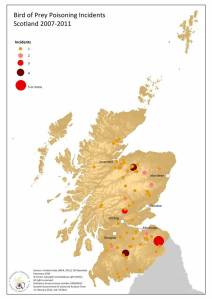
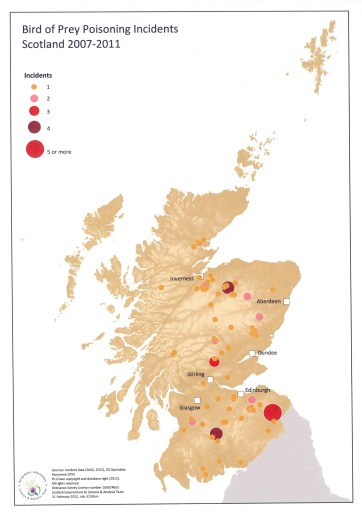
The accurate recording of wildlife crime incidents involving raptors is a major challenge and most will be aware that the RSPB in Scotland produce an annual report. Annual maps of incidents (‘maps of shame’) can also be found on the website above. A major challenge is to make sure that all wildlife crime incidents are reported to the police, preferably to Wildlife Crime Officers who are known locally. It is equally important to make sure that RSPB Investigations staff are also aware of any incidents reported to the police. Wildlife crimes such as suspected shooting or poisoning of birds, destruction of nests or eggs, or reckless disturbance should be reported at the time and without delay. The remains of dead birds of prey, irrespective of age or condition, may be important evidence and require forensic examination. Advice on what to do if you find a suspected incident is available on the PAW Scotland website.

Recently-published research showed that illegal persecution remained particularly prevalent on grouse moors, and for raptor workers and those who visit wild land this is perhaps nothing new. The recent recovery of a poisoned Golden Eagle in Morar and a shot White-tailed Eagle on Skye confirms that birds are at risk throughout the Highlands, not just on sporting estates. Some local populations face the prospect of significant decline unless action is taken. In areas of Scotland such as the Black Isle the re-establishment of the Red Kite continues to be jeopardised by illegal persecution, and each year brings further reports of the destruction of Hen Harriers and Peregrines.

Satellite telemetry is now being used extensively on several species of birds of prey, primarily intended to trace the movements of young birds to gather information which assists their long-term conservation. An unintended outcome from this new science is that when signals indicate a bird has stopped moving, follow-ups have established that birds have been trapped, shot and poisoned. Without satellite telemetry these crimes would never be known about. The Golden Eagle ‘Alma’, poisoned in 2009, is one such example. Unfortunately a significant number of recent persecution casualties involving our large raptors have been found in this way, supporting the argument that reported incidents represent the tip of the iceberg.

The ‘Natural Justice’ thematic inspection recommended dedicated Wildlife Crime Officers in every force. The reality is there are now fewer WCOs than existed when the inspection was carried out. Strathclyde, the largest force in Scotland, have had no full-time post for some years. With a single national police force just months away there is little evidence that there is any genuine commitment on the part of the police service to meet many of the earlier recommendations. Whilst we can work in partnership, increase awareness, improve legislation and ensure landowners and employers accept vicarious responsibility, we can achieve nothing without a properly trained and professional police service which can rise to the challenge. Regrettably, the number of successful prosecutions remains extremely low, and there is a need to ensure that, in terms of enforcement and investigation, the limited resources dedicated to this field of work are properly supported so that much of the political and public relations rhetoric can be converted into tangible results.

I was part of a delegation from Scottish Raptor Study Groups which met Roseanna Cunningham when she was Minister for Environment in November 2010, and we recommended that a dedicated investigative unit be established, comprising trained WCOs and specialists from the RSPB, SSPCA and SNH, with a remit to cover the whole of Scotland, untrammelled by force boundaries. Many will argue, politicians amongst them, that only a few rogue estates and gamekeepers are involved, but any review of the so-called ‘maps of shame’ and the RSPB maps which preceded them, would find that hundreds of estates have been involved in incidents during the last ten years. Uniquely, there are also several estates with histories of persecution going back 30 years. As long as the police have responsibility to investigate such crimes, there is a need for them to develop a cutting edge and target the perpetrators. There would never be a better time to establish a specialist unit than now.

Some fifty years on from my childhood days in south Perthshire I will certainly be able to see Buzzards, Kestrels, Sparrowhawks and even Red Kites when I visit. Unfortunately Hen Harriers remain absent from the moors of Cromlix and Braco. Golden Eagles show little sign of expanding their range, and there is a real risk that fifteen years on from the branding of the problem ‘a national disgrace’, the fate of some of the iconic species which occupy our wild land remains in the balance.

Dead raptors found in suspicious circumstances in Devon

Here’s another example of fine, proactive wildlife policing from Devon WCO Josh Marshall.

On his personal blog, which he set up specifically to raise awareness about wildlife crime in his region, Josh is reporting the discovery of a dead peregrine and a dead sparrowhawk that were found in suspicious circumstances last week. The birds were x-rayed and they hadn’t been shot, but their bodies were too decomposed to allow for any toxicology analysis.

Even though the cause of death could not be established, Josh believes that persecution had taken place due to the position of the birds.

Rather than keeping quiet and forgetting about the incident, knowing that it was going to be virtually impossible to make any more progress with the investigation, Josh chose to publicise the incident and asked people to be extra-vigilant when out walking in the area. Once again, he’s showing how suspected wildlife crimes should be handled. Well done that man.

Story on Josh’s blog here

Pigeon fancier gets police caution for killing sparrowhawks

An un-named pigeon fancier in Bedfordshire has received a police caution after admitting to shooting (and killing) sparrowhawks.

The joint investigation by Bedfordshire Police and the RSPB took place between February – May this year and culminated in the discovery of three dead sparrowhawks. An air weapon was seized during the investigation.

Police Inspector Tracey Day, Bedfordshire Police’s wildlife crime officer said: “Wildlife crime in Bedfordshire is taken seriously and the force will continue to ensure that a positive approach is taken to all matters reported that involve crime against wildlife“.

So, why wasn’t this man named and why did he only receive a police caution for offences that can attract fines of up to £5,000 and/or a six month prison term?

Bedfordshire on Sunday article here

Thank you to the contributor who sent us this link.

Another poisoned raptor, another well-kept secret?

Last week we blogged about Des Thompson’s presentation at the Scottish Wildlife Crime Conference (see here). Here’s a reminder of what he had to say about Northern Constabulary and the problem of red kite persecution in northern Scotland:

So 40% of the dead, just over 100 red kites were poisoned in north of Scotland, without poisoning we should have had 300 plus birds, poisoning of red kites in the north of Scotland is attracting a lot of criticism nationally, and we now know the location of the hotspots problem areas where red kites have been found, poisoned, and we’re working closely with the police to tackle this. And I want to put on record here how grateful we are to Northern Constabulary, er, senior staff at Northern Constabulary for meeting with us to discuss the scientific issues and for taking forward the very ambitious programme of work to tackle this problem“.

So what is this “very ambitious programme of work” and why is it that Northern Constabulary appear to need persuasion to carry out what is its statutory duty to investigate wildlife crime?

If you look at the Force’s website you’ll see that they have 13 police Wildlife Crime Officers (see here) who are overseen by a Force Wildlife Crime Coordinator, Chief Inspector Matthew Reiss. The website also includes a ‘statement of intent’ in relation to tackling wildlife crime and the Force says it is committed to tackling wildlife crime (see here). Further, Chief Inspector Reiss is on record (according to Highland News) as saying Northern Constabulary treats wildlife crime “extremely seriously” (reported here after the convictions of Skibo Estate and Moy Estate employees for wildlife crime offences).

All sounds very convincing and reassuring, doesn’t it? Why is it then that Northern Constabulary has remained tight-lipped about the discovery, 15 months ago, of a poisoned red kite allegedly found on moorland at the boundary of Skibo Estate? We have been told that the satellite-tagged kite was allegedly found in February 2011. SASA documents show that only one red kite from the Highland region was tested in February 2011  and  it had been poisoned by Alphachloralose and was the subject of on ongoing police investigation (SASA ref #11020, see here).
Was there any publicity about this bird? We think we might have remembered if there had been, but we checked back to Northern Constabulary’s archived news items on their website for the month of February 2011 in case we’d missed it – but no, plenty on there about theft of handbags and damage to tractors but not a whisper about the discovery of a poisoned red kite.

Was there a police raid on the surrounding properties where this bird was allegedly found poisoned? If it was found at this location, and given that this is one of the supposed ‘hotspot’ areas for raptor poisoning (three golden eagles and a sparrowhawk found poisoned in 2010 – no convictions; a staked-out poison-laced grouse bait found in 2010 – no convictions) wouldn’t a police raid be the obvious first step in an investigation?

So is that it? No further action? If we hadn’t received a tip-off would it ever have come to light? Where was the RSPB in all of this? Did they know that one of their satellite-tagged kites had allegedly been found poisoned? If they did, why wasn’t the incident publicised? Where was SNH and PAW Scotland in all of this? Did they know that one of the satellite-tagged kites that they’d helped fund had allegedly been found poisoned? Where was their publicity? Where was the NWCU in all of this? Were they notified? Was this alleged incident the trigger for setting up the meeting with senior staff at Northern Constabulary to discuss the red kite persecution ‘science’?

This is the second time in the last few weeks that Northern Constabulary has been at the centre of allegations of secrecy and cover-up when it comes to wildlife crime (see here for earlier report on the suspected shooting and decapitation of a white-tailed eagle on Skye that went unpublicised). How many more incidents are there left to be uncovered? To be fair, Northern Constabulary does sometimes get it right, with current ongoing court cases including the alleged hare snaring at Lochindorb (here) and alleged egg theft (here), but ‘sometimes’ just isn’t good enough. Nobody’s suggesting these investigations are easy – we’ve all seen how difficult it can be to get COPFS to agree to a prosecution – but Northern Constabulary (and others) don’t help themselves when they choose not to publicise, or sometimes even investigate these alleged crimes.

How about everyone stops all the politically-motivated soundbites about commitment and very ambitious work programmes and just focuses on getting the basics right?

2011 poisoning stats ‘out’ in every sense of the word

The Scottish Government has today published the 2011 poisoning map (otherwise known as Scotland’s map of shame).

The newspapers are heralding the figures as a success story, as the numbers show an apparent drop in poisoning incidents (“only [only??!] 16 raptors were killed as a result of being illegally poisoned in Scotland – 12 fewer than in 2010 and the lowest death toll since the first maps were published six years ago“, says The Scotsman). The victims included seven buzzards, four red kites, two peregrines, two sparrowhawks and a golden eagle.

On a superficial level this does look like convincing progress, but let’s scratch the surface and see what’s underneath…

The official Scottish government poisoning map only shows the places where poisoned birds were discovered. Given the remote areas involved and the fact that most of these poisoned birds were found by chance (by passing hillwalkers etc.), the official figures can in no way represent the actual number of raptors that were poisoned (but undetected) during 2011.

The figures behind the map also do not show the areas where poisoned baits (but no dead birds) were discovered during 2011. Nor do they show the other incidents of raptor persecution that were discovered during 2011, including shooting, trapping and nest destruction incidents. According to an article in today’s Guardian, it is claimed that last year’s illegal shooting, trapping and nest destruction incidents “have remained constant with previous years“. We’ll have to wait a good few months for the RSPB Birdcrime Report to see the actual figures. (Incidentally, how come the 2011 poisoning figures, as compiled by SASA, have not yet been released to the public? They’re obviously available as they were used to construct the poisoning map. So far they’ve only published data up to September 2011. Isn’t it in the public interest to release them? Why all the secrecy?).

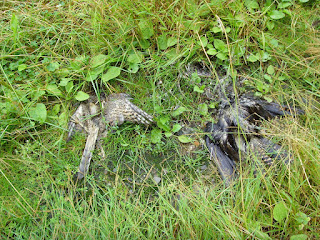
It seems plausible that some shooting estates are doing their best to distance themselves from any sign of illegal raptor persecution, especially in light of the new law on vicarious liability. A likely example of this behaviour was an incident in the Borders in September 2011. A dog walker discovered a bag full of dead raptors by the side of the busy A68  road (see here for earlier blog on this). The police were alerted and the birds were sent to SASA for toxicology tests. The results showed that the two sparrowhawks and two buzzards had been poisoned with the banned pesticide Carbofuran. Because the dead birds had been dumped away from any shooting estate or farm, without being seen, it was virtually impossible for the police to prosecute anyone (SASA reports that the police have now closed the case due to a lack of positive leads – see here). What is the probablity that other estates up and down the country are poisoning raptors on their land and then removing the evidence as far from their location as possible?  It was pure chance that this bag of poisoned raptors was discovered. How many more are left rotting and undiscovered across the country?

But let’s suppose, just for a minute, that the latest map IS an accurate representation of all raptor poisoning incidents that took place in 2011. Should we then accept that shooting estates are cleaning up their act and they’ve all suddenly decided, after over 100 years of persecution, that raptors are actually ok and shouldn’t be killed? The only way to measure that will be to look at LONG-TERM TRENDS of poisoning incidents as well as LONG-TERM TRENDS of raptor populations. We’ve blogged about this before (see here) but it’s worth repeating some of it to show the bigger picture. The graph (adapted from the RSPB’s excellent report: The Illegal Killing of Birds of Prey in Scotland in 2010, see here) shows the long-term trend of poisoning incidents in Scotland from 1989-2010. Look carefully at the graph and you’ll see peaks and troughs in the numbers recorded. Yes, there certainly have been previous drops in the number of poisoning incidents, but then look what happened in the following years – another increase, and then another drop, then another increase etc. Before the game-shooting lobby starts its self-congratulatory back-slapping, we need to see a continuous decline in the number of recorded incidents, AND we need to see raptor populations recovering in those areas where persecution has been endemic. This will take time, but could arguably be judged in about five years’ time.

Of course we all hope that the 2011 figures are the start of a new era in raptor conservation in Scotland. As Environment Minister Stewart Stevenson has said in today’s media: “I hope this proves to be the beginning of a continuing reduction in such cases, leading to the end of this outdated, dangerous and cruel practice“. It is notable that his statement contains more than a hint of caution. That man’s no fool.

See an excellent article about the latest figures in today’s Guardian here

Article in The Scotsman here

Convicted gamekeeper Glenn Brown was a member of the National Gamekeepers’ Organisation

Well finally, the National Gamekeepers’ Organisation has responded to one of the many emails we know were sent to them asking whether convicted gamekeeper Glenn Brown was one of their members (see here).

Here is the reply sent to one of our readers today:

From Ann Robinson-Ruddock (NGO) – “Thank you for your enquiry. I can confirm that Mr Brown was a member of the NGO but that following his convictions he has resigned“.

Fascinating. I guess we now know why the NGO has been reluctant to make a public statement on its website since Brown’s conviction in June 2011. Although to be fair, perhaps they’ve waited seven months to see whether his appeal, based on the assertion that he’d been ‘framed’ by the RSPB, was successful. We found out a week ago that his appeal  had failed, some might say spectacularly. Yet still the NGO has failed to make a public statement.

Wouldn’t you expect an organisation, that not only promotes itself as a member of the Partnership for Action against Wildlife Crime, but states on its website that “Our organisation has a strict disciplinary code  and does not tolerate those who bring the gamekeeping profession into disrepute“, to make a big song and dance about publicly condemning Brown’s criminal activities, and making sure that everyone knew he’d been expelled from the organisation? What we get instead is a delayed private response, that says Brown has resigned, and no mention of condemnation or expulsion.

Is there any wonder that conservationists are so cynical when it comes to trusting the sincerity of the National Gamekeepers’ Organisation? At least when twice-convicted gamekeeper David Whitefield was outed as being a member of the Scottish Gamekeepers’ Association in December 2011, the SGA had the sense to immediately and publicly admit that he was a member, outrightly condemn his criminal activities and kick him out of the club (although the phrase they used was ‘suspended’ rather than ‘expelled for good’ – see here). UPDATE: the SGA has now reportedly given Whitefield “a life ban” (see here).

Come on National Gameepers’ Organisation – when the Scottish Gamekeepers’ Association is making you look bad you know your public credibility rating is probably at rock bottom!

Thank you to the contributor who sent us the NGO email and thanks to everyone who contacted the NGO and pressurised them for an answer.

Is he, or isn’t he?

Last Tuesday (24 Jan), Derbyshire gamekeeper Glenn Brown lost his appeal against his conviction for seven offences under the Wildlife & Countryside and Animal Welfare Acts (see here).

On 25 January 2012, we asked whether Glenn Brown was a member (or now an ex-member) of the National Gamekeepers’ Organisation (NGO), and encouraged readers to contact the NGO and ask for themselves. I don’t know about you, but the NGO has so far ignored the email we sent to them about it.

Interestingly, the NGO was very quick to post a statement on its website recently about the conviction of a Norfolk head keeper and his apprentice for animal cruelty offences (see here). The NGO stated that neither of the offenders were members of the NGO, and this statement was posted the day after the two were sentenced (sentenced on 11 Jan, NGO web statement posted 12 Jan 2012). UPDATE 8 FEB 2012: the NGO has now removed the statement on its website about the Norfolk head keeper and his apprentice.

So, why the silence over Glenn Brown? Was he a member of the NGO or not? It’s a simple enough question, isn’t it?

If anyone else wants to ask the NGO, you can contact them at: info@nationalgamekeepers.org.uk