
SGA donor owns estate ‘among the worst in Scotland for wildlife crime’

SGA donors 2014 EdradynateThe Scottish Gamekeepers’ Association publishes a quarterly magazine for its members. The latest edition (winter/spring 2014) includes a list of recent donors. We were intrigued to see the following entry:

MDCC Campbell Edradynate Estate (Donation: £1720)

Could this be Michael David Colin Craven Campbell, who resides in Hampshire but owns Edradynate Estate? So why would this entry be intriguing? Why wouldn’t they accept funding from Mr Campbell, who was awarded an MBE in 2008 for services to charity, was appointed by the Queen to become High Sheriff of Hampshire 2008-2009 and has an entry in Debretts? No reason whatsoever to reject a generous donation from such an upstanding and distinguished gentleman whose Debrett’s entry lists ‘shooting’ and ‘escaping to Scotland’ amongst his recreational activities. Right?

Edradynate Estate near Aberfeldy in Perthshire was described in 2004 by the then RSPB Investigations Officer Dave Dick as being “among the worst in Scotland for wildlife crime” (see here).

In January 2005, the then Police Wildlife Crime officer for Tayside Police, Alan Stewart, described Edradynate Estate as follows:

Edradynate Estate, which is owned by an absentee landlord from Hampshire, has probably the worst record in Scotland for poisoning incidents, going back more than a decade. In 14 separate incidents since 1998, 16 poisoned victims (9 buzzards, 1 cat, 1 tawny owl, 2 sparrowhawks, 1 common gull, 1 polecat and 1 carrion crow) and 12 poisoned baits (rabbits, wood pigeons and a pheasant) have been found, with traces of the pesticides Mevinphos, Carbofuran and Alphachloralose” (see here, page 3).

These two prominent wildlife crime investigators were commenting following the collapse of a case against two gamekeepers from Edradynate Estate. In 2002, the Head gamekeeper and an under keeper had been charged with nine offences relating to the alleged use of poisoned baits and bird cruelty, including the use of spring traps. These charges followed a police raid on Edradynate Estate where three rabbit baits, a dead buzzard and a dead crow had been found. Lab tests detected Carbofuran and Alphachloralose. A game bag and a knife seized during the search showed traces of these poisons when swabbed.

On 22 July 2004, two years after the original arrests and 13 court hearings later, the Fiscal dropped the case following a series of adjournments called by both the defence and the prosecution. A Crown Office spokeswoman admitted that the time taken to prepare the case for trial had been a major factor in the decision to drop the case.

The 2002 raid was the second police search on Edradynate Estate. In Alan Stewart’s book, Wildlife Detective, he writes the following:

This would be our second major search of the estate under warrant and we hoped this time to find sufficient evidence to bring to an end the catalogue of poisoned baits and victims that had turned up on the estate with the worst record by far not just in Tayside but in Scotland”.

The crimes didn’t end there.
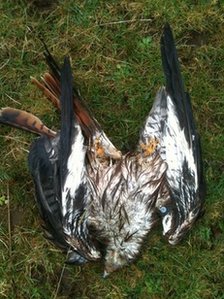
a dead red kiteIn July 2010 a poisoned red kite was discovered in the area (see here). According to Tayside Police, ‘five buzzards and a tawny owl met with the same fate in the same area in the last year’.

In September 2010, an un-named gamekeeper from Edradynate Estate, a self-proclaimed member of the SGA, talked to the Courier about the discovery of the poisoned red kite:

As a member of the Scottish Gamekeepers’ Association, I am against anything illegal. Anybody who does this should be jailed because it’s not on and I have never done anything like this in my life. To find a poisoned bird on my ground is just wrong because I don’t use poison and wouldn’t know how to.

There is something funny about this and I think someone else has killed this bird and planted it on my estate. Why they have done that, I don’t know. We have never seen a red kite, living or dead, in the Strathtay valley so I don’t know where this has come from. The laird is so upset about it, as am I, because it besmirches our reputation and it’s reflecting badly on me.

I am a professional person and I have worked hard for all these years on the estate and never had anything against my name. This is causing me a lot of stress and strain because I don’t know what is going to happen next. I’ve never been involved in anything like this before.

It’s very reassuring to know that I have the full support of the laird because this job is something I love doing.” (see here).

In March 2011 two poisoned buzzards and two poisoned crows were discovered, along with two poisoned pheasant baits. Carbofuran was detected this time. Tayside Police conducted another search (their third on this estate?) and it was reported that a 62 year old man was taken in for questioning but was released pending further enquiries (see here). We’re not aware of any other media statements about this incident.

In September 2013, the Crown deserted a case against Edradynate Estate’s Head gamekeeper on alleged firearms and explosives charges. The reason for this desertion was not made public (see here).

Nobody has ever been convicted for any of the alleged offences on Edradynate Estate.

Alan Stewart wrote about a 1995 incident on Edradynate Estate in his Wildlife Detective book, concerning the discovery of a poisoned cat belonging to the occupier of a cottage on Edradynate Estate. A search in a nearby wood had recovered a poisoned pheasant bait and a poisoned tawny owl – later all found to contain traces of Mevinphos. A further search had recovered two wood pigeon baits and a poisoned sparrowhawk, all found inside a pheasant pen. They all contained traces of Mevinphos. Stewart wrote:

I visited a number of residents on the estate and was absolutely shocked at what I learned. According to the interviews I carried out, my suspect had, at various times, set up a gun with a string attached to the trigger to pepper with wheat any intruder who brushed against the string. He had allegedly driven into Perth to the workplace of a person who lived on the estate, to remonstrate with him after a pheasant had been knocked down and killed by the person’s car. He had allegedly poisoned a tenant farmer’s collie, and also shot dead the dog of a visitor to a neighbouring estate after the dog had run off and was being pursued by its owner. I was taken aback by the vitriol these people had for my suspect but their hatred was tempered with fear and all interviews were ‘strictly off the record’. All those I spoke to were in tied houses and none wanted to become involved in a prosecution. News of my investigation had travelled fast and out of the blue I received a telephone call from a former factor for the estate. He had anticipated the reluctance of those who could potentially help, wished me the best of luck, but doubted that my enquiry would ever result in court proceedings”.

A prosecution in this case was attempted but the case was deserted after it became time-barred due to a lack of available evidence to link the individual suspect to the alleged offences.

Alan Stewart wrote:

The following week [just after the case had been deserted] I learned that another employee had borrowed the suspect’s Land Rover but it had broken down. In his search for tools to repair it, he had lifted up the passenger seat to search the compartment underneath as the most likely place for tools to be stored. Instead of tools there were three dead sparrowhawks. I am sure this would have clinched the case but naturally the employee wanted to keep his job and his house and the information came to me via a third party”.

Stewart wrote about another incident in 2001 – the discovery of a poisoned buzzard on the estate that had been killed by Carbofuran:

The usual enquiries were made and the usual suspect interviewed, but his involvement could not be established……..In the investigations on Edradynate Estate, we could prove beyond reasonable doubt that baits and dead birds and animals were being found with monotonous regularity on the estate. We could prove beyond reasonable doubt that the baits were laced with particular pesticides and that the victims had been poisoned after having consumed part of these baits. What we were so far unable to prove was who set the baits”.
Case against Stody Estate gamekeeper Allen Lambert: part 4

The case against Allen Lambert, a gamekeeper on the award-winning Stody Estate, continued in February and is now set to go to trial.

Lambert, 64, of Old Lodge House, Stody, Melton Constable in Norfolk has already pleaded guilty to storing the pesticides Mevinphos and Aldicarb, but has denied a series of further charges concerning the alleged killing and possession of 14 buzzards, 1 sparrowhawk and 1 tawny owl.

His trial will take place in May.

For previous blogs on this case see here, here and here.

Case against Stody Estate gamekeeper Allen Lambert: part 3

A case management hearing was heard today at Kings Lynn Magistrates Court regarding the remaining charges against Stody Estate gamekeeper, Allen Lambert.

In December 2013, Lambert was charged with seven alleged offences including the killing of 14 buzzards, 1 sparrowhawk and 1 tawny owl (see here).

Lambert, 64, of Old Lodge House, Stody, Melton Constable, Norfolk pled guilty to storing the pesticides Mevinphos and Aldicarb but denied killing and possessing the dead birds.

His case was adjourned today and is expected to continue in February 2014.

Case against Stody Estate gamekeeper Allen Lambert: part 2

Last week we blogged about Norfolk gamekeeper Allen Lambert who had been charged with seven alleged wildlife crime offences including the killing of 14 buzzards, 1 sparrowhawk and 1 tawny owl (see here).

The case against 64-year old Lambert, a gamekeeper on the award-winning Stody Estate, was heard last Thursday (19th December 2013) at Kings Lynn magistrates court.

It has been reported that Lambert pled guilty to keeping banned pesticides (Mevinphos & Aldicarb) but denied killing raptors and keeping some of their bodies.

His case was adjourned until 22nd January 2014.

Interestingly, the news report calls Lambert a ‘former’ gamekeeper.

News report from EDP24 here.

Norfolk gamekeeper faces series of raptor persecution charges

A Norfolk gamekeeper is facing seven charges of alleged wildlife crime.

Allen Lambert, 64, of Stody, near Melton Constable, has been charged with killing 16 wild birds (14 buzzards, 1 sparrowhawk and 1 tawny owl), possession of nine birds (buzzards), failure to comply with a firearms certificate, and four counts of possession and storage of banned poisons (Aldicarb and Mevinphos).

The alleged offences took place between January and April 2013.

Lambert is currently on bail and will appear before King’s Lynn Magistrates court on Thursday (19th Dec).

News articles here and here

North Yorks still worst place for raptor persecution in 2012

The RSPB has published its 2012 Birdcrime report documenting bird persecution throughout the UK.

North Yorkshire has once again come top of the league for the number of reported crimes against birds of prey (34), with Aberdeenshire a close second with 31 reported incidents. Both counties, of course, include large areas of land used for driven grouse shooting.

The 2012 report includes statistics that are all too familiar: confirmed shootings of short-eared owls, sparrowhawks, buzzards, barn owls, tawny owls, hen harriers, golden eagles, marsh harriers, and peregrines; confirmed nest destruction of peregrines, goshawks and barn owls; confirmed illegal spring-trapping of buzzards, golden eagle and peregrine; other types of illegal trapping (including crow cage traps) of sparrowhawks, tawny owls, buzzards and goshawks; and the confirmed illegal poisoning of ravens, red kites, buzzards, golden eagles, marsh harriers, peregrines, cats and dogs.

Remember, these are just the confirmed incidents. Plenty more ‘probable’ and ‘unconfirmed’ cases, and of course there are all the incidents that went undiscovered/unreported.

Does that sound to you like the game-shooting industry is cleaning up its act?

Well done to the RSPB for their meticulous work and especially for their willingness to share these data with the general public.

RSPB press release here

Download the RSPB’s 2012 Birdcrime report here

The photograph shows the shot hen harrier Bowland Betty, found on a North Yorkshire grouse moor in 2012. Nobody has been brought to justice for her death.

Why we don’t trust the National Gamekeepers’ Organisation

A few days ago, Charles Nodder, Political Advisor to the National Gamekeepers’ Organisation (NGO), wrote on this blog:

You should regard us [the NGO] as a key part of the solution [to stamping out illegal raptor persecution], not part of the problem. An organisation to be supported, not attacked”.

The thing is, in order to support an organisation there first needs to be a level of trust. It’s very hard for us to trust the NGO, and here’s why…

Until recently, we were under the impression (mistakenly, as it turns out) that the NGO wouldn’t tolerate any illegal gamekeeping activity and if any of their members were convicted of such an offence, they would be expelled from the organisation. This is what the NGO wants us all to believe, as outlined in their own Disciplinary Code, as published on their website.

However, it would now appear that the NGO does, in our opinion, tolerate some illegal gamekeeping activity. This has only come to light because we discovered that the NGO member who has been applying for licences to kill buzzards (and now sparrowhawks too) was recently convicted for being in possession of several banned poisons, including Carbofuran, the most common poison used to illegally kill birds of prey. We have now discovered that the NGO member, who we have called Mr Buzzard Licence Applicant, was not booted out of the NGO following his conviction for a wildlife crime that is closely linked with the illegal poisoning of birds of prey. Not only was he not booted out, but the NGO then actively supported this member by helping him to apply for his buzzard and sparrowhawk-killing licences.

When challenged about this, Mr Nodder provided some fascinating responses on this blog (see here). Before we take a closer look at those responses, we would first like to acknowledge Mr Nodder’s willingness to engage in conversation on this blog. That’s to his credit; there are many others within the game-shooting industry who have repeatedly refused to engage with us, citing excuses such as, “We don’t communicate with anonymous individuals” but who then go on to complain that we publish articles without giving them the right to reply!! Quite an astonishing response given today’s world of multi-media and social networking communications. A missed opportunity for them, but not really that surprising when you consider that many of them are still hanging on to other 19th Century ideals.

Anyway, back to that NGO policy of supposedly not tolerating any illegal gamekeeping activity.

To begin with, Mr Nodder tried to claim that “The possession of a banned substance [and remember we’re talking here about banned poisons that are routinely used to illegally poison wildlife] is quite clearly a possession offence and not an offence against wildlife”. We were astounded by this comment. There are many, many examples of ‘possession’ offences that are inextricably linked to wildlife crime. Here are just a few examples:

  • Possession of a dead red kite (see James Rolfe case).
  • Possession of 10.5kg of the banned poison Carbofuran (see Dean Barr case).
  • Possession of the banned poison Carbofuran (see Cyril McLachlan case).
  • Possession of wild birds eggs (see Matthew Gonshaw cases).
  • Possession of an illegal pole trap (see Ivan Crane case).
  • Possession of a wild bird (see Craig Barrie case).
  • Possession of live & dead birds for trade/taxidermy (see Gary McPhail case).
  • Possession of the banned poison Alphachloralose (see David Whitefield case).
  • Possession of the banned poison Carbofuran (see Tom McKellar case).
  • Possession of wild birds (see Cogoo Sherman Bowen case).
  • Possession of the banned poisons Carbofuran, Strychnine and Alphachloralose (see Peter Bell case).
  • Possession of wild birds eggs (see Keith Liddell case).
  • Possession of the banned poison Sodium Cyanide (see William Scobie case).
  • Possession of dead wild birds (see Luke Byrne case).
  • Possession of the banned poisons Carbofuran and Alphachloralose (see Graham Kerr case).

In many of these example cases, poisoned and/or other illegally killed raptors were also discovered. Indeed, in many cases it is the discovery of these poisoned animals that then leads on to a police investigation and search that then leads to the discovery of a stash of banned poisons. Quite often, as we all know, the subsequent charges that are brought do not often include charges for actually poisoning the wildlife, but instead the charges relate to the ‘lesser’ (in legal terms) offence of ‘possession’, either due to plea bargaining or due to lack of evidence needed to secure a conviction for the actual poisoning of a wild animal. It stands to reason that the actual poisoning of wildlife is inextricably linked to the possession of banned poisons; in order to poison wildlife, the criminal obviously first has to be in possession of the poison to carry out the act of poisoning.

The National Wildlife Crime Unit defines the possession of a banned poison as a wildlife crime – the Unit often publicises convictions for the possession of banned poisons in its reports. The Scottish Government also defines convictions for possession of banned poisons as wildlife crime – indeed, this is one of the offences that can trigger a prosecution under the new vicarious liability legislation, brought in specifically to address the continuing illegal persecution of raptors. The Crown Office considers possession of banned poisons as a wildlife crime because its specialist wildlife prosecutors take on these cases. The Partnership for Action against Wildlife Crime (PAW, of which the NGO boasts membership) also considers possession of banned poisons a wildlife crime – they, too, publicise ‘possession’ convictions in their newsletters.

So why is it that the National Gamekeepers’ Organisation doesn’t accept possession of banned poisons as a wildlife crime? And if they don’t, why the hell are they allowed to participate in the Raptor Persecution Wildlife Crime Priority Group? Surely that group has been established to find ways of stamping out illegal raptor persecution, but how can it achieve that if one organisational member refuses to expel members who have been convicted of a serious wildlife crime? It makes a mockery of the whole group and does absolutely nothing to instill public confidence in the sincerity of the process.

Mr Nodder’s next explanation for why Mr Buzzard Licence Applicant wasn’t booted out of the NGO was to suggest that possession of a banned poison was not a ‘gamekeeping activity’. On the contrary, if Mr Nodder took the time to look at the conviction statistics (publicly available to those who want to look) he would notice that the significant majority of those convicted for possession of banned poisons are gamekeepers, and that trend has continued for many years. In the case of Mr Buzzard Licence Applicant, his stashes of banned poisons were found in his work vehicle and inside one of his pheasant pens. There’s simply no denying it, unless of course you happen to be the NGO, trying to justify why you haven’t stuck to your stated Disciplinary Code and expelled a member for his criminal conviction.

And what sort of message does this policy send to other NGO members? ‘Don’t worry if you get caught in possession of banned poisons, we won’t kick you out of the club’. It makes you wonder what the law-abiding members of the NGO feel about this policy. If you were a law-abiding member (and there must be some, surely), would you want to be a member of a group that welcomed those with a criminal conviction related to banned poisons? If the NGO doesn’t distinguish between criminal and law-abiding members, why should we?

The third argument Mr Nodder used to try and get us to drop what must be quite embarrassing questions was to pull out the old ‘It’s a spent conviction so we can’t discuss it’ routine. Nice try, but in this case, wholly inapplicable. The legislation that prevents publication of so-called ‘spent convictions’ is the Rehabilitation of Offenders Act 1974 (see here for a good explanation). Its basic premise is that after a period of x years of rehabilitation (depending on the type of crime committed – in this case, five years), the conviction can be ignored and need not be divulged (with one or two exceptions). If somebody does then publish information about the conviction, they may be subject to libel damages, but only if the primary motive of publishing the information was malicious. In this case, seeing as though we haven’t named Mr Buzzard Licence Applicant, even though we’ve had lots of opportunity to do so (and indeed our own received legal advice was that we could name him), it would be extremely difficult, if not impossible, to demonstrate that we are acting in malice (against him as an individual) by discussing his spent conviction because he hasn’t been identified as a named individual. Our primary motive for discussing this case has been to (a) examine the Natural England/DEFRA policy that allows convicted wildlife criminals to apply for licences to kill protected species (see earlier blogs on this), and (b) to examine the sincerity of the NGO’s claims that they won’t tolerate any illegal gamekeeping activity and will expel any member with such a conviction.

And while we’re on the subject of the Rehab of Offenders Act, we’ve made a very interesting observation. Certain professions are exempt from the Act, so that individuals are not allowed to withhold details of previous convictions in relation to job applications. These professions include teachers, social workers, doctors, dentists, vets, accountants etc. But interestingly, also included are “Employees of the RSPCA or SSPCA whose duties extend to the humane killing of animals”. Now then, it is beyond question that the duties of gamekeepers ‘extend to the humane killing of animals’. They probably kill (legitimately) more animals on a daily basis than all the RSPCA and SSPCA employees put together. So why are gamekeepers not included in this list of exemptions? Why should a gamekeeper be able to hide past wildlife crime convictions but an RSPCA/SSPCA employee cannot? That’s a question for the policy makers…

In summary then, in our opinion the NGO’s stated claim that they don’t tolerate any illegal gamekeeping activity is not convincing. They don’t view the possession of a banned poison as a wildlife crime and a conviction for possession of a banned poison is not enough to warrant expulsion from the NGO, even when that poison just happens to be the most commonly used substance to illegally kill birds of prey. It doesn’t matter to us how many wildlife crime groups the NGO has joined – in our view this is just a convenient shield for hiding true intentions – we don’t trust them and will continue to view them with suspicion until they start to back up their stated claims with convincing actions.

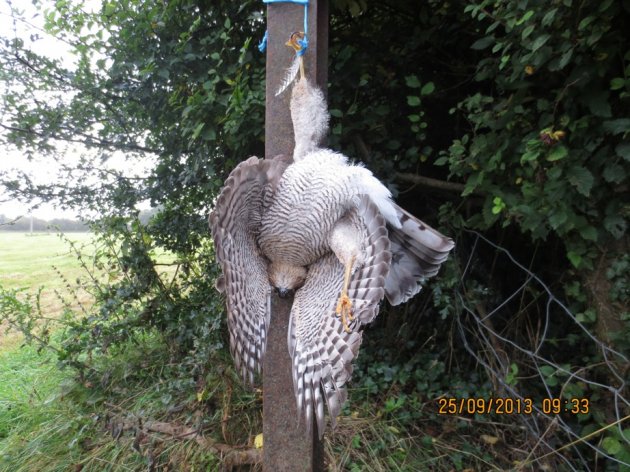
Sparrowhawk shot and strung up from gatepost

shot hung spar IrelandThe Irish National Parks and Wildlife Service are appealing for information after the discovery of a sparrowhawk found hanging from a gatepost. It had been shot and then strung up with a piece of string.

The gruesome discovery was made along a public road in the Rathkenny area of Navan, County Meath.

Further details and a contact telephone number for anyone with information can be found here.

Buzzard licence applicant tries for four more licences

The #Buzzardgate saga continues. Mr Buzzard Licence Applicant (the one who successfully applied for licences to destroy buzzard nests and eggs to protect pheasants earlier this year – see here) has applied for four more licences, this time to kill (by trapping and shooting) 16 buzzards and three sparrowhawks.

The details of these latest applications (well, heavily-redacted versions) have only been revealed after the RSPB again applied under FoI for the information from Natural England. The RSPB’s Conservation Director, Martin Harper, has published these redacted applications and has written a good blog about them (see here). Well done to the RSPB, and particularly to Jeff Knott (who wrote the FoI requests) and to Martin for publishing the results.

This time, Natural England rejected all four applications.

There are a number of issues that are a cause for serious concern, not least the secrecy of the full application material – given the huge public interest in this issue, and the potential for setting precedents that would allow other licences to be issued, the details should be available for public interest and scrutiny, not redacted under heavy black ink. Martin writes eloquently about this in his blog.

But what interests us the most is the involvement, again, of the National Gamekeepers’ Organisation (NGO). The latest licence applications were again made by the NGO “on behalf of our member”. We have blogged extensively about Mr Buzzard Licence Applicant and our strong suspicions that he has a recent conviction for possession of banned poisons, including the gamekeepers’ so-called ‘poison of choice’ – Carbofuran (e.g. see here).

Why do we have these suspicions? Well, we know Mr Buzzard Licence Applicant’s real name, and we know that someone with the same name, working as a gamekeeper, in the same region, was convicted for possession of banned poisons. There is a very slim chance, of course, that it is purely a coincidence that Mr Buzzard Licence Applicant shares the same name, occupation and location as the convicted criminal, but there is also every chance that these two people are one and the same.

According to the NGO’s disciplinary policy (available on their website, see here), they ‘automatically condemn any illegal gamekeeping practice’ and ‘In circumstances where an NGO member is convicted in court of a wildlife crime, that person’s membership will automatically be suspended forthwith, pending the decision of the NGO National Committee. The National Committee will at its next meeting decide, in the light of the court’s findings,…..whether the suspended member shall be expelled or re-admitted”. We and many of you (thank you) emailed the NGO after the first buzzard licence had been issued, seeking clarification about whether Mr Buzzard Licence Applicant was a member of the NGO or whether he had ever been previously suspended. The NGO responded with complete silence.

A few days ago, the NGO’s Political and PR Advisor, Charles Nodder, wrote a comment on this blog concerning another convicted gamekeeper (Andrew Knights). Mr Nodder wrote to advise us that he could find no record of Andrew Knights ever being a member of the NGO (see here). We again asked Mr Nodder for clarification about whether Mr Buzzard Licence Applicant had a previous conviction for wildlife crime and if so, how that fitted in with the NGO’s claimed stance of zero tolerance of illegal acts?

Mr Nodder replied: “Sorry but I am not sure what you are getting at here. The NGO is for best practice and against law-breaking. Is that not clear? Please understand that not all people calling themselves ‘gamekeepers’ are members of the NGO.

This website is implacably against raptor persecution and so too is the NGO. We are members of the Partnership Against Wildlife Crime and active participants in the Raptor Persecution Wildlife Crime Priority Group. We supported and publicised the official maps produced earlier this year showing where birds of prey had been confirmed poisoned.

So far as I know, only two members of the NGO (out of 16,000) have ever been convicted of crimes against raptors have both been publicly condemned on conviction and chucked out. The organisation’s disciplinary policy and unequivocal statement opposing raptor persecution are on the NGO website.

The NGO, and the firm stance it is taking on this subject, can probably achieve more in cleaning up game management practice and encouraging people to follow legal routes than any amount of sniping from the sidelines. You should regard us as a key part of the solution, not part of the problem. An organisation to be supported, not attacked.

And on the buzzard licence applicant, we cannot comment on spent convictions any more than you but I can assure you that he has never been convicted of any crime against wildlife”.

It would seem Mr Nodder has chosen his words carefully, but not carefully enough. You see, possession of banned poisons IS considered a wildife crime and in England, this crime can be prosecuted under the Wildlife & Countryside Act 1981. Or perhaps the NGO don’t consider the illegal possession of banned poisons (usually used to illegally poison wildlife) a legitimate wildlife crime?

So, back to the same question. Is the National Gamekeepers’ Organisation harbouring a convicted criminal amongst its membership? And if so, why is the National Gamekeepers’ Organisation allowed to serve on various wildlife crime committees (e.g. PAW and the Raptor Persecution Wildlife Crime Priority Group)? The legitimate members of these committees should be asking the NGO for clarification and transparency on this issue.

What’s the point of sitting around a table to discuss ways to resolve raptor persecution crime if one of those groups is representing someone with a conviction for wildlife crime? Come on RSPB and the other members of the Raptor Persecution Wildlife Crime Priority Group, ask them the bloody question!

We can also ask them the question: Email to – cnodder@msn.com and info@nationalgamekeepers.org.uk

Dear Charles Nodder/NGO, does Mr Buzzard Licence Applicant, an NGO member whose application to kill buzzards and sparrowhawks you are supporting, have a previous conviction for possession of banned poisons? If so, how does this fit in with the NGO policy of zero tolerance of illegal gamekeeping activities? Thanks.

By the way, we’re still waiting for a response from the Information Commissioner about whether Natural England can refuse to release the name of Mr Buzzard Licence Applicant because they believe it’s in the public interest to keep it secret (see here). We’ll report on that when we’ve had a response.

Sparrowhawk shot dead in Wrexham

SparhawkWrexhamThe BBC is reporting the fatal shooting of a kestrel in Wrexham, although judging by the photograph it appears the victim was a sparrowhawk, not a kestrel.

The critically injured bird was discovered by a member of the public on Thursday 29th August in Brynhyfryd, Johnstown and it died shortly afterwards.

The RSPCA Cymru are appealing for information. Tel: 0300 1234 999.

BBC News article here