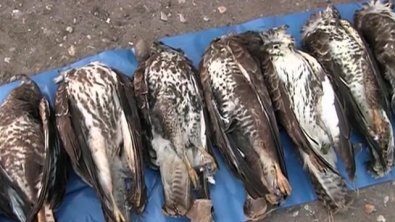
Judicial review: awaiting written decision

The judicial review brought by a Northumberland gamekeeper to question whether Natural England followed due process when they refused to give him licences to kill buzzards and sparrowhawks, has finished.

We now await the written decision of the judge, which can take weeks.

Useful background information about the judicial review process here and here.

Judicial review underway for gamekeeper who wants to kill buzzards

An important judicial review is underway at the High Court this week. It concerns the legal question about whether Natural England acted fairly when it refused licences to a gamekeeper to allow him to kill buzzards and sparrowhawks to protect his pheasants.

The JR has been brought by Northumberland gamekeeper Ricky McMorn and is backed by the National Gamekeepers’ Organisation.

Article in the Chronicle here.

We’ve blogged extensively about this over the last three years. See here for earlier posts, which include discussions about whether DEFRA/Natural England should entertain a licence application from a gamekeeper with a previous conviction for possession of a banned poison (apparently that’s not a problem), whether the National Gamekeepers’ Organisation should expel a member with a conviction for possession of a banned poison (apparently not), and whether there’s any scientific evidence to demonstrate buzzards (and sparrowhawks) have a substantially detrimental effect on game bird shoots (there isn’t).

Henry’s Tour: Day 20

Monday 27 April  Copy

Henry’s arrived in Yorkshire in his quest to find a mate. This should be interesting.

North Yorkshire (includes North York Moors National Park & Yorkshire Dales NP) is the worst county in England for recorded incidents of bird of prey persecution.

Between 2004-2013 there were 70 confirmed raptor persecution incidents. (2014 data not yet published).

These 70 incidents included:

  • At least 26 confirmed incidents involving the illegal use of pesticides – these include the illegal poisoning of 14 red kites, six buzzards, one goshawk, one peregrine plus the finding of a number of poisoned baits; several domestic pets were also poisoned.
  • The confirmed shooting of 25 birds of prey – consisting of 10 buzzards, three red kites, three kestrels, two goshawks, two peregrines plus singles of hen harrier, sparrowhawk, short-eared owl and eagle owl.
  • The illegal trapping of seven birds of prey plus another 11 illegally set traps for raptors.

In connection with these incidents six individuals, all gamekeepers, were prosecuted.

Hen harrier last bred successfully in North Yorkshire in 2007, despite huge areas of suitable habitat.

A Natural England study between 2002 and 2008 showed that of 11 HH breeding attempts recorded in North Yorkshire, only five sites reared any young and most of the sites that failed were believed to be due to human persecution.

#HaveYouSeenHenry

Man charged with attempting to kill sparrowhawk

A man has been charged with attempting to kill a sparrowhawk after he was allegedly seen throwing stones at the bird in Ravenscraig Park, Kirkaldy.

Full story in Fife Today here

Great to see a swift response from Police Scotland and also good to see media coverage. Excellent.

Now, how about some press coverage from Police Scotland regarding the two ‘live, on-going’ poisoning cases that took place at least seven months ago? So far, the police have refused to release details on (a) the crime locations; (b) the victims of the poisonings; (c) the poisons used; and (d) whether they’ve carried out a search (we’re told by a local that at least one of these crimes has not, so far, resulted in a search, seven months on). These two ‘live, on-going’ cases were listed in the Government’s recent raptor crime map data but specific details were not provided.

It’s all well and good to release information about ‘random’ individual persecution incidents, such as the alleged attempt to kill a sparrowhawk in a local park, but what about reporting on the wildlife crimes that regularly take place on some game-shooting estates and arguably are the biggest threat to local populations of some raptor species? Why is information about these crimes still being deliberately withheld, seven months after the offences were committed?

Sparrowhawk photo: photographer unknown.

Subsidy penalty for Stody Estate?

stody buzzardsOn 1st October 2014, gamekeeper Allen Lambert from the Stody Estate in Norfolk was found guilty of poisoning 10 buzzards and one sparrowhawk, which had been found dead on the estate in April 2013. He was also convicted of storing banned pesticides & other items capable of preparing poisoned baits (a ‘poisoner’s kit’), and a firearms offence (see here and here).

On 6th November 2014, Lambert was sentenced. Even though the magistrate acknowledged that Lambert’s crimes passed the custody threshold, he only received a 10 week suspended sentence for poisoning 11 raptors (suspended for one year), a six week suspended sentence for possession of firearms and nine poisoned buzzards (suspended for one year), and was ordered to pay £930 prosecution costs and an £80 victim surcharge.

On 5th October 2014, we blogged about the millions of pounds worth of subsidies that had been awarded to Stody Estate in recent years (see here) and we encouraged blog readers to contact the Rural Payments Agency (RPA) to ask whether Stody Estate would receive a financial penalty in the form of subsidy withdrawal for being in breach of the terms & conditions of their subsidy-fest.

On 10th October 2014, the RPA responded by saying they would consider what action could be taken against Stody Estate (see here).

Then it all went quiet.

One of our blog readers decided to submit an FoI to the RPA in December 2014, to see what was going on. Here is his letter:

12 DECEMBER 2014

To whom it may concern

I am making this request for information under the Freedom of Information Act.

The information I request relates to the conviction in October 2014 of Mr Allen Lambert, a gamekeeper employed by the Stody Estate, Melton Constable, Norfolk, NR24 2ER for illegally poisoning ten buzzards and a sparrowhawk.

I would be grateful if you could provide me with all the information you hold relating to the following questions:

  1. Whether the RPA consider the illegal poisoning carried out by an employee of the Stody Estate as being in breach of Cross Compliance Statutory Management Requirement 1 – Wild Birds.
  2. Did the RPA investigate any breach of cross compliance at the Stody Estate relating to the illegal poisoning offence and what was the outcome of the investigation.
  3. Whether the RPA has imposed a fine on the Stody Estate’s Single Farm Payment, Environmental Stewardship Payment or any other public subsidy the estate receives and if so, how much.

I look forward to hearing from you.

Yours sincerely

XXXXX XXXXX

On 14th January 2015, the RPA responded with this:

14 JANUARY 2015

Dear XXXXX XXXXX

Re: Freedom of Information – Information Request

Thank you for your request for information dated 12 December 2014 which has been dealt with under Freedom of Information Act 2000 (FoIA).

You have asked:

‘1. Whether the RPA consider the illegal poisoning carried out by an employee of the Stody Estate as being in breach of Cross Compliance Statutory Management Requirement 1 – Wild Birds.’

‘2. Did the RPA investigate any breach of cross compliance at the Stody Estate relating to the illegal poisoning offence and what was the outcome of the investigation.’

‘3. Whether the RPA has imposed a fine on the Stody Estate’s Single Farm Payment, Environmental Stewardship Payment or any other public subsidy the estate receives and if so, how much.’

Having considered your request we regret that we are unable to provide you with any meaningful response as we do not hold any information that answers your questions. However, RPA would like to make clear that it is required to assess cross compliance reductions to CAP subsidy claims based on intent, extent, severity, permanence and repetition of the non-compliance. We can assure you that RPA will take action, including cross compliance reductions to CAP subsidy payments applicable, if this is found to be appropriate.

In order to qualify for most CAP subsidy payments, claimants are required to keep their land in Good Agricultural and Environmental Condition and comply with a set of Statutory Management Requirements (SMRs). This is known as cross compliance. One of the SMRs covers wild birds (SMR 1) and this includes a rule about killing, injuring or taking wild birds.

Further information is published on the GOV.UK website (Page 43 – deals with wild birds).

https://www.gov.uk/government/uploads/system/uploads/attachment_data/file/320833/The_Guide_to_Cross_Compliance_in_England_2014_complete_edition.pdf

If you are not happy with the way we have handled your request, you can ask for an internal review. These requests should be submitted within two months of the date of receipt of the response to your original letter and should be addressed to: Access to Information, Rural Payments Agency, North Gate House, 21-23 Valpy Street, Reading, RG1 1AF.

Yours sincerely

Rural Payments Agency

Not very helpful, is it?

Thanks to the blog reader who followed up with the FoI and shared the response with us. We understand the RPA can expect further FoIs until a satisfactory response is received. Watch this space….

Meanwhile, you might be interested to compare Lambert’s pathetic sentence with that of an anti-badger cull protester. Lambert was given a 10 week suspended sentence and ordered to pay £930 costs for the mass poisoning of protected birds, the illegal storage of banned poisons and a firearms offence. The badger cull protester, who breached the terms of an injunction designed to stop him disrupting badger culls (he filmed someone involved with the cull and stood outside the NFU office wearing a t-shirt that said: ‘FCK NFU’), was given a six month suspended sentence and ordered to pay costs that could amount to £55,000 (see here). The first installment of £25,000 is due on 1st May. A crowd-funding page has been set up for those who want to help – see here.

Stody Estate mass poisoner gets…..10 week suspended sentence

Gamekeeper Allen Lambert, convicted of mass raptor poisoning at Stody Estate, Norfolk, has been given a 10 week suspended sentence for poisoning 11 raptors (suspended for one year), a six week suspended sentence for possession of firearms and dead buzzards (suspended for one year) and has been ordered to pay £930 prosecution costs and an £80 victim surcharge.

This sentence will infuriate many. Lambert’s crimes contributed to one of the worst incidents of mass raptor poisoning in the UK. Although it’s not the worst incident, it’s right up there near the top of the list and is certainly the worst mass poisoning of raptors uncovered in England.

District Judge Peter Veits said Lambert’s crimes ‘had crossed the custody threshold’ but that his sentence would be suspended. Why? Sentencing is supposed to serve two purposes. It’s supposed to be a deterrent, not only to the convicted criminal, but also to others who may be contemplating committing the same crime. It’s also supposed to provide a punishment to the perpetrator for having acted criminally.

Does a suspended jail sentence meet any of these aims? No, it certainly does not.

What a wasted opportunity for the judiciary to send out a clear message to those who continue to commit abhorrent wildlife crimes. It’s so rare to actually get a conviction for poisoning; usually it’s the much lesser charge of ‘possession’ of banned poisons [in Scotland] or ‘storage’ of illegal poisons [in England] but here’s a gamekeeper who has been found guilty of actually poisoning 11 protected raptors. Sure, the judge’s sentencing options are constrained within statutory boundaries but the sentence in this case is nowhere near as strong as it could have been. Some of Lambert’s crimes are offences under the Wildlife & Countryside Act. Under this legislation, the maximum sentence, calculated for EACH offence is a £5,000 fine and a six month custodial sentence. That’s just for poisoning 11 birds – in Lambert’s case there are numerous other offences to consider, including firearms offences which usually carry a custodial sentence.

A suspended custodial sentence and a less than £1000 ‘fine’ (prosecution costs) for what Lambert did is absurdly lenient. According to the RSPB, since 2001, four gamekeepers have received suspended custodial sentences for persecution offences. During the same period, 12 egg collectors have actually been jailed. The inconsistency in wildlife crime sentencing is remarkable.

In Scotland there is currently a wildlife crime penalty review underway, at the behest of Environment Minister Paul Wheelhouse. There is an opportunity for you to participate, by filling in a questionnaire which seeks views on whether penalties for wildlife crime offences in Scotland are sufficient deterrent. The closing date is 21 November. Full details here.

So, Lambert’s pretty much got off scot free, but what of his (now former) employers, the Stody Estate? According to the BBC, ‘there is no evidence the estate owner, Charles MacNicol, knew about the poisonings. He wouldn’t tell BBC News whether he knew, or whether he condemned the killings’. Lambert was not sacked by Stody Estate, but instead was allowed to take early retirement, according to ITV news.

What we do know is the Stody Estate has received millions in agricultural subsidies over the years (see here), and as a result of blog readers’ efforts, the Rural Payments Agency is understood to be investigating to see whether financial penalties can be applied for cross-compliance offences (see here).

UPDATE 8/11/14: Here are the judge’s comments on Lambert’s sentencing:  DJ Peter Veits sentencing 6 Nov 2014

Media coverage of Lambert’s sentencing

RSPB press release here

BBC news here

BBC news video here

RSPB Investigations blog here

Daily Mail here

ITV news here

Norfolk Eastern Daily Press here

Telegraph here

Guardian here

Independent here

Norfolk Constabulary press statement here

Lambert 9 bz

Sentencing due for Stody Estate mass poisoner

Allen Lambert, the mass poisoning gamekeeper from Stody Estate, Norfolk, will be sentenced today following his convictions last month.

What sort of sentence does a convicted mass poisoner deserve? He was found guilty of poisoning 10 buzzards and 1 sparrowhawk. He was found guilty of the illegal storage and use of some of the most dangerous pesticides in the world. He was found guilty of having equipment capable of being used to prepare poisoned baits. He was found guilty of having nine dead buzzards in his possession.

Let’s hope the magistrate views this case with the seriousness it deserves.

Previous blogs on this case here, here, here.

Killing with impunity: Birdcrime 2013 published

Birdcrime 2013The RSPB has published its latest annual report on crimes against birds in the UK in 2013.

Their press release here.

The killing goes on, with impunity.

76 individual birds & other animals were confirmed illegally poisoned in 2013. This is more than double the figure from 2012 (29 confirmed victims).

Poisoning victims in 2013 included 30 buzzards, 20 red kites, 1 golden eagle and 1 white-tailed eagle.

68 confirmed incidents involved the shooting or destruction of birds of prey. Victims included two hen harriers, two marsh harriers and 5 peregrines.

These are just the confirmed incidents. A total of 338 incidents were reported to the RSPB in 2013, with North Yorkshire once again being the worst location. There’s also a worrying number of incidents from Powys in South Wales, seemingly relating to poisoned baits.

Birdcrime 2013 is a thoroughly depressing read. The RSPB calls on the shooting industry, again, to clean up its act. Judging by the contents of this report, that’s a seemingly futile request.

Well done and thanks to the RSPB for not only compiling these thorough statistics but importantly, for sharing them in the public domain.

Download Birdcrime 2013: Birdcrime 2013

Hen harrier Bowland Betty, found shot dead on a grouse moor in North Yorkshire. (Photo by Natural England).

Bowland Betty

Rural Payments Agency ‘to consider action’ against Stody Estate

Five days ago we blogged about the millions of pounds of farming subsidies that have been given to Stody Estate over the last few years (see here). For new readers, Stody Estate was in the news last week because their (now former) gamekeeper, Allen Lambert, was found guilty of poisoning 11 raptors (10 buzzards and 1 sparrowhawk) on the estate, as well as other related poison offences (see here and here).

While we wait to find out Lambert’s sentence (due 6th November), we encouraged blog readers to contact the Rural Payments Agency (RPA) to ask whether any action would be taken against Stody Estate as the conviction implied they were in breach of the terms and conditions of their subsidy-fest.

Well done to all those who took the time to contact the RPA – we know from our site stats that at least 40 of you did.

To the RPA’s credit, they have responded very quickly. We’ve seen a number of the responses – some of which have already been shared as comments on this blog, and others which were shared with us privately via email.

From the RPA responses that we’ve seen, it looks as though the RPA is going to take a closer look at Stody Estate. The most common response has been as follows:

I can confirm that RPA will consider what action can be taken under the cross compliance rules in respect of the offences for which the gamekeeper was convicted“.

However, there was one RPA response that didn’t sound quite as promising:

RPA can confirm there is no investigation ongoing“.

Hmm.

As some commentators have already suggested, it’s worth keeping hold of the reference number given at the end of each of the RPA responses so that we can follow up in a few months time to see what action, if any, the RPA has taken.

Lambert 9 bz

The Stody Millions

Following the conviction of (former) Stody Estate gamekeeper Allen Lambert for the mass poisoning of birds of prey (see here and here), has anyone seen any sort of public statement or apology from the Stody Estate, Norfolk? We haven’t…

Lambert 9 bz

We noted with interest a comment from one of our readers (Rob – see here) who suggested asking the Rural Payments Agency whether they’ll be imposing a fine on Stody Estate Ltd’s Single Farm Payment due to a breach in Statutory Management Requirement 1. (See here for details of the cross compliance regulations).

We thought we’d have a look to see how many agricultural subsidies Stody Estate Ltd has received over the years (i.e. money given to them from our taxes to help them farm on the condition they look after the wildlife and wildlife habitats under their management). Here’s what we found a couple of days ago on the excellent Farm Subsidy website (although bizarrely, when we looked today we couldn’t find it) -:

2012. Direct payments under European Agricultural Guarantee Fund: 457,570 EUR

2012. European Agricultural Fund for Rural Development: 274,710 EUR

2011. European Agricultural Fund for Rural Development: 498,617 EUR

2011. Direct payments under European Agricultural Guarantee Fund: 427,449 EUR

2010. Direct payments under European Agricultural Guarantee Fund: 444,050 EUR

2010. European Agricultural Fund for Rural Development: 190,052 EUR

2009. Rural development programmes: 113, 382 EUR

2009. Sugar Restructuring Fund: 58,102 EUR

2009. SPS (Single Payment Scheme): 345,027 EUR

2009. Additional amounts of aid: 139 EUR

2009. Irregularities EAGF – Assigned revenue: -842 EUR

2008. SPS (Single Payment Scheme): 366,524 EUR

2008. Rural development programmes: 135, 922 EUR

2008. Aid for energy crops: 3,630 EUR

2008. Additional amounts of aid: 232 EUR

2007. SPS (Single Payment Scheme): 356,453 EUR

2007. Aid for energy crops: 3,862 EUR

2007. Additional amounts of aid: 190 EUR

2007. Irregularities EAGF – Assigned revenue: -49 EUR

2006. SPS (Single Payment Scheme): 266,781 EUR

2006. Aid for energy crops: 1,053 EUR

2005. Area aid for producers of cereals, oilseeds, proteins, grass sileage and set aside: 254,699 EUR

2004. Aids for producers of cereals: 168,223 EUR

2004. Set-aside: 66,370 EUR

2004. Agri-environment-Farmer system (2000-2006): 39,030 EUR

2004. Aids for producers of peas, field beans & sweet lupins: 31,836 EUR

2004. Aids for producers of soya beans, rape seed & sunflower seed: 16,821 EUR

2004. Aids for producers of non-textile flax seed and hemp grown for fibre: 7,398 EUR

2004. Forestry – New system (2000-2006): 303 EUR

2004. Forestry – Former system (2000-2006): 294 EUR

2004. Other expenditure related to direct payments for arable crops: -30,722 EUR

In total, this amounts to 4,538,719 EUR (£3,549,122.60 GBP).

However, we also found something else on the Farm Subsidy website (which again, bizarrely, we cannot seem to find today). Another recipient was also listed whose address was given as Stody Estate Office, Melton Constable, NR24 2ER: a company by the name of GC & FC Knight Ltd. According to this website, GC & FC Knight Ltd was the former name of Stody Estate Ltd – it was changed to Stody Estate Ltd on 17th December 2002.

So how come, on the Farm subsidy website, GC & FC Knight Ltd are listed as having received 1,264,590 EUR (£991,049,56 GBP) between 2000-2004, if the company changed it’s name to Stody Estate Ltd in 2002?

All very strange. Unless of course the subsidies are paid two years in arrears? If anyone can enlighten us, please do!

Either way, it’s clear from these records that the people farming on Stody Estate have received millions in agricultural subsidies. In light of their gamekeeper’s conviction for mass poisoning using banned pesticides, it would be very interesting to find out if the Rural Payments Agency will be considering a substantial fine for breach of the subsidies regulations. Surely they have to show that wildlife crime doesn’t pay? You can ask them here: csc@rpa.gsi.gov.uk

UPDATE: 10 October 2014 – the Rural Payments agency responds here