In April we wrote a blog called ’21 eagles, 6 years, 0 prosecutions’ (read it here). It’s now five months later and we thought we’d update it. It’s now called ’26 eagles, 6 years, 0 prosecutions’.
As we discussed before, some of these eagles are just ‘missing’ and may not be dead, although the frequency with which these sat-tagged eagles & harriers are going ‘missing’ is indicative of something more sinister, of that there’s no more doubt. It’s also reasonable to point out that there may be (probably will be) a hell of a lot of other eagles that we haven’t included in this list because we just don’t know about them. We only see the tip of a very very large iceberg, as is becoming clearer to everyone by the day.
So, here we go….
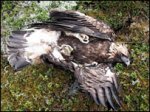 MAY 2006: A dead adult golden eagle was found on the Dinnet & Kinord Estate, near Ballater, Aberdeenshire. Tests revealed it had been poisoned by the illegal pesticide, Carbofuran. Grampian Police launched an investigation. Six years and 4 months later, nobody has been prosecuted.
 JUNE 2006: A dead golden eagle was found on Glen Feshie Estate in the Cairngorms. Tests revealed it had been poisoned by the illegal pesticide, Carbofuran. Northern Constabulary launched an investigation. Six years and 3 months later, nobody has been prosecuted.

AUGUST 2007: A dead adult female golden eagle was found on an estate near Peebles in the Borders. She was half of the last known breeding pair of golden eagles in the region. Tests revealed she had been poisoned by the illegal pesticide, Carbofuran. Lothian & Borders Police launched an investigation. Five years and 1 month later, nobody has been prosecuted.
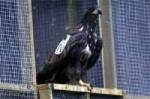 AUTUMN 2007: Tayside Police received a detailed tip-off that a young male white-tailed eagle (known as ‘Bird N’) had allegedly been shot on an estate in Angus. The timing and location included in the tip-off coincided with the timing and location of the last-known radio signal of this bird. Five years later, the bird has not been seen again. With no body, an investigation isn’t possible.
 MAY 2008: A one year old male white-tailed eagle hatched on Mull in 2007 and known as ‘White G’ was found dead on the Glenquoich Estate, Angus. Tests revealed he had been poisoned by an unusual concoction of pesticides that included Carbofuran, Bendiocarb and Isofenphos. A police search in the area also revealed a poisoned buzzard, a baited mountain hare and 32 pieces of poisoned venison baits placed on top of fenceposts on the neighbouring Glenogil Estate. Laboratory tests revealed the baited mountain hare and the 32 poisoned venison baits contained the same unusual concoction of highly toxic chemicals that had killed the white-tailed eagle, ‘White G’. Four years and 4 months later, nobody has been prosecuted.
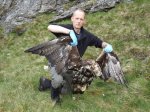 JUNE 2009: An adult golden eagle was found dead at Glen Orchy, Argyll, close to the West Highland Way. Tests revealed it had been poisoned by the illegal pesticide, Carbofuran. Strathclyde Police launched a multi-agency investigation. Three years and 3 months later, estate employee Tom McKellar pled guilty to possession of Carbofuran stored in premises at Auch Estate, Bridge of Orchy and he was fined £1,200. Nobody has been prosecuted for poisoning the golden eagle.
 JULY 2009: A two year old female golden eagle known as ‘Alma’ was found dead on the Millden Estate, Angus. Tests revealed she had been poisoned by the illegal pesticide, Carbofuran. Alma was a well-known eagle – born on the Glen Feshie Estate in 2007, she was being satellite-tracked and her movements followed by the general public on the internet. Tayside Police launched an investigation. Three years and 2 months later, nobody has been prosecuted.
 AUGUST 2009: A young white-tailed eagle was found dead on Glenogil Estate, Angus. Tests revealed it had been poisoned by the illegal pesticide, Carbofuran. Tayside Police were criticized in the national press for not releasing a press statement about this incident until January 2010. Three years and 1 month later, nobody has been prosecuted.
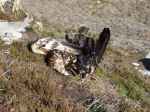 MAY 2010: Three dead golden eagles were found on or close to Skibo Estate, Sutherland. Tests revealed they had been poisoned; two with Carbofuran and one with Aldicarb. Northern Constabulary launched a multi-agency investigation. One year later (May 2011), Sporting Manager Dean Barr pled guilty to possession of 10.5 kg of Carbofuran stored in premises at Skibo Estate. Two years and 4 months later, nobody has been prosecuted for poisoning the three golden eagles.
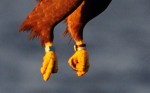 JUNE 2010: Leg rings with unique identification numbers that had previously been fitted to the legs of four young golden eagles in nests across Scotland were found in the possession of gamekeeper James Rolfe, during a multi-agency investigation into alleged raptor persecution at Moy Estate, near Inverness. It is not clear how he came to be in possession of the rings. The bodies of the eagles from which the rings had been removed were not found. No further action was taken in relation to the discovery.
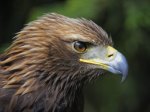 JUNE 2010: A golden eagle and a white-tailed eagle were found dead on Farr Estate, Inverness-shire. Tests revealed they had been poisoned by the illegal pesticide, Carbofuran. Northern Constabulary apparently did not search the property until July 2011. Two years and 3 months later, nobody has been prosecuted.
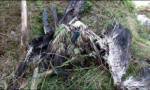 DECEMBER 2010: A decomposing carcass of a white-tailed eagle was found and photographed on Logie (Lochindorb) Estate, Morayshire. It was reported to Northern Constabulary. By the time the police arrived to collect it, the carcass had disappeared. The police said they couldn’t investigate further without the body.
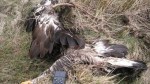 MARCH 2011: The body of a young golden eagle was discovered on North Glenbuchat Estate, Aberdeenshire. Tests revealed it had been poisoned by the illegal pesticide, Carbofuran. Grampian Police launched an investigation and raided the property in May 2011. One year and 4 months later, we are not aware of any pending prosecutions.
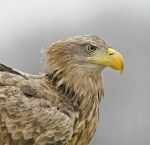 APRIL 2011: The body of a white-tailed eagle was found at the base of cliffs on Skye. The person who discovered it (a professional medic) considered it to have been freshly shot with a rifle, decapitated with a sharp implement and thrown from the cliff top. He took photographs and alerted Northern Constabulary and RSPB. There was a delay of two weeks before the now probably decomposed carcass was collected. A post-mortem was inconclusive. This incident was not made public until one year later after a tip off to this blog. We are not aware of any pending prosecutions.
 NOVEMBER 2011: The signal from a satellite-tracked young golden eagle (hatched in 2010) stopped functioning when she was at a location in the Monadhliaths, a well-known raptor persecution black spot in the Highlands. Her last known location was checked by researchers but there was no sign of the bird. Another technical malfunction of a satellite transmitter or another ‘disappearance’ in suspicious circumstances?
 MARCH 2012: The body of a young golden eagle being tracked by satellite was discovered in Lochaber. Tests revealed it had been poisoned with the banned pesticides Aldicarb and Bendiocarb. Information about this incident was not made public until three months later. As far as we are aware nobody is being prosecuted for poisoning this bird.
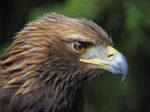 MARCH 2012: The signal from a satellite-tracked young golden eagle (hatched in 2011) stopped functioning when the bird was in the eastern glens, a well-known raptor persecution blackspot. Another technical malfunction of a satellite transmitter or another ‘disappearance’ in suspicious circumstances?
 MAY 2012: The dead body of a young satellite-tracked golden eagle (hatched in 2011) was discovered near a lay-by in Aboyne, Aberdeenshire. The data from its satellite tag & the injuries the bird had when found (2 broken legs) suggests it had been caught in an illegal trap in the Angus glens and then removed, under cover of darkness, to be dumped in another area where it was left to die, probably a slow and agonising death. Information on this incident is only released almost five months later, by the RSPB. It appears the police failed to properly investigate this incident as no search warrants were issued. As far as we are aware, nobody is being prosecuted for killing this bird.
 MAY/JUNE 2012: The signal from a young satellite-tracked golden eagle stopped functioning when the bird was north-east of the Cairngorms National Park. Another technical malfunction of a satellite transmitter or another ‘disappearance’ in suspicious circumstances?
If reading this list has left you wondering how can this still be happening in 21st century Scotland, and questioning why it seems to be impossible to prosecute anyone for these killings even with what appears to be plenty of supporting evidence to back the cases, then you probably want to ‘do’ something about it. The best thing you can do, right now, is to email the new Scottish Environment Minister, Paul Wheelhouse MSP. Tell him that this scandalous situation has to stop once and for all and ask him how he intends to address the problem. Tell him you are sick of being asked to consider all possibilities to explain these dead or missing eagles except the most likely one. Tell him that the Scottish Government is in a position to bring in changes to stop this disgrace and that they haven’t already speaks volumes. Tell him enough is enough and you want to see ACTION. He probably agrees with all these sentiments already but it’s important that he hears it from us all directly. Think about the details of the slow and agonising death of that poor young golden eagle that we read of yesterday and make it’s death mean something. ministerforenvironment@scotland.gsi.gov.uk

 We are certain that this motion (and its amendment) was triggered by the number of people writing to complain about the two recent shocking incidents involving the illegal persecution of golden eagles in Scotland (see here and here). Don’t think for a minute that you can’t make a difference. Look at what happened with ‘buzzardgate’ – a complete u-turn due to massive public opposition. Look at what happened yesterday with the proposed badger cull – a complete u-turn (although Owen Paterson denies this) and an overwhelming majority parliamentary vote against the cull going ahead.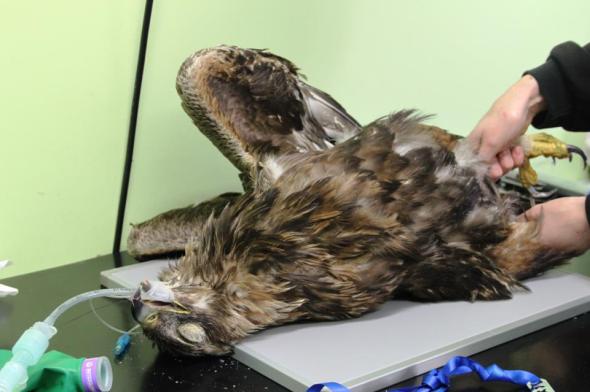
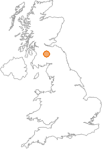 Information from local sources indicate that the bird was discovered on the Buccleuch Estate, very close to the boundary with Leadhills Estate, just to the north of Wanlockhead (see map below – our thanks to Andy Wightman [
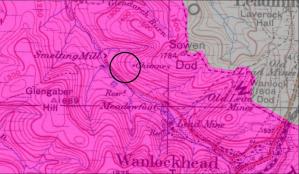 The area where the eagle was found is managed as a driven grouse moor, as is the land immediately on the other side of the estate’s border. It’s been reported that Leadhills Sporting Ltd leases land on Buccleuch Estate (see
  Crikey, this is the third ‘good news’ eagle story this month!
 So, SGA Chairman Alex Hogg is “hugely encouraged” by the forthcoming 2012 poisoning statistics, due to be released by the government agency SASA in the next few days (see
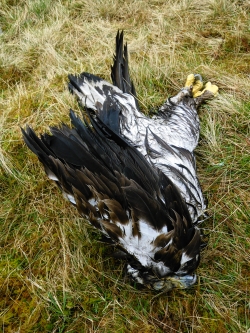
  The Northern Ireland Raptor Study Group has sent us the following press release and photo:
 Raptor Persecution UK