Red kite shot & killed on nest in West Yorkshire

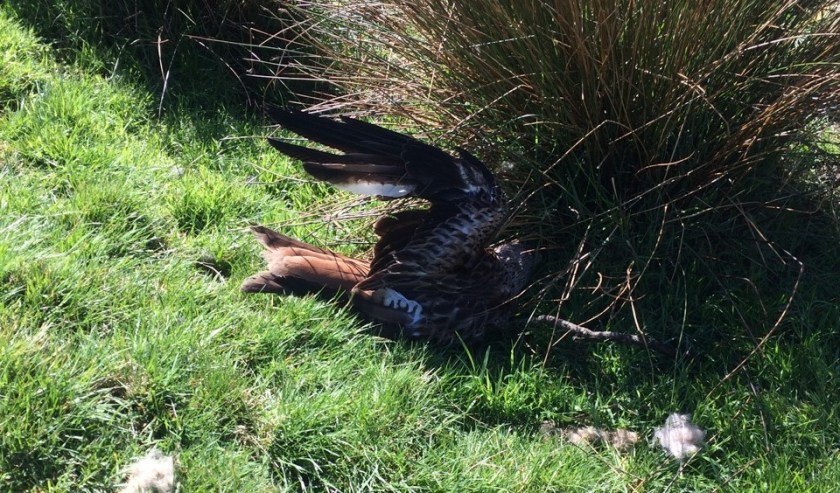
Red kite shot Eccup April 2016 Doug SimpsonOn 21st April 2016, a new red kite nest was discovered in woodland near Alwoodley Lane in the Eccup area of Leeds, West Yorkshire. Hanging in a tree next to the nest was the corpse of a dead kite.

A veterinary examination revealed the bird had suffered shot gun injuries and was most likely killed while on the nest, incubating eggs.

Short article in Yorkshire Evening Post here.

This is the latest in a number of illegally killed or illegally injured red kites reported in recent weeks. Others include this one in North Yorkshire, this one in North-east England, these two in Oxfordshire and another one in North Yorkshire.

Photo of the latest shot red kite in Leeds by Doug Simpson.

Another red kite shot in North Yorkshire

North Yorkshire Police are appealing for information after the discovery of a critically injured red kite near Harrogate.

The wounded kite was discovered on Saturday 23rd April 2016 on farmland near Nidd, Harrogate and was taken to a specialist vet. X-rays revealed it had been shot. The vet believed the bird had been shot while in flight and had survived, unable to fly, for up to two days.

Unfortunately its injuries were so severe the kite had to be euthanised.

Press release from North Yorks Police here.

A big well done to the police for getting this appeal for information out so quickly – kite found on Saturday, press release (with photos) out on Wednesday. That’s a fantastic response.

Sick to the back teeth of hearing about the illegal killing of raptors? Help bring it to an end by signing this e-petition calling for a parliamentary debate on the future of grouse shooting – HERE

Red kite shot Harrogate April 2016

Red kite shot Harrogate x ray April 2016

Red kites shot in the Thames Valley

Thames Valley Police are appealing for information after the discovery of two injured red kites, both suffering from shotgun wounds.

Red Kites.png-pwrt3

Both kites were discovered in Oakley Wood, near Crowmarsh Gifford, Wallingford, Oxfordshire. One was found on 29th March 2016 and the second was found on 5th April.

Both are now in the expert care of Tiggywinkles Wildlife Hospital.

The Police have revealed that a third red kite had been found in the same wood on 22nd March 2016, although the cause of death is not known.

Anyone with information is asked to call  Thames Valley Police on 101, quoting reference #URN 372 06/04/16.

Well done to Thames Valley Police for issuing an appeal for information (here).

Photographs of the two injured kites and their x-rays provided by Tiggywinkles.

Goshawk suffers shotgun injuries to head

The following images appeared on social media a couple of days ago.

This is a goshawk that was found critically injured in Brockweir, Gloucestershire in April 2016 and was taken to Vale Wildlife Hospital. It had been shot in the head.

Unfortunately its injuries were so severe the decision was taken to euthanise the bird.

No further information available.

UPDATE Tues 26th April: Glos Police has today issued an appeal for info here

Photographs by Vale Wildlife Hospital

Goshawk shot Chepstow April 2016

goshawk shot Chepstow April 2016b

Goshawk shot Chepstow April 2016c

Red kite shot dead in North east England

Yet another red kite has been illegally killed in North-east England.

The body of the latest victim was discovered in Chopwell Wood, west of Rowlands Gill, Gateshead, over the Easter weekend. It had been shot.

For those of you who read Mick Render’s poignant guest blog on Mark Avery’s website last week (here), this news will come as no surprise.

Further details of the latest fatality here.

Red kite photo by David Tomlinson

Shot red kite successfully rehabilitated and released

Last month we blogged about an injured red kite that had been found in Malton, North Yorkshire. It had suffered shotgun injuries to the throat and was being cared for by wildlife rehabilitator extraordinaire, Jean Thorpe (see here).

After a few weeks of care and attention, that red kite was successfully released back to the wild yesterday (Photo by Robert Fuller)

13043497_10153433700115812_4569680277323548722_n

Well done and thank you, Jean Thorpe, what a remarkable lady! Remember, Jean does this in a voluntary capacity with no government funding to support her work. Please consider making a small (or large!) donation to help her: HERE.

Of course, North Yorkshire isn’t the only location where red kites are routinely persecuted, either by illegal trapping, shooting or poisoning. There’s a poignant commentary on Mark Avery’s blog today, documenting the disgraceful persecution of red kites on the grouse moors of north east England and how this is suppressing the expansion of the reintroduced kite population. It’s an all too familiar story (e.g. see here).

Join the tens of thousands of ordinary people who are saying enough is enough: HERE

Buzzard shot in East Yorkshire

A buzzard with shot gun injuries has been found on farmland at North Frodingham, Driffield, in East Yorkshire.

It has undergone surgery to have its wing pinned and is now being cared for by Jean Thorpe of Ryedale Wildlife Rehabilitation. If you’d like to help support Jean’s never-ending voluntary efforts, please consider a donation here.

Anyone with news about the buzzard shooting please contact Humberside Police on 101.

Buzzard shot Driffield April 2016 Jean Thorpe

Buzzard shot Driffield April 2016 Jean Thorpe 2

More raptor persecution in North Yorkshire

Over the last few years North Yorkshire has emerged as one of the worst raptor persecution hot spots in the UK (see here). It’s a county where much of the landscape is dominated by grouse moors, particularly in the two National Parks: the North York Moors NP and the Yorkshire Dales NP, as well as a large number of pheasant and partridge shoots.

It’s only March and already this year there’s been an illegally shot red kite and a suspected illegally spring-trapped buzzard.

The critically-injured buzzard was found in February at Wykeham, North Yorkshire. It had a broken, crushed ankle and a broken thigh bone; injuries consistent with being caught in a spring trap, says local Police Wildlife Crime Officer Graham Bilton. Local expert raptor and wildlife rehabilitator Jean Thorpe was once again called to the scene to assist but the buzzard’s injuries were considered too serious and it was euthanised by a vet. Article in Yorkshire Post here. Anyone with information please call Police WCO Graham Bilton on 101.

Photographs of the buzzard by Jean Thorpe:

buzzard spring trapped Jean Thorpe Feb 2016

buzzard spring trapped Jean Thorpe Feb 2016 b

Yesterday, Jean posted the following photographs showing an injured red kite that had been found at Low Marishes, Malton. An x-ray revealed it had been shot. This kite is currently being cared for but whether it survives remains to be seen. Anyone with information please call Police WCO Jez Walmsley on 101.

Red kite shot March 2016 Jean Thorpe

Red kite shot March 2016 Jean Thorpe 2

Jean Thorpe (pictured above with the shot red kite) runs Ryedale Wildlife Rehabilitation. She works closely with the RSPB and local Police Wildlife Crime Officers and has her work cut out, living where she does. In 2014 she was awarded an MBE for her tireless voluntary work. If you’d like to make a donation towards her efforts, please click here.

The e-petition to ban driven grouse shooting can be found HERE.

Cairngorms National Park Authority responds to death of hen harrier ‘Lad’

HH Lad July 2015 Dave PullanFollowing on from yesterday’s news about the discovery of a dead hen harrier (suspected shot) on a grouse moor within the Cairngorms National Park (see here), Grant Moir, CEO of the Cairngorms National Park Authority has issued a statement (see here).

We’ve reproduced it here:

It appears likely from the post-mortem carried out by SRUC that a tagged hen harrier has been shot in the National Park. It is a disgrace that there are still people who think shooting a hen harrier is acceptable in the 21st century.

Millions of people visit this incredible Park every year with 12 per cent of visitors coming here for wildlife watching earning millions for the local economy. 43 per cent of people in the Park are employed in tourism and every illegal raptor crime adversely affects this area and Scotland’s reputation. The National Park Authority will work with all our partners to try and ensure that raptor crime is a thing of the past and that populations and ranges recover in the Park.

END

Good on the CNPA for issuing a statement (that’s more than the Environment Minister seems to have done), and this statement is marginally better than the one it issued nine days ago in response to questions about mountain hare massacres taking place on grouse moors within the National Park (see here), but once again it mostly just reads as empty rhetoric.

Pay attention to that last line: “The National Park Authority will work with all our partners to try and ensure that raptor crime is a thing of the past and that populations and ranges recover in the Park“. It’s all very well saying they’ll ‘work with partners’, but how, exactly, will that translate in to action?

The CNPA has talked a lot about partnership working and action, especially to address the issue of illegal raptor persecution on grouse moors within the Park, which it recognises as “threatening to undermine the reputation of the National Park as a high quality wildlife tourism destination” (see here).

For example, in 2013, a new, five-year ‘action plan’ was launched which aimed to ‘restore the full community of raptor species’ and one of the action points was for the SGA and SLE ‘to trial innovative techniques to increase raptor populations’ (see here). How’s that going? Anyone seen an increase in raptor populations? No, of course not. What we’ve actually seen is a long-term decrease of some raptors on grouse moors within the Park: the local hen harrier population has crashed (see here) as has the local peregrine population (see here) and there is no indication that these declines are about to be reversed.

Last year the CNPA hosted a high-level meeting with the Environment Minister and landowners, in which it was stated in a post-meeting CNPA press statement, “Among the topics discussed was raptor persecution and conservation, with a recognition of the progress made in recent years…” (see here).

What progress is that, then?

The last line of the CNPA’s latest statement in response to the death of hen harrier ‘Lad’ could translate as follows: ‘We’re not happy about this, it casts us in a bad light, we wish it would stop but we’re hopeless and helpless to bring about change’.

We’re not. Please sign the e-petition to ban driven grouse shooting HERE.

Photo of hen harrier ‘Lad’ by Dave Pullan

Hen harrier ‘Lad’ found dead on moor in Cairngorms National Park – suspected shot

Lad HHA young satellite tagged hen harrier named ‘Lad’ has been found dead on moorland in the Cairngorms National Park.

He fledged from a nest on an unnamed estate, also within the Park, in 2015, and was sat tagged as part of the RSPB’s Life+ Hen Harrier Project, where his movements were tracked until early September 2015, when he was found dead on moorland ‘near Newtonmore’. Full details can be read here.

The post-mortem results read as follows:

The skin was split open on the left side of the neck parallel with the jugular groove. There was haemorrhage in the subcutaneous tissues in this area and a horizontal split in the trachea. There was damage to three feathers of the right wing consisting of a single groove mark perpendicular to the shaft of each feather.”

It goes on:

Despite the failure to identify metallic fragments within the carcase the appearance of the damage to the wing feathers is consistent with damage caused by shooting. The injury to the neck could be explained by a shot gun pellet passing straight through the soft tissue of the neck. Both injuries could have brought the bird down and proved fatal.”

There’s lots of moorland ‘near Newtonmore’, and lots of it is intensively managed driven grouse moor, as can be seen in this photo taken in the area in July 2015 (photo by Andy Amphlett)

Burning Loch Cuaich 1 - Copy

The name of the estate where Lad’s corpse was discovered has not been given, but if you look at Andy Wightman’s excellent website Who Owns Scotland you’ll see a number of moorland estates that could all be described as being ‘near Newtonmore’. These include:

Pitmain Estate

Glen Banchor & Stone Estate

Cluny Estate

Drumochter & Ralia Estate

Etteridge, Phones & Cuiach Estate

Lynaberack Estate

So, was Lad, a young hen harrier just weeks out of the nest, shot dead on a driven grouse moor within the Cairngorms National Park? The post mortem report suggests he was, although it isn’t wholly conclusive and no doubt, no doubt at all, the grouse-shooting industry will pounce on this as ‘inconclusive evidence’. And if this was the first time it had ever happened to a hen harrier on a grouse moor, we might just give them the benefit of the doubt.

The thing is, as you all know, this isn’t a one-off. This hen harrier is the latest in a long, long miserable history of hen harrier persecution on driven grouse moors. To add further insult to injury, it happened inside the Cairngorms National Park, that so-called ‘jewel’ of Scotland.

In response, you might want to do the following:

  1. Sign this e-petition to ban driven grouse shooting HERE
  2. Email Environment Minister Dr Aileen McLeod and ask her how the Government intends to respond to this latest crime. She may not be in post after the May election but no matter, if she isn’t, the next Minister will still have to reply. Be in no doubt, your emails to the Minister do have an impact. Emails to: ministerforenvironment@scotland.gsi.gov.uk
  3. Email Hamish Trench, Conservation Director of the Cairngorms National Park Authority, and ask him how the CNPA intends to act on this news. Emails to: hamishtrench@cairngorms.co.uk

UPDATE 23rd March 2016: Cairngorms National Park Authority responds here