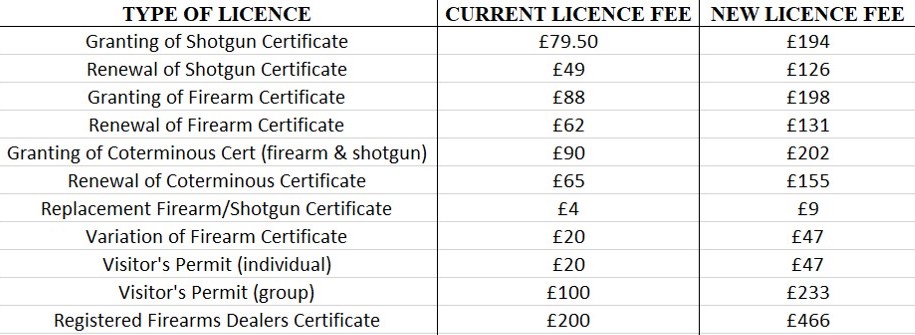
The UK Government has announced that licence fees for firearms and shotguns are set to increase next month to allow for ‘full-cost recovery’, which means that taxpayers will no longer be subsidising the use of these weapons.
Photo by Ruth Tingay
Those wishing to possess, buy or acquire a firearm or shotgun and ammunition in the UK are required to have a certificate, issued by the user’s local police force who act as the licensing authority. These certificates are valid for five years, unless revoked.
Before a certificate is granted, the police undertake a vetting procedure which includes medical checks and a range of suitability checks including referee interviews and a home visit to ensure the applicant has a secure facility to store a weapon and ammunition. All of this costs money from the force’s budget and until now, this cost has been significantly subsidised by the tax payer, costing the national police budget an estimated £17 – £20 million pounds a year.
Last week the Home Office announced an increase in licensing fees, the first since 2015, that will, for the first time, achieve full-cost recovery for police forces.
Here are the current licence fees and the new fees that begin on 5th February 2025:
This has been a long time coming. It was in Labour’s election manifesto and I’m pleased to see the speed with which it’s being rolled out.
Some game-shooting organisations, such as BASC, are dramatically claiming that the fee increase ‘poses a threat to rural livelihoods‘. Having to pay the equivalent of £25.20 per year for a shotgun certificate renewal isn’t exactly going to ruin the rural economy, is it?
Let’s hope the £17-£20 million pounds saved from the annual police budget can be put to good use to chase down all those certificate-holding gamekeepers who continue to use their firearms and shotguns to illegally kill birds of prey.
Lincolnshire Police posted the following on social media yesterday:
Sadly the beautiful buzzard in the picture has died as a result of being shot.
The bird was found alive on Saturday 4 January at Grainthorpe and taken to the emergency vets where it was treated and later collected by Cleethorpes Wildlife Rescue. The buzzard didn’t survive it’s injuries. Crime ref 24*10683 refers.
If is an offence to kill or injure any wild bird. They are protected under the Wildlife and Countryside Act 1981. It is also an offence to interfere with nests, or remove any chicks or eggs.
DC Aaron Flint from our Rural Crime Action Team said: “I’d like to hear from anyone who has information about the shooting of birds in our county. Please don’t think it’s not worth reporting, it very much is and helps us to build a picture of this sort of crime.”
If you have any information that will help with this investigation or similar offences, please get in touch by emailing aaron.flint@lincs.police.uk.
Alternatively contact the independent charity Crimestoppers on 0800 555 111 or online at Crimestoppers-uk.org.
Press release from The National Parks & Wildlife Service (NPWS), 14 January 2025:
INVESTIGATION UNDERWAY FOLLOWING THE DEATH OF A WHITE-TAILED EAGLE IN COUNTY WESTMEATH
The National Parks and Wildlife Service (NPWS) appeal to the public for information.
The NPWS has launched an investigation following the recent shooting dead of a White-tailed Eagle beside Lough Owel, near Mullingar, Co. Westmeath and is appealing to the public for information.
The two-year old female eagle was part of the NPWS White-tailed Eagle Reintroduction Programme. She was released in 2022 on the Shannon Estuary. Investigating officers have established that the bird was shot, but, are awaiting further results of forensic analysis that may provide additional information.
The NPWS deplores the deliberate killing of rare and endangered species, and takes bird of prey persecutions extremely seriously.
NPWS is appealing for any information the public may have in relation to the incident.
As part of the reintroduction programme, White-tailed Eagle chicks are fitted with satellite tags to monitor their movement. Information from the satellite tag for the dead eagle indicates that she died sometime on Friday the 6th of December, the day before Storm Darragh, in the Ballynafid / Portnashangan area at Lough Owel.
Satellite information shows that she was present in the area over the previous couple of weeks having travelled widely across the country since her release in 2022. In early 2023, she left north Kerry, and spent time at various locations along the western seaboard. She also travelled to Donegal and spent a lot of time making trips over and back to north Antrim, Fermanagh, Cavan and other counties, including visiting Lough Ree in the north midlands. Lately she had come back to Westmeath where she moved between local lakes- Lough Owel, Lough Derravaragh and Lough Ennell.
Members of the public can contact the NPWS by emailing wildlifeenforcement@npws.gov.ie. All reports will be treated in the strictest of confidence.
ENDS
There is a further NWPS statement dated 15 January 2025:
MINISTER NOONAN APPEALS TO THE PUBLIC FOR INFORMATION FOLLOWING THE DEATH OF A WHITE-TAILED EAGLE AT LOUGH OWEL IN CO. WESTMEATH
“Like all who cherish our wildlife, I was devastated to hear of the recent shooting dead of a White-tailed Eagle beside Lough Owel, near Mullingar in Co. Westmeath. White Tailed Eagles are magnificent creatures; their presence are such good indicators of the health of our ecosystems and countryside and now part of our wider efforts to restore nature. It is an absolute deplorable act to kill such a rare and endangered species.
“This young female eagle was part of the very successful NPWS White Tailed Eagle Reintroduction Programme in partnership with Norway. I was honoured to be present at the release of these stunning creatures to the wild in my role as Minister of State for Nature and Heritage.
“After being released into the Shannon Estuary in 2022 she had peacefully settled into the Irish landscape travelling from north Kerry, spending time in Western Seaboard before travelling to Armagh, Fermanagh, Cavan and other counties, including visiting Lough Ree in the north midlands. Lately she had returned to Westmeath where she moved between local lakes- Lough Owel, Lough Derravaragh and Lough Ennell. Satellite tags fitted by NPWS indicate that she died on 6th December the day before Storm Darragh, in the Ballynafid/ Portnashangan area at Lough Owel.
“White Tailed Eagles are treasured by local communities and visitors to Ireland alike and any loss resonates throughout. I appeal to the public to come forward with any information that they may have in relation to this incident. I am assured that NPWS are undertaking a thorough investigation led by the Wildlife Crime Directorate with the support of An Garda Siochána and will, where possible, bring the perpetrators of this unacceptable crime to justice. Members of the public can contact the NPWS by emailing wildlifeenforcement@npws.gov.ie. All reports will be treated in the strictest of confidence“.
A few weeks ago just before Xmas, Natural England published an update on the fates of three brood meddled satellite-tracked hen harriers: one that had been found dead in north Devon on 5th March 2024 (it died of natural causes) and two that had both vanished within a week of each other from a winter roost site in the North Pennines in December 2022 and whose gunshot-riddled corpses were later found in April and June 2023 (see here).
An illegally killed hen harrier. Photo by Ruth Tingay
Both of these shot hen harriers were found in the North Pennines National Landscape (previously known as an AONB, Area of Outstanding Natural Beauty) and the North Pennines NL was quick to highlight these ongoing crimes by posting a statement on its website the following day.
The Director of the North Pennines NL, Chris Woodley-Stewart, has long been proactively involved in raising awareness about raptor persecution in the area (e.g. see here) and he’s quoted in the North Pennines NL statement as follows:
“It has taken some time to come to light and given that the bodies were on the ground for months before being found, the precise cause of death is uncertain. However, the two birds were found with lead shot in them, near to a North Pennines roost site.
“Whatever the conclusion about the explicit cause of death, the shotgun pellets tell an unequivocal story of illegality. Someone shot these birds with the intent of ending their lives; why else do it? This, regardless of the ultimate cause of death, is evidence of ongoing illegal raptor persecution in the North Pennines.
“This has to stop. We will continue to work with others to raise awareness and support practical action where we can. We’re asking, as always, for anyone with information about any incidents of raptor persecution, to come forward using the confidential hotline“.
The confidential hotline Chris mentioned is the RSPB’s Raptor Crime Hotline, Tel: 0300 999 0101, for sensitive information specifically relating to the illegal targeting of birds of prey.
Meanwhile, we’re still waiting for Natural England to provide updates / post mortem results on four other satellite-tagged hen harriers that were found dead during the first eight months of 2024, and all four of them in Northumberland:
Hen harrier ‘Susie’, female, Tag ID 201122. Last known transmission 12 February 2024, Northumberland. Found dead. Site confidential. In NE’s April 2024 update, Susie was listed as, ‘recovered, awaiting post mortem‘. In NE’s August 2024 update her listing says, ‘Ongoing police investigation, final transmission location temporarily withheld at police request‘. You might remember ‘Susie’ – she’s the hen harrier whose chicks were brutally stamped on and crushed to death in their nest on a grouse moor in Whernside in the Yorkshire Dales National Park, in June 2022 (here).
Hen harrier ‘Edna’, female, Tag ID 161143a. Last known transmission 7 June 2024, Northumberland. ‘Recovered, awaiting post mortem‘.
Hen harrier, female, Tag ID 254843. Last known transmission 29 July 2024, Northumberland. ‘Recovered, awaiting post mortem‘.
Hen harrier, male, Tag ID 254839. Last known transmission 5 August 2024, Northumberland. ‘Recovered, awaiting post mortem‘.
Natural England last updated its online database of satellite-tagged hen harriers in August 2024. That was five months ago, so who knows how many more may have ‘disappeared’ or been found illegally killed since then?
We know of at least one more killed, as revealed exclusively by Channel 4 News in October 2024 when it published covert footage filmed by the RSPB of three gamekeepers on an undisclosed grouse moor in northern England discussing the shooting of an untagged hen harrier and casually chatting to one another about other protected species they’d shot that same afternoon (see here). The police haven’t released any information about a subsequent investigation.
My current running tally of hen harriers that have either been illegally killed or have ‘disappeared’ in suspicious circumstances, most of them on or close to grouse moors, since 2018 stands at 130 birds and this list doesn’t include any of the four Natural England-tagged hen harriers listed above because their causes of death have not yet been revealed.
The National newspaper published a special report on Monday 16 December 2024 entitled, ‘Why are birds of prey still being killed in Scotland despite new legislation?’, with a particular focus on the Cairngorms National Park.
It’s reproduced below.
SCOTLAND passed the Wildlife Management and Muirburn (Scotland) Bill earlier this year, introducing a licensing scheme for the grouse shooting industry in a bid to end the illegal killing of birds of prey.
The first licenses were issued this past summer, and while considered a blueprint for tougher legislation across the UK – people are still killing birds of prey on grouse moors, which is not an easy thing to do.
Guilty parties must have access to a vehicle, equipment such as a firearm, opportunity and motive.
“This isn’t people traveling from towns and cities going up onto our hills and randomly killing birds of prey. These are targeted offences,” Ian Thomson, investigations manager for the RSPB, told The National.
But why? And who would do this?
Why are grouse moor shootings still taking place?
A Hen Harrier disappeared in February. A buzzard was shot in Perthshire in mid-May. An osprey was shot in the Glen Doll area in August. A dead golden eagle was found in a plastic bag near Loch Rusky in November.
In the last 15 years, more than 1500 birds of prey have been killed, with 57 convictions. However, the majority of these sentences are suspended, and only one person has been jailed.
Most of the evidence gathered by investigators is from satellite tags, fitted to allow conservationists to monitor the movements around the country.
The technology is estimated to be about 97% reliable, and “very rarely suffers some sort of technical function”, according to Thomson.
“Often we believe that there is strong evidence that supports the fact that these birds are being shot often at night, the tags destroyed, and the carcass is disposed of,” Thomson said.
The RSPB investigations team assists Police Scotland by speaking to local land managers and liaising with the community if a tag stops working. When asked why anyone would target the birds, even with the new legislation in place, Thomson said: “The killings are being undertaken by people who are working on the land.
“That’s the reality, and the vast majority of raptor persecution offenses occurring in Scotland are linked to management for kind of game bird shooting and particularly grouse shooting.
“There are many layers of evidence that support that.
“First of all, the location of the incidents that are found. Whether its birds shot, birds poisoned, or nests destroyed, these are all subject to police investigations.
“A significant proportion of people convicted for raptor persecution offenses have been gamekeepers,” Thomson shared.
RSPB data shows that at least 54% of all confirmed incidents in the last 10 years (2014-2023) have been linked to land managed for pheasant, partridge and grouse shooting.
The association of these crimes with the gamebird industry is also evidenced by criminal court records. Of all individuals convicted of bird of prey persecution related offences from 2009 to 2023, 75% were connected to the gamebird shooting industry and 68% were gamekeepers.
The Angus Glens crime hotspot
Angus Glens in the Cairngorms is a hotspot for the number of raptor persecution in Scotland, with the Highlands having 69 since 2009.
There have been multiple confirmed incidents occurring on several estates in the area. This includes many poisoning incidents using chemicals whose possession was long banned, repeated illegal misusing abuse of crow traps and pole traps, shootings and destruction of nests.
Earlier this year, NatureScot placed restrictions on an estate on the edge of the Cairngorms National Park for three years following evidence of bird poisoning on the property.
Thomson said there had been 10 suspicious disappearances of satellite tags on birds of prey in the Angus Glen in the last 15 years.
There has been a peregrine, and an osprey shot since the start of the shooting season in Angus Glens this year, which Thomson described as “worrying”.
The law as it has stood since 2012 has been serious liability, which means landowners are responsible for the actions of their employees and the land.
So are landowners aware of the circumstances surrounding raptor persecutions on their land?
A wall of silence
The first licenses under the new bill were approved this past July, but Thomson noted there would have been no need for it had the industry “taken possession of this problem decades ago”.
He added: “I think had the industry rooted out criminals, then we wouldn’t have needed this sort of legislation moved on.
“We are in a situation where some Victorian management practices towards birds of prey persist. It really is time that the shooting industry got into the 21st century.”
Thomson said it was rare for estates to report raptor persecutions.
When asked whether estates may be protecting or turning a blind eye to those who target birds of prey, Thomson said he could not confirm but he and his team frequently hear of peer pressure within estates to keep reporting low, adding that crimes are rarely reported by the industry.
“The problem is the game keeping industry is used to operating a bit like a closed shop,” Thomson said.
“It’s very difficult. There is no whistleblowing culture, and it would be fantastic if organizations representing gamekeepers set up a scheme where people could report incidents taking place and those are passed on to the police.
“But that just never seems to happen. Exceedingly rare truths are told.”
Thomson revealed that gamekeepers come to the team sharing their worries and are “terrified” to come forward.
“They say to us this information can’t come from me because I may lose my job and I may lose my friends and I may lose my hobby. People are under considerable pressure to keep their mouths shut,” he said.
“Either people won’t see anything or there is just a culture of denial.”
Thomson described “efforts to deny or downplay” incidents, and said that when satellite tags start to disappear, people blame “imaginary wind farms” or factors, dismissing science and evidence of crimes.
“It’s a mix of cultural misinformation, a wall of silence and complete denial”, Thomson added.
ENDS
For those who are sick to the back teeth of birds of prey being illegally killed on grouse moors, you might want to sign this new petition from Wild Justice calling for a ban on driven grouse shooting – HERE.
Natural England has today posted a blog updating the status of three brood meddled satellite-tagged hen harriers, which had previously been reported as ‘dead, awaiting post mortem’ (x 1) and ‘Missing, Fate Unknown’ (x 2).
A post mortem on the dead hen harrier has concluded it died from natural causes. The two ‘missing’ hen harriers have been found dead, and both corpses contained shotgun pellets.
I’ll reproduce Natural England’s blog, below, then I’ll comment on the content of Natural England’s blog, then on the extraordinary (or not) response from the Moorland Association.
An illegally killed hen harrier. Photo by Ruth Tingay
UPDATE ON THE DEATHS OF THREE TAGGED HEN HARRIERS
Natural England blog, 18 December 2024.
Hen harriers remain rare in England, with a welcome increase in their population over the last few years stalling in 2024. Poor weather and food availability may cause their numbers to fluctuate, but ongoing illegal killing remains a serious threat to the species’ survival in England.
Natural England (NE) has recently received confirmation that police investigations into the deaths of two tagged hen harriers have concluded, and we can now be confident that releasing information relating to these cases will not jeopardise the course of justice. We have also recently received final post-mortem information for a third tagged bird. This blog serves to document their fate.
R2-M1-23, #213927
Juvenile male harrier R2-M1-23 was tagged in July 2023, at a release site in Cumbria as part of the Brood Management Trial, before heading to spend the winter in North Devon (a link to our monitoring spreadsheet for all NE tagged hen harriers can be found here). On 29 February 2024, R2-M1-23’s tag recorded a very low body temperature, indicating death. As is standard procedure, NE’s Enforcement and Appeals Team (NE E&A) informed the police of the discrepancies in the tracking data. On 5 March under direction from police, specialist NE E&A staff were deployed to search for the missing hen harrier. R2-M1-23 was found in a small clearing between agricultural fields, his tag clearly visible, and his body showing some signs of predation.
The carcass of R2-M1-23 was photographed and collected, then sent to the Institute of Zoology at Zoological Society of London (ZSL) for a post-mortem examination. Poor body condition, masses growing in the crop, and other internal signs, indicate that he carried a number of common diseases. The role of these in his death cannot be fully quantified, but R2-M1-23 is considered to have died of natural causes.
R2-F2-20 #55144 + R3-F1-22 #213921a
Two female hen harriers R2-F2-20 and R3-F1-22 were tagged in 2020 and 2022 at release sites in northern England as part of the Brood Management Trial. During the winter of 2022 both settled into the same roost site in the North Pennines, monitored by NE Hen Harrier Team field staff under the brood management trial partnership agreement.
On 7 December 2022, R2-F2-20’s tag stopped transmitting. One week later, on 14 December, R3-F1-22’s tag also went offline. Leading up to this both birds had been behaving naturally. With the full cooperation of local land managers, numerous searches were made by police and NE E&A staff around the last transmission site, nearby roost, and in areas used by each bird, but unfortunately neither was found in the weeks that followed.
Further intermittent transmissions were received from both tags between January and April 2023, but further ground searches were unsuccessful until 10 April, when R3-F1-22 was recovered by NE field staff with the assistance of the local gamekeeper and estate manager. Her remains were collected by a Wildlife Crime (police) Officer and sent to ZSL for a post-mortem examination. On 25 June 2023, R2-F2-20 finally transmitted again; she was located 4 days later by a quickly mustered multi-agency search team, and also sent to ZSL for a post-mortem.
After months laying dead, both bodies were highly degraded, but three suspected lead shotgun pellets were found within the body of R2-F2-20, and two in the body of R3-F1-22. The level of decomposition of the bodies led ZSL to conclude that it was not possible to explicitly link the death of either bird to the pellets. NWCU could take the case no further, but the presence of pellets suggests ongoing illegal persecution of hen harriers in northern England.
Detective Inspector Mark Harrison from the National Wildlife Crime Unit (NWCU) said:
“The work that Natural England, and other organisations do to satellite tag these birds has given the police an opportunity to assess what is going on and where the greatest threats are. We have developed new procedures to assess each incident referred to us so that we can try to establish what has happened and to give the police the best chance of recovering evidence when a crime has occurred. It also means that we can be proactive and target repeat crime locations. It is working and there has been a significant decrease in crimes involving tagged birds this year. Obviously, birds do die naturally, but 2 out of 3 of these rare birds was a victim of crime. That is unacceptable and we will do everything we can to prevent further crimes and prosecute offenders.”
Natural England’s Hen Harrier Team monitor, tag and track these rare and threatened birds to support their recovery as set out in the Hen Harrier Action Plan. We are grateful to partner organisations and land managers who support our work, and will continue to work closely with the National Wildlife Crime Unit in their efforts to investigate bird of prey crime. In the interests of transparency, we publish the status of all tagged hen harriers on our tracking update page, and aim to share details of how birds died when possible. News of deliberate killing of tagged hen harriers is always hard for our team to hear, but it does not discourage us from our continued work on hen harrier recovery.
ENDS
The news of brood meddled hen harrier (R2-M1-23, #213927) found dead in North Devon on 5 March 2024 that NE has now confirmed died of natural causes, first came to light in NE’s August 2024 tracking data update that I blogged about on 10 September 2024 (see here). Quite why it’s taken nine months for its cause of death to be publicised is beyond me.
This harrier was one of five that had been found dead during 2024 and for which we were awaiting post mortem results. I note that NE has still not publicised the post mortem results of the other four dead harriers.
This harrier was not included in my running tally of persecuted/’missing’ hen harriers (currently numbering 130 dead/’missing’ birds since 2018) because the circumstances of its death weren’t known. Now we know it died of natural causes, it definitely won’t be added to the list. I await the post mortem results of the other four birds with interest.
The two brood meddled hen harriers (R2-F2-20 #55144 and R3-F1-22 #213921a) were previously listed as ‘Missing, Fate Unknown’ and were included on my list of dead/’missing’ hen harriers.
They both ‘disappeared’ two years ago, in December 2022, within days of each other, from the same winter roost site in the North Pennines. This is the first time that NE has announced their corpses were later found (one in April 2023 and the other in June 2023). Why on earth has it taken NE 18 months and 20 months respectively to reveal that (a) both birds had been found dead, and (b) both corpses contained shotgun pellets (3 and 2 pellets respectively)?
The post mortem results of these two harriers are smothered in caution: “The level of decomposition of the bodies led ZSL to conclude that it was not possible to explicitly link the death of either bird to the pellets“. The key word here is ‘explicitly’. The fact the two corpses contained shotgun pellets shows that they were both definitely the victims of wildlife crime, as stated clearly by Detective Inspector Mark Harrison from the NWCU’s Hen Harrier Taskforce. The fact that both birds had vanished from the same winter roost on a grouse moor in the North Pennines, within a week of one another, points to a pretty obvious set of circumstances to anyone looking at this objectively.
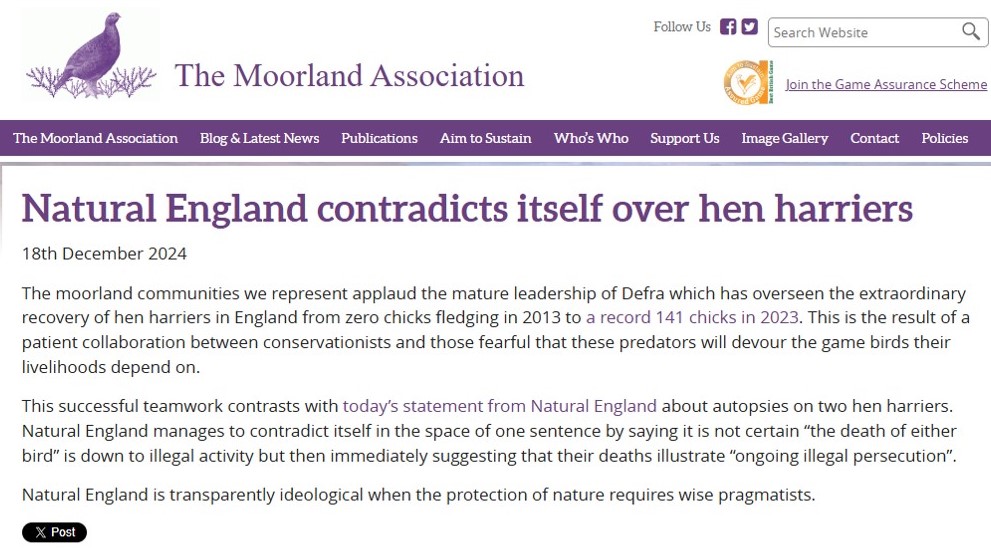
The Moorland Association (the grouse owners’ lobby group) has responded to Natural England’s blog with yet another blatant and shameful attempt at misrepresentation:
In the Moorland Association’s second paragraph, where it purports to quote from the Natural England blog, the Moorland Association blog author has not only removed the context of the post mortem reports, but has also removed several of Natural England’s words, resulting in an entirely distorted (and thus false) ‘quote’.
Natural England wrote:
“The level of decomposition of the bodies led ZSL to conclude that it was not possible to explicitly link the death of either bird to the [shotgun] pellets”.
The Moorland Association wrote:
“This successful teamwork contrasts with today’s infantile press statement from Natural England which manages to contradict itself by saying “it is not possible to link the death of either bird” with illegal activity while also saying that their deaths “serve of evidence of ongoing killing”“.
The Moorland Association has removed the word “explicitly”, removed any reference to shotgun pellets, and then completely fabricated another ‘quote’ from Natural England (“serve of evidence of ongoing killing”).
The Moorland Association blog author is not identified but this level of distortion and misrepresentation has all the hallmarks of Andrew Gilruth, the Moorland Association’s current CEO, who has somewhat of a track record for this kind of shoddy behaviour.
Interestingly, the Moorland Association published its response prior to the Natural England blog being published, presumably after having sight of what Natural England was about to publish.
The Moorland Association has since revised its statement, once Natural England’s blog went live. Here’s how it currently looks:
Even if Andrew Gilruth didn’t write this snidey guff, you’d think as CEO he’d be responsbible for overseeing/approving whatever appears on the Moorland Association’s website.
For how much longer will he remain in post, I wonder? The Moorland Association’s reputation is already in tatters after Gilruth was expelled from the Raptor Persecution Priority Delivery Group (RPPDG) earlier this year after the police accused him of “wasting time and distracting from the real work” of the Hen Harrier Taskforce (see here).
Natural England is currently undertaking a formal review of its ludicrous hen harrier brood meddling sham, with its findings due by the end of this month. Those findings will influence DEFRA’s decision on whether the sham is allowed to continue.
The Moorland Association has already stated it wants brood meddling licences to be issued as a routine part of grouse moor management.
With at least 130 killed/’missing’ hen harriers since the brood meddling sham trial began in 2018, and the Moorland Association’s continual denial and misrepresentation of the bleedin’ obvious, we’ll all be very interested in Natural England’s findings.
Meanwhile, for those who can no longer stomach what’s happening to hen harriers on grouse moors across the country, Wild Justice has another petition calling for a ban on driven grouse shooting. Please sign it HERE.
UPDATE 5th March 2025: Natural England quietly releases intriguing grouse moor location where two shot brood meddled hen harriers found dead (here)
Over the last 17 years or so, satellite-tracking technology has revolutionised our understanding of not only hen harrier ecology, but also the persistent, illegal killing of these birds on driven grouse moors across the UK.
Two organisations have been at the forefront of hen harrier satellite tracking – Natural England and the RSPB (with significant help from raptor study groups and others).
Satellite-tagged hen harrier. Photo by RSPB
For several years now, Natural England has been intermittently publishing the fates of the hen harriers it’s team has tagged (see here), but only with vague explanations about its definition of the category, ‘Missing, Fate Unknown’ (e.g. see here).
Of course, since then, a significant academic paper published in 2019 demonstrated what we all already knew – that patterns of satellite-tagged hen harrier disappearances suggested widespread illegal killing on British grouse moors (see here).
A further paper, published in 2023 and this time analysing the fates of hen harriers tagged by the RSPB, reached the same conclusion (see here).
Since 2018, I have been publishing details about the confirmed/suspected deaths of satellite-tagged (and a few untagged) hen harriers using data from both Natural England and the RSPB (this list currently stands at 130 illegally killed/’missing’ hen harriers although there are still more to add; those data are currently being withheld from the public – see here).
Now, for the first time, the RSPB has launched an interactive map hub showing the fates of hen harriers its team has satellite-tagged since 2014 (currently up to October 2024).
The RSPB’s interactive database includes the fates of 178 of the 226 hen harriers satellite-tagged so far. Some dead hen harriers are not included as they are subject to ongoing police investigations. The hen harriers that are still alive and are currently being tracked are also not included, for what should be obvious reasons.
Screen grab of the RSPB’s new interactive HH map hub
The interactive map hub allows users to filter the ‘fates’ of the RSPB’s tagged hen harriers into five different categories:
Confirmed Illegal persecution
Stop no malfunction (where the bird has disappeared in suspicious circumstances)
Natural
Unknown
Tag failure/expired
Detailed explanations of each of these categories are provided on the hub.
Users are also able to zoom in to the map to show the general area where a harrier died and you can manipulate the map to show terrain etc.
This facility is a useful and welcome addition to the public record on the fates of individual satellite-tracked hen harriers in the UK. I’m not sure it provides us with any wider, big-picture information that we don’t already know but that’s probably not the intention behind this interactive hub anyway. What it does do is provide the public with a level of detail to help them understand the scale of satellite-tagging efforts on the UK’s hen harriers and thus the veracity of the extent of the ongoing illegal killing of this species on many driven grouse moors.
South Yorkshire Police have issued the following press release (dated 9 December 2024):
WITNESS APPEAL AFTER BIRD SHOT IN PEAK DISTRICT
We are appealing for information after a protected bird was reportedly shot in Bradfield, near Sheffield.
On 25 August, a dead raven was found in a field near Agden Side Road, Bradfield, in the Peak District.
The incident was reported to the RSPB who collected the bird. An x-ray of the bird showed that it had been shot.
It is believed the bird was shot between 24 August and 25 August.
Since the incident, officers have been following several lines of enquiry and we are now appealing for anybody who may have any information about the incident to contact us.
You can report information to us online via live chat or by calling 101, quoting incident number 662 of 9 September 2024.
The Agden Side Road lies just beyond the boundary of two grouse moors (Strines and Broomhead) in the Peak District National Park.
This part of the Peak District National Park, dominated by land managed for driven grouse shooting, has a long and sordid history of raptor persecution incidents (e.g. see here, here, here, here, here etc).
Prosecutions are rare, largely due to the difficulty of identifying a named individual to link to a crime that has taken place in a relatively remote landscape with few witnesses.
This is certainly not helped by South Yorkshire Police, who rarely cover themselves in glory with timely investigations, although to be fair unless the shooting of this raven was witnessed and recorded, the police have little to go on.
Yes, the usual suspects will be in the frame but for a prosecution the police need evidence – they can’t just prosecute on the basis of recurrent past criminal behaviour in the area. Although waiting three and a half months to issue an appeal for witnesses, as they’ve done in this case, won’t help.
This scenario happens over and over again in areas managed for driven grouse shooting, even inside our National Parks, and has been happening for decades. Raptors are routinely shot, trapped and poisoned and the criminals get away with their crimes time after time after time.
This is one (of several) reasons why Wild Justice is currently running a petition calling for a ban on driven grouse shooting. The petition currently stands at 30,000 signatures but it needs 100,000 to trigger a parliamentary debate. If you’d like to sign it, please click HERE.
UPDATE 9 June 2025: Another Raven found shot dead next to grouse moor in notorious persecution hotspot in Peak District National Park (here)
The young Golden Eagle, fitted with a satellite-tag, was being monitored by researchers in Scotland until it suddenly disappeared in the Angus Glens – an area dominated by grouse moors and with a history of raptor persecution.
Scotland’s national bird, Golden Eagles are still heavily – and criminally – persecuted.
The sudden disappearance of a satellite-tagged Golden Eagle has sparked concerns of criminal activity in the Angus Glens.
The young bird, which hatched in Tayside in 2022, was fitted with a satellite tag while in its nest. This work was supported by Forestry and Land Scotland for research purposes.
The tag was transmitting as expected until May 2024 when it suddenly went offline. Its last known location was an area of moorland in the Angus Glens – an area with a long history of illegal bird of prey persecution.
The data from the bird’s tag was swiftly provided to the police for independent scrutiny. Police Scotland, the National Wildlife Crime Unit and RSPB Scotland then conducted a search of the area but found no trace of the bird or its tag.
It is a crime to kill a bird of prey, and anyone caught doing so faces a fine or even jail. Furthermore, legislation introduced in March 2024 means that, if illegal activity takes place on a grouse moor, that grouse moor could lose its license to operate.
Will Hayward, RSPB Scotland Senior Investigations Officer, said: “The sudden cessation of transmissions from this tag strongly suggests human interference, and reflects a pattern of tagged birds ‘disappearing’ almost exclusively on or near grouse moors that has become all too evident in recent years. Had this bird died of natural causes or if the tag had become detached, we would be able to locate and retrieve it. Given the well-proven reliability of this technology, when no body or tag is found, this is highly suspicious. We believe this bird has been killed and the tag destroyed.”
Unfortunately, this young bird is the latest of many to disappear without explanation on or near a grouse moor.
Angus was one of the raptor crime hotspots identified in a Government-commissioned report on the fates of satellite tracked golden eagles in Scotland, published in 2017. Sadly there has been no let-up in confirmed incidents and suspicious disappearances since then. Most recently, an Osprey was found shot in the Glen Doll area on 12 August – the opening day of the grouse shooting season. [Ed: And a Peregrine was found shot in the Angus Glens on 3 September 2024, here]. And earlier this year sat-tagged Hen Harrier ‘Shalimar’ disappeared in circumstances similar to this Golden Eagle.
If you notice a dead or injured bird of prey in suspicious circumstances, call Police Scotland on 101 and fill in the RSPB’s online reporting form here.
If you have information about anyone killing birds of prey which you wish to report anonymously, call the RSPB’s confidential Raptor Crime Hotline on 0300 999 0101.
Six months on from the introduction of new legislation intended to tackle raptor persecution, wildlife campaigners have expressed concern about the continued shooting of protected birds of prey near Scotland’s grouse moors.
The League Against Cruel Sports and Raptor Persecution UK have both commented on the shooting of a protected buzzard found near to the boundary of land belonging to Glenturret Estate in Perthshire in mid-May, just a few weeks after the Wildlife Management and Muirburn Act 2024 received Royal assent.
The comments came after police notified the League Against Cruel Sports that they had concluded investigations into the shooting of the buzzard with no charges being brought.
The dead bird was found on its back with its wings spread out by a Field Officer of the League Against Cruel Sports, who was carrying out field research on grouse moor management in the area.
A post-mortem conducted by the SRCU revealed that the buzzard had been injured by a ‘shot gun wound that caused fracture of the lower leg bone’, concluding that ‘the bird died slowly as a result of the leg wound and secondary infection, experiencing significant unnecessary suffering.’
Robbie Marsland Director of Scotland and Northern Ireland for League Against Cruel Sports said:
“Why would anyone shoot at a buzzard – unless it was someone who was trying to make sure there would be more grouse to shoot for so-called sport?
“The new laws were supposed to stop this kind of wanton cruelty but this case just goes to show that the killing goes on. Our worry is that this cruelty will continue as long as buzzards, hen harriers and golden eagles are seen as a threat to the shooting industry, rather than the magnificent creatures that they are.”
Dr Ruth Tingay of Raptor Persecution UK added:
“It was the persistent illegal killing of golden eagles and other raptors that led the Scottish Parliament to introduce a grouse moor licensing scheme earlier this year, a ground-breaking piece of legislation designed to impose sanctions on those who continue to kill our special birds of prey.
“The news that yet another raptor has been shot and killed is appalling. This case, along with other ongoing police investigations such as the recent shooting of an osprey and a peregrine, as well as the poisoning of a red kite and the discovery of a dismembered golden eagle found dumped inside a plastic bag, will test the effectiveness of the new legislation.
“If the killings continue, it’s likely there will be a push to ban gamebird shooting outright. If businesses can’t operate without killing protected species then they shouldn’t be in business.”
The Wildlife Management and Muirburn Act introduced a range of measures including a new licensing framework for grouse moors, banning the practice of snaring and giving greater powers to Scottish SPCA inspectors to tackle wildlife crime.
In a background briefing note about the new legislation, the Scottish Government stated, ‘The Wildlife Management and Muirburn (Scotland) Bill was introduced primarily to address raptor persecution and ensure that the management of grouse moors and related activities are undertaken in an environmentally sustainable and welfare conscious manner.’
The need for land reform to help tackle wildlife crime will be one of the discussion points at the REVIVE Conference in Perth on Sunday 10 November. REVIVE is a coalition of the League Against Cruel Sports, Common Weal, OneKind, Friends of the Earth Scotland and Raptor Persecution UK, and both Robbie Marsland and Dr Ruth Tingay will speak at the event.
The conference will launch the Big Land Question campaign, a year-long programme of independent research with the aim of enhancing and informing policy development and to ascertain public perceptions around land reform.
ENDS
This news was published by the Daily Record this morning (here).
Strathbraan is a large area dominated by grouse moors and is a notorious raptor persecution hotspot.






 Raptor Persecution UK