Regular blog readers will know that the Scottish Parliament voted through a complete ban on the use of all snares (and so-called ‘humane cable restraints’) as part of the Wildlife Management & Muirburn Scotland Act 2024 earlier this year (here).
It was announced in September that the ban will commence with immediate effect on 25 November 2024.
However, last month I blogged (here) about how the game shooting industry a appeared to be attempting to disrupt the commencement of the ban.
A consortium of the usual suspects (Scottish Land & Estates, Scottish Gamekeepers Association, Scottish Countryside Alliance, BASC Scotland, Scotland’s Regional Moorland Groups and the Scottish Association for Country Sports), joined by the National Farmers Union of Scotland, had written an overly-dramatic letter to the Convenor of the Scottish Parliament’s Rural Affairs & Islands Committee to complain about the commencement of the ban.
They suggested that the principles behind the snare ban had ‘not been afforded the customary levels of parliamentary scrutiny’ (even though this subject has been a topic of political debate and public consultation for at least 15 years!), and they complained that Ministers hadn’t conducted a Business & Regulatory Impact Assessment (BRIA) prior to the commencement of the snare ban, and they strongly suggested that this should afford a delay to the commencement of the ban.
Imagine arguing that your business can’t function without the ability to asphyxiate wildlife with a wire noose.
The Convenor of the Rural Affairs & Islands Committee, Finlay Carson MSP, wrote to the Minister to ask for some clarification, in advance of the Committee’s consideration of the legislation behind the commencement of the ban.
Agriculture Minister Jim Fairlie has now responded to Mr Carson, with a ‘nothing to see here’ letter:
The Rural Affairs and Islands Committee will consider this issue at its next meeting on Wednesday (6th November), starting at 9am. You can watch live on Scottish Parliament TV (here) and I’ll publish the transcript when it becomes available.
So far, there hasn’t been a recommendation for an annulment of the ban’s starting date of 25th November 2024 but this Committee has the power to make such a recommendation if it chooses.
I realise this is all quite turgid legalese but the consequences could result in a delay to the commencement date, which would mean that the use of snares would still be lawful after 25th November 2024 instead of being banned.
Definitely one to watch.
UPDATE 25th November 2024: A landmark day in Scotland as snare ban commences (here)
The RSPB has produced a podcast interview with Ian Thomson, Head of Investigations at RSPB Scotland.
Ian has worked in the Investigations team for 18 years and has played a crucial role in not just gathering the evidence of ongoing raptor persecution in Scotland, but perhaps more importantly, he has been highly influential in persuading the law makers that a change of policy was needed to tackle these crimes.
Needless to say, his effectiveness has resulted in him receiving years of defamatory and offensive abuse, on pretty much a weekly basis, from those in the game-shooting industry seeking to undermine his reputation and credibility. They’ve roundly failed – Ian’s opinion is held in high regard by conservationists, politicians, civil servants and journalists alike.
In this podcast Ian discusses the charity’s latest Birdcrime report and he also provides a good overview of the new legislation passed by the Scottish Parliament that is intended to deal with raptor persecution on grouse moors. He also talks about the importance of enforcing the new regulations for the legislation to be effective and for it to do what the Parliament intended when it passed the Bill last spring.
Regular blog readers will know that the Scottish Parliament voted through a complete ban on the use of all snares (and so-called ‘humane cable restraints’) as part of the Wildlife Management & Muirburn Scotland Act 2024 earlier this year (here).
It was recently announced that the ban will commence with immediate effect on 25 November 2024.
Those who have followed the long campaign to bring regulation to the grouse shooting industry’s activities will also be well aware of that industry’s outright hostility to even the concept of a potential grouse moor licensing regime, dating back many years (e.g. here, here, here and here).
The amateur dramatics continued in 2020 (here) when the Scottish Government finally announced its response to the Werritty Review and told the world that grouse moor licensing would definitely be introduced, largely down to the continued illegal persecution of raptors on many driven grouse moors.
The subsequent hysterical scaremongering from the industry included declarations that grouse moor licensing would ‘threaten’ and ‘damage’ the rural economy; an oft-used but wholly unsubstantiated claim by this lot, e.g. on land reform, see here; on the removal of an exemption on business rates, here; and on the introduction of vicarious liability to tackle raptor persecution crimes, here.
Has the rural economy fallen flat on its arse as a result of these measures? Not according to the grouse shooting industry, which is still declaring itself indispensable to the Scottish economy (a claim strongly contested by others, e.g. see here).
It’s no surprise then to see the industry wheel out the so-called ‘negative financial effect’ claim once again, this time on the eve of the snare ban commencement.
A consortium of the usual suspects (Scottish Land & Estates, Scottish Gamekeepers Association, Scottish Countryside Alliance, BASC Scotland, Scotland’s Regional Moorland Groups and the Scottish Association for Country Sports), joined this time by the National Farmers Union of Scotland, has written an overly-dramatic letter to the Convenor of the Scottish Parliament’s Rural Affairs & Islands Committee to complain about the commencement of the ban.
I’m not sure what they’re on about in paragraph 2, suggesting that the principles behind the snare ban “were not afforded the customary levels of parliamentary scrutiny, which is extremely regrettable“. Eh?
Actually, the subject of snares has been debated repeatedly in the Scottish Parliament over many, many years (at least 15 yrs). It has also been the subject of public consultations, and there was a full parliamentary evidence session at Stage 1 of the Bill to which several of these organisations contributed (here). Christ, the grouse shooting industry was even given extra time to submit more evidence, as a gracious gesture by the then Environment Minister, Gillian Martin, so all this portrayal of themselves being victims of procedural unfairness is hilarious.
Their letter reveals their latest ploy to disrupt the will of Parliament – to complain that Ministers haven’t conducted a Business & Regulatory Impact Assessment prior to the commencement of the snare ban, and they strongly suggest that this should afford a delay to the commencement of the snare ban.
I’m sure that in a strictly technical sense, they may have a point, although my understanding of BRIAs is that they are not compulsory and should be proportionate to the new regulation being proposed, but the absurdity of this latest complaint is hard to ignore.
The snare ban doesn’t prevent gamekeepers from continuing to kill foxes. And the foxes they are killing (e.g. 200 per year on one estate whose gamekeeper gave evidence to the Bill committee) are probably at such high densities thanks in large part to the availability of unnaturally-high levels of gamebirds that create an over-abundance of prey that will attract foxes to the estate. Its a problem of the industry’s own making.
To suggest that an estate might face financial ruin if gamekeepers can only shoot foxes in the face rather than asphyxiate them with a wire noose reveals an awful lot about the mindset of these so-called ‘guardians of the countryside’.
Imagine arguing against a ban on a device that causes so much unnecessary suffering to any poor animal unfortunate enough to be caught in it, let alone suggesting that your business can’t function without being able to inflict such cruelty. If that’s the case, they shouldn’t be in business at all.
The Convenor of the Rural Affairs Committee, Finlay Carson MSP (who, along with his fellow Conservatives voted against the Wildlife Management Act) has responded to the letter of complaint by writing his own letter, on behalf of the Committee, to Minister Jim Fairlie (gosh, it’s almost as if this was all pre-planned). Here’s the Convenor’s letter to the Minister:
A full ban on the use of snares was passed by the Scottish Parliament in March 2024 as part of the Wildlife Management & Muirburn (Scotland) Act (here), although it wasn’t clear when the snare ban would actually begin.
This was a significant victory for animal welfare campaigners, especially the League Against Cruel Sports and OneKind, but also many others, who have spent decades putting forward evidence that these devices, cynically named ‘humane cable restraints’ by the game-shooting industry, are cruel, indiscriminate and inhumane and have no place in modern society.
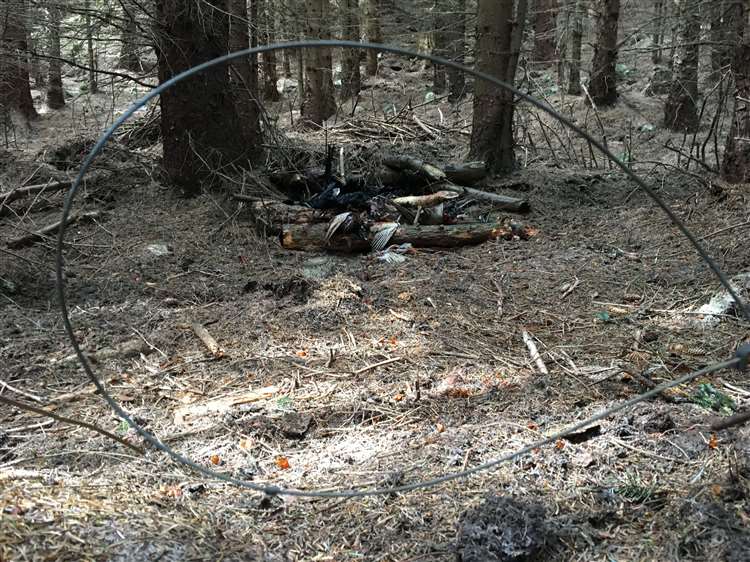
A snare placed close to a ‘stink pit’ (a heap of rotting animals) designed to attract predators such as foxes. Photo: OneKind
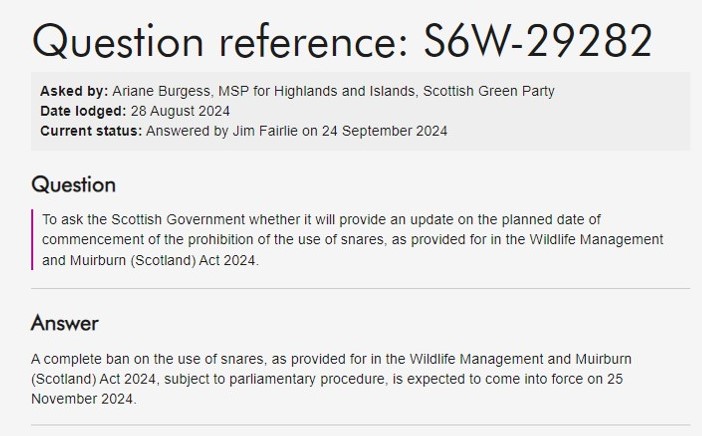
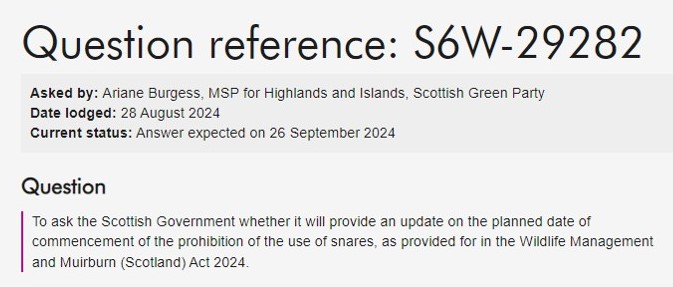
Earlier this month, Green MSP Ariane Burgess lodged a parliamentary question asking the Scottish Government for clarity on the commencement date of the snare ban (see here).
Yesterday, Agriculture Minister Jim Fairlie MSP provided a response and has stated that the snare ban is expected to come into force on 25 November 2024:
It appears from Jim Fairlie’s words that the ban will be immediate, with no ‘phasing-out’ period.
This is excellent news. Well done to everyone involved in this landmark legislation. That’s Wales and Scotland….England next?
Last week 51-year old Dylan Boyle was found guilty at Kirkaldy Sheriff Court in connection with the digging and blocking of an active badger sett during an outing with the Fife Fox Hunt in January 2023 (see Police Scotland press statement here, where the police describe Boyle’s actions as “reckless and deplorable“).
This is an interesting case, not just because Boyle is reportedly an ex-gamekeeper but because part of his (unsuccessful) defence was apparently based upon testimony from an expert witness who just happens to be the ‘chief’ of the Scottish Gamekeepers Association’s (SGA) ‘training centre’.
Why is that important? Well, because the SGA is positioning itself to provide the mandatory training courses as required by those operating grouse moor licences under the new Wildlife Management & Muirburn (Scotland) Act 2024.
I’ll come back to that. First, here’s some more important background information about the case, as provided in a press release by the League Against Cruel Sports (Scotland) –
Man found guilty on two charges for wildlife crimes
Charge 1, digging a badger sett. Contrary to the Protection of Badgers Act 1992.
Charge 2, blocking a badger sett. Contrary to the Protection of Badgers Act 1992.
A former terrier man with the Berwickshire and Fife Fox Hunts, Dylan Boyle, has been found guilty on two charges related to the destruction of a badger sett, by digging into an active badger sett and deliberately blocking entrances to the sett with rocks, nets and earth using a spade. The conviction was supported by covert film evidence captured by the animal charity, League Against Cruel Sports.
Dylan Boyle, aged 52, a transport officer who lives in Avonbridge, pled not guilty at a three-day trial which concluded on Friday 13th September 2024 at Kirkcaldy Sheriff Court.
Sentencing was deferred until the 13th of March 2025, but potential penalties for interfering with a badger sett include a maximum of 12 months imprisonment and / or a £40,000 fine.
The incident, which took place in January 2023 near Cupar, was witnessed and filmed by a Field Research and Investigations Officer for the League Against Cruel Sports who was monitoring the activities of the Fife Fox Hunt, which the terrier man was operating alongside at the time.
During the three-day trial the court was shown video footage of Boyle digging a badger sett. The League Against Cruel Sports investigator also gave verbal evidence relating to the blocking of the badger sett entrances.
On the second day of the trial three other charges were dropped. Two of these related to the treatment of a fox, in which it had been alleged Boyle had pulled a fox out from underground, shot it twice and encouraged his dog to attack and bite at the fox.
Screen grab from video footage of Boyle taking photos whilst a dog savages a fox that Boyle had dug out from a badger sett
The third charge to be dropped was the entering of a dog into an active badger sett, a serious offence concerning the welfare of the protected badgers as well as the dog. According to the Sheriff, the evidence that was presented in court by the Fiscal Prosecutions Officer was not sufficient to bring about a conviction on this occasion. During the final day’s trial, Boyle admitted entering his dog underground.
Sheriff Mark Alan found Boyle guilty on the charges of digging a badger sett and blocking a badger sett, both contrary to the Protection of Badgers Act 1992.
The Sheriff, in summing up, commented that he was very satisfied with the evidence given by the experts from the League Against Cruel Sports, stating that he was “satisfied that Boyle knowingly dug and blocked an active badger sett with disregard to the welfare of the badgers”.
The Sheriff also stated that if Boyle is caught committing further crimes between now and his sentencing in March 2025, then he could be facing jail time.
Robbie Marsland, Director of Scotland and Northern Ireland for League Against Cruel Sports, welcomed the guilty verdict and said:
“I’m very pleased that the League Against Cruel Sports’ vigilant fieldworkers were able to provide Police Scotland with video evidence that led to this successful conviction.
“Crimes against wildlife are all too common in Scotland and I hope this case will serve to remind people like Mr Boyle that our cameras can be anywhere.”
ENDS
The League Against Cruel Sports has published its video footage of the crime scene which provides an insight of Boyle’s offences:
As mentioned above, it’s reported that the defence called Alan Tweedie as an expert witness to defend Boyle’s actions. Alan Tweedie is the SGA’s Training Centre ‘chief’ (here).
According to a member of the public who attended the trial, Tweedie told the court he was an ex-gamekeeper and is now self-employed and works for the SGA providing training courses for gamekeepers.
Tweedie was asked whether he had seen the video evidence, and he told the court that he had. He was asked whether he’d seen anything in the video footage that he thought was wrong and Tweedie reportedly told the court that he saw nothing wrong in Boyle’s actions.
Given Boyle’s subsequent convictions, based on the League’s video evidence, it’s of significant concern that Alan Tweedie didn’t spot the wildlife crime offences described by Police Scotland as “reckless and deplorable”.
If this is the view of the SGA’s ‘training centre chief’ what confidence can be placed in the SGA’s ability to provide suitable training that would meet the requirements of the Wildlife Management & Muirburn (Scotland) Act 2024?
I should say here that I’m far as I’m aware, it hasn’t yet been decided who will provide the training requirements brought in under the new legislation. I understand that NatureScot has been consulting with a number of organisations (including animal welfare and conservation groups) about its proposed plans but that these discussions have so far mostly focused on the training content rather than who will deliver it. Although if you look on the SGA’s website, the SGA is quite clearly positioning itself to deliver the training elements associated with corvid and spring trap use (see here).
One to watch.
UPDATE 17.00hrs: There’s more commentary on the trial written by Jamie McKenzie in an article posted on 18 September in The Courier, although it sits behind a paywall. Here are the interesting bits:
Former gamekeeper Dylan Boyle, 51, was filmed by investigators from the League Against Cruel Sports (LACS) at a farm at Letham, near Cupar, on January 10 last year.
During a trial at Kirkcaldy Sheriff Court he had denied two charges of interfering with a badger sett by digging and damaging it and obstructing access by blocking an entrance with rocks.
Boyle, of Avonbridge near Falkirk, told the trial he had been there with a terrier dog to control foxes that day.
He insisted it was not an active badger sett and he only saw fox holes.
The trial heard an ecologist and police officer went to the site the next day and found tell-tale signs of an active badger sett, as had an LACS investigator on the day of the offence.
The court heard key indicators included D-shaped entrance holes – fox holes are more oval-shaped – and badger hair, scratch marks, bedding material and latrines.
Prosecutor Gerard Drugan put to Boyle he was suggesting experts were wrong about the presence of badger holes, to which the accused replied: “That could have happened the night before – they (experts) were there the following day.”
Mr Drugan said: “Your position is that somehow, overnight, badgers moved into the locus and reshaped the holes?”
Boyle replied: “Yes.”
The fiscal depute said: “But (the LACS investigator) saw they were badger holes?”
Boyle, who said he had studied gamekeeping and wildlife management at college, said: “He could be wrong.”
The fiscal said: “People who have spent a long time being involved with badgers are wrong?
“(The LACS investigator) was wrong,” Boyle responded.
Sheriff Mark Allan said he was satisfied it was an active badger sett on the key date and found Boyle guilty of two charges in contravention of the Protection of Badgers Act 1992.
The sheriff told Boyle: “I am satisfied you both dug the badger sett and obstructed the sett and did so with reckless disregard as to the consequences of your actions.”
Making reference to Boyle’s own background, education and knowledge, the sheriff said: “You should take care, you should not show reckless disregard for what it was you were doing on that particular occasion.
“You require to be careful and ensure what you are not doing is interfering with a badger sett.”
Sentence was deferred for six months, until March 13, for Boyle to be of good behaviour.
ENDS
UPDATE 18 March 2025: Former Scottish gamekeeper receives pathetic sentence for digging Badger sett (here)
For anyone who still wants to pretend that the grouse shooting industry isn’t responsible for the systematic extermination of hen harriers on grouse moors across the UK, here’s the latest catalogue of crime that suggests otherwise.
[This male hen harrier died in 2019 after his leg was almost severed in an illegally set trap that had been placed next to his nest on a Scottish grouse moor (see here). Photo by Ruth Tingay]
This is the blog I now publish after every reported killing or suspicious disappearance.
“They disappear in the same way political dissidents in authoritarian dictatorships have disappeared” (Stephen Barlow, 22 January 2021).
Today the list has been updated to include the most recently reported victims, comprising five of eight reported incidents on Natural England’s latest sat tag update (August 2024) and that I blogged about here a couple of days ago. Three of the hen harriers have, like so many others, ‘disappeared’ without trace and two others have been found dead and are, according to an FoI response I received from Natural England in June, the subject of police investigations. The three of the eight that I’m not including on the list yet have all been found dead but Natural England has not yet reported on the post mortem results nor stated whether they are under police investigation so it’s not yet clear whether they are the victims of illegal persecution.
I’ve been compiling this list only since 2018 because that is the year that the grouse shooting industry ‘leaders’ would have us believe that the criminal persecution of hen harriers had stopped and that these birds were being welcomed back on to the UK’s grouse moors (see here).
This assertion was made shortly before the publication of a devastating new scientific paper that demonstrated that 72% of satellite-tagged hen harriers were confirmed or considered likely to have been illegally killed, and this was ten times more likely to occur over areas of land managed for grouse shooting relative to other land uses (see here). A further scientific paper published in 2023 by scientists at the RSPB, utilising even more recent data, echoed these results – see here).
2018 was also the year that Natural England issued a licence to begin a hen harrier brood meddling trial on grouse moors in northern England. For new blog readers, hen harrier brood meddling is a conservation sham sanctioned by DEFRA as part of its ludicrous ‘Hen Harrier Action Plan‘ and carried out by Natural England (NE), in cahoots with the very industry responsible for the species’ catastrophic decline in England. For more background see here and for a critical evaluation of the trial after 5 years see this report by Wild Justice. This year the brood meddling trial appears to have collapsed for reasons which are not yet clear (see here).
Brood meddling has been described as a sort of ‘gentleman’s agreement’ by commentator Stephen Welch:
“I don’t get it, I thought the idea of that scheme was some kind of trade off – a gentleman’s agreement that the birds would be left in peace if they were moved from grouse moors at a certain density. It seems that one party is not keeping their side of the bargain“.
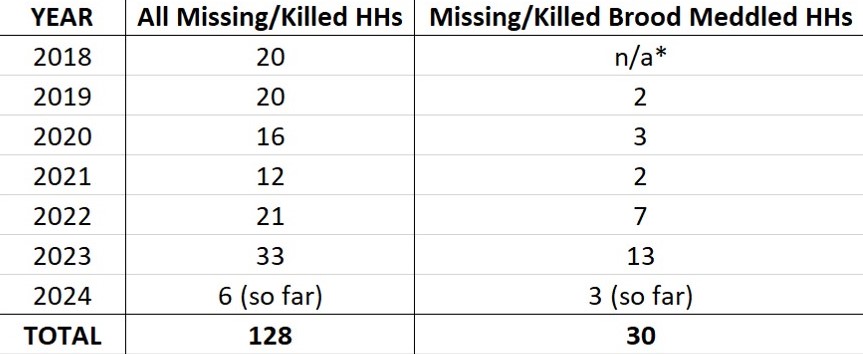
With at least 128 hen harriers gone since 2018, and 30 of those being brood meddled birds, there is no question that the grouse shooting industry is simply taking the piss. Meanwhile, Natural England pretends that ‘partnership working’ is the way to go and DEFRA Ministers remain silent.
*n/a – no hen harriers were brood meddled in 2018
‘Partnership working’ according to Natural England appears to include authorising the removal of hen harrier chicks from a grouse moor already under investigation by the police for suspected raptor persecution (here) and accepting a £75k ‘donation’ from representatives of the grouse shooting industry that prevents Natural England from criticising them or the sham brood meddling trial (see here). This is in addition to a £10k ‘donation’ that Natural England accepted, under the same terms, in 2021 (here).
Thankfully, the Scottish Government has finally decided to act by introducing a grouse moor licensing scheme under the Wildlife Management & Muirburn (Scotland) Act 2024. The intention behind this new legislation is that grouse shooting estates could have their licences suspended/revoked if, on the balance of probability, it is shown that any raptor persecution crimes (& some other associated offences) are linked with grouse moor management on that estate.
So here’s the latest gruesome list of ‘missing’/illegally killed hen harriers since 2018. Note that the majority of these birds (but not all) were fitted with satellite tags. How many more [untagged] harriers have been killed?
February 2018: Hen harrier Saorsa ‘disappeared’ in the Angus Glens in Scotland (here). The Scottish Gamekeepers Association later published wholly inaccurate information claiming the bird had been re-sighted. The RSPB dismissed this as “completely false” (here).
5 February 2018: Hen harrier Marc ‘disappeared’ on a grouse moor in Durham (here).
9 February 2018: Hen harrier Aalin ‘disappeared’ on a grouse moor in Wales (here).
March 2018: Hen harrier Blue ‘disappeared’ in the Lake District National Park (here).
March 2018: Hen harrier Finn ‘disappeared’ near Moffat in Scotland (here).
18 April 2018: Hen harrier Lia ‘disappeared’ in Wales and her corpse was retrieved in a field in May 2018. Cause of death was unconfirmed but police treating death as suspicious (here).
8 August 2018: Hen harrier Hilma ‘disappeared’ on a grouse moor in Northumberland (here).
16 August 2018: Hen harrier Athena ‘disappeared’ on a grouse moor in Scotland (here).
26 August 2018: Hen Harrier Octavia ‘disappeared’ on a grouse moor in the Peak District National Park (here).
29 August 2018: Hen harrier Margot ‘disappeared’ on a grouse moor in Scotland (here).
29 August 2018: Hen Harrier Heulwen ‘disappeared’ on a grouse moor in Wales (here).
3 September 2018: Hen harrier Stelmaria ‘disappeared’ on a grouse moor in Scotland (here).
24 September 2018: Hen harrier Heather ‘disappeared’ on a grouse moor in Scotland (here).
2 October 2018: Hen harrier Mabel ‘disappeared’ on a grouse moor on the edge of the Yorkshire Dales National Park (here).
3 October 2018: Hen Harrier Thor ‘disappeared’ next to a grouse moor in Bowland, Lanacashire (here).
23 October 2018: Hen harrier Tom ‘disappeared’ in South Wales (here).
26 October 2018: Hen harrier Arthur ‘disappeared’ on a grouse moor in the North York Moors National Park (here).
1 November 2018: Hen harrier Barney ‘disappeared’ on Bodmin Moor (here).
10 November 2018: Hen harrier Rannoch ‘disappeared’ on a grouse moor in Scotland (here). Her corpse was found nearby in May 2019 – she’d been killed in an illegally-set spring trap (here).
14 November 2018: Hen harrier River ‘disappeared’ on a grouse moor in the Nidderdale AONB (here). Her corpse was found nearby in April 2019 – she’d been illegally shot (here).
16 January 2019: Hen harrier Vulcan ‘disappeared’ in Wiltshire close to Natural England’s proposed reintroduction site (here).
28 January 2019: Hen harrier DeeCee ‘disappeared’ in Glen Esk, a grouse moor area of the Angus Glens (see here).
7 February 2019: Hen harrier Skylar ‘disappeared’ next to a grouse moor in South Lanarkshire (here).
22 April 2019: Hen harrier Marci ‘disappeared’ on a grouse moor in the Cairngorms National Park (here).
26 April 2019: Hen harrier Rain ‘disappeared’ on a grouse moor in Nairnshire (here).
11 May 2019: An untagged male hen harrier was caught in an illegally-set trap next to his nest on a grouse moor in South Lanarkshire. He didn’t survive (here).
7 June 2019: An untagged hen harrier was found dead on a grouse moor in Scotland. A post mortem stated the bird had died as a result of ‘penetrating trauma’ injuries and that this bird had previously been shot (here).
5 September 2019: Wildland Hen Harrier 1 ‘disappeared’ on a grouse moor nr Dalnaspidal on the edge of the Cairngorms National Park (here).
11 September 2019: Hen harrier Romario ‘disappeared’ on a grouse moor in the Cairngorms National Park (here).
14 September 2019: Hen harrier (Brood meddled in 2019, #183704) ‘disappeared’ in the North Pennines (here).
23 September 2019: Hen harrier (Brood meddled in 2019, #55149) ‘disappeared’ in North Pennines (here).
24 September 2019: Wildland Hen Harrier 2 ‘disappeared’ on a grouse moor at Invercauld in the Cairngorms National Park (here).
24 September 2019: Hen harrier Bronwyn ‘disappeared’ near a grouse moor in North Wales (here).
10 October 2019: Hen harrier Ada ‘disappeared’ on a grouse moor in the North Pennines AONB (here).
12 October 2019: Hen harrier Thistle ‘disappeared’ on a grouse moor in Sutherland (here).
18 October 2019: Member of the public reports the witnessed shooting of an untagged male hen harrier on White Syke Hill in North Yorkshire (here).
November 2019: Hen harrier Mary found illegally poisoned on a pheasant shoot in Ireland (here).
November 2019: Hen harrier Artemis ‘disappeared’ near Long Formacus in south Scotland (RSPB pers comm).
14 December 2019: Hen harrier Oscar ‘disappeared’ in Eskdalemuir, south Scotland (here).
December 2019: Hen harrier Ingmar ‘disappeared’ in the Strathbraan grouse moor area of Perthshire (RSPB pers comm).
January 2020: Members of the public report the witnessed shooting of a male hen harrier on Threshfield Moor in the Yorkshire Dales National Park (here).
23 March 2020: Hen harrier Rosie ‘disappeared’ at an undisclosed roost site in Northumberland (here).
1 April 2020: Hen harrier (Brood meddled in 2019, #183703) ‘disappeared’ in unnamed location, tag intermittent (here).
5 April 2020: Hen harrier Hoolie ‘disappeared’ on a grouse moor in the Cairngorms National Park (here)
8 April 2020: Hen harrier Marlin ‘disappeared’ on a grouse moor in the Cairngorms National Park (here).
19 May 2020: Hen harrier Fingal ‘disappeared’ on a grouse moor in the Lowther Hills, Scotland (here).
21 May 2020: Hen harrier (Brood meddled in 2019, #183701) ‘disappeared’ on a grouse moor in Cumbria shortly after returning from wintering in France (here).
27 May 2020: Hen harrier Silver ‘disappeared’ on a grouse moor on Leadhills Estate, Scotland (here).
2020: day/month unknown: Unnamed male hen harrier breeding on RSPB Geltsdale Reserve, Cumbria ‘disappeared’ while away hunting (here).
9 July 2020: Unnamed female hen harrier (#201118) ‘disappeared’ from an undisclosed site in Northumberland (here).
25 July 2020: Hen harrier Harriet ‘disappeared’ on a grouse moor in the Yorkshire Dales National Park (here).
14 August 2020: Hen harrier Solo ‘disappeared’ in confidential nest area in Lancashire (here).
7 September 2020: Hen harrier Dryad ‘disappeared’ on a grouse moor in the Yorkshire Dales National Park (here).
16 September 2020: Hen harrier Fortune ‘disappeared’ from an undisclosed roost site in Northumberland (here).
19 September 2020: Hen harrier Harold ‘disappeared’ on a grouse moor in the Yorkshire Dales National Park (here).
20 September 2020: Hen harrier (Brood meddled in 2020, #55152) ‘disappeared’ next to a grouse moor in North Yorkshire (here).
24 February 2021: Hen harrier Tarras ‘disappeared’ next to a grouse moor in Northumberland (here)
12th April 2021: Hen harrier Yarrow ‘disappeared’ near Stockton, County Durham (here).
18 May 2021: Adult male hen harrier ‘disappeared’ from its breeding attempt on RSPB Geltsdale Reserve, Cumbria whilst away hunting (here).
18 May 2021: Another adult male hen harrier ‘disappeared’ from its breeding attempt on RSPB Geltsdale Reserve, Cumbria whilst away hunting (here).
24 July 2021: Hen harrier Asta ‘disappeared’ at a ‘confidential site’ in the North Pennines (here). We learned 18 months later that her wings had been ripped off so her tag could be fitted to a crow in an attempt to cover up her death (here).
14th August 2021: Hen harrier Josephine ‘disappeared’ at a ‘confidential site’ in Northumberland (here).
17 September 2021: Hen harrier Reiver ‘disappeared’ in a grouse moor dominated region of Northumberland (here)
24 September 2021: Hen harrier (Brood meddled in 2021, R2-F-1-21) ‘disappeared’ in Northumberland (here).
15 November 2021: Hen harrier (brood meddled in 2020, #R2-F1-20) ‘disappeared’ at the edge of a grouse moor on Arkengarthdale Estate in the Yorkshire Dales National Park (here).
19 November 2021: Hen harrier Val ‘disappeared’ in the Lake District National Park in Cumbria (here).
19 November 2021: Hen harrier Percy ‘disappeared’ in Lothian, Scotland (here).
12 December 2021: Hen harrier Jasmine ‘disappeared’ on a grouse moor (High Rigg Moor on the Middlesmoor Estate) in the Nidderdale AONB in North Yorkshire (here).
9 January 2022: Hen harrier Ethel ‘disappeared’ in Northumberland (here).
26 January 2022: Hen harrier Amelia ‘disappeared’ in Bowland (here).
10 February 2022: An unnamed satellite-tagged hen harrier ‘disappeared’ in a grouse moor dominated area of the Peak District National Park (here). One year later it was revealed that the satellite tag/harness of this young male called ‘Anu’ had been deliberately cut off (see here).
12 April 2022: Hen harrier ‘Free’ (Tag ID 201121) ‘disappeared’ at a ‘confidential site’ in Cumbria (here). It later emerged he hadn’t disappeared, but his mutilated corpse was found on moorland in the Yorkshire Dales National Park. A post mortem revealed the cause of death was having his head twisted and pulled off. One leg had also been torn off whilst he was still alive (here).
April 2022: Hen harrier ‘Pegasus’ (tagged by the RSPB) ‘disappeared’ on a grouse moor at Birkdale in the Yorkshire Dales National Park (here).
May 2022: A male breeding hen harrier ‘disappeared’ from a National Trust-owned grouse moor in the Peak District National Park (here).
May 2022: Another breeding male hen harrier ‘disappeared’ from a National Trust-owned grouse moor in the Peak District National Park (here).
14 May 2022: Hen harrier ‘Harvey’ (Tag ID 213844) ‘disappeared’ from a ‘confidential site’ in the North Pennines (here).
20 June 2022: Hen harrier chick #1 stamped to death in nest on a grouse moor in the Yorkshire Dales National Park (here).
20 June 2022: Hen harrier chick #2 stamped to death in nest on a grouse moor in the Yorkshire Dales National Park (here).
20 June 2022: Hen harrier chick #3 stamped to death in nest on a grouse moor in the Yorkshire Dales National Park (here).
20 June 2022: Hen harrier chick #4 stamped to death in nest on a grouse moor in the Yorkshire Dales National Park (here).
17 August 2022: Hen harrier (brood meddled in 2022, #R1-M1-22) ‘disappeared’ on moorland in the Yorkshire Dales National Park (here).
September 2022: Hen harrier ‘Sullis’ (tagged by the RSPB) ‘disappeared’ on a grouse moor in Cumbria (here).
5 October 2022: Hen harrier (brood meddled in 2022, #R3-M2-22) ‘disappeared’ on moorland in the Yorkshire Dales National Park (here).
10 October 2022: Hen harrier ‘Sia’ ‘disappeared’ near Hamsterley Forest in the North Pennines (here).
October 2022: Hen harrier (brood meddled in 2021, #R1-F1-21) ‘disappeared’ in the North Sea off the North York Moors National Park (here).
December 2022: Hen harrier female (brood meddled in 2020, #R2-F2-20) ‘disappeared’ on moorland in Cumbria (here).
1 December 2022: Hen harrier male (brood meddled in 2021, #R1-M1-21) ‘disappeared’ on moorland in the Yorkshire Dales National Park (here).
14 December 2022: Hen harrier female (brood meddled in 2022, #R3-F1-22) ‘disappeared’ on moorland in the North Pennines AONB (here).
15 December 2022: Hen harrier female (brood meddled in 2022, #R2-F1-22) ‘disappeared’ on moorland in the Yorkshire Dales National Park (here).
30 March 2023: Hen harrier female (brood meddled in 2022, #R1-F3-22) ‘disappeared’ in Yorkshire (here). Notes from NE Sept 2023 spreadsheet update: “Final transmission location temporarily withheld at police request“.
1 April 2023: Hen harrier male (brood meddled in 2022, #R2-M1-22) ‘disappeared’ in Yorkshire (here). Notes from NE Sept 2023 spreadsheet update: “Final transmission location temporarily withheld at police request“.
April 2023: Hen harrier ‘Lagertha’ (tagged by RSPB) ‘disappeared’ in North Yorkshire (here).
April 2023: Hen harrier ‘Nicola’ (Tag ID 234078) ”disappeared’ in North Yorkshire (here).
April 2023: Untagged male hen harrier ‘disappeared’ from an active nest on RSPB Geltsdale Reserve in Cumbria (here).
April 2023: Another untagged male hen harrier ‘disappeared’ from an active nest on RSPB Geltsdale Reserve in Cumbria (here).
April 2023: Untagged male hen harrier ‘disappeared’ from an active nest in Durham (here).
4/5 May 2023: Satellite-tagged male hen harrier called ‘Rush’ ‘disappeared’ from a grouse moor in Bowland AONB in Lancashire (here).
9/10 May 2023: Hen harrier male called ‘Dagda’, tagged by the RSPB in Lancashire in June 2022 and who was breeding on the RSPB’s Geltsdale Reserve in 2023 until he ‘vanished’, only to be found dead on the neighbouring Knarsdale grouse moor in May 2023 – a post mortem revealed he had been shot (here).
17 May 2023: Satellite-tagged hen harrier called ‘Wayland’ ‘disappeared’ in the Clapham area of North Yorkshire, just north of the Bowland AONB (here).
31 May 2023: Hen harrier male (brood meddled in 2022, tag #213932, name: R2-M3-22) ‘disappeared’ in Northumberland (grid ref: NY765687) (here).
11 June 2023: Hen harrier male (brood meddled in 2021, tag #213922, name: R2-M1-21) ‘disappeared’ at a confidential site in the Yorkshire Dales National Park. Notes from the NE spreadsheet: “Final transmission location temporarily withheld at police request“ (here).
12 June 2023: Hen harrier male (brood meddled in 2020, tag #203004, name: R1-M2-20) ‘disappeared’ on a grouse moor in Co. Durham (grid ref: NY976322) (here).
6 July 2023: Satellite-tagged female hen harrier named ‘Rubi’ (tag #201124a) ‘disappeared’ on a grouse moor in Co. Durham (grid ref: NY911151) (here).
23 July 2023: Hen harrier female (brood meddled in 2023, tag #55154a, name: R1-F1-23) ‘disappeared’ on a grouse moor in Co. Durham (close to where ‘Rubi’ vanished), grid ref: NY910126 (here).
29 July 2023: Hen harrier female (brood meddled in 2020, tag #55144, name: R2-F2-20) ‘disappeared’ at a confidential site in the North Pennines. Notes from the NE spreadsheet: “Dead. Recovered – awaiting PM results. Final transmission location temporarily withheld at police request“ (here).
9 August 2023: Satellite-tagged hen harrier called ‘Martha’ ‘disappeared’ on a grouse moor (Westburnhope Moor) near Hexham in the North Pennines (here).
11 August 2023: Satellite-tagged hen harrier called ‘Selena’ ‘disappeared’ on a grouse moor (Mossdale Moor) in the Yorkshire Dales National Park (here).
11 August 2023: Hen harrier female (brood meddled in 2023, tag #201118a, name: R3-F1-23) ‘disappeared’ in Co. Durham (grid ref: NZ072136) (here).
15 August 2023: Satellite-tagged hen harrier called ‘Hepit’ ‘disappeared’ on a grouse moor (Birkdale Common) near Kirkby Stephen in the Yorkshire Dales National Park (here).
24 August 2023: Hen harrier female (brood meddled in 2023, tag #55155a, name: R1-F2-23) ‘disappeared’ at a confidential site in Northumberland. Notes from the NE spreadsheet: “Final transmission location temporarily withheld at police request“ (here).
August-Sept 2023: Satellite-tagged hen harrier called ‘Harmonia’ ‘disappeared’ in the Yorkshire Dales National Park (here).
September 2023: Hen harrier female ‘Saranyu’, tagged by the RSPB in Cumbria in June 2023, ‘disappeared’ in Durham in September 2023 (no further details available yet – just outline info provided in 2022 Birdcrime report) (here).
September 2023: Hen harrier female ‘Inger’, a female tagged by the RSPB in Perthshire in July 2022, ‘disappeared’ on a grouse moor in the Angus Glens in September 2023 (here).
15 September 2023: Hen harrier male called ‘Rhys’, tagged in Cumbria on 1st August 2023, ‘disappeared’ on a grouse moor in the Yorkshire Dales National Park. Grid ref: SD798896 (here).
24 September 2023: Hen harrier female (brood meddled in 2023, name: ‘R2-F2-23’) ‘disappeared’ in the North Pennines, grid ref: NY888062 (here).
25 September 2023: Hen harrier female (brood meddled in 2022, name: ‘R1-F4-22’) ‘disappeared’ on a grouse moor in the Yorkshire Dales National Park, grid ref: SE077699 (here).
26 September 2023: Hen harrier female called ‘Hope’, tagged in Cumbria on 21 July 2023, ‘disappeared’ next to a grouse moor in the Yorkshire Dales National Park, grid ref: SD801926 (here).
4 October 2023: Hen harrier male (brood meddled in 2020, name: ‘R1-M3-20’) ‘disappeared’ in Co Durham, grid ref: NY935192 (here).
4 October 2023: Hen harrier female (brood meddled in 2023, name: ‘R4-F1-23’) ‘disappeared’ on a grouse moor in the Yorkshire Dales National Park, grid ref: SE003981 (here).
14 October 2023: Hen harrier male called ‘Cillian’, tagged in Cumbria on 1 August 2023, ‘disappeared’ in south west Scotland, grid ref: NY051946 (here).
15 November 2023: Hen harrier female called ‘Hazel’, tagged in Cumbria on 21 July 2023, ‘disappeared’ on the Isle of Man, grid ref: SC251803 (here).
27 November 2023: Hen harrier female called ‘Gill’, tagged in Northumberland on 10 July 2023, ‘disappeared’ at a confidential location in Teeside (here).
12 February 2024: Hen harrier female called ‘Susie’, Tag ID 201122, found dead at a confidential location in Northumberland and the subject of an ongoing police investigation (here).
15 February 2024: Hen harrier female called ‘Shalimar’, tagged on the National Trust for Scotland’s Mar Lodge estate in 2023, ‘disappeared’ in suspicious circumstances on a grouse moor in the notorious Angus Glens (here).
7 March 2024: Hen harrier male (brood meddled in 2023, name R2-M1-23) found dead in Devon. According to an FoI response from Natural England in June 2024 this death is the subject of an ongoing police investigation (here).
24 April 2024: Hen harrier male called ‘Ken’, Tag ID 213849a, ‘disappeared’ in suspicious circumstances close to a grouse moor in Bowland, grid ref SD 684601 (here).
17 May 2024: Hen harrier male (brood meddled in 2023, name R2-M2-23) ‘disappeared’ in suspicious circumstances next to Middlesmoor grouse moor in Nidderdale, grid ref SE043754 (here).
25 June 2024: Hen harrier female (brood meddled in 2023, name R2-F1-23) ‘disappeared’ in suspicious circumstances on a grouse moor in Yorkshire Dales National Park, grid ref NY985082 (here).
To be continued…….
Not one of these 128 incidents has resulted in an arrest, let alone a prosecution. I had thought that when we reached 30 dead/missing hen harriers then the authorities might pretend to be interested and at least say a few words about this national scandal. We’ve now reached ONE HUNDRED AND TWENTY EIGHT hen harriers, and still Govt ministers remain silent. They appear not to give a monkey’s. And yes, there are other things going on in the world, as always. That is not reason enough to ignore this blatant, brazen and systematic destruction of a supposedly protected species, being undertaken to satisfy the greed and bloodlust of a minority of society.
And let’s not forget the response from the (now former) Moorland Association Chair (and owner of Swinton Estate) Mark Cunliffe-Lister, who told BBC Radio 4 in August 2023 that, “Clearly any illegal [hen harrier] persecution is not happening” (here).
Nor should we forget the response from the Game and Wildlife Conservation Trust’s (GWCT) Director of Policy Dr Alistair Leake who wrote a letter to the Guardian newspaper in November 2023 stating that the hen harrier brood management [meddling] scheme “is surely a shining example of human / wildlife conflict resolution that would be the envy of other countries trying to find similar solutions“ (I kid you not – here).
It remains to be seen whether DEFRA Ministers under the new Labour Government will be prepared to tolerate such blatant criminality. Watch this space.
The following news item appeared in Peebleshire News on 21 June 2024 (thanks to the blog reader who sent this in):
A pensioner will stand trial at Selkirk Sheriff Court later this year charged with four wildlife offences.
Seventy-three year old Thomas Ebner, from Reston, is accused of causing a protected animal unnecessary suffering and setting in position a snare.
He is also charged with using a snare and failing to fit a tag, and also using a snare and not indicating what species it was intended to catch.
Ebner has pleaded not guilty to all four charges and a trial date was set for September 19th 2024.
ENDS
UPDATE 4 Sept 2024, from Border Telegraph:
A pensioner will stand trial next year on a charge of causing a fox unnecessary suffering. 74-year old Thomas Ebner, of Lakeside, Reston, denies setting the snare which caused the fox to be suspended by the neck on a broken fence line causing it to foam at the mouth and thrash about in an attempt to escape.
It allegedly happened at Old Castles Farm, Chirnside on April 25th 2023. He also pleaded not guilty to three other charges regarding the illegal use of a snare. A trial date has been set for 4 February 2025.
ENDS
A snare placed close to a ‘stink pit’ (a heap of rotting animals) designed to attract predators. [NB: PHOTO NOT RELATED TO THIS CASE]. Photo: OneKind
Meanwhile, we are still waiting to hear when the Scottish Government will announce the commencement of the full ban on snares, which was part of the Wildlife Management and Muirburn (Scotland) Act 2024.
The Bill was voted through Parliament on 21 March 2024 and received royal assent on 30th April 2024, but without setting a commencement date for this part of the new Act, snares are still being used (legally) across Scotland.
How hard can it be to set a date?!
Scottish Greens MSP Ariane Burgess has lodged the following Parliamentary question to get some clarity from the Minister:
NB: As the Ebner case is live, comments won’t be accepted about his trial until criminal proceedings have concluded. Comments about the Scottish Government’s feet-dragging (pun intended) on the commencement date for the snare ban will be accepted.
UPDATE 25 September 2024: Scotland’s landmark ban on snares will commence 25 November 2024 (here)
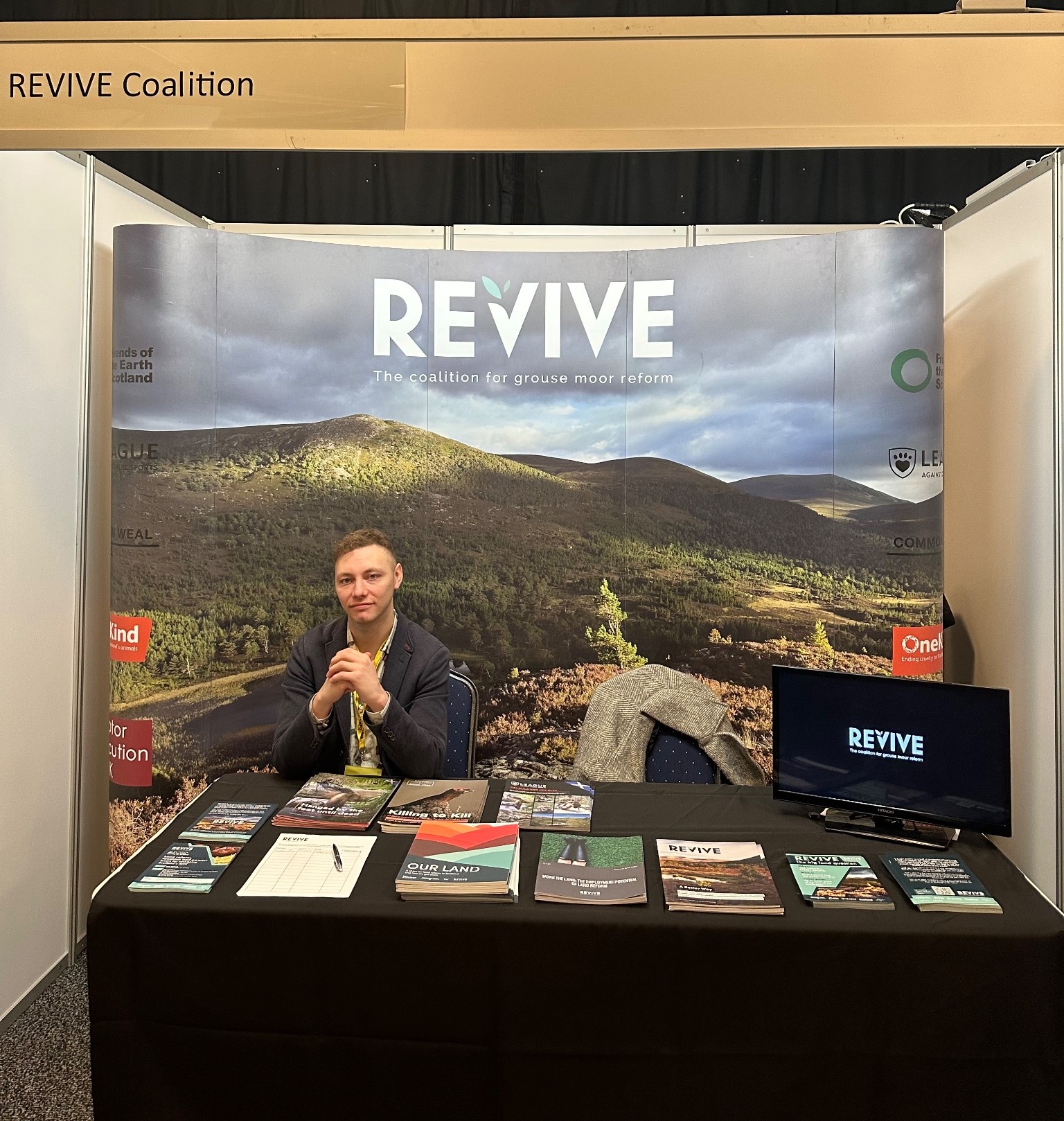
REVIVE, the coalition for grouse moor reform is attending the SNP’s annual conference which starts today.
We have a stand (#17) all weekend where conference delegates can drop by for a chat and pick up copies of our various reports:
On Saturday we’re hosting a fringe event (Sidlaw Room, Level 2) from 12.30 – 13.30hrs on the subject of land reform. Here are the programme notes:
LAND REFORM, TAXATION & POWER: LEVERS FOR RESHAPING SCOTLAND’S LAND
This land is your land but huge swathes of Scotland have been dominated by large landowners and sport shooting interests, enabling unequal land ownership models to persist. In the meantime carbon credits are providing green finance but can it be done better and for the public good instead of private profit? Join us at an opportune time – with an imminent new land reform bill – to discuss levers for progressive change which can be used to achieve transformational land reform for our people, wildlife and environment.
Our panel of speakers will include Max Wiszniewski (REVIVE Campaigns Manager), Dr Helen Armstrong (Sustainable land use consultant at Broomhill Ecology), Dr Craig Dalzell (Head of Policy & Research at Common Weal) and Kate Forbes MSP, Deputy First Minister.
If you’re attending the conference, drop by and say hello!
Today marks the opening of the red grouse shooting season (the Inglorious 12th) and the media is full of ‘woe is us’ stories from the grouse shooting industry claiming that the lack of grouse available to shoot this year (largely down to climate breakdown) will result in the annihilation of the rural economy. (It won’t).
Strangely, the grouse shooting industry is keeping very quiet about the jolly good wheeze it’s got up its sleeve to ensure that the bloodsports enthusiasts will still have something to get their kicks from killing – they’re using the red-legged partridge (RLP) as an alternative quarry to red grouse – although they won’t be able to kill them until the RLP shooting season opens on 1st September.
Millions of this non-native species, hatched and reared by gamebird breeders and sold to shooting estates across the UK, are typically released onto lowland shoots but in recent years there has been an upsurge in the release of this species on to upland grouse moors.
This may be a response to continuing low red grouse stocks, but in Scotland I suspect it’s also a response to the new legislation requiring licences for grouse shooting, which can be suspended / revoked if wildlife crime such as raptor persecution, badger persecution, fox hunting etc continues on those estates.
I’ve written about this previously (here), as the new licences only cover the shooting of red grouse, not the shooting of pheasants or RLPs. I’ve argued that shooting estates can simply by-pass the new grouse shooting licencing rules (and thus sanctions) by shooting RLPs instead of grouse.
Additionally, if a grouse moor owner’s licence is suspended/revoked because wildlife crimes have been uncovered on the estate, that owner/tenant could simply switch to shooting RLPs instead of red grouse because the licence revocation doesn’t apply to shooting RLPs.
Although, to be fair, the Scottish Parliament has recognised that estates may use this ploy to escape sanction for the continued killing of birds of prey on the moors and has thus included a provision in the new Wildlife Management & Muirburn (Scotland) Act 2024 to add other species, including RLPs, to the new licensing regime if it’s found that this is indeed what Scottish grouse moor owners are up to.
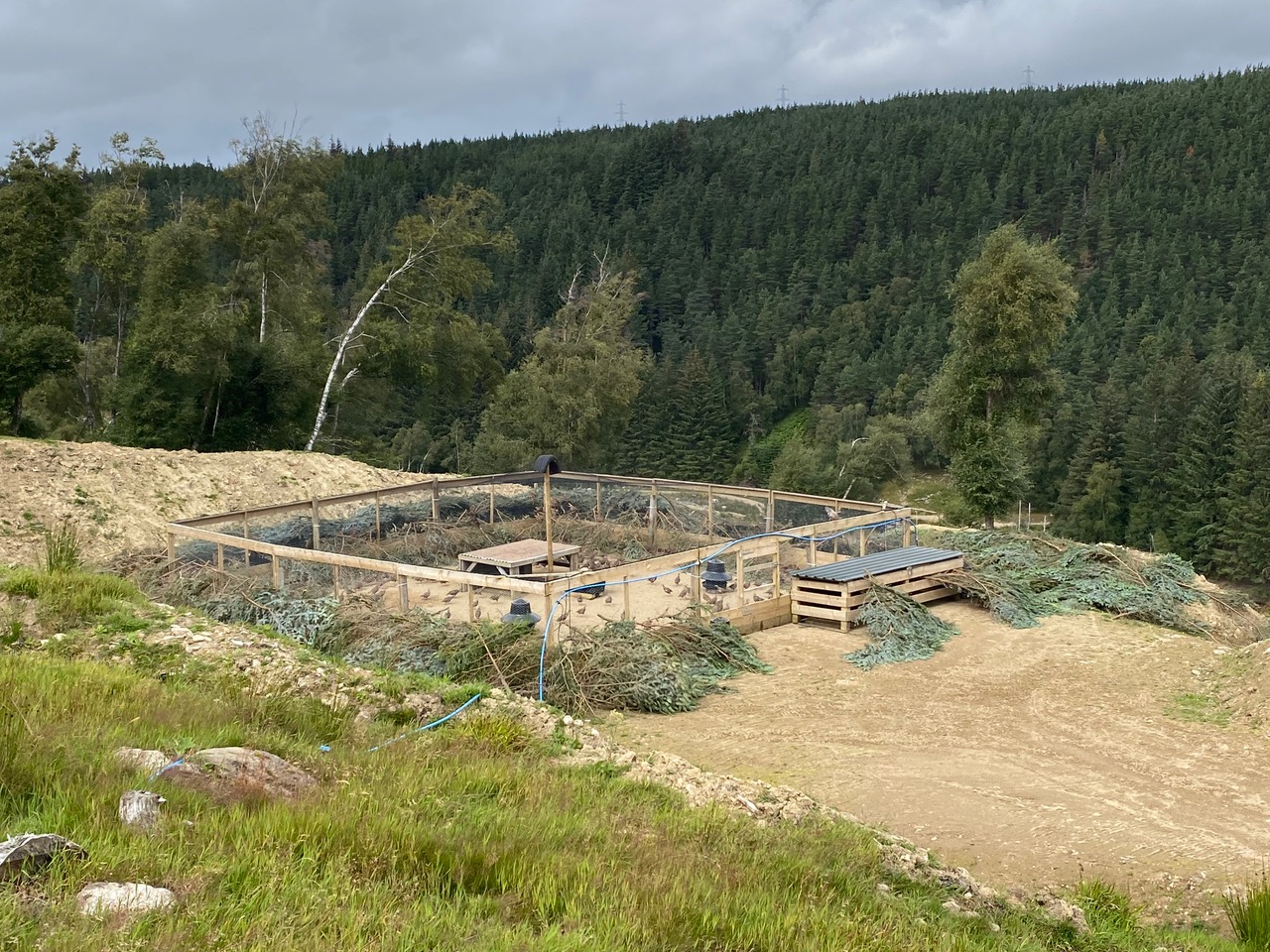
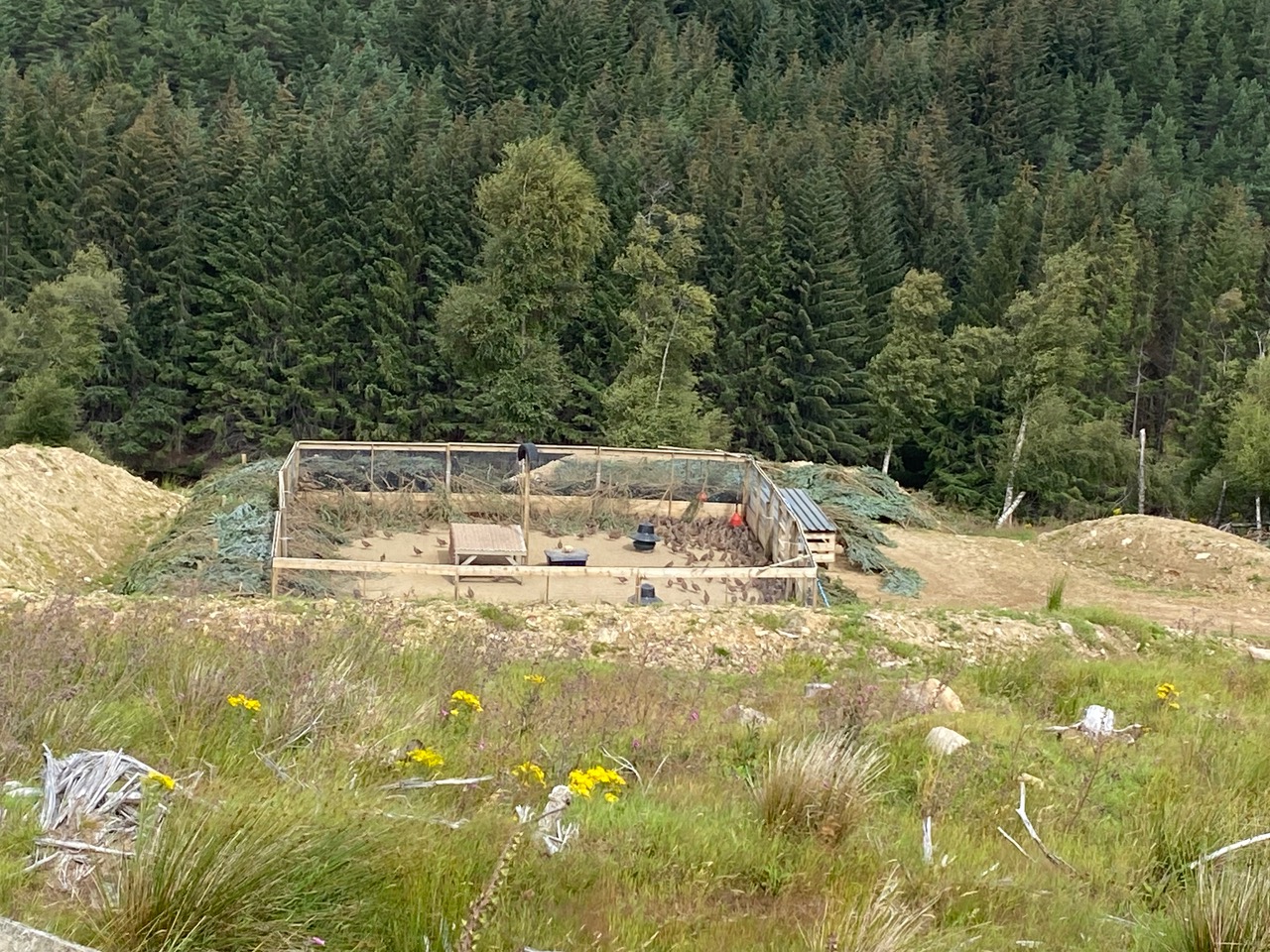
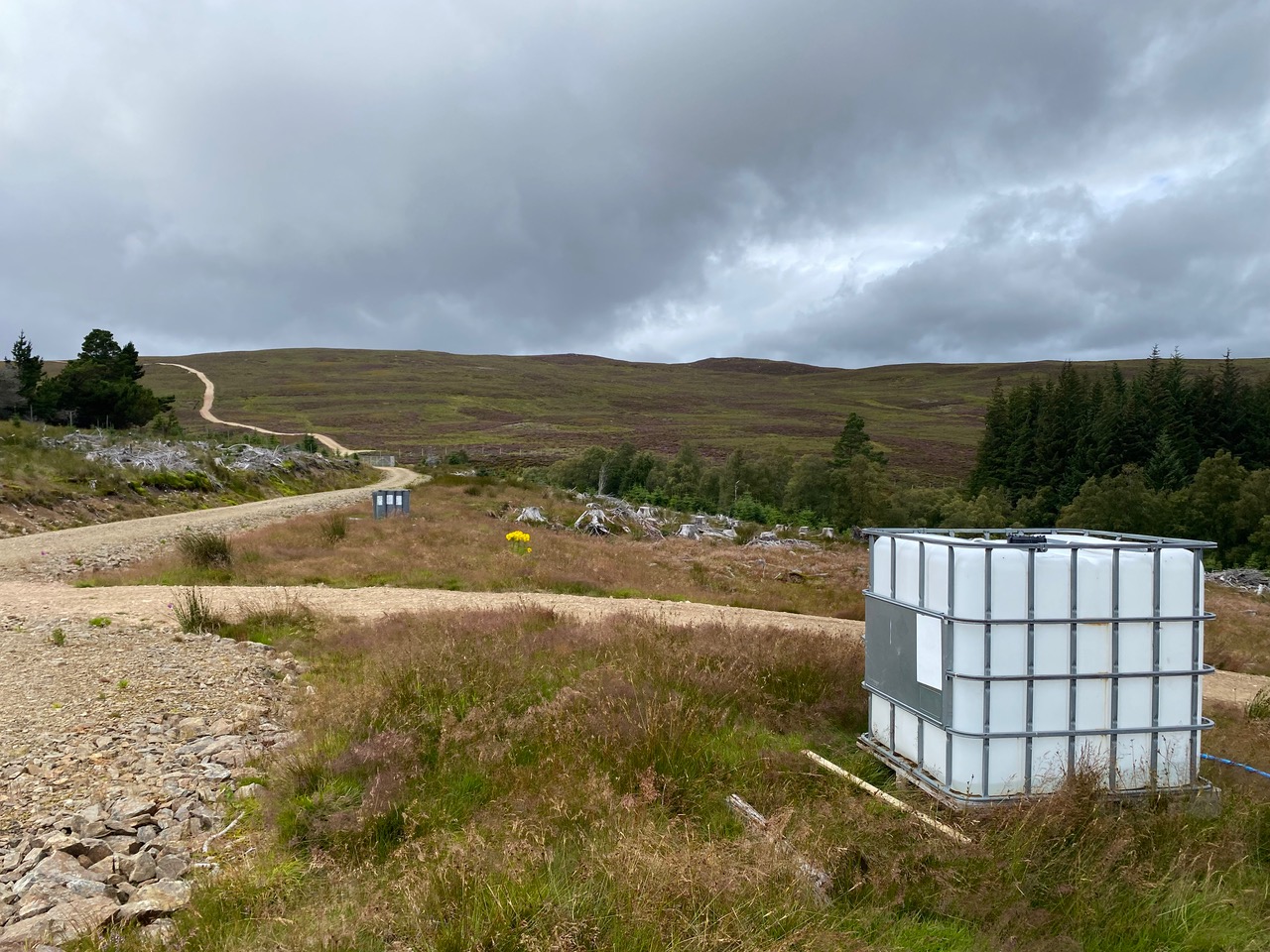
I’ve previously published photographs on here of new RLP release pens being built on grouse moors (here) and now another blog reader (thank you!) has sent me photographs of more new RLP release pens that he found on Friday on a well-known Scottish grouse moor in the Highlands:
The blog reader told me there were three identical RLP release pens at this site, approximately 50m apart, although only one is shown in the above photographs.
You can clearly see the size of the operation, including what looks like brand new hill tracks built across the moor to access the pens. I suspect the hill track campaign run by Scottish Ramblers might be interested in these.
I showed these photographs to Mark Avery at the weekend, who wryly pointed out, “There’ll have trouble arguing that this is traditional“.
Apparently there won’t be much grouse shooting taking place this year when the season opens on Monday (12th August). According to various reports from the grouse shooting industry, this is due to a combination of factors including a cold wet spring and an extraordinarily high worm burden on many moors.
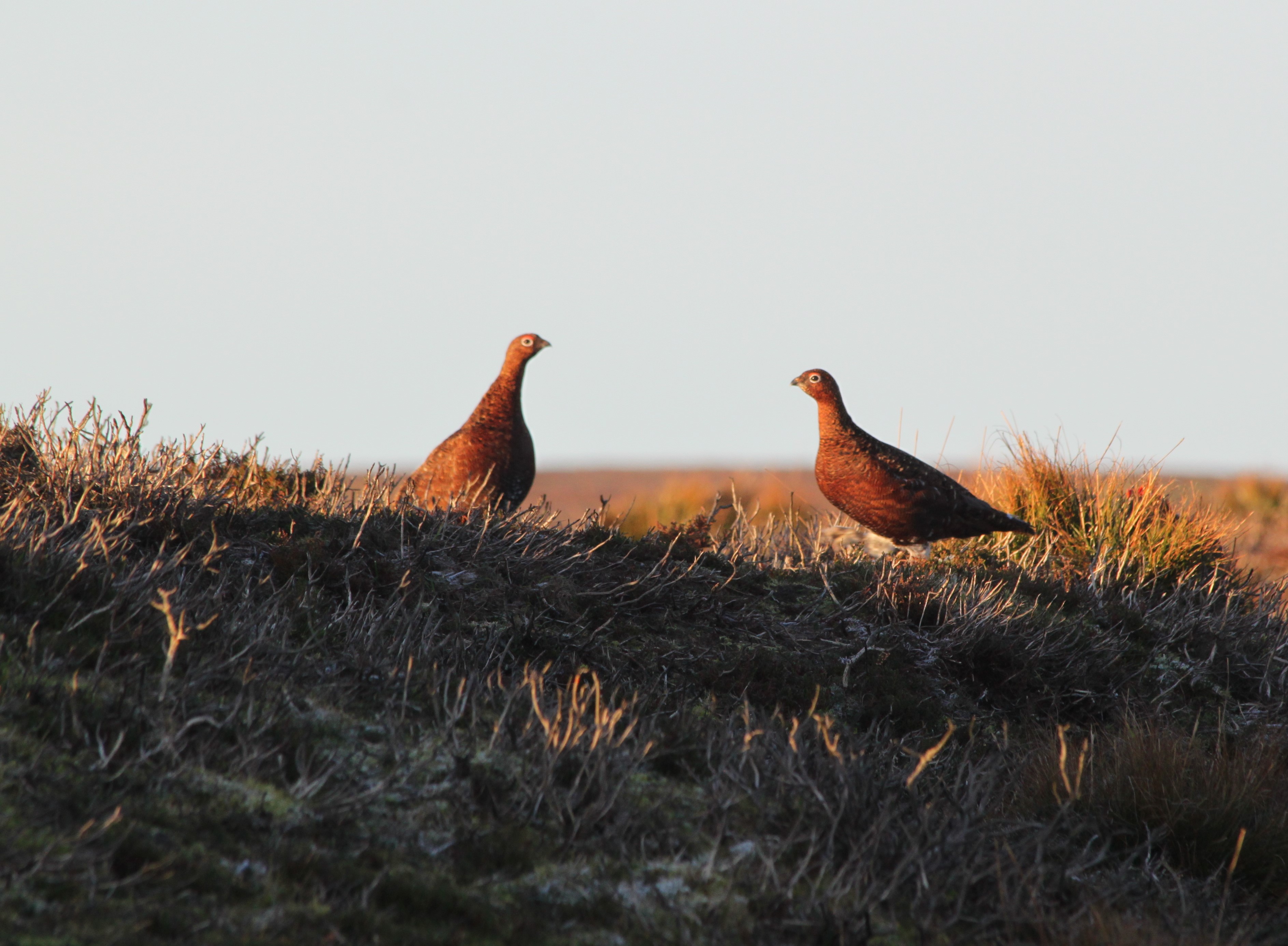
Red grouse photo by Ruth Tingay
They may not be shooting many red grouse but they’re more than making up for it by shooting themselves in the foot instead, particularly in Scotland.
I’ve read quite a few newspaper articles in the last few days about the so-called Glorious 12th but a couple of them stood out – whoever is advising the shooting organisations on their PR strategy is hanging them out to dry! Not that I’m complaining, if they want to make complete fools of themselves it saves me a job.
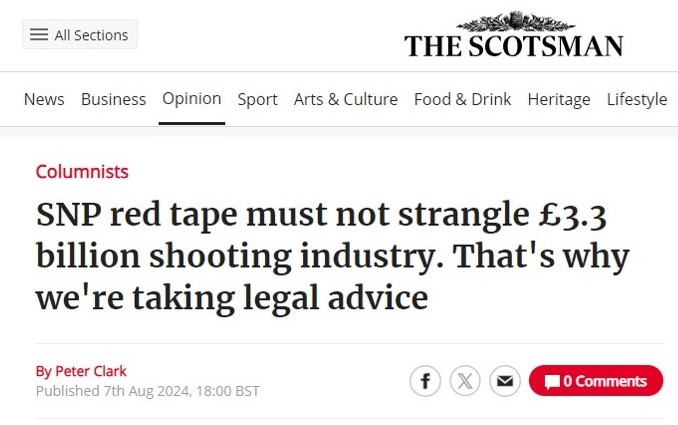
The first article that made me laugh out loud was an opinion piece in TheScotsman by Peter Clark, BASC’s Scotland Director:
I’m not going to reproduce the whole article because it’s too dull – you can read it here if you want to – but I do want to highlight a couple of points.
His opening paragraph goes like this:
“Grouse shooting is crucial to rural upland communities, with the start of the season representing the culmination of a year’s hard work, grit, and determination. Unfortunately, this season doesn’t look as promising as previous ones, with counts looking less positive“.
I wondered if the grit he refers to is the tonnes and tonnes of toxic, medicated grit that grouse moor managers chuck out on the moors, with minimal regulation, to medicate the so-called ‘wild’ red grouse to stop the natural, cyclical population crashes caused by parasites? I somehow doubt it – the industry’s leaders prefer to keep this dodgy practice under the radar.
Peter’s article goes on (and on) about how much shooting is worth to the economy, but predictably he lumps ALL types of shooting together rather than just focusing on grouse shooting, presumably to make grouse shooting look more economically viable than it actually is. It’s a common tactic. He also fails to include in his calculations the economic costs of grouse shooting to society. Again, a common ploy by the defenders of this so-called ‘sport’.
But the real PR disaster comes further down the article where he’s discussing the new grouse moor licences that have been introduced for the first time this year as the Scottish Government’s latest attempt to stop the illegal persecution of birds of prey on grouse moors. Peter writes:
“We clearly communicated to Jim Fairlie, the Scottish Government’s minister for agriculture and connectivity, before the Wildlife Management Bill became an Act that he should pursue amendments to make it more practical.
These proposed adjustments included removing provisions for adding additional game bird species to the shooting licenses, eliminating expanded investigative powers for the Scottish Society for Prevention of Cruelty to Animals, and refining the scope of what are considered to be “relevant offences” under the licencing scheme. These offences include those under wildlife legislation, ranging from the Wildlife and Countryside Act 1981, right through to the new Hunting with Dogs (Scotland) Act 2023. The British Association for Shooting and Conservation (BASC) was clear that the scope of the relevant offences was too broad, given that the sole focus of this licensing regime from its inception was to tackle raptor persecution.
Despite presenting strong evidence of the risks these aspects pose to the sector, our specific proposed changes were not included. While the BASC and other shooting organisations successfully won amendments to the Bill and challenged many aspects of what was originally proposed, ultimately, the shooting community now faces new layers of regulation.
Consequently, BASC is defending its members and seeking legal advice regarding the final version of the licensing scheme, which has now been implemented ahead of the start of the season“.
So let me get this right. Peter seems to be arguing that it’s just not fair that grouse shooting licences could be suspended and/or revoked if offences, other than those relating to raptor persecution, such as badger persecution or the hunting of foxes with more than two dogs, are uncovered on grouse moors!
“BASC is defending its members…” he says. What, by saying that BASC members shouldn’t be sanctioned if these other types of wildlife crime are uncovered??
Is he for real?!!
BASC is not alone in making the industry look ridiculous. In another article, published yesterday in the Guardian (here), BASC, along with industry lobby groups Scottish Land and Estates (SLE) and the Game and Wildlife Conservation Trust (GWCT) are also arguing that the licensable area to which these new regulations apply should be restricted to just the grouse moor area and that’s it’s ‘unnecessary and unfair‘ if the licence applies to other parts of an estate.
Eh? Where’s the logic in that? It’s blindingly obvious that estates would simply restrict their illegal activities to estate land next to the grouse moor, e.g. shooting a sleeping eagle as it roosts in trees on the edge of the moor, thus carefully avoiding culpability and a licence sanction, let alone a criminal prosecution.
The raptor killers have been exploiting this loophole for a long time – the most favoured practice being placing poisoned bait on the tops of fenceposts on an estate’s boundary line, especially at the top of a hill, making it more likely that a poisoned raptor will die further downhill on an adjoining estate and thus putting that neighbouring estate in the frame for the illegal poisoning.
As for the extent of the licence coverage being “unnecessary“, if that were so, why would the shooting organisations be so keen to limit the licence’s geographical extent if they’ve got nothing to hide?
There’s a quote at the end of the Guardian piece from Professor Colin Galbraith, Chair of NatureScot’s Board, discussing the entire coverage of an estate with a licence:
“If they’re not doing anything wrong, why worry about it?“.






 Raptor Persecution UK