Last week the Scottish Parliament’s Environment, Climate Change & Land Reform (ECCLR) Committee held an evidence session as part of their consideration of the Scottish Raptor Study Group’s petition calling for the introduction of state-regulated licensing for all game bird hunting in Scotland.
The archived video of the session can be viewed here
The official transcript can be read here: ECCLR transcript gamebird shooting licensing 18 April 2017
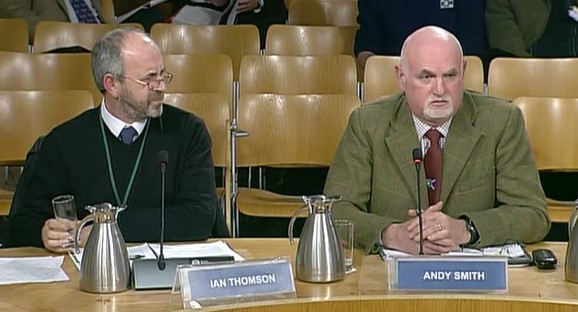
The evidence session was split in to two parts. The first part comprised evidence from the petitioners (Logan Steele & Andrea Hudspeth from the SRSG) and the second part comprised a panel of ‘stakeholders’ including Logan Steele, Duncan Orr-Ewing (RSPB Scotland), Robbie Kernahan (SNH), Andy Smith (Scottish Gamekeepers’ Assoc) and Lord David Johnstone (Scottish Land & Estates). (Photos from ECCLR webpage).
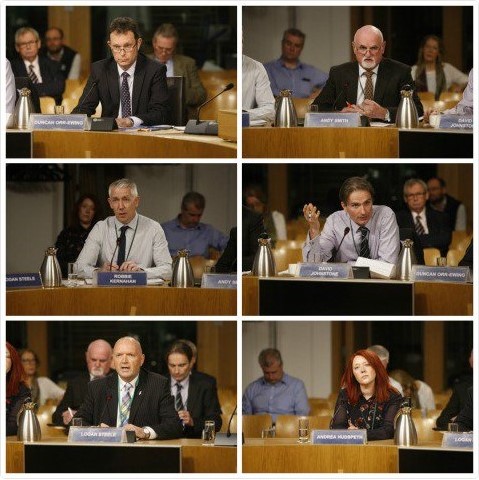
We’re not going to go through the transcript line by line because that would be tedious, but instead we wanted to comment on a few observations.
Unlike the evidence session held at Westminster last autumn, this was a civilised, unbiased hearing. That may be because, unlike the Westminster Environment Committee, none of the ECCLR Committee have a direct conflict of interest in the subject nor receive payment from any of the organisations represented by the witnesses. The Convenor of the ECCLR Committee (Graeme Dey MSP) was far more professional than his inexplicably rude Westminster counterpart, and although Mr Dey is known to support the propagandist Gift of Grouse campaign, his management of this evidence session was reasonably balanced and fair.
In the first part of the session, Logan and Andrea gave measured, thoughtful evidence about the continuing issue of illegal raptor persecution, supported by decades of scientific monitoring and peer-reviewed science. These two witnesses deserve much kudos. They are ‘ordinary’ members of the public, so exasperated by the failure of successive Governments to sort out this problem that they’ve been moved to exercise their right through the democratic process of petitioning the country’s decision-makers. As a result, they’ve been vilified on social media, exposed to a barrage of personal abuse from certain individuals within the game shooting sector, and yet here they were again, calmly and adeptly stating their case. We all owe them a massive vote of thanks.
The performance of the other witnesses was mixed. Andy Smith (SGA) is doubtless well intentioned but his ability to engage in the actual discussion is limited. He clearly had a list of points he wanted to get across, but blurting them out whenever he had an opportunity to speak, instead of listening to the question that was posed and reacting to that, didn’t help his cause.
Robbie Kernahan (SNH) didn’t say too much, and most of what he said was fairly standard SNH-speak (i.e. fence sitting), although he did make an important opening statement that should add some gravitas to the Committee’s future deliberations:
“Generally, in Scotland, we have quite a positive message about the recovery of raptor populations from those all-time lows. It is certainly a national picture. However, that is not to say that there are not issues. Certainly, some of the concerns about the intensification of moorland management prompted our scientific advisory committee to have a review two years ago. Without wanting to go through that chapter and verse, I can say that there is no doubt that the on-going issue of raptor persecution is inhibiting the recovery of populations in some parts of the country“.
The evidence provided by Duncan Orr-Ewing (RSPB) and David Johnstone (SLE) was perhaps the most interesting. Duncan spoke with authority about the extent of illegal raptor persecution, saying the RSPB “thinks the situation is as bad as it has ever been“, while David flatly denied this, pointing to the annual ‘body count’ as his supporting evidence but completely ignoring the long-term population data, as published in peer-reviewed scientific papers. When asked by the Convener whether there was a possibility that culprits might now be better at hiding the evidence, in part pressured by measures such as the threat of vicarious liability, David’s response was “No“. No? Really? No possibility of that happening at all? Come on.
What made David’s response even more incredible (in the literal sense) was that SLE, as members of the PAW Scotland Raptor Group, have been made aware of the recent flow of scientific papers (e.g. on red kite, golden eagle, hen harrier, peregrine), all clearly showing population-level impacts of illegal raptor persecution, and as PAW partners, are supposed to have been advising their members accordingly. So how come the Chairman of SLE hasn’t been informed?
And on the subject of ‘possibilities’, much was made of the possibility of estates being ‘set up’ (i.e. someone planting evidence) if a licensing system was introduced. Both Logan and Duncan accepted that this was a possibility and they were right to do so. Of course it is a possibility, although on previous experience, the probability of it happening seems quite low.
In January 2012, just after the introduction of vicarious liability, David Johnstone was cited as saying there was a risk of estates being set up in response to the new vicarious liability measure. Five years on, there hasn’t, as far as we are aware, been a single case of an estate being ‘set up’.
Similarly, in November 2013, the then Environment Minister Paul Wheelhouse was asked during a Parliamentary Committee whether estates being ‘set up’ was a legitimate concern for landowners and gamekeepers. Wheelhouse responded that yes, it was a possibility, but that there wasn’t currently any evidence to support such claims, although a new study on trap interference was due to assess the issue. The results of that study showed that the illegal tampering of traps was not as widespread as the gameshooting industry had claimed (see here) and when it had happened, the interference mostly related to trap ‘damage’ (rendering the trap inoperable) as opposed to setting an illegal trap to infer a guilty responsibility on the estate.
There was quite a lot of discussion about what a licensing system might look like, and it was argued by Logan and Duncan that it should be based on the civil burden of proof (much like the policy used for General Licence restrictions) and that this should be a tiered approach, so that a number of incidents would be required before a licensing penalty was applied. David Johnstone was totally opposed to this, saying that the use of the civil burden of proof would be too much of a business risk. There was quite an amusing discussion about this between him and Committee member Mark Ruskell MSP, who argued that if the business was already fully compliant with the law, as David claimed, then the risk should be very low.
All in all, it was a useful evidence session and the ECCLR Committee will be hard pressed to justify not taking things further. The Committee now has to consider the evidence presented and decide on its next move. We may well have to wait until after 8 June to find out what that move might be, because thanks to the forthcoming General Election, no political or sensitive announcements or decisions are permitted during election purdah.




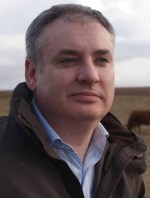 Today at First Minister’s Question Time, Richard Lochhead MSP (Moray, SNP) asked the following question:
 The First Minister responded: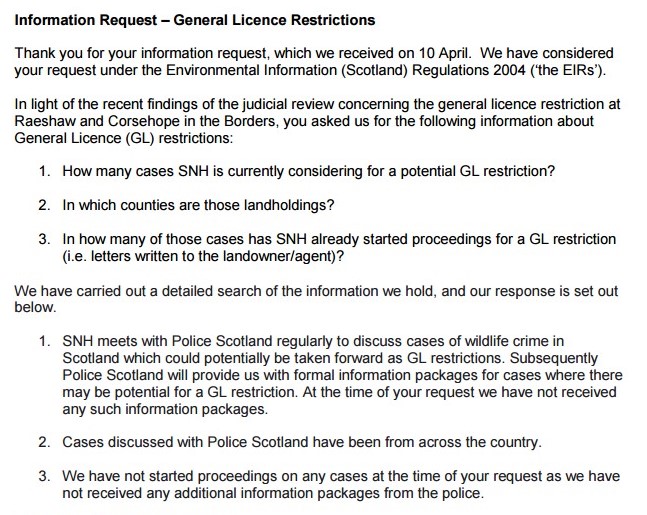

 The data in the above table were derived from the 2003 national golden eagle survey. Since then, a 2015 national survey has been undertaken and we await publication of the detailed results, although the preliminary findings have shown that there have been
  We’ve talked quite a bit on the issue of withheld raptor crime data from the Scottish Government’s 2015 annual Wildlife Crime report. We blogged about it when the report was published in November 2016 (
