Environment Committee brings licensing for driven grouse shooting one step closer

It’s not often we can report good news on this blog but today is one of those rare occasions.

This morning the Scottish Parliament’s Environment Committee considered various options for progressing the Scottish Raptor Study Group’s petition calling for the introduction of a licensing scheme for game bird hunting.

In short, the Committee has agreed to keep this petition open and will be writing to the Environment Cabinet Secretary to recommend that the Scottish Government further explores, with stakeholders, the implementation of a licensing regime for driven grouse shooting.

This is fantastic and very welcome news!

Grouse shooting butt, photo by RPUK

The video archive can be viewed here (starts at 1:04:05).

The official transcript of proceedings can be read here: ECCLR Committee transcript_23May2017

For now, here’s a brief summary of what happened.

As we blogged earlier, the Committee had three options on the table (see here). Briefly, these were (1) to close the petition and do nothing more; (2) recommend that the Scottish Government explores a licensing system and the feasibility of a trial scheme; and (3) do something else, which in this case was to consider maintaining the status quo as recommended by the game shooting industry.

The following MSPs delivered their thoughts on this petition prior to the vote:

Kate Forbes (SNP), Alexander Burnett (Conservative), Claudia Beamish (Labour), Mark Ruskell (Greens), Emma Harper (SNP), Angus MacDonald (SNP), Richard Lyle (SNP) and Graeme Dey (SNP).

Maurice Golden (Conservative) and Finlay Carson (Conservative) did not have anything to say. Dave Stewart (Labour) was not present.

Special mention to Claudia Beamish and Mark Ruskell, who both demonstrated a clear grasp of the scale of raptor persecution, the length of time it has been allowed to persist, the need for a civil burden of proof, and a very marked view that voluntary regulation by the game shooting industry has failed to deliver tangible change.

The votes went as follows:

Option 1 (close the petition & do nothing else)

This option was rejected 10 votes to zero.

Option 2 (recommend that Scot Gov further explores, with stakeholders, how a licensing scheme could work and the feasibility of a trial scheme)

For: Kate Forbes (SNP); Claudia Beamish (Labour); Mark Ruskell (Greens); Emma Harper (SNP), Angus MacDonald (SNP); Graeme Dey (SNP).

Against: Alexander Burnett (Conservative); Maurice Golden (Conservative); Finlay Carson (Conservative); Richard Lyle (SNP).

This option was passed with six votes for, and four against.

Option 3 (close the petition & recommend that Scot Gov considers the non-regulatory alternatives put forward by the game shooting industry)

For: Alexander Burnett (Conservative), Maurice Golden (Conservative), Finlay Carson (Conservative), Richard Lyle (SNP).

Against: Claudia Beamish (Labour); Mark Ruskell (Greens); Emma Harper (SNP); Angus MacDonald (SNP); Graeme Dey (SNP).

Abstention: Kate Forbes (SNP)

This option was rejected with four votes for, and five votes against, and one abstention.

So as you can see, the decision to approve Option 2 was certainly not unanimous and it was a pretty tight call, but that doesn’t really matter. What matters is that this petition is moving in the right direction.

Various members of the Committee wanted to speak before the vote and many of them wanted to put on record their appreciation of petitioner Logan Steele’s evidence-based approach and his calm delivery of that evidence. We would echo that appreciation. As we’ve blogged before, Logan and his fellow petitioner Andrea Hudspeth, have both been subjected to some vile abuse and harassment on social media as a result of presenting this petition to Holyrood and it is to their credit that they refused to be intimidated and remained composed throughout. They deserve recognition for this, and for all the long hours of preparatory work that went in to writing the petition, and we all owe them a huge debt of gratitude.

So what happens next? Committee Convener Graeme Dey will write to Cabinet Secretary Roseanna Cunningham, outlining the comments made during today’s discussions and recommending Option 2 – that the Government needs to explore the issue of licensing, particularly with reference to land that is intensively managed for driven grouse shooting. The issues to consider will not be restricted to the illegal killing of raptors, but will also include other issues such mountain hare slaughter and the environmental impact of muirburn practices and the use of high dosage medicated grit.

We’re under no illusion that a licensing regime will solve the problem – we maintain our long-held concerns about the issue of enforcement, particularly brought in to focus with the recent decisions of the Crown Office to drop four prosecutions despite the availability of very clear evidence. However, we also recognise that a licensing regime is a necessary step before a full ban on driven grouse shooting will be considered. If licensing works, then fine. If it doesn’t, a ban will be inevitable.

We don’t know what the timescale for these stakeholder discussions will be, and, going on past experience, this process may take a long time. Somebody commented on an earlier blog that the issue may be kicked in to the long grass and that is certainly a possibility, but we will be doing everything within our power to make sure that doesn’t happen.

And who knows, today’s decision may prove to be a watershed moment for dealing with raptor persecution in Scotland. The Cabinet Secretary has some important decisions to make before the summer recess (30 June 2017), including her decision on increased powers for the SSPCA and her response to the findings of the raptor satellite tag data review.

Public awareness of both the criminality and environmental damage associated with intensive driven grouse moor management has increased massively in recent years and public opinion has been vociferous. This weight of public opinion, combined with today’s decision, may just buckle the fence on which the SNP has been balancing for far too long.

UPDATE 7.30pm: Game-shooting industry issues joint statement on licensing proposals (here)

UPDATE 26 May 2017: Wildlife conservationists issue joint statement on licensing proposals (here)

Environment Committee meeting this morning

The Scottish Parliament’s Environment Committee will meet this morning to discuss the petition calling for the introduction of licensing for game bird shooting.

The meeting begins at 10.15am and can be watched live on Scottish Parliament TV here

A video archive and a full transcript will be posted later.

Environment Committee seeks clarity from prosecutors on use of video evidence

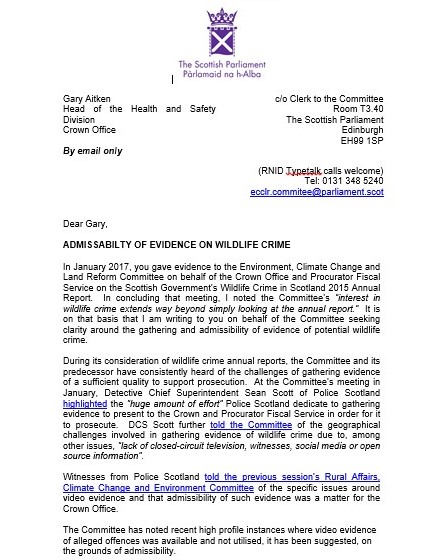
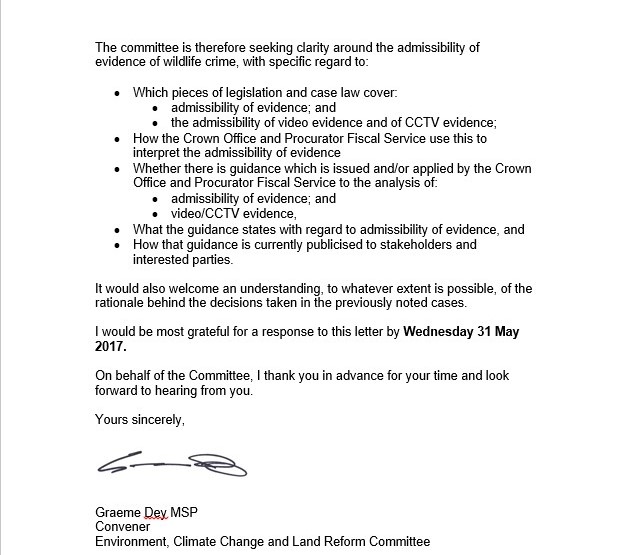
Following recent decisions by the Crown Office to abandon two prosecution cases for alleged raptor persecution because of so-called ‘inadmissible’ video evidence (see here and here), the Scottish Parliament’s Environment Committee has today written to the Crown Office to ask for clarity.

Here is the letter from the Environment Committee to the Crown Office:

We applaud the Environment Committee for trying to hold the Crown Office to account. They seem to be the only ones willing to do so – everyone else seems to just shrug their shoulders and say ‘we can’t comment on Crown Office decisions’. As an example, here is the response one of our blog readers received from the Scottish Parliament’s Justice Committee when they asked about the Crown’s decision to abandon the prosecution for the alleged shooting of a hen harrier on Cabrach Estate:

Thank you for your email. The convener has noted the contents and asked me to reply on her behalf.

The Justice Committee is a cross-party Parliamentary body comprising members of 5 political parties. It is a scrutiny body whose remit is to consider and report on matters falling within the responsibility of the Cabinet Secretary for Justice.

Re your reference to “your justice system”, the Justice Committee does not take any decisions on the criminal process and, in particular, has no power in relation to the prosecution of individual crimes. These decisions are taken under the authority of the Lord Advocate as chief prosecutor and his independence in this role is set out in statute. The Committee is not able to comment on the specific of this case.

However, the Committee may comment on broader policy matters and I am sure that Committee members would agree that wildlife crime is a serious matter that should be tackled with vigour. For information, the Committee recently completed a major report on the COPFS, which included a short section on its handling of wildlife crime and made a recommendation for the COPFS’s consideration (paragraph 167 onwards).

http://www.parliament.scot/parliamentarybusiness/CurrentCommittees/104512.aspx

It is my understanding that under some circumstances affected individuals are entitled to request a review of a decision not to prosecute, although I am not clear how that operates in the case of wildlife crime rather than a crime against a person. You may wish to direct your complaint to the Crown Office and Procurator Fiscal Service and, in so doing, clarify whether there is any scope to formally object to the decision taken in this instance.

You may also with to consider contacting your constituency or regional MSPs to register your disappointment. As already stated, the Lord Advocate is independent in the prosecution of the the crime but there might possibly be other avenues for your MSP(s) to explore if they decide to take up your case.

Yours sincerely,

Peter McGrath, Clerk to the Justice Committee, The Scottish Parliament.

 To be fair to the Justice Committee, we understand that they can’t comment on individual cases. However, they say themselves that they can comment on wider policy issues, so you might think they’d have been interested in addressing the broader issues of video admissibility. But apparently not.
Thankfully, the Environment Committee thinks otherwise and we very much welcome their letter to the Crown Office. It’ll be interesting to see how forthcoming the Crown Office’s response is.
Meanwhile, news has emerged this morning that the Crown Office has dropped yet another prosecution case for alleged raptor persecution – this is the fourth abandoned case in the space of a month. We’ll be blogging about this one shortly….
 

Game shoot licensing petition: Environment Committee to decide next steps

The Scottish Parliament’s Environment Committee will meet next Tuesday to discuss how they wish to proceed with the Scottish Raptor Study Group’s petition calling for state-regulated licensing of game bird shooting.

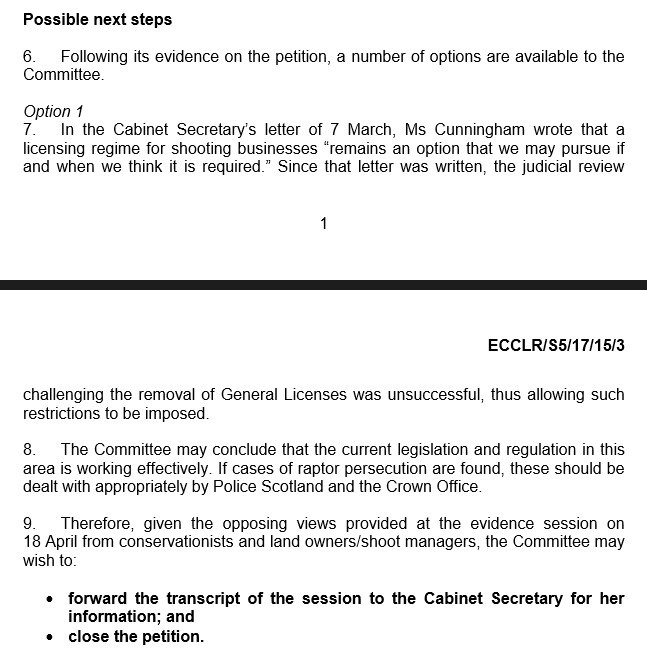
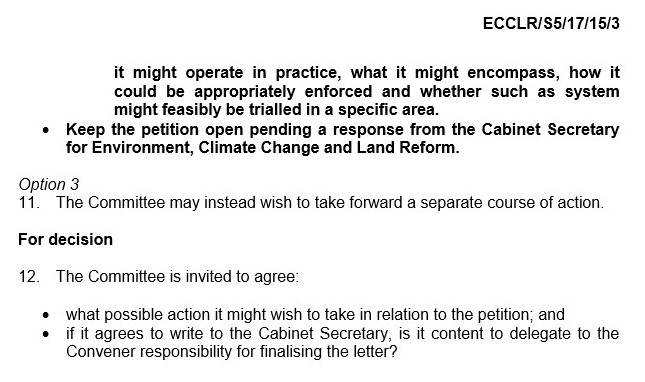
As you’ll recall, the Committee took evidence from a range of stakeholders last month (see here for our commentary) so now they have to decide what should happen next. The ECCLR Committee clerks have outlined three possible options. Here’s option 1:

Given what’s happened since the Committee discussed this petition last month, i.e. Crown Office inexplicably abandoning three long-running prosecutions – alleged vicarious liability at Newlands Estate; alleged hen harrier shooting at Cabrach Estate; alleged pole-trapping offences at Brewlands Estate, and the witnessed shooting of a hen harrier at Leadhills Estate, the Committee will be hard pressed to justify taking option 1, because it is very clear that the current legislation and regulation is NOT working effectively.

Here are options 2 and 3:

As before, the session will be available to watch live on Scottish Parliament TV (we’ll add a link on Tuesday morning) and the video archive and official transcript will be posted here shortly afterwards.

Cabrach hen harrier shooting reaches First Minister’s Question Time

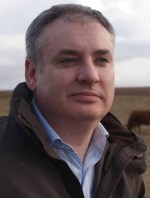
Today at First Minister’s Question Time, Richard Lochhead MSP (Moray, SNP) asked the following question:

The First Minister may be aware that there is huge disappointment and some shock following the decision by the Crown Office and Procurator Fiscal Service after a prolonged police investigation—and I am told, nine separate court hearings—to drop the case relating to the alleged illegal killing of a hen harrier in the Cabrach in my constituency in 2013. The Crown Office appears to have taken the view that the video footage supplied by the RSPB Scotland was inadmissible, despite such evidence being accepted in the past. Notwithstanding the progress that has been made by ministers in recent years to tackle wildlife crime, will the First Minister acknowledge that that case represents a serious crime against a threatened species? Given that wildlife crime is very difficult to detect, because most often it takes place in remote areas, will she acknowledge that the law and the approach of the Crown Office must take into account such factors? I ask the First Minister whether she would be willing to investigate this case, with a view to ensuring that the justice system does not miss any opportunity to hold to account those who illegally kill our endangered species?

The First Minister responded:

I agree with Richard Lochhead. As he well understands, decisions about the prosecution of crime are, of course, decisions for the Crown Office and in that respect law officers act independently of ministers. However, it is important that we take wildlife crime very seriously indeed, particularly in cases where, as Richard Lochhead has highlighted, it threatens a threatened species. I will be happy to ask the relevant minister, Roseanna Cunningham, to meet with Richard Lochhead to look at what more we can do, particularly taking into account his point about those crimes often taking place in remote areas and, therefore, being more difficult to detect. It is important that we make sure that the policy framework, the law around this and the decisions that are taken by the Crown Office in respect of prosecutions—although, as I say, it is independent of ministers—do everything possible to crack down on those kinds of crime. I assure Richard Lochhead that we will continue to do everything that we can to make sure that that is the case.

Well done, and thank you, Richard Lochhead. More of this, please.

No further General Licence restrictions in pipeline because Police Scotland sitting on evidence

The ability for SNH to impose a General Licence restriction order on land where there is evidence of raptor persecution taking place came in to force on 1 January 2014. This measure, based on a civil burden of proof, was introduced by then Environment Minister Paul Wheelhouse in response to the continuing difficulties of meeting a criminal burden of proof to facilitate a criminal prosecution.

Whilst these GL restrictions are not without their limitations (because estates can simply apply for an individual licence instead –  see here, and we’ll soon be blogging again about the individual licences issued for Raeshaw & Corsehope estates in the Borders), Wheelhouse argued that as the restriction notices will be made public, they should act as a ‘reputational driver‘ and to us, that’s still where their value lies.

Since 1 January 2014, SNH has imposed two GL restrictions: one for Raeshaw & Corsehope estates, and one for Burnfoot & Wester Cringate estates in Stirlingshire. These restrictions began in November 2015 but as regular blog readers will know, Raeshaw & Corsehope made a legal challenge which ended up with a judicial review in January 2017. The court’s decision was announced in March 2017 and SNH was found to have acted properly and lawfully.

Since imposing those two GL restrictions in November 2015, SNH has not issued any others, presumably as they needed to await the outcome of the legal challenge, which is fair enough. However, now SNH has been given the green light to proceed with these restriction orders, we are expecting a flurry of further restriction announcements. We are aware of at least half a dozen other confirmed raptor persecution incidents that have taken place since 1 January 2014 that are not progressing for a criminal prosecution (and there’ll be more, it’s just that Police Scotland are currently hiding these from public view) and these should be eligible for SNH to consider for a potential GL restriction.

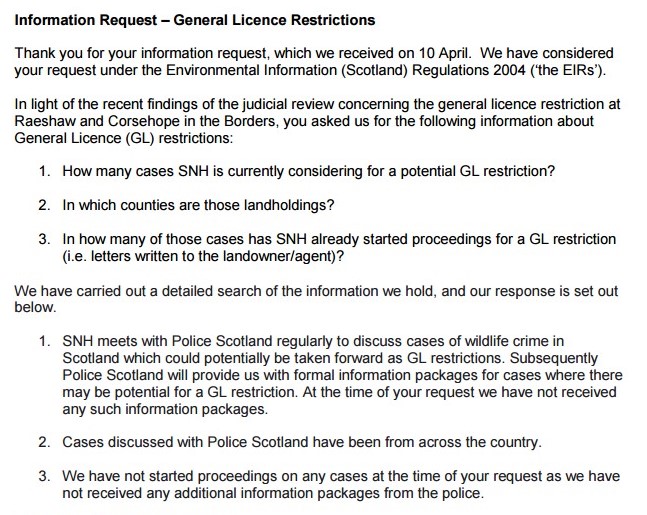
So, soon after the judicial review judgement had been announced, we submitted an FoI to SNH to ask about progress. We received their response last week and it’s staggering. In a nutshell, there aren’t any further General Licence restrictions in the pipeline because Police Scotland hasn’t bothered to pass on the evidence needed by SNH:

This, frankly, is an appalling neglect of duty by Police Scotland. We know that GL restrictions can ONLY be considered by SNH on receipt of evidence from Police Scotland. The Scottish Parliament’s Environment Committee was told by Police Scotland in November 2014 that Police Scotland would meet monthly with SNH, starting that month, to discuss any potential cases (although in the Scottish Government’s 2015 Annual Wildlife Crime Report it was stated that ‘SNH meet with Police Scotland and the National Wildlife Crime Unit every 3 months to review new information on bird crimes in Scotland and to identify any possible cases for future restrictions’).

So if they’ve been meeting regularly (whether that be monthly or quarterly) since November 2014, why the hell hasn’t Police Scotland provided any ‘formal information packages’ to SNH other than those used for the two GL restrictions that were imposed in November 2015?

SNH’s hands are tied until they receive such packages (so this is definitely not a criticism of SNH) and meanwhile, all those estates where evidence of raptor persecution has been uncovered since 1 January 2014 are allowed to continue without sanction. And that’s all thanks to Police Scotland’s apathy.

Police Scotland might argue that they’ve been waiting for the judgement of the judicial review before spending any time collating formal information packages because the judicial review might have gone the other way and prevented SNH from imposing any more. That would be sort of understandable, although a bit surprising for a police force that claims to take wildlife crime, and particularly raptor persecution, ‘very seriously’. However, SNH’s response to us suggests that these joint discussion meetings have been on-going, even during the lengthy judicial review process, but they can’t do anything because Police Scotland haven’t followed through with the evidence. But even if these meetings had been temporarily suspended, the judicial review judgement was announced at the end of March 2017 – that’s six weeks ago – so why has Police Scotland still not provided any evidence for SNH to consider? How long can it take to put together an information package, especially when in some cases you’ve had about 2-3 years to think about it?

It’s utterly pathetic.

We’ll be bringing this to the attention of members of the Scottish Parliament’s Environment Committee (responsible for scrutiny of wildlife crime policy and enforcement) and also to the attention of Environment Cabinet Secretary Roseanna Cunningham as she continues to deliberate (a) increased investigatory powers for the SSPCA and (b) her response to the findings of the raptor satellite tag data review (submitted 6 weeks ago but still to be formally published).

Meanwhile, supposedly protected raptor species will continue to suffer the consequences.

Hen harrier shooting: fury at decision to drop prosecution

Two weeks ago, the public prosecutors in Scotland (Crown Office & Procurator Fiscal Service) decided to discontinue criminal proceedings against a (now former) gamekeeper who was alleged to have shot a hen harrier on a grouse moor at Cabrach Estate in June 2013 (see here).

No explanation was given for this decision.

Earlier this morning, RSPB Scotland released video footage of the incident and issued a press statement (here). Here is the video in case anyone missed it:

After watching this video, it’s hard to find words to express the disbelief, frustration and fury about that decision to discontinue the prosecution. Social media has erupted in outrage and the Crown Office is seen as a laughing stock. Most reasonable, law-abiding people who don’t have a vested interest in driven grouse shooting would be hard pressed to disagree.

The RSPB Scotland statement said that the Crown Office had indicated they could not use the video as evidence, but no further detail was provided. RSPB Scotland quite rightly pointed out that other cases that have relied upon video footage have been used successfully in Scottish courts (the most high profile one being the conviction of gamekeeper George Mutch in 2014), and the RSPB was bewildered by the inconsistency of the COPFS’ approach in this case.

However, this morning, in response to the release of the video, the Crown Office has finally decided to provide an explanation, as published in a BBC news article:

In accordance with the Crown’s ongoing duty to keep prosecutions under review and after carrying out a detailed review of all of the relevant material, Crown counsel considered that the inevitable conclusion was that RSPB investigators entered the land in question and embarked upon evidence gathering for the purpose of prosecution.

Discussions have taken place over a number of years between RSPB and COPFS about the admissibility of evidence obtained through the use of covert surveillance.

The Crown has consistently made it clear that strict legal tests must be met before evidence which has been obtained irregularly, such as the evidence in this case, is admissible. We will continue to have further dialogue with RSPB.

In the whole circumstances, Crown counsel concluded that the evidence would not be admissible in court.

In light of that conclusion it was entirely appropriate that proceedings were brought to an end.”

This statement begs several questions:

  • Essentially, this statement implies that RSPB Scotland was lying about the deployment of the video camera. RSPB Scotland had clearly explained that the camera was positioned as part of a routine research/monitoring study focusing on the breeding success of a threatened species. There’s a Scottish Government project (Heads up for Hen Harriers) that is deploying cameras at hen harrier nests for exactly this purpose for Christ’s sake! The Crown Office apparently disputes the RSPB’s explanation for camera deployment. Why? What evidence do they have that makes them think the RSPB is lying? [NB: see update at foot of blog]
  • If the COPFS believed this camera had been placed “for the purpose of prosecution“, why on earth did it take them three years from the date of the shooting to decide to charge the suspect, and why did it take a further year of court hearings (nine in total) before the decision was made to discontinue proceedings? Why did the COPFS even mark this case for proceedings if they didn’t believe the RSPB’s version of events? What changed in the four years the COPFS have been considering this case?
  • Why is the admissibility of video footage such a controversial issue in cases of alleged raptor persecution, and yet we see it being used in a current court case of alleged fox-hunting? We’ve spoken to one of the investigators who filmed the footage being used in the hunt case and he has confirmed he was filming covertly on private land without landowner permission as part of a wider research project on the behaviour of hunts, whether the hunts were involved in alleged criminal activity at the time or not. That’s no different to the circumstances of this hen harrier case.
  • If the circumstances of how this camera footage was obtained were so controversial, why didn’t the COPFS allow the evidence to be assessed by the court? In a very similar case to this current one, in 2006 a gamekeeper was convicted of stalking a hen harrier and his conviction was based on RSPB video evidence. During that trial, there were several hours of legal argument about the admissibility of the video evidence. The Sheriff accepted the video evidence, commenting that the RSPB presence on the gamekeeper’s estate [from where the video was filmed] was “neither illegal nor irregular, and the intent to obtain evidence did not make it so“.
  • We’ve discussed the issue of the admissibility of video evidence time and time and time again. In 2013, the then Environment Minister Paul Wheelhouse told us that this very issue had been raised with the Lord Advocate (see here). Why then, four years later, is there still such inconsistency and lack of clarity about video admissibility?
  • Why did it take the publication of this video footage, two weeks after the Crown’s decision to discontinue proceedings, for the COPFS to provide an explanation for their decision? Hen harrier persecution is one of the highest national wildlife crime priorities and there is huge and legitimate public concern about it. By remaining silent for two weeks, we would argue the COPFS has displayed an arrogance and contempt for that public concern. It’s not the first time the COPFS has been criticised for poor communications – the Scottish Environment LINK report on wildlife crime enforcement published two years ago was damning on this issue, and this year’s Scottish Parliament’s Justice Committee report on the role and purpose of the COPFS reached a similar conclusion.

The general public, is, quite rightly, furious about how this case has been handled. It seems to us that the Crown Office is more concerned about how the evidence was obtained than the actual alleged crime of killing a protected, national priority species. Of course, the COPFS has to assess the evidential circumstances on a case by case basis, and we don’t question that at all. What we do question is, in this case, on what basis the COPFS decided to disbelieve the RSPB’s explanation for deploying the camera, and why it took so long, at such huge cost to the public purse, to decide to discontinue proceedings.

And let’s not forget that this case is one of three that the Crown Office has recently discontinued, all in the space of two weeks (see here).

For a comical interlude, have a read of the statement issued by the Scottish Gamekeepers’ Association in response to the video footage. They say, “The SGA has no membership interest in this case. It is not our place to comment, therefore, on individuals involved in the alleged incident or to provide a critique of COPFS“. This is the organisation that is supposedly signed up to the Partnership for action Against Wildlife Crime and who serves on the PAW Raptor Group.

Do we have any confidence in the Scottish criminal justice system to address the on-going persecution of birds of prey? On current evidence, the answer is a resounding NO.

What to do about it? We would urge you to contact your MSP (find out who yours is here) and ask him/her to contact the Scottish Government’s Justice Minister, Michael Matheson to complain on your behalf about the handling of this case. The more MSPs that see this video footage, and hear about the public’s serious concerns, the better.

If you don’t live in Scotland but still want to voice your concerns, please email the Convener of the Scottish Parliament’s Justice Committee, Margaret Mitchell MSP (Scottish Conservatives). Email: margaret.mitchell.msp@parliament.scot

Don’t be fobbed off with platitudes or claims of “We can’t comment on individual cases”. Public scrutiny is fundamental to democracy and the public has every right to be asking questions about this ongoing, disgraceful shambles.

UPDATE 14.30hrs: RSPB Scotland has issued a statement in response to the claims of the Crown Office that the camera had been “deployed for prosecution purposes”. Here’s what it says:

In response to the Crown Office’s statement of 5th May as to why the video evidence would not be admissible in court Ian Thomson, Head of Investigations, RSPB Scotland said: “We do not agree with the opinion from the Crown Office that we were attempting to gather evidence for a prosecution. We installed a camera to monitor a protected breeding bird’s nest site, core business for a conservation organisation. We did not share the information about the nest site with anyone, as would be the case with any rare and vulnerable breeding bird species. 

“The fact that an individual came and allegedly shot the female harrier, and that this was captured on film, was an incidental consequence of the camera’s deployment, in the same way that it could easily have captured footage of the nest being naturally predated or failing due to bad weather. It is very disappointing that the opportunity for the court to consider the issue of the admissibility or otherwise of this evidence, as has happened in previous cases, has been removed. Until today, we have received no rationale for the decision to drop the case despite the fact that a number of our staff have provided significant time and expertise in supporting the authorities with the prosecution case.” 

ENDS

UPDATE 8 May 2017: Some more thoughts on the shot hen harrier video (here)

UPDATE 11 May 2017: Cabrach hen harrier shooting reaches First Minister’s Question Time (here)

Evidence session: petition to introduce gamebird hunting licensing

Last week the Scottish Parliament’s Environment, Climate Change & Land Reform (ECCLR) Committee held an evidence session as part of their consideration of the Scottish Raptor Study Group’s petition calling for the introduction of state-regulated licensing for all game bird hunting in Scotland.

The archived video of the session can be viewed here

The official transcript can be read here: ECCLR transcript gamebird shooting licensing 18 April 2017

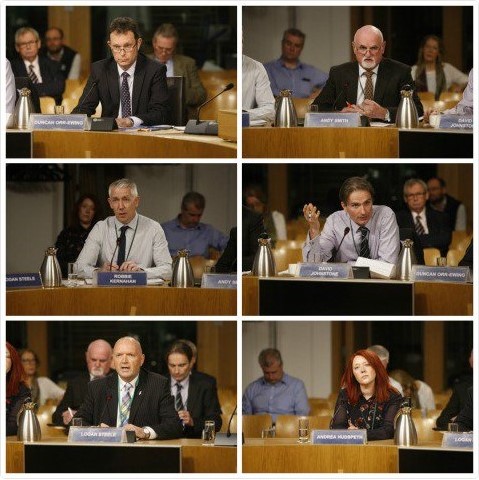
The evidence session was split in to two parts. The first part comprised evidence from the petitioners (Logan Steele & Andrea Hudspeth from the SRSG) and the second part comprised a panel of ‘stakeholders’ including Logan Steele, Duncan Orr-Ewing (RSPB Scotland), Robbie Kernahan (SNH), Andy Smith (Scottish Gamekeepers’ Assoc) and Lord David Johnstone (Scottish Land & Estates). (Photos from ECCLR webpage).

We’re not going to go through the transcript line by line because that would be tedious, but instead we wanted to comment on a few observations.

Unlike the evidence session held at Westminster last autumn, this was a civilised, unbiased hearing. That may be because, unlike the Westminster Environment Committee, none of the ECCLR Committee have a direct conflict of interest in the subject nor receive payment from any of the organisations represented by the witnesses. The Convenor of the ECCLR Committee (Graeme Dey MSP) was far more professional than his inexplicably rude Westminster counterpart, and although Mr Dey is known to support the propagandist Gift of Grouse campaign, his management of this evidence session was reasonably balanced and fair.

In the first part of the session, Logan and Andrea gave measured, thoughtful evidence about the continuing issue of illegal raptor persecution, supported by decades of scientific monitoring and peer-reviewed science. These two witnesses deserve much kudos. They are ‘ordinary’ members of the public, so exasperated by the failure of successive Governments to sort out this problem that they’ve been moved to exercise their right through the democratic process of petitioning the country’s decision-makers. As a result, they’ve been vilified on social media, exposed to a barrage of personal abuse from certain individuals within the game shooting sector, and yet here they were again, calmly and adeptly stating their case. We all owe them a massive vote of thanks.

The performance of the other witnesses was mixed. Andy Smith (SGA) is doubtless well intentioned but his ability to engage in the actual discussion is limited. He clearly had a list of points he wanted to get across, but blurting them out whenever he had an opportunity to speak, instead of listening to the question that was posed and reacting to that, didn’t help his cause.

Robbie Kernahan (SNH) didn’t say too much, and most of what he said was fairly standard SNH-speak (i.e. fence sitting), although he did make an important opening statement that should add some gravitas to the Committee’s future deliberations:

Generally, in Scotland, we have quite a positive message about the recovery of raptor populations from those all-time lows. It is certainly a national picture. However, that is not to say that there are not issues. Certainly, some of the concerns about the intensification of moorland management prompted our scientific advisory committee to have a review two years ago. Without wanting to go through that chapter and verse, I can say that there is no doubt that the on-going issue of raptor persecution is inhibiting the recovery of populations in some parts of the country“.

The evidence provided by Duncan Orr-Ewing (RSPB) and David Johnstone (SLE) was perhaps the most interesting. Duncan spoke with authority about the extent of illegal raptor persecution, saying the RSPB “thinks the situation is as bad as it has ever been“, while David flatly denied this, pointing to the annual ‘body count’ as his supporting evidence but completely ignoring the long-term population data, as published in peer-reviewed scientific papers. When asked by the Convener whether there was a possibility that culprits might now be better at hiding the evidence, in part pressured by measures such as the threat of vicarious liability, David’s response was “No“. No? Really? No possibility of that happening at all? Come on.

What made David’s response even more incredible (in the literal sense) was that SLE, as members of the PAW Scotland Raptor Group, have been made aware of the recent flow of scientific papers (e.g. on red kite, golden eagle, hen harrier, peregrine), all clearly showing population-level impacts of illegal raptor persecution, and as PAW partners, are supposed to have been advising their members accordingly. So how come the Chairman of SLE hasn’t been informed?

And on the subject of ‘possibilities’, much was made of the possibility of estates being ‘set up’ (i.e. someone planting evidence) if a licensing system was introduced. Both Logan and Duncan accepted that this was a possibility and they were right to do so. Of course it is a possibility, although on previous experience, the probability of it happening seems quite low.

In January 2012, just after the introduction of vicarious liability, David Johnstone was cited as saying there was a risk of estates being set up in response to the new vicarious liability measure. Five years on, there hasn’t, as far as we are aware, been a single case of an estate being ‘set up’.

Similarly, in November 2013, the then Environment Minister Paul Wheelhouse was asked during a Parliamentary Committee whether estates being ‘set up’ was a legitimate concern for landowners and gamekeepers. Wheelhouse responded that yes, it was a possibility, but that there wasn’t currently any evidence to support such claims, although a new study on trap interference was due to assess the issue. The results of that study showed that the illegal tampering of traps was not as widespread as the gameshooting industry had claimed (see here) and when it had happened, the interference mostly related to trap ‘damage’ (rendering the trap inoperable) as opposed to setting an illegal trap to infer a guilty responsibility on the estate.

There was quite a lot of discussion about what a licensing system might look like, and it was argued by Logan and Duncan that it should be based on the civil burden of proof (much like the policy used for General Licence restrictions) and that this should be a tiered approach, so that a number of incidents would be required before a licensing penalty was applied. David Johnstone was totally opposed to this, saying that the use of the civil burden of proof would be too much of a business risk. There was quite an amusing discussion about this between him and Committee member Mark Ruskell MSP, who argued that if the business was already fully compliant with the law, as David claimed, then the risk should be very low.

All in all, it was a useful evidence session and the ECCLR Committee will be hard pressed to justify not taking things further. The Committee now has to consider the evidence presented and decide on its next move. We may well have to wait until after 8 June to find out what that move might be, because thanks to the forthcoming General Election, no political or sensitive announcements or decisions are permitted during election purdah.

ECCLR Committee’s latest thoughts on gamebird licensing petition

This morning the Scottish Parliament’s Environment, Climate Change & Land Reform (ECCLR) Committee considered how to progress the Scottish Raptor Study Group’s petition calling for the introduction of a state-regulated licensing system for all gamebird hunting in Scotland.

You may recall the petition was submitted to the Scottish Parliament’s Public Petitions Committee last summer. That Committee took evidence in October 2016 from the SRSG and RSPB Scotland (see here) and then evidence from the Scottish Moorland Group and BASC in December 2016 (see here) before deciding to pass the petition to the Environment, Climate Change & Land Reform (ECCLR) Committee for further consideration.

This morning the ECCLR Committee spent 7 minutes discussing the petition and various ways forward. The video of this morning’s discussion can be viewed here (the relevant start time is 1:46.11) and the official transcript can be read here (starts at page 37): ecclr-transcript-31-jan-2017

One Committee member, Alexander Burnett MSP (Scottish Conservative & Unonist Party, Aberdeenshire West), declared his shooting interests before suggesting that the petition should be dismissed outright because, amongst other things, “those who shoot are already licensed by extremely rigorous shotgun and firearms regimes“. He clearly hasn’t been following the case of the East Arkengarthdale Estate gamekeeper who was able to keep his shotgun and firearms certificates, despite admitting his involvement with an illegal poisons cache (see here).

Fortunately, Mr Burnett’s suggestion found no support from other Committee members and a decision was made to:

(a) Write to the Environment Cabinet Secretary to ask when the gamebird licensing review will be published, and to suggest that it be made available pronto so the ECCLR Committee can continue deliberations without further delay. It was suggested that the Committee would like to be in a position to proceed by March. (Remember, the publication of this review is already overdue and this delay is now affecting other areas of Parliamentary process).

(b) Write to the Environment Cabinet Secretary and ask for her opinion on the effectiveness of other measures such as vicarious liability, general licences etc.

(c) After receipt of the gamebird licensing review, and following a short period of time to consider its findings, the ECCLR Committee will potentially invite the Petitioner (Logan Steele of the Scottish Raptor Study Group) and a range of stakeholders to give further evidence.

UPDATE 22 Feb 2017: letter-from-ecclr-convenor-to-cab-sec-re-petition-pe1615_7feb2017

UPDATE 6 April 2017: Cab Sec letter to ECCLR re gamebird licensing_7March2017

ECCLR Committee to discuss gamebird licensing petition next week

Things are moving forward with the Scottish Raptor Study Group’s petition calling for the introduction of a state-regulated licensing system for all gamebird hunting.

You may recall the petition was submitted to the Scottish Parliament’s Public Petitions Committee last summer. That Committee took evidence in October 2016 from the SRSG and RSPB Scotland (see here) and then evidence from the Scottish Moorland Group and BASC in December 2016 (see here) before deciding to pass the petition to the Environment, Climate Change & Land Reform (ECCLR) Committee for further consideration.

The ECCLR Committee will discuss this petition at its next meeting (Tuesday 31 January 2017) and we’ll be able to watch proceedings live on Scottish Parliament TV (we’ll add a link nearer the time).

We have no idea how the ECCLR Committee will progress this issue – for example, they may decide to call for more evidence, they may decide a public consultation would be a good way forward, they may decide to knock the whole thing on the head. We’ll have to wait and see.

Wouldn’t it be helpful if, before Tuesday’s meeting, the members of the ECCLR Committee could read up on how gamebird hunting is regulated in other countries, to allow them to compare and contrast with the lack of regulation in Scotland? If only there was a Government-commissioned report about this very issue….Ah, there is, it just hasn’t been published yet.