Gamekeepers lead disgusting hate campaign against conservationists (1)

WARNING: For those of a sensitive disposition this post will contain examples of grossly offensive material so if you’re likely to get upset by reading it I’d suggest you don’t go any further than this point.

Today’s post is a follow-on from yesterday’s post (With straight faces, gamekeepers complain about abuse) and it’s recommended you read that first to understand the context of what you’re about to read here.

What follows are a number of examples of the obscenities hurled by gamekeepers and others in the game-shooting industry at those of us who campaign for an end to the illegal killing of birds of prey on game-shooting estates and for strict environmental regulation of the UK game-shooting industry.

There’s so much material it’s going to take a number of blogs to publish just a simple overview to demonstrate the extent and type of abuse we receive. So today’s blog will focus on the abuse I’ve received – future blogs will focus on the abuse my colleagues and others have received.

I don’t write this as a casual observer / commentator. I write it as someone who has been at the receiving end of a targeted smear campaign of hatred for approximately six years.

I am subjected to a volume of online personal abuse pretty much on a daily basis; it’s routinely misogynistic and usually along the lines of being a nasty / ugly / fat / evil / poisonous / vile / lying / bitter / miserable / bigoted / dirty / rabid / lesbian / bitch / whore (take your pick of these or add any other offensive adjective of your choice).

I’ve been accused of being a ‘deranged whore’ and an ‘animal rights extremist’.

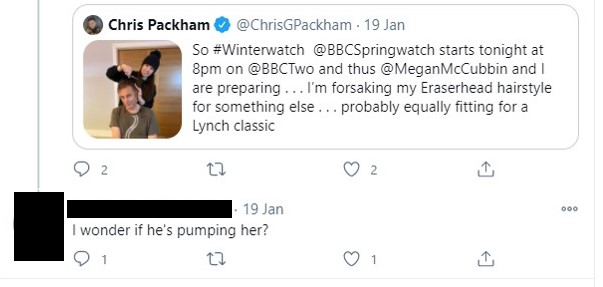
I’ve been accused of sleeping with Dr Mark Avery, Chris Packham, First Minister Nicola Sturgeon, RSPB Investigator Ian Thomson, Cabinet Secretary Roseanna Cunningham, Professor Ian Newton, Chief Inspector Lou Hubble and Andy Wightman MSP.

My personal telephone number has been published and folk have been incited to make abusive phone calls.

I have received abusive text messages.

My home address has been published and shared on social media. Photographs of my home have been published and shared on social media.

I have been followed and photographed on grouse moors and these have been published on social media with accompanying defamatory comment.

I have been accused of fabricating evidence, of perverting the course of justice, of inflicting cruelty to wildlife, of killing eagles, of planting evidence, and conversely (and bizarrely) of withholding evidence from the police, of lying to the police, of lying to Ministers, of lying to supporters, of lying in general…….I think you get the picture.

I don’t often talk about this stuff because frankly it’s not good for my mental health but I have documented the evidence, systematically and meticulously, for over six years and now some of that evidence is being used to support a number of ongoing investigations in to harassment, stalking and offences under the Malicious Communications Act.

Now, I’m not for one minute going to claim that I’ve never ridiculed anyone. Of course I have, many a time, probably just like many people reading this blog will have done. And I intend to continue – humour and mild ridicule are powerful tools for challenging all sorts of people and policies and besides, it helps me to deal with the daily onslaught. However, there is a line that I don’t cross and I certainly don’t support libellous or grossly offensive commentary about anyone, which is evidenced by the strict editorial policy on this blog.

To be clear, I’m not posting about online abuse to elicit any kind of response – I don’t need tea & sympathy, I have a fantastic support system in place and a world-class mental health coach – I’m posting this stuff simply to counter the ridiculous narrative from the game-shooting industry that they’re all innocent victims.

Awareness about campaigns of abuse will be nothing new to some of this blog’s followers – many of you will no doubt remember the disgraceful abuse suffered by a small local brewery in Lancashire (Bowland Brewery) a few years ago after they posted a photograph of Chris Packham and Mark Avery enjoying a pint of Hen Harrier, a brew developed to help raise funds for the RSPB’s hen harrier conservation work. That particular hate campaign was led by a former gamekeeper in Scotland and involved many other gamekeepers from across the UK (see here).

Ok, so here we go….

EVIDENCED EXAMPLES

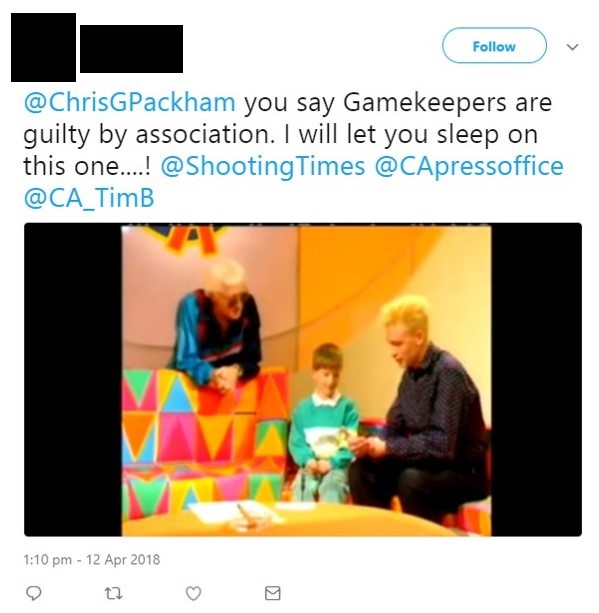
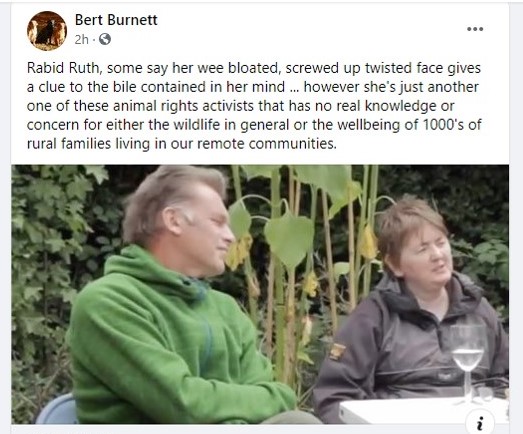
This is written by Bert Burnett, a former Director of the Scottish Gamekeepers Association and a current columnist for the SGA’s quarterly rag for members, who over the last 12 months alone has published almost 100 abusive posts targeting me. He also routinely targets my colleagues at Wild Justice, RSPB and the Scottish Raptor Study Group:

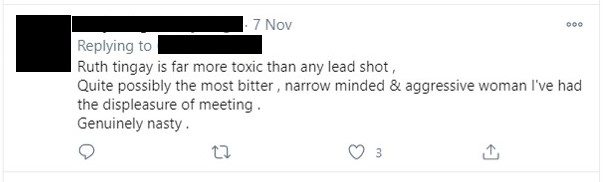
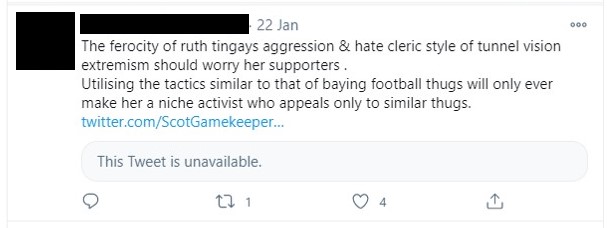
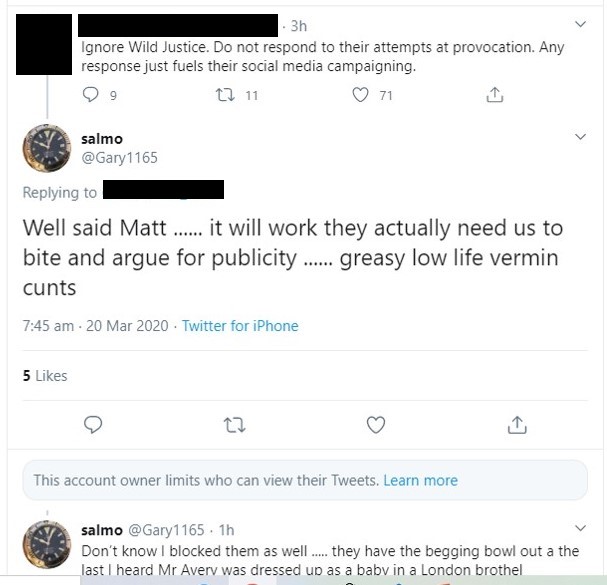
The following three are written by people who identify themselves as gamekeepers:

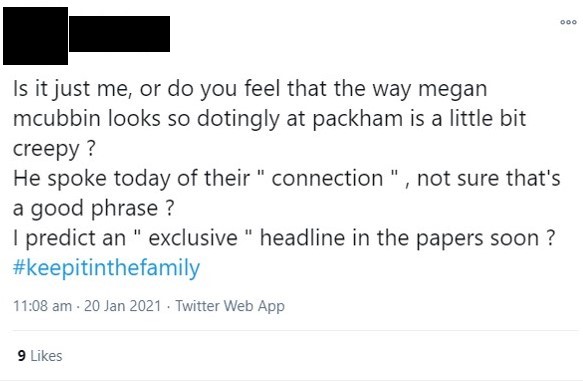
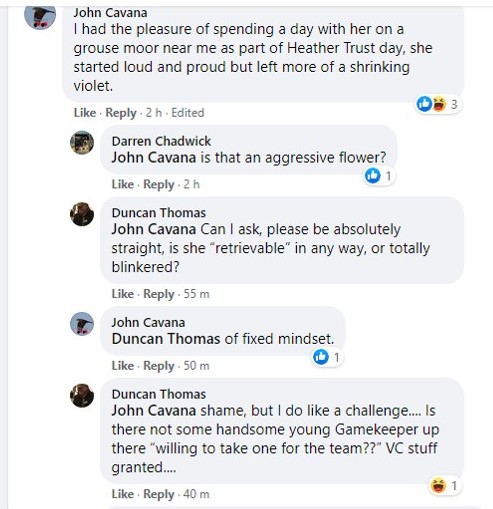
This one from January 2021 documents an example of casual misogyny by Duncan Thomas, BASC’s Director of Northern England, no less! I hope he doesn’t have any direct supervisory capacity of any females at BASC.

I wonder if misogynistic abuse is BASC policy? I’m sure it isn’t. Perhaps I’ll write and ask.

As a co-director of Wild Justice I am also at the receiving end of some pretty gross and offensive abuse. Since we launched our not-for-profit company two years ago it’s provided another avenue for gamekeepers and their supporters within the game shooting industry to publish obscene comments about the three of us. We’ve written before about some of the abuse we’ve received (see here but beware, it’s particularly unpleasant).

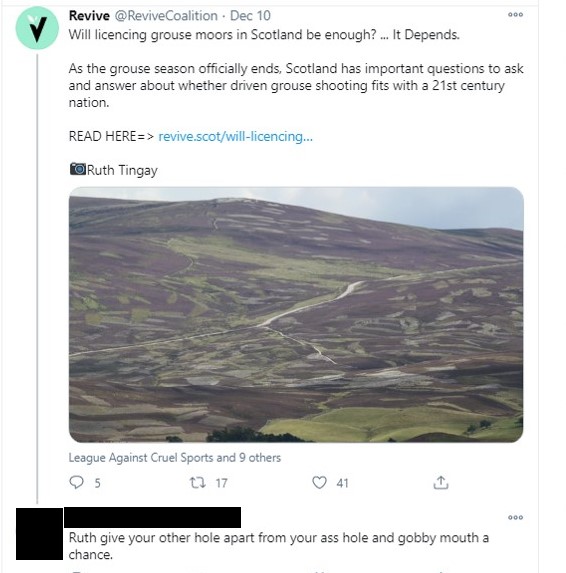
Here are some more examples:

On that note, I think that’s probably enough for today.

I will be writing more on this subject shortly.

UPDATE 19th February 2021: Gamekeepers lead disgusting hate campaign against conservationists (2) (here)

UPDATE 17th March 2021: BASC Director Duncan Thomas apologises for misogynistic abuse (here)

UPDATE 18th July 2021: Organised crime, harassment & intimidation – another day on the grouse moors (guest blog) (here)
Gamekeepers responsible for more illegal raptor killing than any other profession

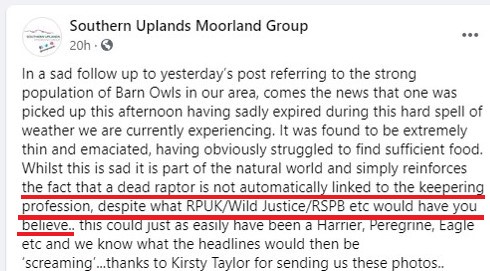
Somebody sent me a screen grab the other day of a statement posted on social media by the Southern Uplands Moorland Group (SUMG), which is one of a number of regional groups representing grouse moor estates around the country and designed to persuade the public that birds of prey are warmly welcomed and that gamekeepers love having birds of prey on their ground.

The statement published by the SUMG is fairly typical of the misrepresentation of facts that we’ve all come to expect from certain quarters of the grouse shooting industry. It reads as follows and I’ve underlined the sentence of interest:

Now, I can’t recall EVER saying on this blog that a dead raptor is automatically linked to the [game]keepering profession and there are numerous examples of illegal raptor killing offences that I’ve reported on here over the years where gamekeepers have quite clearly not been responsible (e.g. see here, here, here, here, here, here, here etc).

As a co-director of Wild Justice I’m also pretty certain that WJ has NEVER made such a claim. If there is such evidence, the SUMG are challenged to provide it.

I can’t speak for the RSPB but I can’t imagine they would EVER make such a ridiculous claim either.

Speaking for myself, I don’t even believe, as some do, that ALL gamekeepers are raptor killers. A lot of them are, of that there’s no doubt whatsoever, and some other gamekeepers will benefit from that killing even if they’re not doing the actual killing themselves, but I also know of some decent, law-abiding gamekeepers who are as thrilled at seeing a raptor as I am. I’ve met them and have worked with them, so I know they exist.

However, there’s no getting away from the undeniable evidence that shows overall, gamekeepers in the UK are responsible for more illegal raptor killing than any other profession. If you want to see the evidence, have a look at this pie chart published by the RSPB last year in their annual Birdcrime report:

Interestingly, one of the individuals included in the convicted gamekeepers section of this pie chart was a certain Alan Wilson, a member of the Scottish Gamekeepers Association who was convicted in 2019 of a catalogue of horrendous wildlife crimes he committed on the Longformacus Estate, a grouse/pheasant shooting moor in, er, the Southern Uplands (see here).

It strikes me that the Southern Uplands Moorland Group would do well to concentrate on ousting the criminals within the gamekeeping industry rather than smearing those of us who report on such crimes and who, quite legitimately, campaign for the Government to clamp down on the criminals involved.

Lies, damn lies & statistics

The following is a guest blog written by someone who wishes to remain anonymous. I know who they are and I understand their reason for wishing to remain anonymous. When you’ve read the blog, you’ll probably understand, too.

This guest blog was originally submitted last week so some of the figures referring to the number of abusive attacks by the Scottish Gamekeepers Association since the beginning of the year will probably now be out of date.

Lies, damn lies & statistics

In November last year, the Scottish Government finally published some more results of their socio-economic review of driven grouse moors (see here). These findings contributed to the Government’s thoughts about how to finally respond to the Werritty review of grouse moor management.

That response, accepting the need for immediate introduction of grouse moor licensing, as well as the regulation of muirburn and the use of medicated grit, came on 26 November. It was widely welcomed by those who had fought long and hard for progress on this issue. But of course, immediately afterwards, and ever since, the announcement led to a considerable amount of wailing and gnashing of teeth from the grouse shooting industry.

Their initial over-the-top response predictably suggested impending rural Armageddon, but it was much the same as they had been saying since the prospect of grouse moor licensing increased when Professor Werritty published his report back in December 2019. Landowners’ lobby group Scottish Land & Estates called the licensing announcement “unnecessary, disproportionate” and “draconian”. A bit like poisoning a young white-tailed eagle on a grouse moor in a National Park?

A few days later the Scottish Gamekeeper’s Association chairman told the world he was “angry beyond expression”, before going on to express how angry he was.

Then, after further dummy-spitting and throwing their toys out of the pram, the SGA announced that they were going to march on Holyrood to protest because “everything to do with our way of life” was being scrutinised.

Just the same as the rest of us then.

I think they want us all to feel sorry for them. But the shooting industry’s latest bout of playing the victim card began just before the Werritty response announcement, when the Scottish Government’s review reports were published. The focus of the industry’s media blitz was a carefully cherry-picked bit of this work, included in the report on the rights of gamekeepers.

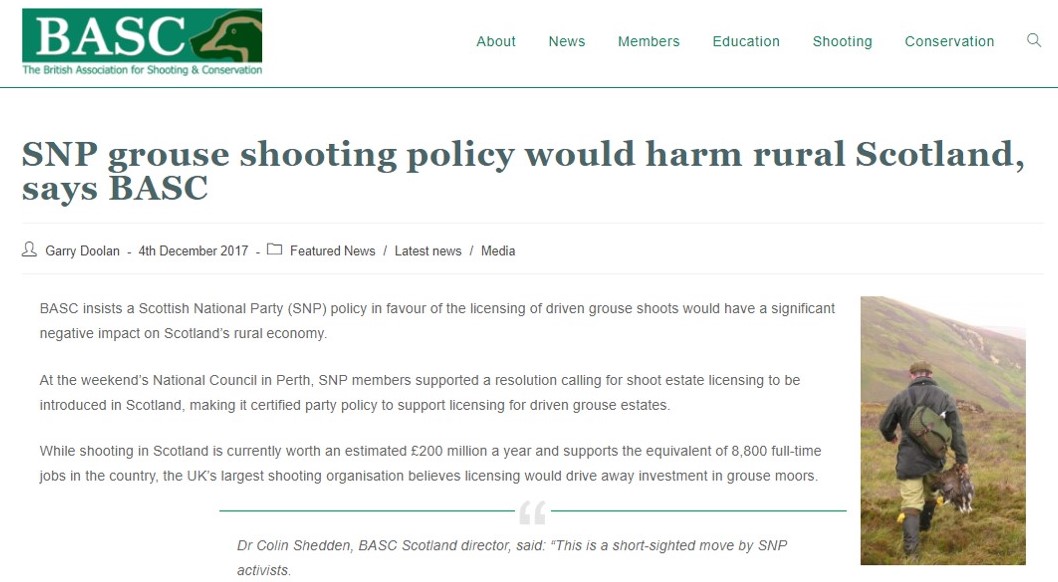
BASC, who were members of the research advisory group overseeing this review (along with SLE, RSPB, NatureScot & SGA), started the ball rolling with a press release saying that “as many as 64% of Scottish gamekeepers experience threatening behaviour or abuse from members of the public at least once every year”. Spokesman Ross Ewing goes on “It is clear that this contemptuous behaviour is in part a product of concerted and maligned campaigns against shooting”.

Readers of this blog will know that many individuals who publicly speak out against some management practices associated with shooting are frequent recipients of abuse and threats, personal attacks, smears or campaigns of intimidation.

Anyone who is the recipient of this sort of behaviour will confirm that it is abhorrent, and will condemn it out of hand.

The claims made by BASC do deserve some scrutiny, however, not least because they are being routinely repeated in the shooting media and elsewhere, even as recently as last week.

The “Employment Rights of Gamekeepers” report was produced for the Scottish Government by SRUC. In introduction, it acknowledges that it is “one of the first independent attempts to investigate the gamekeeping profession and develop a profile of the people involved in the sector, their terms and conditions of employment and opinions they have on issues that impinge on their working lives.” Significantly, it also says that “a number of biases inherently exist within surveys of this type” and goes on “the findings should therefore be viewed with these caveats in mind”.

Funnily enough, none of the media coverage we’ve seen seems to mentions this.

The details about threatening behaviour appear on pg 37 of the report and states – “56% of respondents had experienced abuse/threats ‘rarely’ (once or twice per year), with 7% reporting ‘occasional’ abuse/threats (once or twice a month) and 1% ‘often’ (one or twice per week). That adds up to 64% as claimed by BASC in their press release.

But let’s look a bit more closely at the figures.

Firstly, we need to remember that this work was being undertaken parallel to and with the intention of informing the Scottish Government’s ongoing consideration of the future of grouse moor management, with a recommendation for licensing a very real possibility.

The prospect of shoot licensing described by BASC as long ago as 2017 as having “significant consequences for rural people and businesses”, and the SGA’s chairman quoted in the 22 Feb 2017 edition of Shooting Times as saying licensing “would drive wives, children and grandchildren from their homes”.

Unequivocal, emotive and very strong language, that you would imagine if they had agreed would have had the gamekeeper members of BASC & SGA flocking to contribute to the Scottish Government-commissioned review of the rights of gamekeepers, therefore having their own input to the decision-making process?

The online survey ran for two months, up to February 2020. The published report states “Gamekeeper members of BASC Scotland and the SGA were individually sent details of how to participate in the survey by these membership bodies, who also took actions to encourage uptake through newsletter articles, social media campaigns (Facebook and Twitter) and a radio interview (BBC Radio Scotland Out of Doors – January 2020).”

That’s a lot of publicity and encouragement, and at a time when grouse industry representatives had repeatedly been claiming their industry was under threat, you can understand them perhaps throwing everything at what they thought we be a good opportunity for the strength of feeling to be articulated. Similarly, it’s reasonable to expect that if Scotland’s gamekeeping community believed what their representative organisations were telling them, they would have been champing at the bit to tell their story.

The results were clear.

152 responses were received, 10%-13% of the Scotland’s gamekeepers.

Let that sink in. Only 1 in 9 of Scotland’s gamekeepers were so convinced by the scaremongering by SGA and BASC that they could be arsed responding to the survey by a group commissioned by the Scottish government to inform their grouse moor review. Does that mean 8 in 9 of Scotland’s gamekeepers realise that there is nothing to fear from licencing if you are managing your ground within the law? Let’s hope so!

But this response rate also calls into question the sweeping claims subsequently made in the media about 64% of gamekeepers suffering abuse. Let’s remember the caveat in the report: “a number of biases inherently exist within surveys of this type”.

If I had suffered regular or even occasional abuse just because of my work, here was an outlet where I could be counted, the abuse would be documented, the government and the public would be aware. I would want to participate.

Clearly some did. However, this was not 64% of Scotland’s gamekeepers, but 64% of the 152 people who felt sufficiently motivated to bother filling in a survey that BASC & SGA were pushing hard for their gamekeeper members to participate in.

What this survey actually reveals is that 97 people received personal abuse simply because they are gamekeepers. Again, this abuse is condemned unreservedly. But, this is not the “almost two thirds of Scotland’s gamekeepers” shamelessly peddled to the media!

Therefore, it’s entirely right that we question not just the questionable conclusions and extrapolations from this very limited, strongly caveated dataset, but also the flagrant hypocrisy of those who have desperately tried to make some capital out of these figures.

The latter predictably features the pointless and increasingly marginalised SGA, who since the 1st January this year, have either through posting on their website, publishing in their magazine, hosting on their social media accounts or sharing other’s equally squalid content, have on at least twenty-two occasions made personalised attacks, or published/shared smears, misrepresentations and unsubstantiated allegations targeting at least 9 named individuals simply because they perhaps don’t share their enthusiasm for grouse shooting/mountain hare culls etc.

They also recently hosted photos of four un-named but readily identifiable individuals with accompanying unsubstantiated allegations of crime/malpractice as comments by their supporters on their Facebook page, and have made similar accusations or smears against nine other organisations on at least eighteen occasions this year already.

And just to show how far they will stoop, one of the people targeted by a recent post on the SGA’s Facebook page died almost four years ago.

Lovely people, the SGA.

ENDS

Grouse moors – ‘a birdwatchers’ paradise’ according to Chair of Scottish Gamekeepers Association

Don’t laugh.

Actually, do laugh.

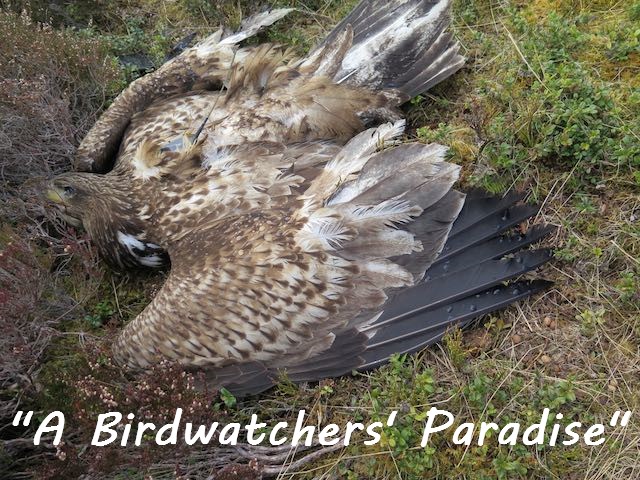
Alex Hogg, Chair of the Scottish Gamekeepers Association, was interviewed last week and he said some pretty baffling things about gamekeeping and grouse moor management, including the fantastic statement, “This is a birdwatchers’ paradise“.

Yep, he really did.

[An illegally poisoned white-tailed eagle, found dead on a grouse moor in the Cairngorms National Park earlier this year – see here and here. What a birdwatchers’ paradise!]

Alex was talking to a presenter on ITV’s regional news programme Representing Border on 2nd December 2020. The programme featured a piece on the Scottish Government’s recent decision to introduce a licensing scheme for driven grouse shooting (here) and it’s well worth five minutes of your time.

The programme is available here (starts at 15.49 mins, ends 22.01).

There was more baffling commentary from Alex, including this unfathomable statement on the effect a licensing scheme would have on gamekeeping:

We’ve done it for 200 years, we’ve kept a balance in the wildlife, and if we, it’s like a three-legged stool, if they take the leg away, we’re gone“.

Eh? I’ve no idea what ‘the leg’ is that he thinks is being ‘taken away’ and why he thinks a licensing scheme means gamekeepers will be ‘gone’. They’ll be gone if they breach the conditions of the licence (assuming it’s effectively enforced) but if they’re not doing anything illegal why would a licence cause them difficulties?

Unfortunately the presenter didn’t follow up on this, or if he did it was edited out. It’s also a shame he didn’t pick up on Alex’s statement about 200 years worth of ‘balancing the wildlife’ and ask him questions about why several species of raptors became extirpated from the UK about 100 years ago? And although some have made a brilliant comeback (with some help), why some populations are still struggling, notably in areas managed for driven grouse shooting? He could also have asked this question of Liz Smith MSP (Scottish Conservatives) who said she didn’t think that “fairly draconian” licensing was needed now!

Other interviewees were much more lucid, including Ian Thomson (RSPB Investigations, Scotland), Claudia Beamish MSP (Scottish Labour) and Mairi Gougeon (Environment Minister), who gave a robust argument for bringing in a licensing scheme now instead of sitting around for another five years doing nothing, including this statement:

There are still persistent problems out there with the illegal persecution of our birds of prey“.

It’s good to see this statement from a Scottish Minister. Can you imagine a similar comment from a Minister at Westminster?

Scotland’s gamekeepers are revolting

Scotland’s gamekeepers are apparently very very angry. So angry they’re going to revolt. Well, protest.

But protest about what? Apparently about having to work within the law.

It’s all so unfair.

This is all part of the response to last week’s news that the Scottish Government has finally reached the end of its tether with the criminality associated with driven grouse shooting and has decided to implement a licensing scheme, not just to tackle the ongoing lawlessness but also to reign in the associated environmental damage (see here).

Here’s how the Scottish Gamekeepers Association (SGA) reacted to the news, with this statement on its website:

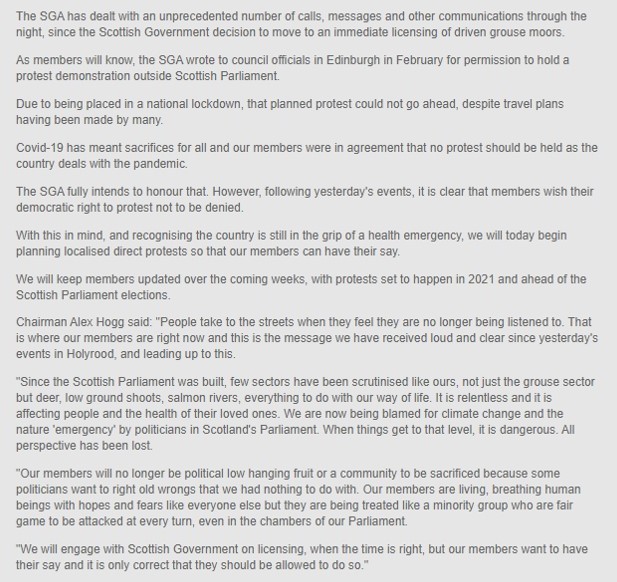
And here’s a further reaction the following day, announcing in a tragic display of victimisation, a series of what it calls ‘localised direct protests’:

You’d think that they’d just been told that gamekeeping was no longer an option and that all their guns, traps, poisons and snares had to be surrendered with immediate effect.

It’s only a licensing scheme, FFS. What’s the problem? Scared that it’ll be difficult/impossible to comply with regulations?

SNP leadership faces grassroots rebellion at conference over watered down grouse shooting motion

The scandal that is driven grouse shooting continues to feature prominently in the Scottish media as pressure continues to mount on the Scottish Government to respond to the Werritty Review on grouse moor licensing, a report that was submitted to the Government almost a year to the day (18 November 2019).

Last week The National ran an article on the 25 regional SNP branches who had submitted a motion for debate at the national conference calling for an end to driven grouse shooting in Scotland (see here).

The motion was proposed by councillor Julie Bell of Kirriemuir and Dean (Angus) and seconded by Ruth Maguire MSP. The resulting personal abuse hurled at them on social media from those with a vested interest in maintaining grouse shooting won’t have gone unnoticed by Julie, Ruth or their party colleagues and probably beyond.

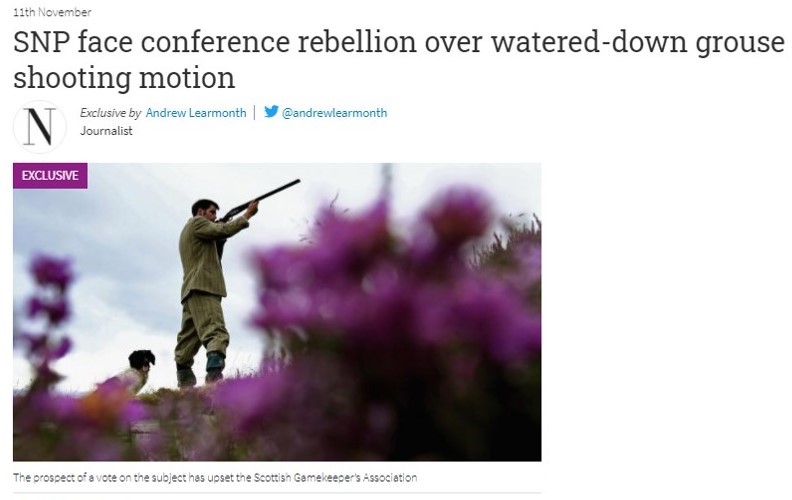
Meanwhile, the motion appears to have been watered down considerably, despite being ‘the most backed resolution this year’, and as a result, Ruth Maguire MSP has lodged an amendment. The National ran an article on this yesterday, as follows:

THE SNP leadership faces a grassroots rebellion at this year’s conference over plans to end grouse shooting in Scotland.

The prospect of a vote on the subject has upset the Scottish Gamekeeper’s Association, who warn that the party risk alienating the countryside.

An initial motion to conference calling for an end to “unsustainable practices on grouse moors including the snaring, trapping and killing of hundreds of thousands of animals, muirburn and mass outdoor medication” was popular with members, being the most backed resolution put forward.

However, it was missing from the conference agenda. Instead there was another resolution which called for Scottish Government to continue its work “on regulating sporting estates in order to protect our biodiversity, native species and peatlands.”

MSP Ruth Maguire said this didn’t go far enough. Backed by her Holyrood colleague Christine Graham and a number of branches, she’s now submitted an amendment which urges the party to back the licensing of all shooting estates, and “move away from driven grouse shooting towards more sustainable and diverse land uses”.

Maguire said: “The original motion submitted to conference appears to be the most backed resolution this year showing the strength of support within the party for tackling Scotland’s grouse moors.

“For the huge swathes of Scotland they use up, driven grouse moors are one of the most destructive land uses in Scotland for our wildlife and environment, offering little economic benefit compared to other land uses.

“As recent polling shows almost three quarters of Scots are against grouse shooting and the SNP membership want the chance to put the party on the forefront of public opinion. This amendment, like the original motion, seeks to end the unsustainable practices of grouse shooting and in line with land reform, make our land work better for our people, our wildlife and the environment.”

Scottish Gamekeepers Association Chairman Alex Hogg said: “The SNP, down the years, has enjoyed strong levels of support within working gamekeepers, their families and extended groups in rural constituencies.

“These are ordinary, hard-working individuals and families who vote for people and parties they feel will represent the interests of their communities.

“Recent policy decisions have left them alienated. Land working people, just now, are angry.

“They feel the Scottish Government is no longer listening or supporting them, despite the many benefits their work brings to the Scottish countryside and economy.”

ENDS

Funny, the so-called ‘strong levels of support’ for the SNP that I’ve seen from the SGA’s members and supporters over the last few years has consisted almost entirely of vile personal misogynistic abuse.

Here’s a short example targeting Environment Cabinet Secretary Roseanna Cunningham in March 2018 after she spoke to campaigners outside Holyrood about the mass slaughter of mountain hares on grouse moors (thanks to the blog reader who’s been compiling this material):

Roseanna hasn’t been the only target – First Minister Nicola Sturgeon has received ‘special attention’ as has Environment Minister Mairi Gougeon. And it’s not just female politicians in the SNP who have been at the receiving end of this disgraceful behaviour – politicians in the Scottish Greens and Labour have also been targeted, as have campaigners, bloggers, researchers, journalists, scientists, police officers, lawyers, raptor workers, tv presenters, bird ringers, satellite taggers, funders, charity workers, in fact anyone who dares even hint that driven grouse shooting is a Victorian throwback with huge environmental costs has been a victim of this abusive and targeted harassment.

There’ll be more on this subject shortly.

Scottish gamekeepers desperate to keep slaughtering mountain hares on grouse moors

The Scottish Gamekeepers Association (SGA) has come out all guns blazing to try and prevent the Scottish Parliament from voting to protect the mountain hare in tomorrow’s debate on Stage 3 of the Animals and Wildlife Bill.

Scottish gamekeepers are terrified that they’ll no longer be able to enjoy what everyone else sees as a grotesque bloodbath.

SGA Chairman Alex Hogg has penned a typically deluded letter to MSPs in which he claims to be ‘a representative of the people of all of Scotland‘ (eh?) and how stopping the mass slaughter of mountain hares on grouse moors ‘will affect human beings’ lives’ (er…) and ‘worsen the conservation status of the mountain hare‘. Really?

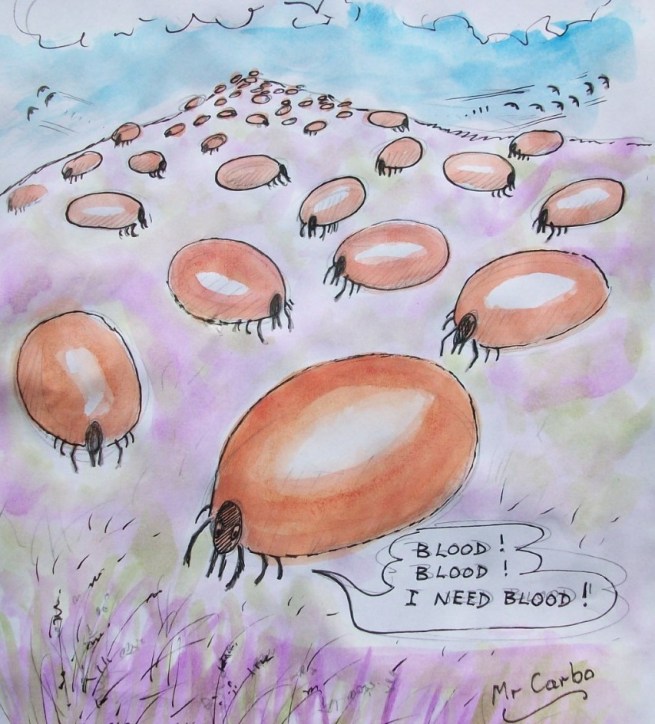
Oh, and further justification for the slaughter is the protection of walkers, ramblers and mountain bikers from the perils of Lyme disease:

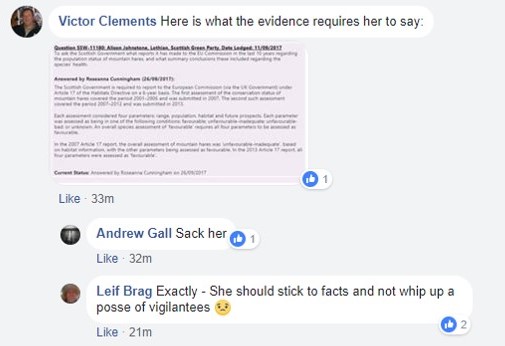
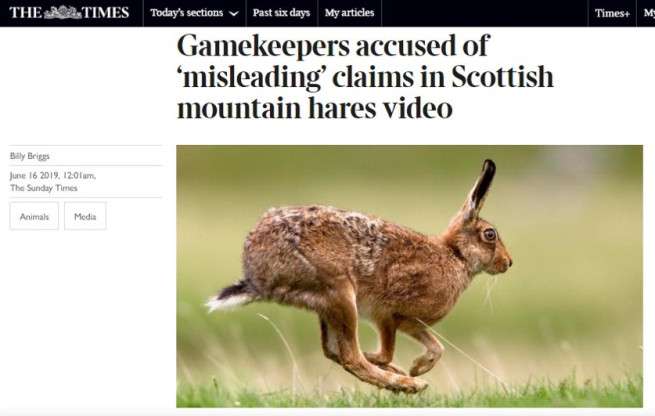
Of course, it’s not the first time the SGA has been accused of making ‘misleading’ and ‘greatly exaggerated’ claims’ about mountain hares (see here and here).

Meanwhile back on planet humanity, support is growing for MSP Alison Johnstone’s amendment to increase protection for the mountain hare that would effectively end the mass killing on grouse moors (see here and here).

The RSPB has published a good blog in support (here), as has animal welfare charity OneKind (here), and the signatures on the Scottish Green’s petition calling for support has now passed 12,000 in just a few days. If you’d like to sign it, please visit HERE.

Please keep writing to your MSPs – we know that mail bags have been inundated on this topic and it’ll be of great interest to see who votes in support of this amendment in tomorrow’s debate.

Parliamentary questions on lead ammunition & medicated grit on grouse moors

The Scottish Greens just keep piling on the pressure.

Some interesting Parliamentary questions from Mark Ruskell MSP on the toxic hazard of lead ammunition and the use of medicated grit on grouse moors:

Question S5W-29820, Date Lodged: 09/06/2020

To ask the Scottish Government what proportion of the active ingredient in the medicated grit that is used on managed grouse moors is excreted by the birds. [Expected answer date 24/6/2020]

Question S5W-29821, Date Lodged: 09/06/2020
To ask the Scottish Government what assessment SEPA has made regarding the wider environmental impacts of the medicated grit that is used on grouse moors. [Expected answer date 24/6/2020]
Question S5W-29822, Date Lodged: 09/06/2020
To ask the Scottish Government what testing is carried out on the levels in the human food chain of the active ingredient in the medicated grit that is used on grouse moors. [Expected answer date 24/6/2020]
Question S5W-29823, Date Lodged: 09/06/2020
To ask the Scottish Government when it expects the use of lead ammunition to be entirely phased out on (a) public and (b) private land. [Expected answer date 24/6/2020]
Question S5W-29824, Date Lodged: 09/06/2020
To ask the Scottish Government what level of lead from shot gameboards [sic] is present in the human food chain, and what regular analysis it carries out of this. [Expected answer date 24/6/2020]
The Scottish Government is going to struggle not to look completely incompetent and/or wholly unconcerned about the unregulated toxic hazards that feature on driven grouse moors. This can be stated with confidence because the answers to Mark’s questions are already known.
The active ingredient in medicated grit is Flubendazole, a drug that has been identified as ‘an emerging environmental contaminant of acute and chronic toxicity’ and has been shown to be particularly toxic to aquatic organisms. Previous Freedom of Information requests submitted by this blog have revealed that the Scottish Government is not monitoring the impact of medicated grit, even though it’s known that some in the industry are using a super-strength dose up to twenty times the original dose! Surveillance undertaken by the Veterinary Medicines Directorate (VMD), responsible for the national (UK) monitoring of veterinary drugs in food products, has been woefully inadequate, and that’s being kind. In a country that shoots an estimated three quarters of a million red grouse each year, the VMD proposed to test just ten birds in 2018 (see here).
The use of lead ammunition to shoot gamebirds in the UK is unregulated, despite the well-documented high toxicity of this metal and the consequential health implications of consuming it. With most of the previously significant sources of lead in the environment now having been eliminated decades ago (e.g. lead-based paints and leaded petrol), lead-based ammunition is the most significant unregulated source of lead deliberately emitted in to the environment. It’s a poison, it’s as simple as that.
If that wasn’t bad enough, the most jaw-dropping revelation is that all gamebirds (including red grouse) appear to be exempt from statutory testing for lead shot, in sharp contrast to other meat types destined for human consumption. Research (here) has shown that shot red grouse destined for the food chain may contain excessive amounts of toxic poisonous lead (over 100 times the lead levels that would be legal for other meat)!
Talk about vested interests! The law makers of the day clearly put their own pleasure and convenience above the health and welfare of the general public and the environment. It’s an absolute shocker that this continues.
The game shooting industry knows that time is up on this issue and earlier this year we saw a high profile media campaign suggesting that the industry supported a ‘voluntary ban’ on the use of lead ammunition (yeah, because this industry’s adherence to voluntary restraint is legendary, right?) and wanted to see it phased out within five years. Unfortunately, not everybody in the industry was singing from the same hymn sheet and it turned in to a bit of a car crash when the Scottish Gamekeepers Association refused to sign up (see here).
It’ll be interesting to see how the Scottish Government responds to Mark’s questions.
For those who want to find out more about the use of medicated grit and lead ammunition, download fully referenced summary report (here) from Revive, the coalition for grouse moor reform.
UPDATE 13 July 2020: Disingenuous parliamentary answers from Scot Gov on toxic hazards of grouse moor management (here)

Scottish Government denies ‘negotiating’ with gamekeepers on new offences for trap damage

In early May we blogged about a claim made by the Scottish Gamekeepers Association (SGA) that it was ‘negotiating with Government for a new offence to be created for damage to legal predator control tools‘, i.e. traps and snares (see here).

[A spring (Fenn) trap set on a log, designed to catch and kill any animal that stands on the trigger plate. Gamekeepers argue that traps like these, and others, are routinely damaged by members of the public. Photo from the Untold Suffering report published by the Revive Coalition last year. NB: It is no longer legal to use Fenn traps for killing stoats in the UK as they have been ruled inhumane – new trap designs have recently been approved (see here)]

This claim led to Scottish Greens MSP Mark Ruskell posing two Parliamentary questions earlier this week, asking the Government for details of these alleged ‘negotiations’ (see here).

Environment Cabinet Secretary Roseanna Cunningham has now responded and her answers are hilarious:

Mark Ruskell MSPTo ask the Scottish Government what discussions it has had with the Scottish Gamekeepers Association regarding creating offences and sanctions in relation to animal trap damage, broken down by (a) date and (b) location of discussion. (S5W-28828).

Roseanna CunninghamThe Scottish Government has not had any recent discussions with the Scottish Gamekeepers Association about creating offences and sanctions in relation to animal trap damage.

Mark Ruskell MSPTo ask the Scottish Government how it plans to change the law in relation to the wilful damage of animal traps. (S5W-28829).

Roseanna CunninghamUnder existing legislation and common law a person interfering with a legally set snare or trap may be committing one of a number of possible offences.

The Independent Review of Grouse Moor Management report which was published in December recommended changes to legislation on the use of animal traps. The Scottish Government is currently considering all of the recommendations in the report and will publish a response in due course.

So, in essence then, no, the Scottish Government is not involved in ‘negotiations’ with the SGA as the SGA has claimed, and no, the Scottish Government does not appear to be considering new legislation for the provision of a new offence for alleged trap damage.

Roseanna Cunningham mentions the Government’s ongoing consideration of the recommendations made in the Werritty Review but that review did not include a recommendation for the provision of a new offence for alleged trap damage. What it did recommend, however, was new legislation for trap operators to have to undertake mandatory training before being allowed to set traps!

This begs the question then, why did the SGA claim to be ‘negotiating with Government’ when apparently it is doing no such thing?!

If the SGA could put aside its delusional posturing for a second it’d do well to be spending some time reminding its members of the current legislation on trap use. According to the RSPB this week, ‘the police are following up several raptor persecution cases and multiple reports of illegal trap use on grouse moors‘ (see here). Let’s hope that none of those traps alleged to be being used illegally, belong to an SGA member.

Scottish Gamekeepers Association ‘negotiating with Government’ for new offence of trap damage

News emerged this week, via the Scottish Gamekeepers Association’s (SGA) e-newsletter for members that it is currently ‘negotiating with Government’ for the creation of a new offence relating to trap damage:

This is really quite interesting. The SGA, with others, has been arguing for several years that legally-set traps have been ‘tampered with’ or damaged by members of the public and these claims usually occur just after an illegally-set trap has been discovered and reported in the media. A recent example of this was the male hen harrier that was found in considerable distress with its leg almost severed in an illegally-set trap on Leadhills Estate (see here).

[Male hen harrier found with an almost severed leg, caught in an illegally-set spring trap next to its nest on Leadhills Estate (see here). Nobody has been prosecuted for this barbaric crime but the estate has had its use of the General Licence restricted by SNH as a direct result of this and other offences (see here)].

The implication of such claims has seemed clear – instead of accepting that some gamekeepers continue to break the law (e.g. by setting illegal traps), the shooting industry would rather deflect the blame on to so-called ‘animal rights extremists’ who are accused of ‘setting up estates’.

During a cross-party RACCE committee hearing in 2013, then Environment Minister Paul Wheelhouse said there was no evidence to support claims of widespread trap tampering/damage by ‘activists’ (see here) although it emerged that BASC was undertaking a survey to assess the extent of this alleged problem.

A couple of years later in 2015 that BASC survey revealed that trap tampering/damage did take place but according to industry evidence, it couldn’t be described as being a ‘widespread’ issue (see here).

In 2017 the SGA again complained of a so-called ‘escalation’ in trap damage and again attributed this to ‘activists’ but as we reported at the time (see here), yet again the evidence was lacking.

Let’s be clear here though. It is quite evident, just looking through social media, that some members of the public are indeed deliberately damaging traps to render them unusable, either because they have an ethical objection to the killing of native wildlife to increase gamebird stocks, or because they’ve become so frustrated with what they perceive to be a lack of enforcement action against the criminal gamekeepers, or because they believe the trap to be illegal. The legislation on trap use is complicated and many members of the public are simply unaware of what is legal and what is illegal. (For a basic introduction have a look at this from OneKind and this from Revive).

To be honest, we’d welcome some clarity on what constitutes ‘tampering’ or ‘damage’. At the moment it is not at all clear and trap tampering may not always constitute a criminal offence. For example, the SGA’s lawyer, David McKie, wrote in a 2013 edition of the SGA’s members’ rag:

As a matter of law, there is a significant difference between interference and vandalism.

Vandalism would involve the breaking of a crow cage trap by someone punching or kicking a hole in it, for example, or the deliberate smashing up of a Fenn trap. It would also include the cutting of snares.

Interference does not necessarily involve a criminal offence….That can involve the removal of traps from their set location, the release of decoy birds or the pulling of snares.

The police can probably not charge the individual with interference’.

In some cases there may be a legitimate defence to causing trap damage – e.g. if a trapped animal is seen to be injured inside a padlocked crow cage trap and needs urgent veterinary attention, but the location is remote and there’s no phone signal to call for help, it might be considered reasonable to cut the trap wire to extricate the wounded animal. Much will depend on the individual circumstances of each incident.

Another example might be the discovery of what is obviously an illegally-set trap. Is it an offence to disable it if there is absolutely no question that it’s been set unlawfully? As an example, here’s a pole trap that was photographed on an estate in the Angus Glens. It’s been an offence to set pole traps for over 100 years!

[An illegal pole trap, photograph by RSPB]

It’d be kind of ironic if a member of the public was prosecuted for disabling such a pole trap, when the person who allegedly set it (a gamekeeper was filmed by the RSPB attending the trap) had the prosecution against him dropped by the Crown Office because the video evidence was deemed inadmissible!

So, yes, regardless of the extent of trap tampering / damage, greater clarity is certainly required on what constitutes an offence. However, given how long we’ve been waiting for the Scottish Government to bring in new legislation to tackle the persistent illegal persecution of birds of prey on sporting estates, that’s happening at such a scale it’s known to be affecting entire populations of some of these species, the trap tampering offence that the SGA claims to be ‘negotiating’ should be way down the list of Government priorities.

UPDATE 12 May 2020: Parliamentary questions on proposed new offences for trap damage (here)

UPDATE 16 May 2020: Scottish Government denies ‘negotiating’ with gamekeepers on new offences for trap damage (here)