‘Unfair to accuse gamekeepers of wildlife crime’, says gamekeeper Alex

In an article published in The Courier on 30 May 2011, Ian Thomson, an investigator for the RSPB, expressed his concern about the high number of wild birds illegally killed in Tayside. 14 incidents were recorded there between March 2010 and March 2011.  In the same article, it is reported that PC Bryan Prestwood, a wildlife crime officer based in Angus, ‘believes the biggest problem is with gamekeepers and land managers’. Full article here

In an angry response published on 6 June 2011, Alex Hogg suggested it was ‘unfair to accuse gamekeepers of wildlife crime’. His letter here

I think people will make up their own minds Alex, based on the factual evidence and government statistics. You’ve even said yourself, on many occasions, that if gamekeepers were to be given licences to kill protected raptors then illegal raptor poisoning would stop. This notion was also repeated last week by David Hendry of Cardney Estate in his BBC 2 Landward interview. Quite a strange prophecy from a ‘profession’ that claims not to be involved with wildlife crime, don’t you think?

For those still in any doubt whether some gamekeepers are involved in willdife crime, and specifically raptor persecution, here’s a link to a piece we wrote on the issue last year, including some revealing statistics provided by the RSPB. Here’s a link to another piece we wrote last year, with the most recently-published RSPB statistics. These show clearly that 85% of people who were convicted of illegally killing birds of prey between 2003-2008 were gamekeepers!

Sleeping gamekeeper fined over guns on table

A GAMEKEEPER who was found asleep in a chair in his kitchen with a shotgun and rifle lying on the kitchen table was fined £160 at Inverness Sheriff Court this week.

Martin MacKenzie has been suspended from his job and also faces losing his firearms licence.

Depute Fiscal Karen Smith said police had to attend the house at Mains of Aberarder and found Mackenzie asleep at the kitchen table.

The rifle and shotgun were lying on the table, she told Sheriff Ian Abercrombie.

Mackenzie (36) of Craggan Valley, Kiltarlity, admitted on May 18 last year failing to comply with conditions of his firearms certificate that he failed to keep the guns in a secure designated place.

Craig Wood, solicitor, said Mackenzie was married with two children, and had been a keeper at Arberarder for 10 years. “Since this incident he has been suspended by his employers.”

Mr Wood added that a letter had been received from the Chief Constable asking for Mackenzie’s certificate to be revoked, but this was the subject of an appeal.

He had been using his guns and intended to clean them,” said Mr Wood. “He took several phone calls and when the police attended he accepts he should have dealt with it more expeditiously. He is a perfectly reasonable human being.”

So, it appears that Northern Constabulary consider falling asleep in your home in charge of unsecured firearms an offence serious enough to revoke a certificate. No complaints here and well done to the newly-appointed Chief Constable of Northern Constabulary, Mr George Graham. It follows then surely that the Moy and Skibo gamekeepers, convicted last week, should also have their firearms certificates revoked given the seriousness of their crimes? If you measure seriousness in terms of the court’s punishment, then both James Rolfe (Moy Estate) and Dean Barr (Skibo Estate) committed crimes far more serious than the one committed by Martin MacKenzie at Aberarder:

Rolfe = £1500 fine; Barr = £3300 fine; MacKenzie = £160 fine.

I also wonder whether MacKenzie is a member of the SGA, and if so, whether he faces sanctions in light of his firearms conviction? Incidentally, there’s still no public statement of condemnation from the SGA over last week’s convictions of the Moy & Skibo keepers. They also haven’t said whether Rolfe or Barr are SGA members and if so, whether their SGA membership has been terminated after their criminal convictions. Hopefully the SGA’s bed-fellows at PAW Scotland will be asking these questions.

Many thanks to the contributor who brought this article to our attention.

Highland News

“Professional gamekeepers do not poison raptors” says Alex Hogg

Episode 11 of the BBC 2 Scotland ‘Landward’ programme went out on Friday 27 May and included a segment on the new vicarious liability regulation in the Wildlife and Natural Environment (Scotland) Act 2011. The programme is available here for a limited period.

The segment opened with Duncan Orr-Ewing, Head of Species at RSPB Scotland, who told the interviewer, “Bird of prey poisoning is particularly associated with driven grouse moors in the upland of Scotland, in the central and eastern highlands, parts of Perthshire and also down in the southern uplands”.

The interviewer, Dougie Vipond, asked: “So who is doing this? Who is killing the birds?”

Orr-Ewing: “Well, it is estate employees, gamekeepers who are usually involved, but they are only employees, they are acting under the direct instructions so ultimately it is the landowners that are responsible for this”.

A short section followed with a brief interview with Liz Plath, listed as a rural law specialist and a partner at Thorntons Law LLP. Basically she explained in simple terms how vicarious liability brings the landowner or the employer into the frame in cases of raptor poisoning.

Next up was Alex Hogg, chairman of the SGA, whose opening line was: “Professional gamekeepers do not poison raptors”. Funny that, because if you bother to look back at the statistics on raptor poisoning for the ten-year period that Hogg has been in post, you’ll see that raptor poisoning incidents have been recorded on many estates, and yes, ‘professional’ gamekeepers have been convicted.

He then contradicted himself (and not for the first time) by saying: “It’s only a small minority that are still at it. A rogue few if you like”.  Lest we forget, here is the official government map showing confirmed raptor poisoning incidents between 2006-2010. Widespread, I’m sure you’ll agree, and the trend is pointing upwards.

He continued: “And we’ve tried our hardest over the past, I’ve now been in this job for ten years, to impress on everybody that it’s absolutely illegal to poison raptors”. Peer pressure from Hogg and co., while welcome, has been ineffective. It can’t help the situation when he and others from his industry continue to claim that raptors are having a significantly negative effect on game birds, songbirds, waders and lambs. Is there any scientific evidence for this? No, not a shred.

Next up came David Hendry, listed as the proprietor of Cardney Estate, near Dunkeld in Perthshire. Now this was an interesting interview. The piece opened with an introduction to Hendry, and video footage of a diving osprey on his estate. We were told that this estate ‘is home to many endangered birds of prey’. Unfortunately, Hendry was not asked how many and what species of raptors made their home there. The osprey was implied, but of course the osprey only eats fish, not exotic red-legged partridge (also known as French partridge) or pheasant, which are reared and released in large numbers for sport shooting on this estate, according to this shooting directory.

Vipond talked about the belief that the only way to stop poisoning is to introduce a licensing system which would allow landowners to control [kill] raptors. Hendry agreed, and suggested “it should become the gamekeeper’s job for instance to look after the rare raptors like harriers, your merlins, bring on your red kites, but they should also be allowed to reduce buzzards and sparrowhawks to numbers that are sustainable, because what we have today is not sustainable”.

Ok, so this is the first time we’ve officially heard that sparrowhawks are also the landowners’ intended target for licensed killing. Until now, the list has ‘just’ included buzzards and ravens. So what happens if they get the go ahead to kill these species? Will we see goshawks added to the next list? They’re just an over-sized sparrowhawk after all, so why not? And golden eagles? They’re just over-sized buzzards, so why not? Where will it stop?

It’s also very interesting that he thinks the current number of buzzards and sparrowhawks is ‘unsustainable’. According to this shooting website, Cardney Estate offers shooting days where between 200-400 exotic birds (partridge/pheasant) can be shot. That’s 200-400 birds per shooting day, depending on the time in the season. In September 2010, a record 677 birds were shot on one day according to one participant! Sounds to me like this sporting estate is doing very nicely thank you, without the need to kill off any indigenous protected raptors, whatever species they may be.

We then went back to Orr-Ewing, who was asked for his opinion about the need to ‘manage’ [kill] protected raptors. “These birds of prey are rightly protected because they’re vulnerable. We have a history of killing birds of prey in Scotland, many species are just recovering from that situation, there’s no other country in Europe that [legally] kills birds of prey”.

His first three points are accurate, but his last statement is not. In 2008 the provincial government of Lower Austria issued a decree allowing hunters to shoot 1,000 buzzards and 250 goshawks over the following five years. It previously allowed the killing of Montagu’s harriers until the EC stepped in to halt it. The decree allowing the legal persecution of buzzards and goshawks resulted in an international public outcry – the same can be expected if the licensed killing of raptors for the benefit of the game bird-shooting industry is permitted in Scotland.

And of course, it’s not just poison that is used to illegally kill raptors. Unfortunately our government does not produce annual statistics on the other incidences of raptor persecution that take place every single year. Thankfully, the RSPB does. Their annual reports (one covering bird persecution in the UK as a whole, and the other covering incidents in Scotland) are a welcome insight into the extent of the problem. Their 2010 annual reports are due for publication in the very near future. Their efforts to compile and publish these reports are worthy of the public’s gratitude because without them, we would only have Alex Hogg and co’s word about the extent of illegal raptor killing on Scotland’s sporting estates.

New Environment Minister in town

Stewart Stevenson MSP is the newly appointed Environment Minister, replacing Roseanna Cunningham MSP. The newly re-elected MSP for Banffshire & Buchan Coast made the following comment about his new role:

“I am delighted to be part of the Rural Affairs team in the new Scottish Government. As an early priority we shall be working closely with UK Ministers in particular to ensure that Scottish interests are properly represented in the European Union. Where we have the powers, we shall seek to work with rural, marine and environmental stakeholders to ensure that we understand and respond to their needs and concerns. For me personally, this is a superb opportunity to work in Government on a range of issues in which I have personal interest. I look forward to working with First Minister Alex Salmond and Cabinet Secretary Richard Lochhead and the rest of our strong team.”

Stewart is no stranger to the raptor persecution issue. In 2003, he was part of a panel listening to a petition put forward by the SGA for licences to kill raptors (yes, here we go again). We have covered this discussion in the past, but we’re re-posting the minutes here because they’re so entertaining they’re worth a second read. Especially the parts where Bert Burnett and Alex Hogg of the SGA have their ‘evidence’ of the ‘raptor problem’ shredded in seconds. Stewart Stevenson MSP is active throughout the discussion, both with the SGA and later with representatives from SNH.

In due course, we look forward to hearing Stewart’s views on how this Scottish government intends to deal with the on-going criminal persecution of Scotland’s raptors, given that the measures introduced by previous governments are clearly no deterrent.

Stewart Stevenson MSP webpage

Vicarious liability for raptor poisoning featured on forthcoming tv programme

The issue of vicarious liability for raptor poisoning incidents will feature in a forthcoming episode of ‘Landward’. It includes an interview with SGA chairman Alex Hogg, who will probably discuss his on-going (but so far thwarted) campaign to legalise raptor killing.
The 30 minute programme airs on Friday 27 May 2011 at 7 pm on BBC 2 Scotland. Also available on Channel 990 for Sky viewers, and BBC iPlayer shortly after transmission.

Landowner Liability: In Scotland, poisoning raptors is a criminal offence punishable with a fine and a jail sentence, yet the slaughter continues. Arguments over birds of prey have raged for decades, but are now coming to a head with the inclusion of vicarious liability for landowners in the Wildlife and Natural Environment (Scotland) Bill, recently introduced by the Scottish Parliament. This means that landowners will be held legally responsible for birds poisoned on their land. Dougie Vipond investigates how this new clause will affect land management in Scotland“.

http://www.bbc.co.uk/programmes/b011lg7s

Roseanna Cunningham MSP stands firm on licences to kill raptors

Following on from the recent publicity about Scottish landowners demanding licences to kill protected birds of prey (see here and here),  last week Elaine Murray MSP (Labour: Dumfriesshire) kicked off the new parliamentary session with the following question:

To ask the Scottish Executive whether it remains its position that ‘the balance of public interest [is] not at present in favour of issuing licences for the control of birds of prey to protect non-native reared game birds’ as stated by the Minister for Environment at the meeting of the Rural Affairs and Environment Committee on 3 November 2010 (Official Report c. 3330“. (Written question SW4-00007)

Roseanna Cunningham MSP gave a succint, one word answer: “Yes“.

Meanwhile, Alex Hogg (Chairman of the SGA) continues with the ridiculous argument that buzzards are “decimating all our wildlife“. He was talking to a BBC Scotland film crew at the time, for a forthcoming edition of Landward. I’m sure we’ll all look forward to watching that and listening to the scientific evidence that Alex puts forward to back up his claim: http://www.scottishgamekeepers.co.uk/content/19th-may

Landowners demand right to kill protected birds

Not content with the annual mass slaughter of millions of animals across Scotland (e.g. hares, rabbits, foxes, crows, stoats), landowners are pushing the Scottish government to issue licences to kill protected birds, including raptors.

According to an article in today’s Scotsman, in a forthcoming documentary on illegal raptor persecution in Scotland, Douglas McAdam of the SRPBA puts forward the argument for licences, claiming that they will reduce the incentive for landowners and gamekeepers to illegally poison and shoot protected species.

So what’s wrong with this logic? Well, in my opinion, nothing if you are a criminal, wanting to commit a crime but not be prosecuted for it. Perhaps we should all ask the government for a licence to walk into shops and take what we want? It would certainly be an incentive to stop the criminal activity of shoplifting but the only ones to benefit would be the shoplifters, not society as a whole. Who would benefit from the licensed killing of protected birds? The landowners. The rest of society would be left all the poorer for the loss of our magnificent species.

There’s nothing illegal about the SRPBA asking for the issue of licences – they are perfectly entitled to do this, and there is even a provision in the Scottish legislation to allow for the issue of licences. Fortunately, so far, our government has not been swayed by the argument and has called instead for a reduction in raptor persecution. So far this year there isn’t any evidence that raptor persecution is on the decline – the discovery of poisoned buzzards, poisoned bait, and most recently another poisoned golden eagle, tells us that these filthy criminal activities are continuing with impunity on Scottish shooting estates.

Of course, this isn’t the first time we have heard about the call for licences. The SGA has been campaigning for over ten years for the right to kill protected raptors, including hen harriers and buzzards. We have covered this topic extensively – see herehere, here, here, here, herehere and here.

No doubt these licence requests will persist – regardless of all the scientific evidence that shows how badly damaged our raptor populations already are thanks to the efforts of landowners and gamekeepers across Scotland.

Scotsman article about forthcoming documentary: http://www.scotsman.com/environment/Landowners-demand-right-to-cull.6764420.jp

BBC news: http://www.bbc.co.uk/news/uk-scotland-13339288

Poisoned buzzards and bait reportedly found on Edradynate Estate

Following blog posts on 6, 7 and 11 April….

The name of the Perthshire sporting estate raided by Tayside Police earlier this month, following the discovery of poisoned buzzards and poisoned bait in March 2011, has been recently reported on the raptor study group website as Edradynate Estate.

Described by Tayside Police Wildlife Crime Officer Alan Stewart in 2005, “Edradynate Estate, which is owned by an absentee landlord from Hampshire, has probably the worst record in Scotland for poisoning incidents, going back more than a decade. In 14 separate incidents since 1998, 16 poisoned victims (nine buzzards, a cat, a tawny owl, two sparrowhawks, a common gull, a polecat and a crow) and 12 poisoned baits (rabbits, woodpigeons and a pheasant) have been found, with traces of the pesticides mevinphos, carbofuran and alphachloralose”.

His comments were made after the collapse of a trial concerning two gamekeepers from the estate, who were charged with various offences involving the alleged poisoning and trapping of birds of prey. The case was dropped by the Procurator Fiscal, reportedly because of the time taken for the case to be heard. Full story here: http://www.rspb.org.uk/Images/legaleagle43_tcm9-132966.pdf

Since his comments, there have been more discoveries of poisoned birds on this estate, and public denials in the media of any involvement by estate gamekeepers, who claim the dead birds must have been ‘planted’ by someone else. Nobody has ever been convicted for wildlife crime offences on this estate and still the poisoning continues. Let’s hope that Tayside Police are able to detect the perpetrator(s) of the most recent poisoning incident.

Interestingly, it is also reported on the raptor study group website that Edradynate Estate is believed to be a member of the SRPBA and that at least one gamekeeper is a self-confessed member of the SGA. This is difficult to verify though as, conveniently, neither group publicises the names of their members. Both of these groups have made many public statements about how they deplore illegal raptor persecution and how they are working hard to eradicate it. They are both also members of PAW Scotland. It was reported last year that the CEO of the SRPBA paid a visit to Edradynate Estate – perhaps to apply some much needed ‘peer pressure’. If he did, then he is to be congratulated for his efforts, although judging by recent events it would appear that peer pressure was unsuccessful. Or perhaps it was successful, and the latest deaths were attributable to those pesky carcass planters – you know, the ones who have never been seen or heard but who are managing to plant poisoned birds on sporting estates up and down the country…

Wishy Washy WANE Bill

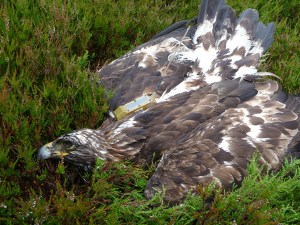
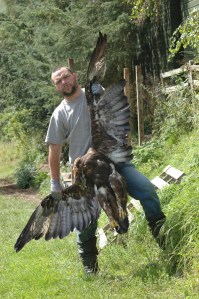
We can expect to see more images like this in the coming years

The long-debated WANE Bill (Wildlife and Natural Environment [Scotland] Bill) was finally passed by the Scottish Parliament on Wednesday 2nd March 2011. Talk about a missed opportunity to crack down on an industry that continues to flout the law when it comes to wildlife crime! “The Scottish Government is not prepared to tolerate continued persecution of our magnificent birds of prey. This government is prepared to act to introduce new measures to combat wildlife crime”, said a pig as it flew over Inverness Police Station.

A concise overview of how the final Bill relates to the continuing illegal persecution of our so-called protected raptors can be found here:

http://www.scottishraptorgroups.org/news.php

While some aspects of the new Bill are to be welcomed, including the introduction of vicarious liability, other measures that could have had a greater impact were refused. One such measure, estate licensing, was turned down in favour of allowing the sporting estates an opportunity to introduce voluntary self-regulation. This manifests itself in the form of the ‘Wildlife Estates Initiative’, dreamt up by the SRPBA in the later stages of the WANE Bill proceedings when it looked like they were under threat from the introduction of a licensing system. Who believes that this ‘initiative’ will work? Isn’t it crystal clear, after five decades of systematic raptor persecution, that the shooting industry has proven itself incapable of voluntary self-regulation? Will the new ‘initiative’ be as lacking in credibility as their May 2010 letter to the Environment Minister that 200+ estate owners signed to say that they opposed raptor poisoning? (The same letter that proved to be highly embarrassing just a few weeks later when multiple poisoned raptors were found on Moy Estate, one of the letter’s signatories). We look forward to watching how their latest ‘initiative’ rolls out, and particularly whether they actually publicise the names of the estates that have signed up to it (information that they have so far failed to make public). If they wish to be taken seriously then transparency will be essential.

In summary, there is as much chance of the current WANE Bill being an effective deterrent to illegal raptor persecution as there is of the SGA opening a wildlife sanctuary. However, full credit should go to Peter Peacock MSP for doing his utmost to secure a safe future for our declining raptor populations. He will be sorely missed when he steps down from politics in May, although we are pleased to note that he intends to lobby his colleagues from the sidelines. RSPB Scotland and the SRSGs also deserve credit for their lobbying efforts throughout the WANE Bill process. Some credit should be given to Roseanna Cunningham for sticking to her guns on the vicarious liability issue, although she loses points for stamping all over some of the other proposals that really could have made a difference.

As we approach the Scottish elections in May, you may want to know how your MSP voted on the raptor persecution issue during the WANE Bill. Check out the official report here:

http://www.scottish.parliament.uk/apps2/business/orsearch/ReportView.aspx?r=6146&mode=html#iob_55286

Silence over hen harrier carnage – now updated

One week on from the publication of the Hen Harrier Conservation Framework, leaked by investigative journalist Rob Edwards on 16 January 2011, here are the published responses from the shooting lobby and from those with a statutory duty to protect this species of high conservation concern:

Scottish Gamekeeper’s Association – silence

Scottish Rural Properties & Business Association (SRPBA) – silence

Scottish Estates Business Group (SEBG) – silence

Scotland’s Moorland Forum – silence

Game and Wildlife Conservation Trust (GWCT) – silence

Scottish Natural Heritage (SNH) – silence

Partnership Against Wildlife Crime Scotland (PAWS) – silence

National Wildlife Crime Unit (NWCU) – silence

Interesting. Perhaps they’re all hoping that if they keep quiet, everyone will forget about the damning evidence presented in the report? It is, after all, only the 5th scientific study published since 1997 to demonstrate the indisputable link between hen harrier persecution and heather moorland that’s managed for red grouse shooting. Here’s a quick summary for anyone who missed the latest scientific facts:

  • The potential national Hen Harrier population for Scotland is estimated to be within the range 1505 – 1790 pairs.
  • The most recent national survey of Hen Harriers in Scotland (2004) was estimated to include 633 pairs.
  • This means that 872 – 1,157 harrier pairs (1,744 – 2,314 individuals) are missing.
  • The areas from where these birds are missing are areas managed as grouse moors.
  • Illegal persecution of hen harriers is particularly prevalent in five areas, where the majority of breeding attempts fail. These five areas are: Central Highlands, Cairngorm Massif, Northeast Glens, Western Southern Uplands and Inner Solway, and Border Hills.
  • At a national scale, the hen harrier in Scotland is not in favourable conservation status, largely due to illegal persecution. Ditto the English hen harrier population.

So, up to 2,314 hen harriers are missing in Scotland, and no-one has anything to say about it? Think about that number. It’s not 23, it’s not even 213 – it is two thousand, three hundred and fourteen birds. This is wholesale destruction on a massive scale! Are we to believe that “just a few rogues” are responsible?

How much more scientific evidence is required before we see the effective enforcement of our wildlife legislation? How can those people who own and manage the sporting estates still be getting away with this level of illegal activity? Why is the Environment Minister still set against the licensing of sporting estates, when it is blindingly obvious that they are unable to self-regulate?

In light of the contents of the leaked report, it is to be hoped that the Scottish Government’s Rural Affairs & Environment Committee will once again push for an amendment to the WANE Bill for estate licensing. Stage 2 of the Bill was completed on Wednesday 19 January and there was no mention of the Hen Harrier Framework during that meeting, probably because the RAE Committee hadn’t had time to read the report in full. Stage 3 begins in several weeks and by that time the Committee and the Environment Minister should be fully conversant with the extent of illegal raptor persecution on Scottish grouse moors.

UPDATE: 28 January 2011. SRPBA denies extent of persecution (yawn)

The SRPBA has written a letter of response to The Sunday Herald, dated 16 January 2011. I’m not sure if it was actually published by The Herald, but here it is as a PDF – SRPBA response to killing fields article 16 Jan 2011

UPDATE: 19 February 2011. See our blog entry on 19 Feb 2011 for an update on this story.