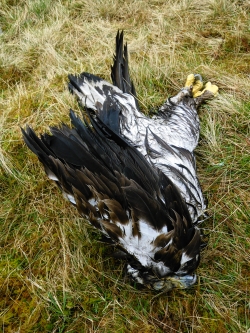
Latest poisoning figures are just a smokescreen

So, SGA Chairman Alex Hogg is “hugely encouraged” by the forthcoming 2012 poisoning statistics, due to be released by the government agency SASA in the next few days (see here for STV news story and here for SGA press release). The figures are expected to show just two confirmed raptor poisonings in the first half of 2012, a considerable drop from the figures of previous years.

Unfortunately, these figues are just a small part of the story, as many regular readers will already be aware. We’ve blogged about this before, back in March when the poisoning figures for 2011 were published (see here for our previous post). As we said then, these figures look promising on a superficial level but do they really reflect the true extent of illegal persecution?

The lower poisoning figures may well be a true indicator that fewer people are still poisoning raptors. That’s what the SGA and friends clearly think and would like the rest of us to think. However, another equally plausible explanation is that the poisoners are just getting better at hiding the evidence. We’ve always known that the published poisoning figures just show a tiny fraction of actual poisoning incidents; these poisonings usually take place in vastly remote areas where few people are around to find the evidence. The poisoned birds that have been discovered have usually been discovered by chance. More recently, they’ve been discovered because more raptors are now fitted with satellite tags so it’s easier to follow their movements and to find the locations where they die.

There is another plausible explanation, too. As we’ve also said before, poisoning is not the only method of illegally killing raptors. Perhaps the lower poisoning figures reflect a substantial shift in the methods used to persecute raptors. Are more raptors being shot at the nest? Are more raptors being shot at roost sites? Are more nests and eggs being destroyed? Are more raptors being caught in traps and being bludgeoned to death? The persecutors know very well that the government doesn’t record these types of incidents; only reported poisoning incidents are published. What better way to make it look like you’ve cleaned up your act than by reducing the poisoning but increasing the other techniques that you know will never be officially reported? (Except by the RSPB who always publish these other persecution incidents in their annual reports, but which are then dismissed as being ‘unofficial’ and ‘exaggerated’ by the game-shooting lobby).

Is it plausible that other persecution methods have now taken precedence over poisoning? Let’s look at the hen harrier situation. The UK’s hen harriers continue to spiral towards oblivion and the main cause has been identified as illegal persecution. Everyone knows it and even the government has acknowledged it. But how many hen harriers do you see listed in the annual poisoning figures? Very few indeed. Mainly because poison is rarely used to kill harriers – they’re not typically a scavenging species that depends on carrion so they’re harder to poison. But just because they don’t feature on the annual list of poisoned raptors doesn’t mean they’re not persecuted! Of course they are; the national hen harrier survey results say it all.

If anyone is still in any doubt about whether the latest poisoning figures are an accurate reflection of the extent of illegal raptor persecution, then consider this. Will the figures for Jan-June 2012 include this ‘missing’ satellite-tagged golden eagle (here), or this ‘missing’ satellite-tagged golden eagle (here), or this dead golden eagle found with substantial injuries (here), or this dead golden eagle found in what was described as ‘suspicious circumstances’ here? Or just the one confirmed poisoned golden eagle found dead in Lochaber (here)?

Stuff and nonsense

The airwaves are busy with criticism of last night’s episode of Countryfile, which featured a few pieces on evil birds of prey, especially buzzards and peregrines.

It’s too tedious to reproduce all the arguments here – we’ve heard it all before, although the SGA chairman Alex Hogg’s apparent inability to count was quite amusing. In a voiceover we were told that Alex was due to release 700 pheasant poults into his woodland pens (prior to letting them loose into the wider countryside so they can be shot dead). The interviewer (Tom Heap) then asked Alex if he had any idea how many poults he might be losing to buzzards. Alex’s response: “We’re probably losing, getting on for over a thousand pheasants in a year to buzzards“. Hmm.

At least the RSPB’s Duncan Orr-Ewing was able to provide some balanced and constructive discussion, but it was disappointing that the producers failed to include any meaningful discussion on the persecution issue. Tom Heap took to his Twitter account after the programme and offered this:

Am intrigued…many accusing #countryfile of buzzard bias. Why? Real country issue, meticulous balance. Proud of our work“.

For anyone who missed it, the episode can be seen on BBC iPlayer for the next seven days (here).

Gamekeeper convicted after trapped buzzard starved to death

Following the post we wrote on 31 May 2012 (see here), another Scottish gamekeeper has been convicted of a wildlife crime offence, this time for allowing a buzzard to starve to death inside a crow cage trap.

Jonathan Smith Graham (30), a gamekeeper on Glen Lyon Estate in Perthshire (see here), pleaded guilty to using a crow cage trap in which a buzzard was trapped and then starved to death. He has been fined £450 which is pretty pathetic when you consider the scope of available penalties (up to £5,000 &/or 6 months in prison), but perhaps more importantly he has now been banned from operating a crow cage trap for five years. Sheriff McCreadie’s comments about Graham’s actions (and in-actions) were also greatly encouraging and are welcomed. Credit to Tayside Police for undertaking the investigation on their own initiative and to wildlife fiscal Shona McJannett for a successful prosecution.

For the details of this case see here, here and here.

Some questions:

1. Will Jonathan Smith Graham be sacked from his gamekeeper job at Glen Lyon Estate now he has a wildlife crime conviction? Ask them directly: sally@glenlyonestate.co.uk

2. Was he/is he a member of the Scottish Gamekeepers’ Association? (His defence lawyer was David McKie – the SGA’s solicitor – just coincidence?). If he is a member, will he be expelled now he has a wildlife crime conviction? Ask them directly: info@scottishgamekeepers.co.uk and while you’re there, ask them if they’re ready to say yet whether convicted gamekeeper Robert Christie (Lindertis Estate) is/was a member (see here).

3. Why hasn’t the SGA issued a public statement condemning the actions of this gamekeeper? Ask them directly: info@scottishgamekeepers.co.uk

4. Is Glen Lyon Estate a member of Scottish Land and Estates? Ask them directly: info@scottishlandandestates@co.uk

Traps in our countryside: a walker’s guide

Thanks to Steve from the animal protection charity OneKind who has advised that his 2010 article, ‘Traps in our countryside: a walker’s guide’ has now been updated.

This excellent illustrated guide provides detailed information for the general public on how to distinguish a legal trap from an illegal trap. The updated version also includes information about a new trap which is known by several common names: clam trap, snapper trap, butterfly trap and Larsen mate trap. This particular trap is causing controversy: the game-shooting industry argues it is legal and safe whereas others strongly disagree and some have even suggested its use could be an offence under animal welfare legislation, although this has yet to be tested in a court of law. It is understood that SNH is still consulting about the lawfulness of this trap and more information should be forthcoming in the near future (see here).

The SGA’s views on the clam trap can be read here and here. A copy of their consultation response to SNH on the use of clam traps can be read here.

A copy of the SRPBA’s (now called Scottish Land and Estates) consultation response to SNH on the use of clam traps can be read here. Its interesting to compare this with the SGA’s response – copy and paste, anyone?

Click here to read OneKind’s updated article – Traps in our Countryside: a walker’s guide.

Click here to read our recent article – Crow Traps: what you should know.

SGA leaders try to spin the science….but fail

Those award-winning scientific gurus at the Scottish Gamekeepers’ Association have been sharing their intellectual acumen as they interpret recent scientific research relating to raptors.

First up is Professor Bert Burnett, who chose Facebook as his outlet (well, scientific journals are just so passé) for an examination of the recent paper on historical eagle distribution in the UK and Ireland (see here). His thesis starts with this:

The RSPB are even more powerful than i thought. The are now able to contact the dead, who had the foresight to record raptor numbers on blocks of stone knowing that the RSPB would be needing the info in 3,000 years time. Has anyone actually checked the validity of this latest garbage from RSPB? We have also had teradactals  etc in the uk, have the RSPB got the population info on them as well? With a bunch of irate 21st century farmers breathing down their necks, me thinks the RSPB are getting fidgity“.

Thirty-four minutes later, Professor Burnett decided that actually, this peer-reviewed scientific paper might be useful after all, as it appears to support his hypothesis that eagles are not constrained by persecution and certainly not by gamekeepers, no siree bob:

looking at the post 3000 year population figures from RSPB i note that the golden eagle pop. was 650 for the uk as a whole. Scotland has 440 now, living in a much changed counryside from 3000bc, i would think this is a huge success story not the doom and gloom pushed out by the RSPB“.

Had Professor Burnett studied the data in a little bit more detail, he would have noted that the golden eagle breeding population estimate for c. 500 was actually 1,000 – 1,500 pairs. Oops.

Professor Burnett’s esteemed colleague, Professor Alex Hogg, also had his own unique interpretation on recent scientific research, this time on the DEFRA buzzard ‘study’. Choosing that highly-acclaimed scientific journal Shooting Times to report his scientific results, Prof Hogg wrote this:

In Scotland, we are already ahead of where England is now with this [the proposed buzzard ‘study’ that included the destruction of nests and permanent removal of adult buzzards into captivity]. The trials have been done“. (Read full article here).

Really? Where and when were these trials done in Scotland, and where are the published, peer-reviewed results?

Professors Burnett and Hogg are not the only ones from the game-shooting community who have been demonstrating a shocking ability to misinterpret science….more in a following post.

Crow traps: what you should know part 1

Without even the tiniest weeniest hint of irony, the Scottish Gamekeepers Association is complaining about ‘criminal activity in the countryside’ in reference to the recent alleged release of crows from a trap on a Scottish sporting estate.

Oh and it gets better…. according to the SGA, in response to this criminal activity Northern Constabulary has “issued an appeal for information”. Although we should point out that we’ve been unable to find any public record of this ‘appeal for information’ so we only have the SGA’s word to rely upon. But let’s assume the SGA is telling the truth…

Is this the same Northern Constabulary who apparently failed to fully investigate the suspected decapitation and shooting of a white-tailed eagle on Skye (see here) and the discovery of a poisoned red kite on the boundary of Skibo Estate (see here)?

That’s not the end of the irony either – the SGA goes on to suggest that cameras could be installed at crow traps, presumably to film any member of the public who may be inclined to interefere with the trap (which may amount to a criminal offence). Wouldn’t it be interesting to see whether that film footage would be considered as acceptable evidence in any subsequent prosecution, especially after recent film footage showing the activities of a Scottish gamekeeper using a stick to beat crows to death inside a crow trap on a Speyside sporting estate (see here), was deemed inadmissable evidence?

One rule for one but not the other? Surely not!

In light of the SGA’s recent one-sided promotion of crow traps and their encouragement to SGA members to report suspected trap interference (see here for their article) as well as the landowners’ representative body, Scottish Land and Estates, encouraging their members to do likewise (see here), we thought it only fair that we provide an alternative view on the use (and more importantly the mis-use) of crow traps on Scottish sporting estates and give the public the neccessary information about how to recognise the difference between a legal and an illegal trap, and what to do if you find an illegal one.

Watch this space…

Is this convicted gamekeeper a member of the SGA?

Last Tuesday (3 April 2012), Scottish gamekeeper Robert Christie of the Lindertis Estate was convicted at Forfar Sheriff Court of wildlife crimes (see here).

Nine days later, we are still waiting for the Scottish Gamekeepers Association (SGA) to issue a public statement condemning the criminal activities that led to the conviction and also clarifying Christie’s SGA membership status. Was he an SGA member at the time he committed the offences (2010)? If so, is he still a member now he has a criminal conviction?

It’s unusual for the SGA to be so coy about the membership status of a convicted gamekeeper. To their credit, in each of the cases that have been heard so far this year (and even in one case that didn’t even make it to court – the crow trap video case), the SGA has been quick to publicise whether the accused/convicted gamekeeper was an SGA member.

So why so coy this time? Perhaps we should give them the benefit of the doubt and assume that they just got caught up in the Easter holidays and haven’t got around to making a statement yet. Although they have managed to find the time to add various other news items to their website, including an announcement about a forthcoming snaring training course at a choice of venue that certainly raised our eyebrows (see here).

If anyone has tried to contact the SGA about Christie’s membership status we would be very interested to hear about it. For anyone who wants to ask them now, here are the SGA’s contact details:

Email: info@scottishgamekeepers.co.uk

Tel (Perth Office): 01738 587515

Why convicted gamekeeper Robert Christie only got a telling off

Two days ago we blogged about Scottish gamekeeper Robert Christie (Lindertis Estate) who was convicted at Forfar Sheriff Court after pleading guilty to wildlife crimes (see here).

Since then there has been a fair bit of press coverage but the media hasn’t really picked up on the fact that Christie’s ‘punishment’ was just an admonishment (effectively a telling off), even though the available penalties included a fine of up to £5,000 and/or a six month prison sentence.

However, an article published in yesterday’s Courier did include commentary about the penalty:

“…Sheriff Kevin Veal at Forfar decided not to impose a penalty on gamekeeper Robert Christie after hearing the ‘immediate and draconian consequences’ connected with breaching a trapping licence could render the 57-year-old unemployable for the rest of his working life”.

Christie’s solicitor, David McKie (who also happens to be the SGA’s solicitor – see here), reportedly commented:

There are implications under the general licence – if the court imposes anything more than an admonition the licence is automatically withdrawn for five years“.

Was what Christie did the crime of the century? No of course it wasn’t, but what it was, without a doubt, was a criminal offence under the wildlife legislation. It seems astonishing that the Sheriff would decide not to impose any penalty, especially given the current high priority that the Scottish Government has placed on tackling wildlife crime.

What we are seeing yet again is an inconsistency in sentencing (compare Christie’s penalty with that of Aswanley Estate gamekeeper Craig Barrie who was recently fined £520 for illegal use of a trap, see here) and the sense that wildlife crime is still not being taken seriously by some Scottish courts. Do you think this defence would be acceptable for other offences, such as a drink driving taxi driver? ‘Oh, sorry m’Lord, yes I was drunk when I drove my car and I really should have known the consequences of doing this as driving is my profession but the immediate and draconian measure of losing my licence will also mean I lose my job’.

Talking of taking wildlife crime seriously, the Scottish Gamekeepers’ Association has not yet issued any public statement of condemnation for Christie’s actions, nor have they said whether he is/was an SGA member. To find out about Christie’s SGA membership status, send an email to: info@scottishgamekeepers.co.uk

Article in the Courier here

Scottish gamekeeper ‘admonished’ for wildlife crimes

Scottish gamekeeper Robert Alexander Christie (58) was convicted today at Forfar Sheriff Court for wildlife crimes relating to the illegal use of a crow cage trap. He was ‘punished’ by receiving an admonishment.

Christie pled guilty to taking a wild bird, possessing a wild bird, and using an illegal trap by failing to adhere to the terms of the general licence (this general licence governs the use of crow cage traps in Scotland).

The offences took place on the Lindertis Estate near Kirriemuir, Angus on 8 August 2010. Lindertis Estate is listed as a sporting estate providing pheasant and partridge shooting (see here). A tawny owl was rescued from inside a crow cage trap in a wood on the estate by a member of the public. The owl was reportedly in poor condition (severely malnourished and unable to hold its own bodyweight on its legs) when it was found and it was sent to a vet for treatment. The owl was released back into the wild on 13 August.

The crow cage trap reportedly did not contain food or shelter, and a tray of water contained green algae, and the trap did not have an identification tag, all contrary to the terms of the general licence.

Christie has 24 years of gamekeeping experience and has been employed as a full-time gamekeeper on this estate for approximately 18 years.

Also due to appear in court was Christie’s employer, who according to Burke’s Peerage is a hereditary peer: The Rt Hon The Lord Colyton, although in the court listing his name was given as Alisdair John Munro Hopkinson. Charges against Hopkinson related to allegedly causing/permitting the gamekeeper to use an illegal trap (Wildlife & Countryside Act). However, charges against Hopkinson were not proceeded, perhaps because Christie pled guilty.

This case was prosecuted by one of the new specialist wildlife fiscals, Shona McJannett. She is quoted as saying:

Today’s conviction highlights the importance of ensuring that crow cage traps are operated legally in terms of the general licence. The protection of our wildlife is a priority and a robust view will be taken by the Crown Office and Procurator Fiscal Service in relation to any reports alleging breach of these general licence conditions.”

Now, it’s refreshing news to hear that COPFS will take a ‘robust view’ of this type of wildlife crime and hopefully they will continue to prosecute these cases, but the penalty handed out by the court doesn’t quite match the Fiscal’s view of the seriousness of the offence. Christie’s ‘punishment’ (the admonishment) is effectively no punishment at all. It’s basically a ‘telling off’ (see here for a definition) and because he wasn’t given a more serious penalty (e.g. a fine) it means he is NOT banned from continuing to operate crow cage traps under the general licence. What sort of deterrent is a telling off? What message does this send to other wildlife criminals? Does anyone think Christie will lose his job now he’s got a conviction for wildlife crime?

It is not known whether Christie is a member of the Scottish Gamekeeper’s Association. Anyone interested in finding out can ask the SGA by emailing: info@scottishgamekeepers.co.uk. We would be very interested to learn whether he is a member, and if so, does his wildlife crime conviction mean that he is now barred from the club professional body?

Despite the pathetic ‘penalty’ (can you even call it that?), big kudos to the SSPCA for leading on this investigation, and well done also to COPFS for prosecuting; it’s not often we have cause to congratulate COPFS but on this occasion its deserved.

If you are out and about in the Scottish hills and glens and  come across a trapped raptor caught inside a crow cage trap (or any other trap for that matter), then you should call the SSPCA hotline immediately: 03000-999-999

SSPCA press release here

News article on Deadline News website here

COPFS press release here

See here for another blog on why Christie only got a telling off

STOP PRESS: One of our readers (thank you!) has contacted us to say he thinks this is the same estate that we blogged about last June (see here). Obviously we’re unable to confirm or refute this as the name of the estate in the June blog was kept a big secret, although the location is very similar!

2012 wildlife crime conference: Charlie Everitt (NWCU)

The 2012 annual police wildlife crime conference took place a couple of weeks ago. Quite a few of this year’s presentations were relevant to raptor persecution so we’ll be commenting on these in due course. To start off the series we’ll focus on what Charlie Everitt had to say. Charlie is the Scottish Investigative Support Officer at the UK National Wildlife Crime Unit (NWCU). See here for more details.

Charlie Everitt: Update on Raptor Persecution

Scottish Raptor Persecution Priority Delivery Group, and that’s a mouthful, erm, has been concentrating more on poisonings just at the moment, and also on processes so that we can get things right in order to take things forward for core purposes. Consequently we’re just finishing off and hoping to sign off at the next meeting an evidence gathering protocol. Now this is guidance and best practice for organisations who are likely to come across raptor persecution victims, er, giving advice and guidance on who they should contact, how the, er, any carcasses should be recovered and where they should be handed in to, so it’s giving best practice in order to maximise our chances for convictions in court so we get the process right. So that should be signed off, er, at the next meeting.” [See here for a previous blog about an earlier draft of this protocol. We haven’t seen the final version yet but look forward to seeing it in the near future].

“And similarly we’re looking at, er, another protocol with regards to satellite tagged birds, and this is a case where we have birds that have been satellite tagged and maybe the tag, er, stops giving off a signal, erm, or the signal remains stationary, just a protocol as to what we should do, er, in order to take the next step in order to recover the satellite and to investigate what’s happened. So just to make sure that we are lawful in what we are doing. So that’s a protocol as well that should get signed off very soon.

And the third angle, and it’s taking up a fair bit of time, is looking at a very new approach to the whole raptor, erm, raptor persecution issue. Now I can’t really say a great deal more on this at the minute, it’s in its early stages of development just now but when it is it will be put through tests and if it is fit for purpose it will be rolled out and, erm, yes you’ll all be made well aware of it when it does emerge.

We’ve also been looking to the use of science to try and benefit from what science can deliver to us. Now the science of course can back up intelligence and information crucially and the science has been used to good effect when combined with information and intelligence in a presentation to Northern Constabulary last year about the red kites on the Black Isle and their failure to manage to expand from there. So I think that was a good example of just how the two can sit together.” [Eh?]

“The Raptor Study Group of course do a lot of good work with regards to monitoring, erm, raptors and are able to work out where black holes might appear where we should have raptors and where there might not be some. Now there might be good reason for these black holes appearing, [no shit, Sherlock!] er, but what it does do, as I say, when you mix the intelligence and information with the science we get the fuller picture of what might be happening on the land there.

And the final thing we’re looking at doing is to ensure that we can capture all the information from the Raptor Study Group because they’re the people who are out on the land and if they do have any snippets of information we want to make sure that we capture all that intelligence and information in the National Wildlife Crime Unit through the five X five X five system, so that’s, er, er, another area which I’m looking to address very soon.

Now we’ve had some prosecutions, er, either concluded, erm, or, er, occurring during 2011, er, just run through some for you just as an update. In May a shoot manager in Skibo was fined £3,300 for possessing 10.5 kilograms of carbofuran, er, that was the biggest haul we’ve ever recovered in Scotland. And also in May last year a keeper from Moy was fined £1,500 for the possession of a dead red kite. On in October a ‘keeper from Huntly was fined £250 for the illegal use of a cage trap and possession of an illegally trapped buzzard. In November two photographers from London and Norwich were fined £600 and £500 respectively for recklessly disturbing a pair of white-tailed sea eagles at a nest in Mull. In January of this year a former gamekeeper from Biggar was ordered to carry out 100 hours of community service for poisoning four buzzards with alphachloralose and this is a guy who had been convicted before back in 2008. And also in January of this year a, er, another keeper from Lamington was fined £635 for possession of carbofuran. Now for me I think that’s a really good return for one year’s worth of work, er, and there used to be years when we only got two or three convictions in a year, now we have a good number and, er, I think buried inside all of those results is excellent partnership working which I think we must recognise with all our partner agencies.”

[We believe it’s misleading to use these cases as an indicator of success. What Charlie failed to mention is that in some of these cases (Skibo, Moy and Lamington) the only successful charges related to ‘possession’. Nobody was actually charged for poisoning the raptors that were found at each of these sites (and in the Moy case, there were also other offences that related to the illegal use of spring traps, for which nobody was charged). It looks like the Crown Office has gone for the minimum charge possible (i.e. possession) just to secure a conviction. To put this in context, it would be like claiming a success if someone had gone on a killing rampage using a car but was only convicted for not having any road tax. One of the other cases mentioned (Biggar – i.e. David Whitefield from Cullter Allers Farm, who already had a previous conviction for wildlife crime) was given a pathetic 100 hours community service order for poisoning four buzzards! Not good enough and certainly not an indication of ‘a really good return for one year’s worth of work’].

“The 2011 poisoning figures as the Minister suggested was significantly down, er, er, which is great news and very, very welcome to us to hear. Erm, all I’ll say is let’s see if we can continue that downward trend for the next three to five years and actually, and then, erm, solidify into a trend so that we do have this downward movement in poisonings but very grateful for anything where we have a drop in poisonings and that is, erm, excellent news.”

[Charlie failed to distinguish between reported poisoning incidents and actual poisoning incidents. There’s quite a difference and this should put the 2011 poisoning figures into context. He also failed to acknowledge the other methods of illegal killing and their impact on the overall issue of raptor persecution in Scotland. See here for previous blog on this].

“The hotspot maps meantime continue to help the police to focus their attention and, erm, identify where the areas need to be for resources to be deployed.

Now a few years back Lothian & Borders police had a pesticides dog that was able to sniff out carbofuran but it was very quickly withdrawn after there were some health and safety concerns. Well I’ve been having this chat with some of the dog handlers across Lothian & Borders and, er, they have told me that that dog is now available again for any searches, er, which Scotland want to undertake with regards to carbofuran. So that’s I think a positive move they’ve managed to sort out any health and safety issues there and just to put a little bit of context into that, Spain now have 15 dogs that can sniff out carbofuran and other poisons. Carbofuran poisoning has dropped by 40% since the early 2000s so we can think about the impact of the dogs.”

[Again, Charlie has only given half the story here. Yes, in parts of southern Spain (but not all!) the number of reported poisoning incidents has dropped by 40% since sniffer dogs were employed from 2004 onwards. However, crucially, there has also been a concurrent effort to increase enforcement against the poisoners. This includes the use of fines that have a real deterrent (up to €200,000 [~£167,000!]) as well as prison sentences; the temporary closure of the hunting area where poison has been detected; the suspension of hunting rights where the hunting methods are considered to have an unsustainable effect on natural resources; the employment of specialised units (x 3, containing 18 dogs) to patrol areas for the detection of poison – these patrols include ‘emergency inspections’ after poison has been reported, as well as ‘routine inspections’ of hotspots where the use of poison is suspected; and the use of three toxicology labs for poison testing. This is particularly interesting as when poison has not been detected in the first lab, but the use of poison is still suspected based on forensic evidence found at the crime scene (e.g. presence of certain insects), then the carcass/bait is submitted to one of two other labs that use more powerful techniques. In 2010, poison was detected in 38% of these carcasses/baits even though it was undetected at the first lab.

So yes, Charlie, the use of one single sniffer dog in Scotland is a positive move, but without the wider enforcement measures as outlined above, we’d be exceptionally naïve to expect that what has been achieved in parts of southern Spain will be replicated here in Scotland].

“Vicarious liability is also, erm, very much in discussion at the moment and I think last year I described myself as being cautiously optimistic about it. Well this year I’m very optimistic about it, er, with all the work that has been going on, er, behind the scenes and, er, what I would say is that this is not something that is just going to be a case of well we can’t get the person who has put out the poison so let’s just go and charge the landowner, this is going to require a lot of work, er, by any police forces looking into it, er, and looking to, to, er, look at charges of vicarious liability. The industry have also looked into it and have indeed a number of organisations in order to understand what they need to do to fulfil their obligations and that is to be welcomed because it does give us a minimum standard across the, er, industries which is as I say very, very welcomed.

So I was interested in the Minister’s comment as well that, erm, I got the impression that he wasn’t really looking for many prosecutions from this, erm, he was hoping that this would sort of be a Sword of Damocles if anybody was to continue poisoning so, er, I think with some of the work that’s been going on in the Raptor Priority Delivery Group that I think that is a very realistic possibility that we will get things sorted before we ever have to resort to vicarious liability.

One final thing, well another thing I’d just like to, er, just bring to your attention is a egg collector who was, lived down in London, erm, and his house was searched, a number of eggs removed including some golden eagle and osprey, erm, eggs which had been taken from Scotland. The CPS did some work, er, with one of the partner organisations and sought an ASBO against him and although he’s currently in jail, when he re-emerges he will not be allowed to enter Scotland during the nesting season for the next ten years. Now that’s a very powerful piece of legislation and a powerful condition to put on him and it’s something which I’ve asked for them to see if we can get hold of the paperwork to look at the procedure to see if we can do some, mirror something like that up in Scotland because it’s not just for, erm, for egg collecting that this is relevant, I can see other angles of hare coursing, er, deer coursing and the like so, er, that is going to be an interesting development to see what how it transpires.

Finally on the raptor persecution side, these are the guys who make up the Scottish Raptor Persecution Priority Delivery Group. Now there have been articles that are out in the public domain where we actually have organisations, people from organisations that are representative of the group, trying to drive wedges in against other organisations which, er, are in that group as well, which is often very disruptive and really doesn’t help us with the trying to take the full raptor persecution debate forward. What I would say to you is that if you do have an issue which you would like to discuss in, er, er, in an appropriate forum, rather than having a, er, er, a rant shall I say for a better word in, er, other media, here is a foum which you could bring this to through your representative in order to get a good full informed debate amongst all the organisations that need to be consulted in it. So that’s what I’d urge you to do if you do have any issues and you want to bring forward then please do not hesitate to contact them through your, through your representative.” [We think this rebuke was aimed at the Scottish Gamekeepers Association who recently published an article that suggested raptor workers could be laundering eggs and chicks on the black market – see here for previous blog on that].