Scottish gamekeeper convicted of killing buzzard

The long-running case against Scottish gamekeeper William (Billy) Dick concluded today with a conviction for illegally killing a buzzard.

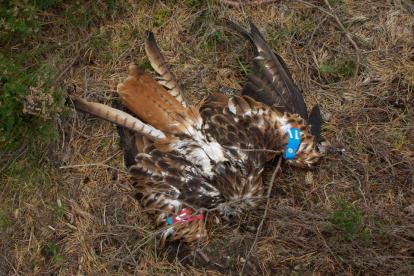
Dick, 25, of Whitehill Cottages, Kirkmahoe, Dumfries, had been observed by two witnesses on the Newlands Estate striking a buzzard with rocks and then repeatedly stamping on it, in April last year. The observers were alerted to the scene by the sound of a gun shot. Dick had denied the charges (in addition to two alleged firearms offences, which were subsequently dropped) but was convicted today at Dumfries Sheriff Court.

He will be sentenced in early September.

Well done to the SSPCA and Police Scotland for their investigation and to the Crown Office for a successful prosecution.

We understand that a vicarious liability prosecution will get underway at Dumfries Sheriff Court later this month.

The Newlands Estate offers driven partridge and driven pheasant shooting. This estate has previously donated to the GWCT’s Scottish Auction (see here – page 23).

While we wait for the sentencing hearing, here are some questions you might like to ask:

1. Is/was Dick a member of the Scottish Gamekeepers’ Association? Emails to: info@scottishgamekeepers.co.uk

2. Is Dick still employed on the Newlands Estate? Emails to: awbd@newlandsestate.co.uk

3. Is the Newlands Estate a member of Scottish Land & Estates? They get a mention in the SLE’s 2013 newsletter (here – page 10). Emails to: info@scottishlandandestates.co.uk

The photograph of Billy Dick was sourced from his Facebook page.

Previous blogs on this case here, here, here, here, here, here, here, here, here

Environment Minister hails Scotland’s wildlife killers

The world’s gone bonkers.

A few days ago we had Scottish Natural Heritage, the Government’s statutory nature conservation body, promoting Scotland’s dead wildlife pantry and the grouse shooting industry, claiming that red grouse are ‘healthy’, natural’ and harvested ‘sustainably’ when actually they’re anything but (see here).

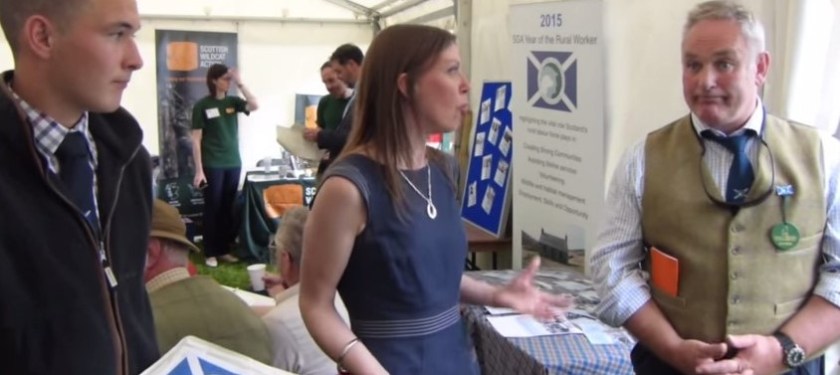
And now we have Scotland’s Environment Minister, Dr Aileen McLeod, praising “the significant and valuable contribution” of the Scottish Gamekeepers’ Association as she presented the SGA’s Young Gamekeeper of the Year Award 2015 at the Scottish Game Fair yesterday. Here’s what she had to say:

I just want to say, obviously, thank you very much, Alex [Hogg], and I’m absolutely delighted to be invited here this afternoon, this is obviously my first time I’ve ever been to the game fair as well so I’m really delighted to be here, the opportunity to be next to Alex and this young man as well [Duncan Seaton, the recipient of the award], so also I just thought it’d be a good opportunity just to thank the Scottish Gamekeepers’ Association for all the long term support which you have provided to Scottish Government in various areas of policy, development and implementation and making sure we are implementing best practices of conservation and wildlife and wildlife management and I think to be really honest without your guys significant and valuable contribution to the management of Scotland’s countryside, we really wouldn’t have the world famous landscapes which many people from home and abroad enjoy which makes such a valuable contribution to Scotland’s rural economy“.

You can watch the video here.

No mention, then, of the hundreds of thousands of native animals that are snared, trapped and shot on an industrial scale every year by gamekeepers to ensure that an artificially high surplus of game birds (some non-native) is available to be, er, shot? And that’s just the legal killing. No mention either of the illegal poisoning, trapping, shooting and beating to death of protected wildlife, particularly birds of prey, which we know takes place on a significant scale because it affects the population range of a number of species; that doesn’t happen on that scale if it’s ‘just a few rogues at it’.

We’ve been waiting for Dr McLeod to show her hand since she first took office last November. It looks like she just has.

McLeod SGA Game Fair 2015

Land Reform Bill introduced

Today sees the launch of the Scottish Government’s highly controversial Land Reform Bill (see here).

The ‘radical’ proposals included in this Bill could have far-reaching effects on land ownership in Scotland, with an emphasis on achieving sustainability, fairness and transparency.

Aside from the obvious wider social justice aspects of this Bill, there are a couple of proposed measures that are of specific interest to us:

1. The ending of rates exemptions for shooting and deerstalking estates;

2. Greater transparency and public accessibility to information on the ownership of land through a new land register.

Sporting rates were abolished in 1994 under John Major’s Conservative Government. As Andy Wightman wrote last year, “It is clearly inequitable that, whilst the corner shop, the pub and the hairdresser all pay NDR [Non-Domestic Rates], the multi-million pound assets [sporting estates] outside the villages and towns of Scotland pay virtually none with all “agricultural” land (including sporting estates and woodland) removed from the valuation roll altogether“.

The Scottish Gamekeepers’ Association is unimpressed with this proposed measure and cites job losses as its main concern (see their response to the recent Land Reform consultation here, question 26). It’s a familiar use of the old victim card from them – they used the same alarmist scaremongering nonsense back in 2003 when they argued ‘jobs would be at risk’ if the Government didn’t issue them with licences to kill buzzards, sparrowhawks and peregrines (see here). Licences weren’t issued, jobs weren’t lost and the gamebird-shooting industry didn’t collapse; on the contrary, it’s booming, with last season’s grouse shooting predicted as “one of the best years in living memory” (see here).

Greater transparency about who owns the vast sporting estates in Scotland is of obvious interest to us; we want to know which estates are ‘at it’ and what positions of power and influence the landowner may have, especially in relation to the effective enforcement of vicarious liability in cases where illegal raptor persecution has been uncovered. See here for a very good example of why this transparency is required.

It’ll be interesting to follow the progress of this Bill through the Parliamentary process and to see just how resolute the politicians will be against the might of the omnipotent landowning lobby.

Scottish gamekeeper convicted for using a gin trap on Cardross Estate: gets community service order

James Alfred O’Reilly, 50, a Scottish gamekeeper working on the Cardross Estate in Stirlingshire, has been convicted of four wildlife crime offences, including the use of a gin trap to catch a buzzard. His punishment? It’s the usual pathetic response: he’s been ordered to carry out 240 hours of unpaid work.

Here is the press release from the Crown Office:

At Stirling Sheriff Court today, gamekeeper James O’Reilly was given a Community Payback Order and ordered to carry out 240 hours of unpaid work after having pled guilty to four charges under the Wildlife and Countryside Act 1981.

O’Reilly was convicted at Stirling Sheriff Court on 24 April of a number of charged including the use of an illegal trap for the purposes of taking of wild birds on the Cardross Estate in March 2013. Common buzzards, red kites, goshawks and white tailed eagles can all be found nesting in or as regular visitors to the area.

A man walking his dog on the estate, at a location known as Gartur came to an open area next to a pheasant pen where a distressed buzzard was caught in a trap by its leg next to a decomposed deer carcase.

The man released the jaws of the trap from the buzzard’s leg. When it became apparent that the buzzard was unable to fly he took the bird home and called the SSPCA. The SSPCA reported the incident to the police who continued the investigation. They found an illegal trap, which by its nature and placement by the accused was calculated to cause injury to wild birds.

They also found that the accused had set a number of snares in the area. None of which had identification tags on them as required by law.

It was clear to police that there was an issue in relation to the pest control methods employed by the accused and as a result, a search warrant for his house was obtained and executed on 4 April 2013.

In the course of the search, a snare containing decomposed fox parts was found next to a pheasant pen near to accused’s home address. It was apparent that a fox had become snared and the Accused maintains that he shot the fox after it had become trapped, and left the carcase lying. Staff at the Scottish Agricultural College confirmed that the fox caught in the snare had been there for more than 24 hours and possibly from the back end of 2012.

The buzzard was examined by a veterinary surgeon who found it had a severe injury to the right leg just above the foot. He commented that the injuries would have been extremely painful for the bird and would have taken several days to occur. Treatment was provided to the bird but its condition deteriorated and the bird was euthanized on welfare ground as it would never be suitable for release back into the wild.

Notes to Editor

  1. James Alfred O’Reilly (DOB 30/06/1964) of Stirling pleaded guilty on 24 April 2015 at Stirling Sheriff Court to four offences under the Wildlife and Countryside Act 1981 as below. He was sentenced to 240hrs Community Payback Order, on all charges cumulo:

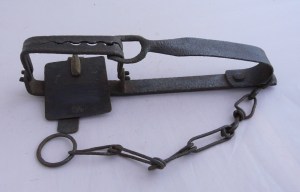
gin trap* Between 22 March 2013 and 25 March 2013 at Gartur, Cardross Estate , Port of Menteith, you JAMES ALFRED O’REILLY did intentionally or recklessly injure and take a wild bird, namely a buzzard in that you did set a gin trap also known as a leg hold trap on open ground or other similar type of trap which was baited with a deer carcass which trapped said buzzard by the leg, injuring it whereby it had to be humanely euthanased due to its injury; CONTRARY to the Wildlife and Countryside Act 1981 Section 1(1)(a);

* between 1 February 2013 and 4 April 2013 at Tamavoid, Cardross Estate, Port of Menteith, you JAMES ALFRED O’REILLY, whilst carrying out an inspection of a snare, did find an animal, whether alive or dead, caught by said snare and did fail to release or remove said animal namely a fox; CONTRARY to Wildlife and Countryside Act 1981, Section 11(3)(A);

* between 1 April 2013 and 4 April 2013 at Gartur, Tamavoid and The Big Wood , Cardross Estate , Port of Menteith you JAMES ALFRED O’REILLY did set in position a snare without having been issued an identification number by the Chief Constable under Section 11A(4) of the aftermentioned Act and did set 2 snares at a stink pit , 4 snares at a pheasant release pen and 1 snare at a stink pit, all of which did not have identification tags attached; CONTRARY to the Wildlife and Countryside Act 1981, Sections 11A(1) and (5);

* Between 22 March 2013 and 25 March 2013 at Garfur, Cardross Estate, Port of Menteith you JAMES ALFRED O’REILLY did set in position a trap, namely a gin trap also known as a leg hold trap being of such a nature and so placed as to be likely to cause bodily injury to any wild birds coming into contact therewith in that said trap was set on open ground next to bait, namely a deer carcass; CONTRARY to the Wildlife and Countryside Act 1981, Section 5(1)(a).

The requirement to tag snares was introduced by the 2011 Wildlife and Natural Environment Act as part of a suite of measures aimed at improving the accountability of snaring. This requirement came into force on 1st April 2013. Under the new regime, those responsible for setting snares were required to attend a training course, prior to being given an identification number. The accused O’Reilly had been issued with such a number on 23rd March 2013 by the licensing office in Pitt Street, Glasgow.

END

So, here are some questions:

1. Is O’Reilly still employed as a gamekeeper on the Cardross Estate (where they offer driven pheasant and partridge shooting)? Emails to: enquiries@cardrossestate.com

2. Is O’Reilly a member of the Scottish Gamekeepers Association, and if so, has he now been booted out? Emails to: info@scottishgamekeepers.co.uk

3. Is the Cardross Estate a member of Scottish Land & Estates, and if so, has it now been booted out? Emails to: info@scottishlandandestates.co.uk

4. When will the review of wildlife crime penalties be published by the Scottish Government (we understand it’s been submitted) and, more importantly, when will the review’s recommendations for change be implemented? Emails to: ministerforenvironment@scotland.gsi.gov.uk

You can perhaps combine this last email with one asking the Minister when we can expect to see a General Licence restriction order enforced on land where a poisoned red kite, a poisoned peregrine, and an illegally trapped red kite have been found – see here.

UPDATE 21st May 2015: some responses to these questions here.

Ten conservation groups call for 3-year ban on grouse moor mountain hare slaughter

Ten conservation groups in Scotland have called on SNH to implement an immediate three-year ban on the mass slaughter of mountain hares that has been taking place in Scotland.

The indiscriminate and unregulated mass killing of mountain hares has been taking place on grouse moors for many years. We’ve blogged about it a lot (see here for previous posts) and many others have also been campaigning against this obscene bloodbath.

Mountain hares are (supposedly) protected under European legislation and SNH, as the Government’s statutory conservation agency, has a legal duty to ensure the population has a favourable conservation status. The problem is, nobody really knows how many hares there are (previous surveys have only resulted in crude and pretty meaningless results). More importantly, nobody knows how this persistent mass culling is affecting the status of the overall hare population.

The latest call for an immediate ban comes hot on the heels of SNH’s recent call for grouse moor managers to exercise ‘voluntary restraint’ with their culls – a system that’ll never work because it relies entirely on the altruism of grouse moor managers (see here).

The ten groups calling for the immediate three-year ban include National Trust for Scotland, John Muir Trust, RSPB Scotland, RSZZ, Highland Foundation for Wildlife, Scottish Wildlife Trust, Scottish Raptor Study Group, The Cairngorms Campaign, the Mammal Society and the Badenoch & Strathspey Conservation Group. There are some quite hefty credentials there and SNH would be wise to take heed. You get the feeling that if they don’t, they might just find themselves facing (another) complaint to the EU.

Naturally, representatives from the grouse-shooting industry have reacted strongly against the call for a ban. According to the SGA, calling for a ban is “environmentally irresponsible” and “it will be bad for birds and bad for biodiversity”.

Tim (Kim) Baynes from Scottish Land and Estates claims the ban would be “ill-informed” and “heavy-handed”.

These are unsurprising responses and just provide further evidence that SNH’s ‘voluntary restraint’ plea will go unheeded because these grouse moor landowners and their gamekeepers don’t think there’s anything wrong with the current level of hare culling.

Calling for an immediate ban is just the first step. Several of the ten organisations calling for the ban will next call for a meeting with SNH and Scottish Government officials to discuss the issue further and, presumably, keep the pressure on SNH to stop procrastinating and actually do something meaningful to bring the carnage to a halt.

BBC News article here

RSPB Scotland press release here

Here’s what happens to mountain hares on many grouse moors in Scotland, including inside the Cairngorms National Park:

mh4 - Copy

mountain-hare-cull-angus-glens-large - Copy

Environment Minister visits Cairngorms National Park to discuss raptor persecution

You may remember last May, the Cairngorms National Park Authority (CNPA) wrote to the then Environment Minister, Paul Wheelhouse, to tell him that the continuing incidents of raptor persecution and ‘disappearing’ birds in the eastern part of the Cairngorms National Park “threatens to undermine the reputation of the National Park as a high quality wildlife tourism destination“. The Minister was invited to a meeting of ‘stakeholders’ to discuss ways to address the on-going problem (see here).

Eight months on, the current Environment Minister Dr Aileen McLeod attended that meeting earlier this week. Here’s what the CNPA press release said about it:

The Minister for the Environment, Climate Change and Land Reform, Dr Aileen McLeod, visited the Cairngorms National Park yesterday (19th January) to chair a meeting with landowners.

Meeting in Ballater, landowners, Scottish Natural Heritage and the Cairngorms National Park Authority (CNPA) discussed how best to collaborate to deliver landscape scale benefits for objectives including moorland management, raptor conservation, woodland expansion and peatland restoration.

Minister for Environment, Climate Change and Land Reform, Dr Aileen McLeod said “I was pleased to meet with land owners in the Cairngorms National Park yesterday. The Cairngorms National Park, one of Scotland’s best places for nature, should be at the forefront of demonstrating an integrated approach to management that tackles some of our longstanding challenges, including raptor persecution, habitat diversity and carbon management. I very much welcome the positive collaboration shown yesterday between the National Park Authority and land owners and look forward to seeing a real difference on the ground”.

Among the topics discussed was raptor persecution and conservation, with a recognition of the progress made in recent years and a shared determination to ensure no return of incidents connected to sporting management.

Grant Moir, Chief Executive of the CNPA said: “The Cairngorms is an outstanding place for nature and an internationally renowned tourism destination. We must all work to prevent the recurrence of raptor persecution, and focus on what we can do to enhance raptor conservation. This discussion helps take forward practical action on the ground, bringing together sporting management with wider priorities such as woodland expansion, peatland restoration and raptor conservation.”

Tim Baynes of Scottish Land and Estates said: “Moorland managed for sporting is the largest scale land use in the Park and we are pleased to be working with the Cairngorms National Park Authority to bring a number of estates together in a moorland management initiative. We see real opportunities through this very practical approach to show how management for sporting objectives is integrated with delivering diverse habitat and species benefits, and ways in which that can be taken further as science and national policies develop.  This builds on the Wildlife Estates Scotland accreditation scheme developed by Scottish Land & Estates which now covers 20% of the entire Park area”.

Moorland Management was one of the subjects at a recent CNPA board meeting, more information can be found at http://cairngorms.co.uk/media/news/taking-a-lead-on-moorland-collaboration-in-the-cairngorms

END

The press release doesn’t really tell us a great deal, other than these people met and talked. Unfortunately there’s scant detail about what they actually intend to do.

We did note the sentence: ‘Among the topics discussed was raptor persecution and conservation, with a recognition of the progress made in recent years and a shared determination to ensure no return of incidents connected to sporting management‘. What progress is that, then? Had there been any, presumably the CNPA wouldn’t have felt the need to ask the Minister for ‘action’ against raptor persecution within the Park.

The CNPA and its landowner ‘stakeholders’ are quite big on ‘action’. Who remembers the launch of ‘Cairngorms Nature’ in 2013? We blogged about it here. It’s an ambitious five-year ‘action plan’ which included the following ‘actions’:

ACTION: Restore the full community of raptor species.

KEY PARTNERS: SGA and SLE to trial innovative techniques to increase raptor populations.

Wonder how that’s going? What are the ‘innovative techniques’? Stop poisoning, shooting & trapping?

KEY SPECIES FOR FOCUSED ACTION: Golden eagle

KEY ACTIONS: SLE, SGA and SNH to work with moorland managers to manage mountain hare populations for the benefit of golden eagles.

Wonder how that’s going? Not terribly well by the looks of these photographs, taken in February 2014 near Glenshee, in the southern part of the National Park. Is this what Tim (Kim) Baynes means when he says “management for sporting objectives is integrated with species benefits“? We counted at least 150 dead hares, presumably killed during one session….Aren’t our National Parks great?

Balaclava sales set to rise

Daily Mail Bloody battle of the glens (2)The angst generated by the successful use of video evidence to convict gamekeeper George Mutch continues, as does the game-shooting lobby’s pathetic attempts to discredit the RSPB….

The following excerpts are from a recent article in the Mail, written by Jonathan Brocklebank:

The camera was hidden in a pile of twigs deep inside a sporting estate whose owner had no idea that it had been infiltrated by Europe’s wildlife charity.

But then, RSPB Scotland needs no invitation or permission to launch covert surveillance ops on private land. These days, it gives its own go-aheads.

So it was that gamekeeper George Mutch, 48, came to be filmed with a juvenile goshawk he beat to death with a stick on the Kildrummy Estate, Aberdeenshire. He began a four month jail sentence this week after damning footage showed him using two traps to catch birds of prey.

His apparent motive was to protect pheasants from the raptors, thus ensuring a plentiful supply of game birds for the shooting parties whose business helps keep such estates alive. Mutch, thought to be the first person ever to be jailed in Scotland for killing a bird of prey, will win no sympathy from animal lovers.

But the court case did not simply highlight the inhumane behaviour of a lone gamekeeper who brought disgrace upon his profession. It also served as a demonstration of the now immense power of the charity whose evidence convicted him.

That power, say ever-growing numbers of critics, leaves few areas of outdoor and rural life untouched.

[There follows some predictably tedious claims made by Botham’s You Forgot The Birds campaign, whose failed complaints about the RSPB to the Charity Commission Mr Brocklebank failed to mention (see here), and how some landowners are erecting signs saying RSPB Not Welcome (see here). It then continues….]

During Mutch’s trial, Aberdeen Sheriff Court was told the RSPB routinely enters estates without asking the landowners and, once inside, staff are free to use hidden cameras to gather ‘data’.

When questioned in court, Ian Thomson, the charity’s head of investigations, explained why they needed no permission. “Because we are entering an area for scientific study, we feel we are using our access rights under the Land Reform Act”.

Is it, then, acceptable for RSPB officials to march onto a private estate and set up equipment to secretly video employees?

It seems so. A spokesman for the charity told the Mail: “In Scotland, the Land Reform Act (2003) enshrined a legal “right to roam” and this includes access for survey and research purposes, provided this is carried out responsibly”.

He said the shocking images captured on the video spoke for themselves.

Notwithstanding Mutch’s appalling actions, there is a distinct air of discomfort in the Scottish Gamekeepers’ Association (SGA) over the means by which the RSPB’s evidence was obtained.

A spokesman for the organisation said it seemed wrong for individuals “from one particular profession” to be under surveillance in their workplace without their knowledge.

He added: “Is it the case now that charities can do this rather than the police – and is this the correct thing?

They have said they used their rights of access to go on to the land to do this. Really, they should have asked the landowner out of courtesy, if anything. Although it is not sacrosanct in law to do so, I think it would rile people a lot less if there were a little bit more cooperation from organisations such as the RSPB.

These are the things that lead to the breakdown of trust. If they did things a little bit more with due respect, they would find themselves in a lot less problems”.

His words hint at both a clash of cultures and at competing interests in the schism between senior figures in the charity and the ‘tweedies’ who own and manage vast swathes of the Scottish countryside.

While Scottish Natural Heritage (SNH) routinely issues licences to farmers to control wildlife which threatens their livestock, it has never issued a licence to a gamekeeper or landowner to control any species threatening birds kept for game, which also count as livestock under the Wildlife & Countryside Act 1981. The reasons for this, gamekeepers believe, is obvious: politics.

[The rest of the article covers complaints from a gamekeeper on the Lochnell Estate in Argyll about people turning up unannounced to monitor raptor nests; how many members the RSPB has; how much income the RSPB generates; the RSPB’s involvement in the renewal energy debate; how the RSPB is seen as the ‘go to’ organisation for advice on developments; how arrogant the RSPB is; and ends with the question: Is there a time, perhaps, when a charity just becomes too big?]

ENDS

So, the SGA thinks that wildlife crime investigators should let landowners know, in advance, of their arrival on a privately-owned estate. They seem to be missing the point. The landowner can now be held criminally vicariously liable for some crimes against raptors that are carried out by their gamekeepers; what do you think is the first thing the landowner would do, if he/she was notified that wildlife crime investigators were on their way? Advanced warning would hardly be in the interest of an investigation, (or justice), would it? Besides, as was pointed out in the article, nobody has to give advanced warning to a landowner of an impending visit and as long as they act responsibly once on the land, they’re well within their rights – that’s kind of the point of the Land Reform Act.

And what’s all this guff about gamekeepers have never been issued an SNH licence to ‘control’ (kill) “any species” that is perceived as a threat to their game birds? What utter nonsense! Gamekeepers routinely use the SNH General Licences to ‘control’ (kill) corvids. Ironically, this is what Mutch was supposed to be doing when he was filmed killing a trapped goshawk and shoving two other raptors in sacks and walking off with them. Sounds to us like the SGA are trying to play the victim card, again, albeit unsuccessfully.

McAdam 1The SGA aren’t the only ones up in arms about the admissibility of the RSPB’s video footage which was used to devastatingly good effect in the Mutch trial.

Here’s what the CEO of Scottish Land & Estates (SLE), Doug McAdam, wrote in last week’s SLE e-newsletter:

There can be no doubt that the custodial sentence handed down this week to a gamekeeper convicted of wildlife crime will send a very strong message out to those who continue to break the law. The illegal killing of any bird of prey is unacceptable and anyone who engages in such activity can, rightly, expect to feel the full weight of the law.

However, this case has raised some fundamental issues regarding access rights and the law as it becomes clear that a central party to this investigation [he means the RSPB] has chosen to totally disregard Scottish Government approved guidance contained in the Scottish Outdoor Access Code regarding undertaking survey work on someone else’s land. This is a serious matter in its own right, but it also reaches well beyond matters of wildlife crime, crossing in to areas such as new development and planning work where it could have some serious implications”.

Why is this “a serious matter”? It’s no such thing (unless you happen to be CEO of an organisation that just wants to have another go at discrediting the RSPB or is concerned about what future video footage may reveal). The Scottish Outdoor Access Code is just that – it’s a code, not a statutory instrument. It has as much legal influence as the Green Cross Code. It is trumped, magnificently, by the 2003 Land Reform Act. The totally independent Sheriff in the Mutch trial (who, don’t forget, was brought in because the defence thought that the original Sheriff, as an RSPB member, might be biased – see here) deemed that, in this instance, the RSPB video footage was admissible.

That’s not to say that other video footage will be deemed admissible in other trials – it will depend entirely on the circumstances of the case. In the Mutch trial, the RSPB argued successfully that their cameras were not in place to ‘catch someone at it’ – they had been placed as part of a long-term study in to crow cage trap use. That their footage captured Mutch engaging in his disgusting crimes was just a very happy coincidence.

You have to wonder, with all this consternation from the game-shooting crowd, just what it is they’re so frightened that covert cameras might record….

Now might be a good time to buy some shares in balaclava-making companies.

Details, details

The following letter appeared in the Press & Journal today:

Wind turbines affecting wildlife – Sir – I congratulate Lyndsey Ward for her excellent letter on windfarms and wildlife. There is absolutely no doubt that the raptors found dead or seriously injured at wind turbines are only the tip of the iceberg. For political reasons, the true figures will never be released. While I fully support Lyndsey’s call for an independent study into the decline of all vulnerable species in areas where there are windfarm developments, I would suggest the study should go further to include the impact protected predators have on species that are in serious decline. The RSPB and Scottish Government would do well to remember and pay heed to the wise words of King George VI: “the wildlife of today is not ours to dispose of as we please. We have it in trust. We must account for it to those who come after”. Peter Fraser, Catanellan, Crathie.

Fascinating, isn’t it, how a discussion about the potential impact of wind farms on raptors is suddenly turned into a dig at the RSPB and an unrelated discussion on ‘the impact protected predators have on species that are in serious decline’?

Perhaps not so surprising when you realise that the author, Peter Fraser, just happens to share the same name and address as the Vice Chair of the Scottish Gamekeepers’ Association. The same Peter Fraser who recently retired after 43 years as a gamekeeper and stalker on Invercauld Estate and whose views on who is responsible for illegal raptor persecution are not supported by actual evidence.

In light of Peter Fraser’s background, it’s interesting to re-read the letter and see how highly it scores on the brilliantly-devised Lagopus’s Delusion Index.

SGA Our team


Disingenuous SGA uses flawed analysis to misrepresent raptor crime data

There’s a shockingly poorly-researched article in today’s Telegraph, penned by Scottish journalist, Auslan Cramb.

He claims that ‘Wind turbines have killed more birds of prey than persecution‘ this year. The basis of his flawed claim is his analysis of the latest SASA data, covering the period Jan-June 2014.

Cramb states that, “Four raptors were killed by turbines between January and June. Over the same period, two birds were confirmed to have been poisoned or shot“.

Dear God. Let’s just have a closer look at the SASA data, shall we?

March 2014: Dead peregrine found in Strathclyde – Carbofuran poisoning.

April 2014: Dead peregrine found nr Stirling – [shot on the nest].

April 2014: Dead buzzard found in Fife. Poisoned [“banned poison” not named by police].

June 2014: Dead hen harrier found in Muirkirk – [shot].

That’s four confirmed illegal killings in the report. Can’t Mr Cramb count? There’s also a further entry:

January 2014: Dead rook, rabbit bait & hare bait (Carbofuran) found in Strathclyde. Not a raptor, granted, but its misleading not to mention this incident especially as Carbofuran-laced baits are routinely used to kill raptors. This incident is no less serious than a poisoned raptor.

But what’s missing from the SASA report? According to our research, the following:

January 2014: 1 dead bird [species unidentified] & suspected poison bait, South Lanarkshire.

March 2014: 16 red kites poisoned in Ross-shire [“banned poison” not named by police].

March 2014: 6 buzzards poisoned in Ross-shire [“banned poison” not named by police].

April 2014: 1 dead buzzard, allegedly shot, bludgeoned and stamped on, Dumfries & Galloway. A criminal trial is underway.

That makes a total of 27 confirmed illegally-killed raptors between Jan-June 2014, plus one rook and one unidentified bird.

Now, it’s quite possible that Mr Cramb is unaware of some of those additional persecution incidents (although if he was a half-decent journalist he would have done some homework – information about all of those crimes can be found on this blog).

However, it is inconceivable that the 22 raptors poisoned in the Ross-shire Massacre in March this year escaped his attention. He’s a journalist – it’s his job to keep abreast of the news.

Sure, the 22 poisoned raptors are not listed in the SASA report because mysteriously, SASA has chosen to exclude them, probably at the request of Police Scotland – we blogged about this exclusion here and the ramifications of their secrecy just keep coming, as evidenced here), but it’s very poor journalism for him to have excluded them from his analysis on windfarm deaths vs persecution deaths.

Cramb’s poor research skills are one thing. However, his flawed analysis appears to have been readily accepted by the Scottish Gamekeepers’ Association, and used by them to misrepresent the truth about raptor persecution stats. In the article, Cramb says this of the SGA:

A spokesman for the SGA said the report revealed the truth behind the “prejudice” aimed at landowners and farmers which painted the shooting industry as “guilty until proven innocent“.

He added: “It is important the public can understand for themselves the true picture regarding wildlife crime.

“After the appalling finger-pointing at the shooting and farming industries following Conon Bridge this year by the highly politicised conservation movement, we will be interested to see if those groups now call for the same licensing measures against the government-backed wind farm industry”‘.

So, the SGA have accepted Cramb’s analysis even though they are fully aware that the 22 illegally-poisoned raptors at Conon Bridge are not included in his results. They can’t deny knowledge of the Ross-shire Massacre because the SGA spokesman even mentioned it in his quote!

We would argue that the SGA is being disingenuous, readily accepting Cramb’s flawed analysis because it suits their agenda to keep denying the extent of raptor persecution crimes in Scotland. That’s outrageous. Why is this organisation still allowed to sit on the PAW Scotland Raptor Group, whose objective is to raise awareness of raptor persecution, not to deny it? They’re a disgrace.

Telegraph article here

UPDATE 3rd November 2014: RSPB Scotland has also blogged about this here

Ross-shire Massacre: Police Scotland, see what you’ve done?

Last Friday, Police Scotland put out an idiotic press release stating that they could now CONFIRM that the 22 raptors illegally poisoned in the Ross-shire Massacre seven months ago “were most likely not deliberately targeted“. It was an astonishing statement, not least because they had ruled out criminal intent before they’d even got a suspect, and despite the fact that those birds are known to have been killed with a banned poison. We blogged about it here and we’ll be blogging further on this shortly, following the grilling that senior police officers received during yesterday’s Scot Gov RACCE Committee hearing (see here).

Following that Police Scotland press statement, Tim (Kim) Baynes of Scottish Land & Estates wrote a letter to the Herald complaining about media speculation and stating (falsely) that raptor persecution crimes had declined (see here).

In response to that letter, yesterday Duncan Orr-Ewing of RSPB Scotland set out the facts about the increase in raptor persecution crimes (see here).

Today, another letter has appeared in the Herald, in response to Duncan Orr-Ewing’s letter. This letter was tweeted by the SGA this morning, with the following statement: “Herald letter from Ayrshire reader on the legal concept of innocent until proven guilty”.

Here’s the letter:

Thursday 30 October 2014

RSPB has its own agenda

DUNCAN Orr-Ewing, Head of Species and Land Management for RSPB Scotland, does not let the facts get in the way of his argument (Letters, October 29).

I would remind Mr Orr-Ewing that he stated in this very journal that a crime had been committed with the poisoning of raptors on the Black Isle and he then proceeded to promote his agenda against gamekeepers and shooting estates. Police Scotland has stated that no crime was committed, but that has not stopped RSPB advocating regulation which would allow it to attempt to criminalise legal businesses.

Rather than being a positive, the involvement of RSPB in police investigations creates a massive question about impartiality. This underlines the danger of allowing bodies with their own agendas to be involved in criminal investigations. They appear willing to ignore the fact that in this country we are all innocent until proven guilty.

David Stubley,

22 Templeton Crescent, Prestwick.

So Mr Stubley thinks that the Ross-shire Massacre was not a crime. This is precisely why Police Scotland should never have issued their press statement. Although their press statement did say: “The criminal investigation into their deaths is still ongoing”, those seeking to diminish this crime as something ‘accidental’ have been given the perfect fodder to perpetuate their ignorant claims which many average members of the public will likely believe.

As for the SGA re-tweeting this letter, with no mention that the Ross-shire Massacre was indeed a crime, well that speaks volumes, doesn’t it?

Mr Stubley is no stranger to muddying the water about the Ross-shire Massacre. In May he wrote another letter to the Herald about this crime:

Wednesday 21 May 2014

Falling prey to an accident?

I NOTE that immediately after the discovery of several dead raptors on the Black Isle many people jumped to the conclusion that they had been poisoned by a gamekeeper, even though there was not a shred of evidence to back up this assumption.

Several weeks later and despite a large reward being offered no-one has been charged. I have a suggestion for a possible cause of the poisoning.

Those responsible for the reintro­duction of red kites and other birds set up feeding sites where the birds know they will be fed and therefore congregate in large numbers. The birds are fed on agricultural beasts which have been killed, roadkill or, during the shooting season, gamebirds which cannot be sold. Could one of those food sources have been exposed to poison by accident? This would surely explain the concentration of dead birds and the lack of anyone to blame.

David Stubley,

22 Templeton Crescent, Prestwick.

We wonder if Mr Stubley is a member of the SGA? Just sayin’……

Police Scotland’s media strategy about this high profile crime has been appalling. They complained yesterday during the RACCE Committee hearing that media speculation hadn’t been helpful. They could easily have alleviated that speculation by publishing clear, timely and precise information about this crime, without jeopardising their criminal investigation.

More on this shortly.