Educating the 21st Century gamekeeper – with 19th Century ignorance

We often hear (from the shooting industry) about how well qualified young gamekeepers are these days and how these young men & women are so much better informed than their predecessors. Two years ago there was a parliamentary motion put forward to recognise the need for ‘well-trained young gamekeepers’ and the value of responsible gamekeeping to Scotland’s economy and biodiversity (see here), and this year, the SGA’s Young Gamekeeper of the Year Award was presented by none other than the Environment Minister (see here).

SGA Chairman Alex Hogg has hailed the Scottish colleges involved (see here), and apparently all graduates must pass key tests in various areas and have an understanding of conservation.

Sounds good, right?

One of the colleges offering qualifications in gamekeeping is Borders College. They have a webpage headed: ‘Educating the 21st Century Gamekeeper’ (see here).

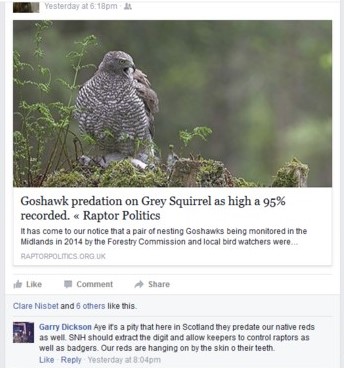
Imagine our surprise, then, when we were sent the following image, captured from Facebook two days ago:

Garry Dickson

In case you can’t read it, here is the comment written by Garry Dickson about protected native goshawks:

Aye, it’s a pity that here in Scotland they predate our native reds as well. SNH should extract the digit and allow keepers to control raptors as well as badgers. Our reds are hanging on by the skin of their teeth“.

Who’s Garry Dickson? He’s a lecturer on the gamekeeping course at Borders College.

Is this the sort of ill-informed, unsubstantiated nonsense he’s teaching to young gamekeeping students at Borders College? Mind you, if they don’t hear it from their lecturer they’ll probably hear it from the SGA – Alex Hogg shared his ignorance on goshawks a couple of years ago – see here.

It’s no surprise that the goshawk is listed as a wildlife crime priority species (because of the extent of persecution against it) if armies of young gamekeeping graduates are being let loose in the countryside after being taught such moronic 19th Century prejudice.

Raeshaw and Burnfoot Estates to appeal General Licence Restriction orders

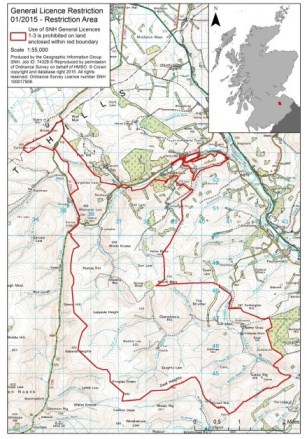
Raeshaw Corshope GL restriction map 2015Further to last week’s news that SNH has suspended the use of General Licences on four estates for what it said was “clear evidence that wildlife crimes have been committed on these properties”, which includes the discovery of poisoned raptors and illegal traps (see here and here), two of the estates involved are set to appeal.
According to quotes in this week’s Scottish Farmer, defence agent David McKie, representing Raeshaw Estate in the Borders, said: “We are disappointed by this decision and will be vigorously challenging it“.

A spokesman for Burnfoot Estate said: “We absolutely dispute the conclusions reached by SNH and consider the decision to be unfair. We will be appealing the decision“.

Meanwhile, a spokesperson for Scottish Land & Estates is quoted: “Our concerns about the level of evidence and robustness of process, which were raised previously along with other land management organisations, remain. We will be working with key industry stakeholders to learn more about the circumstances surrounding these new restrictions“.

A spokesman for the Scottish Gamekeepers’ Association is quoted: “It is up to the estates involved to take counsel and make a case if they feel there is insufficient evidence for the measure to proceed. When this measure was initially subject to consultation, the SGA opposed it, not in the spirit of what it was trying to do, but rather that it was simply not a good proposal“.

Article in Scottish Farmer here

Wonder if Raeshaw Estate or Burnfoot Estate is a member of the SLE?

Scottish gamekeeper convicted of snaring offences on estate in Aberdeenshire

George Allan, 61, a Scottish gamekeeper working on an estate in Aberdeenshire, has been convicted of two snaring offences. He was sentenced yesterday at Aberdeen Sheriff Court and received a £600 fine.

A press release about this conviction is available on the SSPCA website here.

According to our local sources, Allan was a full time gamekeeper employed by the Easter Skene Shooting Syndicate on land rented to them by Dunecht Estate. There is no suggestion that Dunecht Estate had any knowledge of what Allan was up to.

This, clearly, is not a raptor persecution case, so some people (people who don’t like this blog) will no doubt query why we’re blogging about it. There are a few reasons why:

  1. This is yet further evidence that some gamekeepers are not the ‘law-abiding guardians of the countryside and friends to all animals’ that we’re so frequently told they are. This gamekeeper had completed the obligatory snaring training course (a legal requirement for anyone who wishes to set snares in Scotland) and yet, even though he had passed this course and so presumably knew the laws relating to snare-use, he chose to ignore them.
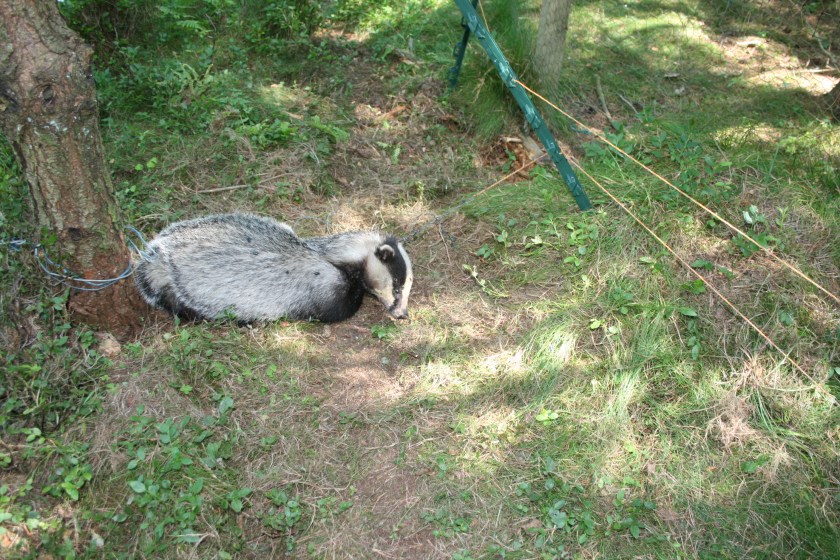
  2. He pled guilty to two snaring offences. There is no mention of him being convicted for causing unnecessary suffering to a badger. There is no doubt whatsoever that this badger suffered – it was electrocuted (from the electric fence) and, judging by the graphic photograph, it was more than likely asphyxiated too. So why wasn’t there a welfare charge against this keeper? Did the Crown accept a plea bargain and decide to just go for the snaring offences? As there was no conviction relating to the welfare of the badger, does this mean that this badger-related wildlife crime will not feature in the Government’s annual statistics on recorded badger crime?
  3. In order to secure the snaring convictions, the SSPCA used some advanced techniques to find supporting evidence. For the first time, they used forensic entomology to determine the age of the fly larvae present on the badger, to show that the badger had been in that snare for longer than the 24 hour period ‘allowed’ by the snaring regulations. Further evidence, as if it was needed (it isn’t), that the SSPCA will make extraordinary efforts to investigate wildlife crime offences. Why is it taking Environment Minister Dr Aileen McLeod so very long to make a decision about increasing the investigatory powers of this organisation? It’s now been one year and two months since the public consultation ended on this issue. These SSPCA investigators are experts in the field and know how to secure evidence that will stand up to legal scrutiny. It’s an absolute no-brainer that they should be given increased investigatory powers if the Scottish Government is committed to cracking down on wildlife crime, as it says it is.
  4. We’re interested to know if criminal gamekeeper George Allan is/was a member of the Scottish Gamekeepers’ Association. Emails to: info@scottishgamekeepers.co.uk

badger pic 1 - Copy

Kildrummy Estate: vicarious liability prosecution?

On 11th December 2014, Scottish gamekeeper (and SGA member) George Mutch was convicted of four wildlife crime offences that he’d committed on the Kildrummy Estate, Aberdeenshire in 2012 (see here).

On 12th January 2015, Mutch was given a four month custodial sentence for his crimes; the first gamekeeper to be jailed in the UK for killing raptors (see here).

Both his conviction and sentence were widely welcomed across the conservation community, not least because video evidence had been deemed admissible in this case and because the agencies involved in the investigation and prosecution had worked exceptionally hard to achieve these results.

Hopes were high that a subsequent vicarious liability prosecution would follow, especially when a journalist friend told us that Fiscal Tom Dysart had made a point of asking Mutch in court whether he’d received any training for the use of his traps, to which Mutch had replied, “No”. That response would indicate that a defence of ‘due diligence‘ wouldn’t stand up to scrutiny for anyone charged with being vicariously liable for Mutch’s crimes. All good so far, although Andy Wightman cast doubt over the feasibility of charging someone from Kildrummy Estate given the difficulty of establishing ownership there (read his blog here).

So seven months on, what’s happening now?

Well, it all gets a bit interesting around about now.  As we understand it, for offences committed under the Wildlife & Countryside Act, criminal proceedings MUST begin within three years from the date of the commission of the offence (two years in England & Wales). After three years, the case becomes ‘time-barred’ and it is no longer possible to prosecute.

Mutch was convicted of four offences, and the dates those offences were commissioned are as follows (info from COPFS press release, January 2015) –

  1. On 14 August 2012 & 15 August 2012, Mutch did intentionally or recklessly kill or take a wild bird, namely a goshawk.
  2. On 23 August 2012 and 24 August 2012, Mutch did intentionally or recklessly take a wild bird, namely a buzzard.
  3. On 28 August 2012, Mutch did intentionally or recklessly kill, injure or take a wild bird, namely a goshawk.
  4. Between 6 August 2012 – 13 September 2012, Mutch did use a trap to catch two goshawks and a buzzard.

Pay close attention to those dates. The first three offences are now time-barred (unless someone has already been charged) because it is over three years since they took place. The final offence is not quite time-barred, but will be by this Sunday (13 Sept 2015).

So, two big questions:

  1.  Has somebody from Kildrummy Estate been charged for a vicarious liability prosecution for the first three offences, and if not, why not?
  2. Is the Crown Office intending to charge someone (before Sunday) from Kildrummy Estate for a vicarious liability prosecution for the fourth offence, and if not, why not?

This case is of huge public interest and we don’t think it unreasonable to be asking questions, especially when successive Environment Ministers keep telling us that the effectiveness of Government policy against the raptor killers will be measured by the success of approaches such as vicarious liability.

If, like us, you’re curious about what’s happening with this case, you can email the Crown Office and ask them. The usual response when we ask about criminal cases is ‘As this case is on-going it would be inappropriate to comment’. It’s a handy ‘get out’ option when the authorities want to keep the public in the dark. The Crown Office could legitimately respond like this in this case, if they’ve already charged somebody. However, if they haven’t charged anybody, then the case is now time-barred and therefore cannot be said to be ‘on-going’.

Let’s see how transparent and accountable they wish to be. Emails to Helen Nisbet, Head of Wildlife & Environmental Crime Unit, Crown Office & Procurators Fiscal Office: Helen.Nisbet@copfs.gsi.gov.uk

The intellectual capacity of a cabbage

There was an article in Country Life magazine recently (26th Aug edition) on the proposed plan (see here) to bolster the golden eagle population in southern Scotland. (Thanks to the contributor who sent us a copy).

The short piece included commentary from Dr Cat Barlow (the new project officer) and also a bit from everybody’s favourite ecological expert, Alex Hogg of the SGA:

Alex Hogg, Chairman of the Scottish Gamekeepers’ Association, believes that the large raptors [golden eagles] could threaten not only grouse, but, ironically, the endangered hen harrier. “Grouse cover a huge area and can stand the pressure of hunting, but hen harriers nest en masse and are thus particularly vulnerable. And white hares, one of the eagle’s favourite prey, only breed well in areas where foxes are controlled”, he points out. He adds: “I’m delighted about the idea of the golden-eagle release, but I’m worried there won’t be enough food supply. My overriding feeling is that if the golden eagle had wanted to settle in southern Scotland, it would have done so“‘.

My ‘overriding feeling’ is that Alex Hogg has the intellectual capacity of a cabbage.

How many “en masse nesting” hen harriers are there in southern Scotland? According to the most recent data available from the Scottish Raptor Monitoring Scheme, in 2013 one hundred hen harrier home ranges were checked across southern Scotland for occupancy. Of those 100, there were only 23 breeding attempts and of those, only 18 nests produced fledglings. Here are the data:

Dumfries & Galloway: 24 home ranges checked, 10 breeding attempts, 8 nests producing fledglings.

Lothian & Borders: 5 home ranges checked, 3 breeding attempts, 2 nests producing fledglings.

South Strathclyde: 71 home ranges checked, 10 breeding attempts, 8 nests producing fledglings.

As for a shortage of food, perhaps if the grouse moor gamekeepers in southern Scotland (and elsewhere) weren’t slaughtering mountain hares in their thousands (e.g. see here), in addition to the mass killing of other eagle prey items such as crows, stoats, weasels, fox cubs etc, Alex’s touching concern could be put to rest.

SGA attacks RSPB on false premise

Annie Langholm harrier shot April 2015Never ones to miss an opportunity to stick the boot in on the RSPB, those wildlife crime-fighting heroes at the Scottish Gamekeepers’ Association have mis-kicked, again.
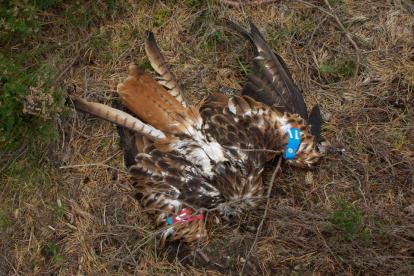
They’ve been whining in the media (Scottish Farmer, see here) about the timing of the RSPB’s press release relating to the discovery of a shot hen harrier called ‘Annie’ (see here).

As you’ll recall, Annie was a young satellite-tagged hen harrier from the Langholm project whose tag indicated she’d stopped moving in March this year (see here). Her corpse was discovered on a grouse moor in late April after several weeks of intensive moorland searches (by the RSPB) and the news of her death was published on 11th August, the day before the start of the grouse-shooting season, when everyone associated with driven grouse shooting is doing their level best to promote it as a sustainable, conservation-friendly tradition (ahem).

How inconsiderate of the RSPB to break this news on the day before the Inglorious 12th. How dare they inconvenience the grouse-shooting lobby like that. Shame on the RSPB for telling the world about another illegally killed raptor found on a grouse moor.

The thing is, the RSPB wasn’t in control of when the news was released.

When Annie’s body had been found (late April), it was submitted the very next day to the SAC Veterinary lab for post mortem. The post mortem results were not released to the RSPB until early August. The RSPB passed on the results to Police Scotland on 5th August. It was then Police Scotland’s call as to when the news was released. According to the article in Scottish Farmer (see here), the police asked the RSPB to sit on the news so that they (Police Scotland) could “crime” the incident, whatever that means. It was then decided, apparently after discussion with the Scottish Government (since when do they get involved with when crime details are released?!) that the news would be published on 11th August.

Instead of trying to smear and discredit the RSPB for publicising this crime, surely the SGA, as a co- member of the Partnership for Action Against Wildlife Crime, should be (a) praising the RSPB for putting in the time and effort, at their own expense, in extreme weather conditions, to retrieve Annie’s corpse; (b) asking the SAC vet lab why it took over three months for the post mortem results to be made available; (c) praising the RSPB for preparing and publishing the press release; (d) focusing their condemnation on the criminal(s) responsible for killing this bird, who, with all probability, are members of the game-shooting industry; and (e) asking the RSPB and other members of PAW Scotland how they (SGA) can usefully contribute to help stop these killings?

Is that really too much to ask?

Two Red kites poisoned & shot in Highlands: get your act together, Police Scotland

RK Cawdor poisoned 2014RSPB Scotland has issued a press release about the discovery of two illegally killed red kites in the Highlands. One was found shot on a railway line and the other one was found poisoned on Cawdor Estate (see photo).
The press release is interesting (read it here) but what’s more interesting is what is revealed by reading in between the lines.

Both birds were discovered in 2014. The shot red kite was found near Beauly in June 2014 (probably this one we blogged about in October 2014) and the poisoned red kite was found in September 2014.

The RSPB statement says, “Both of these incidents took place in 2014 and are now being made public as the Police have concluded their enquiries”.

So it takes Police Scotland over a year to disclose an illegally shot red kite and almost a year to disclose an illegally poisoned red kite. They’ve now ‘concluded their enquiries’ without appealing for information from the public and without executing a search under warrant on Cawdor Estate. What exactly did their ‘enquiries’ entail? Sitting around a table, scratching their heads, before deciding to keep both crimes under wraps?

Of course, an investigation in to the circumstances of the shot red kite would be a hide in to nothing – the bird was most probably shot elsewhere and dumped on the railway line to make it look like it had collided with a train. That’s a very difficult crime to detect, although had the Police made an appeal for information at the time the bird was found, there was always a slim chance that someone might have seen something. But no, far easier just to keep quiet and not attract any more embarrassing media coverage so soon after the mass poisoning of 22 kites and buzzards at nearby Conon Bridge (which is still undetected….more on that soon).

However, the ‘investigation’ in to the circumstances of the poisoned red kite that was found on Cawdor Estate just beggars belief. Cawdor Estate is well known as it has been at the centre of alleged wildlife crimes for over two decades. Here are just some of the incidents recorded either on the estate or close to the estate (for which nobody has ever been prosecuted) –

1992: Dead buzzard, magpie and sheep (laced with Strychnine)

1993:  Dead buzzard (poisoned with Alphachloralose) found on Forestry Commission land 100 metres from the boundary of Cawdor Estate.

1994: Three dead buzzards (poisoned with Alphachloralose) and a poisoned rabbit bait

1996: Three poisoned baits found: a hare laced with Alphachloralose, a goat laced with Aldicarb and a widgeon laced with Strychnine.

1996: A hidden pit containing a suspected bird of prey poisoning kit uncovered by investigators three miles from the estate.

1999: A report sent to the Procurator Fiscal alleging that mountain hares were illegally persecuted in snares on the estate.

2000: A second report submitted to the Fiscal claiming mistreatment of hares on the estate.

2001: A dead golden eagle (poisoned with Carbofuran)

2004: A number of illegal gin traps found set around rabbit baits

2004: A dead buzzard (poisoned with Carbofuran)

2005: A dead red kite (poisoned with Carbofuran)

2007: A dead red kite (poisoned with Carbofuran)

2010: Two red kites found poisoned on neighbouring ground close to estate boundary

With a record like this, wouldn’t you expect Police Scotland, on discovery of the latest poisoned red kite, to request a search warrant and head straight for the estate? Wouldn’t that be a logical first step? Why didn’t that happen?

Did the Police actually talk to anybody on Cawdor Estate about this poisoned kite? If you read a quote attributed to Alex Hogg of the SGA (on the BBC news website here), you’d think not. Hogg says:

“This is the first we have heard of any such incidents….”.

Really? Cawdor Estate has very close links to the SGA. Cawdor’s former Head Gamekeeper and later Sporting Manager Roddy Forbes was the inaugural Chairman of the SGA. And further, the SGA’s 2010 Young Gamekeeper of the Year was an employee on Cawdor Estate. That’s indicative of pretty close ties between the estate and the SGA, and yet the SGA claim not to have heard about this crime?

As an aside, Hogg is further quoted: “….We do not know the possible causes [of the birds’ deaths] which makes it difficult to comment further”.

Eh? The causes of death have been established. One kite was shot, the other was poisoned. Why is it ‘difficult to comment further’? A little bit too embarrassing, Alex?

A Police Scotland spokesperson is also quoted in the BBC article:

“Investigating wildlife crime is challenging because of its nature, and the vast areas covered. Police Scotland works closely with partners including the RSPB to tackle wildlife crime, and brings to bear the full range of investigative techniques at its disposal. Our detection rate is increasing. Our aim is to reduce wildlife crime and earlier this year we launched a campaign raising awareness”.

Yes, of course investigating wildlife crime is challenging, nobody disputes that. But sitting on enquiries, hiding them from the public, and not undertaking searches on estates where poisoned birds are discovered is not ‘bringing to bear the full range of investigative techniques’ at their disposal. It’s anything but that.

And what’s this about ‘our detection rate is increasing’? Are there any data to support this claim or are we supposed to just accept the word of a police force under increasing pressure to get its act together?

So what now for Cawdor Estate, almost one year on from the discovery of this poisoned kite? Might it be too much to hope that SNH will issue a General Licence restriction order? Guess we’ll have to wait and see, although that might be a bit embarrassing for SNH given that they have chucked thousands of pounds (of our money!) at Cawdor Estate to help fund their ranger service.

SGA Committee Member wouldn’t mind setting Hen Harrier Day protesters on fire

There was an article in the Daily Record on Saturday about the forthcoming grouse shooting season (the Inglorious 12th) which outlined many of the reasons that have triggered a call to ban the ‘sport’. The piece included extensive quotes from Mark Avery (see here).

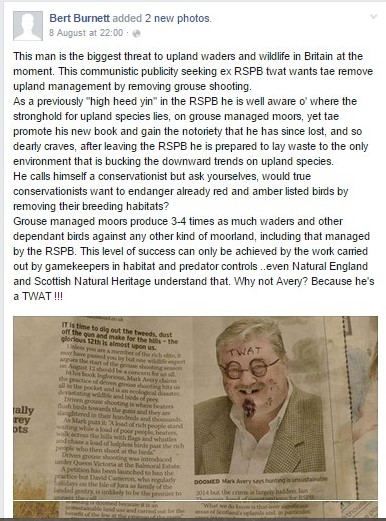
SGA Committee Member Bert Burnett has obviously thought long and hard about the arguments against driven grouse shooting and he presented them on his Facebook page on Saturday night. Watch out for a new SGA fund-raising drive to purchase some new crayons for Bert.

Bert Burnett Facebook Avery twat - Copy

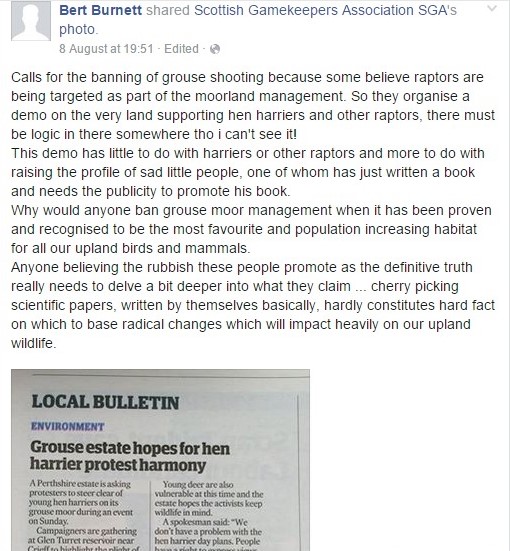
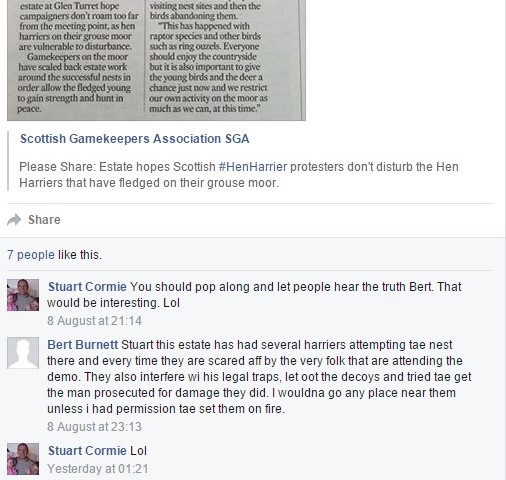
On a related issue, he also shared his considered views on the Hen Harrier Day protesters who were due to gather in Perthshire the following day:

Bert Burnett Facebook HH Day Perthshire 1 - Copy

On a more serious and sinister note, when one of his Facebook acquaintances suggests that Bert should attend the protest demo, he said this:

Bert Burnett Facebook HH Day Perthshire 2 - Copy

It’s a perfectly illustrated example of why so-called ‘partnership working’ is nothing but a sham. It would also be interesting to know how Police Scotland view his comments when they assess his suitability to hold firearms and shotgun certificates. Threat to public safety springs to mind.

Hen Harrier spin: 2

In public relations, spin is a form of propaganda, achieved through providing a biased interpretation of an event or campaigning to persuade public opinion in favour or against some organisation of public figure. While traditional public relations may also rely on creative presentation of the facts, “spin” often implies the use of disingenuous, deceptive, and highly manipulative tactics” [Wikipedia].

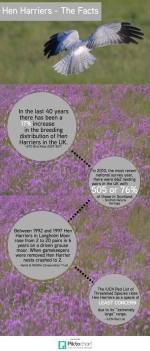
HH the facts sga - CopyYesterday (Hen Harrier Day 2015), at 10:03hrs (3 seconds after over 5.6 million thunderclap messages about missing hen harriers were beamed around the world), the SGA posted this image on their Facebook page.

Here’s the text:

Hen Harriers – The Facts

  • In the last 40 years there has been a 17% increase in the breeding distribution of Hen Harriers in the UK.
  • In 2010, the most recent national survey year, there were 662 nesting pairs in the UK with 505 or 76% of those in Scotland.
  • Between 1992 and 1997 Hen Harriers in Langholm Moor rose from 2 to 20 pairs in 6 years on a driven grouse moor. When gamekeepers were removed Hen Harrier nests crashed to 2.
  • The IUCN Red List of Threatened Species rates Hen Harriers as a species of least concern due to its extremely large range.

END

Here are some missing facts from a government report that they forgot to include:

  • The potential national hen harrier population in Scotland is estimated (conservatively) to be within the range 1467-1790 pairs.
  • The current national hen harrier population in Scotland as recorded during the most recent (2010) national survey is 505 pairs, more than a 20% decline from the numbers recorded during the 2004 national survey.
  • In Scotland, the hen harrier has a favourable conservation status in only five of 20 regions.
  • Two main constraints have been identified: illegal persecution, and in one region, prey shortages.
  • The species is particularly unsuccessful in the Central Highlands, Cairngorm Massif, Northeast Glens, Western Southern Uplands and the Border Hills. There is strong evidence in these grouse moor regions that illegal persecution is causing the failure of a majority of breeding attempts.

Now, this claim of the species being classified as ‘Least Concern’ is often trotted out by those trying to downplay the seriousness of the species’ conservation status in the UK. It is an accurate statement in as much as this is what is written on the species’ IUCN Red List entry (from where the quote is taken), with the addition of one important statement conveniently left out by the SGA – under the heading ‘Major Threats’:

Persecution is an important threat locally, notably on game preserves in Scotland (del Hoyo et al. 1994)”.

The species’ IUCN listing is fine to use if you want to stick to a species’ global conservation status and ignore its European and UK conservation status. If you look at the IUCN global status for the three wader species for which the grouse shooting industry is often claiming to be the one and only saviour, the IUCN listings also give little cause for concern:

Lapwing – listed as Least Concern. Estimated population c. 5,200,000-10,000,000 individuals. Major threats include land use intensification, pollution and hunting. [Note, no mention of raptors being a major threat].

Curlew – listed as Near Threatened. Estimated population c. 77,000-1,065,000 individuals. Major threats include afforestation, agricultural intensification and hunting. [Note, no mention of raptors being a major threat].

Golden Plover – listed as Least Concern. No population estimate given. Major threats include cultivation and afforestation, severe weather conditions and hunting. [Note, no mention of raptors being a major threat].

So, on the basis of suggesting that the hen harrier’s conservation status is of ‘least concern’ on a global scale [and therefore why all the fuss of losing an almost entire breeding population in England and between 66-72% of the Scottish breeding population?], the statement is equally as applicable to those three wader species, right? We shouldn’t be concerned about any of them because on a global scale they’re all doing just fine, right?

Wrong.

Fortunately, government and non-governmental organisations are a lot more clued in and understand the concept, and importance, of national, regional and local biodiversity. Indeed, the Westminster and Scottish Governments have a statutory responsibility for ensuring that national biodiversity targets are met and maintained (although you wouldn’t know it by their continuing failure to address illegal raptor persecution). Rather than use the broad-based IUCN Red List as guidance, they look to more detailed and relevant assessments such as the UK ‘Birds of Conservation Concern’ scientific review. In this document, the hen harrier and lapwing are red listed, and the golden plover and curlew are amber listed.

It’s quite telling, isn’t it, that those with a vested interest in driven grouse-shooting should continue to not only deny their involvement in the catastrophic loss of hen harriers across the UK, but also continue to downplay its conservation significance.

Please sign the petition to ban driven grouse shooting HERE

Hen Harrier spin: 1

In public relations, spin is a form of propaganda, achieved through providing a biased interpretation of an event or campaigning to persuade public opinion in favour or against some organisation of public figure. While traditional public relations may also rely on creative presentation of the facts, “spin” often implies the use of disingenuous, deceptive, and highly manipulative tactics” [Wikipedia].

The Scottish Gamekeepers’ Association issued the following press release yesterday lunchtime. Here it is in full:

Estate hope Harriers on their moor are fine after Harrier Protest.

A Perthshire estate hopes a Hen Harrier protest staged next to their ground yesterday (sun) will not have bothered the Hen Harriers which have fledged on their grouse moor.

Campaign groups gathered at Glen Turret reservoir near Crieff to highlight the plight of the birds, three days before the start of the grouse shooting season.

The lobby groups believe some of the birds of prey are being killed on grouse moors because they feed on wild red grouse and their chicks.

However, the estate adjoining the site where the protest was staged has successfully fledged Hen Harrier chicks on its grouse moor this year and are hopeful the protest will not have disturbed the young birds which are just beginning to hunt independently.

An estate spokesperson said: “It was great to see people that share the same interest as ourselves in Hen Harrier conservation. The future definitely lies in co-operation between land managers who produce birds such as Hen Harriers and those who wish to see and enjoy them.

“We regularly have Harriers here on our grouse moor and we are lucky to have had successes this year, despite the weather. Naturally, our concern is for the birds because we have had nests of differing species abandoned, due to members of the public or photographers visiting the nests.

“We have restricted the activities of the estate around the nests so the birds get the best chance they can to grow and hunt in peace. Obviously, the gamekeepers will be checking the area to make sure the young birds are fine, but we are hopeful everything has gone off, well.”

The estate bordering the protest was audited recently, with RSPB counts in 2012 showing 9 raptor species on the grouse moor, 6 of which are known to have bred.

The estate is also a haven for other birds with two species of eagle recorded.

END

It’s fascinating that the SGA is attempting to infer that a group of peaceful protesters might ‘disturb’ some birds on an adjacent site by standing in the rain for a couple of hours, chatting, miles from any nests. No mention then of the start of the grouse shooting season in three days time where large groups of beaters will be marching across the moor waving flags, shouting and whistling as they scare (‘drive’) any bird in their path (but notably red grouse) towards a line of grouse butts where another load of people will be standing with guns to blast the birds to bits. Which activity do you think is likely to cause the most ‘disturbance’?

But what’s particularly interesting about this press release is the claim that there was a successful hen harrier breeding attempt on this driven grouse moor this year. Why is this interesting? Well, because the one known hen harrier breeding attempt on this site actually failed about a month ago [cause of failure unknown].

Now, of course, it’s possible that there was a second hen harrier breeding attempt on this estate, and that the raptor workers who closely monitor this site just missed it, and that the breeding attempt was successful and that there are indeed now young hen harriers “which are just beginning to hunt successfully”. If that is the case, then presumably the estate will have notified SNH’s ‘Heads up for Hen Harriers Project’ because, like all good Scottish sporting estates, this one will be keen to cooperate (we’ll be blogging more about the Heads up for Hen Harriers project in a separate ‘spin’ blog, to be posted later).

Up until a few years ago, this estate was part of the Operation Countrywatch Partnership – we blogged about it here and applauded their efforts. Funny thing is, this estate pulled out of the project shortly after it was suggested that nest cameras could be installed at hen harrier nests to better understand the causes of breeding failure regularly being recorded in this area. However, it was probably just a complete coincidence that the estate pulled out at that time and there will undoubtedly be an unrelated and perfectly reasonable explanation for their withdrawal.

Also interesting to note the final sentence of the press statement. Two species of eagle have indeed been ‘recorded’ on this estate (note the ambiguous choice of word – ‘recorded’ can mean a breeding attempt but it can also mean something was simply observed flying over/passing through). Just for the record, there aren’t any officially recorded white-tailed eagle breeding attempts on this estate, but golden eagles have certainly bred there in the past. Funny thing is, this year the golden eagle nest site was burnt out and the eagles moved to another estate for their breeding attempt. Those spontaneously combusting nests are a real problem on driven grouse moors, it seems.

The photograph shows some of the people who attended the Hen Harrier rally in Perthshire yesterday. Well done to those who organised it and also to those who turned out to support it.

HH Day Perthshire 2015