Number of poisoned raptors in Scotland more than quadrupled in 2014

Persecution map 2010 to 2014 - CopyThe Scottish Government has today released the annual poisoning and persecution maps relating to crimes against raptors in 2014.

The accompanying press release is a careful study in damage limitation. We can’t blame them – it must be a constant source of embarrassment for them that raptor persecution continues with virtual impunity so of course they’re going to put out a statement that showcases the positives (there aren’t that many) and plays down the negatives (there are many).

The basic premise of their press release is that reported raptor crimes (incidents) have dropped from 23 in 2013 to 19 in 2014. Sounds like progress, eh? But wait – what if you look at the actual number of persecuted raptors – that tells a completely different story!

Let’s ignore the different types of persecution crimes (e.g. shooting, trapping, disturbance) for a minute and just start with poisoning. Here are the Government’s official number of reported poisoning incidents for the last three years:

2014: 6

2013: 6

2012: 3

So on the face of it, no change from last year and still double the number of reported incidents in 2012. But now let’s look at the number of reported individual raptors that were poisoned over those three years:

2014: 27 (17 x red kite; 7 x buzzard; 1 x peregrine; 2 x unknown because Police Scotland hasn’t released the data)

2013: 6 (1 x red kite; 4 x buzzard; 1 x golden eagle – data from Scot Gov annual report on wildlife crime)

2012: 3 (2 x buzzard; 1 x golden eagle – data from Scot Gov annual report on wildlife crime)

That’s quite an increase, isn’t it? Three reported in 2012, 6 in 2013 and a whopping 27 reported in 2014. Does that sound like raptor poisoning in Scotland is in decline? Nope, it shows that the number of poisoned raptors actually quadrupled in 2014.

However, the Government doesn’t agree that 27 raptors were poisoned in 2014. According to their data, only 16 raptors were poisoned in the Ross-shire Massacre (12 red kites + 4 buzzards). They seem to have conveniently forgotten that 22 dead birds were found, not 16. Even Environment Minister Aileen McLeod ignores the ‘missing six’ and just refers to the poisoned 16 in today’s press release! Sure, there may only be toxicology reports for 16 of those victims – we don’t know the cause of death for the remaining six victims because Police Scotland hasn’t bothered to tell us. But surely they and the Scottish Government aren’t trying to convince us that the remaining six victims (four red kites + two buzzards) weren’t poisoned at all, but that they all just happened to die of natural causes at the same time and in the same fields as the other 16 poisoned birds? Come on. Why try and diminish the extent of such an appalling crime?

And, once again, the poisoning maps exclude other crimes where bait was discovered but with no apparent raptor victim. We know of at least one of these incidents that occurred in 2014 – a poisoned rook found in January close to a poisoned rabbit bait and a poisoned hare bait (Carbofuran & Chloralose) (here). Why doesn’t this count?

Now let’s have a look at the other types of raptor persecution crimes reported in 2014. These include shooting, trapping and disturbance. According to the Government’s data released today, there were 8 reported shootings, 2 reported trapping offences, 1 reported disturbance incident and 2 listed as ‘other’.

Interestingly, they’ve excluded incidents where satellite-tagged raptors have (un)mysteriously disappeared in known persecution hotspot areas, such as the young white-tailed eagle (see here) and several others that Police Scotland has so far chosen to keep under wraps.

They’ve also excluded incidents where illegally-set traps have been found but without an apparent raptor victim. Again, the police have chosen to keep these under wraps. Why don’t those count?

So let’s now look at the Government’s ‘official’ three-year figures for all types of raptor persecution incidents in Scotland (including poisoning, shooting, trapping, disturbance, and ‘other’):

2014: 19

2013: 23

2012: 13

As we said at the beginning, on a superficial level it appears that reported raptor persecution incidents have declined since 2013, although we now know that the Government has excluded several known incidents, and we also know that these are only the reported crimes – many more will have occurred but weren’t detected. But let’s have a look at the number of known raptor victims during that three-year period:

2014: 40

2013: 23

2012: 13

That’s pretty clear then. Illegal raptor persecution continued in 2014 and the number of (known) victims rose considerably from the previous year and the year before that.

What an utter disgrace.

Scottish Government press release here

Scottish Government’s persecution maps and background data can be downloaded here:

Scottish Gov background raptor persecution data (released 31 Mar 2015)

Ross-shire Massacre: one year on

RK7It’s been one year since the corpses of 22 birds of prey (16 red kites and 6 buzzards) were found in a small area around Conon Bridge in the Highlands.

We know that 16 of these birds were illegally poisoned (12 red kites & 4 buzzards). Still no word on the other six victims.

Still no word on the type of poison used, although Police Scotland did eventually admit that it was an “illegally-held poisonous substance” (see here). Carbofuran is suspected by many of us (see here).

The details of this illegal mass poisoning have still been deliberately excluded from the quarterly SASA reports – the Government reports that are supposed to inform us about recent illegal poisoning crimes in Scotland.

Police Scotland still maintains that the birds “were most likely not targeted deliberately but instead were the victims of pest control measures” – even though they can’t possibly know this unless they have a suspect who has given a full confession.

We’re still waiting to hear whether MSP Dave Thompson’s request, back in November 2014, for a review of Police Scotland’s handling of this investigation will be undertaken (see here).

We’re still waiting for the thousands of pounds worth of funds, that many of us donated, to be released by Police Scotland so that RSPB Scotland can redistribute them to support the work of their investigations team (see here).

Twelve months on and still no arrests.

Twelve months on and still no charges.

Twelve months on and still no prosecution.

Twelve months on and still no conviction.

Twelve months on and still no justice.

Twelve months on and still no confidence in Police Scotland’s ability to solve this appalling crime.

Previous posts on the Ross-shire Massacre here.

The face of ‘modern landownership’ in Scotland

This is a belter. Surely inspired by the Gloria Gaynor classic, a Scottish estate owner has erected signs on his land telling the RSPB they’re ‘not welcome’.

Go on now go

Walk out the door

Just turn around now

‘Cause you’re not welcome anymore

John Mackenzie, who owns the massive Gairloch and Conon Estates, said he’d put up the signs because:

It is years of frustration and anger boiling over. Landowners, farmers and gamekeepers have always been an easy target, blamed by the society [RSPB] for the poisoning and shooting of raptors“.

Er, wouldn’t that have something to do with the fact that the majority of those convicted for poisoning and shooting raptors are, erm, gamekeepers working on shooting estates?

He went on to say he was “irritated” to find out that the RSPB had been “driving around looking at things themselves“. How dare they!

Ironically, the Conon Estate is close to the area where 22 raptors were found dead last spring in what has been termed the Ross-shire Massacre – 16 of them confirmed illegally poisoned (still no information on the other six).

Poor old Laird MacKenzie. He knows he can’t stop the RSPB, or anyone else for that matter, accessing his land, but he thought he’d stick up his signs anyway. Bless.

We wonder how his actions fit in with the recently launched Landowners Charter? Prepared by Scottish Land & Estates and published last September, this charter ‘sets out a commitment to the principles and responsibilities of modern landownership in Scotland’. The ‘four pillars’ of this charter are for landowners to be open, inclusive, enabling and responsible.

Not rude, arrogant, intolerant and stupid, then?

Bring on the land reform.

Article in Daily Mail here

Article in Daily Telegraph here

Article on BBC news website here

Come on, Aileen

Aileen McLeod MSPWe didn’t know what to expect from the newly-appointed Environment Minister when she took on her role a little over a month ago. Dr Aileen McLeod’s political experience had been largely focused on European policy work, although she was clearly highly educated and we knew she’d be well advised by the wildlife crime policy officers in Holyrood. Nevertheless, it would inevitably take time for her to achieve the level of insight and knowledge of her predecessor, Paul Wheelhouse MSP, who had the benefit of two years in office and was beginning to achieve considerable momentum against the raptor killers, until he was pushed out to another department in the Cabinet reshuffle in November.
Obviously, the jury is still out on Dr McLeod’s effectiveness and we need to give her a bit of time to get her bearings, although we fully expect her to adopt the Government’s stated intolerance of wildlife crime and to do everything she can to ensure that the raptor killers are brought to justice.

Two recent statements show that she has a thoughtful and measured approach, although we have cause to question a few of her comments.

First off, she has responded to the concerns of the Rural Affairs, Climate Change and Environment (RACCE) Committee, who wrote to her (see here) after taking evidence on wildlife crime from Police Scotland, COPFS and the former Environment Minister.

Here is her response: Environment Minister response to RACCE Committee Dec 2014

On the whole, her response is non-contentious and is pointing in the right direction, but she does say a couple of odd things. On the issue of the detection and prosecution of wildlife crime she says:

Reported crime numbers also reflect not only public awareness of wildlife crime, but also confidence that there will be an appropriate response from the authorities. Police Scotland has worked hard to ensure that consistent structures and resources are in place throughout Scotland and we expect this to produce improved results in wildlife crime reporting“.

We haven’t seen any evidence of this, in fact the complete opposite. We would agree that Police Scotland has been consistent, but not in a good way; consistently poor responses to reports of wildlife crime (with a handful of exceptions) seems to have been the norm for a very long time.

On the subject of the absence of species potentially indicating criminal activity (i.e. the absence of certain raptor species from vast swathes of driven grouse moors) she says:

We know that there may also be other non-criminal explanations for the absence of species. Nevertheless I agree that this would be useful work for the PAW Scotland Science sub-group to take forward“.

What other non-criminal explanations are there for the absence of certain raptor species from driven grouse moors? All the science (and there has been plenty of it, some dating back almost two decades) indicates a direct link to the illegal persecution of raptors on those moors. Sure, natural factors such as habitat, climate, prey availability, predation etc can and do affect the natural distribution of species, but we’re talking about species that have either ‘disappeared’ from their former natural ranges or their breeding attempts in parts of those ranges consistently fail. It’s no coincidence that these areas just happen to be managed as driven grouse moors.

On the subject of increasing the investigatory powers of the SSPCA she says:

I am also aware of the need to carefully balance a number of factors such as resources, accountability and proportionality in coming to a decision on whether to extend further powers to the SSPCA as regards wildlife crime“.

‘Proportionality’ is an interesting word. It suggests that the measure of extending the SSPCA’s powers should be fair, reasonable and appropriate. Who would argue that extending the SSPCA’s powers would be a dis-proportionate response to the rising level of wildlife crime in Scotland and Police Scotland’s inability to cope? Well we already know the answer to that – see here and here. The question is, will the Environment Minister consider it a disproportionate measure? We’ll find out soon enough, although if the last sentence of her letter to the RACCE Committee is anything to go by, she’ll do the right thing:

Tackling wildlife crime is a key priority for the Scottish Government and one that I am keen to take forward robustly in my new role“.

Other statements in her response letter were very encouraging, and we particularly welcome her intention to consider including the locations of illegally placed poison baits and traps on the annual PAW raptor persecution maps. That’s something that we (and others) have been asking for for a long time (e.g. see here).

We were also pleased to see a (diplomatic) dig about Police Scotland’s ridiculous press statement on the cause of the Ross-shire Massacre (here is some background on their idiotic statement, in case you missed it). Dr McLeod says:

Police Scotland’s press release on 24 October was designed to bring about a reduction in speculation that was widespread across social media on this high profile case. I am confident that lessons will have been learned on the need to be very careful with wording of such communications“.

She went a bit further in a recent statement published in the Scottish Farmer (here), where she announced NFU Scotland as a new member of PAW. In that statement she reiterated that the Ross-shire Massacre was the result of criminal activity. In other words, it wasn’t the result of an accidental poisoning.

 So, all in all a good start from her, with just a couple of questionable statements. Come on, Aileen, let’s see what you can deliver in 2015…

Ross-shire Massacre: 9 months on

KeystoneCopsIt’s been nine months since 22 raptors (16 red kites + 6 buzzards) were illegally killed in a mass poisoning incident near Conon Bridge, Ross-shire.

Still no word from Police Scotland on the name of the ‘illegally held substance’ that was used to kill these birds.

Still no arrests.

Still no charges.

Still no prosecution.

Still no justice.

Police Scotland’s handling of this investigation continues to astound….

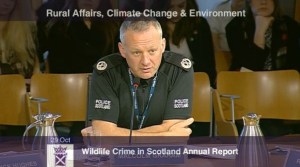
You may remember, back in October, some senior officers from Police Scotland gave evidence on this case to the Parliamentary Rural Affairs, Climate Change & Environment Committee (RACCE). The police were being questioned about their idiotic recent press release which had stated: “These birds were most likely not targeted deliberately but instead were the victims of pest control measures“.

We were particularly interested in what Assistant Chief Constable Malcolm Graham had to say to the RACCE about this press release:

We put out information into the public domain that we thought was going to clarify what we thought our best assessment was, lay behind the intent of the acts that we’re investigating, and from everything that we have done, in combination with a number of other agencies who are active in this field AND WHO SUPPORTED THE PRESS RELEASE THAT WE PUT OUT [Emphasis by RPS], we wanted to say that it didn’t appear that the activity had sought to deliberately target the birds that had been killed“.

We were intrigued about who these “other agencies” were that had supposedly “supported the press release that we put out” because, to be blunt, we didn’t believe ACC Malcolm Graham’s claim.

So in October we encouraged blog readers to email ACC Graham to ask him for clarification on the identity of these “other agencies“. There was no response for six weeks. So last week we encouraged blog readers to consider writing to the Information Commissioner to put in a formal complaint about Police Scotland’s refusal to respond. That prompted the following letter from Police Scotland, sent on 11th December 2014:

Dear XXXXX XXXXX

ACC Graham has asked me to reply to your email on his behalf.

I can confirm that a number of organisations both governmental and non-governmental have assisted the police in this enquiry from the outset. Significantly, both the RSPB Investigations Team and the SSPCA Special Investigations Unit have been involved and offered professional opinions at various times based on their experience of the the killing of birds of prey and the use and impact of poisons.

When drafting the press release these considered opinions along with those given by others were taken in to consideration. The press release reflected the belief at this time that the birds of prey were not the intended target of the illegal poison. However, as stated in the press release the illegal killing of the 16 poisoned birds remains a crime and therefore subject to a criminal investigation.

Regards,

Sergeant Andrew Mavin

Scottish Wildlife Crime Coordinator

Specialist Crime Division

Police Scotland

Glasgow West End Police Office

609-611 Dumbarton Road

Glasgow

G11 6HY

An interesting response, eh? We already know that RSPB Scotland didn’t support the press release (see here), and neither did Environment Minister Paul Wheelhouse (see here). The SSPCA didn’t respond to our queries so we don’t know whether they supported the release or not but we could take an educated guess.

While we wouldn’t go as far as to suggest that Police Scotland gave misleading evidence to a Parliamentary Committee, we would suggest that their evidence (specifically, their claim that “other agencies who supported the press release that we put out“) deserves further scrutiny and we’ll be writing to the RACCE about this.

Meanwhile, we await with interest to see whether the new Cabinet Secretary for Justice, Michael Matheson, responds to MSP Dave Thompson’s request for a review of the police handling of this investigation.

Previous blogs on the Ross-shire Massacre here

RACCE committee writes to new Environment Minister re: wildlife crime

RACCEYou’ll recall last month that the Scottish Parliament’s cross-party Rural Affairs, Climate Change & Environment (RACCE) Committee took evidence on wildlife crime, following the publication of the Government’s 2013 annual report on wildlife crime in Scotland.

We blogged about the evidence given by Police Scotland and the Crown Office (here) and the evidence from (now former) Environment Minister Paul Wheelhouse (here).

We said at the time that the RACCE Committee were a pretty well-informed bunch and, with the publication of their letter to the new Environment Minister Aileen McLeod, we continue to be impressed.

It is clear from their letter that they are no push-over, and that they intend to hold the Minister, as well as Police Scotland and the Crown Office, to account. Good on them!

The letter sets outs their views on the issues that were discussed during the two hearings. These include their continuing concerns about the inconsistent presentation of data in the annual wildlife crime reports; their concerns about recorded wildlife crimes being ‘the tip of the iceberg’ and how this needs to be addressed; continuing concerns about police under-resourcing; and a suggestion that PAW Scotland should include incidents of poison baits and illegal traps in their annual wildlife crime mapping exercise. Excellent stuff.

There is a rather pointed comment about Police Scotland’s last press release on the Ross-shire Massacre, basically agreeing with the general view that their press release was ridiculous (although they’re a bit more diplomatic than that, obviously). Talking of that press release, has anyone had a response from Assistant Chief Constable Malcolm Graham about his claim that other agencies had supported that press release (see here)? We haven’t heard a word from him, even though he was asked for information on 31st October – we’d be interested to know if anyone else has received a reply or if ACC Graham is ignoring everyone? If he is, then we’ll be encouraging you to contact the Information Commissioner to seek a review.

Staying on the Ross-shire Massacre for a minute, there’s also a claim in the RACCE’s letter that Police Scotland undertook “a full review” of the inquiry, including the investigative approach, the media strategy and the forensic investigation, and that “this process has involved partners including RSPB Scotland and the SSPCA”. Really? Disppointingly, the RACCE Committee didn’t ask to see the results of that “full review” and instead just commented that “once the case has concluded, Police Scotland and PAW Scotland are asked to consider what lessons are to be learned for the future”. Let’s be realistic here – this case isn’t going to ‘conclude’ – it’s been nearly nine months since 22 raptors were killed in a mass-poisoning with a banned poison and nobody has been arrested, let alone charged. The lessons need to be learned now, not in three years time when everyone has forgotten about it.

The letter also includes the Committee’s concerns about the poor detection and conviction rates associated with wildlife crime, and suggests that these crimes are “insufficiently prioritised” by COPFS. We’re greatly looking forward to the publication of a forthcoming report that will examine, amongst other issues, the detection and conviction rates of some wildlife crimes in Scotland. The report is due out shortly and apparently there’ll be a presentation on its findings at the BAWC Wildlife Crime Conference in March. Should be interesting.

All in all then, a promising letter from the RACCE Committee and we’ll wait with interest to read the new Environment Minister’s response.

Download the letter here: RACCE letter to Env Minister re Wildlife Crime Dec 2014

Environment Minister gives evidence on wildlife crime to RACCE Committee

Wheelhouse RACCEA couple of weeks ago, Police Scotland and COPFS gave evidence to the Scottish Parliament’s Rural Affairs, Climate Change and Environment (RACCE) Committee about wildlife crime (see here).

Last week it was the turn of Environment Minister Paul Wheelhouse. The archived video can be watched here and the full transcript can be read here.

So what did we learn? Quite a lot.

1. The Minister is “confident” that surveillance cameras can be used in wildlife crime investigations and the Lord Advocate has made it clear that the option is available to Police Scotland. (Interestingly, Police Scotland were not quite so keen when they were asked about it two weeks ago).

2. The Minister will shortly be announcing a forthcoming pesticide disposal scheme (he made it clear it was not an amnesty) – no further details available.

3. The committee reviewing wildlife crime penalties (led by Prof Poustie) will report back early in the New Year, and not in December as originally planned.

4. The Minister recognises the “wall of silence” that so often prevents the reporting of wildlife crime. Good.

5. Two weeks ago, Police Scotland claimed that the number of reported wildlife crimes was more than just the tip of the iceberg. The Minister disagrees with that and cited the large areas of suitable and yet unoccupied raptor habitat as evidence of widespread unreported wildlife crime. However, he suggested that more research was necessary to understand why raptors may be missing from those areas. Eh? What about the twenty years of high quality research that has shown time and time again the link between driven grouse moor management and raptor persecution?

6. The Minister recognises that the (police) response to every wildlife crime incident isn’t perfect. However, he believes that everyone in the law enforcement community takes wildlife crime seriously. He said that with a straight face.

7. On the new General Licence restrictions, the Minister explained that he was taking a ‘targeted approach’ to try and avoid penalising those who are not involved in wildlife crime. He accepts that the restriction measure could easily be by-passed by someone simply applying for an individual licence, although he maintains that SNH may not issue one – each case will be judged on its merit. He has more faith in SNH than we do but time will tell.

He also said that he expects GL restriction cases to be listed publicly on SNH’s website “on a live basis” because he wants the restriction to be used as a ‘reputational driver’. Good.

He made an interesting statement about who is probably responsible for poisoning birds:

In most cases in which we find a dead poisoned bird on a landholding, we can be reasonably confident that the poisoning took place on that landholding and that the bird died on the landholding as a result of that poisoning“.

That’s very encouraging to hear.

8. On the idiotic Police Scotland press release about the Ross-shire Massacre, the Minister said “unfortunately” he didn’t have any input into the wording of the statement and he urged the Committee not to read too much into the statement, but instead to focus on the fact that 16 of the 22 dead birds are confirmed to have been poisoned and that a criminal investigation was continuing. You can read between the lines – he didn’t think much of the police statement.

9. On the SSPCA consultation, the Minister said he hadn’t yet made up his mind about whether to increase their investigatory powers and he was waiting for an analysis of the consultation responses before he decided. He expected to receive the analysis “early next year at the latest“.

10. When asked whether he was considering further measures to tackle wildlife crime, the Minister said he didn’t have a definitive timescale but wanted to give the current measures time to take effect. However, he did say that he had already commissioned a review of game-shoot licensing in other countries, in preparation for consideration of further measures. He wants to know what options are available to him should he decide to take a harder line. The review will be undertaken by Prof Poustie as soon as the wildlife crime penalties review has been completed in the New Year. Excellent.

11. The Minister said he would try to incorporate further data in the next wildlife crime annual report, including reports of illegal traps (but with no apparent victim) and poisoned baits (with no apparent victim). Good.

12. Two weeks ago, COPFS claimed that vicarious liability was already proving to be an effective deterrent against raptor crime (based on what the landowners had been saying). The Minister disagreed, citing on-going wildlife crime as a clear indication that not everyone is deterred by the threat of vicarious liability. He thinks that may change if/when there is a successful VL conviction. Good.

All in all, we think the Minister did pretty well. He may be a bit too light-handed and cautious for many of us, but it’s clear that he has taken a personal interest in addressing wildlife crime, he’s incredibly well-informed, he’s not fooled by the cries of denial from the wildlife killers, and his measures are heading in the right direction, albeit slowly. He thinks the GL restrictions will be the most important step in the process but we disagree. His defining moment will come when he makes the decision on whether to increase the SSPCA’s powers. That decision, and that decision alone, will tell us all we need to know about how seriously committed this Government is to tackling wildlife crime.

Ross-shire Massacre: MSP calls for review of police investigation

As the Ross-shire Massacre fiasco rolls into its eighth month, one MSP is making a stand.

Dave Thompson MSP (SNP: Skye, Lochaber and Badenoch) has called on Justice Secretary Kenny MacAskill to undertake a review in to the police handling of this investigation. Well done, that man!

The police investigation into one of the most high profile mass raptor poisoning crimes in decades has blundered along for far too long and is fully deserving of public scrutiny, as is the accompanying police media strategy. Rather than providing clear and timely information, their strategy has been to release a series of untimely, misleading and willfully ambiguous statements that have done anything but inform. Indeed, these statements have simply led to more and more outlandish speculation and a growing sense of frustration and anger. Given how keen Police Scotland are on “public accountability” (e.g. see here), they’ll no doubt welcome a review of their handling of this case.

Dave Thompson MSP is a member of the Scottish Parliament’s Rural Affairs, Climate Change and Environment (RACCE) Committee, who recently heard evidence from two senior Police Scotland representatives about the Ross-shire Massacre (see here). It seems he was as unimpressed with their answers as we were.

He said: “It would be useful if a full review of the investigation process was carried out. It would go a long way to allaying any fears the general public may have but also, in the interests of transparency, such a review would take away any lingering confusion about how these great birds of prey met their demise.

This is why I have written to Justice Secretary Kenny MacAskill to request that a review of the investigation process takes place and why I will be making sure the Lord Advocate is copied into any correspondence on the matter“.

Dave Thompson MSP formally opening the Tollie Red Kite feeding station in 2012, assisted by Alex Matheson (Brahan Estate) and George Campbell (RSPB Regional Director). [RSPB Scotland photo]

Dave Thompson MSP


Ross-shire Massacre: more on that Police Scotland press release

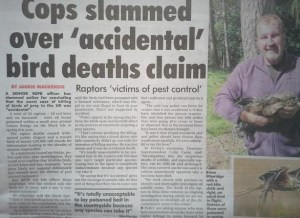
Brian Etheridge statementA week ago, Police Scotland issued a ludicrous press statement concerning the illegal poisoning of 22 raptors in Ross-shire. They said that they could CONFIRM that the birds “were most likely not targeted deliberately but instead were the victims of pest control measures“.
We’ve blogged quite a bit on that press statement already (see here, here, here, here). Our main issue with it is that the police appear to have ruled out intent (i.e. inferring the birds were accidental victims) before they’ve even identified a suspect. How could they possibly know what the intent was without first having a confession from the poisoner? We also take issue with them citing ’16’ victims instead of 22 victims. It may well be that they only have confirmed poisoning results from 16 of the 22, but to completely ignore the other six birds merely diminishes the scale of this crime.

We are not alone in this view. An article in the North Star quotes the RSPB’s Brian Etheridge (he’s the guy who has worked with the Black Isle red kite population for 19 years and was heavily involved in the discovery of the poisoned birds) as folllows:

It’s a very stupid statement. That’s almost justifying the killing. It’s like saying that a drunk driver who kills somebody didn’t go out with the intention of killing anyone. He was just drunk and it was an accidental death“.

Last week, we invited blog readers to contact two of the partner agencies involved in this investigation (RSPB Scotland & SSPCA) to formally ask whether they agreed with the content of the Police Scotland statement. The SSPCA is yet to respond, but Ian Thomson, Head of Investigations at RSPB Scotland has issued the following statement:

The use of poisoned bait, deliberately placed in the open countryside, is an indiscriminate and criminal act, whatever the intention of the perpetrator, and is aggravated in this case by the fact that an illegal chemical was used.

Whether these birds were killed deliberately or otherwise is irrelevant. Someone placed a fast-acting and very toxic poison out in the open, in an area well-known as being frequented by protected birds of prey, including a significant part of the north of Scotland red kite population. The resulting deaths were an entirely predictable result. It is very fortunate that the members of the local community who discovered poisoned birds did not become victims themselves.

The placing of poisoned bait, just a few miles from the popular Tollie red kite feeding station, was not only a reckless attack on local wildlife but also on the local tourist economy.

 I hope this provides clarification of our position”.

END.

Now, while Mr Thomson’s statement doesn’t really answer directly the question he was asked (and to be fair, we’d have been surprised if he had, given that the RSPB has to work in partnership with the police), it is nevertheless very revealing. He specifically mentions poisoned bait – something Police Scotland has so far failed to do, but more importantly, if you read between the lines, it’s pretty obvious that RSPB Scotland isn’t too happy about the Police Scotland statement: “Whether these birds were killed deliberately or otherwise is irrelevant” and “The resulting deaths were entirely predictable“. Indeed.

The Police Scotland statement came in for further scrutiny at the Scottish Government’s Rural Affairs Committee hearing on Wednesday. The session was all about wildlife crime and two senior police officers, as well as a rep from COPFS, gave evidence to what turned out to be an impressively well-informed Committee. We’ll be blogging more on what was said at that hearing in due course, but suffice to say it was extremely illuminating. The official transcript apparently won’t be available until Monday, but in the meantime we thoroughly recommend you watch the video of the hearing (available here).

Malcolm GrahamSo, what was said about the Police Scotland press statement during that hearing? Quite a lot! The discussion on this specific item lasted for 18 minutes (see video 01.20-01.30 and then 01.34-01.42) and those well-informed Committee members clearly expressed their concern about the Police Scotland statement.

The police officers (ACC Malcom Graham, pictured left, and DCS Robbie Allan) tried to defend their position – notably, they didn’t apologise for any of the confusion their statement had caused – but their defence wasn’t very impressive. They did state, clearly, that they hadn’t intended to infer the poisonings were accidental, and they did confirm a criminal investigation was on-going. That was good, but they couldn’t justify why they thought the birds “were most likely not targeted deliberately” and quite surprisingly, they claimed that their partner agencies had been in support of the press release! Here’s part of what Assistant Chief Constable Malcolm Graham had to say:

 “We put out information into the public domain that we thought was going to clarify what we thought our best assessment was, lay behind the intent of the acts that we’re investigating, and from everything that we have done, in combination with a number of other agencies who are active in this field AND WHO SUPPORTED THE PRESS RELEASE THAT WE PUT OUT [Emphasis by RPS], we wanted to say that it didn’t appear that the activity had sought to deliberately target the birds that had been killed“.

We find it very hard to believe, given the formal press statement issued by RSPB Scotland, that they were in any way supportive of the Police Scotland statement. So who were these “other agencies who are active in this field” who “supported the press release“? We’re very interested in this and perhaps Assistant Chief Constable Malcolm Graham would like to be given the opportunity to explain, given how keen on public accountability Police Scotland claim to be. Perhaps he wouldn’t like to explain, but we’ll never know unless we ask. Emails to: ACC.CrimeMCPP@scotland.pnn.police.uk

Disingenuous SGA uses flawed analysis to misrepresent raptor crime data

There’s a shockingly poorly-researched article in today’s Telegraph, penned by Scottish journalist, Auslan Cramb.

He claims that ‘Wind turbines have killed more birds of prey than persecution‘ this year. The basis of his flawed claim is his analysis of the latest SASA data, covering the period Jan-June 2014.

Cramb states that, “Four raptors were killed by turbines between January and June. Over the same period, two birds were confirmed to have been poisoned or shot“.

Dear God. Let’s just have a closer look at the SASA data, shall we?

March 2014: Dead peregrine found in Strathclyde – Carbofuran poisoning.

April 2014: Dead peregrine found nr Stirling – [shot on the nest].

April 2014: Dead buzzard found in Fife. Poisoned [“banned poison” not named by police].

June 2014: Dead hen harrier found in Muirkirk – [shot].

That’s four confirmed illegal killings in the report. Can’t Mr Cramb count? There’s also a further entry:

January 2014: Dead rook, rabbit bait & hare bait (Carbofuran) found in Strathclyde. Not a raptor, granted, but its misleading not to mention this incident especially as Carbofuran-laced baits are routinely used to kill raptors. This incident is no less serious than a poisoned raptor.

But what’s missing from the SASA report? According to our research, the following:

January 2014: 1 dead bird [species unidentified] & suspected poison bait, South Lanarkshire.

March 2014: 16 red kites poisoned in Ross-shire [“banned poison” not named by police].

March 2014: 6 buzzards poisoned in Ross-shire [“banned poison” not named by police].

April 2014: 1 dead buzzard, allegedly shot, bludgeoned and stamped on, Dumfries & Galloway. A criminal trial is underway.

That makes a total of 27 confirmed illegally-killed raptors between Jan-June 2014, plus one rook and one unidentified bird.

Now, it’s quite possible that Mr Cramb is unaware of some of those additional persecution incidents (although if he was a half-decent journalist he would have done some homework – information about all of those crimes can be found on this blog).

However, it is inconceivable that the 22 raptors poisoned in the Ross-shire Massacre in March this year escaped his attention. He’s a journalist – it’s his job to keep abreast of the news.

Sure, the 22 poisoned raptors are not listed in the SASA report because mysteriously, SASA has chosen to exclude them, probably at the request of Police Scotland – we blogged about this exclusion here and the ramifications of their secrecy just keep coming, as evidenced here), but it’s very poor journalism for him to have excluded them from his analysis on windfarm deaths vs persecution deaths.

Cramb’s poor research skills are one thing. However, his flawed analysis appears to have been readily accepted by the Scottish Gamekeepers’ Association, and used by them to misrepresent the truth about raptor persecution stats. In the article, Cramb says this of the SGA:

A spokesman for the SGA said the report revealed the truth behind the “prejudice” aimed at landowners and farmers which painted the shooting industry as “guilty until proven innocent“.

He added: “It is important the public can understand for themselves the true picture regarding wildlife crime.

“After the appalling finger-pointing at the shooting and farming industries following Conon Bridge this year by the highly politicised conservation movement, we will be interested to see if those groups now call for the same licensing measures against the government-backed wind farm industry”‘.

So, the SGA have accepted Cramb’s analysis even though they are fully aware that the 22 illegally-poisoned raptors at Conon Bridge are not included in his results. They can’t deny knowledge of the Ross-shire Massacre because the SGA spokesman even mentioned it in his quote!

We would argue that the SGA is being disingenuous, readily accepting Cramb’s flawed analysis because it suits their agenda to keep denying the extent of raptor persecution crimes in Scotland. That’s outrageous. Why is this organisation still allowed to sit on the PAW Scotland Raptor Group, whose objective is to raise awareness of raptor persecution, not to deny it? They’re a disgrace.

Telegraph article here

UPDATE 3rd November 2014: RSPB Scotland has also blogged about this here