Red kite shot dead in Co Down

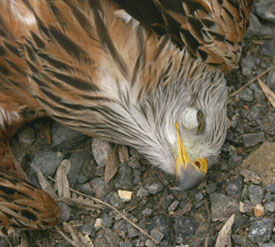
Red kite fawkes shot NI MAY 2015A female red kite, born in Wales and released in Northern Ireland as part of the reintroduction project there, has been found shot dead.

The bird, named ‘Fawkes’, hatched in Wales in 2010 and was donated to the Northern Ireland Red Kite Reintroduction Project – she had been adopted by the Ballyclare High School in 2011 and staff and pupils from the school had been following the bird’s progress over the last few years.

Her corpse was discovered on 20th May 2015 near Katesbridge. She was discovered in a breeding territory belonging to two known breeders, both of whom have ‘disappeared’ in recent weeks.

News article on UTV here

The loss of this bird is a big blow to the reintroduction project. With an estimated 14 breeding pairs of red kites in Northern Ireland, and no plans for further release of additional birds to boost the numbers, this tiny population looks set for certain demise.

Henry’s Tour day 42: Leadhills

Thurs 11th June Copy

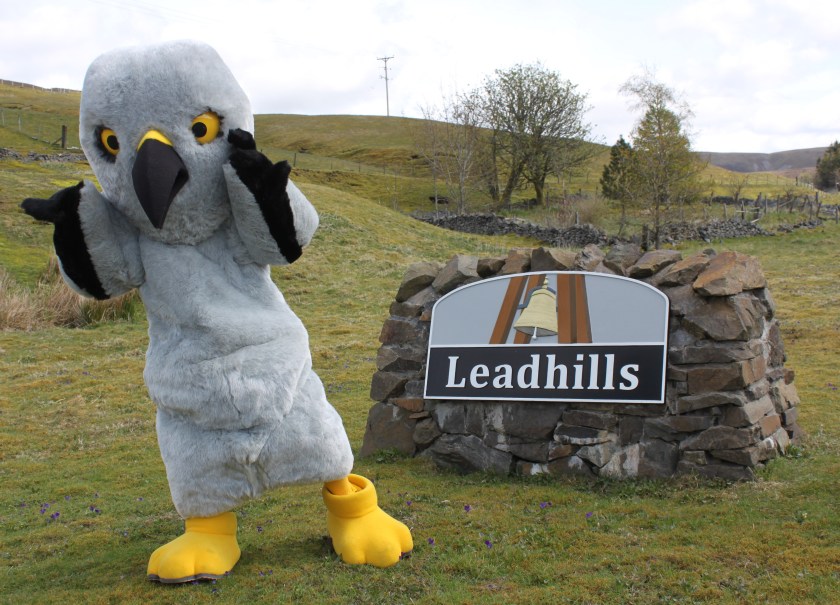
Henry went with an armed escort to visit Leadhills in South Lanarkshire.

He looks a bit distressed. Perhaps he was being deafened by the booming gas guns that have recently been deployed on the grouse moors of the Leadhills (Hopetoun) Estate.

Or perhaps he’d just been told about the long list of wildlife crimes that have been discovered in this corner of South Lanarkshire; 46 confirmed since 2003, but only two resulting in successful convictions (2004 – Leadhills Estate gamekeeper convicted of shooting a short-eared owl; 2009 – Leadhills Estate gamekeeper convicted of placing out a poisoned rabbit bait).

Here’s the list, all from Leadhills unless otherwise stated:

2003 April: hen harrier shot [prosecution failed – inadmissible evidence]

2003 April: hen harrier eggs destroyed [prosecution failed – inadmissible evidence]

2004 May: buzzard shot [no prosecution]

2004 May: short-eared owl shot [gamekeeper convicted]

2004 June: buzzard poisoned (Carbofuran) [no prosecution]

2004 June: 4 x poisoned rabbit baits (Carbofuran) [no prosecution]

2004 June: crow poisoned (Carbofuran) [no prosecution]

2004 July: poisoned rabbit bait (Carbofuran) [no prosecution]

2004 July: poisoned rabbit bait (Carbofuran) [no prosecution]

2005 February: poisoned rabbit bait (Carbofuran) [no prosecution]

2005 April: poisoned buzzard (Carbofuran) [no prosecution]

2005 June: poisoned rabbit bait (Carbofuran) [no prosecution]

2005 June: poisoned rabbit bait (Carbofuran) [no prosecution]

2006 February: poisoned buzzard (Carbofuran) [no prosecution]

2006 March: poisoned buzzard (Carbofuran) [no prosecution]

2006 March: poisoned pigeon bait (Carbofuran) [no prosecution]

2006 April: dead buzzard (persecution method unknown) [no prosecution]

2006 May: poisoned rabbit bait (Carbofuran) [no prosecution]

2006 May: poisoned rabbit bait (Carbofuran) [no prosecution]

2006 May: poisoned egg baits (Carbofuran) [no prosecution]

2006 June: poisoned buzzard (Carbofuran) [no prosecution]

2006 June: poisoned raven (Carbofuran) [no prosecution]

2006 June: 6 x poisoned rabbit baits (Carbofuran) [no prosecution]

2006 June: poisoned egg bait (Carbofuran) [no prosecution]

2006 September: 5 x poisoned buzzards (Carbofuran) [no prosecution]

2006 September: poisoned rabbit bait (Carbofuran) [no prosecution]

2006 September: poisoned rabbit bait (Carbofuran) [no prosecution]

2007 March: poisoned buzzard (Carbofuran) [no prosecution]

2007 April: poisoned red kite (Carbofuran) [no prosecution]

2007 May: poisoned buzzard (Carbofuran) [no prosecution]

2008 October: poisoned buzzard (Carbofuran) [listed as ‘Nr Leadhills’] [no prosecution]

2008 October: poisoned rabbit bait (Carbofuran) [listed as ‘Nr Leadhills’] [no prosecution]

2008 November: 3 x poisoned ravens (Carbofuran) [listed as ‘Nr Leadhills’] [no prosecution]

2009 March: poisoned rabbit bait (Carbofuran) [no prosecution]

2009 March: poisoned raven (Carbofuran) [no prosecution]

2009 April: poisoned rabbit bait (Carbofuran) [gamekeeper convicted]

2009 April: poisoned magpie (Carbofuran) [no prosecution]

2009 April: poisoned raven (Carbofuran) [no prosecution]

2010 October: short-eared owl shot [no prosecution]

2011 March: illegally-set clam trap [no prosecution]

2011 December: buzzard shot [no prosecution]

2012 October: golden eagle shot (just over boundary with Buccleuch Estate) [no prosecution]

2013 May: shot otter found on estate [no prosecution]

2013 June: significant cache of pre-prepared poisoned baits found on estate [no prosecution]

2013 August: red kite found shot and critically-injured in Leadhills village [no prosecution]

2014 February: poisoned peregrine (Carbofuran) [‘Nr Leadhills’] [no prosecution]

Word has it from a local informant that a suspected shot raven was found on Leadhills Estate in May 2015. Post-mortem results are awaited.

Just a few weeks ago, we were sent footage of a young man dressed in camouflage who was lying on the moor holding a firearm, looking over at a plastic decoy peregrine which had been placed on top of a small mound. When he realised he’d been spotted, he removed the decoy and took off back down the hill on a quad bike. Can’t imagine who that was or what his intentions might have been.

Now THAT’S a deterrent!

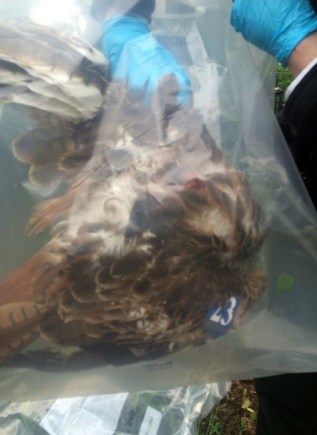
rk poisoned (redkitenet)A farmer in Spain has been found guilty of laying out poisoned baits and poisoning at least 11 red kites, five dogs, six foxes, a cat, a raven, a buzzard and four vultures.
His sentence? Two years in prison, two years disqualification from farming or any other profession relating to animal husbandry (post release), four years disqualification from hunting (post release), a fine of 90,270 Euros plus an additional fine of 28,500 Euros to be used specifically to monitor red kites in the local area for the next three years (see here).

Now THAT’S a deterrent!

Spain is one of several European countries way ahead of the game when it comes to tackling raptor persecution. Amongst other measures, they have a dedicated dog unit that utilises specialist sniffer dogs trained to detect poison and poisoned baits. These dogs are so good they can even detect the location where a poisoned bait has been laid previously but has since been removed. These dog units are not just deployed to a site of a suspected incident; they are routinely deployed to undertake spot checks wherever they want and whatever time they want. There’s none of this ‘you need landowner permission’, or ‘you need a warrant’.

Remember this the next time you hear the Scottish Government or the UK Government say they are tackling raptor persecution and are treating this crime seriously.

Henry’s tour day 39: Moy Estate

Mon 8 June 2015 - Copy

Henry paid a visit to Moy Estate in the Monadliaths.

Regular blog readers will probably remember what was found on Moy Estate in 2010:

  • A dead red kite in the back of a gamekeeper’s vehicle. It had two broken legs and had died as a result of a blow to the head.
  • The remains of a further two dead red kites.
  • A red kite’s severed leg, along with wing tags that had been fitted to a sateliite-tracked red kite, hidden in holes covered with moss.
  • Six illegal baited spring traps set in the open.
  • A trapped hen harrier (still alive) caught in an illegally set spring trap.
  • A poisoned bait.
  • Four leg rings previously fitted to golden eagle chicks found in the possession of a gamekeeper.

A 20-year-old gamekeeper (James Rolfe – straight out of game-keeping college) was charged with possession of the dead red kite and was fined £1,500. No charges were ever brought against anyone for any of the other offences.

Previous blogs on Moy: see here, here, here and here. It’s particularly worth having a look at this, especially in light of recent hen harrier ‘disappearances’ in England. They weren’t necessarily shot (as the grouse-shooting industry keeps telling us) – they could just as easily have been trapped like this (as the grouse-shooting industry keeps forgetting to mention).

The gamekeeper on Moy was convicted four years ago in 2011. Since then, several more satellite-tracked red kites have ‘disappeared’ since their last signals emitted from Moy, and several buzzard and goshawk nests seem to fail each year. It’s quite windy at Moy. It was probably the wind that blew off those rings from the young golden eagles’ legs and blew them straight in to a jar inside the gamekeeper’s house. It was probably the wind that severed the leg of the red kite and then blew it in to a hole on the moor and then blew moss over the hole to cover it. It was probably the wind that blew away the more recent ‘missing’ red kites. It was probably the same wind that blew holes in those buzzard and goshawk nests, too. Still no breeding hen harriers on this estate – yep, must have been blown away.

Word has it that the game management on Moy Estate is being taken over by a sporting agent with whom we’re very familiar. Cue hundreds of thousands of pounds worth of night vision equipment to carry out his particular style of grouse moor management.

Henry left the estate before darkness fell. He lives another day, although he’s still single.

Head keeper on Glenogil Estate rescues red kite

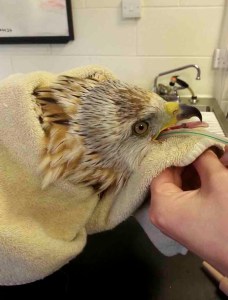
Glenogil RK rescuedThe head gamekeeper on Glenogil Estate has reportedly helped rescue an injured red kite that was hanging upside down in a tree after becoming entangled in string.

Danny Lawson was apparently able to shoot off the branch so the kite fell to the ground. He disentangled the bird and took it to Thrums Veterinary Group in Kirriemuir. The vets say the bird is recovering well and is now being cared for by the SSPCA.

News article here.

Photo by Thrums Veterinary Group

Red kite illegally trapped on Scottish grouse moor has to be euthanised

The BBC news website is reporting that a red kite that had been illegally trapped last week has had to be euthanised due to the severity of its injuries.

The kite was found ‘in distress and seriously injured’ on Wednesday 13th May 2015.

The article (see here) is fairly low on details, but what has been written is actually quite informative.

It quotes a Police Scotland spokesman: “This was clearly an intentional act with the sole purpose of trapping this kind of bird of prey“.

That tells us that the bird probably wasn’t caught inside a crow cage trap (by accident), but more than likely was caught in an uncovered, illegally-set spring trap, baited and deliberately placed to trap a bird of prey by its leg(s).

The article also states that the bird was found trapped ‘on moorland west of Stirling’. This is also pretty revealing. There isn’t much moorland to the west of Stirling and the moorland that is there is managed for grouse shooting (for those who don’t know the area, have a look on google maps and look for the tell-tale muirburn strips that identify the land as a grouse moor).

This latest raptor persecution crime is not the first one reported from this area in recent months. In July 2014, a poisoned red kite was found in the area. This crime wasn’t publicised by Police Scotland and didn’t reach the public domain until we blogged about it in January this year, when we found the details hidden away in a government report. At that time, we asked blog readers to contact SNH to ask whether they had issued a General Licence restriction order for the land where the poisoned kite had been found (see here).

In February 2015, Andrew Bachell, Director of Operations at SNH responded by saying the case was ‘under consideration’ (see here).

Meanwhile, later in February, a poisoned peregrine was found on the same estate (see here). It, too, had been killed by ingesting the banned poison Carbofuran.

According to the SNH website, a General Licence restriction order has still not been issued for this estate (or any other estate, come to that).

And now, three months later, an illegally trapped red kite is discovered in what appears to be the very same area.

Somebody (or some people?) is clearly conducting a campaign of raptor persecution crimes in this area. Where’s the enforcement? Why hasn’t a General Licence restriction order been issued for this area of moorland? Had one been issued for the poisoned red kite (July 2014) or the poisoned peregrine (Feb 2015), this latest crime may not have occurred and this poor red kite may not have had to suffer such appalling injuries that it had to be euthanised.

We think it’s time to ask Environment Minister Dr Aileen McLeod some questions about the apparent lack of enforcement action in this area. Only last month she wrote an article stating that “wildlife crime will not be tolerated in modern day Scotland” and she specifically mentioned the General Licence restriction orders: “Arrangements are also in place for SNH to restrict the use of general licences where there is evidence of wildlife crime” (see here).

So, if “arrangements are also in place”, why hasn’t a General Licence restriction notice already been enforced in this particular area and when might we see notification that one has been issued? It’s time for the Government Minister responsible for tackling wildlife crime to show her mettle. Emails to: ministerforenvironment@scotland.gsi.gov.uk

Red kite photo by David Tomlinson

Henry’s Tour: Day 20

Monday 27 April  Copy

Henry’s arrived in Yorkshire in his quest to find a mate. This should be interesting.

North Yorkshire (includes North York Moors National Park & Yorkshire Dales NP) is the worst county in England for recorded incidents of bird of prey persecution.

Between 2004-2013 there were 70 confirmed raptor persecution incidents. (2014 data not yet published).

These 70 incidents included:

  • At least 26 confirmed incidents involving the illegal use of pesticides – these include the illegal poisoning of 14 red kites, six buzzards, one goshawk, one peregrine plus the finding of a number of poisoned baits; several domestic pets were also poisoned.
  • The confirmed shooting of 25 birds of prey – consisting of 10 buzzards, three red kites, three kestrels, two goshawks, two peregrines plus singles of hen harrier, sparrowhawk, short-eared owl and eagle owl.
  • The illegal trapping of seven birds of prey plus another 11 illegally set traps for raptors.

In connection with these incidents six individuals, all gamekeepers, were prosecuted.

Hen harrier last bred successfully in North Yorkshire in 2007, despite huge areas of suitable habitat.

A Natural England study between 2002 and 2008 showed that of 11 HH breeding attempts recorded in North Yorkshire, only five sites reared any young and most of the sites that failed were believed to be due to human persecution.

#HaveYouSeenHenry

Henry’s Tour: Day 19

Fri 24 April Copy

Henry went for a skydance across the lawns of Holkham Hall in north Norfolk.

This place is home to Viscount Coke, Vice Chairman of the Board of Trustees of that well-known raptor-loving organisation Songbird Survival.

In 2000, a Holkham Estate gamekeeper was prosecuted for 17 offences including the shooting of two kestrels and the poisoning of a third. He kept his job on the estate. Case write-up here.

In 2009, a dead buzzard was found at Holkham. It had been shot. The Holkham Estate put up a £500 reward for information leading to a conviction, as did the RSPB. Nobody was ever prosecuted.

Henry didn’t see any female hen harriers during his visit but he did watch a buzzard and three red kites. One kite had what some would call the ‘Malta Moult’ – a large hole blown through the feathers of one wing.

Henry thought it was time to get out of Norfolk but not before he called in for tea and cake with the legendary Richard Porter, author of the 1974 classic Flight Identification of European Raptors. More recently, Richard’s studies on the local buzzard population helped to convict Stody Estate gamekeeper Allen Lambert. Lambert had claimed that the ten poisoned buzzards found on the Stody Estate had been killed elsewhere and then ‘dumped’ on his estate in an attempt to set him up. His defence was to claim that they couldn’t possibly have been poisoned at Stody because there weren’t that many local buzzards to start with. He hadn’t banked on the evidence of one of the world’s leading raptor ID experts, who had recorded 233 buzzard sightings and had counted 73 pairs. Oops.

Thurs 23 April  Copy


Number of poisoned raptors in Scotland more than quadrupled in 2014

Persecution map 2010 to 2014 - CopyThe Scottish Government has today released the annual poisoning and persecution maps relating to crimes against raptors in 2014.

The accompanying press release is a careful study in damage limitation. We can’t blame them – it must be a constant source of embarrassment for them that raptor persecution continues with virtual impunity so of course they’re going to put out a statement that showcases the positives (there aren’t that many) and plays down the negatives (there are many).

The basic premise of their press release is that reported raptor crimes (incidents) have dropped from 23 in 2013 to 19 in 2014. Sounds like progress, eh? But wait – what if you look at the actual number of persecuted raptors – that tells a completely different story!

Let’s ignore the different types of persecution crimes (e.g. shooting, trapping, disturbance) for a minute and just start with poisoning. Here are the Government’s official number of reported poisoning incidents for the last three years:

2014: 6

2013: 6

2012: 3

So on the face of it, no change from last year and still double the number of reported incidents in 2012. But now let’s look at the number of reported individual raptors that were poisoned over those three years:

2014: 27 (17 x red kite; 7 x buzzard; 1 x peregrine; 2 x unknown because Police Scotland hasn’t released the data)

2013: 6 (1 x red kite; 4 x buzzard; 1 x golden eagle – data from Scot Gov annual report on wildlife crime)

2012: 3 (2 x buzzard; 1 x golden eagle – data from Scot Gov annual report on wildlife crime)

That’s quite an increase, isn’t it? Three reported in 2012, 6 in 2013 and a whopping 27 reported in 2014. Does that sound like raptor poisoning in Scotland is in decline? Nope, it shows that the number of poisoned raptors actually quadrupled in 2014.

However, the Government doesn’t agree that 27 raptors were poisoned in 2014. According to their data, only 16 raptors were poisoned in the Ross-shire Massacre (12 red kites + 4 buzzards). They seem to have conveniently forgotten that 22 dead birds were found, not 16. Even Environment Minister Aileen McLeod ignores the ‘missing six’ and just refers to the poisoned 16 in today’s press release! Sure, there may only be toxicology reports for 16 of those victims – we don’t know the cause of death for the remaining six victims because Police Scotland hasn’t bothered to tell us. But surely they and the Scottish Government aren’t trying to convince us that the remaining six victims (four red kites + two buzzards) weren’t poisoned at all, but that they all just happened to die of natural causes at the same time and in the same fields as the other 16 poisoned birds? Come on. Why try and diminish the extent of such an appalling crime?

And, once again, the poisoning maps exclude other crimes where bait was discovered but with no apparent raptor victim. We know of at least one of these incidents that occurred in 2014 – a poisoned rook found in January close to a poisoned rabbit bait and a poisoned hare bait (Carbofuran & Chloralose) (here). Why doesn’t this count?

Now let’s have a look at the other types of raptor persecution crimes reported in 2014. These include shooting, trapping and disturbance. According to the Government’s data released today, there were 8 reported shootings, 2 reported trapping offences, 1 reported disturbance incident and 2 listed as ‘other’.

Interestingly, they’ve excluded incidents where satellite-tagged raptors have (un)mysteriously disappeared in known persecution hotspot areas, such as the young white-tailed eagle (see here) and several others that Police Scotland has so far chosen to keep under wraps.

They’ve also excluded incidents where illegally-set traps have been found but without an apparent raptor victim. Again, the police have chosen to keep these under wraps. Why don’t those count?

So let’s now look at the Government’s ‘official’ three-year figures for all types of raptor persecution incidents in Scotland (including poisoning, shooting, trapping, disturbance, and ‘other’):

2014: 19

2013: 23

2012: 13

As we said at the beginning, on a superficial level it appears that reported raptor persecution incidents have declined since 2013, although we now know that the Government has excluded several known incidents, and we also know that these are only the reported crimes – many more will have occurred but weren’t detected. But let’s have a look at the number of known raptor victims during that three-year period:

2014: 40

2013: 23

2012: 13

That’s pretty clear then. Illegal raptor persecution continued in 2014 and the number of (known) victims rose considerably from the previous year and the year before that.

What an utter disgrace.

Scottish Government press release here

Scottish Government’s persecution maps and background data can be downloaded here:

Scottish Gov background raptor persecution data (released 31 Mar 2015)

Ross-shire Massacre: one year on

RK7It’s been one year since the corpses of 22 birds of prey (16 red kites and 6 buzzards) were found in a small area around Conon Bridge in the Highlands.

We know that 16 of these birds were illegally poisoned (12 red kites & 4 buzzards). Still no word on the other six victims.

Still no word on the type of poison used, although Police Scotland did eventually admit that it was an “illegally-held poisonous substance” (see here). Carbofuran is suspected by many of us (see here).

The details of this illegal mass poisoning have still been deliberately excluded from the quarterly SASA reports – the Government reports that are supposed to inform us about recent illegal poisoning crimes in Scotland.

Police Scotland still maintains that the birds “were most likely not targeted deliberately but instead were the victims of pest control measures” – even though they can’t possibly know this unless they have a suspect who has given a full confession.

We’re still waiting to hear whether MSP Dave Thompson’s request, back in November 2014, for a review of Police Scotland’s handling of this investigation will be undertaken (see here).

We’re still waiting for the thousands of pounds worth of funds, that many of us donated, to be released by Police Scotland so that RSPB Scotland can redistribute them to support the work of their investigations team (see here).

Twelve months on and still no arrests.

Twelve months on and still no charges.

Twelve months on and still no prosecution.

Twelve months on and still no conviction.

Twelve months on and still no justice.

Twelve months on and still no confidence in Police Scotland’s ability to solve this appalling crime.

Previous posts on the Ross-shire Massacre here.