Red kite found poisoned in the Highlands

Police are appealing for information following the death of a red kite in the Nairn area. Police statement as follows:

The kite was discovered by a member of the public on farmland in the Glenferness area at the end of October. Police were contacted with immediate action being taken to establish the cause of death. Subsequently, test results returned this week have confirmed the bird had ingested an illegal pesticide.

Commenting on the investigation, Area Commander Chief Inspector Colin Gough said:

“Sadly it has been confirmed the red kite had died as a result of consuming a poisonous substance and an investigation is now taking place into the circumstances. It appears to be an isolated incident involving a single bird of prey. Police Scotland and partners are committed to tackling wildlife crime and will utilise all available resources to bring those responsible to justice.”

“Investigations into wildlife crime can be very complex and challenging, with a major part of our enquiries involving liaising with members of the local community who may hold essential information.

“We would appeal to anyone who has any information to make contact as a matter of urgency via 101 or Crimestoppers on 0800 555 111”

Ian Thomson, Head of Investigations for RSPB Scotland said:

“It is very disappointing to hear of yet another incident of raptor persecution in this area. It is thoroughly depressing that in 21st century Scotland, there are still those who have a Victorian attitude towards birds of prey, as well as a criminal disregard of the law.

“The continued targeting of our raptors is a stain on our country’s reputation and has no place in modern Scotland. I urge anyone who has information about this incident to contact the police as soon as possible.”

END

Well done to Police Scotland for putting out a timely appeal for information.

So, yet another illegally-killed raptor. Yet another poisoning with a banned pesticide. Yet more evidence that current deterrents are not working. Are you paying attention, Environment Minister?

Red kite photo by David Tomlinson

SNH reveals reasons for general licence restrictions on Raeshaw & Burnfoot Estates

Raeshaw Corshope GL restriction map 2015Last week we blogged about the implementation of General Licence restrictions on parts of four properties: Burnfoot Estate & Wester Cringate Estate in Stirlingshire, and Raeshaw Estate & Corsehope Estate in the Borders (see here).

At the time, SNH did not reveal the reasons for the General Licence restrictions, other than to say “There is clear evidence that wildlife crimes have been committed on these properties” [since 1st January 2014, when the new regulations were enacted].

We speculated that the General Licence restrictions at Burnfoot and Wester Cringate in Stirlingshire were related to the poisoning of a red kite (July 2014), a poisoned peregrine (Feb 2015), and the illegal trapping of a red kite (May 2015).

We had no idea why the General Licence restrictions had been implemented at Raeshaw and Corsehope in the Borders, because there hadn’t been any publicity about any recent raptor persecution crimes in this area.

However, last Saturday (7th November 2015), a bit more information was revealed during an interview with SNH Wildlife Operations Manager, Robbie Kernahan, on the BBC Radio Scotland Out of Doors programme.

Amongst other things, the presenter asked Mr Kernahan directly about the reasons for General Licence restrictions on these four properties. Here’s what Mr Kernahan said:

Stirlingshire GL restrictions:Relates to some issues associated with poisoning birds of prey, birds of prey being found poisoned in that location, and illegal use of traps“.

Borders GL restrictions:There are issues about the illegal placement of traps“.

No further explicit detail was provided, although there was a general wider discussion about the use of General Licence Restrictions and their deterrent value in tackling raptor persecution.

The interview can be heard here for the next 26 days (starts at 02:15; ends at 09:06).

General licences suspended on four Scottish grouse moors in response to raptor persecution crimes

Yesterday, SNH published the following press release:

General licences restricted in wildlife crime hotspots

Scottish Natural Heritage (SNH) has restricted the use of general licences on four properties in two wildlife crime hotspots – one in Stirlingshire and one in the Borders – this week. The decision was made on the basis of evidence provided by Police Scotland of wildlife crime against birds.

Nick Halfhide, SNH Director of Operations, said:

“There is clear evidence that wildlife crimes have been committed on these properties. Because of this, and the risk of more wildlife crimes taking place, we have suspended the general licences on these four properties for three years. They may though still apply for individual licences, but these will be closely monitored.

“This measure should help to protect wild birds in the area, while still allowing necessary land management activities to take place, albeit under tighter supervision. We consider that this is a proportionate response to protect wild birds in the area and prevent further wildlife crime.”

General licences allow landowners or land managers to carry out actions which would otherwise be illegal, including controlling common species of wild birds to protect crops or livestock.

The new measure complements other recent actions to reduce wildlife crime, including vicarious liability for offences against wild birds, which was introduced in 2011.

Restrictions will prevent people from using the general licences on the land in question for three years. This period will increase if more evidence of offences comes to light.

END

As promised in earlier correspondence with SNH about potential General Licence restrictions (e.g. see here), SNH has published ‘details’ of the current restrictions on its website. Although when we say ‘details’ we use the term loosely. The names of the estates have not been published (but see below) and the specific reasons (crimes) that triggered the restriction orders are also absent.

Instead, SNH has published two maps showing the areas where the three-year restriction orders will be in place.

Restriction order #1 can be viewed here: GL restriction order 1_ Nov 2015-2018

The map denoting the area relating to Restriction order #1 is here:

Raeshaw Corshope GL restriction map 2015

Having consulted Andy Wightman’s brilliant website Who Owns Scotland to check estate boundaries, we now know that the delineated area shown in Restriction order #1 includes parts of Raeshaw Estate and the neighbouring Corsehope Estate.

This is fascinating. Raeshaw Estate is well known to us and continues to be of interest. It is a mixed upland estate combining driven grouse shooting as well as pheasant and partridge shooting. We have documentary evidence that Mark Osborne’s company is involved in the estate management (more on that in the near future). Raeshaw Estate has been raided by the police at least twice (2004 and 2009 – poisoned and shot raptors and poisoned baits – see here) although nobody has ever been prosecuted for these crimes. However, the General Licence Restriction can only be applied for crimes that have been uncovered since 1st January 2014; it cannot be applied retrospectively for offences that took place prior to 1st January 2014. This means that further raptor crimes have been uncovered here but there has not been any publicity about them. Why not? There was news of a shot buzzard found in the nearby area on 24th July 2015 (see here), but this bird was found AFTER SNH had notified the estate of the intention to restrict the General Licence (see here) so this incident cannot be the one that triggered the General Licence Restriction.

Corsehope Estate has not been on our radar, although we’re told by local sources that gamekeepers from Raeshaw Estate are involved with ‘vermin control’ here so now we’re very interested.

Restriction order #2 can be viewed here: GL retriction order 2_ Nov 2015-2018

The map denoting the area relating to Restriction order #2 is here:
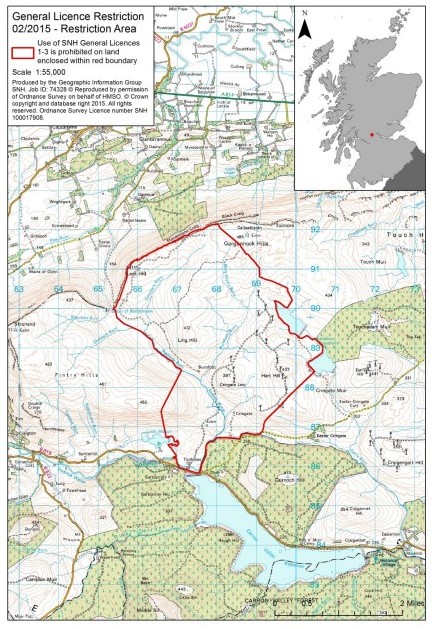
Burnfoot Wester Cringate GL restriction map 2015

Again, consulting Andy Wightman’s excellent website Who Owns Scotland to check estate boundaries, we now know that the delineated area shown in Restriction order #2 includes parts of Burnfoot Estate and Wester Cringate Estate.

This is also interesting. We believe (although it must be stressed that this is educated speculation as SNH has not published the information) that this restriction order probably relates to a series of raptor persecution crimes including a poisoned red kite (July 2014), a poisoned peregrine (February 2015) and an illegally trapped red kite (May 2015) – see here.

So, what do these General Licence Restriction orders mean? Basically, it means that the following activities, usually permitted under General Licences 1, 2 and 3, are now not permitted in the areas shown on the two maps for three years, starting 13th November 2015 and ending 12th November 2018:

The killing or taking of the following species:

Great black-backed gull, carrion crow, hooded crow, jackdaw, jay, rook, ruddy duck, magpie, Canada goose, collared dove, feral pigeon, wood pigeon, lesser black-back gull, and herring gull.

The use of the following methods to kill/take these species are not permitted:

Pricking of eggs, oiling of eggs, destruction of eggs and nests, use of Larsen trap, use of Larsen Mate trap, use of Larsen Pod trap, use of multi-catch crow cage trap, shooting with any firearm, targeted falconry, and by hand.

That sounds great, doesn’t it? But it’s not quite as clear cut as that. As we’ve discussed before, and as is stated in the SNH press release at the top of this blog, although these activities can no longer be carried out in the two denoted areas under the cover of the three General Licences, individuals may still apply for an individual licence to permit these activities, although SNH claims that if granted, these will be “closely monitored”.

What does ‘closely monitored’ actually mean? Closely monitored by whom? Daily inspections by SNH? Police Scotland? That’s hardly going to happen, is it?

Let’s hope that members of the general public, exercising their right to visit these areas under open access legislation, pay close attention to what’s going on around them. If they see a Larsen trap in use, or a crow cage trap in use, or witness any of the above bird species being killed/taken by any of the methods mentioned above, they inform the Police straight away. Actually, let’s hope they forget the police and inform RSPB Scotland and/or the SSPCA instead – they’re more likely to get a quick response from them.

It’ll be interesting to see how this all pans out. On the one hand, we welcome these Restriction orders and applaud the Scottish Government (especially former Environment Minister Paul Wheelhouse for initiating them), SNH and Police Scotland for pursuing what we hope will be the first of many such Restriction orders. But on the other hand, will these restrictions be anything more than a minor inconvenience to the estates involved because they can simply apply for individual licences to continue their game-shooting activities? We’ll have to wait and see.

RSPB Scotland’s response to the two General Licence Restriction orders here

As yet no response from Scottish Land & Estates or the Scottish Gamekeepers’ Association but we’ll post them here if/when they comment.

UPDATE 11.50hrs: The SGA has issued the following statement on their website:

On November 4th 2015, SNH announced general licence restrictions to two areas encompassing four properties.
The SGA has issued the following statement in response to questions.

A Spokesman for The Scottish Gamekeepers Association said: “The SGA cannot condone wildlife crime and has a clear and consistent policy regarding this.
“As regards this case, it is our understanding that legal discussions are taking place regarding the areas affected and, therefore, it is not appropriate for us to comment further.”
END
UPDATE 13.20hrs: Statement from Environment Minister Dr Aileen McLeod:

“The announcement by SNH that the use of general licences has been restricted on specified areas of land in the Borders and in Stirlingshire is a result of work that the Scottish Government commissioned in July 2013 as part of a package of measures to combat wildlife crime.

We welcome the progress that has been made with this work. However we have not been involved in the decision-making and do not have any comment on the individual cases in question. The General Licence system is a light touch form of regulation. It is clearly sensible to apply closer scrutiny to areas where there is good evidence that wildlife crime has taken place, and we believe that this will prove a useful tool in the fight against bird of prey persecution.”

Ross-shire Massacre: local MSP tries again for review of police investigation

In November 2014, Dave Thompson, the local MSP for Skye, Lochaber and Badenoch, wrote to the then Cabinet Secretary for Justice, Kenny MacAskill, to ask for a review of how Police Scotland had handled the investigation into the deaths of 22 raptors that had been found poisoned near Conon Bridge (the Ross-shire Massacre). The Police had been severely criticised for their handling of this case, not just for the investigation itself but also for what many of us believed to be an appalling media strategy. We blogged about it here.

Here is a copy of Dave Thompson’s letter to the Cabinet Secretary:

Dave Thompson MSP letter to Justice Sec

We didn’t hear anything further so an FoI was recently submitted to the Justice Department to find out what had happened.

It turns out that in December 2014 Mr MacAskill’s successor, Michael Matheson, had responded to Dave Thompson’s request by stating that he couldn’t comment about a live, on-going police investigation but suggested that Mr Thompson should raise any concerns with the Chief Constable. Here is a copy of Mr Matheson’s letter:

Justice Minister letter

Almost a year on from his first request, and with no sign that the Police investigation has made any progress in the 18 months since the dead birds were discovered (see here), Dave Thompson has now written to the Chief Constable of Police Scotland to urge him to issue an interim report on the first stages of the Police investigation of this case. His second request for a review was no doubt influenced by the recent release of an excellent short documentary video (see here) about the mass poisoning.

Dave Thompson MSP said: “I appreciate the need to await the full review into the investigation, especially as the case is live, and as such, we must be sensitive to the investigative process.

However, I feel enough time has elapsed that the general public are owed an explanation of where the case is at, which is why I have requested an interim review to be issued by Police Scotland, so we can see how the process has been handled in the early stages.

I have written to the Chief Constable and copied in the Chief Superintendent, Julian Innes, and the Cabinet Secretary for Justice, Michael Matheson, on the matter.

I look forward to hearing back from the Chief Constable as soon as is practically possible on what is an issue that still remains a concern to many of my constituents and beyond“.

Here is the transcript of his latest letter:

Dear Chief Constable,

Given the length of time that has passed and the failure to date to bring a culprit to justice, I am writing to ask if Police Scotland could issue an interim report on the first stages of the investigation, perhaps the first six months, into the raptor deaths around Conon Bridge. 

As you know there is considerable public anger at the incident and I believe this would go some way to helping people understand how seriously the Police are taking the investigation and the constraints you may have been under in the early stages.

Yours sincerely

Dave Thompson SNP MSP

END

Red sky on the Black Isle: new film on the Ross-shire Massacre

A short, 12 minute film has been released about the 2014 Ross-shire Massacre, the mass illegal poisoning of 22 red kites and buzzards.

Entitled ‘Red Sky on the Black Isle’, this is an excellent film and includes interviews with some of the key individuals involved with the investigation which, as you’ll know, still remains unsolved 19 months on (see here).

Watch the film here

Rossshire Massacre film

Misleading conclusions from Scot Gov’s 2014 wildlife crime report

Wildlife Crime in Scotland 2014 reportYesterday the Scottish Government published its latest report on wildlife crime: ‘Wildlife Crime in Scotland: 2014 annual report’ (see here).
It was accompanied by a Government press release (here) with a headline statement claiming ‘ Recorded wildlife crime dropped by 20 per cent in the period 2013-2014‘. This claim has been regurgitated, without real examination, in much of the national press, which will give the public the impression that all’s going swimmingly in the fight against wildlife crime in Scotland. This couldn’t be further from the truth.

Let’s start with the report’s name. It claims to be the ‘2014 annual report’, but actually the period covered by the report is the 2013/14 financial year: April 2013 to March 2014. That means the majority of the data are from 2013 (9 months worth) – these are wildlife crimes that took place as long ago as 2.5 years and the most ‘recent’ took place 18 months ago (March 2014). Many more offences occurred during the nine months between April-Dec 2014 but they are not included in this report. Although the report itself does explain the reasons behind this odd time-frame selection, the report’s title does not, which means anyone just browsing the headline news will be given a false impression of how recent these findings are. It’s a small point, but it’s an important one.

However, there are bigger issues than just a misleading report title.

If you take the report’s data at face value (which we don’t – more on that in a second) and accept that it’s representative of all reported wildlife crime in Scotland between April 2013 and March 2014, you might also accept that the claim of a 20% reduction in recorded wildlife crime is accurate. But if you look at the data (Table 1), you’ll notice that this supposed broad reduction (i.e. reduction of recorded wildlife crimes in general) is actually almost entirely due to a large reduction in one particular area of wildlife crime: specifically, fish poaching. To then apply this reduction of a specific wildlife crime to all other types of wildlife crime in a broad sweeping statement is wholly misleading.

Our main issue with this report, as with previous reports, is the Government’s insistence on only using crime data that has been recorded by the Police. Although this report does attempt to address this problem by including separate sections on data collected by others (e.g. Scottish Badgers, SSPCA), these data are still not included in the overall analysis of wildlife crime trends because these incidents weren’t recorded on the Police national crime database. A good example of this is shown in Table 10, which details the number of wildlife cases investigated by the SSPCA. The report accepts that cases investigated solely by the SSPCA (as opposed to cases where the SSPCA has assisted the Police) are not included in the ‘official’ recorded crime data because ‘they are not recorded on the police national crime database’. So in effect, 69 cases that were investigated solely by the SSPCA during the period covered by the report are absent from the national figures. It seems bizarre that even though these data are available (of course they are, they appear in this report, albeit in a separate section!) they are still excluded from the main analysis. This blatant exclusion immediately reduces our confidence in the robustness of the ‘national’ data.

Another blatant exclusion of data is demonstrated in Table 17 in the Raptor Persecution section. This table identifies only 16 bird of prey victims from the mass poisoning in March 2014 known as the Ross-shire Massacre, excluding the other six victims that were found. The report justifies this exclusion by explaining that evidence of poisoning was not found after examinations of those six raptors. That’s fair enough, but surely we’re not expected to believe that those six victims all died of natural causes, in the same small area, and at the same time, as the 16 confirmed poisoning victims? They don’t appear in the figures because a crime couldn’t be identified, but they still died as a result of this crime and to pretend otherwise is nonsense.

An additional problem that erodes public confidence in the accuracy of the ‘national’ data is the issue of how carefully wildlife crimes are recorded. A report published earlier this year (which includes part of the period covered by this latest Government report) revealed systemic problems with the under-recording of several types of wildlife crime as well as failures by the police to undertake follow-up investigations on reports of suspected wildlife crimes (see LINK report here). If the police don’t follow up with an investigation, the incident is unlikely to be recorded as a crime. Until these issues are suitably addressed, the accuracy of ‘official’ ‘national’ wildlife crime data will inevitably be viewed with suspicion.

So, we don’t have much confidence in this report’s data and we certainly don’t agree with the Government’s claim that (overall) recorded wildlife crime has reduced by 20%, but there are some positives. It’s clear that more thought has been put in to the material contained in this year’s report and there is definitely more clarity about the sources used. That’s good progress.

There are also a couple of things in this report that we are particularly pleased to see.

First, let’s go back to Table 10 (SSPCA data). You may remember (if you have a long memory) that in March 2014, the Government opened its consultation on whether to increase the investigatory powers of the SSPCA. That consultation closed in September 2014 and, over a year later, we’re still waiting for a decision. It’s our understanding that one of the main sticking points is with Police Scotland (who, as you’ll recall, strongly objected to an increase of powers – see here). Apparently, the current sticking point is that Police Scotland are worried that they’ll be excluded from wildlife crime investigations because the SSPCA ‘refuses to work with them’. However, if you look at Table 10, you’ll notice that 50% of all wildlife cases taken by the SSPCA during the period covered by this report were undertaken in partnership with the Police. That’s 50%. Does that look like an organisation that is refusing to work with the Police? It doesn’t to us.

The second point of interest in this report appears in Table 18b. This table provides information about recorded bird of prey crimes between April 2013 and March 2014. Have a look at the 7th entry down:

Species: Hen Harrier

Police Division: Aberdeenshire and Moray

Type of Crime: Shooting

Date: June 2013.

Why is this of particular interest? Well, cast your mind back to January 2014 when we blogged about a vague Police Scotland press release that stated a man had been reported to the Crown Office ‘in relation to the death of a hen harrier’ in Aberdeenshire that took place in June 2013 (see here). So it turns out this hen harrier had been shot. Amazing that it took over two years for this information to be made public. But that’s not the most interesting bit. For this unnamed individual to be reported to the Crown for allegedly shooting this hen harrier means that the Police have some level of evidence that they think links him to the crime. If they didn’t have evidence, he wouldn’t have been reported. So, the alleged crime took place 2.4 years ago. The Crown Office was notified 1.9 years ago. What’s happening with this case? Is there going to be a prosecution? Why such a long delay for a crime that is deemed a ‘priority’ by the Scottish Government?

Ross-shire Massacre: 18 months on

It’s been 18 months since the corpses of 22 birds of prey (16 red kites and 6 buzzards) were found in a small area around Conon Bridge in the Highlands.

We know that 16 of these birds were illegally poisoned (12 red kites & 4 buzzards). Still no word on the other six victims.

Still no word on the type of poison used, although Police Scotland did eventually admit that it was an “illegally-held poisonous substance” (see here). Carbofuran is suspected by many of us (see here).

The details of this illegal mass poisoning have still been deliberately excluded from the quarterly SASA reports – the Government reports that are supposed to inform us about recent illegal poisoning crimes in Scotland.

Police Scotland still maintains that the birds “were most likely not targeted deliberately but instead were the victims of pest control measures” (see here) – even though they can’t possibly know this unless they have a suspect who has given a full confession.

We’re still waiting to hear whether MSP Dave Thompson’s request, back in November 2014, for a review of Police Scotland’s handling of this investigation will be undertaken (see here).

We’re still waiting to hear when the thousands of pounds worth of reward funds, that many of us donated, will be released by Police Scotland so that RSPB Scotland can redistribute them to support the work of their investigations team (see here).

Two months ago in July 2015 MSP Bill Kidd called on Police Scotland to tell the public more about the investigation (see here). We’re still waiting.

18 months on and still no arrests.

18 months on and still no charges.

18 months on and still no prosecution.

18 months on and still no conviction.

18 months on and still no justice.

18 months on and still no confidence in Police Scotland’s ability to solve this appalling crime.

Previous posts on the Ross-shire Massacre here.

Three more poisoned red kites

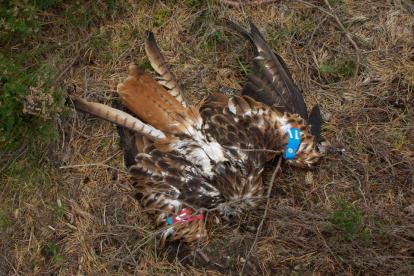
WT J 1 as I foundThe following press release has been issued today by FoRK (Friends of Red Kites) –
POISONING OF RED KITES CONDEMNED

Three red kites have been found illegally poisoned in a blow to efforts to re-establish a thriving population across north east England.

One found near a grouse moor died from Carbofuran poisoning despite the use of the chemical being banned in Britain since 2002. The two others were found together and died as a result of poisoning by Aldicarb, a widely-used pesticide which has been implicated in deliberate poisonings elsewhere in Britain.

The bodies of all three were recovered and sent for post-mortem examination after tip-offs from the public.

The three deaths, revealed by Friends of Red Kites (FoRK), the voluntary group set up to protect and monitor the population, brings the region’s total number of known kite casualties from illegal poisoning to ten in recent years.

FoRK has condemned the killings but fears that the known deaths are just the tip of the iceberg and that many more dead birds are never found. It believes that persistent persecution, mainly through illegal poisoned baits, is among factors preventing the birds from spreading from their core Derwent Valley sites.

The bird killed by Carbofuran was found near Edmundbyers, Co Durham. The two others were found at High Spen, Gateshead, and included a wing-tagged female from a nearby breeding site which had produced young for the previous four years.

Previous poisoning involved two kites found dead in Hexhamshire and a breeding pair killed near Whittonstall whose chicks then perished in the nest. Other local kites were found poisoned in Teesdale and Wharfedale, Yorkshire. Another bird, which moved to Scotland, was found poisoned in the Cairngorms. Other kites have been found in suspicious circumstances but have been dead too long for scientific examination.

Allan Withrington, FoRK Kite Welfare Officer, said: “These poisonings are appalling and totally unacceptable. Carbofuran has been illegal in this country for many years but is still apparently the poison of choice of those who illegally put out poisoned baits to target raptors, crows and foxes. 

Leaving poisoned baits in the open is not only illegal but completely indiscriminate as the deaths of many bird and animals, including dogs and cats, has shown over the years.

We will be continuing to do everything possible to expose those responsible and work with the police, farmers, landowners and other conservation organisations to protect the red kites and other species.”

The most recent available figures from the RSPB show that there were 76 confirmed cases of illegal poisoning in Britain in 2013, including 19 from Carbofuran and 5 from Albicarb. Twenty-one red kites were among the victims which also included buzzard, white-tailed eagle, golden eagle and marsh harrier. Raven, magpie, sparrowhawk and even a collared dove also died along with two dogs and two cats.

Britain’s single worst recorded wildlife poisoning incident occurred in April 2014 with red kites being the main victims. 16 kites and six buzzards were found dead near Inverness. Despite a major investigation by Police Scotland and rewards totalling £32,000 being offered no-one has been charged.

ENDS

There are a number of interesting facets to this press release. Firstly, no dates are given for when these birds were found poisoned. We can’t be certain, but the press release may refer to three poisoned kites that were discovered in Co Durham in 2014: two in November 2014 and one in December 2014, according to government statistics. It’s possible that the three kites mentioned in the above press release were poisoned this year, but the published government stats only cover the first quarter of 2015 (up until March) and no poisoned kites in Co Durham are present in those figures. These days we have to wait more than six months to find out what’s actually been going on more recently so if they were poisoned after March 2015 we might find out about it ‘officially’ sometime after Christmas.

The second interesting point about this press release is it has come from FoRK. Here’s how FoRK describe themselves:

The Friends of Red Kites (FoRK) is a constituted, membership-based, community organisation which was formed by volunteers in 2009 to continue to encourage an active interest in the conservation of the red kite population in Gateshead’s Lower Derwent Valley and to continue to monitor their health & welfare.

FoRK is the successor to the funded Northern Kites Project which was responsible for the re-introduction of 94 young red kites in the core area between 2004 – 2009. In 2006 red kites began to breed in the region for the first time after an absence of 170 years.

Interesting then that a voluntary, community-based organisation has issued this press statement, and not the police and not Natural England. Has FoRK issued this press statement because they’re tired of waiting for action by the authorities? Was there a police follow up? Was there a follow up by Natural England? If these three birds were poisoned in November and December 2014, why haven’t the police or Natural England said anything? Could their (apparent) silence / inaction have anything to do with the localities of the poisoned carcasses? Check out the village of Edmundbyers on a Google Earth map – see all those weird rectangular shapes on the hills surrounding the village? They’re the tell-tale muirburn strips (burnt heather) that indicate that this area is dominated by driven grouse moors.

Say no more.

Petition to ban driven grouse shooting – PLEASE SIGN HERE

Friends of Red Kites (FoRK) website here

Edmundbyers


Red kite dies after persecution incident ‘near Tomatin’

Reports have emerged this afternoon that a red kite has died after it was found injured ‘near Tomatin’ on 30 August 2015.

According to a BBC news article (here), ‘Police said its injuries did not appear to have been as a result of natural causes’.

According to an article in the P&J (here), ‘Early examinations of the bird have found its death is not due to natural causes’.

In other words, this kite has been illegally killed but apparently Police Scotland is ‘unable to disclose the nature of the bird’s injuries’ (according to the P&J). So the cause of death has not been revealed, and neither has the location where the injured kite was picked up, other than ‘near Tomatin’. Tomatin is in the heart of driven grouse moor country – just put it in to google maps and look at the amount of muirburn strips that surround the village – this region also has a long track record of raptor persecution on a par with other grouse moor regions such as the Angus Glens.

So, another example of an embarrassingly vague Police Scotland statement in relation to the illegal killing of yet another raptor. It’s the latest in a series of similar cryptic police statements relating to the illegal persecution of raptors:

In September 2010 the police issued a vague appeal for information following the discovery of an osprey in the Highlands that died from what they described as “deliberately inflicted injuries“. It was later reported that the bird had been shot (see here).

In June 2013 a similarly cryptic press release followed the discovery of a dead red kite in Aberdeenshire: “After recovery of the carcass, a post mortem was carried out. This revealed that the bird’s death was not by natural causes“. It was later reported the kite had been shot (see here).

In January 2014, we got more of the same after the discovery of a dead buzzard ‘near the village of Tomatin’. Ooh, that sounds familiar, doesn’t it? The press statement said: “Police said an examination of the buzzard suggested it had not died of natural causes” (see here). We still don’t know how it was killed.

In June 2014 there was another one, this time a hen harrier found dead near it’s nest in Muirkirk. The police said: “Whilst at this time we cannot divulge how the bird was killed, we do believe it was the result of a criminal act and we need to establish why this has happened” (see here and here). Guess, what? Turns out it had been shot (see here).

Police Scotland will claim that withholding information about the cause of the death is part of their investigative strategy, because it is ‘specialist knowledge’ that only the perpetrator and any potential witness will know. That’s a legitimate strategy, of course, but given the low likelihood of actually catching anyone for this type of offence it seems like a fairly pointless exercise. It will, though, allow the game shooting lobby to deny all knowledge and refute any suggestion that the bird was killed by anyone associated with that industry.

Marvellous.

So what do you reckon? Is the illegal killing of this red kite going to be the crime that finally jolts the Scottish Government in to taking the oft-promised ‘further action if necessary’? Probably not. We’re still waiting to hear the Minister’s response to a question we posed three weeks ago following the discovery of a shot buzzard in the Borders. We asked her how she defined ‘if necessary’? (see here). Her response should make for an interesting read.

Whatever she says, she really does need to start delivering something tangible, and fast.

Red kite photo by David Tomlinson

Two Red kites poisoned & shot in Highlands: get your act together, Police Scotland

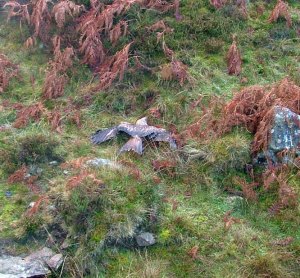
RK Cawdor poisoned 2014RSPB Scotland has issued a press release about the discovery of two illegally killed red kites in the Highlands. One was found shot on a railway line and the other one was found poisoned on Cawdor Estate (see photo).

The press release is interesting (read it here) but what’s more interesting is what is revealed by reading in between the lines.

Both birds were discovered in 2014. The shot red kite was found near Beauly in June 2014 (probably this one we blogged about in October 2014) and the poisoned red kite was found in September 2014.

The RSPB statement says, “Both of these incidents took place in 2014 and are now being made public as the Police have concluded their enquiries”.

So it takes Police Scotland over a year to disclose an illegally shot red kite and almost a year to disclose an illegally poisoned red kite. They’ve now ‘concluded their enquiries’ without appealing for information from the public and without executing a search under warrant on Cawdor Estate. What exactly did their ‘enquiries’ entail? Sitting around a table, scratching their heads, before deciding to keep both crimes under wraps?

Of course, an investigation in to the circumstances of the shot red kite would be a hide in to nothing – the bird was most probably shot elsewhere and dumped on the railway line to make it look like it had collided with a train. That’s a very difficult crime to detect, although had the Police made an appeal for information at the time the bird was found, there was always a slim chance that someone might have seen something. But no, far easier just to keep quiet and not attract any more embarrassing media coverage so soon after the mass poisoning of 22 kites and buzzards at nearby Conon Bridge (which is still undetected….more on that soon).

However, the ‘investigation’ in to the circumstances of the poisoned red kite that was found on Cawdor Estate just beggars belief. Cawdor Estate is well known as it has been at the centre of alleged wildlife crimes for over two decades. Here are just some of the incidents recorded either on the estate or close to the estate (for which nobody has ever been prosecuted) –

1992: Dead buzzard, magpie and sheep (laced with Strychnine)

1993:  Dead buzzard (poisoned with Alphachloralose) found on Forestry Commission land 100 metres from the boundary of Cawdor Estate.

1994: Three dead buzzards (poisoned with Alphachloralose) and a poisoned rabbit bait

1996: Three poisoned baits found: a hare laced with Alphachloralose, a goat laced with Aldicarb and a widgeon laced with Strychnine.

1996: A hidden pit containing a suspected bird of prey poisoning kit uncovered by investigators three miles from the estate.

1999: A report sent to the Procurator Fiscal alleging that mountain hares were illegally persecuted in snares on the estate.

2000: A second report submitted to the Fiscal claiming mistreatment of hares on the estate.

2001: A dead golden eagle (poisoned with Carbofuran)

2004: A number of illegal gin traps found set around rabbit baits

2004: A dead buzzard (poisoned with Carbofuran)

2005: A dead red kite (poisoned with Carbofuran)

2007: A dead red kite (poisoned with Carbofuran)

2010: Two red kites found poisoned on neighbouring ground close to estate boundary

With a record like this, wouldn’t you expect Police Scotland, on discovery of the latest poisoned red kite, to request a search warrant and head straight for the estate? Wouldn’t that be a logical first step? Why didn’t that happen?

Did the Police actually talk to anybody on Cawdor Estate about this poisoned kite? If you read a quote attributed to Alex Hogg of the SGA (on the BBC news website here), you’d think not. Hogg says:

“This is the first we have heard of any such incidents….”.

Really? Cawdor Estate has very close links to the SGA. Cawdor’s former Head Gamekeeper and later Sporting Manager Roddy Forbes was the inaugural Chairman of the SGA. And further, the SGA’s 2010 Young Gamekeeper of the Year was an employee on Cawdor Estate. That’s indicative of pretty close ties between the estate and the SGA, and yet the SGA claim not to have heard about this crime?

As an aside, Hogg is further quoted: “….We do not know the possible causes [of the birds’ deaths] which makes it difficult to comment further”.

Eh? The causes of death have been established. One kite was shot, the other was poisoned. Why is it ‘difficult to comment further’? A little bit too embarrassing, Alex?

A Police Scotland spokesperson is also quoted in the BBC article:

“Investigating wildlife crime is challenging because of its nature, and the vast areas covered. Police Scotland works closely with partners including the RSPB to tackle wildlife crime, and brings to bear the full range of investigative techniques at its disposal. Our detection rate is increasing. Our aim is to reduce wildlife crime and earlier this year we launched a campaign raising awareness”.

Yes, of course investigating wildlife crime is challenging, nobody disputes that. But sitting on enquiries, hiding them from the public, and not undertaking searches on estates where poisoned birds are discovered is not ‘bringing to bear the full range of investigative techniques’ at their disposal. It’s anything but that.

And what’s this about ‘our detection rate is increasing’? Are there any data to support this claim or are we supposed to just accept the word of a police force under increasing pressure to get its act together?

So what now for Cawdor Estate, almost one year on from the discovery of this poisoned kite? Might it be too much to hope that SNH will issue a General Licence restriction order? Guess we’ll have to wait and see, although that might be a bit embarrassing for SNH given that they have chucked thousands of pounds (of our money!) at Cawdor Estate to help fund their ranger service.