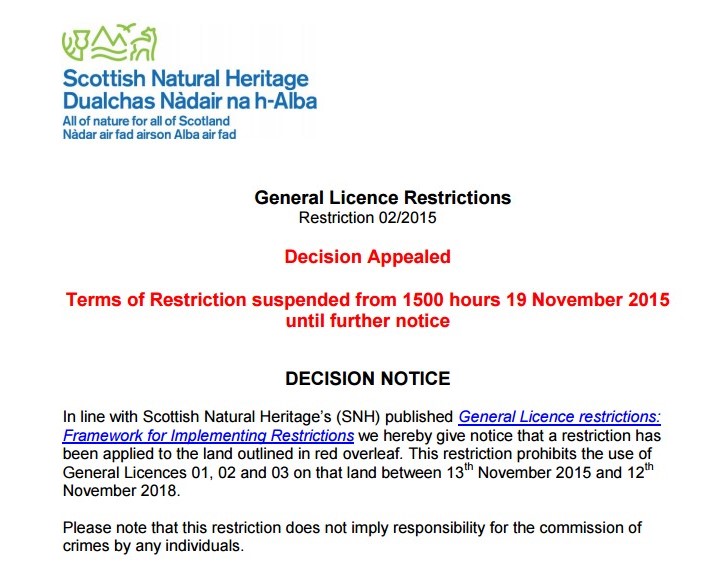
Shot red kite successfully rehabilitated and released

Last month we blogged about an injured red kite that had been found in Malton, North Yorkshire. It had suffered shotgun injuries to the throat and was being cared for by wildlife rehabilitator extraordinaire, Jean Thorpe (see here).

After a few weeks of care and attention, that red kite was successfully released back to the wild yesterday (Photo by Robert Fuller)

13043497_10153433700115812_4569680277323548722_n

Well done and thank you, Jean Thorpe, what a remarkable lady! Remember, Jean does this in a voluntary capacity with no government funding to support her work. Please consider making a small (or large!) donation to help her: HERE.

Of course, North Yorkshire isn’t the only location where red kites are routinely persecuted, either by illegal trapping, shooting or poisoning. There’s a poignant commentary on Mark Avery’s blog today, documenting the disgraceful persecution of red kites on the grouse moors of north east England and how this is suppressing the expansion of the reintroduced kite population. It’s an all too familiar story (e.g. see here).

Join the tens of thousands of ordinary people who are saying enough is enough: HERE

More raptor persecution in North Yorkshire

Over the last few years North Yorkshire has emerged as one of the worst raptor persecution hot spots in the UK (see here). It’s a county where much of the landscape is dominated by grouse moors, particularly in the two National Parks: the North York Moors NP and the Yorkshire Dales NP, as well as a large number of pheasant and partridge shoots.

It’s only March and already this year there’s been an illegally shot red kite and a suspected illegally spring-trapped buzzard.

The critically-injured buzzard was found in February at Wykeham, North Yorkshire. It had a broken, crushed ankle and a broken thigh bone; injuries consistent with being caught in a spring trap, says local Police Wildlife Crime Officer Graham Bilton. Local expert raptor and wildlife rehabilitator Jean Thorpe was once again called to the scene to assist but the buzzard’s injuries were considered too serious and it was euthanised by a vet. Article in Yorkshire Post here. Anyone with information please call Police WCO Graham Bilton on 101.

Photographs of the buzzard by Jean Thorpe:

buzzard spring trapped Jean Thorpe Feb 2016

buzzard spring trapped Jean Thorpe Feb 2016 b

Yesterday, Jean posted the following photographs showing an injured red kite that had been found at Low Marishes, Malton. An x-ray revealed it had been shot. This kite is currently being cared for but whether it survives remains to be seen. Anyone with information please call Police WCO Jez Walmsley on 101.

Red kite shot March 2016 Jean Thorpe

Red kite shot March 2016 Jean Thorpe 2

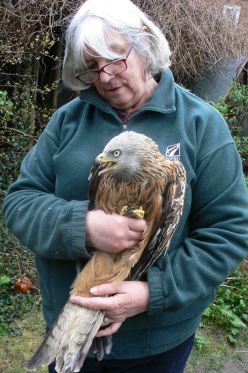
Jean Thorpe (pictured above with the shot red kite) runs Ryedale Wildlife Rehabilitation. She works closely with the RSPB and local Police Wildlife Crime Officers and has her work cut out, living where she does. In 2014 she was awarded an MBE for her tireless voluntary work. If you’d like to make a donation towards her efforts, please click here.

The e-petition to ban driven grouse shooting can be found HERE.

Increase in raptor persecution crimes in 2015

The Partnership for Action against Wildlife Crime (PAW Scotland) has just published the ‘official’ 2015 raptor persecution data, including their annual persecution hotspot maps.

The PAW Scotland press release can be read here and the hotspot maps can be accessed here.

20 crimes against birds of prey were recorded in 2015, which is an increase on the 18 recorded in 2014. The 2015 crimes included six poisoning incidents, five shootings, five disturbance incidents, three trapping or attempted trapping offences and one case of chick theft. The victims included red kite, peregrine, buzzard, goshawk, osprey and hen harrier. Surprisingly, golden eagle isn’t included in the list. We’ll discuss that below.

Having read the press release and looked at the hotspot maps, four things jumped out at us.

First is the increase in recorded raptor persecution incidents in 2015. It’s only a slight increase, from 18 to 20 recorded crimes, but nevertheless it is still an increase. This is important to note, especially in light of a recent statement made by Tim (Kim) Baynes of the Scottish Moorland Group (funded by the landowners’ lobby group Scottish Land & Estates). In December 2015, in response to the publication of the RSPB’s 20-year raptor persecution review, Kim said this:

Bird of prey deaths……have fallen dramatically over the last five years in particular“.

At the time, Kim didn’t back up this claim with any evidence and as the 2015 data have now been published, it’s clear why he didn’t. Basically, the evidence wasn’t there. As Head of RSPB Scotland’s Investigation team Ian Thomson says in the latest PAW Scotland press release:

These latest figures make it readily apparent that claims of a decline in the illegal killing of raptors are wholly without foundation“.

This time, Kim isn’t claiming that there has been a decline but he still tries to diminish the problem by saying “annual variations [in the number of reported persecution crimes] are now very small“. Another way of putting it, Kim, would be to say that no progress has been made!

The second thing to jump out at us is perhaps the most concerning of all, and that’s the withholding of data relating to a quarter of the recorded 2015 crimes. If you read the PAW Scotland press release, you’ll notice the following caveat written in the ‘Notes to Editors’ section:

Further details of 5 of the 20 bird of prey crimes recorded in 2015 are currently withheld for police operational reasons. It has therefore not been possible to include the locations of these incidents on the hotspot maps‘.

So here’s one of the maps purporting to show all types of raptor persecution crimes recorded over a three-year period in Scotland (2013-2015). Only it doesn’t show them all, as 25% are missing. Not only are 25% missing, but also missing are details of poisoned baits (no victims present) that were recorded during this period – for some reason they’ve been placed on a separate map. So when you look at this map, ignore the misleading title. It isn’t a map of ‘All Recorded Bird of Prey Crimes Scotland – 2013-2015’, it’s a map of SOME Recorded Bird of Prey Crimes 2013-2015, just the ones we’re allowed to know about.

ALL Raptor crimes 2013 to 2015

The purpose of publishing these annual hotspot maps and their associated data is, according to the PAW Scotland website, ‘to allow all the partner organisations to enter into meaningful discussions and work together to eradicate bad or illegal practices in Scotland‘. Presumably, because the maps and data are also placed in the public domain, the purpose is also to increase transparency and thus public confidence. What is the point of publishing a proportion of the data and withholding the rest? It just makes a mockery of the whole process. Why bother publishing at all?

The caveat in the ‘Notes to Editors’ section goes on to say:

The [withheld] incidents are, however, included in the figures provided in the summary tables accompanying the maps. The maps and background data will be updated, where possible, in future publications‘.

Sounds promising, but when you actually look at the summary tables you find large sections still marked as ‘withheld’:

Confirmed poisonings 2015

ALL raptor crimes 2015

These ‘withheld’ incidents, shrouded in secrecy, make it virtually impossible to cross reference known reported persecution crimes with those being touted as the ‘officially recorded’ crimes, which closes off any opportunity to scrutinise these ‘official’ data to ensure that incidents have not been ‘missed’ or ‘forgotten’ (we’re being kind). In other words, we are expected to accept and trust the ‘official’ data from Police Scotland as being accurate. Sorry, but having seen Police Scotland’s shambolic handling of some wildlife crime incidents we have limited confidence in their ability, either intentionally or unintentionally, to get this right.

This leads us nicely on to the third thing to jump out at us. As mentioned above, we were surprised not to see golden eagle listed as one of the 2015 victims. According to our sources, a traditional golden eagle eyrie was burnt out in 2015 – we blogged about it here. Why wasn’t this incident included in the 2015 PAW data? Or was it included and it was categorised in the ‘withheld’ category? Who knows. Do you see what we mean about the difficulty of cross-referencing known incidents?

The fourth thing to jump out was an entry in Table 5c (see above). The second line down tells us that a red kite was poisoned in Tayside in January 2015. That’s news to us. Does anybody remember seeing anything in the media about this crime? Any appeal for information? Any warning to the public that deadly poison was being used in the area? No, thought not.

The reticence of the police to publicise some of these crimes is deeply concerning, and especially when that suppression extends to details of crimes in ‘official’ reports that are supposed to demonstrate openness and transparency. Ask yourselves, in whose interest is it to keep these crimes under wraps?

Ross-shire Massacre: two years on

nothingSo, it’s been two years since 22 dead birds of prey were discovered in a small area around Conon Bridge in the Highlands. It was one of the most significant illegal raptor persecution crimes ever uncovered in the UK.

Are we any closer to finding the culprit(s)? Of course not. Here’s what we do know:

  1. 22 dead raptors (16 red kites + 6 buzzards) were found in the same small area over a period of weeks in March/April 2014.
  2. Sixteen of those raptors were later confirmed poisoned: 12 red kites + 4 buzzards.
  3. No cause of death has been given for the other six victims.
  4. The poison used was a banned substance.
  5. Nobody has been arrested.
  6. Nobody has been charged.
  7. Nobody has been convicted.

According to a ridiculous Police Scotland press statement, these birds “were most likely not targeted deliberately but instead were the victims of pest control measures“. Quite how they’d know this without having spoken to a known culprit is anybody’s guess (see here) and until they do, that’s all their conclusion can be, a guess.

The police are still withholding the name of the poison used – we’re told this is ‘for operational purposes’. We’re also told that this is still ‘a live investigation’.

What it actually is is a shambles and it has been from the start.

The first six dead birds were discovered between 18-24 March 2014 and poisoning was immediately suspected. The police put out a press statement on 25th March (here) but at that stage they hadn’t conducted a proper search, so by telling the world about this suspected crime they gave the culprit(s) every opportunity to hide any remaining evidence. A thorough police search didn’t take place until 9th April (see here) – three weeks after the discovery of the first dead birds. Unsurprisingly, no evidence to link the crime to a suspect was found.

Two years on and we’re no closer to seeing justice prevail. It’s just another unsolved raptor-killing crime amongst hundreds of others.

Previous blogs on the Ross-shire Massacre here

Crown Office drops prosecution against Glenogil Estate gamekeeper

Snared fox dead alt, Glenogil Estate, Credit OneKindRegular blog readers will know we’ve been following the case of Scottish gamekeeper William Curr, who had been charged last year with alleged snaring offences on Glenogil Estate in the Angus Glens, said to have occurred in September 2014 (see here, here, here and here).

The charges related to allegations that several snares had not been checked (as they are required to be) within a 24-hour period of being set, after a field officer from the charity OneKind had discovered a dead snared deer, a dead snared fox and another snared fox that was still alive but had to be euthanised at the scene due to the extent of its horrific injuries (see OneKind photo).

For a harrowing description of what was found on Glenogil Estate, including a confrontation with the Head Gamekeeper, read this blog on the OneKind website.

Curr’s trial was due to start on 9th May but last week (10 March) the Crown Office informed the court that it was not going to proceed. OneKind has not yet been able to ascertain the reason for this decision, and in fact may never find out because the Crown Office is under no obligation to explain.

Accountability and transparency, anybody?

To quote from the OneKind blog:

OneKind is mystified by the dropping of this case, given the eye witness evidence, the horrific video footage and the detailed follow-up investigation carried out by the Scottish SPCA. This was a shocking incident where at least six people, including gamekeepers, witnessed the terror and pain of a live fox as the wire noose of a snare sliced into its abdomen. Had our research officer not been on the estate on that particular day, who knows how much longer the fox would have continued to suffer?

To put this dreadful story in the wider context: snares are still legal in Scotland and the rest of the UK. It is simply intolerable that the suffering this fox endured should be considered legally acceptable. The video footage is utterly harrowing and illustrates an animal which is clearly distressed, both physically and mentally. OneKind has long called for an outright ban on all snares and sadly we feel these calls have been justified by this case.

OneKind will seek an explanation for the failure of the Scottish justice system to bring this animal welfare case to court“.

The reason we’ve been so interested in this case is because the alleged offences occurred on the Glenogil Estate, one of several grouse shooting estates in the Angus Glens where wildlife crime incidents keep cropping up but have never resulted in a successful prosecution. For example, here are some incidents reported from in and around Glenogil over the last ten years:

2006 March: poisoned rabbit bait (Carbofuran). Listed as ‘Glenogil’ in RSPB annual report. No prosecution.

2006 April: poisoned buzzard (Alphachloralose). Listed as ‘Glenogil’ in RSPB annual report. No prosecution.

2006 April: poisoned tawny owl (Alphachloralose). Listed as ‘Glenogil’ in RSPB annual report. No prosecution.

2006 May: poisoned rabbit bait (Carbofuran). Listed as ‘Glenogil’ in RSPB annual report. No prosecution.

2006 June: poisoned woodpigeon bait (Carbofuran). Listed as ‘Glenogil’ in RSPB annual report. No prosecution.

2006 June: Traces of Carbofuran found in estate vehicles & on equipment during police search. Not listed in 2006 RSPB annual report but reported here. (Now former) estate owner John Dodd had £107k withdrawn from his farm subsidy payments as a result. This was being appealed but it is not known how this was resolved. Also a write up in RSPB 2007 annual report. No prosecution.

2007 November, Glenogil Estate: Disappearance of radio-tagged white-tailed eagle ‘Bird N’ coincides with tip off to police that bird been shot. No further transmissions or sightings of the bird. Not listed in RSPB annual report but reported here. No prosecution.

2008 May: poisoned white-tailed eagle ‘White G’ (Carbofuran, Isophenfos, Bendiocarb). Listed as ‘Nr Noranside’ in RSPB annual report. No prosecution.

2008 May: poisoned buzzard (Bendiocarb). Listed as ‘Nr Noranside’ in RSPB annual report. No prosecution.

2008 May: poisoned mountain hare bait (Carbofuran, Isophenfos, Bendiocarb). Listed as ‘Nr Noranside’ in RSPB annual report. No prosecution.

2008 May: 32 x poisoned meat baits on fenceposts (Carbofuran, Isophenfos, Bendiocarb). Listed as ‘Nr Noranside’ in RSPB annual report. No prosecution.

2008 October: poisoned meat bait on fencepost (Carbofuran). Listed as ‘Nr Noranside’ in RSPB annual report. No prosecution.

2009 March: poisoned buzzard (Carbofuran). Listed as ‘Glenogil’ in RSPB annual report. No prosecution.

2009 March: poisoned buzzard (Carbofuran). Listed as ‘Glenogil’ in RSPB annual report. No prosecution.

2009 August: poisoned white-tailed eagle “89” (Carbofuran). Listed as ‘Glenogil’ in RSPB annual report. No prosecution.

2010 May: poisoned red kite (Carbofuran). Listed as ‘Nr Noranside’ in RSPB annual report. No prosecution.

2010 September: poisoned buzzard (Chloralose). Listed as ‘Glenogil’ in RSPB annual report. No prosecution.

2010 October: poisoned buzzard (Carbofuran). Listed as ‘Glenogil’ in RSPB annual report. No prosecution.

2010 October: poisoned pigeon bait (Carbofuran). Listed as ‘Glenogil’ in RSPB annual report. No prosecution.

2010 October: poisoned pigeon bait (Carbofuran). Listed as ‘Glenogil’ in RSPB annual report. No prosecution.

2012 April: Remains of buzzard found beside pheasant pen. Listed as ‘Nr Noranside’ in RSPB annual report. No prosecution.

2014 June: shot buzzard. Listed as ‘Glenogil’ in RSPB annual report. No prosecution.

Mass raptor poisoning in Wales: police respond but questions remain

Following on from yesterday’s blog (see here) about the illegal mass poisoning of raptors in the Powys region of Wales and our question about whether Dyfed-Powys Police had covered up this atrocity…..

Poisoned RK Powys

Chief Constable Simon Prince (head of Dyfed-Powys Police, Chair of the PAW UK Steering Group and ACPO lead on wildlife crime) sent us a tweet yesterday saying he would investigate our report and provide an update. He was as good as his word as this evening he sent us another tweet directing us to a statement that has just been added to the police website. In case it disappears, we’ve reproduced it here:

In response to blog by Raptor Persecution Scotland

Dyfed Powys Police take allegations of wildlife crime very seriously and investigates all incidents reported to us. Following information received in 2012 and 2013, relating to the deaths of raptors in Powys, a full investigation was carried out in partnership with the RSPB, the National Wildlife Crime Unit and the Wildlife Management Team in the Welsh Government.   During the investigation a number of search warrants under the Wildlife and Countryside Act were executed and two people were arrested in connection with the incidents. A file of evidence was subsequently submitted to the Crown Prosecution Service who advised that there was insufficient evidence to proceed with a prosecution.

END

We’re grateful to Chief Constable Prince for replying so promptly but this police statement leaves a lot to be desired and a lot of questions still unanswered.

The statement tells us that an investigation was undertaken, and this is further verified by a detailed blog written by one of the RSPB investigations team that has just appeared on the RSPB website (here). Good, we shouldn’t expect anything less. But, as is common in so many of these raptor persecution cases, the evidence was insufficient to proceed to a prosecution. That doesn’t mean that the mass poisoning didn’t occur – it clearly did – but it was not possible to identify a named suspect to face charges. We’re not going to criticise the police for that, especially after reading how pleased the RSPB investigator was with the police’s efforts during the investigation.

However, the focus of yesterday’s blog was whether Dyfed-Powys Police had embarked on a ‘cover-up’ of this mass raptor poisoning and that question still remains open. This crime has been described by the RSPB investigator as “the most significant wildlife poisoning case ever recorded from Wales, and the second highest recovery of poisoned birds of prey in any UK investigation during the last 40 years“. So why has Dyfed-Powys Police not made any public statement about it until we started asking questions yesterday? Surely it’s in the public interest to know about this?

In the recent past it has been standard practice for this police force, and other Welsh police forces, to make public statements about other (much smaller and thus less significant) poisoning/persecution incidents – e.g. see here, here, here, here and here. These statements can include an appeal for information and/or a warning to members of the public to be aware of dangerous toxic poisons in the local vicinity.

So just what is it about this mass poisoning crime that Dyfed-Powys Police has kept quiet about it for so long, even after the investigation had concluded?

You’ll note in the above police statement that the location has not been revealed. You’ll also note in the RSPB investigations blog that the location is given as a sporting (pheasant shooting) estate in the Brecon Beacons National Park, although the estate is still not named.

We think we’ve got a pretty good idea why this mass poisoning crime has not previously been made public (we’d call that covering it up). Since we published yesterday’s blog, several people have contacted us privately and each has named the same estate as being at the centre of the investigation. We’re not yet in a position to publish that estate name because we need to verify a few things first. But OH MY GOD. If it does turn out to be this estate, you’ll not struggle to put two and two together.

Photo of one of the poisoned red kites found on a pheasant shooting estate in the Brecon Beacons National Park, by Guy Shorrock (RSPB).

Ross-shire Massacre discussed at RACCE meeting

RK5Back to the Rural Affairs, Climate Change & Environment (RACCE) committee meeting in January….

The topic of the Ross-shire Massacre was raised again. For new readers, the Ross-shire Massacre refers to the discovery of 22 dead raptors in a small area of Conon Bridge in the Highlands in March 2014. Sixteen red kites and six buzzards were found dead: 12 red kites and 4 buzzards have since been confirmed to have been poisoned by a ‘banned substance’. There have been no arrests to date. Our last update was on the 18 month anniversary (here) and we’ll be writing more when the two-year anniversary rolls around in March.

In the meantime, here’s the discussion from the RACCE committee meeting in January. In a nutshell, 22 months on from one of the biggest mass raptor poisonings uncovered in Scotland, the police have no progress to report:

Dave Thompson MSP (Skye, Lochaber and Badenoch) (SNP): This concerns the cases involving raptors up in Ross-shire. I have a couple of letters from Police Scotland in that regard, and I want to tease out one or two little points. One of the letters refers to the “consequence of a … use of a banned substance” and to the belief “that the raptors may not have been the specific target”. The second letter makes it very clear regarding one case that “there are limited opportunities to progress unless someone comes forward with information.”

You are probably aware that I have asked for some kind of interim report into the initial handling of that case. I was told in that letter that “Police Scotland does not produce ‘interim reports’ during a live investigation”. Given that the case in question could be live for the next 20 years, we are never going to get an opportunity to consider how things were initially handled in relation to the matter. There are concerns in the community and elsewhere that there was perhaps some unnecessary delay and so on. Given that there will be “limited opportunities to progress unless someone comes forward” with evidence, have you carried out, or do you plan to carry out, any internal investigation as to how the investigation itself was initially carried out? If so, have you learned any lessons from that? Will you able to make any of that public at any point?

Assistant Chief Constable Graham: We had a fairly lengthy discussion last year about the current state of the case at that stage. Some similar points were raised about the handling of the matter in the media—that was about press statements, if I remember correctly. There was a desire to review our approach.

At the heart of the letter to which you have referred is the point that having the police produce a report is not necessarily the best way to address the issues. However, I would be very happy to be involved in something in future with a range of organisations and interested parties, including yourself, whereby we are able to sit down and gather what the concerns are. We are aware of most of them. We could work through how we could do things differently in future, and we could achieve that even within the scope of a live investigation, which would not require the police to produce a report as such. As I say, producing a report might not be the most effective approach.

As I reported last year, we have done a number of things internally to review the investigation at senior detective level, which is unprecedented in a wildlife crime investigation. We had what we call a major investigation advisory group meeting, with a process around that. That has been subject to both peer and senior officer review, assessment and support. Notwithstanding all that, we have not arrived at a position where we have been able to solve the crimes, as it were, although that is not to say that we will not in the future.

Therefore, I would still be cautious in ensuring that we do not do anything to prejudice any potential future cases. A lot of information is still being received about the case. Much of that is statements or reports along the lines of, “Everybody knows who’s done it”, “We all know what’s gone on”, or “Everybody knows where the police should be looking.” I can assure the committee that we have followed up every statement in which we can identify the individuals involved. That includes people coming to us or people whom we have been made aware of who have made such statements publicly or privately.

The committee might have had feedback indicating that people are surprised when we have taken a statement from them after quite some time has passed. Unfortunately, in every single case, the statement has turned out to be without substance. We have spoken to everybody we possibly could and, although there is a general perception that everybody knows who did it, no one has been able to give us their names. Given the huge effort that has gone into—and continues to go into—the inquiry, we should have a caveat here because of public concern about perceived police inaction. The case is still sitting with the detective superintendent in Inverness, who is the lead investigator. I have been assured by him, as recently as last week, that there is still an active review and engagement on any potential lines of inquiry that come to light.

A short documentary was recently aired on the internet that interviewed a number of people. We picked up a number of lines from that, which were similar to previous statements in which people asserted that everybody knew who had done it. However, no one in the documentary knew who had done it, because we have spoken to them all.

Dave Thompson: You suggested a meeting between a range of bodies and parties, perhaps including myself. It would have to be before 23 March, because I am not standing again, although I am sure that my successor—whoever that is— would be happy to take part. Such a meeting would reassure people. Although the public accept that the police continue to look into the case and that they would dearly like to get any evidence that would allow them to conclude it, there are questions about how the police went about things at the beginning. Such a meeting would be really useful because frank discussions could take place and the issue could be talked through, without you having to divulge things that might prejudice the case. I would welcome such a meeting, if you are offering one.

Assistant Chief Constable Graham: I am, and I offer to do it before 23 March.

More raptor persecution uncovered in the Scottish Borders

We’re still working our way through RSPB Scotland’s recently published twenty-year review (see here) and what a fascinating read it’s proving to be. We’ve already blogged about two things that caught our eye (see here and here), and now here’s the third.

On page 14 of the report, the following has been written:

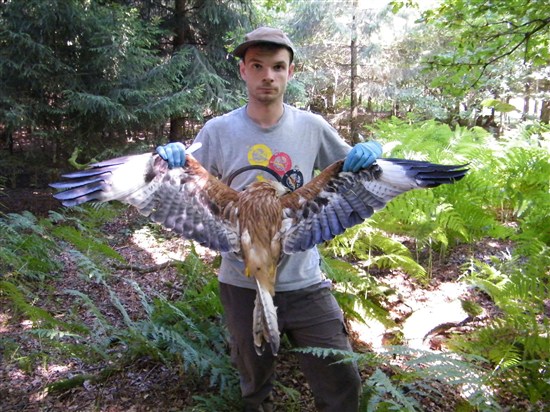
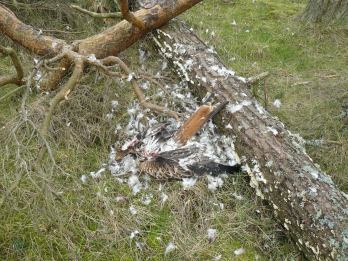
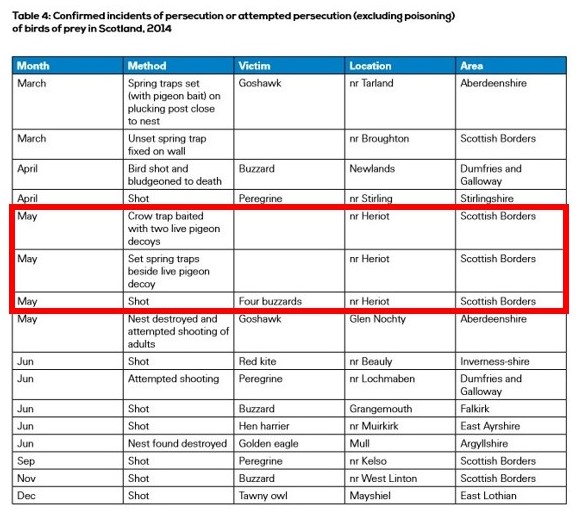
Lines 5, 6 and 7 of Table 4 describe the finding at one site, in an area intensively managed for driven grouse shooting, of a set crow trap, hidden within a small area of woodland, which was found to contain two feral pigeons indubitably being used as illegal lures to attract birds of prey. Under a tree, only a few metres away, were found the decomposed carcasses of four buzzards that had been shot, while a short distance from the crow trap a pigeon was found in a small circular cage, with four set spring traps set on the ground, hidden under moss, attached to the trap“.

Here’s a copy of Table 4, with lines 5, 6 and 7 highlighted:

Nr Heriot 2014

Also included in the report is a photograph of the pigeon inside a small cage with the four set spring traps hidden under moss:

Pigeon in trap Heriot 2014

So, according to the RSPB report, these offences were uncovered in May 2014 on a driven grouse moor in the Borders, with the location given as “nr Heriot“. Funny, we don’t remember seeing anything in the press about these crimes.

Hmm. Could these wildlife crimes be in any way related to SNH’s recent decision to serve a General Licence restriction order on parts of the Raeshaw Estate and Corsehope Estate (see here)? Both Raeshaw Estate and neighbouring Corsehope Estate can be described as being ‘nr Heriot’; indeed, the recorded property address for Raeshaw Estate is given as ‘Raeshaw House, Heriot, EH38 5YE’ (although the owner is only listed as Raeshaw Holdings Ltd., registered in the Channel Islands, natch), according to Andy Wightman’s excellent Who Owns Scotland website. And according to SNH, the General Licence restriction order on these two estates was served due to “issues about the illegal placement of traps” (see here). It’s possible that they’re connected, but it’s also possible that these crimes are unconnected with SNH’s General Licence restriction order on these two estates because Raeshaw isn’t the only grouse moor that could be described as being ‘nr Heriot’. Unfortunately, the (lack of) detail available in the public domain doesn’t allow us to be conclusive. Perhaps there’ll be some transparency once the legal arguments (see here) about the General Licence restrictions have concluded (which should happen fairly soon). Then again, perhaps there won’t.

If these crimes were not uncovered on either the Raeshaw or Corsehope Estates, we hope there’ll at least be a General Licence restriction order served on whichever grouse moor these traps were found because there’s been a clear breach of the General Licence rules – pigeons are not permitted as decoy birds in crow cage traps; set spring traps are not permitted out in the open; oh, and shooting buzzards is also illegal. There should also be a prosecution of course, but that’s highly improbable given the track record of non-prosecutions for raptor crimes uncovered in this part of the Borders.

There’s been a long history of raptor persecution “nr Heriot“, dating back to at least 2001. Here’s a list we’ve compiled of confirmed raptor persecution crimes, all listed within RSPB annual reports:

2001 May: poisoned buzzard (Carbofuran) “Heriot Dale”. No prosecution

2003 Feb: poisoned buzzard (Carbofuran) “Heriot”. No prosecution

2003 Mar: poisoned buzzard (Carbofuran) “Heriot”. No prosecution

2003 Apr: poisoned buzzard (Carbofuran) “Heriot”. No prosecution

2003 Nov: poisoned buzzard (Carbofuran) “Heriot”. No prosecution

2004 Feb: Carbofuran (possession for use) “Heriot”. No prosecution

2004 Feb: two poisoned buzzards (Carbofuran) “Heriot”. No prosecution

2004 Oct: poisoned buzzard (Carbofuran) “Heriot”. No prosecution

2005 Dec: poisoned buzzard & raven (Carbofuran) “Heriot”. No prosecution

2006 Sep: poisoned buzzard (Carbofuran) “Heriot”. No prosecution

2006 Oct: poisoned buzzard (Carbofuran) “Heriot”. No prosecution

2009 Mar: two poisoned buzzards (Carbofuran) “nr Heriot”. No prosecution

2009 Jun: poisoned red kite (Carbofuran) “nr Heriot”. No prosecution

2009 Jun: 4 x poisoned baits (2 x rabbits; 2 x pigeons) (Carbofuran) “nr Heriot”. No prosecution

2010 Nov: poisoned buzzard (Carbofuran) “nr Heriot”. No prosecution

2011 Jan: poisoned buzzard (Carbofuran) “nr Heriot” No prosecution

2013 Jun: shot + poisoned buzzard (Carbofuran) “nr Heriot”. No prosecution

2014 May: crow trap baited with two live pigeon decoys “nr Heriot”. Prosecution?

2014 May: four set spring traps beside live pigeon decoy “nr Heriot”. Prosecution?

2014 May: four shot buzzards “nr Heriot” Prosecution?

Not included in an RSPB annual report (because it happened this year): 2015 Jul: shot buzzard “found by side of road between Heriot and Innerleithen” according to media reports (see here). Prosecution?

Interestingly, also not included in the RSPB’s annual reports but reported by the Southern Reporter (here) and the Guardian (here), a police raid on Raeshaw Estate in 2004 uncovered nine dead birds of prey, including five barn owls, two buzzards, a kestrel and a tawny owl, described as being “poisoned or shot“. In addition, “a number of illegal poisons were discovered but no-one was ever prosecuted“. According to both these articles, during a further police raid on Raeshaw in 2009 ‘three injured hunting dogs were seized by the SSPCA on suspicion of involvement with badger baiting’. We don’t know whether that resulted in a prosecution.

Also not included in the above list is the sudden ‘disappearance’ of a young satellite-tagged hen harrier in October 2011. This bird had fledged from Langholm and it’s last known signal came from Raeshaw Estate. A search failed to find the body or the tag.

Fascinating stuff.

New report reveals hundreds of raptors illegally killed on game-shooting estates in Scotland

RSPB persecution review 1994 2014Yesterday the RSPB published its latest figures on illegal raptor persecution in Scotland.

Rather than their usual annual review, this time they’ve produced a 20-year review covering the period 1994-2014. This is a really useful exercise as it puts the scale of (known) persecution in to perspective. It’s a sobering read.

A total of 779 birds of prey were confirmed to have been illegally killed during this period, either by poisoning, shooting or trapping. The known victims included 104 red kites, 37 golden eagles, 30 hen harriers, 16 goshawks, 10 white-tailed eagles and 458 buzzards.

In addition to these confirmed victims, a further 171 incidents are documented where poisoned baits and/or non-birds of prey victims were found, including 14 pet cats and 14 pet dogs, and then a further 134 incidents where no victim had been found but clear attempts to target raptors had been uncovered (e.g. illegally-set traps).

The report includes a map showing the landholdings of all known persecution incidents during this period. As ever, it’s pretty revealing, with a handful on the west coast but the vast majority in the uplands of central, eastern and southern Scotland – areas dominated by driven grouse shooting.

RSPB persecution review 1994 2014 map

Drilling down in to the detail, there’s a useful analysis of land-use type of confirmed poisoning incidents between 2005-2014 (219 incidents). A shocking (or not) 81% of confirmed poisoning incidents during this nine-year period were on land used for game-shooting: 57% on grouse moors and 24% on land managed for lowland pheasant shoots. This tells us a great deal about who is responsible for the vast majority of illegal raptor poisoning. Despite their continued denials and protestations, and their increasingly-desperate attempts to minimise the scale of these crimes (“it’s just a few rogues”, “it’s just a small minority”), this graphic exposes the criminality at the heart of the game-shooting industry:
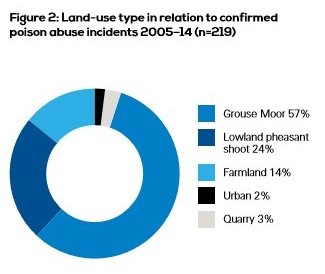
RSPB persecution review 1994 2014 land use

Further damning evidence, which isn’t needed by most of us but for the benefit of those who are still in denial of the bleedin’ obvious, is this graph showing the occupations of those convicted of raptor persecution between 1994-2014. Surprise, surprise, 86% of them were gamekeepers:

RSPB persecution review 1994 2014 occupation

RSPB Scotland is to be commended for publishing this exceptionally detailed and meticulously-researched report. There are a number of things in it that are of particular interest to us and we’ll come back to those in due course. For now though, particular recognition should go to the Investigations team – they may be small in number but their contribution to exposing the disgraceful continuation of illegal raptor persecution in Scotland is enormous. They, and their colleagues south of the border, are worthy of high acclaim. If anybody reading this is in a position to recognise excellence in the field of raptor conservation, e.g. a nomination for an award, this team should be at the top of your list.

So, how has the Environment Minister, Dr Aileen McLeod, responded to such an embarrassing report? She said: “There is no doubt that the figures in this report make for uncomfortable reading, but we have made progress in recent years with the new vicarious liability provisions, the publication of the report from the Wildlife Crime Penalties Review Group, new measures implementing restrictions on the use of General Licences and earlier this year the Scottish Government funded pesticide disposal scheme that removed over 700kg of illegally held poisons in Scotland“.

We have made progress…” Hmm. Let’s have a look:

Vicarious liability – introduced almost 4 years ago and only two successful convictions to date. A slow (but good) start, but we need to see many more convictions.

Wildlife Crime Penalties Review – Commissioned over two years ago, published last month. An excellent report calling for tougher sanctions but we’re waiting to hear whether the Environment Minister will act on the recommendations. Can only be defined as ‘progress’ if she agrees to act.

General Licence restrictions – available to be used against landholdings where raptor crimes committed/suspected from 1st January 2014. So far, only two restrictions have been implemented and those only lasted for six days each before they were suspended as legal arguments continue. A slow start, and the legal challenges were to be expected, but can’t be defined as ‘progress’ unless the restrictions are fully implemented. There should also be a lot more of them.

Pesticide disposal scheme –  implemented this year and resulted in the removal of some illegally-held poisons. That is progress, although it is tinged with frustration that the game-shooting industry was given yet another chance to avoid justice as this scheme (the second of its kind) comes 14 years after the pesticides were originally banned. It’s also interesting to note in the RSPB’s report (page 18) that evidence suggests a number of individuals have retained their illegal stocks. This is supported by more poisoning incidents that have taken place this year, after the disposal scheme ended.

So some progress has been made (and almost entirely due to the efforts of Dr McLeod’s predecessor, Paul Wheelhouse) but it is glacially slow and, so far, has not stemmed the occurrence of illegal persecution, as the damning figures in this report show all too clearly. Much, much more can and needs to be done before we’ll be convinced that Dr McLeod is having any sort of impact. She has, though, announced that tenders have just been invited for a review of game licensing practices in other countries (to inform a possible decision of introducing licensing to game-shooting estates in Scotland), and that’s a good thing, but again, the research needs to be done and then a decision made, which probably won’t happen for a number of years if past performance is anything to go by. She’d find herself with a lot more support if she got on with announcing increased investigatory powers for the SSPCA – the public consultation closed 1 year and 3 months ago – and still we await her decision as the criminals continue their rampage. It’s not impressive at all.

And what of the response of the game-shooting industry itself? Some didn’t bother to publish a statement (Scottish Gamekeepers’ Association), which ironically tells us quite a lot, although they are quoted in an article by STV (see media coverage below) where they revert to type and simply deny the evidence and slag off the RSPB instead. And remember, the SGA is a fully-paid up member of the Partnership for Action Against Wildlife Crime (cough).

Scottish Land and Estates (SLE), another PAW partner, did manage to issue a statement, via their Scottish Moorland Group (see media coverage below). Again, it’s the usual lamentable denial, characterised beautifully by this statement from Director Tim (Kim) Baynes:

Bird of prey deaths……have fallen dramatically over the last five years in particular“.

Er, here are some persecution figures that Kim might want to re-punch in to his calculator:

2012 – 18 confirmed deaths

2013 – 28 confirmed deaths

2014 – 37 confirmed deaths

There’s also this statement:

Our condemnation of wildlife crime is unquivocal...” All very touching but how is that “condemnation” manifested in the real world? It’s been brought to our attention that the current head gamekeeper on a Scottish grouse shooting estate has a (spent) conviction for shooting dead a raptor when he worked on another Scottish grouse moor. How does a criminal with a conviction like that (spent or not) remain employed in the game-shooting industry, let alone get a senior position on another Scottish grouse moor? Was he one of the posse of moorland gamekeepers recently invited to Holyrood to mingle with, and be applauded by, a number of MSPs, as part of the Gift of Grouse propaganda campaign? Surely not…

Download the RSPB report here

Media coverage

RSPB press release here

Statement from Environment Minister Dr Aileen McLeod here

Scottish Moorland Group statement here

BBC news here

STV article here

BBC Radio Scotland (Newsdrive) interview with Ian Thomson, Head of Investigations RSPB Scotland here (starts at 21.50, available for 29 days)

Guardian article here (a mis-leading headline but nevertheless good to see coverage in this paper)

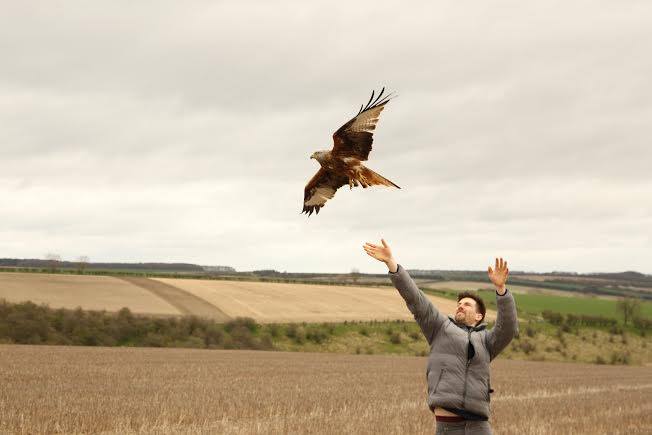
General Licence restrictions on Raeshaw & Burnfoot Estates last only six days

On 4th November, we blogged about SNH’s intention to restrict the use of General Licences in two areas, in response to alleged raptor persecution incidents. The two areas included parts of the Raeshaw and Corsehope Estates in the Borders (Restriction #1), and parts of the Burnfoot and Wester Cringate Estates in Stirlingshire (Restriction #2) (see here for our earlier blog about these restrictions, and see here for SNH’s explanation for the restrictions).

The General Licence restrictions were due to begin on 13th November 2015 and run for three years. They actually only ran for six days.

SNH GL restriction 1 SUSPENSION - Copy

SNH GL restriction 2 SUSPENSION - Copy

On 19th November 2015, the General Licence restrictions were suspended in both areas until further notice, because the Estates have lodged legal appeals, as they said they would last week (see here). While the appeals are underway, the Estates can continue to use the General Licences (i.e. continue to set crow traps and Larsen traps to catch and kill corvids, continue to shoot corvids, and continue to kill lots of other stuff that falls under the remit of activities permitted under the General Licences – see here for a list).

We don’t know what the basis of the appeals are, and nor do we know the procedural process of the appeals system, but presumably SNH now has a fixed period of time to respond. If SNH decides to uphold the appeals then the General Licence restrictions will be removed. If SNH decides to stick to its original decision and impose the three-year restrictions, then the restrictions would be re-instated. However, then these Estates would be entitled to apply for a judicial review to test whether SNH has acted fairly.

Settle yourselves in for a long legal battle.