Police appeal after red kite found shot on Harewood Estate, Yorkshire

WEST YORKSHIRE POLICE APPEAL FOR INFORMATION, 18th May 2018

POLICE APPEAL FOR INFORMATION AFTER YORKSHIRE RED KITE SHOT IN LEEDS

Police are appealing for information after a Yorkshire Red Kite was shot in Leeds.

The incident happened on Thursday 10 May when an injured Red Kite was found by two walkers on a footpath just inside the northern boundary of the Harewood Estate.

They took the bird to the estate office, who arranged for it to be cared for by staff at the Harewood Bird Garden. It had suffered serious injuries and was taken by staff to a nearby veterinary practice for treatment.

X-rays revealed that the bird had been shot and a pellet was lodged in its right wing. The bird was put down by staff at the practice, as its injuries were too severe for it to survive and wouldn’t have been able to fly any distance.

It is believed the shooting occurred close to the entry point of the public footpath into the Harewood Estate from the A659, near to the junction with the A61 at the bottom of Harewood Bank.

West Yorkshire Police are appealing for witnesses who were in the area and may have seen anything suspicious; to come forward and contact the police to assist with their investigation.

In 2016, at around the same time of the year, six Red Kites were known to have been shot in Yorkshire – two in West Yorkshire and four in North Yorkshire.

In all but one of these cases, the injuries proved fatal. Other instances of kites being targeted by firearms, include one fatally shot at Pateley Bridge in 2017 and several which had been victims of illegal poisoning but which had been found to be carrying lead shot from non-fatal shooting incidents.

Ben Lascelles, Development Manager at Harewood Estate, said: “The Harewood Estate works hard to champion conservation of Red Kites and other native wildlife, and many thousands of people visit us each year to enjoy them. To discover one of these majestic birds has been shot is particularly disappointing and upsetting.”

Howard Jones, RSPB Investigations Officer, said: “Illegal persecution is a real and persistent threat to birds of prey like red kites. They’re a wonderful sight, and the conservation effort to return these birds to our skies has been huge – it is disgraceful that some are spoiling this through their thoughtless and criminal actions.

The RSPB’s new raptor crime hotline on 0300 999 0101 allows whistle-blowers to come forward confidentially in relation to this type of crime and, given the number of illegally kites in Yorkshire, we hope someone will speak up and reveal who is responsible.”

Doug Simpson, Yorkshire Red Kites Co-ordinator, said: “This latest attack on the reintroduced Red Kite population is particularly sickening. A lot of hard work has gone into this programme and for someone to strike right at the heart of it, at the actual release site, is both unbelievable and devastating. It once again raises the question of the suitability of some people to own guns.

No fewer than 43 Red Kites have been confirmed as victims of illegal persecution since releases began in Yorkshire in 1999. That 23 of them have been found by people out in the countryside shows the importance of everyone keeping their eyes open for anything untoward and reporting it.”

Anyone with information about this incident is asked to call West Yorkshire Police on 101 quoting crime reference number 13180232956. Anyone wishing to remain anonymous can call the RSPB’s confidential Raptor Crime Hotline on 0300 999 0101.

ENDS

4th raptor poisoning in south Scotland this year

From BBC News (2 May 2018):

RED KITE POISONINGS IN SOUTH WEST SCOTLAND INVESTIGATED

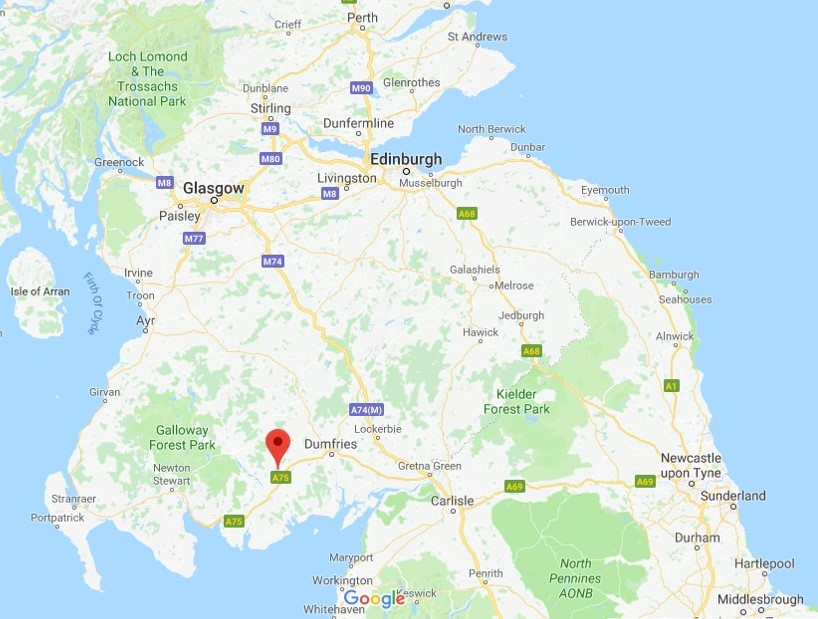
A police investigation has started following the discovery of three dead red kites in Dumfries and Galloway.

Tests have confirmed that two of the birds were illegally poisoned with examinations ongoing on the third.

It takes the number of birds killed by illegal pesticides in the region since the start of the year to four.

Police said the use of poisoned bait was “illegal and totally unacceptable” and could have “devastating consequences” for wildlife.

The incidents in the region since the start of the year are:

  • a red kite discovered poisoned in Kirkpatrick Durham in January
  • a buzzard found dead in Mossdale in March
  • a second red kite killed at a separate location in Kirkpatrick Durham in April
  • another red kite poisoned in April at Old Bridge of Urr
  • a further red kite death with the cause yet to be established at Gelston in April

Specialist Wildlife Crime Officer PC Alan Steel said police were working closely with SAC Consulting and Science and Advice for Scottish Agriculture (SASA) to investigate the cases.

What we have established is that illegal pesticides have been used to kill four of the birds,” he said.

The pesticides identified have been banned in the UK for many years, but despite this there would still appear to be those who leave out poisoned bait, whether that is to target crows, foxes, raptors or other wildlife.

The use of such poisoned bait is illegal and totally unacceptable and those responsible should understand that their unlawful activities not only serve to have devastating consequences on their intended targets but also on various other forms of wildlife.”

He said they were “absolutely determined” to put a stop to the killings and find the people responsible.

They are working with a number of landowners and farmers and liaising with RSPB Scotland as part of the investigation.

We have also carried out a number of land searches in the vicinity of where the birds have been located with a view of trying to locate poisoned bait at these locations,” he added.

It is anticipated that further land searches will take place in the near future.”

A red kite trail in the region is reckoned to be worth millions of pounds to the local economy.

A study last year said the Galloway Kite Trail had generated more than £8.2m since it was launched in 2003.

ENDS

Red kite found poisoned in North Yorkshire (yes, another one)

Press release from North Yorkshire Police (2 May 2018):

WILDLIFE POISONING WARNING AFTER RED KITE FOUND DEAD NEAR KNARESBOROUGH

Police are appealing for information after receiving confirmation that a red kite, found dead near Knaresborough in December 2017, had been poisoned with a pesticide.

The discovery has prompted a warning from North Yorkshire Police – as part of the force’s Operation Owl campaign – about the cruel, illegal and dangerous practice of lacing animal carcasses with poison to kill other wildlife.

The dead kite was found by a member of the public just outside the village of Ferrensby between Knaresborough and Boroughbridge in North Yorkshire. The bird was in good physical condition and there was no evidence to indicate the cause of death. The finder was concerned that the bird may have been killed illegally, and reported it to the police.

Specialist wildlife crime officers at North Yorkshire Police had the bird x-rayed and this ruled out any cause of death due to physical injury. The police then arranged with Natural England for the bird to be sent away for a post mortem and toxicology tests.

The results showed the bird had significant amounts of chloralose, a pesticide, in its kidney – and it was concluded that this was the cause of death. The post mortem could not identify the nature of the kite’s last meal. The bird would have succumbed within a few minutes of consuming the poison. The location where the kite picked up the poison is not known.

Officers need to hear from anyone who has any information about the illegal use of pesticides to poison birds of prey in North Yorkshire. The practice of lacing animal carcasses with poison to kill other wildlife is both cruel and illegal. It is also poses a serious risk to members of the public and their children or pets if they come into contact with them.

Operation Owl is an ongoing initiative by North Yorkshire Police, the RSPB and the RSPCA, together with the North York Moors and Yorkshire Dales National Parks, the Nidderdale Moorland Group, and others, to reduce the number of illegal attacks on birds of prey. As part of the operation, police carry out surveillance checks on known raptor persecution hot-spots at random times to disrupt offender activity. Officers are also calling on the public to be the ‘eyes and ears’ of the police when out in the countryside.

Sergeant Kevin Kelly, of North Yorkshire Police’s Rural Taskforce, said:North Yorkshire’s wonderful countryside is host to many specially-protected birds of prey, including red kites. It is completely unacceptable that people think they can ignore the law and subject these birds to poisonings and other forms of persecution without consequence.

Like other forms of rural crime, raptor persecution is not a problem that the police can tackle alone. If everyone keeps their eyes open for illegal traps and poisoned bait, it will be a massive boost to our surveillance operation. Operation Owl is a real opportunity to reduce the number of wild birds that suffer and die unnecessarily, and send a clear message to offenders that we will not tolerate this crime in our countryside.”

Howard Jones, RSPB Investigations Officer, said:We are deeply saddened to hear of another illegally poisoned red kite in North Yorkshire. Although the re-introduction of this species into the region has been a conservation success, there continues to be an unacceptable level of persecution towards these majestic birds. Kites are struggling to expand their range into upland areas such as the Yorkshire Dales and, in this case, it is clear that they are not safe in other areas of the county either. We will continue to work closely with North Yorkshire Police and Yorkshire Red Kites to tackle the issue of illegal killing.”

Doug Simpson, Yorkshire Red Kites Co-ordinator, said:I am particularly concerned about this case, it being the first recorded kite death from illegal poisoning in this particular area. It is yet another instance of a red kite persecution victim having been found by someone out walking in the countryside, 22 of our 42 confirmed illegally killed or injured kites having been found in this way.”

Anyone with any information about this incident is asked to call North Yorkshire Police on 101, choose option 1 and be ready to quote reference 12170217776.

Alternatively email bill.hickson@northyorkshire.pnn.police.uk If you wish to remain anonymous, call the RSPB’s confidential Raptor Crime Hotline for free on 0300 999 0101.

ENDS

SNH issues licence for mass raven cull in 5-year ‘experiment’

To the utter disbelief of conservationists, statutory conservation agency Scottish Natural Heritage (SNH) has issued a licence authorising the mass killing of ravens in a large area of Perthshire (an area identified as a wildlife crime hotspot where six satellite-tagged eagles have suspiciously disappeared in recent years), as part of a proposed five-year experiment, on the basis of ‘seeing what happens’ to wader populations when ravens are removed.

The licence has been issued to a consortium calling itself the Strathbraan Community Collaboration for Waders (SCCW) which, according to the licence application, ‘represents some of the local land management (farmers, gamekeepers) and private interests in the area who value wading birds for their biodiversity, social and economic value to the area and to Scotland more widely. The application is supported by the Scottish Gamekeepers Association and technical advice and support, notably data gathering and interpretation, is being provided by the Game & Wildlife Conservation Trust (GWCT)‘.

The following has been written by a group of Scottish Raptor Study Group (SRSG) members as a guest blog:

STRATHBRAAN RAVEN LICENCE

The news about the missing white tailed sea eagle disappearing in Glen Quaich on Tuesday 17th April could sadly not have been more timely as Scottish Natural Heritage, (SNH), have issued a licence to several estates in the Strathbraan area in Perthshire, including Glen Quaich Estate, for the killing of 300 ravens in a large scale trial over five years to see if wader productivity and populations can be improved by removing raven predation.

The manner in which the government’s statutory nature conservation agency have conducted themselves has come as a shock and there is grave concern about the mis-application of science, the lack of consultation with key stakeholders, such as the RSPB and SRSG, their choice of estate partners and the lack of transparency, trust and honesty, and even seasoned SNH watchers are aghast.

We have raised our concerns and are unhappy with the response so far and have resorted to writing this blog to make the matters public. Following the “suspicious” disappearance of the white tailed sea eagle and the fact the police are describing this as ‘an illegal act’ we call upon SNH to conduct a review and if the circumstances fulfil what we consider to be the established criteria set out in SNH’s own report then we expect the licence to be withdrawn.

Our concerns focus on three areas, firstly the choice of partners:-

Firstly when selecting a trial area why would you choose an area dominated by driven grouse shooting with a history of illegal raptor persecution? What message does this send out to the many law-abiding estates? Is it that persecution will enable you to ‘cut a deal’ with the statutory nature conservation body? Cynics might suggest this is more about an opportunity to kill ravens in an attempt to protect red grouse stocks and it could also be argued that a licence has been issued to kill one species of bird to enable another bird to be shot for fun.

[Map of proposed cull area in north Perthshire, from the licence application, running from Loch Tay in the west to the A9 in the east]:

Raptor workers over the years have been monitoring the area and can speak with authority on raptor persecution. The Scottish Government’s review of satellite-tagged golden eagles showed that four of these birds have disappeared suspiciously in this area, with a satellite-tagged red kite also disappearing in 2010. In all cases, the tags can be classed as “stopped – no malfunction” as used in the review – ie. highly suspicious.

[Map of north Perthshire showing the last known fixes of five satellite-tagged golden eagles that disappeared in suspicious circumstances. Sea Eagle Blue X also disappeared in Glen Quaich last month]:

In addition, a radio-tagged white-tailed eagle was tracked to this area, but disappeared in January 2012, while a further satellite-tagged white-tailed eagle recently similarly disappeared in Glen Quaich. An illegal clam trap was found in November 2012, while a buzzard was spring-trapped in January 2012. A red kite was found poisoned in January 2015. A raven was poisoned in 2017. In addition, licenced raptor study group members have noted a number of cases of suspicious failure of nesting attempts by hen harrier, red kite and buzzard across the area. They have also recorded a higher than usual turnover of red kites and a loss of breeding pairs at nearby sites. All of which indicates on-going illegal persecution.

Even bearing in mind these detected incidents represent an unknown proportion of actual persecution taking place, this is an area where land management practices have displayed a proven criminal intolerance to protected species, stretching back for many years. All this has been in the public domain so why did SNH press on knowing that their partners in this initiative have such a dubious record, and what level of confidence can we have in their honesty and integrity?

Secondly, science and key questions that remain unanswered:-

  • What monitoring is in place to assess that this cull will not affect the raven population status?
  • How will SNH be able to differentiate from other factors affecting the decline of waders such as other predatory pressures, the loss of suitable habitat and changes in agricultural practices?
  • What criteria will be used to differentiate between breeding and non-breeding birds? This year we have noticed that the breeding season is later than usual.
  • What allowance has been made for the immigration of immature flocks into the proposed licence area?
  • Why has the licensing decision been taken in the absence of the raven population modelling report, as it was commissioned with the sole, or at least the main, purpose of underpinning raven licensing decisions with sounder background information?
  • What is the nature and extent of the independent scrutiny that has been carried out?
  • If any raven roosts are located during the period of the licence, can we be assured that any Schedule 1 non-breeding species and other protected species (possibly also using the same roosts) will not be disturbed?
  • What safe guards are in place to ensure the numbers killed will remain within that permitted?

Thirdly, the lack of engagement

SNH are always keen to trumpet words such as ‘trust’, ‘building relationships’, ‘shared objectives’ ‘working collaboratively’ but we have seen none of this.

  • There has been no communication with SRSG workers who have been active in the proposed licence area and have many years of breeding data on ravens and raptors.
  • We understand that not all landowners/managers within the area of licence have been contacted about this licence, contrary to reassurances provided.
  • This proposed application was developed outside the much lauded ‘Working for Waders’ initiative and we only became aware of this by accident; hardly working together or building trust!
  • Under the Scottish Raptor Monitoring Scheme raven data are submitted to SNH (who is a key partner), yet it seems this information was not included in the licence considerations, (we know this as under the permission sharing protocols raptors workers who collected the information in the first place would have had to have been consulted).

We are deeply suspicious that the lack of engagement was deliberate as SNH knew their proposal was weak and would not stand up to the rigour of an independent scientific review.

We again call upon SNH to withdraw the licence.

ENDS

It’s well known that SNH issues a number of licences every year to cull ravens where they are considered a ‘serious threat’ to livestock (e.g. see here, here) but these are apparently for a limited cull, not related to game management and supposedly based on sound scientific evidence of a perceived local problem.

It’s also well known that gamekeepers have long wanted ravens to be added to the General Licence (e.g. see here, here) because they are seen as a perceived threat to grouse stocks.

It’s also well known that ravens are routinely demonised in the press, including this outrageous piece published by the BBC (see here, and well worth a read to understand the hysteria whipped up around this protected species).

However, this latest licence authorising a multi-year mass culling of ravens over a large area for spurious reasons (and apparently very little, if any, scientific justification) is unprecedented. That it also happens to be a well-known raptor persecution hotspot just adds to the lunancy of this situation.

If you share the concerns of the SRSG members, please consider sending an email to Mike Cantlay, SNH Chair, calling on him to withdraw the licence with immediate effect. Emails to: chair@snh.gov.uk

UPDATE 14.20hrs: Thanks to the blog reader who brought this article to our attention, reporting on the results of a scientific study that dispels many of the myths associated with ravens and wader population declines. And here is the scientific peer-reviewed paper by Amar et al that specifically warns against making predator control licensing decisions without a thorough evaluation of the evidence.

UPDATE 21 April 2018: A quote from SNH Head of Wildlife, Robbie Kernahan:

We understand the concerns over wildlife crime in Strathbraan, but we are also clear that the granting of this licence is wholly unconnected to the issues concerned.

This licence is about a pressing and complex conservation issue. It  is a large-scale collaborative trial which will help improve our understanding of factors affecting key wader species, populations of which are declining at an alarming rate. We are satisfied this licence will not affect the population of ravens overall, and is over a five year period.

The licence places significant responsibility and expectations on all those involved – to be able to show that this approach can work and will help deliver what are essentially shared objectives.

Trust is a key element of this and this presents a great opportunity to develop that trust and relationships with all involved. If it becomes apparent that actions are not being carried out in accordance with the terms of any licence then we will have no hesitation in removing the licence“.

UPDATE 21 April 2018: A quote from RSPB Scotland Head of Species & Land Managament, Duncan Orr-Ewing:

We are extremely concerned about the likely scale on impact of this research licence on the local raven population in the Strathbraan area of Perthshire. We are also very surprised that SNH have issued such a research licence  in the vicinity of Strathbraan, which has an appalling  and well documented track record of illegal persecution of raptors, noting also the very recent “suspicious” disappearance of a satellite tagged white-tailed eagle in this very same area.

We, together with local raptor workers who have been monitoring ravens in the area for decades, could have helped SNH with this background detail to the licence application if we had been consulted.

We will be seeking a high level meeting with SNH shortly to discuss. We will be pressing for the research licence to be revoked on the back of the white-tailed eagle incident, and instead consideration given by SNH to removing the use of the Open General Licence in this area, as is within their powers“.

UPDATE 22 April 2018: Raven cull update and what you can do to help (here)

UPDATE 23 April 2018: Article published in The National (here)

UPDATE 23 April 2018: Article published in The Herald (here)

UPDATE 23 April 2018: RSPB Scotland blog in response to raven cull licence (here)

UPDATE 25 April 2018: OneKind blog in response to raven cull licence (here)

UPDATE 25 April 2018: Chris Packham’s response to raven cull licence (here)

UPDATE 26 April 2018: Is the raven cull licence still active whilst SNH review takes place? (here)

UPDATE 26 April 2018: SNH refuses to say whether raven cull licence has been suspended (here)

UPDATE 27 April 2018: Green MSPs seek urgent meeting with SNH re: raven cull licence (here)

UPDATE 27 April 2018: ‘No justification’ for raven cull licence, says RSPB Scotland Director (here)

UDATE 28 April 2018: Raven cull licence: SGA evasive on benefits to grouse moors (here)

UPDATE 1 May 2018: Strathbraan Community Collaboration for Waders: who’s involved? (here)

UPDATE 4 May 2018: Raven cull: next steps to take as SNH blunders on (here)

UPDATE 7 May 2018: “Let’s have more trials [culls] whether it’s about ravens or other things” says SNH (here)

UPDATE 8 May 2018: Parliamentary questions lodged on raven cull licence (here)

UPDATE 9 May 2018: Alison Johnstone MSP lodges Parliamentary motion on raven cull licence (here)

UPDATE 12 May 2018: Raven cull: please ask your MSP to support this Parliamentary motion (here)

UPDATE 23 May 2018: Raven cull update: scientific advisory committee not being asked to repeal licence (here)

UPDATE 23 May 2018: Raven cull: Parliamentary questions and answers (here)

UPDATE 20 May 2018: Raven cull: latest update (here)

UPDATE 5 June 2018: Legal challenge to raven cull licence: your help needed! (here)

UPDATE 6 June 2018: Raven cull: legal challenge crowdfunder smashes £10k target on day one! (here)

UPDATE 19 June 2018: Raven cull: a few updates (here)

UPDATE 20 June 2018: #Justice4Ravens fundraising merchandise now available (here)

UPDATE 22 June 2018: Preston man receives warning for raven cull death threat (here)

UPDATE 1 July 2018: Last push on #Justice4Ravens crowdfunder (here)

UPDATE 1 July 2018: #Justice4Ravens crowdfunder target smashed! (here)

UPDATE 5 July 2018: #Justice4Ravens: application lodged for judicial review (here)

UPDATE 23 July 2018: Surprise! Gamekeeper in raven cull area declares cull a success (here)

UPDATE 30 July 2018: Raven cull licence: scientific rigour ‘completely inadequate’ says SNH’s scientific advisory committee (here)

UPDATE 30 July 2018: Voluntary suspension of raven cull is meaningless greenwash (here)

UPDATE 7 August 2018: #Justice4Ravens: judicial review update (here)

UPDATE 20 August 2018: Raven cull: application for judicial review withdrawn, for now (here)

UPDATE 30 April 2019: SNH reluctant to discuss licensed raven cull in Strathbraan this year (here)

UPDATE 2 May 2019: SNH rejects 2019 licence application for Strathbraan raven cull (here)

UPDATE 30 May 2019: Scottish Gamekeepers Association’s pity party in response to failed Strathbraan raven cull bid (here)

UPDATE 10 November 2022: Ravens illegally shot on two Strathbraan grouse moors (here)

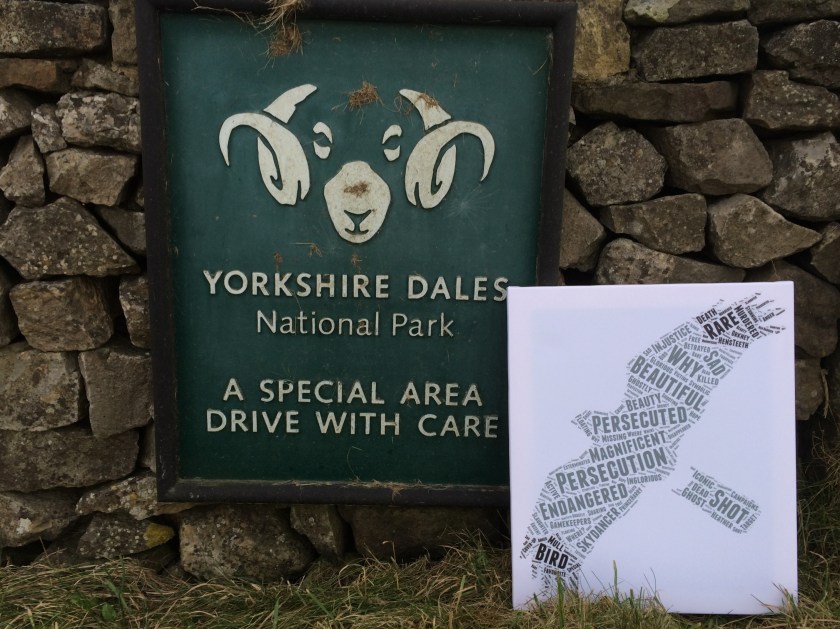
Red kites “hammered” by persistent persecution, says Chair Yorkshire Dales National Park Authority

The Yorkshire Dales National Park Authority continues its recent efforts to highlight and condemn illegal raptor persecution in and around the National Park.

Last month we blogged about some of these efforts, which have included the Park’s involvement with ‘Operation Owl’, a police-led multi-agency initiative designed to target the raptor-killing criminals in North Yorkshire, the Park’s publication of a raptor persecution ‘evidence report’, a wildlife crime seminar organised for Park staff teaching them how to recognise and report suspected wildlife crimes, and an article on raptor persecution published in the Yorkshire Post and written by the Park Authority’s CEO, David Butterworth.

The latest in this commendable series of activities is an article published in the Craven Herald, written by the Chair of the Yorkshire Dales National Park Authority, Carl Lis, entitled, ‘Red kites ‘hammered’ by persistent persecution on national park borders’.

Read the article here

Mr Lis focuses on the ‘barbaric’ persecution of red kites taking place on the eastern border of the National Park in the Nidderdale Area of Outstanding Natural Beauty. He is quoted:

There is no doubt that the eastern fringes, where the grouse moors start, is the real problem area. Red kites have attempted to spread east from their reintroduction sites but have got hammered“.

Here is an RSPB map detailing the illegal killing of 22 red kites in the Nidderdale AONB between 1999-2017 – read this blog for more information:

Mr Lis goes on to say, “I want to stress that the national park authority is not against grouse shooting, and we have had fantastic cooperation from a number of grouse moor managers and owners. What the authority is against is the barbaric and persistent persecution of birds of prey“.

This public condemnation of raptor persecution is very, very welcome, but Mr Lis needs to understand that by continuing to support driven grouse shooting, he is indirectly supporting the continued illegal killing of raptors. There’s no separating the two: driven grouse shooting, in its current format where bag size is king, is reliant on the illegal killing of raptors.

The article ends with some commentary from Amanda Anderson of the Moorland Association who talks about the “great success” of red kites and how “large numbers of red kite are spotted on grouse moors within the Yorkshire Dales on a regular basis including Bolton Abbey in North Yorkshire as well as across the eastern fringe of the national park“.

She forgets to mention how many of those red kites haven’t made it alive off those grouse moors.

Interestingly, we are currently looking in to a claim that the Moorland Association, on behalf of its grouse moor owning members, is apparently concerned about the number of red kites on grouse moors and is seeking advice from Natural England on legal measures to ‘remove’ them. More on this in due course, along with the similar claim about how the Moorland Association has apparently asked Natural England about licences to ‘control’ Marsh harriers.

Dead red kite in south Scotland now confirmed poisoned

Further to yesterday evening’s blog about a dead red kite found in south Scotland in January that “may” have been poisoned (see here), the BBC news article has now been updated (6/4/18) to confirm this bird was definitely poisoned:

POLICE APPEAL AFTER PROTECTED BIRD OF PREY POISONED

Police investigating the death of a protected bird of prey have said it was poisoned.

The body of the red kite was found by a member of the public in the Durham Hill Lane area of Kirkpatrick Durham in Castle Douglas on 20 January.

An investigation has been launched and officers involved in it have appealed for information.

[Red kite photo from Scottish Raptor Study Group]

PC Alan Steel, a specialist wildlife crime officer, said the illegal use of poison can be deadly for wild birds.

He said: “Due to the inherent scavenging nature of red kites, they are particularly vulnerable to the illegal use of poisonous bait.

Red kites are legally protected and Police Scotland works closely with partner agencies, including the Scottish Agricultural College (SAC), Science and Advice for Scottish Agriculture (SASA) and the Royal Society for the Protection of Birds (RSPB) to ensure that those responsible are brought to justice.”

RSPB Scotland’s head of investigations said illegal poison use can also harm pets and people.

Numbers of detected cases of illegal poisoning of our birds of prey have, thankfully, been very low in recent years, so this case is of serious concern,” Ian Thomson added.

The Galloway Red Kite trail, just a few miles from where this bird was killed, is a popular tourist attraction and of great benefit to the local economy.”

ENDS

Red kite suspected poisoned in south Scotland

From BBC News (5/4/18):

Police investigating the death of a protected bird of prey have said it may have been poisoned.

The body of the red kite was found by a member of the public in the Durham Hill Lane area of Kirkpatrick Durham in Castle Douglas on 20 January.

An investigation has been launched and officers involved in it have appealed for information.

[Red kite photo from Scottish Raptor Study Group website]

PC Alan Steel, a specialist wildlife crime officer, said the illegal use of poison can be deadly for wild birds.

He said: “Due to the inherent scavenging nature of red kites, they are particularly vulnerable to the illegal use of poisonous bait.

Red kites are legally protected and Police Scotland works closely with partner agencies, including the Scottish Agricultural College (SAC), Science and Advice for Scottish Agriculture (SASA) and the Royal Society for the Protection of Birds (RSPB) to ensure that those responsible are brought to justice.”

RSPB Scotland’s head of investigations said illegal poison use can also harm pets and people.

Numbers of detected cases of illegal poisoning of our birds of prey have, thankfully, been very low in recent years, so this case is of serious concern,” Ian Thomson added.

The Galloway Red Kite trail, just a few miles from where this bird was killed, is a popular tourist attraction and of great benefit to the local economy.”

ENDS

It’s a bit of a strange article, presumably based on a police press release, although we couldn’t find anything on the Police Scotland website.

It’s strange in that it says the kite “may” have been poisoned. Surely, if it was picked up on 20 January, two and half months ago, the toxicology tests will have been done and the results known?

And if poisoning was suspected, why has it taken two and a half months for this news to come out?U

UPDATE 6 April 2018: Red kite now confirmed poisoned (here)

5 red kites, 1 buzzard & 1 raven found dead in suspicious circumstances in Oxfordshire

Press article from today’s Oxford Mail:

A police investigation has been launched after five red kites, a raven and a buzzard were discovered dead in a village in Oxfordshire.

The birds were discovered by a family on Sunday, September 17, near the village of Pyrton, on the edge of the Chilterns, who reported them to the RSPB.

All the birds were recovered and x-rayed by a local vet. The x-rays revealed no signs of shot.

However, the birds have now been sent off for toxicology testing by Natural England as part of the Wildlife Incident Investigation Scheme (WIIS), to see if the birds have been poisoned.

All birds of prey and ravens are protected by UK law, making it illegal to kill or harm them. Those found to have done so could face six months in jail or an unlimited fine.

Thames Valley Police, Natural England and RSPB are now working together on a joint investigation and are appealing to the public for information.

If you have any information relating to this incident, call Thames Valley Police on 101.

With their six-foot wingspan, red kites are Britain’s third-largest bird of prey and feed mainly on carrion.

If you find a wild bird which you suspect has been illegally killed, contact RSPB Investigations on 01767 680551, email crime@rspb.org.uk or fill in the online form: https://www.rspb.org.uk/our-work/our-positions-and-campaigns/positions/wildbirdslaw/reportform.aspx

ENDS

Four months after discovery and still no toxicology report?

UPDATE 31 Dec 2018: This incident has now been reported in the WIIS database as follows:

7 birds were found under a bridge caught in netting or barbed wire. Analysis has confirmed a residue of bromadiolone which may have contributed to the death of a red kite. Case closed as unable to determine where the exposure occurred‘.

Poisoning of reintroduced red kites in England: new paper

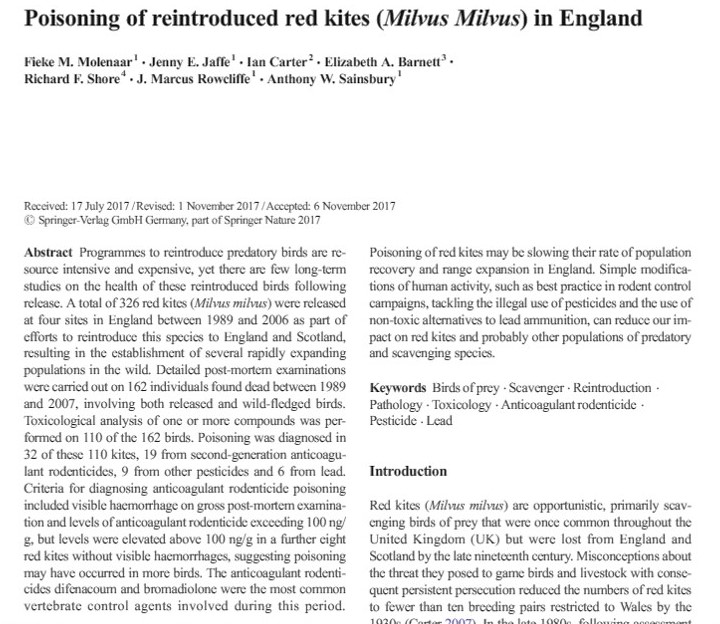
A new scientific paper has just been published that suggests anti-coagulant rodenticide poisoning, illegal pesticide poisoning, and lead poisoning ‘may be slowing the recovery of red kites in England’.

The paper, ‘Poisoning of reintroduced red kites (Milvus milvus) in England’ has been authored by scientists from the Institute of Zoology, Natural England, FERA Science Ltd and the NERC Centre for Ecology and Hydrology and was published online today in the European Journal of Wildlife Research.

The full paper can be accessed here

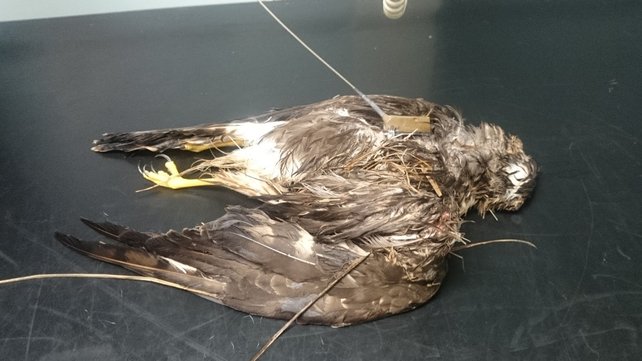
Photo of a poisoned red kite by Marc Ruddock

The research was undertaken on 162 red kites collected between 1989-2007, so these are pretty old data and the game-shooting apologists will undoubtedly claim that illegal persecution is no longer a problem, ten years on.

However, regular blog readers will be well aware of the long list of confirmed red kite persecution incidents (illegal poisoning and shooting) in England since 2007 (e.g. see here) which is restricting the kite’s population range in some parts of England, just as it is in some parts of Scotland (see here).

Illegal poisoning, coupled with secondary poisoning from anti-coagulant rodenticides and lead poisoning was a problem for the newly-reintroduced red kites and, along with illegal shooting and trapping, still remains a problem 28 years on.

Same shit, different decade.

Here’s the abstract from the new paper:

Chair of Nidderdale AONB condemns illegal raptor persecution

Don’t ever underestimate the power of public pressure.

You know that big solid wall of silence we’re all so used to looking at every time a raptor crime is discovered and reported? It looks like it’s finally beginning to crumble.

The latest to speak out, spontaneously (i.e. without prompting), about the continued illegal killing of birds of prey is the Chair of the Nidderdale Area of Outstanding Natural Beauty’s Joint Advisory Committee, Councillor Nigel Simms:

He’s obviously taken a lead from the spontaneous statement made by the neighbouring Yorkshire Dales National Park Authority yesterday.

The publication of this statement from the Nidderdale AONB is really, really welcome. The Nidderdale AONB in North Yorkshire is notorious as a raptor persecution hotspot and has been for many years. We’ve lost count of the number of red kites that never make it out of this particular hell hole, although the RSPB has been keeping track – 22 poisoned or shot in the last ten years, and that’s only the ones that were found.

Nidderdale red kite persecution incidents 2007-2017, map by RSPB:

Illegally-killed red kite (photo Marc Ruddock):

We also know that hen harriers rarely get out of Nidderdale alive – unfortunately we can’t show you a detailed map because Natural England wants to keep the details a secret. Natural England is supposed to protect hen harriers but it’s clearly more interested in protecting the reputations of criminal landowners and gamekeepers. Anyway, here’s a photo of an illegally-killed satellite-tagged hen harrier – something you might see if you visit Nidderdale AONB, assuming you get to it before the gamekeeper who shot it:

It’s interesting to see that these crimes are “starting to have a damaging effect on tourism businesses“, according to Cllr Simms. Good, not for the businesses affected, obviously, but good that it will drive increased local pressure to bring these crimes to an end.

Cllr Simms’ comment that illegal raptor persecution “undermines the work of law-abiding landowners and gamekeepers who are actively working alongside us to improve prospects for all forms of wildlife in the AONB” is slightly odd. Which law-abiding landowners and gamekeepers are those? Presumably not anyone involved with any of the aforementioned red kite killings or hen harrier disappearances, nor, presumably, anybody involved with the attempted shooting of a nesting marsh harrier and the removal of its eggs, as filmed on a Nidderdale AONB grouse moor by the RSPB earlier this year?

There’s much work to do in this AONB but this very public condemnation of illegal raptor persecution from the Chair of the AONB Advisory Committee is encouraging. Well done, Cllr Nigel Simms.

Now, who’s next to speak out and bring that wall of silence crashing down?