Law professor comments on inadmissibility of video evidence in wildlife crime prosecutions

As regular blog readers will be aware, the Crown Office & Procurator Fiscal Service (COPFS), the public prosecutors in Scotland, have, in the space of two months, either dropped or refused to prosecute five cases of alleged wildlife crime. These include:

25 March 2017 – gamekeeper John Charles Goodenough (Dalreoch Estates), accused of the alleged use of illegal gin traps. Prosecution dropped due to paperwork blunder by Crown Office.

11 April 2017 – landowner Andrew Duncan (Newlands Estate), accused of being allegedly vicariously liable for the actions of his gamekeeper who had earlier been convicted for killing a buzzard by stamping on it and dropping rocks on to it. Prosecution dropped due to ‘not being in the public interest’.

21 April 2017 – gamekeeper Stanley Gordon (Cabrach Estate), accused of the alleged shooting of a hen harrier. Prosecution dropped as video evidence deemed inadmissible.

25 April 2017 – gamekeeper Craig Graham (Brewlands Estate), accused of allegedly setting and re-setting an illegal pole trap. Prosecution dropped as video evidence deemed inadmissible.

21 May 2017 – an unnamed 66 year old gamekeeper (Edradynate Estate), suspected of alleged involvement with the poisoning of three buzzards. Crown Office refused to prosecute, despite a plea to do so by Police Scotland.

Two of these cases (Cabrach Estate and Brewlands Estate) were dropped due to the COPFS deciding that the use of RSPB video evidence, on which the prosecutions relied, was inadmissible.

There has been widespread public condemnation and political concern about these decisions, especially in the case of the alleged shooting of a hen harrier on Cabrach Estate in Morayshire. The Crown Office has attempted to explain the decisions but many questions remain unanswered for those of us who don’t have the legal expertise, or all the case details, to challenge the COPFS decisions.

We read with interest, then, a blog that was published yesterday written by Peter Duff, Professor of Criminal Justice at Aberdeen University. His blog, entitled ‘The law of evidence, video footage, and wildlife conservation: did COPFS make the correct decisions?‘ deals specifically with the Cabrach & Brewlands cases and can be read here.

We thoroughly recommend reading it. It’s important to read the perspective of an independent, expert academic who has no axe to grind on either side of the debate. It’s hard for those of us who are either tainted by years of frustration about criminal raptor killers getting away with it, or those with a vested interest in raptor killers avoiding prosecution, to take an unbiased view of the law and its application, so Professor Duff’s opinion is a valuable contribution to the debate. Not only that, it’s great to see this issue receiving wider coverage than the usual commentators.

That’s not to say we agree with his interpretation though! In short, Professor Duff concludes that the COPFS decisions were “perfectly reasonable”, and he explains his reasoning for this, but, crucially, some of what he writes does not take in to account previous case law on this issue, perhaps because he was unaware of such cases?

For example, Professor Duff states: ” In my view also, for what it is worth, I agree that the courts would not excuse such an irregularity in obtaining the video evidence and prosecutions would be fruitless“.

First of all, the Scottish courts HAVE excused the irregularity of obtaining video evidence without the landowner’s permission and far from those prosecutions being ‘fruitless’, they actually resulted in the conviction of the accused (e.g. see the Marshall trial here and the Mutch trial here).

During the Marshall trial, there were several hours of legal argument about the admissibility of the video evidence. The Sheriff accepted the video evidence, commenting that the RSPB presence on the gamekeeper’s estate [from where the video was filmed] was “neither illegal nor irregular, and the intent to obtain evidence did not make it so“.  This is no different to the recent Cabrach case.

During the Mutch trial, again involving several hours of legal argument about the admissibility of evidence, the Sheriff accepted that the RSPB had not placed the video camera with the purpose of gathering evidence for prosecution, but they had placed it as part of a legitimate survey in to the use of traps. This is no different to the recent Cabrach case.

There is also an on-going trial at the moment (concerning alleged fox hunting) that relies heavily on video evidence filmed on privately-owned land without the landowner’s permission. The court has accepted the video evidence as admissible (although we can’t comment too much on this as the trial is still live).

So on that basis, we profoundly disagree with Professor Duff’s opinion that covertly filmed video evidence would not be accepted by the Scottish courts. It already has been, on several occasions, resulting in convictions. The question remains then, why did the COPFS decide it was inadmissible? Somebody within the Crown Office (presumably an experienced lawyer from with the Wildlife & Environmental Crime Unit) decided, when this case was first marked, that the video evidence was admissible. It took nine court hearings over a period of a year before the COPFS decided that the video evidence was inadmissible. We still don’t know the basis for that decision. And the other related question to this is why didn’t the COPFS let the court make the decision? It’s this inconsistency of approach that has caused so much confusion, and as Professor Duff writes, ‘bewilderment’.

Professor Duff also writes: “The actions by the RSPB [of placing a covert camera] are a breach of the right to privacy of both the estate owners and their employees (whilst not quite analogous, imagine if your neighbour installed a secret camera to record everything that went on in your garden)“. Sorry, but it’s quite absurd to compare these two scenarios given the size difference between these two types of landholdings. Nobody could argue that placing a covert camera to film somebody’s back garden wouldn’t be a breach of privacy, as you’d reasonably expect to see the human occupants on a daily basis. But on a multi-thousand acre estate, far from any private dwelling? Come on, “not quite analogous” is one hell of an understatement. And not only that, in the Cabrach case, the camera was aimed at the nest of Schedule 1 hen harrier, which by law cannot be approached/disturbed without an appropriate licence from SNH so you wouldn’t expect to film anybody anywhere near the nest.

All in all then, Professor Duff’s interpretation of the law, whilst useful, still doesn’t explain, or justify, the decisions made by the Crown Office in these two cases.

And questions still remain about the decisions to drop the other three cases (gamekeeper John Charles Goodenough of Dalreoch Estates; landowner Andrew Duncan of Newlands Estate; an unnamed gamekeeper of Edradynate Estate), none of which were reliant upon video evidence.

Crown Office drops 5th case of alleged wildlife crime

Public prosecutors from Scotland’s Crown Office have dropped yet another case of alleged wildlife crime.

According to an article in the Sunday Post (see here), gamekeeper John Charles Goodenough, 32, had been charged after he was allegedly caught with illegal gin traps covered in animal blood, with dead fox cubs found nearby, in May 2016. It is reported Goodenough was employed at the time by Dalreoch Farming & Sporting Estates, owned by the well-connected Wellesley family. It was alleged that Goodenough was using the illegal traps on a neighbouring farm in Ayrshire.

The case was due to be heard at Ayr Sheriff Court on 27 March 2017 but two days prior to the hearing, the Crown Office dropped the case ‘after getting the dates wrong on its paperwork’.

This latest case brings the total of recently abandoned prosecutions for alleged wildlife crime to five. That’s five abandoned cases in the space of two months:

25 March 2017 – gamekeeper John Charles Goodenough (Dalreoch Estates), accused of the alleged use of illegal gin traps. Prosecution dropped due to paperwork blunder by Crown Office.

11 April 2017 – landowner Andrew Duncan (Newlands Estate), accused of being allegedly vicariously liable for the actions of his gamekeeper who had earlier been convicted for killing a buzzard by stamping on it and dropping rocks on to it. Prosecution dropped due to ‘not being in the public interest’.

21 April 2017 – gamekeeper Stanley Gordon (Cabrach Estate), accused of the alleged shooting of a hen harrier. Prosecution dropped as video evidence deemed inadmissible.

25 April 2017 – gamekeeper Craig Graham (Brewlands Estate), accused of allegedly setting and re-setting an illegal pole trap. Prosecution dropped as video evidence deemed inadmissible.

21 May 2017 – an unnamed 66 year old gamekeeper (Edradynate Estate), suspected of alleged involvement with the poisoning of three buzzards. Crown Office refused to prosecute, despite a plea to do so by Police Scotland.

Given how difficult it is to get just one wildlife crime case anywhere near a court, to have five abandoned in the space of two months does not inspire confidence in the criminal justice system.

In fact such was the public concern about some of these cases being abandoned due to the supposed inadmissibility of video evidence, last month the Scottish Parliament’s Environment Committee wrote to the Crown Office to ask for an explanation (see here).

The Crown Office has now responded with this: COPFS letter to ECCLR_EvidenceAdmissibility_May2017

We are not legally qualified to comment in depth about how good or how poor the Crown Office’s response is. If any of our legally-minded readers (Adam?) would like to comment, please do so.

However, what we can say is that this response does not address the question of why the Crown Office made the decision about inadmissibility instead of allowing a court to decide, as has happened in previous cases (e.g. see here).

Nor does this response address the question of why the Crown Office did not believe the RSPB ‘s explanation for their use of video surveillance for monitoring a hen harrier breeding attempt at Cabrach Estate. The Crown Office maintains, without explanation, that the RSPB had installed the video ‘for the purpose of detecting crime’, whereas the RSPB maintains the camera was installed as part of a legitimate monitoring study, an explanation which had been accepted by both the Crown and the court in a similar situation in another case (here).

The RSPB’s case is not so strong in the Brewlands Estate case, where a camera was installed to monitor an illegal pole trap (a trap that the RSPB had since made safe by flicking on the safety catch), although the circumstances might have been different had the police been able to attend the scene as soon as they were notified of an illegally-set trap. Nevertheless, the fact that the Crown Office allowed a year’s worth of court hearings to pass by before deciding to abandon this case, and their unwillingness to communicate their specific concerns to the RSPB, is yet to be adequately addressed by the Crown Office.

The Crown Office’s response also does not explain (although to be fair, it wasn’t asked to) why dropping the prosecution against Andrew Duncan for alleged vicarious liability was deemed to be ‘not in the public interest’, and nor does it explain why a prosecution was not brought against the unnamed Edradynate Estate gamekeeper for the alleged poisoning of three buzzards, despite pleas from Police Scotland to do so.

The Crown Office’s letter to the Environment Committee ends with this:

COPFS remains committed to tackling wildlife crime, including raptor persecution. There is a strong presumption in favour of prosecution in cases reported to the Service where there is sufficient admissible evidence and prosecution is in the public interest‘.

You could have fooled us.

To be honest, as frustrating as it was to see these cases abandoned for what seem to us to be spurious reasons, the Crown Office’s unimpressive performance has probably helped move things along, because these dropped cases came at the time when the Scottish Government was already under severe public pressure to do something other than make vague promises to tackle wildlife crime. That’s not to say we are pleased with the outcome of these cases – far from it – but it’s quite likely that these failed prosecutions helped tip the balance and persuaded the Scottish Government that actually, the current system is failing and they need to find new ways of addressing the problem.

Brewlands Estate gamekeeper ‘cries with laughter’ at discontinued prosecution

Following this morning’s publication of an RSPB video showing footage of an alleged gamekeeper setting then re-setting an illegal pole trap on the Brewlands Estate in July 2015, which has been deemed ‘inadmissible evidence’ by the Crown Office (see here), we’ve been interested to see the response from the gamekeeping community.

Bert Burnett (an apparently now former committee member of the Scottish Gamekeepers’ Association) posted clear condemnation on his facebook page (good) before the ‘discussion’ predictably descended in to criticism of the RSPB.

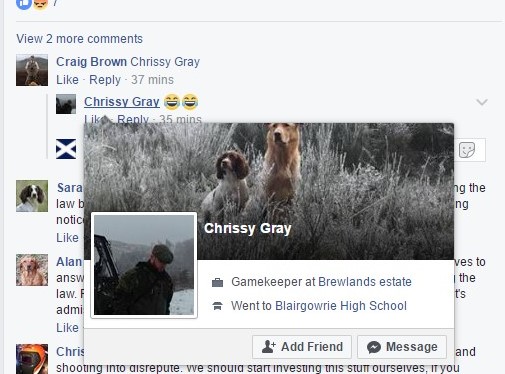
One of Bert’s followers ‘tagged in’ somebody called Chrissy Gray (for those who are unfamiliar with Facebook, ‘tagging’ someone just means alerting that tagged person’s attention to a particular post).

Chrissy Gray responded to the post with two ‘crying with laughter’ emojis:

For those who don’t know what a ‘crying with laughter’ emoji is about, have a read of this.

We were curious about who would be ‘crying with laughter’ about the news that this prosecution had been discontinued and so we clicked on Chrissy Gray’s name to find out who he was. Here’s what we found:

According to his profile details, Chrissy Gray is a gamekeeper at Brewlands Estate.

Interestingly, his comment has been up there for over three hours and nobody has condemned it.

They are figuratively (and literally?) laughing in your face, Roseanna Cunningham.


Brewlands Estate “inadmissible” pole trapping video released

A week after RSPB Scotland published the “inadmissible” video evidence of a hen harrier being shot on Cabrach Estate in Moray (see here), this morning they have released another video from another case that prosecutors decided to drop without explanation.

This case concerned gamekeeper Craig Graham, who was accused of allegedly setting and re-setting an illegal pole trap on the Brewlands Estate in the Angus Glens in July 2015.

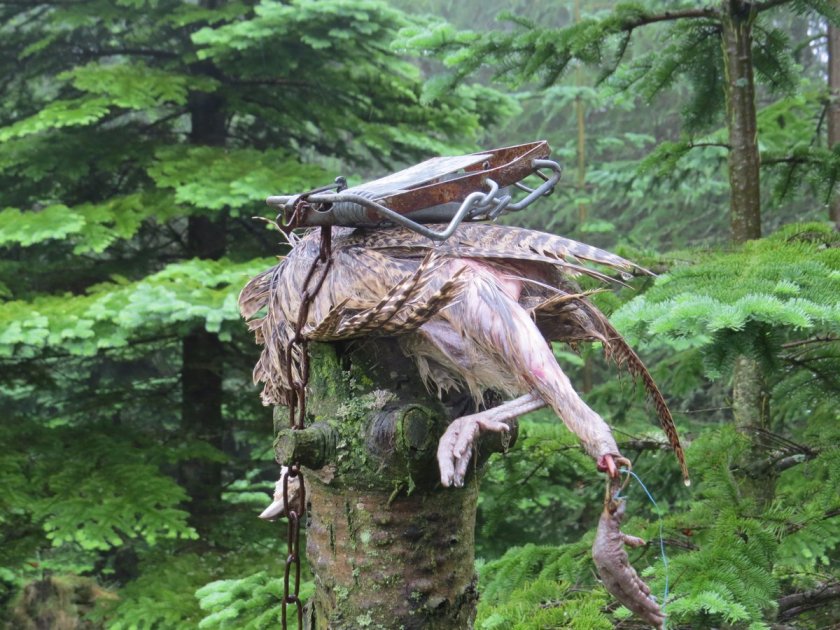
Photo of illegally-set pole trap on Brewlands Estate (by RSPB Scotland).

The case called in March 2016 and Mr Graham denied all charges so the case was sent for trial. We tracked this case through the courts, where it was repeatedly adjourned (two trial dates were set and then later dumped). A third trial date was set for 15 May 2017 but then at another hearing on 25 April 2017, we learned that the case had not called as the Crown Office had dropped all proceedings. This was the third case the Crown Office had inexplicably dropped within a two week period.

Here’s the “inadmissible” RSPB Scotland video footage:

It’s worth turning up the sound as part of a conversation has also been recorded: “And then, when we were there, a buzzard went right over the top, if you had a shotgun it’d be dead“. It’s not clear who is speaking to whom, but it’s an indication that more than one person was present at the scene.

Here is the RSPB press statement:

Second discontinued prosecution for alleged raptor persecution offences

RSPB Scotland has expressed its frustration and disappointment after another prosecution of an individual charged with alleged wildlife crime offences was discontinued by the Crown Office in Scotland.

The latest case began on 9th July 2015 when RSPB Scotland staff, walking on the Brewlands Estate in Glen Isla, Angus, discovered an illegally set spring trap placed on top of a pheasant carcass that had, in turn, been placed on a post just a few metres inside a pheasant pen. The trap was in effect a baited “pole trap”, which has been illegal since 1904, and is designed to snap shut and break the legs of a bird of prey, holding the victim until it can be dispatched by the trap operator.

The RSPB team, having no mobile phone signal to allow contact with the police, made the trap safe to ensure no birds would be caught. They then deployed a video camera focussed on the area, with a view to securing the evidence until the police could attend and recover the trap.

A few days later, RSPB Scotland staff accompanied a police wildlife crime officer to the scene, where it was found that the trap had been reset. The police seized the trap as evidence, and the camera was recovered.

Review of the footage filmed by the camera showed an individual resetting the trap twice in the days after which it had been found. On the first occasion it was set, it was seen to later fall off the pheasant bait and trigger itself.

The footage was passed to the police, who subsequently identified the individual setting the trap, and who later charged him with four alleged offences, contrary to the Wildlife and Countryside Act, 1981, and sent a report to the Procurator Fiscal, who marked the case for prosecution.

The case was first called, at Forfar Sheriff Court, on 31st March 2016, with subsequent hearings on 22nd April and 12th May 2016, during which the accused plead not guilty to the charges libelled. Following two further hearings, the Crown Office Procurator Fiscal Service recently notified RSPB Scotland that following consideration of the case by Crown Counsel, the prosecution could not rely on the RSPB video evidence and would be discontinued. No reason for this decision was provided. The case had been scheduled for a trial beginning on 15th May 2017.

RSPB Scotland’s Head of Species and Land Management, Duncan Orr-Ewing said: “For one case, where there was excellent video evidence to support the prosecution, to be discontinued inexplicably by the Crown Office so close to the trial was baffling. For a second case to be discontinued, again with no explanation from the Crown Office, and again without the opportunity for the evidence to be tested in court, is deeply concerning, and significantly undermines our confidence in the ability of Scotland’s justice system to bear down on the criminals who continue to target our protected birds of prey.”

END

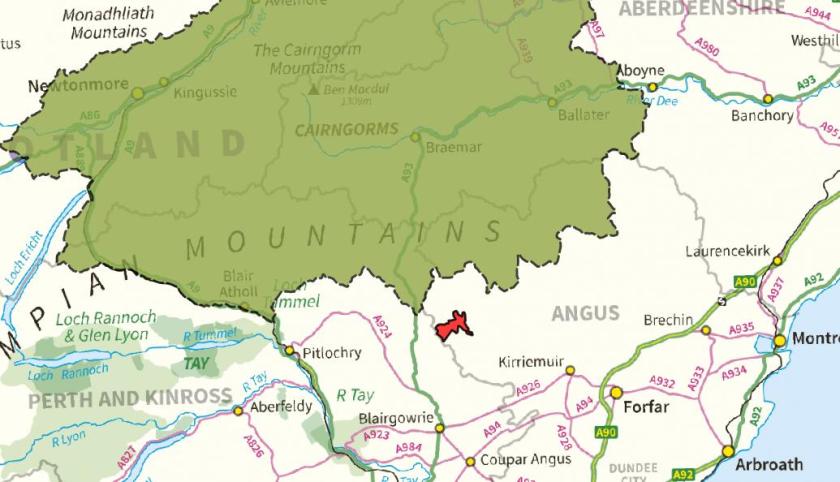
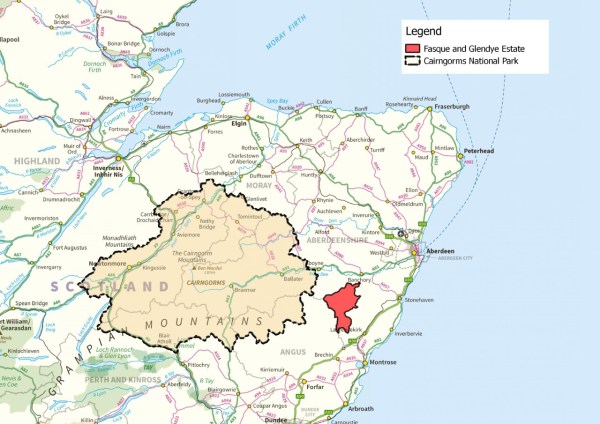
Map showing location of the Brewlands Estate in the Angus Glens (estate boundary based on information from the Who Owns Scotland website).

So, here we are again. There’s not much we can say that hasn’t already been said. Justice has once again not been seen to be done and it looks, to all intents and purposes, that something is seriously amiss with the criminal justice system. How can this case, as with the hen harrier shooting case, get so far down the prosecution route only to be dropped at the last minute? Why did the Crown fiscals deny the opportunity for this evidence to be scrutinised in court? We don’t know, because, yet again, the Crown Office has refused to discuss the decision.

Public anger was very evident last week after RSPB Scotland released the video showing a hen harrier being shot, and this resulted in questions being asked yesterday at First Minister’s Question Time. The release of this latest video footage will only add fuel to that fire.

Again, if you live in Scotland we would urge you to contact your local MSP and ask them to raise this issue with the Lord Advocate and the Justice Cabinet Secretary. We know through correspondence that many of you contacted your MSP last week (thank you) and it’s important that you do so again with this case. You can find your local MSP here. For those of you not in Scotland, please email your concerns to the Convener of the Scottish Parliament’s Justice Committee, Margaret Mitchell MSP (Scottish Conservatives). Email: margaret.mitchell.msp@parliament.scot

We are at a critical point right now, with Environment Cabinet Secretary Roseanna Cunningham due to make two serious decisions concerning illegal raptor persecution in Scotland: the long overdue decision on whether to increase the investigatory powers of the SSPCA, and her intended action in response to the findings of the raptor satellite tag data review. These decisions are expected before the end of June 2017. There is also the Environment Committee’s on-going consideration of the petition to introduce a licensing system for all game bird hunting, although the time-frame for their deliberations is less clear.

What happens between now and the end of June will be pivotal to how we proceed in future. If the Scottish Government continues to prevaricate, in the face of such blatant and persistent criminality, and in the face of such overwhelming evidence, we will be re-thinking our strategy. Enough is enough.

UPDATE 3pm: Brewlands Estate gamekeeper ‘cries with laughter’ at discontinued prosecution (here)

MEDIA COVERAGE

BBC Scotland website here

STV news here

Scottish Gamekeepers’ Association statement here (as last time, no membership interest so very little comment, and no condemnation)

Crown Office drops third prosecution in two weeks

Two weeks ago, we blogged about how the Crown Office & Procurator Fiscal Service (COPFS – the public prosecutors in Scotland) had dropped a long-running vicarious liability prosecution against landowner Andrew Duncan, who was alleged to have been vicariously liable for the crimes of his gamekeeper, who had killed a buzzard on the Newlands Estate in 2014. When pressed for a reason behind the decision to drop the vicarious liability case, the Crown Office said it was “not in the public interest to continue” but did not provide any further detail of how, or why, that decision had been reached (see here).

Ten days later, we learned that the COPFS had dropped another long-running prosecution, this time against gamekeeper Stanley Gordon who was alleged to have shot a hen harrier on the Cabrach Estate in 2012. No explanation was given for this decision.

And now today, we have learned that the COPFS have dropped another long-running prosecution, this time against Angus Glens gamekeeper Craig Graham who was alleged to have set and re-set an illegal pole trap on the Brewlands Estate in 2015. Again, no explanation has been given for this decision.

That’s three high profile prosecutions for alleged raptor persecution crimes, dropped within a two week period, with no explanation why.

One long-running case being dropped would raise an eyebrow; a second long-running case dropped a few days later would cause concern, but three long-running cases, all dropped within a fortnight, all on the eve of an actual trial? That is highly suspicious, even for the most unassuming observer.

Was it incompetence on the part of the COPFS? That is surely a possibility, especially as each of these cases has been running for months, at huge cost to the public purse. Why did it take so long to decide to abandon each case? Was it an issue with video evidence? We’ve been there before, although we’ve also seen successful prosecutions based on video evidence. If it was an issue with video admissibility (and we don’t yet know if it was, so this is just speculation), why did it take so long to reach that decision and anyway, wouldn’t admissibility be an issue for the court to decide, not the prosecutor? Was there another reason for discontinuing these cases? We don’t know, because the Crown Office is saying nothing.

Whatever it was, the discontinuing of these three cases will cause huge damage to public confidence in the Scottish criminal justice system. What do you have to do to get someone to stand trial for alleged raptor persecution in Scotland? We know how difficult it is to identify a named suspect, and we know that the evidential threshold is set extraordinarily high for this sort of crime, so when you do manage to secure enough evidence to charge and then prosecute somebody, it is massively frustrating to (a) see the cases dropped and (b) not be told why.

What is clear amongst all this murkiness is that the current system is not fit for purpose. This series of discontinued prosecutions just adds more grist to the mill for the introduction of a licensing system, and for basing that system on the civil burden of proof.

Meanwhile, we’re looking forward to the release of the video footage……

Remember those illegal pole traps found set on Mossdale Estate?

Remember those three illegally-set pole traps that were found on the Mossdale Estate in the Yorkshire Dales National Park last year? (Photo: RSPB)

You know, the ones where a Mossdale Estate gamekeeper was filmed by the RSPB as he re-set them on posts on the grouse moor? (Photo: RSPB)

Yes, the gamekeeper who escaped with a police caution after a procedural blunder, instead of facing a full blown prosecution.

Well, guess what? Two of those traps had been used previously to illegally catch birds. How do we know? Because when those traps were seized from the Mossdale Estate, sharp-eyed and forensically-aware RSPB investigators suspected that they’d been used for trapping other birds. The traps were sent for expert examination at the Wildlife Forensics Unit at the SASA labs near Edinburgh and tests revealed the presence of kestrel DNA on one trap, and DNA from another (unidentified) falcon species on the other. (Photo: Guy Shorrock)

Unfortunately a prosecution was not possible as it wasn’t known where the traps had been used previously, when they’d been used, and by whom.

You can read more about this, and other DNA cases, on a fascinating RSPB Investigations blog written by Guy Shorrock and published earlier this afternoon (here).

Court case continues for Angus Glens gamekeeper accused of alleged pole trapping offences

Criminal proceedings continued yesterday (28 March 2017) against Scottish gamekeeper Craig Graham.

Mr Graham, 51, is accused of allegedly setting and re-setting a pole trap, baited with a pheasant carcass, on the Brewlands Estate in the Angus Glens between 9-17 July 2015. He has denied the charges.

This case was first called on 31 March 2016, then on 22 April 2016, then on 12 May 2016 when Mr Graham pleaded not guilty. A provisional trial date was set for 9th September 2016.

This trial date was later dumped (at a hearing on 16 August 2016) and another provisional trial date was set for 5th December 2016. This was also later dumped and a third provisional date (at a hearing on 5 December 2016) was set for 15 May 2017.

At yesterday’s hearing, the case was adjourned, again, for a further intermediate diet scheduled for 25 April 2017. We don’t know whether the third provisional trial date of 15 May 2017 still stands – it depends what happens at the hearing on 25 April 2017.

Previous blogs on this case herehere and here

UPDATE 25 April 2017: The Crown Office has discontinued this case – see here.

Update on illegally-set traps on Glendye grouse moor

Two months ago we blogged about a series of illegally-set traps that had been photographed on the grouse moor of Glendye Estate in Aberdeenshire (see here).

We, and many of you (thank you) passed on the information to the local Police Wildlife Crime Liaison Officer, PC Doug Darling in the hope that an investigation might take place. We contacted him again a few days ago and asked if he was able to provide an update on this case.

He told us that an enquiry had been carried out in the area the day after the incident had been reported to the police, but no illegally-set traps had been found.

The person who had taken the photographs and published them on a blog was then contacted by the police, to learn as much as possible about the incident (how the traps were set, whether any baits had been seen etc).

The police then visited the Estate Factor and the gamekeeper, who were in possession of the traps as they had been informed of the incident by the original witness. PC Darling told us: “They took it upon themselves to remove the traps in case something were to become caught and denied knowing whose traps they were and how they came to be found on the estate set in an illegal manor [sic]”.

That’s interesting. What would you do if you were working in the land management sector and a member of the public told you they’d found illegally-set traps on your land? Wouldn’t you leave the evidence in place and immediately notify the police?

Anyway, PC Darling went on: “Given we have no physical evidence it would not be possible to report the incident to the Procurator Fiscal however Scottish Natural Heritage are aware of the incident and we will be discussing any other measures we could pursue given the circumstances“.

Presumably ‘any other measures’ would include SNH putting a General Licence restriction order on this Estate, because according to SNH guidelines, evidence which may be considered by SNH in any decision to impose a General Licence restriction includes:

Illegal placement, design or use of traps or methods that are not in compliance with the requirements of the General Licence‘.

We’ll see if that happens because of course much still depends on the findings of the judicial review, which examined the process SNH used to impose a General Licence restriction on Raeshaw Estate back in 2015. The court’s decision has not yet been announced, at least not in public.

This case highlights something we discussed yesterday when blogging about the pine marten that had been caught in a spring trap on another grouse shooting estate in Scotland (see here). If every trap had to carry a unique police-issued number identifying the registered trap-user, then this investigation might have ended with a better result. As happens over and over again, whoever set these traps has escaped being held to account for their criminal activities.

PC Darling deserves full credit here. Not only did he launch an investigation the day after being alerted to these traps, he then followed up with the witness and paid a visit to those responsible for managing the land, and he was also very quick and willing to explain what had happened when asked about this case. What a breath of fresh air. His actions will inspire confidence for anyone else thinking about reporting a suspected wildlife crime in this region, rather than the brick wall we’ve become accustomed to expect from Police Scotland. Let’s hope his senior officers take note and applaud his efforts as much as we do.

Illegal pole trap set next to pheasant pen on Lanarkshire shooting estate

An article was published yesterday on The Ferret website about an illegal pole trap found next to a pheasant pen on an unnamed shooting estate in Lanarkshire.

Unfortunately the article now sits behind a paywall because we’ve viewed our allotted three free articles in one month, so we can’t add the actual link here. Some of you will be able to access the specific article by visiting The Ferret website and searching for it, or you can subscribe and get access to everything they publish.

Here’s an overview of the pole trap incident:

On 7 September 2015 at around 10.30am an investigator from the League Against Cruel Sports (Scotland) found an illegal pole trap that had been positioned next to a pheasant-rearing pen. The trap was set (i.e. the safety catch was off) and had been placed on top of a freshly-dead pheasant.

The investigator phoned the SSPCA who attended the scene at around 1.30pm and said the police should be called.

At 3.09pm, a man arrived at the pen carrying a bag of pheasant feed and was informed an illegal pole trap had been found next to the pen’s entrance door. Despite being warned not to tamper with potential police evidence, the man removed the trap from the pheasant bait and left it dangling from the post. He then entered the pen, fed the pheasants and then left the scene.

Two police officers turned up at 4pm and took the trap away in an evidence bag.

The police subsequently dropped the case.

The League Against Cruel Sports have published a video from the scene – watch it here.

The point being made in The Ferret article is that had the SSPCA been given increased investigatory powers, the SSPCA officer attending the scene would have been permitted to remove the illegal trap and collect it as evidence before the man came along and dismantled it, and the outcome of this case could have been very different.

As regular blog readers will know, we are still waiting for a long-overdue decision from the Scottish Government about whether the SSPCA will be given increased investigatory powers. Environment Cabinet Secretary Roseanna Cunningham said in January 2017 that a decision would be announced in the first half of 2017.

Illegally set traps on Glendye Estate grouse moor, Aberdeenshire

Have a look at this blog. You’ll see a series of photographs, taken yesterday (17 January 2017) on a grouse moor at Glendye, just beyond the famous Clachnaben hill, which is part of the Fasque & Glendye Estate according to Andy Wightman’s always useful website Who Owns Scotland. This area looks like it’s the area covered by the Glendye Grouse Syndicate who apparently took on a 20-year lease of this moor in 1997.

We’re not allowed to reproduce the photographs here so you’ll have to click the link if you want to see them. And you really should see them.

Three of these photographs depict illegally-set traps. They are all ‘bridge traps’ – comprising a Fenn spring trap fixed to a log across a burn or gully and designed to catch so-called ‘vermin’ such as stoats or weasels. This type of trap is legal if the trap is covered either in a natural or artificial tunnel, but the three traps photographed yesterday are definitely illegal.

One is covered with wire mesh but the entry and exit holes are wide open. This is illegal. These entry/exit holes are supposed to be partially closed to minimise the risk of catching non-target species. This trap in the photograph could easily catch a non-target species, including protected Scottish wildcats, otters and pine martens.

The other two spring traps are totally uncovered except for a single wire loop above each trap. A wire loop is not going to protect any species from standing on these traps and thus both traps are illegal. These two traps are effectively pole traps – if a bird or mammal stands on the trap, the trap will fall from the log, with the animal attached (probably by the leg), and the animal will dangle, suspended below the log, until it dies a slow, miserable death.

We don’t know whether the photographer has reported these crimes to the local police. We would hope he has – he understands that the traps are illegally-set (the safety catch is not on – we’ve looked) so we’d expect him to have provided grid references and photographs to the local Police Wildlife Crime Officer. In case he hasn’t reported them, we’ll do it for him, although by now the individual who set these traps has probably been alerted and is probably out on the moor removing all the evidence as we speak.

The local Police Wildlife Crime Officer is Doug Darling. Here’s his email address: douglas.darling@scotland.pnn.police.uk

Ask him for a crime reference number so we can follow up what action he has taken to identify the individual(s) responsible. This is important because after his investigation, we expect him to alert SNH to these illegal traps. Why? Well, because these illegal traps should result in the withdrawal of the General Licence on this grouse moor. According to SNH guidelines, evidence which may be considered by SNH in any decision to impose a General Licence restriction includes:

Illegal placement, design or use of traps or methods that are not in compliance with the requirements of the General Licence‘.

However, the evidence must be provided by the Police. So, just in case the Police ‘forget’ to tell SNH, we’ll notify SNH as well so they can’t then argue they haven’t been informed. Emails should be sent to Nick Halfhide, Director of Operations: nick.halfhide@snh.gov.uk 

To be fair to SNH, they are probably awaiting the findings of the Raeshaw Estate judicial review before they impose any more General Licence restrictions. That’s fine, they can just add this case to the others they’re currently sitting on and hopefully they’ll be in a position to take action in due course.

And, if you’re in the mood for writing emails, you might also want to alert the Environment Cabinet Secretary, Roseanna Cunningham, to these illegally-set traps. The information will be very helpful as she ponders the issue of introducing state-regulated licensing. These photographs confirm that law-breaking continues, despite the grouse shooting industry’s fervent claims to the contrary. Emails to: scottish.ministers@gov.scot and mark it FAO Roseanna Cunningham.

We wonder what the grouse shooting industry’s Gift of Grouse project has to say about these illegal traps? We wonder if Glendye is part of the Grampian Moorland Group, which in turn is part of the Gift of Grouse propaganda campaign? That’d be interesting…..

UPDATE 17 March 2017: Update on illegally-set traps on Glendye grouse moor (here)