white-tailed sea eagle poisoned nr Mallaig, western Scotland

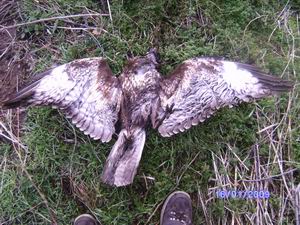
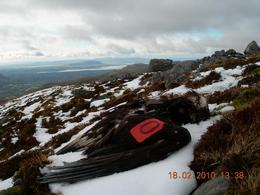
In March 2002, an adult white-tailed sea eagle was found dead on the Morar Peninsular near Mallaig, Western Scotland. Tests revealed this was the male of a breeding pair and he had been poisoned with Aldicarb.

This eagle had been donated by Norway as part of the sea eagle reintroduction project, and he had been released in Wester Ross in 1997. In 2000, when only three years old, he found a mate and they successfully raised one chick that year. Breeding at such a young age is unusual – normally, sea eagles do not breed until they are at least five years old.

Sadly, his female partner was also poisoned in the same area in the following year.

Young golden eagle poisoned in Ireland

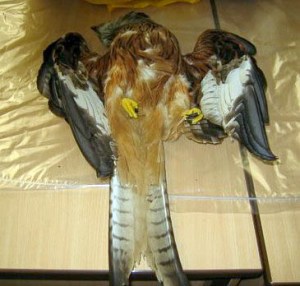
The body of the poisoned golden eagle found in Ireland in February 2010.

Raptor persecution is not just limited to Scotland. It is also prevalent in other parts of the UK and the Irish Republic. We will be highlighting these incidents on this blog in due course, beginning with the young golden eagle that was found poisoned in Ireland in February 2010.

Any golden eagle poisoning event is tragic, but this one particularly so. This 10 month old eagle hatched in the wild in Donegal in 2009 and became one of the first wild-bred golden eagles in Ireland for over 100 years. The Golden Eagle Trust has been working hard to re-establish a population of golden eagles in Ireland, after they were persecuted to extinction during the last century. Young golden eagle chicks have been donated from nests across Scotland (typically from nests containing two chicks where usually only one chick would survive naturally) and released and monitored throughout north-west Ireland.

This eagle had been poisoned by Nitroxynil, which had been poured over the fleece of a dead lamb.

For further detailed information, please see: http://www.goldeneagle.ie/news_viewnews.php?x=5&z=132&news_id=11&article=262

Paltry Fine for Cabrach Estate Gamekeeper who Shot Trapped Buzzards

According to a report in the Press and Journal, on 27 April 2006 a gamekeeper on the Cabrach Estate in NE Scotland shot two buzzards he had caught in a crow trap and was seen burying them down a nearby rabbit hole. The keeper, David Scott, was subsequently charged and due to the seriousness of the offence, the matter was fast-tracked by the Fiscal. He appeared at Egin Sheriff court in May 2006, pleaded guilty and was fined a paltry £200 when potentially the fine could have been ten times this level.

Apparently an additional 11 buzzards that had been shot were found buried in rabbit holes near the crow trap, according to the RSPB’s 2006 Annual Persecution Report.

From the Press & Journal, 9 May 2006 (written by Raymond Shewan):

A Gamekeeper shot two buzzards which had become caught in a trap designed to control crow numbers, Elgin Sheriff Court heard yesterday.

It was claimed that David Scott, 40, killed the protected birds of prey rather than risk injury trying to release them.

His solicitor, William Park, said Scott now realised he had not chosen the right course of action in shooting them.

Fiscal depute Geoff Main told the court that witnesses walking on the Cabrach estate, near Dufftown, had seen a trap containing two crows and two buzzards and had watched as Scott drove up in a Land Rover before shooting the buzzards and disposing of them in rabbit holes.

Mr Park said Scott was an under-keeper on the estate which had a serious problem with carrion crows and hooded crows killing the chicks of ground-nesting birds, including grouse.

The estate had given its keepers permission to trap crows and it had seven traps which were designed to lure them with a live decoy.

On April 25 Scott, of the Kennels, Cabrach Lodge, had checked one of the traps and found two buzzards which had found their way in, attracted by rabbit bait put down for crows.

Mr Park said Scott, who admitted two charges of breaking wildlife and countryside legislation by intentionally killing the buzzards, was in a situation where he had to make a choice of what to do.

He said one option would have been to open the trap and release the birds, but that would also have meant releasing the crows.

Alternatively, he could have gone into the trap – which measured 6ft by 6ft by 5ft – to manually remove the buzzards, although Mr Park claimed that would have put him at some risk of “significant harm”.

“In the circumstances, he elected to shoot the birds,” said Mr Park. “He realises the decision he took was a serious error of judgment on his part and one he must accept responsibility for. He realises that such offences can provoke strong feelings, but there was no cruel intent or malice on his part.”

Sheriff Robert Brodie said he found it difficult to understand Scott’s decision to shoot two protected birds.
He noted that Scott was a first offender and fined him £200.

END

Eight years earlier, police raids in February and March 1998 reportedly revealed widespread poisoning across the estate – 10 rabbits, 6 pigeons, 6 grouse and 2 hares were laced with the lethal poison Carbofuran and laid out on the hill. Three illegal pole traps and an owl whose legs had been smashed by a trap were also reportedly found, along with a dead peregrine in the back of the estate’s landrover. Tests revealed the peregrine had been poisoned with Carbofuran. The head gamekeeper was convicted at Elgin Sheriff Court in October 1998 and was fined £700.

The estate is reportedly owned by multi-millionaire Christopher Moran, a businessman with an interesting past. See here for details.

Red Kite Found Poisoned Near Glenturret Estate, Tayside.

A third red kite has been poisoned with a banned pesticide in Perthshire, police have said.

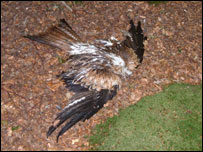
The Dead Glenturret Red Kite

The dead bird was found on the edge of the Glenturret Estate near Crieff in August 2007.

Two other red kites have also been killed this year and tests have shown all the birds had eaten bait laced with carbofuran, which was outlawed in 2001.

Tayside Police have appealed for information about the deaths, which have been called “sickening” and “an absolute disgrace”.

The force’s wildlife and environment officer said those involved in the deaths should “hang their head in shame.” Alan Stewart said: “It is an absolute disgrace that a method commonly employed to kill birds of prey two centuries ago is still in use in 2007. Pesticides can easily kill people as well as wildlife yet these deadly baits are still left out in the open” He added that it would be “naive” to think the three dead red kites found in Tayside were the only poisoning incidents this year, as most baits and victims were never reported to the police.

http://news.bbc.co.uk/1/hi/scotland/tayside_and_central/6958331.stm

Report in Strathearn Herald here

Red Kites were absent from Scotland’s skies for over a century due to human persecution. In 1989 a reintroduction programme was initiated by SNH and RSPB to bring this elegant bird of prey back. Although this programme has been successful it has been dogged by illegal poisoning. The red kite’s scavenging feeding habits make it especially vulnerable to this type of crime.

3 red kites poisoned nr Laurieston, Dumfries & Galloway

Another poisoned red kite

Three poisoned red kites were found near Laurieston, Dumfries & Galloway in April 2003. A post mortem revealed they had died from Carbofuran poisoning. http://news.bbc.co.uk/1/hi/scotland/2985915.stm

Later the same month, in the same area, two sparrowhawks were poisoned from Carbofuran that had been laid on pigeon baits.

3 buzzards found poisoned on Invercauld Estate, Royal Deeside

Three buzzards found dead in woodland next to a grouse moor on Invercauld Estate, Deeside in March 2005 had been poisoned: http://news.bbc.co.uk/1/hi/scotland/4400327.stm

Invercauld Estate, located between Braemar and Crathie and next door to the Balmoral Estate, attracts a large number of paying guests who visit for grouse shooting, deer stalking and salmon fishing. According to their website, “The Estate is managed commercially but with great respect for the natural environment”. The Estate is run under the guidance of Captain Farquharson and other members of his family. Simon Blackett, the Estate Factor, is married to Geva Blackett, the former parliamentary officer for the Scottish Gamekeepers Association.

In the late 1990s,  a gamekeeper on the Estate was convicted of using an illegal spring trap and was fined £120. http://www.antisnaring.org.uk/news/traps/invercauld_estate_gamekeeper_fined?searched=invercauld&advsearch=oneword&highlight=ajaxSearch_highlight+ajaxSearch_highlight1

Poisoner at Leadhills Estate could not be identified

A gamekeeper on the Leadhills Estate in South Lanarkshire, was found not guilty of alleged raptor persecution crimes on the Leadhills grouse moor.

Leadhills Estate was raided in September 2006 after a tip-off about the continued use of illegal poisons to kill raptors. Rabbit baits and two dead buzzards were recovered from the estate, as well as knives and a gamebag that contained residues of the illegal poison, Carbofuran.

The case came to court in November 2008. Sheriff Stewart concluded, “No doubt illegal posioning was occuring on this estate in 2006 and that birds were poisoned”. However, from the evidence presented, she was unable to determine whether this particular gamekeeper was responsible, as his defence team claimed that the knives and gamebag were used communually, rather than exclusively by him. This defence is often used to successfully avoid individual prosecution.

4 buzzards poisoned at Eaglesfield, Dumfries & Galloway


An illegally poisoned dead buzzard

Four buzzards became the victims of illegal poisoning at Eaglesfield, Dumfries & Galloway, in March 2008. Police did not appeal for information until August 2008. The reason for the delayed publicity is unknown, but it is hard to expect anyone to come forward with information for the police 5 months after the crime was committed.


http://news.bbc.co.uk/1/hi/scotland/south_of_scotland/7537660.stm

red kite poisoned nr Castle Douglas, Dumfries & Galloway

The bodies of dead red kites that have been poisoned or shot are becoming more common in the Scottish landscape.

A dead red kite found in January 2008 on a farm near Laurieston, nine miles north of Castle Douglas in Dumfries & Galloway, had been poisoned with Carbofuran.

Re-introduced kites in this area, as well as other areas in Scotland, have been heavily targeted by poisoners who mistakenly think that the birds are a threat to their gamebirds. Red kites feed mainly on carrion (animals that have already died), worms and insects. They are highly susceptible to poisoning because they eat so much carrion, so it is easy for someone to stake out a poisoned bait in an area where kites forage for food.

No-one has been found responsible for the death of this red kite.

Further info: http://news.scotsman.com/latestnews/Poisoned-kite-sparks-fear-of.3705255.jp

Sea eagle feared killed on Glenogil Estate, Angus

This is the missing sea eagle, known as 'Bird N'

A young white-tailed sea eagle, less than six months old, is feared to have been killed on Glenogil Estate, Angus in the autumn of 2007, according to an article published in The Scotsman. Tayside police apparently received an anonymous tip-off that suggested the eagle had allegedly been shot on the estate. The information correlates with radio tracking data from the bird, who was regularly tracked in the area but whose signal disappeared around the time of the alleged incident, although the signal could have failed as a result of a mechanical malfunction.The young eagle has never been seen again. No arrests have been made.

The sea eagle was one of 15 young birds that were donated by Norway for the East Scotland re-introduction project. The young birds were released in Fife in August 2007, fitted with radio transmitters and wing tags for identification.

Glenogil Estate is owned by multi-millionaire John Dodd, who is reported to take grouse moor management advice from Mark Osborne. Glenogil has been at the centre of previous investigations of alleged wildlife crime offences, and John Dodd was fined £107,000 in 2008 for the suspected use of illegal poisons on raptors.  Dodd is appealing the decision.

For further information about the missing sea eagle: http://news.bbc.co.uk/1/hi/scotland/tayside_and_central/7124862.stm

http://news.scotsman.com/birdsofprey/Claim-and-denial-as-a.3589649.jp