
Episode 11 of the BBC 2 Scotland ‘Landward’ programme went out on Friday 27 May and included a segment on the new vicarious liability regulation in the Wildlife and Natural Environment (Scotland) Act 2011. The programme is available here for a limited period.
The segment opened with Duncan Orr-Ewing, Head of Species at RSPB Scotland, who told the interviewer, “Bird of prey poisoning is particularly associated with driven grouse moors in the upland of Scotland, in the central and eastern highlands, parts of Perthshire and also down in the southern uplands”.
The interviewer, Dougie Vipond, asked: “So who is doing this? Who is killing the birds?”
Orr-Ewing: “Well, it is estate employees, gamekeepers who are usually involved, but they are only employees, they are acting under the direct instructions so ultimately it is the landowners that are responsible for this”.
A short section followed with a brief interview with Liz Plath, listed as a rural law specialist and a partner at Thorntons Law LLP. Basically she explained in simple terms how vicarious liability brings the landowner or the employer into the frame in cases of raptor poisoning.
Next up was Alex Hogg, chairman of the SGA, whose opening line was: “Professional gamekeepers do not poison raptors”. Funny that, because if you bother to look back at the statistics on raptor poisoning for the ten-year period that Hogg has been in post, you’ll see that raptor poisoning incidents have been recorded on many estates, and yes, ‘professional’ gamekeepers have been convicted.
He then contradicted himself (and not for the first time) by saying: “It’s only a small minority that are still at it. A rogue few if you like”. Lest we forget, here is the official government map showing confirmed raptor poisoning incidents between 2006-2010. Widespread, I’m sure you’ll agree, and the trend is pointing upwards.
He continued: “And we’ve tried our hardest over the past, I’ve now been in this job for ten years, to impress on everybody that it’s absolutely illegal to poison raptors”. Peer pressure from Hogg and co., while welcome, has been ineffective. It can’t help the situation when he and others from his industry continue to claim that raptors are having a significantly negative effect on game birds, songbirds, waders and lambs. Is there any scientific evidence for this? No, not a shred.
Next up came David Hendry, listed as the proprietor of Cardney Estate, near Dunkeld in Perthshire. Now this was an interesting interview. The piece opened with an introduction to Hendry, and video footage of a diving osprey on his estate. We were told that this estate ‘is home to many endangered birds of prey’. Unfortunately, Hendry was not asked how many and what species of raptors made their home there. The osprey was implied, but of course the osprey only eats fish, not exotic red-legged partridge (also known as French partridge) or pheasant, which are reared and released in large numbers for sport shooting on this estate, according to this shooting directory.
Vipond talked about the belief that the only way to stop poisoning is to introduce a licensing system which would allow landowners to control [kill] raptors. Hendry agreed, and suggested “it should become the gamekeeper’s job for instance to look after the rare raptors like harriers, your merlins, bring on your red kites, but they should also be allowed to reduce buzzards and sparrowhawks to numbers that are sustainable, because what we have today is not sustainable”.
Ok, so this is the first time we’ve officially heard that sparrowhawks are also the landowners’ intended target for licensed killing. Until now, the list has ‘just’ included buzzards and ravens. So what happens if they get the go ahead to kill these species? Will we see goshawks added to the next list? They’re just an over-sized sparrowhawk after all, so why not? And golden eagles? They’re just over-sized buzzards, so why not? Where will it stop?
It’s also very interesting that he thinks the current number of buzzards and sparrowhawks is ‘unsustainable’. According to this shooting website, Cardney Estate offers shooting days where between 200-400 exotic birds (partridge/pheasant) can be shot. That’s 200-400 birds per shooting day, depending on the time in the season. In September 2010, a record 677 birds were shot on one day according to one participant! Sounds to me like this sporting estate is doing very nicely thank you, without the need to kill off any indigenous protected raptors, whatever species they may be.
We then went back to Orr-Ewing, who was asked for his opinion about the need to ‘manage’ [kill] protected raptors. “These birds of prey are rightly protected because they’re vulnerable. We have a history of killing birds of prey in Scotland, many species are just recovering from that situation, there’s no other country in Europe that [legally] kills birds of prey”.
His first three points are accurate, but his last statement is not. In 2008 the provincial government of Lower Austria issued a decree allowing hunters to shoot 1,000 buzzards and 250 goshawks over the following five years. It previously allowed the killing of Montagu’s harriers until the EC stepped in to halt it. The decree allowing the legal persecution of buzzards and goshawks resulted in an international public outcry – the same can be expected if the licensed killing of raptors for the benefit of the game bird-shooting industry is permitted in Scotland.
And of course, it’s not just poison that is used to illegally kill raptors. Unfortunately our government does not produce annual statistics on the other incidences of raptor persecution that take place every single year. Thankfully, the RSPB does. Their annual reports (one covering bird persecution in the UK as a whole, and the other covering incidents in Scotland) are a welcome insight into the extent of the problem. Their 2010 annual reports are due for publication in the very near future. Their efforts to compile and publish these reports are worthy of the public’s gratitude because without them, we would only have Alex Hogg and co’s word about the extent of illegal raptor killing on Scotland’s sporting estates.
 According to an article published in The Scotsman (
 The images here show the dead kite in the back of his vehicle. No explanation has been given to account for the obvious injury this bird suffered to its head area. According to the Inverness Courier, Rolfe claimed the bird was already dead when he found it.
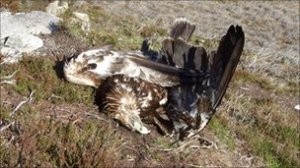 Despite this conviction, the Crown accepted he had ‘no part’ in the deaths of two poisoned golden eagles and a sparrowhawk (killed with Carbofuran)
  The issue of vicarious liability for raptor poisoning incidents will feature in a forthcoming episode of ‘Landward’. It includes an interview with SGA chairman Alex Hogg, who will probably discuss his on-going (but so far thwarted) campaign to legalise raptor killing.
 Following blog post 12 May 2010…
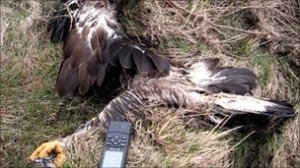 An investigation is underway after the discovery of a dead golden eagle found poisoned on the North Glenbuchat Estate in Aberdeenshire. The young eagle, being tracked by satellite, was found dead on 29 March. Tests have confirmed the eagle had been poisoned by Carbofuran. Grampian Police raided the estate yesterday and items have been removed for forensic testing but nobody has been charged as yet. Well done to Grampian Police for publicising this incident.
 Raptor Persecution UK