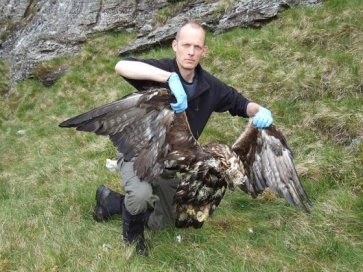
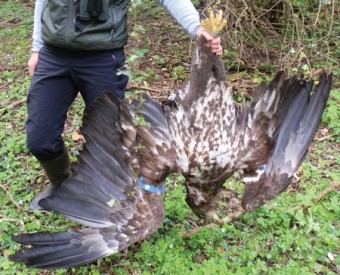
Another poisoned raptor, another well-kept secret?

Last week we blogged about Des Thompson’s presentation at the Scottish Wildlife Crime Conference (see here). Here’s a reminder of what he had to say about Northern Constabulary and the problem of red kite persecution in northern Scotland:

So 40% of the dead, just over 100 red kites were poisoned in north of Scotland, without poisoning we should have had 300 plus birds, poisoning of red kites in the north of Scotland is attracting a lot of criticism nationally, and we now know the location of the hotspots problem areas where red kites have been found, poisoned, and we’re working closely with the police to tackle this. And I want to put on record here how grateful we are to Northern Constabulary, er, senior staff at Northern Constabulary for meeting with us to discuss the scientific issues and for taking forward the very ambitious programme of work to tackle this problem“.

So what is this “very ambitious programme of work” and why is it that Northern Constabulary appear to need persuasion to carry out what is its statutory duty to investigate wildlife crime?

If you look at the Force’s website you’ll see that they have 13 police Wildlife Crime Officers (see here) who are overseen by a Force Wildlife Crime Coordinator, Chief Inspector Matthew Reiss. The website also includes a ‘statement of intent’ in relation to tackling wildlife crime and the Force says it is committed to tackling wildlife crime (see here). Further, Chief Inspector Reiss is on record (according to Highland News) as saying Northern Constabulary treats wildlife crime “extremely seriously” (reported here after the convictions of Skibo Estate and Moy Estate employees for wildlife crime offences).

All sounds very convincing and reassuring, doesn’t it? Why is it then that Northern Constabulary has remained tight-lipped about the discovery, 15 months ago, of a poisoned red kite allegedly found on moorland at the boundary of Skibo Estate? We have been told that the satellite-tagged kite was allegedly found in February 2011. SASA documents show that only one red kite from the Highland region was tested in February 2011  and  it had been poisoned by Alphachloralose and was the subject of on ongoing police investigation (SASA ref #11020, see here).

Was there any publicity about this bird? We think we might have remembered if there had been, but we checked back to Northern Constabulary’s archived news items on their website for the month of February 2011 in case we’d missed it – but no, plenty on there about theft of handbags and damage to tractors but not a whisper about the discovery of a poisoned red kite.

Was there a police raid on the surrounding properties where this bird was allegedly found poisoned? If it was found at this location, and given that this is one of the supposed ‘hotspot’ areas for raptor poisoning (three golden eagles and a sparrowhawk found poisoned in 2010 – no convictions; a staked-out poison-laced grouse bait found in 2010 – no convictions) wouldn’t a police raid be the obvious first step in an investigation?

So is that it? No further action? If we hadn’t received a tip-off would it ever have come to light? Where was the RSPB in all of this? Did they know that one of their satellite-tagged kites had allegedly been found poisoned? If they did, why wasn’t the incident publicised? Where was SNH and PAW Scotland in all of this? Did they know that one of the satellite-tagged kites that they’d helped fund had allegedly been found poisoned? Where was their publicity? Where was the NWCU in all of this? Were they notified? Was this alleged incident the trigger for setting up the meeting with senior staff at Northern Constabulary to discuss the red kite persecution ‘science’?

This is the second time in the last few weeks that Northern Constabulary has been at the centre of allegations of secrecy and cover-up when it comes to wildlife crime (see here for earlier report on the suspected shooting and decapitation of a white-tailed eagle on Skye that went unpublicised). How many more incidents are there left to be uncovered? To be fair, Northern Constabulary does sometimes get it right, with current ongoing court cases including the alleged hare snaring at Lochindorb (here) and alleged egg theft (here), but ‘sometimes’ just isn’t good enough. Nobody’s suggesting these investigations are easy – we’ve all seen how difficult it can be to get COPFS to agree to a prosecution – but Northern Constabulary (and others) don’t help themselves when they choose not to publicise, or sometimes even investigate these alleged crimes.

How about everyone stops all the politically-motivated soundbites about commitment and very ambitious work programmes and just focuses on getting the basics right?

21 eagles, 6 years, 0 prosecutions

Ever since that poisoned golden eagle was found in Glen Orchy in June 2009, we’ve been assured by the authorities (including in an email from a spokeswoman of the former Environment Minister, Roseanna Cunningham) that, despite our concerns to the contrary, the alleged wildlife crime uncovered that day was being ‘dealt with’.

We’ve had to wait for almost three years to find out that, according to a statement in The Herald attributed to RSPB investigator Ian Thomson, nobody has been charged with poisoning that golden eagle (see Herald article here).

It’s just the latest in a long line (21 eagles in six years!) of both confirmed and suspected eagle deaths for which nobody has ever been prosecuted.

In fairness, some of the 21 examples shown below may not be a result of criminal behaviour (i.e. the bodies of seven of the eagles listed have never been recovered so foul play, whilst suspected, cannot be verified, but neither can it be ruled out). However, there have been 14 confirmed eagle deaths (13 poisoned and one shot), that we know about, for which nobody has been charged. There are probably more confirmed deaths that we don’t know about because for some reason, some confirmed deaths are not being publicly reported. And without a shadow of a doubt, there are other deaths that are attributable to criminal behaviour that never see the light of day.

Here’s the list of the ones we do know about:

MAY 2006: A dead adult golden eagle was found on the Dinnet & Kinord Estate, near Ballater, Aberdeenshire. Tests revealed it had been poisoned by the illegal pesticide, Carbofuran. Grampian Police launched an investigation. Five years and 11 months later, nobody has been prosecuted.
 

JUNE 2006: A dead golden eagle was found on Glen Feshie Estate in the Cairngorms. Tests revealed it had been poisoned by the illegal pesticide, Carbofuran. Northern Constabulary launched an investigation. Five years and ten months later, nobody has been prosecuted.


AUGUST 2007: A dead adult female golden eagle was found on an estate near Peebles in the Borders. She was half of the last known breeding pair of golden eagles in the region. Tests revealed she had been poisoned by the illegal pesticide, Carbofuran. Lothian & Borders Police launched an investigation. Four years and eight months later, nobody has been prosecuted.


AUTUMN 2007: Tayside Police received a detailed tip-off that a young male white-tailed eagle (known as ‘Bird N’) had allegedly been shot on an estate in Angus. The timing and location included in the tip-off coincided with the timing and location of the last-known radio signal of this bird. Four and a half years later, the bird has not been seen again. With no body, an investigation isn’t possible.


MAY 2008: A one year old male white-tailed eagle hatched on Mull in 2007 and known as ‘White G’ was found dead on the Glenquoich Estate, Angus. Tests revealed he had been poisoned by an unusual concoction of pesticides that included Carbofuran, Bendiocarb and Isofenphos. A police search in the area also revealed a poisoned buzzard, a baited mountain hare and 32 pieces of poisoned venison baits placed on top of fenceposts on the neighbouring Glenogil Estate. Laboratory tests revealed the baited mountain hare and the 32 poisoned venison baits contained the same unusual concoction of highly toxic chemicals that had killed the white-tailed eagle, ‘White G’. Three years and 11 months later, nobody has been prosecuted.
 

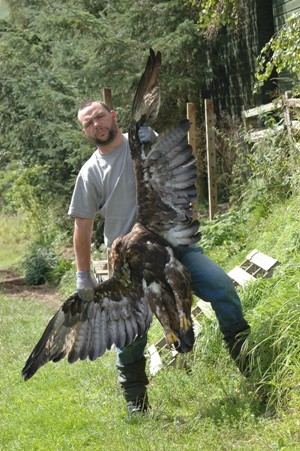
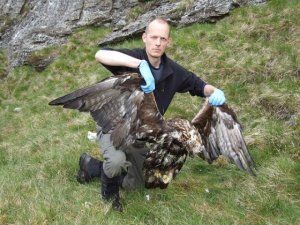
JUNE 2009: An adult golden eagle was found dead at Glen Orchy, Argyll, close to the West Highland Way. Tests revealed it had been poisoned by the illegal pesticide, Carbofuran. Strathclyde Police launched a multi-agency investigation. Two years and ten months later (April 2012), Tom McKellar pled guilty to possession of Carbofuran stored in premises at Auch Estate, Bridge of Orchy. Nobody has been prosecuted for poisoning the golden eagle.
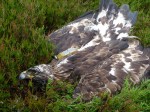
 

JULY 2009: A two year old female golden eagle known as ‘Alma’ was found dead on the Millden Estate, Angus. Tests revealed she had been poisoned by the illegal pesticide, Carbofuran. Alma was a well-known eagle  – born on the Glen Feshie Estate in 2007, she was being satellite-tracked and her movements followed by the general public on the internet. Tayside Police launched an investigation. Two years and nine months later, nobody has been prosecuted.


AUGUST 2009: A young white-tailed eagle was found dead on Glenogil Estate, Angus. Tests revealed it had been poisoned by the illegal pesticide, Carbofuran. Tayside Police were criticized in the national press for not releasing a press statement about this incident until January 2010. Two years and 8 months later, nobody has been prosecuted.


MAY 2010: Three dead golden eagles were found on or close to Skibo Estate, Sutherland. Tests revealed they had been poisoned; two with Carbofuran and one with Aldicarb. Northern Constabulary launched a multi-agency investigation. One year later (May 2011), Sporting Manager Dean Barr pled guilty to possession of 10.5 kg of Carbofuran stored in premises at Skibo Estate. One year and 11 months later, nobody has been prosecuted for poisoning the three golden eagles.


JUNE 2010: Leg rings with unique identification numbers that had previously been fitted to the legs of four young golden eagles in nests across Scotland were found in the possession of gamekeeper James Rolfe, during a multi-agency investigation into alleged raptor persecution at Moy Estate, near Inverness. It is not clear how he came to be in possession of the rings. The bodies of the eagles from which the rings had been removed were not found. No further action was taken in relation to the discovery.

JUNE 2010: A golden eagle and a white-tailed eagle were found dead on an estate near Farr, Inverness-shire. Tests revealed they had been poisoned by the illegal pesticide, Carbofuran. Northern Constabulary apparently did not search the property until July 2011. One year and ten months later, nobody has been prosecuted.
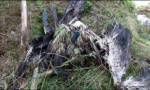
 

DECEMBER 2010: A decomposing carcass of a white-tailed eagle was found and photographed on Logie (Lochindorb) Estate, Morayshire. It was reported to Northern Constabulary. By the time the police arrived to collect it, the carcass had disappeared. The police said they couldn’t investigate further without the body.


MARCH 2011: The body of a young golden eagle was discovered on North Glenbuchat Estate, Aberdeenshire. Tests revealed it had been poisoned by the illegal pesticide, Carbofuran. Grampian Police launched an investigation and raided the property in May 2011. One year and one month later, we are not aware of any pending prosecutions.

 

APRIL 2011: The body of a white-tailed eagle was found at the base of cliffs on Skye. The person who discovered it (a professional medic) considered it to have been freshly shot with a rifle, decapitated with a sharp implement and thrown from the cliff top. He took photographs and alerted Northern Constabulary and RSPB. There was a delay of two weeks before the now probably decomposed carcass was collected. A post-mortem was inconclusive. This incident was not made public until one year later after a tip off to this blog. We are not aware of any pending prosecutions.

 

NOVEMBER 2011: The signal from a satellite-tracked young golden eagle (hatched in 2010) stopped functioning when she was at a location in the Monadhliaths, a well-known raptor persecution black spot in the Highlands. Her last known location was checked by researchers but there was no sign of the bird. Another ‘disappearance’ in suspicious circumstances or a technical malfunction of the satellite transmitter?

Glen Orchy poisoner has “brilliant” character references, says Sheriff

More and more news reports are emerging following the conviction yesterday of Tom McKellar of Auch Estate for possession of Carbofuran.
Some of these reports have mentioned the poisoned golden eagle that led to the discovery of the illegal stash of banned poison at McKellar’s house, and some of them haven’t. One recent report, published today in the Daily Record (here) does mention the golden eagle. It also includes a comment from McKellar’s defence lawyer, David McKie (sound familiar??) who is reported to have said that McKellar was pleading guilty to possessing the poison but not to killing an eagle.

It is looking more and more likely that McKellar was not charged with poisoning this eagle, which perhaps explains why the COPFS press release yesterday (here) didn’t even hint at the presence of a Carbofuran-poisoned eagle found in the locality. Does anyone else find this omission strange, especially when the press release contained quotes said to be from specialist wildlife crime prosecutor, Kate Fleming:

The possession of Carbofuran is illegal. It’s use as a poison can lead to the indiscriminate poisoning of wildlife…”

Er, poisoned golden eagle found nearby, poisoned by Carbofuran. Illegal stash of Carbofuran found at McKellar’s place, some of it reportedly found inside a gamebag in his home porch (RSPB news here), and an admission (according to the BBC – here) that he’d laid out poisoned baits. No connection and not worth commenting on then, Kate? We’ll be writing more on the role of COPFS in this case a bit later on.

Also included in the Daily Record article was the following sentence:

‘Mr McKie handed a sheaf of glowing testimonials on his client’s character to Sheriff Douglas Small, who conceded they were “brilliant”‘.

However, he also said the offence [of possession] was “a serious matter” and he had to consider all options before sentencing.

Big, big day in court (part 5): Glen Orchy golden eagle

Here we go….

Tom McKellar, previously reported as being a gamekeeper (see link below for his earlier conviction for possession of illegal guns) but currently reported as being a farmer, has today pleaded guilty at Oban Sheriff Court to being in possession of the illegal pesticide Carbofuran.

This poison stash was discovered during a multi-agency raid on McKellar’s house in June 2009, where investigators found three separate containers of Carbofuran as well as traces of it in a syringe.

McKellar reportedly admitted during a police interview that he had, “in the past”, placed the poison out on laced meat to kill foxes.

Sentencing was deferred until 29 May 2012 for background reports.

McKellar had previously been charged for the illegal possession of two handguns, kept in his attic, that came to the attention of the police during the raid. On conviction, instead of receiving the mandatory five year jail sentence, he was given just 300 hours of community service (see here).

What has not been mentioned in the press (so far), is that McKellar’s house was raided after the discovery of a poisoned golden eagle, reportedly found with the body of a fox and a sheep carcass at Glen Orchy in June 2009 (see here and here). Toxicology tests reportedly detected Carbofuran on all three animals, although interestingly, only the golden eagle results appear in the official SASA results table; the sheep and the fox results are only mentioned in the RSPB’s 2009 report.

Does today’s reporting mean that McKellar, or anyone else, has not been charged with poisoning the golden eagle?

Rest assured, this is not the last we will be writing about this case…

COPFS press release here

STV article here

2012 wildlife crime conference: Charlie Everitt (NWCU)

The 2012 annual police wildlife crime conference took place a couple of weeks ago. Quite a few of this year’s presentations were relevant to raptor persecution so we’ll be commenting on these in due course. To start off the series we’ll focus on what Charlie Everitt had to say. Charlie is the Scottish Investigative Support Officer at the UK National Wildlife Crime Unit (NWCU). See here for more details.

Charlie Everitt: Update on Raptor Persecution

Scottish Raptor Persecution Priority Delivery Group, and that’s a mouthful, erm, has been concentrating more on poisonings just at the moment, and also on processes so that we can get things right in order to take things forward for core purposes. Consequently we’re just finishing off and hoping to sign off at the next meeting an evidence gathering protocol. Now this is guidance and best practice for organisations who are likely to come across raptor persecution victims, er, giving advice and guidance on who they should contact, how the, er, any carcasses should be recovered and where they should be handed in to, so it’s giving best practice in order to maximise our chances for convictions in court so we get the process right. So that should be signed off, er, at the next meeting.” [See here for a previous blog about an earlier draft of this protocol. We haven’t seen the final version yet but look forward to seeing it in the near future].

“And similarly we’re looking at, er, another protocol with regards to satellite tagged birds, and this is a case where we have birds that have been satellite tagged and maybe the tag, er, stops giving off a signal, erm, or the signal remains stationary, just a protocol as to what we should do, er, in order to take the next step in order to recover the satellite and to investigate what’s happened. So just to make sure that we are lawful in what we are doing. So that’s a protocol as well that should get signed off very soon.

And the third angle, and it’s taking up a fair bit of time, is looking at a very new approach to the whole raptor, erm, raptor persecution issue. Now I can’t really say a great deal more on this at the minute, it’s in its early stages of development just now but when it is it will be put through tests and if it is fit for purpose it will be rolled out and, erm, yes you’ll all be made well aware of it when it does emerge.

We’ve also been looking to the use of science to try and benefit from what science can deliver to us. Now the science of course can back up intelligence and information crucially and the science has been used to good effect when combined with information and intelligence in a presentation to Northern Constabulary last year about the red kites on the Black Isle and their failure to manage to expand from there. So I think that was a good example of just how the two can sit together.” [Eh?]

“The Raptor Study Group of course do a lot of good work with regards to monitoring, erm, raptors and are able to work out where black holes might appear where we should have raptors and where there might not be some. Now there might be good reason for these black holes appearing, [no shit, Sherlock!] er, but what it does do, as I say, when you mix the intelligence and information with the science we get the fuller picture of what might be happening on the land there.

And the final thing we’re looking at doing is to ensure that we can capture all the information from the Raptor Study Group because they’re the people who are out on the land and if they do have any snippets of information we want to make sure that we capture all that intelligence and information in the National Wildlife Crime Unit through the five X five X five system, so that’s, er, er, another area which I’m looking to address very soon.

Now we’ve had some prosecutions, er, either concluded, erm, or, er, occurring during 2011, er, just run through some for you just as an update. In May a shoot manager in Skibo was fined £3,300 for possessing 10.5 kilograms of carbofuran, er, that was the biggest haul we’ve ever recovered in Scotland. And also in May last year a keeper from Moy was fined £1,500 for the possession of a dead red kite. On in October a ‘keeper from Huntly was fined £250 for the illegal use of a cage trap and possession of an illegally trapped buzzard. In November two photographers from London and Norwich were fined £600 and £500 respectively for recklessly disturbing a pair of white-tailed sea eagles at a nest in Mull. In January of this year a former gamekeeper from Biggar was ordered to carry out 100 hours of community service for poisoning four buzzards with alphachloralose and this is a guy who had been convicted before back in 2008. And also in January of this year a, er, another keeper from Lamington was fined £635 for possession of carbofuran. Now for me I think that’s a really good return for one year’s worth of work, er, and there used to be years when we only got two or three convictions in a year, now we have a good number and, er, I think buried inside all of those results is excellent partnership working which I think we must recognise with all our partner agencies.”

[We believe it’s misleading to use these cases as an indicator of success. What Charlie failed to mention is that in some of these cases (Skibo, Moy and Lamington) the only successful charges related to ‘possession’. Nobody was actually charged for poisoning the raptors that were found at each of these sites (and in the Moy case, there were also other offences that related to the illegal use of spring traps, for which nobody was charged). It looks like the Crown Office has gone for the minimum charge possible (i.e. possession) just to secure a conviction. To put this in context, it would be like claiming a success if someone had gone on a killing rampage using a car but was only convicted for not having any road tax. One of the other cases mentioned (Biggar – i.e. David Whitefield from Cullter Allers Farm, who already had a previous conviction for wildlife crime) was given a pathetic 100 hours community service order for poisoning four buzzards! Not good enough and certainly not an indication of ‘a really good return for one year’s worth of work’].

“The 2011 poisoning figures as the Minister suggested was significantly down, er, er, which is great news and very, very welcome to us to hear. Erm, all I’ll say is let’s see if we can continue that downward trend for the next three to five years and actually, and then, erm, solidify into a trend so that we do have this downward movement in poisonings but very grateful for anything where we have a drop in poisonings and that is, erm, excellent news.”

[Charlie failed to distinguish between reported poisoning incidents and actual poisoning incidents. There’s quite a difference and this should put the 2011 poisoning figures into context. He also failed to acknowledge the other methods of illegal killing and their impact on the overall issue of raptor persecution in Scotland. See here for previous blog on this].

“The hotspot maps meantime continue to help the police to focus their attention and, erm, identify where the areas need to be for resources to be deployed.

Now a few years back Lothian & Borders police had a pesticides dog that was able to sniff out carbofuran but it was very quickly withdrawn after there were some health and safety concerns. Well I’ve been having this chat with some of the dog handlers across Lothian & Borders and, er, they have told me that that dog is now available again for any searches, er, which Scotland want to undertake with regards to carbofuran. So that’s I think a positive move they’ve managed to sort out any health and safety issues there and just to put a little bit of context into that, Spain now have 15 dogs that can sniff out carbofuran and other poisons. Carbofuran poisoning has dropped by 40% since the early 2000s so we can think about the impact of the dogs.”

[Again, Charlie has only given half the story here. Yes, in parts of southern Spain (but not all!) the number of reported poisoning incidents has dropped by 40% since sniffer dogs were employed from 2004 onwards. However, crucially, there has also been a concurrent effort to increase enforcement against the poisoners. This includes the use of fines that have a real deterrent (up to €200,000 [~£167,000!]) as well as prison sentences; the temporary closure of the hunting area where poison has been detected; the suspension of hunting rights where the hunting methods are considered to have an unsustainable effect on natural resources; the employment of specialised units (x 3, containing 18 dogs) to patrol areas for the detection of poison – these patrols include ‘emergency inspections’ after poison has been reported, as well as ‘routine inspections’ of hotspots where the use of poison is suspected; and the use of three toxicology labs for poison testing. This is particularly interesting as when poison has not been detected in the first lab, but the use of poison is still suspected based on forensic evidence found at the crime scene (e.g. presence of certain insects), then the carcass/bait is submitted to one of two other labs that use more powerful techniques. In 2010, poison was detected in 38% of these carcasses/baits even though it was undetected at the first lab.

So yes, Charlie, the use of one single sniffer dog in Scotland is a positive move, but without the wider enforcement measures as outlined above, we’d be exceptionally naïve to expect that what has been achieved in parts of southern Spain will be replicated here in Scotland].

“Vicarious liability is also, erm, very much in discussion at the moment and I think last year I described myself as being cautiously optimistic about it. Well this year I’m very optimistic about it, er, with all the work that has been going on, er, behind the scenes and, er, what I would say is that this is not something that is just going to be a case of well we can’t get the person who has put out the poison so let’s just go and charge the landowner, this is going to require a lot of work, er, by any police forces looking into it, er, and looking to, to, er, look at charges of vicarious liability. The industry have also looked into it and have indeed a number of organisations in order to understand what they need to do to fulfil their obligations and that is to be welcomed because it does give us a minimum standard across the, er, industries which is as I say very, very welcomed.

So I was interested in the Minister’s comment as well that, erm, I got the impression that he wasn’t really looking for many prosecutions from this, erm, he was hoping that this would sort of be a Sword of Damocles if anybody was to continue poisoning so, er, I think with some of the work that’s been going on in the Raptor Priority Delivery Group that I think that is a very realistic possibility that we will get things sorted before we ever have to resort to vicarious liability.

One final thing, well another thing I’d just like to, er, just bring to your attention is a egg collector who was, lived down in London, erm, and his house was searched, a number of eggs removed including some golden eagle and osprey, erm, eggs which had been taken from Scotland. The CPS did some work, er, with one of the partner organisations and sought an ASBO against him and although he’s currently in jail, when he re-emerges he will not be allowed to enter Scotland during the nesting season for the next ten years. Now that’s a very powerful piece of legislation and a powerful condition to put on him and it’s something which I’ve asked for them to see if we can get hold of the paperwork to look at the procedure to see if we can do some, mirror something like that up in Scotland because it’s not just for, erm, for egg collecting that this is relevant, I can see other angles of hare coursing, er, deer coursing and the like so, er, that is going to be an interesting development to see what how it transpires.

Finally on the raptor persecution side, these are the guys who make up the Scottish Raptor Persecution Priority Delivery Group. Now there have been articles that are out in the public domain where we actually have organisations, people from organisations that are representative of the group, trying to drive wedges in against other organisations which, er, are in that group as well, which is often very disruptive and really doesn’t help us with the trying to take the full raptor persecution debate forward. What I would say to you is that if you do have an issue which you would like to discuss in, er, er, in an appropriate forum, rather than having a, er, er, a rant shall I say for a better word in, er, other media, here is a foum which you could bring this to through your representative in order to get a good full informed debate amongst all the organisations that need to be consulted in it. So that’s what I’d urge you to do if you do have any issues and you want to bring forward then please do not hesitate to contact them through your, through your representative.” [We think this rebuke was aimed at the Scottish Gamekeepers Association who recently published an article that suggested raptor workers could be laundering eggs and chicks on the black market – see here for previous blog on that].

Red kite found poisoned in North Yorkshire

An article published in the York Press today reports that a poisoned red kite has been found near Pickering in North Yorkshire.

It was reportedly found in woodland at Cawthorn Roman Camp, and was rescued by a dog walker. The bird is now being cared for at Ryedale Wildlife Rehabilitation.

PC Stewart Ashton of North Yorkshire Police said: “Despite it being illegal to harm birds of prey, we have intelligence that people are still actively killing them in areas of Ryedale“.

According to the article, North Yorks Police are appealing for help in catching the person(s) responsible for this latest poisoning incident, although it is not known when the bird was found, what it was poisoned with, and no details are provided about who should be contacted. There isn’t a press statement on the North Yorks Police website either.

According to RSPB statistics, North Yorkshire was identified as having the highest level of reported raptor persecution incidents in the UK in 2010 (see here).

York Press news article here

2011 poisoning stats ‘out’ in every sense of the word

The Scottish Government has today published the 2011 poisoning map (otherwise known as Scotland’s map of shame).

The newspapers are heralding the figures as a success story, as the numbers show an apparent drop in poisoning incidents (“only [only??!] 16 raptors were killed as a result of being illegally poisoned in Scotland – 12 fewer than in 2010 and the lowest death toll since the first maps were published six years ago“, says The Scotsman). The victims included seven buzzards, four red kites, two peregrines, two sparrowhawks and a golden eagle.

On a superficial level this does look like convincing progress, but let’s scratch the surface and see what’s underneath…

The official Scottish government poisoning map only shows the places where poisoned birds were discovered. Given the remote areas involved and the fact that most of these poisoned birds were found by chance (by passing hillwalkers etc.), the official figures can in no way represent the actual number of raptors that were poisoned (but undetected) during 2011.

The figures behind the map also do not show the areas where poisoned baits (but no dead birds) were discovered during 2011. Nor do they show the other incidents of raptor persecution that were discovered during 2011, including shooting, trapping and nest destruction incidents. According to an article in today’s Guardian, it is claimed that last year’s illegal shooting, trapping and nest destruction incidents “have remained constant with previous years“. We’ll have to wait a good few months for the RSPB Birdcrime Report to see the actual figures. (Incidentally, how come the 2011 poisoning figures, as compiled by SASA, have not yet been released to the public? They’re obviously available as they were used to construct the poisoning map. So far they’ve only published data up to September 2011. Isn’t it in the public interest to release them? Why all the secrecy?).

It seems plausible that some shooting estates are doing their best to distance themselves from any sign of illegal raptor persecution, especially in light of the new law on vicarious liability. A likely example of this behaviour was an incident in the Borders in September 2011. A dog walker discovered a bag full of dead raptors by the side of the busy A68  road (see here for earlier blog on this). The police were alerted and the birds were sent to SASA for toxicology tests. The results showed that the two sparrowhawks and two buzzards had been poisoned with the banned pesticide Carbofuran. Because the dead birds had been dumped away from any shooting estate or farm, without being seen, it was virtually impossible for the police to prosecute anyone (SASA reports that the police have now closed the case due to a lack of positive leads – see here). What is the probablity that other estates up and down the country are poisoning raptors on their land and then removing the evidence as far from their location as possible?  It was pure chance that this bag of poisoned raptors was discovered. How many more are left rotting and undiscovered across the country?

But let’s suppose, just for a minute, that the latest map IS an accurate representation of all raptor poisoning incidents that took place in 2011. Should we then accept that shooting estates are cleaning up their act and they’ve all suddenly decided, after over 100 years of persecution, that raptors are actually ok and shouldn’t be killed? The only way to measure that will be to look at LONG-TERM TRENDS of poisoning incidents as well as LONG-TERM TRENDS of raptor populations. We’ve blogged about this before (see here) but it’s worth repeating some of it to show the bigger picture. The graph (adapted from the RSPB’s excellent report: The Illegal Killing of Birds of Prey in Scotland in 2010, see here) shows the long-term trend of poisoning incidents in Scotland from 1989-2010. Look carefully at the graph and you’ll see peaks and troughs in the numbers recorded. Yes, there certainly have been previous drops in the number of poisoning incidents, but then look what happened in the following years – another increase, and then another drop, then another increase etc. Before the game-shooting lobby starts its self-congratulatory back-slapping, we need to see a continuous decline in the number of recorded incidents, AND we need to see raptor populations recovering in those areas where persecution has been endemic. This will take time, but could arguably be judged in about five years’ time.

Of course we all hope that the 2011 figures are the start of a new era in raptor conservation in Scotland. As Environment Minister Stewart Stevenson has said in today’s media: “I hope this proves to be the beginning of a continuing reduction in such cases, leading to the end of this outdated, dangerous and cruel practice“. It is notable that his statement contains more than a hint of caution. That man’s no fool.

See an excellent article about the latest figures in today’s Guardian here

Article in The Scotsman here

Nest cameras to protect raptors in south west England

In a bid to tackle increasing levels of wildlife crime, Devon & Cornwall Police have teamed up with the RSPB to launch ‘Operation Wilderness’, a new scheme that will see 24 hr nest cameras installed at vulnerable sites across the region.

This is a proactive response to the spate of raptor persecution incidents last year, which included the illegal poisoning (with Carbofuran) of four goshawks and a buzzard (see here) and three peregrines (see here and here). There is also concern about egg collectors and pigeon fanciers in the area.

The cameras have been paid for by the Devon Bird Watching and Preservation Society, and Operation Wilderness is being led by Police Wildlife Crime Officer PC Josh Marshall.

Well done to everyone involved  – this is an impressive  joint effort.

BBC news article here

Eyes wide shut

It’s often said that the number of reported raptor persecution incidents in Scotland represents just the ‘tip of the iceberg’, which means that many more incidents probably remain undetected and thus unreported (see here for an earlier blog post about this). This shouldn’t come as a surprise to any of our regular readers, who understand that the combination of remote locations, increasingly-aware gamekeepers and some less-than-interested police forces can often result in an inaccurate (under)-estimation of the number of persecution incidents taking place each year.

With the imminent publication of the Scottish government’s 2011 Raptor Poisoning Map, due out any day now if they follow the pattern of previous years, we’ll soon hear claims from the game-shooting lobby that poisoning figures have dropped. We’ll also hear from the conservationists that the officially reported figures may have dropped but that the real extent of persecution remains unreported. The poisoning maps are a good example of this, because apparently they only show the areas where poisoned birds have been detected. What they don’t show, we’re told, is the areas where poisoned baits have been discovered. If that’s true, why do you think poisoned baits are not mapped and reported?

The Raptor Poisoning Maps also don’t show the extent of other types of illegal raptor persecution, such as shooting, trapping, nest disturbance, egg-smashing, chick killing etc. Nor do they show the last known locations of satellite-tracked raptors that have mysteriously ‘disappeared’ into thin air. Perhaps it’s time that the Scottish Government started to publish other maps to depict the extent of these various other incidents. Why don’t they do this already?

Inevitably, many potentially illegal incidents will slip through the net. We’ve been told of one such incident that happened very recently on a shooting estate in Scotland. We’ve been asked not to identify the estate or the gamekeeper for operational reasons.

So, a member of the public (let’s call him John) goes for a walk on this estate and sees what he thinks is a buzzard, in some distress, flapping around with a Fenn (spring) trap dangling from one of its legs. John is fairly clued up and immediately calls the police to report it. It’s a Sunday afternoon, so the Police Wildlife Crime Officer isn’t available (?!). Instead, an ‘ordinary’ police officer is sent to investigate. Mr Police Officer heads onto the estate to look for the distressed buzzard. He is met en-route by a certain gamekeeper, who asks him what he’s looking for. Mr Police Officer explains, and Mr Gamekeeper tells him that, by pure coincidence, he is also looking for a missing Fenn trap that has disappeared from a site where he had set it (legally), inside a tunnel to prevent non-target species from getting caught. His explanation for what had probably happened went something like, ‘Oh, the buzzard must have got inside the tunnel and then got caught in the jaws of the trap and flew off with the trap still attached’. Mr Police Officer apparently believed this explanation and off they went together to find the buzzard. They located it, and Mr Police Officer apparently asked Mr Gamekeeper what to do, and Mr Gamekeeper said the buzzard wouldn’t survive and it would be best if he killed it and disposed of the body, which he duly did. No body, no trap, no evidence, end of story.

The following day, two people visited the area where the buzzard had been found. Mr Gamekeeper appeared, challenged them, apparently told them to ‘get ‘arf my land’ (although his language was reportedly more colourful than that) and then told them ‘come back and collect your car tomorrow’, before dashing off down the road to block the exit with a tractor and trailer, preventing the visitors from leaving. The police were called, and eventually Mr Gamekeeper was instructed to remove his tractor.

The incident in question may or may not have been a case of persecution. Mr Police Officer clearly thought is was just an accident, which of course it could have been. Had he been aware of this estate’s history though, he might have viewed the incident differently. The estate in question has a well-documented track record of alleged raptor persecution (although none of the incidents have ever resulted in a prosecution). The incidents include the reported discovery of at least three poisoned raptors, and multiple nesting failures of breeding hen harriers in suspicious circumstances. In addition, at least two gamekeepers on the estate have a reputation for what might be generously called ‘obnoxious behaviour’ towards members of the public, dating back over a number of years, including claims of alleged assault (prosecution failed) and the deliberate blocking-in of vehicles to inconvenience visitors (presumably to discourage them from further visits). The police would be well aware of this history. Whether Mr Police Officer knew is not known, but hopefully he has now passed on the details of this latest incident to the Police Wildlife Crime Officer. If nothing else, the WCO could pay Mr Gamekeeper a visit to make sure his Fenn traps are being set legally (ie. covered).

We’re told that this estate is one of the 250+ that have signed up for the new Wildlife Estates Initiative. Unfortunately this cannot be verifed yet as the Initiative doesn’t seem to be interested in transparency at this stage of its development, even though one of its stated aims is ‘to introduce an objective and transparent system that demonstrates how wildlife management undertaken by Scottish landowners, in line with the principles of biodiversity conservation, can deliver multiple benefits for society and rural communities’. We’re all looking forward to the time when the Initiative is opened up to public scrutiny.

Scottish gamekeeper jailed for poison scare

Ok, ok, so the headline is misleading but we couldn’t resist! What, you really thought that a gamekeeper had been sent to jail for a wildlife poisoning offence? Don’t be daft, this is Scotland after all!

This is the story of Scottish gamekeeper Graeme Thompson, who sparked a major scare by [falsely] claiming he’d swallowed the banned poison Cyanide, along with some razor blades, in a bid to commit suicide “in a blaze of glory” (see here for earlier blog about this).

Thompson, of Primrose Crescent, Perth, was yesterday sentenced to 25 months in jail (see report in Daily Record here).

Amazing that a gamekeeper who had falsely claimed to have a banned poison can receive a two-year & one month jail sentence, whereas a gamekeeper who has actually been convicted of using a banned poison to kill protected species has never yet been given a prison sentence! Funny old world, isn’t it?