 Thanks to @Bucktonbirder for the tip-off –
Illegal raptor poisoning on BBC’s Countryfile tonight (7pm BBC 1), exposed by RSPB Investigations undercover work.
Preview here.

Thanks to @Bucktonbirder for the tip-off –
Illegal raptor poisoning on BBC’s Countryfile tonight (7pm BBC 1), exposed by RSPB Investigations undercover work.
Preview here.
 Following on from yesterday’s blog about the conviction of “vicious” gamekeeper Robert William Hebblewhite (see here), more information has emerged about what happened in court.
We mentioned yesterday how unusual it was for a gamekeeper to be convicted of actually killing the dead raptor(s) found on their land; typically, in case after case, the gamekeeper is convicted for the lesser offence of “possession” (e.g. of poison) and the charge for the actual killing is dropped. This has caused an immense amount of frustration, not only for those investigators who often spend months working on getting a case to court, but also for us, the members of the public, who feel a massive sense of injustice every time it happens.
Well, not so in this case. If you read the article published here, you’ll notice that the judge (in this case District Judge John Stobard) was having none of it.
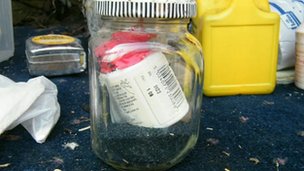
The prosecutor (Mark Holmes) contended that Hebblewhite’s motive was clear. He was the gamekeeper on this shoot, with responsibilities for pest control. The shoot had been losing birds because buzzards were in the area (his words, not ours!). Pheasant carcasses laced with Carbofuran had been found next to the Carbofuran-poisoned buzzards. A jar of Carbofuran was found in Hebblewhite’s van (see photo). Hebbelewhite’s van had been seen going to the scene on several occasions.
Hebblewhite had pleaded guilty to possession of Carbofuran (the lesser offence) but not for poisoning the buzzards.
The defence argued that the poisoner could have been anyone.
District Judge John Stobard wasn’t fooled. He is reported to have said this:
“The birds died from Carbofuran and here in a van is the very stuff that killed them. The defence says it could have been anyone. Well, could it? I’m not here to discuss the case as a philosophical argument. What is the reality of the matter?
This defendant is here to secure the presence of the shoots that take place by the way of being a gamekeeper. He must look after the pheasants and protect them from other animals.
I think he has done so in an old fashioned and particularly nasty way by lacing the pheasant with Carbofuran in the full knowledge the buzzards would be killed.
It can only point to one conclusion – he did it“.
So finally, here’s a judge who put two and two together and didn’t make five. It’s quite telling though, that this is such an unusual result that we need to highlight it here. What does that say about how our justice system deals with raptor persecution crimes? What does it tell us about our low expectations for these court cases?
In Scotland we’re so used to seeing ridiculous legal obstacles placed in the way of justice that we now expect the poisoner/trapper/killer to get off. “Did you see the defendant place the poison? Did you see the eagle/buzzard/goshawk/red kite actually eat from that very poisoned bait? Was it filmed? Did you have permission to film on that land? Can you forensically match the poison on the bait/inside the dead raptor with the big stash of illegal poison found in the defendant’s house /shed /garage /vehicle /porch /gamebag /jacket pocket? No? Well then he can’t be convicted”.
Well done again to the RSPB Investigations Team, to the CPS, and particularly to District Judge John Stobard for seeing the bleedin’ obvious and acting upon it.
UPDATE: There’s an excellent news piece on this conviction from BBC Look North. Decent coverage and explains that raptor poisoning is a national issue. Great stuff. Available on BBC iPlayer here for limited period (starts at 11.58 – ends at 14.40).
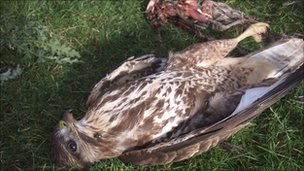
The RSPB Investigations Team scored another victory today as a Lincolnshire gamekeeper was convicted of killing two buzzards and possessing the banned poison Carbofuran.
Robert William Hebblewhite, 71, of Appleby, Scunthorpe, was fined £1,950 at Lincoln Magistrates Court.
The two buzzards were found dead in Sept 2011 on land at Bonsall Lane in Blyton, near Gainsborough, where he works as a gamekeeper. Toxicology tests revealed the birds had died from Carbofuran poisoning from poison-laced pheasant carcasses. The RSPB said Hebblewhite was in possession of enough Carbofuran to destroy all the raptors in Lincolnshire.
It’s not known whether Hebblewhite is a member of the National Gamekeepers Organisation. Hopefully they will put out a statement to clarify his membership status and to condemn this disgusting, persistent practice.
Congratulations to the RSPB guys for a successful prosecution. Importantly, he was convicted for actually killing the birds and not just for the lesser offence of possession of poison, which is the result we usually see. Well done indeed.
RSPB press release here
 There’s a comical news item on BBC News today about the new generation of gamekeepers.
The Borders College and Scotland’s Rural University College in Fife said ‘the skills obtained by their students [on gamekeeping courses] were proving valuable to landowners’. Yes, aren’t they just.
According to Angus McNicol of Cawdor Estates, “It’s a highly-trained profession these days. It’s very different to how things were in the past“. Really?
What short memories they all have. Here are a couple of recent examples of newly-trained students, fresh out of gamekeeping college, who now have wildlife crime convictions:
1. Lewis Whitham, who was 19 when he was caught placing a Carbofuran-laced rabbit bait out on the hill on Leadhills Estate (see here).
2. James Rolfe, who was 19 when he was caught with a severely-injured dead red kite in the back of his landrover on Moy Estate (see here).
How very inconvenient when we’re supposed to believe that the criminal gamekeeper is of the old school, now dying out and being replaced by a new generation of ‘highly-trained professionals’. Nice try.
BBC News article here.
 Happy Hogmanay!
Tomorrow marks the start of another Scottish government themed year: The Year of Natural Scotland, in which we’re encouraged to celebrate Scotland’s stunning natural beauty and biodiversity. Good job it wasn’t this year’s theme as there might have been some red faces in the government:
These are just a few of the ‘highlights’ from Scotland this year – there are a few more that we can’t yet report but we will in the New Year. And of course this list doesn’t include other confirmed incidents from other parts of these fair isles such as England, Wales, Northern Ireland and the Irish Republic; a list that includes shot and poisoned sea eagles, buzzards, kites, harriers, peregrines and sparrowhawks. Nor does it include the incidents that went undiscovered.
We’ll be blogging quite a lot about the Year of Natural Scotland, which hopefully won’t be just a banner-waving exercise by the government but an opportunity for them to put their money where their mouths are. You don’t think so? No, neither do we. Why should 2013 be any different from the previous three decades of ineffective action?
A hint of what’s to come is the revelation that the theme will be highlighted during several events throughout the year. Two particular locations caught our attention: the Scone Game Fair and the Moy Game Fair.
The Scone Game Fair is of course organised by the GWCT. That’s the same GWCT that has recently asked for the addition of buzzards and sparrowhawks to the General Licences (that means they want permission to kill them…we’ll be blogging about that shortly). It’s also the same Game Fair that has previously attracted sponsorship from some very, how shall we put it, ‘surprising’ sources.
The Moy Game Fair is held on the Moy Estate near Inverness. If you’re unaware of this place, try googling it.
Thanks for all your interest and support in 2012…we’ll see you soon. Sláinte!
 This isn’t especially new news, as it happened in the summer, but we were reminded of it today after reading something on Mark Avery’s blog – more on that later – and it does seem pertinent to blog about it now.
So, most readers will be aware of the Environment Council’s ‘Hen Harrier Dialogue’ – a process that started in 2006 that aimed to bring ‘stakeholders’ together to try and work out a way of resolving the hen harrier / grouse moor conflict in England (see here for website). Those stakeholders involved in these dialogue meetings included the usual suspects such as BASC, Countryside Alliance, Country Land and Business Association, GWCT, Moorland Association, National Gamekeepers’ Organisation, RSPB, Hawk & Owl Trust, Northern England Raptor Groups etc.
The ‘dialogue’ process has produced an awful lot of documents (and a lot of awful documents, see here) and meeting reports (see here), and a strong interest in pursuing a trial on a ‘quota system’ for hen harriers – a controversial idea spawned by Steve Redpath several years ago. In simplistic terms, this quota system would mean that grouse moor owners would ‘allow’ a certain number of breeding pairs (number yet to be established) and once a ‘ceiling’ had been reached, then they would be ‘allowed’ to remove harrier broods (non-lethally) to other parts of the UK away from grouse moors. This idea is still being discussed, although it brings with it obvious ethical and legal debates.
 Some argue that conservation groups shouldn’t be sitting at the table with representatives from an industry that has been responsible for killing off England’s breeding hen harrier population. Others argue that the quota scheme may be the best way forward because at least there’d be some harriers, which is a better proposition than having none. Others have suggested that the quota system would never get off the ground anyway because the grouse moor owners would have to ‘allow’ a certain number of breeding hen harriers on their estates and they’ve shown themselves incapable of tolerating any.
Whatever your point of view, the bottom line is that six years on from the start of the dialogue process, and after all that talking over egg sandwiches and coffee, the English hen harrier breeding population has been reduced to one known pair. That’s it. Just the one pair. In a country that has suitable habitat to support over 300 breeding pairs.
This summer, the RSPB made a bold move and decided to walk away from the dialogue process. They said that as hen harriers have been systematically eradicated from English grouse moors then there was no longer any conflict and therefore no point in spending any more time talking about it. Instead, they intended to get on with their own plans for hen harrier recovery.
It’s not yet known what will happen to the Environment Council dialogue process now a major player has walked away. As far as we’re aware, there are still many questions about the lawfulness of the proposed trial quota scheme so it’s unclear whether attempts will still be made to push that through.
So what next for English hen harriers? After the recent sad story of the illegal shooting of Bowland Betty (see here), in addition to all the other horror stories we keep reading about from English and Scottish grouse moors (e.g. see here, here, here, here, here), is it time for a different approach? It’s obvious that the authorities can’t, or won’t deal with illegal persecution, and the grouse-shooting industry can’t, or won’t put a stop to it either. An alternative suggestion has been put forward by Mark Avery – unless things miraculously improve for breeding hen harriers in Northern England in 2013 then it will be time to start the campaign, on 12 August 2013, to end grouse shooting (see here for Mark’s blog).
Up until now we’d been supporters of the idea of estate-licensing schemes rather than an outright ban. Licensing seemed a fair and reasonable approach to regulate an industry so clearly incapable of expelling its criminal elements. But now? The time for being reasonable has long since passed. Count us in, Mark.
For our anagram fans: Grouse moor – morgue or so
More bad news from Ireland…
One of the reintroduced Irish white-tailed eagles, known as ‘Irish Brian’ after his exploits in East Scotland last year, has been found dead in County Kerry. Apparently his body, which was found on a hillside near Glencar, was too decomposed for any conclusive tests but this is an area where three other reintroduced sea eagles were found poisoned in 2008 (see the Golden Eagle Trust’s website here for details of the sea eagle reintroduction project).
Rhian Evans, the RSPB’s East Scotland Sea Eagle Project Officer has blogged about Irish Brian here.
The annual Purdey Awards for Game and Conservation were established to celebrate those who achieve most in game conservation, according to the Purdey Awards website (here). These awards are viewed as the game-shooting industry’s most prestigious, giving recognition to those ‘who do most to help our flora and fauna, by improving biodiversity and developing better land management‘.
The 2012 Purdey Award winners were recently announced. We were particularly interested in the ‘Highly Commended’ category:
“Brian Kaye of Redmyre Farm Shoot of Invergowrie, near Dundee, has been highly commended for his work in creating a high quality farm shoot and for enhancing the landscape and natural environment. Mr Kaye has not only dramatically improved the habitats and biodiversity for a wide variety of game birds and plant life, but has also demonstrated how shooting goes hand in hand with conservation. The award is made in recognition of outstanding work over 20 years in establishing an exemplary shoot over 320 acres of the Sidlaw Hills“.
Surely not the same Brian Kaye who owns Redmyre Estate near Invergowrie (according to the East of Scotland Association for Wildfowling and Conservation: see here)? Nah, it couldn’t possibly be. A gamekeeper on Redmyre Estate was convicted in 2010 of shooting dead a buzzard and for possession of the banned poisons Carbofuran and Alpha-chloralose (see here, here, and especially here).
Other ‘greats’ that have been celebrated with Purdey Award wins include:
Geoff Eyre, the sporting tenant on Howden Moor (2005 Purdey Gold Award). In 2011, the gamekeeper on Howden Moor was convicted of a series of wildlife crimes (see here).
Jimmy Shuttlewood, the head gamekeeper on Snilesworth Estate (2005 Purdey Special Award). In 2008, Shuttlewood and two other gamekeepers were convicted of a series of wildlife crimes (see here).
Lochindorb Estate (2008 Purdey Gold Award). In 2010 a dead sea eagle that had been found on the estate mysteriously disappeared just before the police arrived (see here). In 2011, the trial against two Lochindorb gamekeepers began, accused of illegally snaring mountain hares. The case against one gamekeeper was dropped earlier this year; the trial against the other gamekeeper will continue in January 2013 (see here).
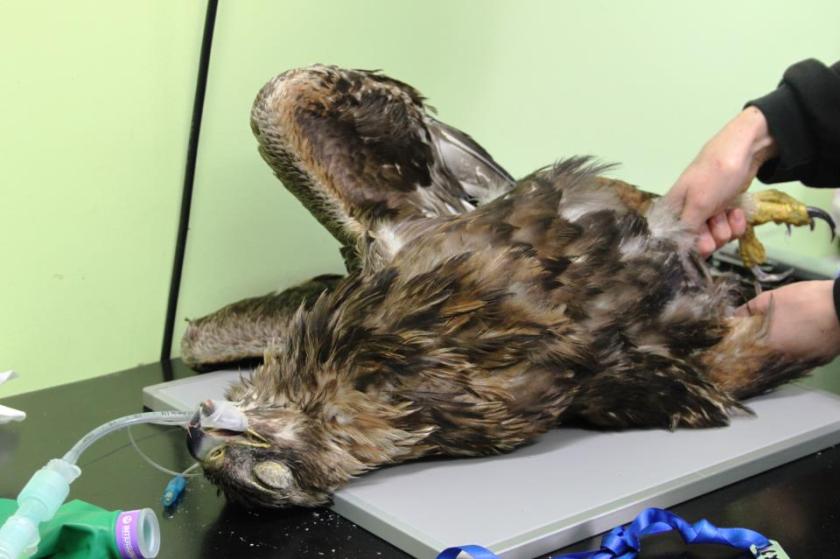
A young hen harrier has been found shot dead on a Yorkshire grouse moor. Regular blog readers will not be surprised to learn that it has taken over 5 months for an appeal for information to be made by North Yorks police.
The harrier was raised in a nest in Bowland, Lancashire in 2011. She was nick-named ‘Bowland Betty’ and was fitted with a satellite tag as part of Natural England’s so-called ‘Hen Harrier Recovery Project’. During her first year of life she was tracked through the uplands of Northern England and as far north as Caithness in northern Scotland. In June 2012 she was back in the Yorkshire Dales. Predictably, by late June her sat tag data suggested she was stationary and her dead body was found on 5 July on Thorny Grain Moor in Colsterdale in the Yorkshire Dales. Post-mortem results confirmed she had been shot.
This area is dominated by moorland managed for grouse shooting. We understand her body was found on Swinton Estate, although it is not known where she was actually shot as she could have flown for several miles before succumbing to her injuries.
RSPB and government data show the Yorkshire Dales as a hot spot for illegal raptor persecution, with at least 20 birds of prey illegally poisoned, trapped or shot between 2007-2011. This figure includes 10 poisoned red kites, 4 poisoned buzzards, 2 shot red kites, 2 shot buzzards, 1 shot kestrel and 1 trapped sparrowhawk. In addition there were at least 4 incidents of poisoned baits and a number of dogs were also poisoned.
Hen harriers have been tracked from Bowland since 1999. Wing tags were used to monitor hen harrier dispersal and survival between 1999-2002 (data from at least 42 birds). From 2002-2010, 118 hen harriers have been tracked either via radio transmitter or satellite tag. Astonishingly, Natural England have released very little detail about the results of this project, ten years on. They did produce a report in 2008 (see here) although this related to hen harriers over a broad geographic area and didn’t include specific detail about individual birds. What happened to all those birds? Where are their data? Why, when a satellite tag suggests that a harrier’s movements are suspicious (i.e. it’s been stationary on a grouse moor for several hours), do NE researchers have to seek the estate owner’s permission before they can go and search for the (presumably dead) bird? We’ve used an analogy before but it’s worth repeating – would you expect a police officer to call ahead to a suspected drug dealer to ask permission to go and search his house?
We all know only too well what will happen now. The death of this harrier will be added to the never-ending list of illegally-persecuted raptors found dead on UK grouse moors. Nobody will be prosecuted for shooting it. The public will express outrage for a few days but it’ll soon be forgotten, just like all the others that have been illegally killed before and all the others that undoubtedly will be killed in the future. The people who hold the positions of power that could bring this disgraceful practice to an end will continue to show wilful blindness and downplay the extent of the problem. The police will continue to form ‘partnerships’ with organisations who harbour the criminals responsible for this systematic killing. Nothing will change. Tune in next month to read about the latest victim. (Actually, tune in later this month….)
What can we do? The only thing we can do is to keep publicising these incidents. We can all play a part; don’t leave it to someone else. Tweet it, Facebook it, blog it, talk about it, email your MP about it. Do it.
 RSPB Scotland has just published its latest report, The Illegal Killing of Birds of Prey in Scotland in 2011. You probably won’t be surprised or shocked by the content, especially if you’ve read the previous 17 annual reviews. In fact, when you read this 18th review, you might get a strong sense of déjà vu.
It opens with a Foreword by Stuart Housden, Director of RSPB Scotland. Apart from the new photo, this foreword looks like a cut and paste job from the 2010 report, with a few words or sentences added or adjusted. To be fair, not much has changed since the 2010 report was published so perhaps he felt justified in repeating what he’d written the previous year.
Then there are RSPB Scotland’s strategic recommendations for addressing raptor persecution. Again, these show a remarkable similarity to the recommendations made in the 2010 report, and also in the 2009 report. The recommendations were / are still good and to see them repeated again is a useful indicator of how little progress has been made by those with the power to push them forward.
Next come the tables showing the confirmed and probable persecution incidents recorded by the RSPB during 2011. It’s these tables that the game-shooting lobby usually object too – they’re especially reluctant to accept the ‘probable’ incidents although to date, they’ve failed to provide a convincing argument to account for any of them.
The data in the 2011 tables demonstrate once again that illegal raptor persecution is widespread, with incidents reported in Perthshire, Angus, South Lanarkshire, Aberdeenshire, Dumfries-shire, East Ayrshire, Borders and Inverness-shire. We counted 15 very familiar-sounding locations within these regions, although there are a few notable absentees this time. Have they stopped their criminal activities or have they just got better at covering up? Time will tell.
Just focusing on the confirmed incidents, in total 17 incidents of deliberate poison abuse were confirmed during 2011, involving 20 victims: 7 buzzards, 4 red kites, 1 golden eagle, 2 peregrines, 2 ravens and 4 other bird species. Sixteen other illegal incidents relating to shooting, nest destruction, and the use of uncovered spring traps or cage traps were confirmed. The victims included 8 buzzards, 2 peregrines, 1 goshawk, 1 sparrowhawk, 2 kestrels and 1 short-eared owl. As in previous years, not all of these incidents were publicised at the time they occurred. It’s a continual disappointment that several years have to pass before the public learns of these appalling crimes.
 Once again the occupations and interests of those convicted for illegal raptor persecution crime have been analysed (data from 2003-2011 inclusive). 87% of them were gamekeepers (7% pigeon racers, 3% pest controllers, 3% farmers).
The report includes an interesting case study of poisoned raptors that have been found in recent years on the Glen Kyllachy and Farr Estate near Inverness. Very little of this information has been previously published and certainly this is the first time these photographs have been published. It’s a shame it’s taken several years for the info and images to reach the public domain but nevertheless it’s very encouraging to see RSPB Scotland highlight these cases, especially as Northern Constabulary hasn’t bothered.
All in all the report makes for grim reading, but nobody should be surprised by that. We all owe a large debt of gratitude to the RSPB’s Investigations Team for meticulously collecting these data and especially for making them publically available.
TO DOWNLOAD A COPY OF THE REPORT CLICK HERE
Here’s some media coverage:
RSPB Scotland press release here
BBC news article here
STV news article here
Herald Scotland article here
Scottish Gamekeepers Association: statement here
Scottish Land and Estates: nothing yet
@SNHMedia: “SNH report finds vast majority of gamekeepers highly qualified”. Link to this.
PAW Scotland: nothing yet
 Raptor Persecution UK