Disingenuous SGA uses flawed analysis to misrepresent raptor crime data

There’s a shockingly poorly-researched article in today’s Telegraph, penned by Scottish journalist, Auslan Cramb.

He claims that ‘Wind turbines have killed more birds of prey than persecution‘ this year. The basis of his flawed claim is his analysis of the latest SASA data, covering the period Jan-June 2014.

Cramb states that, “Four raptors were killed by turbines between January and June. Over the same period, two birds were confirmed to have been poisoned or shot“.

Dear God. Let’s just have a closer look at the SASA data, shall we?

March 2014: Dead peregrine found in Strathclyde – Carbofuran poisoning.

April 2014: Dead peregrine found nr Stirling – [shot on the nest].

April 2014: Dead buzzard found in Fife. Poisoned [“banned poison” not named by police].

June 2014: Dead hen harrier found in Muirkirk – [shot].

That’s four confirmed illegal killings in the report. Can’t Mr Cramb count? There’s also a further entry:

January 2014: Dead rook, rabbit bait & hare bait (Carbofuran) found in Strathclyde. Not a raptor, granted, but its misleading not to mention this incident especially as Carbofuran-laced baits are routinely used to kill raptors. This incident is no less serious than a poisoned raptor.

But what’s missing from the SASA report? According to our research, the following:

January 2014: 1 dead bird [species unidentified] & suspected poison bait, South Lanarkshire.

March 2014: 16 red kites poisoned in Ross-shire [“banned poison” not named by police].

March 2014: 6 buzzards poisoned in Ross-shire [“banned poison” not named by police].

April 2014: 1 dead buzzard, allegedly shot, bludgeoned and stamped on, Dumfries & Galloway. A criminal trial is underway.

That makes a total of 27 confirmed illegally-killed raptors between Jan-June 2014, plus one rook and one unidentified bird.

Now, it’s quite possible that Mr Cramb is unaware of some of those additional persecution incidents (although if he was a half-decent journalist he would have done some homework – information about all of those crimes can be found on this blog).

However, it is inconceivable that the 22 raptors poisoned in the Ross-shire Massacre in March this year escaped his attention. He’s a journalist – it’s his job to keep abreast of the news.

Sure, the 22 poisoned raptors are not listed in the SASA report because mysteriously, SASA has chosen to exclude them, probably at the request of Police Scotland – we blogged about this exclusion here and the ramifications of their secrecy just keep coming, as evidenced here), but it’s very poor journalism for him to have excluded them from his analysis on windfarm deaths vs persecution deaths.

Cramb’s poor research skills are one thing. However, his flawed analysis appears to have been readily accepted by the Scottish Gamekeepers’ Association, and used by them to misrepresent the truth about raptor persecution stats. In the article, Cramb says this of the SGA:

A spokesman for the SGA said the report revealed the truth behind the “prejudice” aimed at landowners and farmers which painted the shooting industry as “guilty until proven innocent“.

He added: “It is important the public can understand for themselves the true picture regarding wildlife crime.

“After the appalling finger-pointing at the shooting and farming industries following Conon Bridge this year by the highly politicised conservation movement, we will be interested to see if those groups now call for the same licensing measures against the government-backed wind farm industry”‘.

So, the SGA have accepted Cramb’s analysis even though they are fully aware that the 22 illegally-poisoned raptors at Conon Bridge are not included in his results. They can’t deny knowledge of the Ross-shire Massacre because the SGA spokesman even mentioned it in his quote!

We would argue that the SGA is being disingenuous, readily accepting Cramb’s flawed analysis because it suits their agenda to keep denying the extent of raptor persecution crimes in Scotland. That’s outrageous. Why is this organisation still allowed to sit on the PAW Scotland Raptor Group, whose objective is to raise awareness of raptor persecution, not to deny it? They’re a disgrace.

Telegraph article here

UPDATE 3rd November 2014: RSPB Scotland has also blogged about this here

Ross-shire Massacre: Police Scotland, see what you’ve done?

Last Friday, Police Scotland put out an idiotic press release stating that they could now CONFIRM that the 22 raptors illegally poisoned in the Ross-shire Massacre seven months ago “were most likely not deliberately targeted“. It was an astonishing statement, not least because they had ruled out criminal intent before they’d even got a suspect, and despite the fact that those birds are known to have been killed with a banned poison. We blogged about it here and we’ll be blogging further on this shortly, following the grilling that senior police officers received during yesterday’s Scot Gov RACCE Committee hearing (see here).

Following that Police Scotland press statement, Tim (Kim) Baynes of Scottish Land & Estates wrote a letter to the Herald complaining about media speculation and stating (falsely) that raptor persecution crimes had declined (see here).

In response to that letter, yesterday Duncan Orr-Ewing of RSPB Scotland set out the facts about the increase in raptor persecution crimes (see here).

Today, another letter has appeared in the Herald, in response to Duncan Orr-Ewing’s letter. This letter was tweeted by the SGA this morning, with the following statement: “Herald letter from Ayrshire reader on the legal concept of innocent until proven guilty”.

Here’s the letter:

Thursday 30 October 2014

RSPB has its own agenda

DUNCAN Orr-Ewing, Head of Species and Land Management for RSPB Scotland, does not let the facts get in the way of his argument (Letters, October 29).

I would remind Mr Orr-Ewing that he stated in this very journal that a crime had been committed with the poisoning of raptors on the Black Isle and he then proceeded to promote his agenda against gamekeepers and shooting estates. Police Scotland has stated that no crime was committed, but that has not stopped RSPB advocating regulation which would allow it to attempt to criminalise legal businesses.

Rather than being a positive, the involvement of RSPB in police investigations creates a massive question about impartiality. This underlines the danger of allowing bodies with their own agendas to be involved in criminal investigations. They appear willing to ignore the fact that in this country we are all innocent until proven guilty.

David Stubley,

22 Templeton Crescent, Prestwick.

So Mr Stubley thinks that the Ross-shire Massacre was not a crime. This is precisely why Police Scotland should never have issued their press statement. Although their press statement did say: “The criminal investigation into their deaths is still ongoing”, those seeking to diminish this crime as something ‘accidental’ have been given the perfect fodder to perpetuate their ignorant claims which many average members of the public will likely believe.

As for the SGA re-tweeting this letter, with no mention that the Ross-shire Massacre was indeed a crime, well that speaks volumes, doesn’t it?

Mr Stubley is no stranger to muddying the water about the Ross-shire Massacre. In May he wrote another letter to the Herald about this crime:

Wednesday 21 May 2014

Falling prey to an accident?

I NOTE that immediately after the discovery of several dead raptors on the Black Isle many people jumped to the conclusion that they had been poisoned by a gamekeeper, even though there was not a shred of evidence to back up this assumption.

Several weeks later and despite a large reward being offered no-one has been charged. I have a suggestion for a possible cause of the poisoning.

Those responsible for the reintro­duction of red kites and other birds set up feeding sites where the birds know they will be fed and therefore congregate in large numbers. The birds are fed on agricultural beasts which have been killed, roadkill or, during the shooting season, gamebirds which cannot be sold. Could one of those food sources have been exposed to poison by accident? This would surely explain the concentration of dead birds and the lack of anyone to blame.

David Stubley,

22 Templeton Crescent, Prestwick.

We wonder if Mr Stubley is a member of the SGA? Just sayin’……

Police Scotland’s media strategy about this high profile crime has been appalling. They complained yesterday during the RACCE Committee hearing that media speculation hadn’t been helpful. They could easily have alleviated that speculation by publishing clear, timely and precise information about this crime, without jeopardising their criminal investigation.

More on this shortly.

Killing with impunity: Birdcrime 2013 published

Birdcrime 2013The RSPB has published its latest annual report on crimes against birds in the UK in 2013.

Their press release here.

The killing goes on, with impunity.

76 individual birds & other animals were confirmed illegally poisoned in 2013. This is more than double the figure from 2012 (29 confirmed victims).

Poisoning victims in 2013 included 30 buzzards, 20 red kites, 1 golden eagle and 1 white-tailed eagle.

68 confirmed incidents involved the shooting or destruction of birds of prey. Victims included two hen harriers, two marsh harriers and 5 peregrines.

These are just the confirmed incidents. A total of 338 incidents were reported to the RSPB in 2013, with North Yorkshire once again being the worst location. There’s also a worrying number of incidents from Powys in South Wales, seemingly relating to poisoned baits.

Birdcrime 2013 is a thoroughly depressing read. The RSPB calls on the shooting industry, again, to clean up its act. Judging by the contents of this report, that’s a seemingly futile request.

Well done and thanks to the RSPB for not only compiling these thorough statistics but importantly, for sharing them in the public domain.

Download Birdcrime 2013: Birdcrime 2013

Hen harrier Bowland Betty, found shot dead on a grouse moor in North Yorkshire. (Photo by Natural England).

Bowland Betty

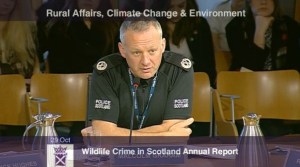
Senior police face wildlife crime grilling at Holyrood

RACCEThe Scottish Government’s Rural Affairs, Climate Change & Environment Committee (RACCE) will tomorrow hear evidence from two senior Police Scotland officers about the Government’s latest annual report on wildlife crime in Scotland.

The two officers are Assistant Chief Constable Malcolm Graham (Major Crime and Public Protection), and Detective Chief Superintendent Robbie Allan (Wildlife Crime Portfolio Holder).

Following them will be Patrick Hughes, Head of Wildlife & Environmental Crime Unit, Crown Office & Procurator Fiscal Service.

This hearing is fairly routine – the RACCE took evidence last year from the Environment Minister following the publication of the Government’s first report on wildlife crime, and the Minister is set to give evidence again next week (Nov 5th) now that the second annual report has been published.

However, in light of recent events, we hope that the police will be asked to account for their actions on (a) their outrageous statement that the 22 raptors poisoned in the Ross-shire Massacre seven months ago were “not deliberately targeted”, and (b) their staggeringly hypocritical response to the consultation on whether the SSPCA should be given increased investigatory powers.

We’re still awaiting a formal response from the RSPB’s Head of Investigations, Ian Thomson and the SSPCA’s Head of Special Investigations Unit, Mark Rafferty as to whether they agreed with Police Scotland’s claim that the Ross-shire Massacre was ‘accidental’, although they have said that they’ve contacted Police Scotland for an explanation and will respond to blog readers in due course. We can assume then, that neither the RSPB or the SSPCA were party to that Police Scotland press release, even though they are supposedly ‘partners’ in this investigation.

In the meantime, we asked RSPB Scotland Director, Stuart Housden, what his thoughts were. Yesterday he tweeted the following response:

To use a poisoned bait(s), placed in the open is an indiscriminate and illegal act aggravated by the use of a banned chemical“.

It seems that Mr Housden is, quite rightly, not impressed with Police Scotland’s statement. Note also he mentioned ‘poisoned bait(s)’ and ‘a banned chemical’. These are carefully chosen words. If those 22 birds had been killed by the accidental use of rodenticide, as some members of the game-shooting lobby are claiming on social media, Housden would probably have said ‘a controlled substance’, because rodenticides are NOT a ‘banned chemical’. Interesting stuff.

You can watch the RACCE wildlife crime hearing live on Holyrood TV tomorrow. The session starts at 10am although the first item on the agenda is consideration of the South Arran Marine Conservation Order 2014. The wildlife crime session will follow that. You can watch by clicking this link to Committee Room 5.

For those who can’t watch it, we’ll post the minutes from the session on this blog as soon as they become available (usually within 24 hours of the hearing).

UPDATE 29/10/14: For those who missed the live tv broadcast, HERE is the archived video. A full transcript will follow (within 24 hours) plus our analysis of the evidence heard.

UPDATE 4/11/14: The official transcript of the hearing is now available here.

UPDATE 4/11/14: What we learned from the RACCE Committee hearing here.

Ross-shire Massacre: SLE complains about media speculation

A letter has been published in the Herald today, penned by Tim (Kim) Baynes of Scottish Land and Estates:

Speculation around bird of prey deaths has become more hysterical

The announcement by Police Scotland that the 20 raptors found poisoned in March near Conon Bridge were “not deliberately targeted” raises number of serious matters.

Despite the trend of crimes against birds of prey having gone down in the last 3-5 years, particularly by poisoning, the speculation around each case has become more hysterical; the RSPB even tried to link the Conon Bridge incident to grouse moor management. There are now websites and bloggers and organisations involved in police investigations who are not slow to feed information to the media and promote speculation.

This speculation is having a corrosive knock-on effect on many other aspects of land management, severely straining the relationship between land managers and conservation bodies.

This also brings into focus the new measure whereby General Licences to control pest birds may be withdrawn where there is only a suspicion of wildlife crime, rather than it being proven in court.

Any deliberate killing of a bird of prey is illegal and is to be condemned but it is not in anyone’s interests that various activists and organisations can leap to conclusions without any evidence to support their point of view which in turn is afforded political and media credence. It would be a major step forward if government and other interested organisations were to take a lead in ensuring that reckless speculation should be discouraged. If everyone sticks to the facts and works more constructively together then the interests of conservation will be better served.

Tim Baynes,

Scottish Moorland Group,

Scottish Land & Estates,

Stuart House,

Eskmills Business Park,

Musselburgh.

So our Kim wants everyone to “stick to the facts”. His own track record on sticking to facts isn’t very impressive (e.g. see here, here, here).

His latest letter was written in response to Police Scotland’s outrageous announcement last Friday that the illegal poisoning of 22 raptors at Conon Bridge seven months ago was “not deliberately targeted” (see here). That idiotic statement was pure speculation – is Kim complaining about that?

Earlier this year, Jamie McGrigor MSP speculated, during a televised parliamentary debate, that the Ross-shire Massacre could have been the result of accidental food contamination at the Tollie Red Kite feeding station (see here). Did Kim complain about that?

Kim & Co had better batten down the hatches – speculation is bound to be rife when Police Scotland consistently fail to provide timely, and accurate, updates about such appalling crimes.

Understandably, Kim and his mates would probably prefer everyone to just shut up about raptor persecution crimes. It’s a bit too late for that.

Oh, and by the way, Kim, seeing as how you love facts, here’s one: It was twenty two dead raptors at Conon Bridge, not twenty. And here’s another fact: the Government’s 2013 wildlife crime report showed an increase in raptor persecution crimes. And guess what? The 2014 figures will also show an increase, because the ‘Conon Bridge 22’ will be included in those stats.

In other news, tissue sales are set to increase in Musselburgh.

There’s also an article in the Herald, based around the content of Kim’s letter and how he thinks that the speculation has ‘sullied’ the reputation of SLE members (here).

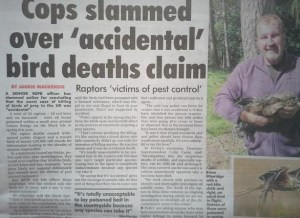
Ross-shire Massacre: unbelievable press release from Police Scotland

RK7Following the mass poisoning of raptors (16 red kites & 6 buzzards) at Conon Bridge, Ross-shire, seven months ago, Police Scotland has this evening put out the following press release:

Appeal for information in relation to death of raptors

Police Scotland has issued a further appeal for information relating to the deaths of raptors in various locations across the Ross-shire/Black Isle area earlier this year.

Following investigation Police Scotland can now confirm that the birds, 12 red kites and four buzzards, were most likely not targeted deliberately but instead were the victims of pest control measures. The raptor deaths occurred over March and April this year.

The criminal investigation into their deaths is still ongoing and Police Scotland continues to work closely with partners.

Detective Superintendent, Colin Carey, said:

“Investigations into the suspicious deaths of wildlife and especially raptors can be difficult and prolonged. The areas covered can be vast and it is seldom immediately apparent why a bird may have died.

“We work closely with partners to identify and thoroughly investigate all wildlife crime. The death of the raptors in Ross-shire remains an on-going investigation during which we are endeavouring to establish all of the circumstances around this crime. We would ask anyone who may have further information to come forward.”

A significant reward is being offered for witnesses or further information.

Partner agencies would seek to remind members of the public that if anyone finds any further dead birds or animals in the area they are asked to make a note of its location and inform the police on 101. Under no circumstances should anyone touch or attempt to recover any dead animal.

If anyone has any information regarding this matter please contact Dingwall Police Station, telephone 101.

END

This police statement is staggering. Pay close attention to the second paragraph: Police Scotland can now CONFIRM…..

How can they possibly CONFIRM this, without a full confession from the person who laid out the poison baits? Does this CONFIRMATION mean that they’ve got the poisoner? That he/she has been arrested? That he/she has been charged?

The truth of the matter is, they haven’t got the poisoner, so they cannot possibly CONFIRM whether the poisoner meant to target raptors or meant to target a legitimate ‘pest’. Besides, the only legitimate method of poisoning ‘pests’ is by the controlled use of rodenticides. We already know that the poison(s) involved in this case included a banned poison – the police said so months ago. According to the Vice President of the RSPB, the poison used was Carbofuran. We don’t know that for sure because Police Scotland has refused to say, and the Government toxicology lab who would normally publish this information has mysteriously chosen not to on this occasion. We also know that poisoned baits were picked up at the crime scene – as reported here and here. How can this possibly be classified as a ‘non-deliberate’ poisoning?! It’s illegal to even possess these banned poisons, let alone to use them!

What on earth are Police Scotland playing at? This press statement is a disgrace. If we applied their logic to every other raptor that has been poisoned by a banned poison over the last ten years, then they’ve all been accidental! An unfortunate mistake by someone carrying out pest control measures! What sort of message does this police statement send to those who continue to use banned poisons to kill wildlife? ‘Ah don’t worry lads, we know you didn’t mean to deliberately target that golden eagle/red kite/buzzard with your illegal poisoned bait’.

WTF?

Somebody needs to be asking questions about this. It’s pointless us trying to ask Police Scotland – we’ll just get the stock response of “It’s a live investigation so we can’t comment”. So much for police accountability, eh? All this guff about how the SSPCA shouldn’t be given extra powers because they’re ‘unaccountable’ – Jesus.

So seeing as we have no confidence in Police Scotland to be (a) accountable, (b) competent or (c) trustworthy about this case, how about we ask the partner agencies “working closely” with the police on this case, whether they agree with Police Scotland’s CONFIRMATION that this incident was accidental?

Let’s ask Ian Thomson, Head of Investigations at RSPB: ian.thomson@rspb.org.uk and let’s ask Mark Rafferty, Head of Special Investigations Unit at SSPCA: mark.rafferty@scottishspca.org We’re not asking them to reveal any confidential information about the case, just whether they agree with Police Scotland’s assertions that these poisoned birds were not deliberately targeted, and if so, on what basis has the assertion been made?

First vicarious liability prosecution: part 2

wane1Last week we blogged about what we believe to be the first prosecution under the 2011 vicarious liability legislation (see here), relating to poisoning offences that took place on the Glasserton & Physgill Estates in December 2012. Gamekeeper Peter Bell was convicted in June 2013 for those crimes, including the laying out of a poisoned bait that subsequently killed a buzzard, and the possession of three banned poisons (Carbofuran, Strychnine and Alphachloralose) which were found in his tool shed and in his home (see here).

The vicarious liability prosecution was adjourned yesterday and the next hearing is due in November.

Definitely one to watch.

Ross-shire Massacre: seven months on

It’s been seven months since 22 birds of prey (16 red kites and six buzzards) were illegally killed in a mass poisoning incident near Conon Bridge, Ross-shire.

Here’s an imaginary update from the police:

No arrests.

No charges.

No prosecution.

No justice.

Previous posts on the Ross-shire Massacre here.

“In the last 10 years we have stamped out poisoning”, says Alex Hogg

BBC radio ScotlandThe latest quote from Scottish Gamekeepers’ Association Chairman, Alex Hogg, is one of those classics that can be added to his other fantastical claims such as, “Professional gamekeepers do not poison raptors” (see here) and, “It is unfair to accuse gamekeepers of wildlife crime” (see here) and, when asked whether gamekeepers are involved with the poisoning, shooting and trapping of raptors: “No they aren’t. We would dispute that” (see here).

His latest claim, “In the last ten years we have stamped out poisoning” is extraordinary. Why make such a statement in the full knowledge that poisoning figures are freely available in the public domain for anyone to see? Perhaps he’s suffering from memory loss (too much lead in his bloodstream?) or perhaps he’s just deluded.

His claim was made during a BBC Radio Scotland interview, broadcast last week, about the potential for landowners and gamekeepers who are suspected of committing wildlife crime to have their General Licences removed. Also interviewed was Environment Minister Paul Wheelhouse, who confirmed our concerns (see here) that the removal of a General Licence doesn’t necessarily mean that estates will be prevented from carrying out their ‘vermin’ control activities – they can simply apply for an individual licence and carry on as normal.

Here is the transcript of the programme:

Presenter: Over the past few years, certainly far too often, we’ve reported on birds of prey which have been illegally killed. Now, there are laws in place for putting guilty offenders behind bars but so far this hasn’t happened. I’m not sure that’s true, I think one did. [RPS Ed: Nope, not a single raptor killer has received a custodial sentence].

As you may have heard on BBC Scotland news this week, there’s now a new tool available to those fighting this crime and the right for estates to control birds which predate on grouse and pheasants could be removed, potentially affecting their income stream. There are some who feel this measure could result in gamekeepers losing jobs. We take a look at the implications of the new legislation.

A tranquil rural scene, but, there’s anguish and anger in this area. Red kites were reintroduced here, starting 20 years ago. They’re popular with local people and visitors alike. But these illegal killings have wiped out 10% of the fragile population.

[Cut to Brian Etheridge, RSPB Scotland]: “I’m just gutted. This for me is just the worst two weeks I’ve had in this job. Going out and responding to calls from members of the public……”

Presenter: Brian Etheridge of the RSPB in Craig Anderson’s BBC Scotland report on the mass poisonings of red kites in the Black Isle. And it was cases like this that prompted the Environment Minister, Paul Wheelhouse, to call for Scottish Natural Heritage to come up with a different way of tackling the crimes.

At the start of the whole process, I spoke to the man in charge of developing those new initiatives, Robbie Kernahan, Head of Wildlife Operations at SNH.

Robbie Kernahan: “Well, the Minister in July asked us to scope out the possibility of restricting General Licences on estates and properties where we feel that wildlife crime may be taking place, and we’ve spent a bit of time trying to better understand some of the practicalities associated with that, and it’s a difficult one because General Licences are there to allow people to undertake activities such as crow control, corvid control, to prevent damage to, conserve wild birds and also agricultural crops but at the same time they are a privilege, they’re not a right, and they are a form of very light-touch regulation. I think it’s reasonable for us to look at how best to restrict those licences where we have got concerns about the potential for raptor persecution taking place”.

Presenter: So what would be the impact on an estate if the licence was not re-issued?

Robbie Kernahan: “Well, I mean corvid control is a pretty fundamental requirement for most moorland management, certainly if you’re interested in grouse productivity, certainly if you’re interested in conserving wild birds too, the corvid control is an important part of that. So withdrawing an ability for an estate to actively manage crows could be quite detrimental”.

Presenter: The new process of potentially restricting a General Licence is now up and running. But will it work to stop the killings? Environment Minister, Paul Wheelhouse:

Paul Wheelhouse: “Well we will only know in due course. I hope it has a deterrent effect because it will increase the hassle for land managers who are needing to control particular species, they will have to apply for individual licences, so I know there is some concern about jobs on the part of gamekeepers and other estate workers, but, they’ll still be able to control, assuming that they apply successfully for an individual licence. What we’re doing is taking away the privilege of a General Licence and I hope…..”

Presenter: Sorry, can I just nail this on the head? There are a lot of gamekeepers out there who are seriously concerned that if an estate loses its licence then their jobs are on the line. You’re saying the gamekeeper can apply for an individual licence?

Paul Wheelhouse: “Well we’re saying that to SNH the land manager can apply for a licence to control individual species they feel it’s necessary to protect livestock, you know, crows, corvids, other species they feel as necessary, we’re just not going to allow them the luxury of having a General Licence which is a privilege, not a right, and that they will have to go through a more onerous process to get permission, and it can’t guarantee that they will get permission, but clearly that’s a possibility, they can apply for an individual licence”.

Presenter: What about the other serious worry that because up until now, the lack of people in jail rams home how difficult it is to get a conviction in this sphere. By lessening the amount of proof that’s needed, are you not in danger of punishing an estate that might be innocent?

Paul Wheelhouse: Well these are factors that obviously the police and SNH would take in to account, when police, through an information-sharing protocol, share information with SNH about a landholding that they suspect perhaps wildlife crime has been on, they will take these factors in to account and they will look at the weight of evidence  there is and whether the balance of probabilities that that wildlife crime has been committed , that’s how civil burden of proof works, on the balance of probabilities rather than the definitive, if you like, basis that beyond all reasonable doubt which is where the criminal law comes in to effect”.

Presenter: The change in the legislation has come about because it is just so difficult to get a successful prosecution in cases involving birds of prey. A source of frustration for the police, SSPCA and RSPB investigators. RSPB Scotland investigator Ian Thomson:

Ian Thomson: “I think it’s a positive step, it’s certainly something that we welcome because what this mechanism that has been announced by SNH does is it uses a civil burden of proof, which is a lower burden of proof that is needed to obtain a criminal conviction, so rather than beyond all reasonable doubt, this is on the balance of probabilities, and frankly, where you have areas of Scotland unfortunately repeatedly seen to be involved in the illegal killing of birds of prey, then this is hopefully going to be a useful tool. Obviously the proof of the pudding is in the eating and it may take us several years to know how effective this is being”.

Presenter: But it’s got the potential though to, for a miscarriage of justice for want of a better expression.

Ian Thomson: “I don’t think SNH are taking this at all lightly, but the fact of the matter is there are many areas in Scotland where we know birds of prey are being killed, we have a pretty good idea of who is doing it, and certainly a group of individuals who are doing it, and so I think if the evidence is presented by the police to SNH, then ultimately they will make a decision. There is an appeal process in this, and if that process finds that there isn’t sufficient evidence then the licence will be reinstated. It’s SNH’s decision at the end of the day, but something we very much welcome, it’s another tool to tackle this on-going problem”.

Presenter: I approached Scottish Land and Estates for their reaction to the new policy but failed to get a response. But the folk at the sharp end of this whole debate are the gamekeepers, many of which fear for their jobs if a General Licence is withdrawn. A licence which people like Alex Hogg of the Gamekeepers’ Association feel is an essential part of estate management, both for game and for wildlife.

Alex Hogg: “It’s so important because it means it might take the right away to trap carrion crows in the spring of the year, which is vital to remove them for the sake of your ground-nesting birds. But, more so, you could have maybe six keepers working on an estate, as a team, the whole lot could lose their licence because they’re applying it [the General Licence restriction] to the ground, on suspicion, and then you’ve got no work for them. You know, they could end up out of their homes, and young families, stuff like that. Would it happen with plumbers and joiners, if a plumber misbehaved would they take all the licences away in the town for every other plumber? It’s absolutely ridiculous, really”.

Presenter: So if a licence was taken away, is it a sweeping statement to say they wouldn’t need keepers on an estate?

Alex Hogg: “Aye. I mean, you know, we can trap stoats, and weasels and rats, and the fox population we can keep on top of, but it disnae allow us to trap birds, and that’s a really important issue for us”.

Presenter: You’re saying you want to protect curlews and lapwings, but is the reality not that you want to protect grouse and pheasants, you know, because this is a money-maker for an estate? You guys, your employers, estate owners, aren’t running charities here.

Alex Hogg: “No, no, we’re running businesses and it should be recognised as such, but we can work round a lot of the issues to do with pheasant poults, and buzzards and things, which we’ve had to do, but let’s get right back to the things we cannot work round and that’s your waders. We feel we’ve been really done, badly done by. We’ve had raids on houses, dawn raids, you know, at 6 o’clock in the morning, 50 policemen, the wives have had their cupboards searched, the kids’ medicine bottles have been taken away, all to no avail. Now, in the past ten years, we have stamped out poisoning. We have come down so hard on it. We’ve had meetings up and down the countryside, we’ve absolutely finished it, and I think that if the police got murder, house-breaking down to the numbers we’ve got it down to, which is a minimal, below half a dozen this year apart from the Ross-shire incident, you know, we feel we’ve done our job. So the next part of the process should have been licensing, where you can apply for a licence to control a species that’s having a detrimental effect on another species”.

Presenter: But there are many people who’d say one poisoned bird is one too many. You’re saying you’ve sorted it, I would say you haven’t sorted it.

Alex Hogg: “One bird is too many but you’ve got to get it down to a minimum and we feel we’ve done that”.

END

Update on first vicarious liability prosecution

wane1Regular blog readers will know that we’ve been interested in the first prosecution of a landowner under the vicarious liability legislation for some time now….in fact ever since the legislation was enacted as part of the WANE Act on 1st January 2012 (see here for background info on what vicarious liability is and to what wildlife crime offences it can be applied).

We believe the first prosecution relates to the employers of gamekeeper and (now ex) SGA member Peter Bell, who was convicted in June 2013 of various poisoning offences that took place in December 2012 on the Glasserton & Physgill Estates. Those offences included laying a poisoned bait that subsequently killed a buzzard, and the possession of three banned poisons (Carbofuran, Strychnine and Alphachloralose) found in his tool shed and in his home (see here).

We’ve been asking whether there would be a vicarious liability prosecution against Bell’s employers for over a year, but each time we asked, various obstructions were put in our way (see here and here). However, in May this year, Environment Minister Paul Wheelhouse announced during a parliamentary debate on raptor persecution that vicarious liability proceedings had commenced (see here).

Since May, we’ve heard nothing at all, which we find surprising given the high level of public interest in how this new (well, nearly 3-year-old now)  and significant legislation will work.

We’ve been doing quite a lot of research since then and have finally discovered that this case is indeed in progress, and the next court hearing will take place next week. It won’t be an evidence-led hearing – it’s a special hearing that is designed to hear legal arguments. What happens next will depend on what the Sheriff decides at the end of the hearing. We’ll keep you posted.

We’ve also heard that there is a second vicarious liability case underway…..more on that in due course.