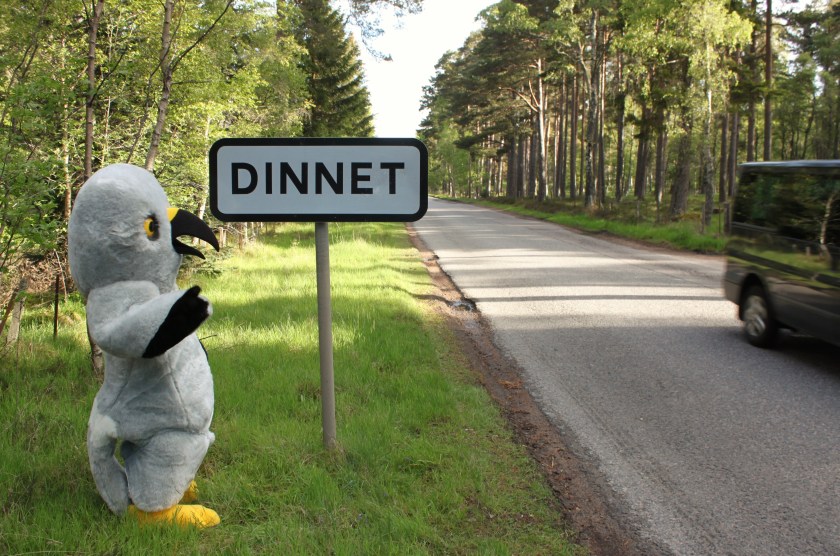
Henry called in at Dinnet (Deeside) but would only visit in daylight hours – here’s why.
It’s actually not all that safe in the daytime either – here’s why.
Welcome to the Cairngorms National Park.

Henry called in at Dinnet (Deeside) but would only visit in daylight hours – here’s why.
It’s actually not all that safe in the daytime either – here’s why.
Welcome to the Cairngorms National Park.
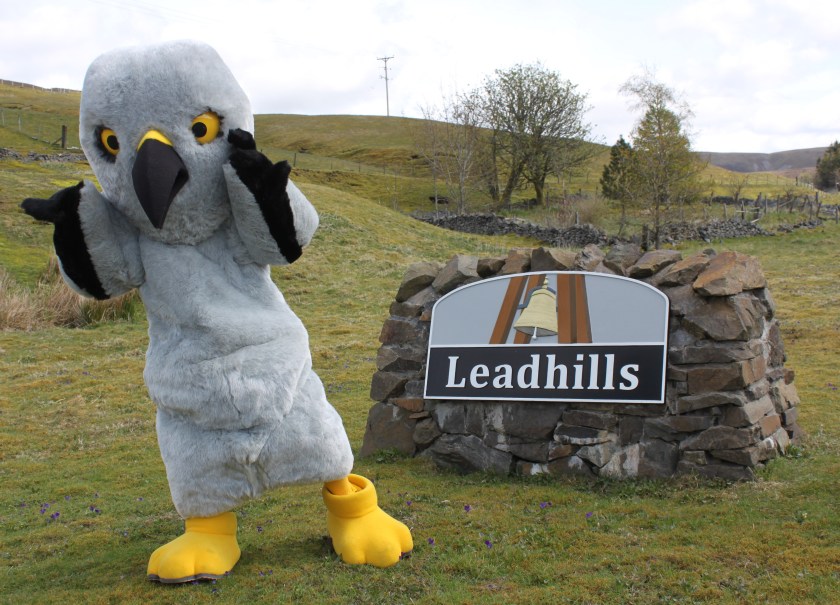
Henry went with an armed escort to visit Leadhills in South Lanarkshire.
He looks a bit distressed. Perhaps he was being deafened by the booming gas guns that have recently been deployed on the grouse moors of the Leadhills (Hopetoun) Estate.
Or perhaps he’d just been told about the long list of wildlife crimes that have been discovered in this corner of South Lanarkshire; 46 confirmed since 2003, but only two resulting in successful convictions (2004 – Leadhills Estate gamekeeper convicted of shooting a short-eared owl; 2009 – Leadhills Estate gamekeeper convicted of placing out a poisoned rabbit bait).
Here’s the list, all from Leadhills unless otherwise stated:
2003 April: hen harrier shot [prosecution failed – inadmissible evidence]
2003 April: hen harrier eggs destroyed [prosecution failed – inadmissible evidence]
2004 May: buzzard shot [no prosecution]
2004 May: short-eared owl shot [gamekeeper convicted]
2004 June: buzzard poisoned (Carbofuran) [no prosecution]
2004 June: 4 x poisoned rabbit baits (Carbofuran) [no prosecution]
2004 June: crow poisoned (Carbofuran) [no prosecution]
2004 July: poisoned rabbit bait (Carbofuran) [no prosecution]
2004 July: poisoned rabbit bait (Carbofuran) [no prosecution]
2005 February: poisoned rabbit bait (Carbofuran) [no prosecution]
2005 April: poisoned buzzard (Carbofuran) [no prosecution]
2005 June: poisoned rabbit bait (Carbofuran) [no prosecution]
2005 June: poisoned rabbit bait (Carbofuran) [no prosecution]
2006 February: poisoned buzzard (Carbofuran) [no prosecution]
2006 March: poisoned buzzard (Carbofuran) [no prosecution]
2006 March: poisoned pigeon bait (Carbofuran) [no prosecution]
2006 April: dead buzzard (persecution method unknown) [no prosecution]
2006 May: poisoned rabbit bait (Carbofuran) [no prosecution]
2006 May: poisoned rabbit bait (Carbofuran) [no prosecution]
2006 May: poisoned egg baits (Carbofuran) [no prosecution]
2006 June: poisoned buzzard (Carbofuran) [no prosecution]
2006 June: poisoned raven (Carbofuran) [no prosecution]
2006 June: 6 x poisoned rabbit baits (Carbofuran) [no prosecution]
2006 June: poisoned egg bait (Carbofuran) [no prosecution]
2006 September: 5 x poisoned buzzards (Carbofuran) [no prosecution]
2006 September: poisoned rabbit bait (Carbofuran) [no prosecution]
2006 September: poisoned rabbit bait (Carbofuran) [no prosecution]
2007 March: poisoned buzzard (Carbofuran) [no prosecution]
2007 April: poisoned red kite (Carbofuran) [no prosecution]
2007 May: poisoned buzzard (Carbofuran) [no prosecution]
2008 October: poisoned buzzard (Carbofuran) [listed as ‘Nr Leadhills’] [no prosecution]
2008 October: poisoned rabbit bait (Carbofuran) [listed as ‘Nr Leadhills’] [no prosecution]
2008 November: 3 x poisoned ravens (Carbofuran) [listed as ‘Nr Leadhills’] [no prosecution]
2009 March: poisoned rabbit bait (Carbofuran) [no prosecution]
2009 March: poisoned raven (Carbofuran) [no prosecution]
2009 April: poisoned rabbit bait (Carbofuran) [gamekeeper convicted]
2009 April: poisoned magpie (Carbofuran) [no prosecution]
2009 April: poisoned raven (Carbofuran) [no prosecution]
2010 October: short-eared owl shot [no prosecution]
2011 March: illegally-set clam trap [no prosecution]
2011 December: buzzard shot [no prosecution]
2012 October: golden eagle shot (just over boundary with Buccleuch Estate) [no prosecution]
2013 May: shot otter found on estate [no prosecution]
2013 June: significant cache of pre-prepared poisoned baits found on estate [no prosecution]
2013 August: red kite found shot and critically-injured in Leadhills village [no prosecution]
2014 February: poisoned peregrine (Carbofuran) [‘Nr Leadhills’] [no prosecution]
Word has it from a local informant that a suspected shot raven was found on Leadhills Estate in May 2015. Post-mortem results are awaited.
Just a few weeks ago, we were sent footage of a young man dressed in camouflage who was lying on the moor holding a firearm, looking over at a plastic decoy peregrine which had been placed on top of a small mound. When he realised he’d been spotted, he removed the decoy and took off back down the hill on a quad bike. Can’t imagine who that was or what his intentions might have been.
 A farmer in Spain has been found guilty of laying out poisoned baits and poisoning at least 11 red kites, five dogs, six foxes, a cat, a raven, a buzzard and four vultures.
His sentence? Two years in prison, two years disqualification from farming or any other profession relating to animal husbandry (post release), four years disqualification from hunting (post release), a fine of 90,270 Euros plus an additional fine of 28,500 Euros to be used specifically to monitor red kites in the local area for the next three years (see here).
Now THAT’S a deterrent!
Spain is one of several European countries way ahead of the game when it comes to tackling raptor persecution. Amongst other measures, they have a dedicated dog unit that utilises specialist sniffer dogs trained to detect poison and poisoned baits. These dogs are so good they can even detect the location where a poisoned bait has been laid previously but has since been removed. These dog units are not just deployed to a site of a suspected incident; they are routinely deployed to undertake spot checks wherever they want and whatever time they want. There’s none of this ‘you need landowner permission’, or ‘you need a warrant’.
Remember this the next time you hear the Scottish Government or the UK Government say they are tackling raptor persecution and are treating this crime seriously.

Henry paid a visit to Moy Estate in the Monadliaths.
Regular blog readers will probably remember what was found on Moy Estate in 2010:
A 20-year-old gamekeeper (James Rolfe – straight out of game-keeping college) was charged with possession of the dead red kite and was fined £1,500. No charges were ever brought against anyone for any of the other offences.
Previous blogs on Moy: see here, here, here and here. It’s particularly worth having a look at this, especially in light of recent hen harrier ‘disappearances’ in England. They weren’t necessarily shot (as the grouse-shooting industry keeps telling us) – they could just as easily have been trapped like this (as the grouse-shooting industry keeps forgetting to mention).
The gamekeeper on Moy was convicted four years ago in 2011. Since then, several more satellite-tracked red kites have ‘disappeared’ since their last signals emitted from Moy, and several buzzard and goshawk nests seem to fail each year. It’s quite windy at Moy. It was probably the wind that blew off those rings from the young golden eagles’ legs and blew them straight in to a jar inside the gamekeeper’s house. It was probably the wind that severed the leg of the red kite and then blew it in to a hole on the moor and then blew moss over the hole to cover it. It was probably the wind that blew away the more recent ‘missing’ red kites. It was probably the same wind that blew holes in those buzzard and goshawk nests, too. Still no breeding hen harriers on this estate – yep, must have been blown away.
Word has it that the game management on Moy Estate is being taken over by a sporting agent with whom we’re very familiar. Cue hundreds of thousands of pounds worth of night vision equipment to carry out his particular style of grouse moor management.
Henry left the estate before darkness fell. He lives another day, although he’s still single.
The BBC news website is reporting that a red kite that had been illegally trapped last week has had to be euthanised due to the severity of its injuries.
The kite was found ‘in distress and seriously injured’ on Wednesday 13th May 2015.
The article (see here) is fairly low on details, but what has been written is actually quite informative.
It quotes a Police Scotland spokesman: “This was clearly an intentional act with the sole purpose of trapping this kind of bird of prey“.
That tells us that the bird probably wasn’t caught inside a crow cage trap (by accident), but more than likely was caught in an uncovered, illegally-set spring trap, baited and deliberately placed to trap a bird of prey by its leg(s).
The article also states that the bird was found trapped ‘on moorland west of Stirling’. This is also pretty revealing. There isn’t much moorland to the west of Stirling and the moorland that is there is managed for grouse shooting (for those who don’t know the area, have a look on google maps and look for the tell-tale muirburn strips that identify the land as a grouse moor).
This latest raptor persecution crime is not the first one reported from this area in recent months. In July 2014, a poisoned red kite was found in the area. This crime wasn’t publicised by Police Scotland and didn’t reach the public domain until we blogged about it in January this year, when we found the details hidden away in a government report. At that time, we asked blog readers to contact SNH to ask whether they had issued a General Licence restriction order for the land where the poisoned kite had been found (see here).
In February 2015, Andrew Bachell, Director of Operations at SNH responded by saying the case was ‘under consideration’ (see here).
Meanwhile, later in February, a poisoned peregrine was found on the same estate (see here). It, too, had been killed by ingesting the banned poison Carbofuran.
According to the SNH website, a General Licence restriction order has still not been issued for this estate (or any other estate, come to that).
And now, three months later, an illegally trapped red kite is discovered in what appears to be the very same area.
Somebody (or some people?) is clearly conducting a campaign of raptor persecution crimes in this area. Where’s the enforcement? Why hasn’t a General Licence restriction order been issued for this area of moorland? Had one been issued for the poisoned red kite (July 2014) or the poisoned peregrine (Feb 2015), this latest crime may not have occurred and this poor red kite may not have had to suffer such appalling injuries that it had to be euthanised.
We think it’s time to ask Environment Minister Dr Aileen McLeod some questions about the apparent lack of enforcement action in this area. Only last month she wrote an article stating that “wildlife crime will not be tolerated in modern day Scotland” and she specifically mentioned the General Licence restriction orders: “Arrangements are also in place for SNH to restrict the use of general licences where there is evidence of wildlife crime” (see here).
So, if “arrangements are also in place”, why hasn’t a General Licence restriction notice already been enforced in this particular area and when might we see notification that one has been issued? It’s time for the Government Minister responsible for tackling wildlife crime to show her mettle. Emails to: ministerforenvironment@scotland.gsi.gov.uk
Red kite photo by David Tomlinson
 Eight and half months after the close of the public consultation on whether the SSPCA’s investigatory powers should be increased (see here) and we’re still waiting for a decision from Environment Minister Dr Aileen McLeod.
Regular blog readers may recall that those against an increase of powers included Police Scotland and many organisations with vested interests in game shooting. They gave a variety of reasons for their opposition, which can be read here. They include issues about ‘accountability’ and ‘lack of training and competence’, amongst others.
Interesting, then, that in the last couple of months, criminal investigations led by the SSPCA have resulted in the conviction of two poisoners. In both cases, the poisoners had targeted cats by laying poisoned baits laced with antifreeze (see here and here).
Apart from the obvious point that cats are not raptors, what is so different about the principle of investigating cat poisoning crimes and raptor poisoning crimes? The principles seem pretty similar – somebody deliberately laces bait with poison and then deliberately lays it out to target an animal. The investigators need to identify who laid out the poisoned baits and thus who was responsible for the crime.
The Crown Office didn’t seem to have any issue with the standard of investigation in the two cat poisoning crimes, otherwise they wouldn’t have decided to prosecute.
The Sheriffs didn’t seem to have any issue with the standard of investigation in the two cat poisoning crimes, otherwise they wouldn’t have convicted the offenders.
The main difference between cat poisoning crimes and raptor poisoning crimes is the politics. One offence typically involves ordinary members of the public (as far as cat poisoners can be described as ‘ordinary’), while the other offence typically involves those associated with game shooting.
Interesting, isn’t it?
Police forces in England, Wales and Scotland have recently launched poster campaigns to raise awareness of crimes against birds of prey.
A couple of days ago, North Yorkshire Police announced their campaign against the illegal poisoning of raptors. They’ve produced a poster that will be distributed in rural areas including the Yorkshire Dales and the North York Moors; both of these areas are dominated by driven grouse moors and both areas are well known as raptor persecution hotspots. The posters will be displayed in National Park Centres and on parish council notice boards.

Earlier this month, North Wales Police launched a campaign called Operation Raptor, aimed at targeting raptor poisoners in their region. This follows the poisoning of five peregrines last year and a suspected buzzard poisoning incident this year. The main peregrine poisoning suspects in the region are usually pigeon fanciers/racers.
Police Scotland launched their wildlife crime campaign in March (in collaboration with PAW Scotland), which involves raising awareness of all six national wildlife crime priorities, including raptor persecution.
These publicity campaigns are good to see. Excellent, in fact. However, the most important facet of tackling wildlife crime is not raising awareness (as important as that is), but what the police actually do in response to a reported wildlife crime. A recently published report on wildlife crime enforcement in Scotland revealed a catalogue of failures, including poor follow-up investigations and sometimes no follow-up at all (see here).
We’re watching with interest to see just how long it takes Police Scotland to publicise a number of raptor persecution crimes that have taken place within the last 12 months, especially those involving the use of banned poisons that have killed raptors on or very close to sporting estates with long histories of such crimes.
Environment Minister Dr Aileen McLeod has written an article on wildlife crime that has been published in the Holyrood magazine:
WILDLIFE CRIME CANNOT BE TOLERATED IN MODERN DAY SCOTLAND
In the past year, between April 2014 and February 2015, almost 250 wildlife crimes were recorded by Police Scotland.
That’s 250 too many.
The crimes included persecuting badgers, poisoning birds of prey and trading in some of the world’s most endangered species.
There is no room for complacency – last year saw one of the worst ever bird of prey poisoning cases, with the discovery of 12 dead red kites and four buzzards in Ross-shire, which were confirmed by SASA as having been poisoned.
I want to make it abundantly clear that the illegal poisoning of wildlife cannot – and will not – be tolerated in a modern Scotland.
This is one of our priorities which the Scottish Government is continuing to tackle head-on. I recently launched a scheme, with the support of PAW Scotland partners, to get rid of illegal pesticides which could be used to poison wildlife.
The scheme allows those who know, or suspect, they are in possession of certain pesticides which are illegal, to dispose of them safely and confidentially. Arrangements are also in place for SNH to restrict the use of general licences where there is evidence of wildlife crime.
Here in Scotland we have the strongest wildlife legislation in the UK, and in the last few months we have seen the first ever custodial sentence for the killing of birds of prey and the first conviction of a land owner under the vicarious liability provisions, for crimes committed in 2012.
I believe this sends out a clear message to those who continue to illegally target Scotland’s wildlife that their actions will not be tolerated.
Recently I helped Police Scotland launch its new awareness campaign to tackle wildlife crime in Scottish cities, towns and rural areas.
Figures reported by Police Scotland indicated that the detection rate for wildlife crime has increased from the previous year by almost 13 per cent to a 77 per cent detection rate and I’m pleased to see that more is being done to catch those offenders.
As the Chair of the Partnership for Action Against Wildlife Crime in Scotland I am delighted to support this campaign. In Scotland we have long recognised the value of our wildlife and the importance of protecting it.
Police Scotland’s campaign will play a key role in raising awareness about wildlife crime and what people should do if they encounter it.
Investigations into wildlife crime can be difficult so it is essential that we work closely with our partners to get the message out there and raise public awareness to help us prevent it from happening in the first place.
Last year, the Scottish Government’s second annual wildlife crime report was published in a bid to develop the bigger picture of what offences are occurring in Scotland. Figures in the report showed that the largest volume of wildlife crime in Scotland is poaching related – fish, deer and coursing offences.
While poaching is the most commonly recorded offence, crimes against our rare birds of prey and vulnerable freshwater pearl mussel populations are of most serious concern in terms of damage to Scotland’s ecosystems and our reputation.
We must continue to work with stakeholders to raise awareness and therefore ensure prevention, so that these crimes decrease and stop. We are not there yet but with the help of the PAW Scotland partners and the actions of the public I am confident that we are moving in the right direction.
Dr Aileen McLeod, Minister for the Environment, Climate Change and Land Reform
END
It’s good to hear from the Environment Minister on this issue. Five months in to her tenure as Environment Minister, she’s been relatively quiet. Perhaps that’s a bit unfair, as we’re comparing her perceived (public) involvement on this issue with that of her predecessor, Paul Wheelhouse, who clearly was very engaged with the subject. She also has a wider portfolio of responsibilities than Wheelhouse had, so of course her time is going to be squeezed. Nevertheless, we haven’t yet seen much evidence that Dr McLeod is coming in with all guns blazing.
Whilst the above article, and sentiment, is to be welcomed, what does it actually amount to? Not very much, to be honest. It’s the same old rhetoric that we’ve been fed for years: ‘it’s a priority’; ‘it won’t be tolerated’; ‘there’s no room for complacency’, yada yada.
Meanwhile, raptor persecution continues and Police Scotland are doing their level best to keep the details from the public domain. We’re aware of several crimes against raptors that have taken place within the last 12 months that still have not been publicised – and we probably don’t know the half of it. It’s interesting to compare this policy of secrecy with the policy of openness being displayed by North Wales Police. One of their wildlife crime officers, Sgt. Rob Taylor, is frequently telling his Twitter followers what wildlife crimes he’s currently investigating. More power to him. His openness doesn’t seem to be affecting the investigation of those offences so what’s the real reason for Police Scotland hiding the facts about the crimes they’re supposedly investigating?
There have been a couple of big success stories in Scotland – the first vicarious liability conviction of a landowner and the first custodial sentence for a raptor-killing gamekeeper. These were both excellent results, there’s no doubt about that, but they were both a long, long time coming and, so far, have proved the exception rather than the rule.
How about the Environment Minister telling us whether the SSPCA will be granted increased investigatory powers? The public consultation closed almost 8 months ago! What’s the decision?
How about the Environment Minister giving us an update on the Govt-commissioned report from Professor Poustie on his review of wildlife crime penalties? That was due ‘early in the New Year’. Where is it?
How about the Environment Minister telling us why SNH haven’t yet publicised any General Licence Restriction Orders for estates where raptor persecution is believed to be taking place? They’ve had the power to enforce such restriction orders since September 2014, for incidents that have taken place since 1st January 2014. What have they been doing for the last seven months? Have they imposed any restriction orders or not? If not, why not?
And please, Minister, will you stop implying that the Ross-shire Massacre only claimed 16 victims. Twenty two raptors were found dead in that one incident. Sure, only 16 have been confirmed as victims of poisoning but the remaining six birds did not all just die of natural causes at the same time, in the same fields where the confirmed poisoned corpses were found. And by the way, can you tell us why Police Scotland has not yet released the name of the poison(s) used to kill those protected species?

Henry’s arrived in Yorkshire in his quest to find a mate. This should be interesting.
North Yorkshire (includes North York Moors National Park & Yorkshire Dales NP) is the worst county in England for recorded incidents of bird of prey persecution.
Between 2004-2013 there were 70 confirmed raptor persecution incidents. (2014 data not yet published).
These 70 incidents included:
In connection with these incidents six individuals, all gamekeepers, were prosecuted.
Hen harrier last bred successfully in North Yorkshire in 2007, despite huge areas of suitable habitat.
A Natural England study between 2002 and 2008 showed that of 11 HH breeding attempts recorded in North Yorkshire, only five sites reared any young and most of the sites that failed were believed to be due to human persecution.
#HaveYouSeenHenry
The judicial review concerning Natural England’s decision to refuse a gamekeeper a licence to shoot buzzards and sparrowhawks to protect his pheasants will take place during a three-day hearing at the High Court in London in June.
The gamekeeper, Ricky McMorn from Northumberland, has received financial support from the National Gamekeepers’ Organisation to bring this review and challenge Natural England’s handling of his licence applications.
A quick recap: in 2013, Natural England secretly provided Mr McMorn with a licence to destroy buzzard eggs and nests in order to ‘protect a pheasant shoot’ in Northumberland.
Later in 2013, Natural England received an application for four more licences, this time to shoot 16 buzzards and three sparrowhawks. Natural England rejected the application.
In 2014, Natural England refused another licence application, this time to shoot ten buzzards to prevent “serious damage” to pheasant poults.
It is these refusals that are being challenged in the judicial review.
Previous blogs on this issue:
25 November 2014: Buzzard licence applicant gets High Court approval for judicial review.
1 October 2013: Why we don’t trust the National Gamekeepers’ Organisation.
26 September 2013: Buzzard licence applicant tries for four more licences.
13 August 2013: Natural England claims release of buzzard licence info ‘not in public interest’.
20 June 2013: Hand in of buzzard petition today at Holyrood.
5 June 2013: Natural England says no to buzzard-killing licence.
5 June 2013: Surely the buzzard licence applicant doesn’t have prior convictions for poison offences?
3 June 2013: Buzzard licensing: turning up the heat.
30 May 2013: Two important questions to ask about the buzzard licence applicant.
25 May 2013: New petition: SNH, do not licence buzzard culling in Scotland.
23 May 2013: Natural England issues licence to destroy buzzard eggs and nests to protect pheasants.
10 January 2013: The buzzard blame game.
13 June 2012: #Buzzardgate aftermath.
30 May 2012: DEFRA backs down on buzzard ‘management’ trial.
24 May 2012: DEFRA responds to public outcry over buzzard ‘management’ trial.
23 May 2012: RSPB response to DEFRA’s proposed (illegal) buzzard trial.
21 May 2012: Buzzard ‘management’ trial gets govt approval and £375K funding.
 Raptor Persecution UK