Grouse shooting industry response to police appeals re: missing hen harriers

Earlier this week North Yorkshire Police put out a public appeal for information regarding satellite-tagged hen harrier ‘John’, missing in suspicious circumstances and whose last known location was Threshfield Moor, a grouse moor in the Yorkshire Dales National Park.

We also saw a public appeal for information from Northumbria Police and the RSPB regarding satellite-tagged hen harrier ‘Manu’, also missing in suspicious circumstances and whose last known location was Blenkinsopp Common in the North Pennines.

We’ve just looked at the News sections of several organisations websites, all of whom are partners in the Raptor Persecution Priority Delivery Group (RPPDG: whose remit includes ‘providing publicity about raptor persecution to build trust and transparency’). Here’s what we found:

Moorland Association – NOTHING

National Gamekeepers Organisation – NOTHING

Countryside Alliance – NOTHING

British Association for Shooting & Conservation – NOTHING

No statements, no urging their members to come forward with any information they might have, no appeals to the public, not even a cut & paste job of the police appeals for information. Absolutely nothing.

It’s the same deafening silence we heard in August when North Yorkshire Police appealed for information about the attempted shooting of nesting marsh harriers and the theft of their eggs on a grouse moor in the Nidderdale AONB, and the same deafening silence that followed the news of a poisons cache buried on another North Yorkshire grouse moor (see here).

Their silence tells us all we need to know.

Scottish Government announces Grouse moor management review group

Back in May 2017, Cabinet Secretary Roseanna Cunningham announced an intention to set up an independently-led group to review grouse moor management practices, and to advise on the introduction of an estate shoot licensing scheme. This was mainly in response to the publication of the Golden Eagle Satellite Tag Review, which found that almost one third of sat-tagged golden eagles had disappeared in highly suspicious circsumstances on intensively managed driven-grouse moors. But make no mistake, this was also in response to increased public pressure from the SRSG’s petition calling for game shoot licensing and also in response to increasing public anger about the continuing illegal persecution of birds of prey on driven grouse moors.

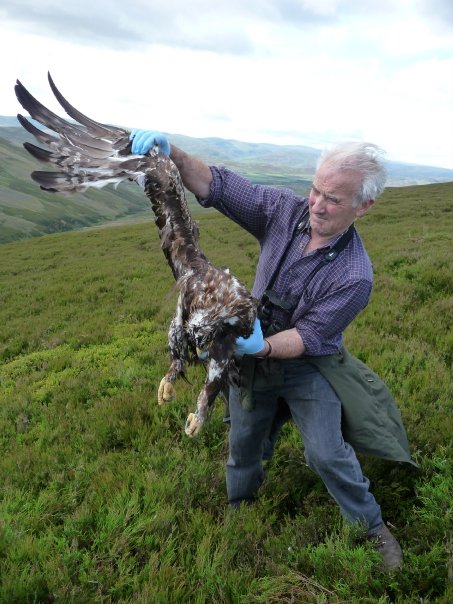
[Photo: Conservationist Roy Dennis with dead golden eagle ‘Alma’ – one of Roy’s first satellite-tagged eagles that was found illegally poisoned on an Angus Glens grouse moor]

Finally, almost six months after that first announcement, the Scottish Government has just released the news about who will serve on this review group.

Here’s the Scottish Government press statement:

New group to focus on sustainability of driven-grouse moors.

Membership of an independent group to ensure grouse moor management practices are sustainable and legally compliant has been confirmed.

The new group will be led by Professor Alan Werrity, who previously chaired a Scottish Natural Heritage review into sustainable moorland management. It includes scientists, moorland managers, regulatory experts and advisers from SNH, Scottish Wildlife Trust, the Game and Wildlife Conservation Trust and the Scottish Environmental Protection Agency.

The group has been set up in response to SNH research that found almost a third of golden eagles being tracked by satellite died in suspicious circumstances and that the majority of cases were where land is intensively managed for driven grouse shooting.

The group will look at the environmental impact of grouse moor management practices such as muirburn, the use of medicated grit and mountain hare culls and advise on the option of licensing grouse shooting businesses.

Environment Secretary Roseanna Cunningham said:

We have been clear that the continued killing of protected species of birds of prey damages the reputation of law-abiding gamekeepers, landowners and the country as a whole.

This new group will look at what we can do to balance our commitment to tackling wildlife crime with grouse moor management practices, so it continues to contribute to our rural economy, while being sustainable and compliant with the law.

The group membership reflects the complex nature and wide range of issues that need to be considered and I look forward to hearing their advice in due course.”

Professor Werrity said:

This is truly challenging work given the traditions underlying moorland management and the concerns coming to light over some mal-practices.

My earlier work chairing the SNH Moorland review also sought to reconcile nature conservation interests with promoting the rural economy. I will be taking an evidence-based approach, and for this we have the right mixture of experience, expertise and knowledge on the group to get to grips with the subject. I look forward to getting started on this review. ”

Background

Read the Golden Eagle Satellite Tag Review

The confirmed membership of the group includes Professor Alan Werrity FRSE, Professor Ian Newton OBE, FRS, FRSE, Professor Alison Hester FSB, (Professor Colin Reid FRSA – see update below) and moorland managers Alexander Jameson BLE MRICS FAAV and Mark Oddy MRICS CEnV MIAagrM.

[Update 28 Nov 2017: Law professor joins grouse moor management review group, here ]

Dr Calum Macdonald (SEPA), Professor Des Thompson (SNH), Dr Adam Smith (GWCT Scotland) and Susan Davies (SWT) will be specialist advisers to the group.

ENDS

Here is the response from RSPB Scotland to today’s announcement:

RSPB Scotland welcomes announcement of grouse moor enquiry

RSPB Scotland has welcomed today’s announcement by the Scottish Government on the grouse moor enquiry panel. Duncan Orr-Ewing, Head of Species and Land Management for RSPB Scotland said: “We very much welcome the announcement of this enquiry and of the independent panel. We look forward to giving evidence to the panel in due course.

The remit of the panel includes consideration as to how grouse moors can be managed sustainably and within the law. There are significant public concerns about how grouse moors are currently being managed in Scotland, including clear evidence gathered over decades of the illegal killing of birds of prey.

In recent years these concerns have broadened to encompass wider grouse moor management practices, as commercialisation has taken place, with an emphasis on producing very large and unsustainable grouse numbers for sport shooting. These practices include muirburn on peatland habitats which are important as carbon stores for combating climate change, the culling of mountain hares and the medication of ‘wild’ red grouse, both designed to prevent grouse diseases and artificially boost grouse bags.

We support the introduction of an effective licensing system for driven grouse shooting, with sanctions including the removal of such licences where illegal practices are confirmed. A licensing system could be supported by a statutory Code of Practice setting out clear management standards to protect public interests and prevent bad management practices. These kind of licensing systems are common place in other European countries and equally support legitimate and well run shooting enterprises.”

ENDS

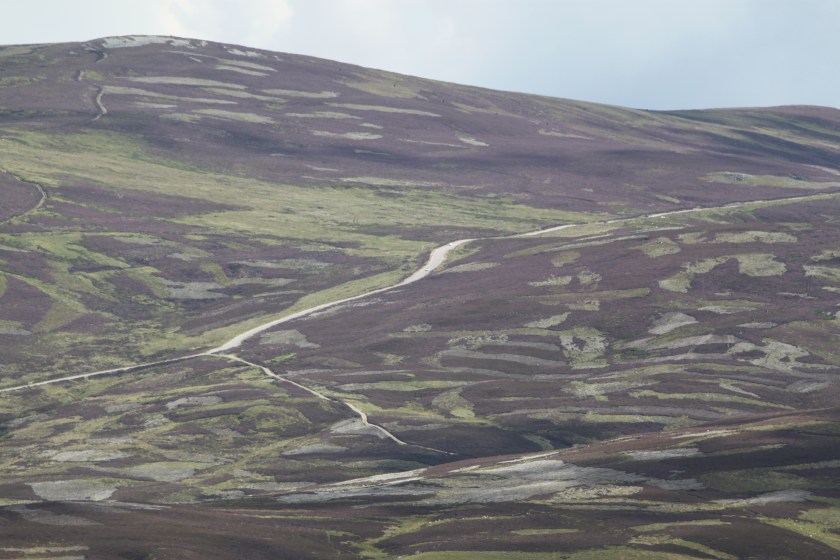
[Photo: the typical landscape of an intensively-managed driven grouse moor in Scotland. Photo by Ruth Tingay]

Here is the response from the Scottish Raptor Study Group to today’s announcement:

Scottish Raptor Study Group warmly welcomes today’s announcement by the Scottish Government on the grouse moor enquiry panel.

Patrick Stirling Aird, Secretary of the Scottish Raptor Study Group said, “We are delighted that the membership of the panel has been announced and look forward to providing evidence when called upon to do so“.

The public have increasing concerns around the way in which grouse moors are being operated with a substantial body of science proving beyond all doubt the widespread and illegal persecution of birds of prey on many such moors.

We support the introduction of licensing for driven grouse shooting with enforceable sanctions where illegal practices are confirmed. Such a licensing scheme could incorporate a statutory code of practice which helps to protect the public interest and to prevent bad management practices. This concept is widespread in Europe and elsewhere and works well with legitimate shooting interests.

ENDS

Here are our first thoughts.

Hallelujah! The panel has finally been announced and presumably its work will now get underway, although notice there is no mention of timescales in the Scottish Government’s statement. That’s not too much of a concern right now – as Roseanna mentions, this work will be complex and it’s in everyone’s interests that it is done thoroughly, so we probably shouldn’t expect any output until at least 2019.

This panel has some serious intellectual heavy weights (Chair, Professor Werrity, and panel members Professors Newton and Hester). All three are at the top of their respective fields and have been for years; their academic achievements and scientific authority are undisputed. We are delighted to see these three involved, especially given Professor Werrity’s intention for having an “evidence-based approach” to the review. Excellent.

The other two panel members (Mr Jameson and Mr Oddy) are a bit of a surprise, to be honest. We didn’t expect to see anybody with such obvious vested interests be part of what had been described as an independently-led review group. Nevertheless, there is probably good reason for having them on board, not least to get buy-in to the review from the game-shooting sector. We know very little about Mr Jameson and only a little bit about Mr Oddy – he’s the chap who, when working for Buccleuch Estates on the Langholm Moor Demonstration Project, suggested that lethal control of buzzards should be a considered option…..but his suggestion was based on no scientific evidence whatsoever, in fact it was the exact opposite of what the science was showing. Hmm.

All in all, just like RSPB Scotland and the Scottish Raptor Study Group, we very much welcome today’s announcement. It is the next step on the road to what many see as the inevitable introduction of an estate licensing scheme in Scotland. We look forward to giving evidence, if invited to do so.

UPDATE 28 November 2017: Law professor joins grouse moor management review group (here)

UPDATE 24 April 2018: Grouse Moor Management Review Group: 1st meeting report (here)

New report reveals widespread raptor persecution in Northern Ireland

The Partnership for Action against Wildlife Crime Northern Ireland (PAW NI) has today published its latest report on bird of prey persecution 2015-2016.

The report reveals that there were five confirmed illegal persecution incidents reported in 2015 and a further six in 2016, involving the killing of 12 protected birds of prey in Northern Ireland (6 x buzzards, 5 x peregrines, 1 x sparrowhawk). As with every other annual raptor persecution report these figures are probably just the tip of the iceberg.

The report’s lead author, Dr Eimear Rooney (Raptor Officer for the Northern Ireland Raptor Study Group) commented: “This latest persecution report helps us all to understand the scale and distribution of the problem. It is particularly shocking to see new areas appear on the hot-spot maps, showing the issue of raptor persecution to be widespread. It is heart-breaking to think of the deaths of these protected birds but it is particularly shocking to see the continued usage of highly toxic Carbofuran. The PAW NI group will continue to take action to tackle raptor persecution and it is encouraging to see all the partners proactively working together on this report.”

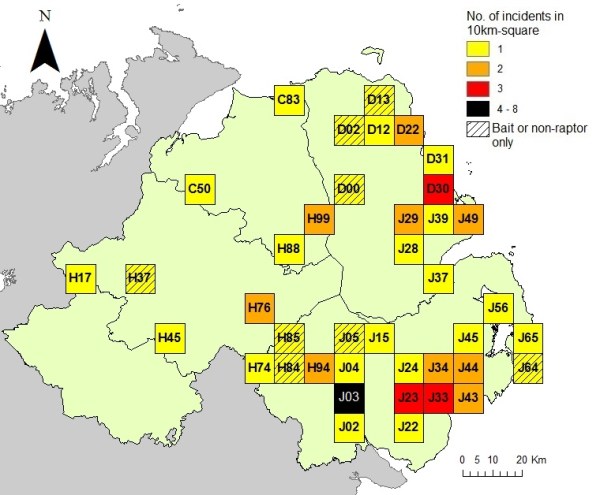
Hotspot map of confirmed incidents of raptor persecution, and poisoned baits & wildlife, reported in Northern Ireland from January 2009-December 2016.

Download the PAW NI report here

Read the PAW NI press release here

On the subject of illegal raptor persecution in Northern Ireland, a 13-year old boy named Dara MacAnulty is doing a 45km sponsored trek in January 2018 to help raise funds for a new raptor satellite-tagging project in Northern Ireland.

Dara is a pretty special young man, passionate about the environment, especially raptors, and he has an exceptional talent for expressing his thoughts – have a read of his blog and you’ll be constantly questioning how a thirteen year old can possibly write so well!

Dara’s fundraising project is off to a good start but he needs more support. If you’ve got a few quid to spare, please consider supporting his efforts HERE. Thanks.

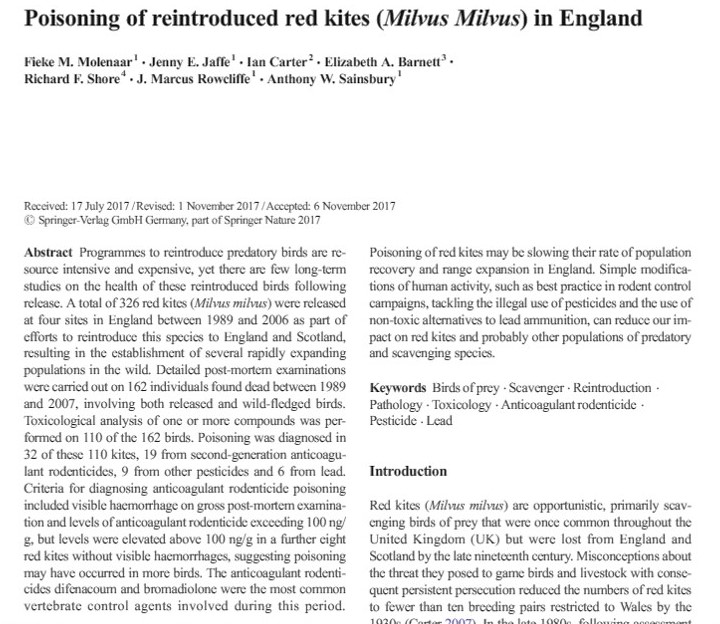
Poisoning of reintroduced red kites in England: new paper

A new scientific paper has just been published that suggests anti-coagulant rodenticide poisoning, illegal pesticide poisoning, and lead poisoning ‘may be slowing the recovery of red kites in England’.

The paper, ‘Poisoning of reintroduced red kites (Milvus milvus) in England’ has been authored by scientists from the Institute of Zoology, Natural England, FERA Science Ltd and the NERC Centre for Ecology and Hydrology and was published online today in the European Journal of Wildlife Research.

The full paper can be accessed here

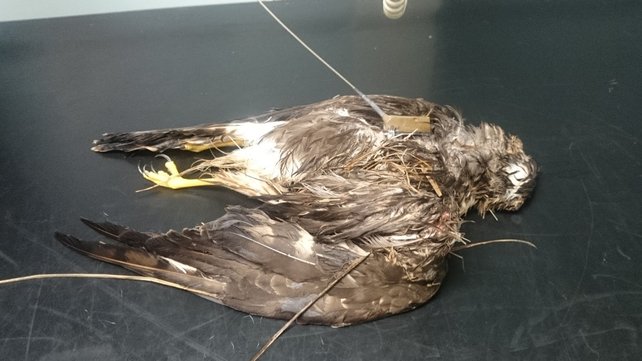
Photo of a poisoned red kite by Marc Ruddock

The research was undertaken on 162 red kites collected between 1989-2007, so these are pretty old data and the game-shooting apologists will undoubtedly claim that illegal persecution is no longer a problem, ten years on.

However, regular blog readers will be well aware of the long list of confirmed red kite persecution incidents (illegal poisoning and shooting) in England since 2007 (e.g. see here) which is restricting the kite’s population range in some parts of England, just as it is in some parts of Scotland (see here).

Illegal poisoning, coupled with secondary poisoning from anti-coagulant rodenticides and lead poisoning was a problem for the newly-reintroduced red kites and, along with illegal shooting and trapping, still remains a problem 28 years on.

Same shit, different decade.

Here’s the abstract from the new paper:

Chair of Nidderdale AONB condemns illegal raptor persecution

Don’t ever underestimate the power of public pressure.

You know that big solid wall of silence we’re all so used to looking at every time a raptor crime is discovered and reported? It looks like it’s finally beginning to crumble.

The latest to speak out, spontaneously (i.e. without prompting), about the continued illegal killing of birds of prey is the Chair of the Nidderdale Area of Outstanding Natural Beauty’s Joint Advisory Committee, Councillor Nigel Simms:

He’s obviously taken a lead from the spontaneous statement made by the neighbouring Yorkshire Dales National Park Authority yesterday.

The publication of this statement from the Nidderdale AONB is really, really welcome. The Nidderdale AONB in North Yorkshire is notorious as a raptor persecution hotspot and has been for many years. We’ve lost count of the number of red kites that never make it out of this particular hell hole, although the RSPB has been keeping track – 22 poisoned or shot in the last ten years, and that’s only the ones that were found.

Nidderdale red kite persecution incidents 2007-2017, map by RSPB:

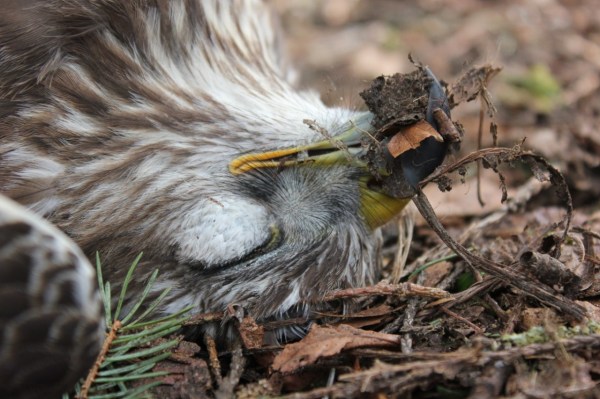
Illegally-killed red kite (photo Marc Ruddock):

We also know that hen harriers rarely get out of Nidderdale alive – unfortunately we can’t show you a detailed map because Natural England wants to keep the details a secret. Natural England is supposed to protect hen harriers but it’s clearly more interested in protecting the reputations of criminal landowners and gamekeepers. Anyway, here’s a photo of an illegally-killed satellite-tagged hen harrier – something you might see if you visit Nidderdale AONB, assuming you get to it before the gamekeeper who shot it:

It’s interesting to see that these crimes are “starting to have a damaging effect on tourism businesses“, according to Cllr Simms. Good, not for the businesses affected, obviously, but good that it will drive increased local pressure to bring these crimes to an end.

Cllr Simms’ comment that illegal raptor persecution “undermines the work of law-abiding landowners and gamekeepers who are actively working alongside us to improve prospects for all forms of wildlife in the AONB” is slightly odd. Which law-abiding landowners and gamekeepers are those? Presumably not anyone involved with any of the aforementioned red kite killings or hen harrier disappearances, nor, presumably, anybody involved with the attempted shooting of a nesting marsh harrier and the removal of its eggs, as filmed on a Nidderdale AONB grouse moor by the RSPB earlier this year?

There’s much work to do in this AONB but this very public condemnation of illegal raptor persecution from the Chair of the AONB Advisory Committee is encouraging. Well done, Cllr Nigel Simms.

Now, who’s next to speak out and bring that wall of silence crashing down?

Evidence of wildlife crime results in General Licence restriction on Edradynate Estate

As many of you will know, SNH has the ability to impose a three-year General Licence restriction order on land, or on an individual, where there is sufficient evidence, substantiated by Police Scotland, that raptor persecution has taken place (see SNH framework here).

This measure, based on a civil burden of proof, was introduced by then Environment Minister Paul Wheelhouse in 2013 in response to the continuing difficulties of meeting a criminal burden of proof to facilitate a criminal prosecution. The measure became available for incidents that occured on or after 1 January 2014.

Photo of a poisoned buzzard (RPUK)

Since then, only two restriction orders have been imposed, both in November 2014: one for the Raeshaw/Corsehope Estates in the Scottish Borders, and one for the Burnfoot/Wester Cringate Estates in Stirlingshire (see here for details, and an explanation of what a General Licence restriction actually means).

As you’ll also probably be aware, Raeshaw Estate and Corsehope Estate made a legal challenge to SNH’s decision and this resulted in a judicial review. The judicial review dragged on for some time but eventually concluded in March this year, and the court found that SNH had acted fairly and that the General Licence restriction at Raeshaw Estate and Corsehope Estate should remain in place (see here).

While this legal challenge was underway, SNH, quite reasonably, did not impose any further General Licence restrictions, even though there were plenty of candidate estates to consider. Once the legal argument had been settled, we expected SNH to open the floodgates and impose many more restriction orders for offences that had taken place since January 2014. We asked SNH about this in June 2017 and we were told that two notifications were underway, relating to offences in Perthshire and Aberdeenshire, although no further details were given at that time, presumably as SNH was giving the affected parties time to respond/appeal. Fair enough.

Today, SNH has announced that two General Licence restriction orders have been imposed in two separate cases.

The first of those cases relates to Edradynate Estate in Perthshire: SNH_GL Restriction Notice_Edradynate Estate_15Sept2017

Here is the decision notice:

And here is the estate boundary map to which the General Licence restriction applies for the next three years:

For the next three years, Edradynate Estate will no longer be able to enjoy the privilege of using General Licences 1, 2 or 3, but the estate will be entitled to apply for the use of an Individual Licence that will allow them to kill certain bird species but under closer scrutiny than if the estate was using a General Licence. We’ll be monitoring the use of any Individual Licences that SNH approves for this estate, and, if there is any breach of the licence conditions, we fully expect SNH to revoke the Individual Licence just as they did for Raeshaw Estate earlier this year.

SNH has not provided any information about the Police Scotland evidence used as the basis for this General Licence restriction order on Edradynate Estate. However, it’s probably a fair assumption that it relates to the alleged poisoning of several buzzards in 2015. This is one of the five prosecution cases that the Crown Office dropped earlier this year, without explanation. The case did not involve video evidence, as some of the others did, and the case was dropped by the Crown despite a plea from Police Scotland to proceed (see here).

We’ve been blogging about Edradynate Estate for a very long time. It’s well worth reading an earlier summary we wrote (here) which includes some fascinating commentary about the estate by former RSPB Investigator Dave Dick, who claimed as far back as 2004 that the estate was “among the worst in Scotland for wildlife crime“, and commentary by former Police Wildlife Crime Officer Alan Stewart, who said in 2005, “Edraynate Estate has probably the worst record in Scotland for poisoning incidents, going back more than a decade“. The details involve a disturbingly high number of poisoned birds and poisoned baits that were found over the years, as well as a number of dropped prosecution cases (nobody has ever been convicted for any of the alleged offences). The summary also includes information about links between the estate and the Scottish Gamekeepers’ Association.

Now, whether you think a General Licence restriction order is a sufficient sanction against this estate is open to debate. However, while we wait for the Scottish Government to get on with estate licensing, a General Licence restriction order is all that is currently available, so well done to SNH for imposing the General Licence restriction order on this particular estate and for being semi-transparent about the details.

Unfortunately, we can’t say the same about the second General Licence restriction order that SNH has just imposed. We’ll be blogging about that one in the next blog…..it’s an absolute shocker.

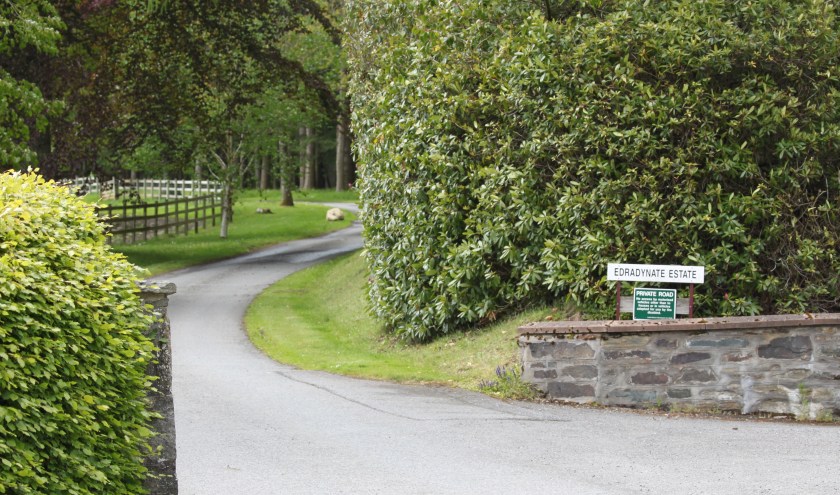
Edradynate Estate (photo by RPUK)

UPDATES:

RSPB press statement here

SNH imposes General Licence restriction on ‘mystery’ gamekeeper (here)

More on the mystery gamekeeper with the General Licence restriction (here)

Police appeal in suspected peregrine poisoning incident

Press release from Devon & Cornwall Police, 18 August 2017:

POISONED PEREGRINE FALCON: WITNESS APPEAL

Officers are investigating an incident after being contacted by staff at Glendinning Quarry in Ashburton, on Tuesday 15 August, following reports of an injured Peregrine falcon.

The falcon had been located on the floor of the quarry which is home to a breeding pair of Peregrine falcons.

Devon and Cornwall Police Wildlife Crime Officer, PC Josh Marshall, sought that the juvenile Peregrine falcon was given the immediate care it required. However, the bird died the next day.

PC Marshall said: “The initial inspection and condition of the bird strongly suggests that this bird had been poisoned. The bird has now been placed into the Wildlife Investigation scheme administered by Natural England where it will be forensically examined to establish the cause of death and a police investigation has now begun into the incident.

Members of the public are warned that poisons commonly used to commit a crime like this are incredibly toxic to humans and pets. Should any person locate any dead or injured birds they are strongly advised not to touch them or let pets come into contact with them.

Ingestion of these poisons can lead to death. It is incredibly concerning that individuals are using these types of chemicals within public areas that not only kill our wildlife but could also place members of the public, children and their animals into harm’s way.

The area of Ashburton and neighbouring Buckfastleigh is unfortunately a hot spot for poisoning of these birds of prey. Previous incidents at the site are as follows:

2011 – 1 poisoned Peregrine falcon at White Cleaves (Buckfastleigh) Quarry – substance used – Aldicarb and Carbofuran.

2005 – Poisoned bait (racing pigeon) Glendinnings Quarry– substance used Aldicarb. A live bird with clipped wings. Adults missing presumed dead, chicks rescued. Police fitted telemetry device to see if pigeon would relocate but this failed. In Legal Eagle 47, page 5.

2005 – 1 poisoned peregrine and 1 poisoned bait (pigeon) – substance used – Aldicarb, peregrine found on dead pigeon which had wings clipped.

2003 – Two men with a pigeon on a length of string appearing to try and lure peregrines from the top of White Cleaves (Buckfastleigh) Quarry. Police visited site but men had gone.

2000 – 1 poisoned Peregrine, substance used Aldicarb at Glendinnings quarry

2000 – 1 shot Sparrowhawk near Buckfastleigh (it lived).

1992 – 2 dead peregrines at White Cleaves (Buckfastleigh), with pigeon flesh in crop – tested positive for Malathion.

As can been seen from this data, the use of illegal banned poisons are evident and put the public at significant risk. In the 2005 incident, a number of children could have been harmed or potentially worse when the poisoned bait (a racing pigeon) was located wondering around near to a childminders address.

Significantly racing pigeons have been used as the bait for a number incidents both here and nationally and the answer to solving and preventing these poisonings could lie somewhere within a rogue minority of the racing pigeon community.

Peregrine falcons do not differentiate between prey items such as wild pigeons and racing pigeons, this obviously causes conflict with some prize racing pigeons being taken by these birds of prey.

Generally the method used will be to smear the bait with a vasaline type substance containing the poison onto either a live or dead bird. When the Peregrine plucks and eats the bait item the poison is then ingested and kills the bird. The bird dies then endures an excruciating few hours whilst waiting to die.

South West Peregrines, a volunteer group who monitor these birds and others within the South West, have described the incident as ‘abhorrent’.

We are urging members of the local community to come forward with any information they may have that can assist in bringing these offenders to justice”.

Information is handled in the strictest of confidence and can be passed directly to PC Marshall at Joshua.marshall2@devonandcornwall.pnn.police.uk or by email 101@dc.police.uk or calling 101 quoting log number 0223 180817.

Information can be passed anonymously to Crimestoppers via 0800 555111 or the charity’s website at www.crimestoppers-uk.org

Tony Whitehead speaking for RSPB in the South West said: “Peregrines are magnificent and much-loved birds, whose comeback over the past twenty years is a conservation success. However, once again, it appears the peregrines at this site have been deliberately targeted and, it is suspected, poisoned.

Should this prove to be the case, this is outrageous and the criminals must be brought to justice. We are also concerned that, should this again prove to be a poisoning, someone is wantonly placing toxic chemicals in the countryside which can be a danger to both humans and pets.

Someone in the local community must have information about who’s doing this and we urge people to come forward and contact the police. A £1,000 reward has been offered by the RSPB for information that directly leads to the prosecution of the offender.

ENDS

Scottish Raptor Study Group letter in response to estate licensing scaremongering claims

Earlier this month we blogged about two articles that were published in the Scottish Mail on Sunday about so-called ‘draconian’ proposals to introduce a licensing scheme for game shooting estates (see here).

One piece was just a review of various organisations’ positions and the other one was a fairly lengthy comment piece written by Carrieanne Conaghan, a gamekeeper’s wife and coordinator of the Speyside Moorland Group. Carrieanne claimed that the introduction of estate licensing would ‘penalise‘ law-abiding estates, although she didn’t explain how she thought this would work.

Logan Steele, the estate licensing petitioner (on behalf of the Scottish Raptor Study Group) contacted the Mail on Sunday and asked for the opportunity to provide a comment piece in response, especially as Carrieanne had made a number of unsubstantiated (and inaccurate) claims about his motivation for launching the petition. The Mail on Sunday refused (surprise!) but did say he could write a 150-word letter, an option Logan described in a comment on this blog as “a pretty second rate alternative“.

Nevertheless, Logan did submit a letter and it appeared at the weekend. He says it’s been “butchered” (the published version is only 89 words) and they couldn’t even spell his name correctly. Even so, he makes his points well:

A quick bit of background research has led us to believe that Carrieanne’s husband is employed as a gamekeeper at Glenlochy, near Grantown-on-Spey in the Cairngorms National Park. This estate is no stranger to police investigations into alleged raptor persecution (e.g. see here) although nobody has ever been prosecuted. This history, perhaps well before her husband’s employment, might help explain Carrieanne’s concerns about the introduction of an estate licensing scheme.

Edradynate Estate gamekeeper in court for alleged crop poisoning

Well this is absolutely fascinating.

From the Courier & Advertiser (Perth & Perthshire edition), 22 June 2017:

Gamekeeper in court over estate crop poisoning allegation.

A senior gamekeeper has appeared at Perth Sheriff Court accused of poisoning crops on a Perthshire estate. David Campbell was working on the Edradynate Estate, near Aberfeldy, when he is said to have committed the offence.

A charge alleges he maliciously damaged the crops between April 14 and 16 this year by spraying them with an unknown substance, causing them to rot and perish. The 69 year old is also said to have stolen a thermal imaging spotting scope.

He made a brief appearance on petition before Sheriff William Wood at Perth Sheriff Court and made no plea or declaration. Campbell had his case continued. He was released on bail.

ENDS

You might be wondering why we’re blogging about this? The simple answer – we are very interested in the Edradynate Estate and have been for a long time as it has repeatedly been at the centre of police wildlife crime investigations (particularly the alleged poisoning of birds of prey) although nobody has ever been convicted.

Most recently (May 2017) our interest has been in relation to the Crown Office’s refusal to prosecute an unnamed Edradynate gamekeeper for alleged offences relating to the poisoning of several buzzards, despite a plea from Police Scotland to proceed (see here). The Crown Office has not provided an explanation about why this decision was taken (video evidence was not involved), other than to say:

The Procurator Fiscal received a report concerning a 66-year-old man, in relation to alleged incidents between 18 March and 4 June 2015. Following full and careful consideration of the facts and circumstances of the case, including the available admissible evidence, the Procurator Fiscal decided that there should be no proceedings taken at this time. The Crown reserves the right to proceed in the future should further evidence become available.”

As the alleged wildlife crime offences took place in 2015, the case will not become time barred until June 2018 so there may still be a prosecution, although we won’t be holding our breath given the Crown Office’s recent performances in this area (five cases of alleged wildlife crime dropped in the space of two months).

It’s ironic then, that an Edradynate Estate gamekeeper (although we understand this particular gamekeeper left Edradynate at the end of Jan 2017, despite what was reported in the Courier) has been charged with an alleged poisoning offence – not of a protected raptor species, but of a crop. That in itself is fascinating, but even more interesting is that this charge is deemed sufficiently serious for the Crown (prosecutors) to begin proceedings by petition (before deciding whether to prosecute on indictment or by summary complaint). Only serious cases are begun by petition.

We’ll be tracking this case with great interest.

Please note: if you decide to comment on this specific blog, please remember that this case and the alleged wildlife crime offences from 2015 are still ‘live’ and at this stage the offences are only alleged. Please think carefully about your choice of words. Thanks.

Law professor comments on inadmissibility of video evidence in wildlife crime prosecutions

As regular blog readers will be aware, the Crown Office & Procurator Fiscal Service (COPFS), the public prosecutors in Scotland, have, in the space of two months, either dropped or refused to prosecute five cases of alleged wildlife crime. These include:

25 March 2017 – gamekeeper John Charles Goodenough (Dalreoch Estates), accused of the alleged use of illegal gin traps. Prosecution dropped due to paperwork blunder by Crown Office.

11 April 2017 – landowner Andrew Duncan (Newlands Estate), accused of being allegedly vicariously liable for the actions of his gamekeeper who had earlier been convicted for killing a buzzard by stamping on it and dropping rocks on to it. Prosecution dropped due to ‘not being in the public interest’.

21 April 2017 – gamekeeper Stanley Gordon (Cabrach Estate), accused of the alleged shooting of a hen harrier. Prosecution dropped as video evidence deemed inadmissible.

25 April 2017 – gamekeeper Craig Graham (Brewlands Estate), accused of allegedly setting and re-setting an illegal pole trap. Prosecution dropped as video evidence deemed inadmissible.

21 May 2017 – an unnamed 66 year old gamekeeper (Edradynate Estate), suspected of alleged involvement with the poisoning of three buzzards. Crown Office refused to prosecute, despite a plea to do so by Police Scotland.

Two of these cases (Cabrach Estate and Brewlands Estate) were dropped due to the COPFS deciding that the use of RSPB video evidence, on which the prosecutions relied, was inadmissible.

There has been widespread public condemnation and political concern about these decisions, especially in the case of the alleged shooting of a hen harrier on Cabrach Estate in Morayshire. The Crown Office has attempted to explain the decisions but many questions remain unanswered for those of us who don’t have the legal expertise, or all the case details, to challenge the COPFS decisions.

We read with interest, then, a blog that was published yesterday written by Peter Duff, Professor of Criminal Justice at Aberdeen University. His blog, entitled ‘The law of evidence, video footage, and wildlife conservation: did COPFS make the correct decisions?‘ deals specifically with the Cabrach & Brewlands cases and can be read here.

We thoroughly recommend reading it. It’s important to read the perspective of an independent, expert academic who has no axe to grind on either side of the debate. It’s hard for those of us who are either tainted by years of frustration about criminal raptor killers getting away with it, or those with a vested interest in raptor killers avoiding prosecution, to take an unbiased view of the law and its application, so Professor Duff’s opinion is a valuable contribution to the debate. Not only that, it’s great to see this issue receiving wider coverage than the usual commentators.

That’s not to say we agree with his interpretation though! In short, Professor Duff concludes that the COPFS decisions were “perfectly reasonable”, and he explains his reasoning for this, but, crucially, some of what he writes does not take in to account previous case law on this issue, perhaps because he was unaware of such cases?

For example, Professor Duff states: ” In my view also, for what it is worth, I agree that the courts would not excuse such an irregularity in obtaining the video evidence and prosecutions would be fruitless“.

First of all, the Scottish courts HAVE excused the irregularity of obtaining video evidence without the landowner’s permission and far from those prosecutions being ‘fruitless’, they actually resulted in the conviction of the accused (e.g. see the Marshall trial here and the Mutch trial here).

During the Marshall trial, there were several hours of legal argument about the admissibility of the video evidence. The Sheriff accepted the video evidence, commenting that the RSPB presence on the gamekeeper’s estate [from where the video was filmed] was “neither illegal nor irregular, and the intent to obtain evidence did not make it so“.  This is no different to the recent Cabrach case.

During the Mutch trial, again involving several hours of legal argument about the admissibility of evidence, the Sheriff accepted that the RSPB had not placed the video camera with the purpose of gathering evidence for prosecution, but they had placed it as part of a legitimate survey in to the use of traps. This is no different to the recent Cabrach case.

There is also an on-going trial at the moment (concerning alleged fox hunting) that relies heavily on video evidence filmed on privately-owned land without the landowner’s permission. The court has accepted the video evidence as admissible (although we can’t comment too much on this as the trial is still live).

So on that basis, we profoundly disagree with Professor Duff’s opinion that covertly filmed video evidence would not be accepted by the Scottish courts. It already has been, on several occasions, resulting in convictions. The question remains then, why did the COPFS decide it was inadmissible? Somebody within the Crown Office (presumably an experienced lawyer from with the Wildlife & Environmental Crime Unit) decided, when this case was first marked, that the video evidence was admissible. It took nine court hearings over a period of a year before the COPFS decided that the video evidence was inadmissible. We still don’t know the basis for that decision. And the other related question to this is why didn’t the COPFS let the court make the decision? It’s this inconsistency of approach that has caused so much confusion, and as Professor Duff writes, ‘bewilderment’.

Professor Duff also writes: “The actions by the RSPB [of placing a covert camera] are a breach of the right to privacy of both the estate owners and their employees (whilst not quite analogous, imagine if your neighbour installed a secret camera to record everything that went on in your garden)“. Sorry, but it’s quite absurd to compare these two scenarios given the size difference between these two types of landholdings. Nobody could argue that placing a covert camera to film somebody’s back garden wouldn’t be a breach of privacy, as you’d reasonably expect to see the human occupants on a daily basis. But on a multi-thousand acre estate, far from any private dwelling? Come on, “not quite analogous” is one hell of an understatement. And not only that, in the Cabrach case, the camera was aimed at the nest of Schedule 1 hen harrier, which by law cannot be approached/disturbed without an appropriate licence from SNH so you wouldn’t expect to film anybody anywhere near the nest.

All in all then, Professor Duff’s interpretation of the law, whilst useful, still doesn’t explain, or justify, the decisions made by the Crown Office in these two cases.

And questions still remain about the decisions to drop the other three cases (gamekeeper John Charles Goodenough of Dalreoch Estates; landowner Andrew Duncan of Newlands Estate; an unnamed gamekeeper of Edradynate Estate), none of which were reliant upon video evidence.